Home › Crypto Regulation › Kenya
Bitcoin & Cryptocurrency Regulation in Kenya
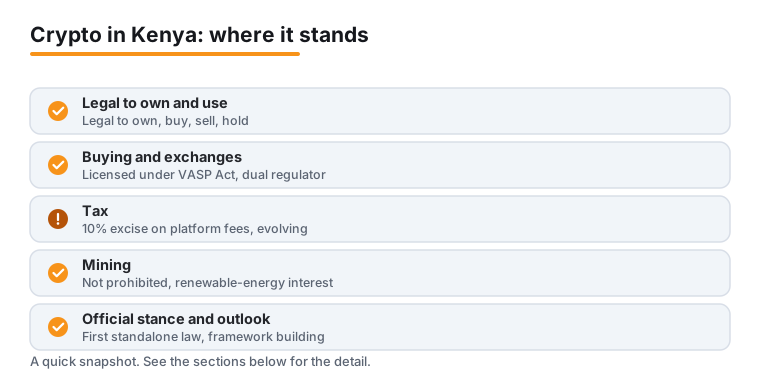
Quick answer — Kenya, 2026
- Legal: Legal to own and trade, not legal tender
- Tax: 10 percent excise on platform fees, income tax may apply to users
- Buying: Via international exchanges, P2P and mobile money; licensing rules in force since 22 July 2026, existing platforms must comply by 4 November 2026
Kenya is one of Africa's most active cryptocurrency markets, consistently ranking among the leading countries worldwide for grassroots adoption and stablecoin transaction volume. For years, owning and trading Bitcoin sat in a legal grey zone: it was never banned for individuals, but it operated outside any dedicated licensing framework, and the Central Bank of Kenya repeatedly cautioned the public about the risks. That changed in late 2025, when Kenya enacted its first standalone law for virtual assets and began building the supporting rulebook. This page explains the current legal status of cryptocurrency in Kenya, who regulates it, how exchanges are licensed, how crypto is taxed, the anti-money-laundering rules, and the practical realities of buying, using, mining, and sending crypto. The information here is general and current as of 2026; it is not legal, tax, or financial advice, and because the framework is changing quickly you should verify any specific point with the Central Bank of Kenya, the Capital Markets Authority, the Kenya Revenue Authority, or a qualified Kenyan professional before acting. For broader context see our overview of crypto regulation.
On this page: Legal status · Who regulates it · Taxes · How to buy · Mining
Is Bitcoin and crypto legal in Kenya?
Yes. Owning, buying, selling, and holding Bitcoin and other cryptocurrencies is legal in Kenya. There is no law that criminalises individuals for using digital assets, and that did not change when the new framework arrived. What changed is that the activity is no longer unregulated: Kenya now has a dedicated statute governing the businesses that provide crypto services.
Two distinctions matter. First, crypto is not legal tender in Kenya. The Kenyan shilling, issued by the Central Bank of Kenya, remains the only official currency, and no merchant is obliged to accept Bitcoin. Second, for several years the Central Bank publicly warned the public and cautioned commercial banks against facilitating crypto transactions because the sector lacked oversight and consumer protections. That cautionary stance has now given way to a formal licensing regime, signalling a deliberate shift from warning to regulating. In short, you can legally use crypto as an individual, but the platforms that serve you are moving into a supervised, licensed environment.
Who regulates crypto in Kenya?
Kenya has adopted a dual-regulator model, set out in the Virtual Asset Service Providers Act, 2025 and its First Schedule:
- Central Bank of Kenya (CBK) oversees payment-related virtual-asset activity, including custodial wallet services, payment processors handling virtual assets, and the issuance of stablecoins. The CBK is established under Article 231 of the Constitution.
- Capital Markets Authority (CMA) supervises investment-style activity, including crypto exchanges, brokers, investment advisers and managers, and tokenisation platforms.
The two regulators are supported by a Multi-Agency Task Force convened by the National Treasury, and the Financial Reporting Centre receives suspicious-transaction reports under the anti-money-laundering framework. The Cabinet Secretary for the National Treasury can designate additional bodies by notice in the Kenya Gazette. You can confirm a regulator's mandate or check a platform's licensing status on the official sites of the Central Bank of Kenya and the Capital Markets Authority.
Key laws and frameworks
Kenya's approach is built around a dedicated law for businesses, now supported by detailed regulations gazetted on 22 July 2026.
- The Virtual Asset Service Providers Act, 2025 (Act No. 20 of 2025). Kenya's first standalone virtual-asset law was assented to by the President on 15 October 2025 and commenced on 4 November 2025. It creates a licensing framework for firms that offer crypto services and brings them under anti-money-laundering and counter-terrorism-financing obligations. The Act explicitly bars natural persons from operating as virtual asset service providers; only companies incorporated or registered in Kenya with a physical local office may be licensed.
- Virtual Asset Service Providers Regulations, 2026 (Legal Notice 134 of 2026). The National Treasury, working with the Multi-Agency Task Force, the CBK and the CMA, published draft regulations in March 2026 and closed public comment on 10 April 2026. The Cabinet Secretary for the National Treasury then made the final Regulations on 3 July 2026 under section 49 of the Act, and they were published as Legal Notice 134 of 2026 in Kenya Gazette Supplement No. 185 (Legislative Supplement No. 103) dated 22 July 2026. The instrument runs to 151 regulations and six schedules covering licensing and authorisation, ongoing obligations, corporate governance, intervention and statutory management, initial coin offerings, tokenisation, stablecoins, capital and financial requirements, cybersecurity, safekeeping of consumer assets, market conduct, advertising, freezing and seizure orders, and enforcement.
The framework is designed to align Kenya with the Financial Action Task Force (FATF) standards for virtual assets, notably Recommendation 15, and forms part of the country's wider effort to strengthen its AML/CFT regime. You can read the law itself on the official Kenya Law portal.
Licensing and registration of exchanges (VASPs)
The defining feature of the new framework is that the platforms serving Kenyan users are expected to be licensed and supervised rather than operating informally. A virtual asset service provider that wants to operate in or from Kenya must obtain a licence from the relevant regulator: the CBK for payment and stablecoin activity, or the CMA for exchanges, broking and investment activity.
Key requirements drawn from the Act and the gazetted 2026 Regulations include:
- Local incorporation and presence. Only companies incorporated in Kenya, or registered foreign branches, with a genuine physical office in the country are eligible. Regulation 4(2) of the 2026 Regulations reaches beyond Kenyan-registered firms: a person is deemed to be operating in or from Kenya where that person actively solicits or targets local consumers, or derives an economic benefit or income from Kenya, regardless of whether the person has physical presence in Kenya or not. Natural persons cannot be licensed.
- Fit-and-proper checks. Directors and senior officers must pass background and competence assessments by the regulators.
- Minimum capital. The Fifth Schedule to the gazetted Regulations sets paid-up capital by category: KSh 300,000,000 for stablecoin issuance, KSh 150,000,000 for wallet providers, KSh 100,000,000 for exchanges, KSh 20,000,000 for asset managers, initial coin offering providers and token issuance platforms, KSh 10,000,000 for brokers, payment processors and tokenization providers, and nil for investment advisors. Each category also carries a liquid capital floor, for example KSh 20,000,000 or 8 percent of total liabilities for an exchange, whichever is higher. Under regulation 85(3) a licensee must maintain core capital of not less than the prescribed paid-up capital at the time of licensing and at all times afterwards.
- Transition period. Existing providers were given a one-year window from the 4 November 2025 commencement, that is until 4 November 2026, to apply for and obtain a licence or cease operations. Operating without a licence after the window closes is a criminal offence carrying substantial fines and possible imprisonment for directors.
Always confirm a platform's current licensing status with the CBK or CMA before depositing funds, and see our guide to crypto regulation for how licensing regimes work more broadly.
Crypto and Bitcoin tax in Kenya
Crypto activity in Kenya is taxable, but the structure of that tax was recently overhauled, so be careful with older online guidance. Kenya had introduced a Digital Asset Tax through the Finance Act 2023, levied at 3% on the value of crypto transfers and exchanges. The Finance Act 2025 repealed that transaction-value tax, effective 1 July 2025, and replaced it with a 10% excise duty on platform fees. The repeal is section 8 of the Finance Act 2025 (Act No. 9 of 2025), and the charge sits in the Excise Duty Act First Schedule, Part II, paragraph 9, which reads that excise duty on fees charged on virtual assets transactions by virtual asset providers shall be ten percent of the excisable value. The Finance Act 2026 (Act No. 19 of 2026) did not amend the Excise Duty Act, so this charge is unchanged. Taxing service fees rather than the full transaction value substantially lowers the cost burden on each trade and aligns Kenya more closely with international practice. Under the new rule the platform, not the individual user, is responsible for collecting the 10% excise duty on its fees, registering with the Kenya Revenue Authority as a collector, and remitting the tax by the 20th of the following month.
Separately, general tax principles can still apply to users: profits may attract income tax depending on whether assets are traded as a business, held as investments, or received as payment for goods and services, and the Kenya Revenue Authority has signalled increased focus on record-keeping and reporting for virtual-asset transactions. Because exact thresholds, reporting rules, and how they apply to your individual circumstances are still being refined, this page does not quote every figure as settled law. Confirm the current treatment and your filing obligations with the Kenya Revenue Authority or a licensed Kenyan tax adviser, and see our general explainer on crypto taxes. This section is informational only and is not tax advice.
AML, KYC, and consumer protection rules
The Virtual Asset Service Providers Act, 2025 folds crypto firms into Kenya's anti-money-laundering and counter-terrorism-financing regime. Licensed providers are expected to:
- Verify customer identity (KYC). Collect and verify identity and source-of-funds information before allowing transactions, in line with AML/CFT rules.
- Monitor and report. Monitor transactions for suspicious activity and file suspicious-transaction reports with the Financial Reporting Centre.
- Segregate client funds. Keep customer assets separate from the firm's own operating funds, with stablecoin issuers required by regulation 75 to hold reserve assets at all times at least equal to the nominal value of all outstanding units, segregated from the issuer's operating assets and limited to cash including Central Bank of Kenya reserve deposits and bank deposits, government securities maturing within ninety days, repurchase agreements maturing within seven days, and other assets the Central Bank approves.
- Submit to audits and governance standards. Maintain proper governance, records, and regular independent audits.
For consumers, the practical takeaway is to be wary of any platform that lets you transact large sums with no identity verification, since that is a red flag for an unregulated or non-compliant service. The reserve, capital, and segregation requirements in the framework are intended to give users stronger protection if a platform runs into trouble, but until the regime is fully operational, recourse may still be limited.
Buying and using crypto in practice
Kenyans have long bought and sold crypto through international exchanges, peer-to-peer (P2P) marketplaces, and local startups, with mobile money making on- and off-ramping unusually smooth. A typical purchase looks like this, and you should treat it as a neutral how-to rather than an endorsement of any provider:
- Choose a platform. Prefer a service that is licensed in Kenya, or that holds strong regulatory standing elsewhere and serves Kenya transparently, and that you have researched for security and fees.
- Create and verify an account. Complete the KYC identity checks required under AML/CFT rules.
- Fund your account. Deposit Kenyan shillings via mobile money such as M-Pesa, bank transfer, or another supported method. Conversion between shillings and stablecoins is often near-instant.
- Place your order and check the all-in price including fees and spread.
- Secure your holdings. For meaningful amounts, consider moving funds to a wallet you control, and protect your keys and account credentials.
- Keep records of every transaction for tax and compliance purposes.
Crypto trading can also intersect with Kenya's foreign-exchange rules, particularly for cross-border flows, so clear record-keeping matters. None of the above is a recommendation of any specific platform; do your own due diligence on security, fees, withdrawal limits, and licensing.
Bitcoin ATMs in Kenya
Bitcoin ATMs, also called BTMs, exist in Kenya and have appeared in parts of Nairobi, including the central business district and areas such as Westlands, typically inside malls or retail locations. They let users buy crypto with cash or a card, and some support selling back to cash, offering a convenient entry point for newcomers.
A few cautions apply. The number of machines is small relative to the size of the market, so coverage is limited outside major urban centres. Bitcoin ATMs often charge noticeably higher fees and wider spreads than online exchanges, which can make them an expensive way to transact. Operators of such machines fall within the broader virtual-asset framework and are expected to apply identity verification and AML controls once licensed. Compare the effective rate against an exchange before using a BTM for anything more than a small amount.
Bitcoin mining in Kenya
Bitcoin mining is not prohibited in Kenya, and the country has drawn interest as a potential mining location because of its renewable energy profile. Kenya generates a large share of its electricity from geothermal, hydro, and other renewable sources, which has prompted discussion about using surplus or stranded clean power for mining and other compute-heavy workloads.
That said, prospective miners should treat it as an energy and business decision rather than a regulatory free pass. Key considerations include the cost and reliability of grid power, the terms of any arrangement with a power producer, hardware import duties and logistics, and the volatility of mining profitability, which depends on Bitcoin's price, network difficulty, and electricity costs. Standard business obligations, including company registration, tax, and any applicable energy-sector approvals, apply. Anyone planning a sizeable operation should seek local legal, tax, and energy advice and confirm current rules with the relevant Kenyan authorities.
Recent developments and outlook
The direction of travel in Kenya is toward clearer, more comprehensive regulation. The Virtual Asset Service Providers Act, 2025 came into force on 4 November 2025, the Finance Act 2025 replaced the 3% Digital Asset Tax with a 10% excise duty on platform fees from 1 July 2025, and the National Treasury released the draft VASP Regulations, 2026 in March 2026, closed public comment on 10 April 2026, and gazetted the final Virtual Asset Service Providers Regulations, 2026 as Legal Notice 134 of 2026 on 22 July 2026. Existing providers have until 4 November 2026 to become licensed under the transition window. The CBK has also moved to recruit staff for virtual-asset licensing and oversight, and the framework is being positioned to support Kenya's broader push to strengthen its AML/CFT standing with the FATF.
For users, the eventual result should be stronger consumer protection and more accountable platforms; for businesses, it means real compliance obligations around licensing, local presence, governance, capital, and AML/CFT. The main risks to watch are price volatility, scams and fraud, the wait for the first licences to actually be issued, and concern from some industry voices that the gazetted capital thresholds could favour larger or foreign players over local startups. Because the framework is evolving, the single most important habit is to verify current requirements with official sources before you transact, mine, or build.
Consumer risks and protection
Whether Bitcoin or any cryptocurrency is suitable for you depends entirely on your personal financial situation, goals, and tolerance for risk. This page does not make price predictions or recommend buying or selling any asset.
The practical appeal some Kenyans cite includes low-cost remittances, a hedge against shilling depreciation, and access to dollar-denominated value through stablecoins. Kenya has become one of the world's most significant markets for stablecoin activity, and deep mobile-money penetration allows near-instant conversion between on-chain dollars and shillings. The risks are equally real: crypto prices are highly volatile and can fall sharply; scams, fraudulent schemes, and fake platforms have repeatedly targeted Kenyan users; and the regulatory and tax framework is still settling, which creates uncertainty. Until the new licensing regime is fully operational, consumer-protection recourse may be limited if a platform fails or disappears. Only consider amounts you can afford to lose, prefer licensed or reputable providers, keep good records, and consult an independent, licensed financial adviser before committing significant funds.
How large is Kenya's crypto market?
Kenya is one of the more active crypto markets in sub-Saharan Africa, and adoption is driven more by everyday payments and dollar access than by speculative trading. On Chainalysis's 2024 Global Crypto Adoption Index, Kenya ranked 28th in the world. In the 12 months to June 2024, Kenyans sent and received about 3.3 billion US dollars in stablecoin transactions, which placed Kenya among the largest stablecoin markets on the continent behind Nigeria, South Africa, and Ghana. Stablecoins, mostly dollar-pegged tokens, make up a large share of on-chain activity across the region.
The practical driver is Kenya's deep mobile-money network, which lets users move between shillings and on-chain dollars quickly. These figures describe usage, not risk or return; they are not a recommendation to buy or hold any asset. You can review the underlying data on Chainalysis.
Official sources and how to verify
Because Kenya's crypto rules are changing month to month, always check the primary sources rather than relying on summaries. The information on this page is general and current as of 2026 and is not legal, tax, or financial advice; verify any specific point with the named official regulator before acting.
- The law itself: the Virtual Asset Service Providers Act, 2025 on Kenya Law.
- Payment and stablecoin oversight, plus official notices: the Central Bank of Kenya.
- Exchange, broker, and investment-product oversight and licensing status: the Capital Markets Authority.
- Tax treatment and filing: the Kenya Revenue Authority.
For related explainers, see our pages on crypto regulation, crypto taxes, and our wider regulation hub.
What is changing: the 2026 Regulations are now law
On 3 July 2026 the Cabinet Secretary for the National Treasury made the Virtual Asset Service Providers Regulations, 2026 under section 49 of the Act. They were published as Legal Notice 134 of 2026, in Kenya Gazette Supplement No. 185 (Legislative Supplement No. 103) dated 22 July 2026. The consultation draft that closed for comment on 10 April 2026 is no longer the operative text, and the Legal Notice carries no separate commencement clause, so it runs from gazettement.
That matters because of what the Central Bank of Kenya said when the Act itself commenced. Its public notice of 18 November 2025 stated that the licensing of VASPs would commence upon issuance of these Regulations, and confirmed that neither the CBK nor the CMA had licensed any VASP to operate in or from Kenya. The gazettement of Legal Notice 134 removes that precondition.
Three dates now govern the sector:
- 4 November 2025: the Virtual Asset Service Providers Act, 2025 commenced.
- 22 July 2026: the Regulations were gazetted, fixing capital, fees, governance, conduct, advertising and stablecoin rules.
- 4 November 2026: section 47 of the Act requires any person providing virtual asset services to comply within one year of commencement. This is the practical cut-off for platforms already serving Kenyan users.
Licensing has not started. The CBK press releases and public notices page lists only two virtual asset entries, the November 2025 notice and the consultation notice dated 18 March 2026, with nothing on virtual assets since, and no register of licensed providers has been published by either regulator. Until a regulator publishes a name, treat any claim of holding a Kenyan licence as unverified. Enquiries go to [email protected] or [email protected], the addresses given in the CBK notice.
What the gazetted Regulations require: capital, fees and categories
Regulation 85 and the Fifth Schedule set the capital floors, and the First Schedule sets the fees. Under regulation 85(3) a licensee must maintain core capital of not less than the prescribed paid-up capital at the time of licensing and at all times afterwards. All figures are Kenya shillings, and the regulator column follows the First Schedule to the Act. Category names are those used in the Regulations.
| Licence category | Regulator | Paid-up capital | Liquid capital | Application fee | Licence fee |
|---|---|---|---|---|---|
| Virtual Asset Wallet Provider | CBK | 150,000,000 | 30,000,000 or 100% of current liabilities for at least 30 days, whichever is higher | 100,000 | 500,000 |
| Virtual Assets Exchange | CMA | 100,000,000 | 20,000,000 or 8% of total liabilities, whichever is higher | 100,000 | 1,000,000 |
| Virtual Asset Payment Processor | CBK | 10,000,000 | 100% of current liabilities for at least 30 days | 100,000 | 200,000 |
| Virtual Asset Broker | CMA | 10,000,000 | 2,000,000 or 8% of total liabilities, whichever is higher | 100,000 | 100,000 |
| Virtual Assets Investment Advisor | CMA | NIL | NIL | 10,000 | 50,000 |
| Virtual Asset Manager | CMA | 20,000,000 | 4,000,000 or 8% of total liabilities, whichever is higher | 50,000 | 200,000 |
| Offering Provider: Initial Coin Offering | CMA | 20,000,000 | 4,000,000 or 8% of total liabilities, whichever is higher | 100,000 | 500,000 |
| Offering Provider: Virtual Asset Tokenization | CMA | 10,000,000 | 2,000,000 or 8% of total liabilities, whichever is higher | 100,000 | 500,000 |
| Offering Provider: Token Issuance Platform | CMA | 20,000,000 | 4,000,000 or 8% of total liabilities, whichever is higher | 100,000 | 500,000 |
| Offering Provider: Stablecoin Issuance | CBK | 300,000,000 | 60,000,000 or 100% of current liabilities for at least 30 days, whichever is higher | 100,000 | 2,000,000 |
Other operating rules that follow from the same instrument:
- Licences are renewed annually, and a renewal application must be lodged at least two months before expiry (regulation 11). Exchange renewal costs KSh 500,000 or 0.5 percent of the previous year's gross revenue, whichever is higher; payment processor renewal is banded by annual gross transaction value, from KSh 20,000 up to one billion shillings to KSh 15,000,000 above one trillion.
- Converting virtual assets to or from foreign currency needs a separate authorisation from the Central Bank of Kenya, which expires on 31 December of the year it is issued (regulation 14).
- Approval of an initial coin offering or a virtual asset tokenization offer costs 0.25 percent of the value of the successful offer, subject to a minimum of KSh 200,000 and a maximum of KSh 30 million.
- An application must be determined within thirty days of the regulator receiving all required documents and completing due diligence (regulation 6(4)).
The full text is on Kenya Law as Legal Notice 134 of 2026.
Who the rules catch, and what breaking them costs
Regulation 4 settles the perimeter question. The Regulations apply to persons offering virtual asset services in or from Kenya, and a person is deemed to be operating in or from Kenya where that person actively solicits or targets local consumers, or derives an economic benefit or income from Kenya, regardless of whether the person has physical presence in Kenya or not. An offshore exchange that markets to Kenyan users is inside the perimeter even with no Nairobi office.
Part XIII extends this to promotion. Regulation 123 prohibits any person from advertising or promoting a virtual asset service, including initial coin offerings and non-fungible tokens, unless that person complies with the Regulations, and a licensee is liable and responsible for anyone advertising on its behalf as if it had undertaken the advertising itself. Three carve-outs apply: advertising by government ministries, departments, authorities or agencies; persons in the business of printing commercial and promotional materials for licensees; and persons who place an advertisement without being responsible for its contents. Part XII creates market conduct offences covering insider dealing, market manipulation, false trading and market rigging, fraudulent inducement, manipulative devices, misleading statements, front-running, churning and cold calling.
The penalty ladder runs as follows:
- Providing virtual asset services without a licence: under sections 8(3) and 40(3) of the Act, a fine not exceeding KSh 10 million or imprisonment not exceeding five years, or both, for an individual, and a fine not exceeding KSh 25 million for a company.
- Administrative breaches listed in regulation 142: a fine up to KSh 3 million for an individual and up to KSh 5 million for a company, alongside suspension or revocation of a licence, approval or authorisation, or a direction to take remedial action.
- Offences listed in regulation 143, which include the market conduct offences: a fine up to KSh 5 million or five years imprisonment, or both, for an individual, and up to KSh 8 million for a company. Financial penalties are recoverable summarily as a civil debt under regulation 144.
None of this creates an offence for an individual who simply buys, holds or sells crypto for their own account. The obligations sit on the businesses and on those who promote them. Both instruments are on Kenya Law: the Act and the Regulations.
Stablecoin issuers: reserves, reporting and the interest ban
Stablecoin issuance is the most heavily capitalised category and sits with the Central Bank of Kenya, at KSh 300,000,000 paid-up capital and a KSh 2,000,000 licence fee. Beyond capital, regulation 75 requires an issuer to fully back its stablecoin with reserve assets, so that the value of those assets is at all times at least equal to the nominal value of all outstanding units, and it limits what the reserves may consist of: cash including Central Bank of Kenya reserve deposits and bank deposits, government securities with a residual maturity of not more than ninety days, repurchase agreements with a maturity of not more than seven days backed by such cash, and any other assets the Central Bank approves. Reserve assets must be segregated from the issuer's operating assets and from the reserve assets of any other stablecoin.
Reporting is frequent. Under regulation 84 an issuer must report to the Central Bank monthly, by the tenth day of the following calendar month, on the number of holders, the value, circulation and peak values of the stablecoin, average daily transaction numbers and values, the number of consumers and new account holders, the composition of reserve assets and any instances of de-pegging, and must also submit daily reconciliation reports on transactions, stablecoin issued and reserve assets. Regulation 72 prohibits an issuer from granting interest to holders, and treats any benefit linked to how long a holder holds the coin as interest.
For stablecoins issued outside Kenya, regulation 83 allows the Central Bank to direct licensed intermediaries operating in Kenya to restrict access to, or trading of, that stablecoin, and more generally to require exchanges, wallet providers or other intermediaries to restrict, suspend or delist a stablecoin in the interest of financial stability or consumer protection. The text is in Legal Notice 134 of 2026.
Frequently asked questions
Is cryptocurrency legal in Kenya?
Yes. Buying, holding, and trading cryptocurrency is legal for individuals in Kenya, and the country now has a dedicated law, the Virtual Asset Service Providers Act, 2025 (Act No. 20 of 2025), which commenced on 4 November 2025 and regulates the firms that provide crypto services. However, crypto is not legal tender; the Kenyan shilling remains the only official currency, and no one is required to accept crypto as payment.
Who regulates crypto in Kenya?
Kenya uses a dual-regulator model under the VASP Act, 2025. The Central Bank of Kenya oversees payment-related and stablecoin activity, while the Capital Markets Authority supervises exchanges, brokers, investment advisers, and tokenisation platforms. They operate alongside the Financial Reporting Centre for anti-money-laundering reporting. The detailed Virtual Asset Service Providers Regulations, 2026 were gazetted as Legal Notice 134 of 2026 on 22 July 2026 and are now in force.
Do crypto exchanges need a licence in Kenya?
Yes. Under the VASP Act, 2025 a firm must be licensed by the CBK or the CMA to provide virtual-asset services in or from Kenya. Only companies incorporated or registered locally with a physical office qualify; natural persons cannot be licensed. Existing providers were given a one-year transition window from November 2025 to obtain a licence or stop operating, and unlicensed operation afterwards is a criminal offence. Always confirm a platform's licensing status with the CBK or CMA before depositing funds.
How is crypto taxed in Kenya?
The rules changed recently. Kenya's earlier 3% Digital Asset Tax on transaction value was repealed by the Finance Act 2025 and replaced, from 1 July 2025, with a 10% excise duty on the fees and commissions charged by virtual-asset platforms. General income tax can still apply to users depending on their activity, and reporting rules are still being refined, so confirm your obligations with the Kenya Revenue Authority or a licensed tax adviser. This is not tax advice.
Is Bitcoin mining allowed in Kenya?
Mining is not prohibited, and Kenya's large share of renewable (geothermal and hydro) electricity has attracted interest in clean-energy mining. It should be approached as an energy and business venture, subject to standard company, tax, and any applicable energy-sector rules. Profitability is volatile and depends on electricity costs and Bitcoin's price, so seek local legal, tax, and energy advice first.
Can I use Bitcoin to send money to or from Kenya?
Yes, and it is a popular use case. Stablecoins and Bitcoin are widely used for cross-border transfers because they can be faster and cheaper than traditional remittance channels, and Kenya's strong mobile-money ecosystem makes converting to and from shillings easy. You must use compliant services and follow AML and foreign-exchange rules, and conversions may have tax implications. This is general information, not financial advice.
When must crypto platforms in Kenya be licensed?
The Virtual Asset Service Providers Act, 2025 commenced on 4 November 2025 and gives providers already operating in Kenya a one-year transition window, until 4 November 2026, to apply for and obtain a licence from the Central Bank of Kenya or the Capital Markets Authority, or to stop operating. Operating without a licence after that date is a criminal offence. Confirm any platform's licensing status with the CBK or CMA before depositing funds.
How popular is crypto in Kenya?
Kenya is one of the more active crypto markets in sub-Saharan Africa. It ranked 28th on Chainalysis's 2024 Global Crypto Adoption Index, and Kenyans sent and received about 3.3 billion US dollars in stablecoin transactions in the 12 months to June 2024. Usage is driven largely by remittances, payments, and access to dollar-pegged stablecoins through mobile money rather than by speculation. These are usage figures, not a recommendation to buy any asset.
Are Kenya's VASP Regulations final, or still a draft?
They are final. The Virtual Asset Service Providers Regulations, 2026 were made on 3 July 2026 and published as Legal Notice 134 of 2026 in Kenya Gazette Supplement No. 185, Legislative Supplement No. 103, dated 22 July 2026. The Legal Notice sets no separate commencement date, so it operates from gazettement. The March 2026 consultation draft is no longer the operative text.
How much capital does a crypto exchange need in Kenya?
Under the Fifth Schedule to the 2026 Regulations, a virtual assets exchange needs KSh 100,000,000 in paid-up capital and liquid capital of KSh 20,000,000 or 8 percent of total liabilities, whichever is higher. The application fee is KSh 100,000 and the licence fee KSh 1,000,000. Renewal is annual, at KSh 500,000 or 0.5 percent of the previous year's gross revenue, whichever is higher. A stablecoin issuer needs KSh 300,000,000 paid-up capital; an investment advisor has no capital floor.
Do foreign or offshore exchanges need a Kenyan licence?
Regulation 4 of the 2026 Regulations applies to anyone offering virtual asset services in or from Kenya, and treats a person as operating in or from Kenya where they actively solicit or target local consumers, or derive an economic benefit or income from Kenya, regardless of whether they have physical presence in the country. An offshore platform marketing to Kenyan users is therefore inside the licensing perimeter.
Has any crypto platform actually been licensed in Kenya yet?
Not as far as either regulator has publicly stated. The Central Bank of Kenya confirmed in its 18 November 2025 public notice that neither the CBK nor the CMA had licensed any VASP, and said licensing would commence once the Regulations were issued. The Regulations were gazetted on 22 July 2026, but the CBK press and public notices listing carries no virtual asset item after the 18 March 2026 consultation notice, and neither regulator has published a licensing notice or a register of licensed providers. Verify any claim of a Kenyan licence directly with the CBK at [email protected] or the CMA at [email protected] before depositing funds.
What are the penalties for running a crypto business in Kenya without a licence?
Section 8(2) of the Virtual Asset Service Providers Act, 2025 bars carrying on virtual asset services in or from Kenya without a licence, and section 40(3) sets the penalty: a fine not exceeding KSh 10 million or imprisonment for up to five years, or both, for an individual, and a fine not exceeding KSh 25 million for a company. Separately, regulation 142 of the 2026 Regulations allows administrative fines of up to KSh 3 million for an individual and KSh 5 million for a company, plus suspension or revocation of a licence, and regulation 143 sets criminal sanctions of up to KSh 5 million or five years for individuals and KSh 8 million for companies.
Can I advertise or promote a crypto service in Kenya?
Only in compliance with Part XIII of the 2026 Regulations. Regulation 123 prohibits any person from advertising or promoting a virtual asset service, including initial coin offerings and non-fungible tokens, unless that person complies with the Regulations, and a licensee is liable for anyone advertising on its behalf. Carve-outs cover government ministries, departments, authorities and agencies, commercial printers working for licensees, and persons who place an advertisement without being responsible for its content. The Regulations also set rules on content, performance information, fee disclosure, risk warnings and internet advertising.
Facts reviewed: 13 August 2026. Page updated: 13 August 2026.