Home › Crypto Regulation › Djibouti
Bitcoin & Cryptocurrency Regulation in Djibouti
Quick answer — Djibouti, 2026
- Legal: Not banned, not legal tender, but crypto service providers need a central bank licence
- Tax: No crypto-specific tax; general tax code may apply
- Buying: No licensed local exchanges; use international platforms
Djibouti is a small, strategically located nation on the Horn of Africa, controlling the entrance to the Red Sea and hosting major shipping lanes, undersea data cables, military bases and a growing logistics and finance sector. Its currency, the Djiboutian franc (DJF), has been pegged to the US dollar at a fixed rate under a currency board arrangement for decades, and it is managed by the country's central bank. When it comes to digital assets, however, Djibouti remains largely uncharted territory: there is no act of parliament that defines or prohibits Bitcoin, but since 26 August 2025 there has been dedicated, published central bank regulation licensing the firms that provide crypto services.
This guide explains what is and is not known about the legal standing of crypto in Djibouti, names the relevant authority and its official website, and sets out how everyday matters such as buying coins, paying tax, sending remittances and mining tend to play out in a country with a bespoke crypto framework for service providers, BCD Circulaire n° 2025-01, in force since 26 August 2025. Because the rules here are general rather than crypto-specific, the safe approach is to treat the space cautiously and confirm anything important directly with the regulator and a qualified local professional. This article is general information as of 2026, not legal, tax or financial advice, and you should verify the current position with the Banque Centrale de Djibouti before acting. For broader context, see our guide to crypto regulation.
On this page: Legal status · Who regulates it · Taxes · How to buy · Mining
Is Bitcoin and crypto legal in Djibouti?
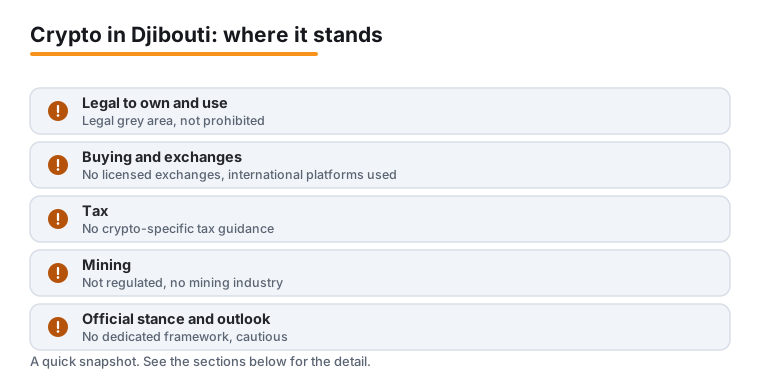
There is no Djiboutian law that specifically bans owning, buying or selling Bitcoin and other cryptocurrencies, and there is no public enforcement action treating mere possession as a crime. At the same time, there is no law that formally recognises crypto as legal tender, as a regulated financial instrument, or as a licensed product. In practice crypto sits in a legal grey area: it is not prohibited to hold, but it is also not protected or supervised the way bank deposits and licensed financial services are.
The only money that is legal tender in Djibouti is the Djiboutian franc, issued by the central bank and pegged to the US dollar. Bitcoin and stablecoins are not recognised as official currency, so merchants are under no obligation to accept them, and there is no government guarantee or consumer-protection scheme standing behind crypto holdings.
The absence of a specific framework is not a green light. General laws still apply in full: fraud, money laundering, terrorism financing, tax evasion and carrying on an unlicensed financial activity can all be prosecuted under existing statutes, even when crypto is the vehicle. The legal position is also unsettled and could change with little notice, so anything you read here should be re-checked against the official source before you rely on it.
Who regulates crypto in Djibouti? The Banque Centrale de Djibouti
The principal financial authority is the Banque Centrale de Djibouti (BCD), the country's central bank. Its statutory mandate is set out in Law 118/AN/11/6eme L, which gives it the general mission of ensuring monetary stability and the proper functioning of the banking and financial system. The BCD holds the exclusive privilege of issuing the national currency, manages the country's foreign-exchange position and US-dollar reserves, and supervises, regulates and inspects financial institutions operating in and from Djibouti, including conventional banks, Islamic banks, microfinance institutions and money changers.
Since 26 August 2025 the BCD has run a licensing regime aimed specifically at crypto service providers, under Circulaire n° 2025-01 as restated by Circulaire n° 2026-01 of 8 April 2026, although there is still no separate crypto regulator and no approved provider appears on its published register. Oversight of any crypto-related activity therefore falls back on the BCD's general powers over banking, payments, foreign exchange and financial crime, rather than on a purpose-built virtual-asset law.
You can confirm the regulator's current position and published instructions on its official website: Banque Centrale de Djibouti (banque-centrale.dj). Anyone planning a crypto-related business in Djibouti should seek formal guidance from the BCD and a local lawyer rather than assuming the activity is permitted by default.
Key laws and frameworks that apply to crypto
Djibouti has not enacted a comprehensive virtual-asset statute, so there is no single law that you can point to as the crypto rulebook. Instead, several existing frameworks are the ones most likely to touch crypto users and businesses:
- The central-bank and banking law (Law 118/AN/11/6eme L), which establishes the BCD's monetary mandate and its power to approve and supervise all financial activity on national territory.
- Anti-money-laundering and counter-terrorist-financing (AML/CFT) law. Djibouti's original AML law dates from 2001 and has since been reinforced. These rules apply to financial institutions and can capture crypto-related transactions that pass through banks or licensed operators.
- Foreign-exchange and monetary rules, given the currency-board arrangement and the BCD's control over the franc and cross-border flows.
- The General Tax Code, which consolidated Djibouti's tax provisions and governs how income and profits are assessed, including, in principle, gains that involve crypto.
- Consumer-protection, fraud and general criminal law, which apply regardless of the technology involved.
Note that Djibouti is not a member of the European Union, so the EU's Markets in Crypto-Assets Regulation (MiCA) does not apply here. International standards from bodies such as the Financial Action Task Force (FATF) influence the direction of travel, but it is national law and BCD practice that determine what is permitted on the ground.
Licensing and registration of exchanges and VASPs
Since 26 August 2025 Djibouti has operated a dedicated licensing regime for crypto exchanges and virtual-asset service providers, called prestataires de services sur actifs virtuels (PSAV). The published BCD framework is Circulaire n° 2025-01, restated by Circulaire n° 2026-01 of 8 April 2026, and applications go to the BCD under Article 8. What is still missing is any approved provider: the BCD's register of licensed institutions lists 42 entities and none of them is a PSAV.
That gap has two consequences. First, residents who buy and sell crypto generally do so through international platforms or peer-to-peer arrangements rather than a locally regulated venue, because no such venue is licensed at home. Second, any business that wants to offer crypto services in or from Djibouti cannot simply rely on the absence of a rule: the BCD's banking law requires its approval for financial activity on national territory, so a would-be operator should approach the BCD directly to clarify whether and how its activity may be authorised.
Because the picture depends heavily on how the central bank interprets its existing powers, the responsible course for any commercial activity is to obtain written guidance from the BCD and qualified local legal advice before launching, rather than assuming a service is lawful by default.
Crypto and Bitcoin tax in Djibouti
Djibouti does not have tax guidance written specifically for cryptocurrency. That does not mean crypto gains are automatically tax-free. Djibouti consolidated its tax rules into a General Tax Code, which sets out how income and profits are assessed, and where a transaction produces income or a profit it may fall within those general rules depending on its nature, the taxpayer's status and how the authorities characterise the activity.
The questions that usually matter are:
- Is the activity a one-off personal disposal, or a regular trading or business activity?
- Does the gain look more like investment income, business income, or something else under local law?
- Are you a tax resident of Djibouti, and how is your overall income assessed?
For context, Djibouti applies a corporate profits tax and a progressive personal income tax under the General Tax Code, but there is no confirmed crypto-specific rate or threshold on the books. This guide deliberately does not state a crypto tax figure, because quoting an unofficial percentage would risk being wrong and misleading. The responsible approach is to keep detailed records of every purchase, sale, swap and transfer, including dates and DJF values, and to consult a qualified Djiboutian tax adviser or the tax authority before filing. See our general guide to crypto taxes for the principles, but treat any country-specific figure with caution unless an official source confirms it. This section is informational only and is not tax advice.
AML and KYC rules
Although Djibouti has no crypto-specific statute, it does have an anti-money-laundering and counter-terrorist-financing framework, and that framework is where crypto most directly intersects with the law. The original AML law dates from 2001, and Djibouti has since enacted further laws and decrees to address gaps, including measures on targeted financial sanctions and the reorganisation of its Financial Intelligence Unit.
Djibouti's AML/CFT system was assessed in a mutual evaluation carried out by the Middle East and North Africa Financial Action Task Force (MENAFATF), with an on-site visit running from 18 February to 7 March 2024 and the resulting report endorsed within the FATF global network. In that assessment Djibouti was rated Compliant on 8 and Largely Compliant on 10 of the 40 FATF technical Recommendations, and it did not achieve a Highly Effective or Substantially Effective mark on any of the 11 effectiveness measures. The report found that banks and larger institutions apply customer due diligence, while noting that the country's understanding and implementation of money-laundering risks was still at an early stage.
For ordinary users, the practical effect is felt mainly through banks and licensed money-transfer operators, which must apply know-your-customer (KYC) checks and may scrutinise or decline crypto-linked transactions under their AML policies. Reputable international exchanges enforce their own KYC, so expect to provide identity documents and proof of address. You can review the BCD's published instructions to financial institutions on its official website, and consult the FATF country page for Djibouti for the AML/CFT assessment status.
Buying and using crypto in practice
Because Djibouti does not license domestic crypto exchanges, residents who buy Bitcoin generally rely on international platforms or peer-to-peer arrangements rather than a locally regulated venue. There is no specific law prohibiting this, but there is also no local regulator standing behind those services if something goes wrong. The main hurdles are practical and financial rather than criminal:
- Fiat on-ramps. Many global exchanges support major currencies and cards but offer limited or no direct support for the Djiboutian franc, so users often rely on USD-denominated methods, cards or stablecoins as a bridge. The franc's long-standing peg to the US dollar can make USD-based value feel familiar.
- Banking cooperation. Whether a card payment or bank transfer to an exchange succeeds depends on the individual bank's risk appetite under its AML policies; some institutions are cautious about crypto-linked payments.
- Identity verification. Expect KYC checks on any reputable platform, including ID and proof of address.
- Self-custody. For anything beyond a small amount, consider moving coins off the exchange into a wallet you control, ideally a hardware wallet, and back up your recovery phrase offline.
When choosing a platform, prioritise established exchanges with strong security, clear fees and a solid compliance record in their home jurisdictions, and keep records of every transaction. Avoid informal peer-to-peer deals where you cannot verify the counterparty, as these carry a high risk of fraud and offer no local recourse. As of 2026 there is no public evidence of licensed Bitcoin ATMs operating in Djibouti, so over-the-counter cash-to-crypto conversion is generally not a local option.
Bitcoin mining in Djibouti
Bitcoin mining is not specifically regulated in Djibouti, and there is no dedicated licensing scheme for mining operations. In principle that leaves room for activity, but the on-the-ground realities are demanding, and as of 2026 large-scale, cost-effective mining is not an established industry in the country.
Energy is the central issue. Mining is extremely power-hungry, and Djibouti has historically faced relatively high electricity costs and a grid that has depended significantly on imported power. The country has been investing in renewable capacity, including solar, wind and geothermal potential linked to its location in the East African Rift, alongside cross-border power links with neighbours. These are sometimes cited as a basis for future low-cost or green mining, but that remains an aspiration rather than a proven activity today.
Anyone seriously considering mining should weigh electricity price and reliability, which ultimately determine profitability; import duties and logistics for specialised hardware; cooling costs in a hot climate, which add to the energy burden; and regulatory uncertainty, since rules on energy use, business licensing or taxation could change. Before committing capital, confirm the legal and energy position directly with the relevant Djiboutian authorities and the electricity provider.
Recent developments (2025 to 2026)
The most concrete recent development affecting Djibouti's financial system is in the AML/CFT area rather than in crypto specifically. The MENAFATF mutual evaluation, with its on-site visit in early 2024, prompted Djibouti to strengthen its anti-money-laundering laws, sanctions regime and Financial Intelligence Unit. These reforms tighten the compliance environment that crypto-linked transactions pass through, even though they do not create a crypto law.
On the digital-currency front, Djibouti has not announced a live central bank digital currency (CBDC), and reporting suggests limited near-term appetite for one, although the central bank has separately issued crypto regulation twice in eight months, in August 2025 and April 2026. Discussion of a national digital currency has appeared in local media, but a formal crypto framework is in force, namely BCD Circulaire n° 2025-01 of 26 August 2025 as restated by Circulaire n° 2026-01 of 8 April 2026, while no CBDC launch has been confirmed by the central bank. Where Djibouti has moved is in mobile money rather than crypto: Djibouti Telecom launched a mobile-wallet service called D-Money in June 2020, offering deposits, withdrawals, person-to-person transfers, bill and merchant payments and salary payments, and it operates under the central bank's oversight. D-Money is electronic money denominated in Djiboutian francs, not a cryptocurrency, but it shows the direction the authorities have chosen for digital payments so far.
The reform has already happened. The BCD signed Circulaire n° 2026-01 on 8 April 2026, adding a travel rule and occasional client identity checks to the licensing regime it created in August 2025. Djibouti's investments in connectivity, data infrastructure, energy and its role as a regional logistics and finance hub give it genuine reasons to engage with digital finance over time, potentially through clearer rules or supervised payment innovation. But readers should not assume any particular reform is coming, and the most reliable way to stay current is to monitor announcements from the BCD.
Consumer risks and protection
The defining feature of crypto in Djibouti is the absence of a local safety net. Because there is no crypto-specific framework and no licensed domestic exchange, holders rely on overseas platforms that are not supervised by Djiboutian authorities, and there is no local consumer-protection or deposit-guarantee scheme behind crypto holdings. The main risks for residents include:
- No local recourse. If an overseas exchange fails or you are defrauded, pursuing a remedy from within Djibouti is difficult, and the BCD does not stand behind these services.
- Regulatory risk. New laws, a central-bank position or restrictions could appear with little warning and change what is permitted, including how holdings are taxed or whether banks will process crypto payments.
- Liquidity and access risk. Limited fiat on-ramps and off-ramps make moving between francs and crypto harder than in larger markets.
- Market and security risk. Price volatility, scams, phishing and lost private keys remain constant threats everywhere.
Sensible principles apply: never invest more than you can afford to lose, be sceptical of guaranteed-return schemes, use secure storage, keep records, and diversify rather than concentrating savings in a single volatile asset. This guide makes no price predictions and is not financial advice.
Official sources and how to verify
Because the position in Djibouti is unsettled and unwritten in places, you should verify anything important against primary sources rather than relying on summaries. The most authoritative starting points are:
- The regulator. The Banque Centrale de Djibouti publishes its statutes, missions, instructions to financial institutions and the list of approved establishments. This is the place to check for any new crypto guidance, payment rules or AML instructions.
- The AML/CFT assessment. The FATF country page for Djibouti and the MENAFATF mutual evaluation set out the state of Djibouti's anti-money-laundering framework, which is the area most likely to affect crypto users through their banks.
- Tax. Djibouti's tax provisions are consolidated in the General Tax Code; for a country overview see resources such as ICAEW's Djibouti tax summary, and confirm your own position with a local tax adviser or the tax authority.
For more general background, see our overview of crypto regulation and our country-by-country regulation hub. To repeat the key caveat: this article is general information as of 2026 and is not legal advice; confirm the current rules with the Banque Centrale de Djibouti and a qualified local professional before acting.
What is changing: Djibouti now licenses crypto firms
The Banque Centrale de Djibouti (BCD) created a licensing regime for crypto businesses in August 2025 and tightened it in April 2026. Both measures are already in force, so there is no future start date to wait for.
| Text | Signed | Status | What it does |
|---|---|---|---|
| Circulaire n° 2025-01, portant régime des prestataires de services sur cryptoactifs | 26 August 2025, by Governor Ahmed Osman | In force from the date of signature (Article 15) | Creates the PSAV status, defines crypto-assets, lists ten regulated services, sets own funds, governance and consumer rules, and makes BCD approval compulsory |
| Circulaire n° 2026-01, modifiant et complétant la circulaire n° 2025-01 | 8 April 2026 | In force from the date of signature (Article 18) | Restates and renumbers the regime, then adds a BCD supervision article, a travel rule for virtual asset transfers, an occasional client identity threshold of 177,000 DJF, and a new sanctions basis in loi n° 178/AN/25/9ème L |
The 2025 circular appears on the BCD's list of circulaires. The 2026 circular is hosted on the BCD website and carries the Governor's signature and the bank's seal, but as of August 2026 it has not been added to that index page, so the consolidated text has to be reached by its direct link. Neither circular sets a transition period for firms already operating, and neither creates a regime for mining or for a central bank digital currency.
Who needs a BCD licence, and what it costs
Article numbers below follow Circulaire n° 2026-01, the consolidated text now in force. The 2025 circular used the same wording but numbered most of these articles one lower.
Article 2 covers ten services when they are provided in Djibouti: custody and administration of crypto-assets for clients; operating a crypto-asset trading platform; exchanging crypto-assets for fiat currency; exchanging crypto-assets for other crypto-assets; executing orders for clients; placement of crypto-assets; receiving and transmitting orders for clients; advising on crypto-assets; crypto-asset portfolio management; and crypto-asset transfer services for clients.
Article 8 states the consequence directly: no one may carry on PSAV activities, claim that status, or create the appearance of it in their company name, trading name or advertising, without first being approved or registered by the Banque Centrale de Djibouti.
The main conditions an applicant must meet:
- Legal form: only a société anonyme, société par actions simplifiée or société à responsabilité limitée. Single member limited companies are excluded (Article 4).
- Own funds: at all times the highest of 100 million Djibouti francs, 2 percent of the investments received in the previous year, or one quarter of the previous year's fixed overheads (Article 11). At the franc's fixed peg of 177.721 to the US dollar, 100 million DJF is about USD 563,000. The funds must be fully paid up in cash when the provider starts trading.
- Where the money sits: own funds are held on an account on the books of the BCD, and client money paid in to buy crypto-assets sits in a segregated account at a bank established in Djibouti (Article 12).
- Fit and proper: criminal record evidence for directors, supervisory body members and anyone holding more than 10 percent of the capital, covering fraud, forgery, theft, breach of trust, bankruptcy offences, extortion and misappropriation of public funds (Article 4).
- Application file: sixteen items filed with the BCD, lettered a to p, including the company statutes, a business plan with projected accounts over at least two years, a legal opinion confirming the assets are crypto-assets and not another regulated instrument such as e-money tokens, a governance description, a risk map covering cybersecurity, business continuity arrangements and complaint handling procedures (Article 8).
The BCD supervises approved providers permanently, through both on-site and desk-based controls (Article 3), and providers must arrange regular independent audits whose results are made available to the BCD (Article 9).
The AML rules added in April 2026
Circulaire n° 2026-01 brought Djibouti's crypto rules into line with the FATF standard on virtual asset transfers. Four obligations matter:
- Travel rule (Article 13): providers must attach and verify originator and beneficiary information on national and international virtual asset transfers. That means the sender's name, physical address rather than wallet address, date of birth, an identifier where the sender is a legal person, the purpose of the transfer and the source of the virtual assets, plus the beneficiary's name, physical address, registered office for companies, identifier, and the name and jurisdiction of the beneficiary's own provider. The circular states that the same obligations that apply to financial institutions apply to providers when sending or receiving virtual assets for a client.
- Occasional clients (Article 14): providers must identify occasional clients and the beneficial owner before carrying out any operation. They must verify that identity, under the modalities set by article 2-2-4 of loi 178, where the operation or a set of linked operations exceeds 177,000 Djibouti francs, which is just under USD 1,000 at the fixed peg, and before any operation of any amount where there is a suspicion of money laundering or terrorist financing.
- Compliance machinery (Article 15): risk mapping on four axes covering geography, customer, product and distribution channel; named officers for anti-money-laundering work including a correspondent to the Agence Nationale des Renseignements Financiers; written procedures; customer and beneficial owner identification; staff training; automated screening of suspicious transactions; and an internal control function. These follow BCD Instruction n° 2025-01 on preventing money laundering and terrorist financing, signed on 26 August 2025, which providers must comply with in full.
- Reporting and sanctions (Articles 16 and 17): quarterly returns to the BCD on the annexed template, covering own funds and activity, including client deposits for investment, refunds to clients, crypto converted into other crypto, crypto transferred on behalf of clients and third party portfolios under management. Breaches attract disciplinary sanctions under article 2.3.4 of loi n° 178/AN/25/9ème L of 2 June 2025, replacing the 2025 circular's reference to article 58 of loi n° 119/AN/11/6ème L of 22 January 2011.
What this means in practice right now
The circulars bind providers, not holders. Nothing in either text bans owning, buying or selling crypto as an individual, and the Djibouti franc remains the only legal tender. Djibouti operates a currency board with the franc fixed at 177.721 to the US dollar and maintains an exchange regime free of restrictions on payments and transfers for current international transactions, according to the Banque Centrale de Djibouti.
The gap is authorisation. The BCD's published list of licensed institutions covers 42 entities in seven categories: 10 conventional banks, 3 Islamic banks, 1 Islamic window, 3 specialised financial institutions, 4 microfinance institutions, 2 electronic money issuers and 19 financial auxiliaries. There is no PSAV category and no crypto provider on it, and the BCD's procédures d'agréments page carries no PSAV application procedure. So the practical position for a resident in August 2026 is unchanged from a year ago: you use offshore platforms, and the protections the circular creates apply only when you buy through a provider the BCD has actually approved.
Those protections, when they do apply, are worth knowing:
- A white paper handed over against receipt, stating plainly that crypto-assets can lose all or part of their value, are not always transferable, may not be liquid, and are not subject to supervision or prudential controls by the BCD nor covered by any compensation or guarantee scheme in Djibouti (Article 5).
- A 14 calendar day right to withdraw from a purchase, with no fee and no reason required, running from the day the client agrees to buy. Refunds are due within 14 days and by the same payment method used originally (Article 10).
- A compulsory warning on every marketing communication, whatever the channel, stating that the communication has not been examined or approved by any competent authority of the Republic of Djibouti and that the provider alone is responsible for its content (Article 6).
Two things the circulars do not cover: tax, and mining. There is still no crypto-specific tax guidance published in Djibouti, so the general rules of the tax code apply to gains and to business profits, and anyone trading at scale should take local advice rather than assume a disposal is untaxed.
Frequently asked questions
Is cryptocurrency legal in Djibouti?
There is no law that specifically bans cryptocurrency in Djibouti, so owning and trading it is not in itself illegal. However, crypto is not formally recognised or regulated either, and the Djiboutian franc remains the only legal tender. General laws on fraud, money laundering and tax still apply. Because the position is unsettled and could change, confirm the current rules with the Banque Centrale de Djibouti and a local professional before acting.
Who regulates crypto in Djibouti?
The Banque Centrale de Djibouti has issued crypto-specific licensing rules and is the authority that approves crypto service providers, though it had approved none as of August 2026. The Banque Centrale de Djibouti (BCD) is the key body: under Law 118/AN/11/6eme L it issues the national currency, manages foreign exchange and supervises banks and other financial institutions. Crypto activity is therefore governed by general financial, monetary, AML and criminal law rather than a dedicated crypto framework. The regulator's official website is banque-centrale.dj.
Do I have to pay tax on crypto in Djibouti?
Djibouti has no published crypto-specific tax guidance, but that does not mean profits are automatically tax-free. Djibouti assesses income and profits under its General Tax Code, and depending on the nature of the activity and your tax status, gains could fall under those general rules. There is no confirmed crypto rate or threshold, so keep full records and consult a qualified Djiboutian tax adviser or the tax authority. This is informational only and not tax advice.
Are crypto exchanges licensed in Djibouti?
In law yes, in practice not yet. A dedicated licensing regime for crypto exchanges and virtual-asset service providers has applied since 26 August 2025 under BCD Circulaire n° 2025-01, restated by Circulaire n° 2026-01 of 8 April 2026, but no crypto business appears among the 42 institutions on the BCD's published register. Residents typically use international platforms instead. Any business wanting to offer crypto services should approach the Banque Centrale de Djibouti directly, because its banking law requires the central bank's approval for financial activity on national territory.
Does EU MiCA apply in Djibouti?
No. Djibouti is not a member of the European Union, so the EU's Markets in Crypto-Assets Regulation (MiCA) does not apply there. Djibouti has no equivalent comprehensive crypto law of its own as of 2026. International standards from bodies such as the Financial Action Task Force influence the direction of travel, but national law and Banque Centrale de Djibouti practice determine what is permitted locally.
Can I send remittances to Djibouti using Bitcoin?
It is technically possible to send value via Bitcoin or dollar-pegged stablecoins, and the franc's long-standing peg to the US dollar can make USD-based value familiar. The challenge is the last mile: converting crypto into spendable Djiboutian francs is harder because there are few local off-ramps, and cross-border transfers still fall under AML and foreign-exchange expectations. Many users still rely on regulated money-transfer operators, which the central bank supervises.
Does Djibouti have a central bank digital currency or a national crypto coin?
No. As of 2026 the Banque Centrale de Djibouti has not launched a central bank digital currency (CBDC), and there is no national cryptocurrency. The main digital-money development in Djibouti is D-Money, a mobile-wallet service launched by Djibouti Telecom in June 2020 under central-bank oversight. D-Money is electronic money denominated in Djiboutian francs for transfers and payments, not a cryptocurrency, so it does not change the legal position of Bitcoin.
What did the FATF evaluation say about Djibouti?
A mutual evaluation carried out by the Middle East and North Africa Financial Action Task Force (MENAFATF), based on an on-site visit from 18 February to 7 March 2024 and endorsed within the FATF global network, rated Djibouti Compliant on 8 and Largely Compliant on 10 of the 40 FATF technical Recommendations. It did not award a Highly Effective or Substantially Effective mark on any effectiveness measure and noted that the country's understanding of money-laundering risk was still developing. This matters for crypto users because banks apply these anti-money-laundering standards to crypto-linked transactions.
Is crypto legal in Djibouti in 2026?
Yes for individuals. Nothing in Djiboutian regulation bans owning, buying or selling crypto, and the Djibouti franc remains the only legal tender. What changed is the business side: since Circulaire n° 2025-01 took effect on 26 August 2025, no one may carry on the activities of a virtual asset service provider, claim that status, or create the appearance of it, without prior approval or registration by the Banque Centrale de Djibouti.
Does Djibouti license crypto exchanges now?
In law yes, in practice not yet. The Banque Centrale de Djibouti has had power to approve virtual asset service providers since 26 August 2025, and applications go to the BCD under Article 8 of the circular. But as of August 2026 the BCD's published list of licensed institutions shows 42 entities across seven categories, and none of them is a virtual asset service provider. Residents still rely on offshore platforms.
How much capital do you need to run a crypto business in Djibouti?
Own funds must at all times be at least the highest of three figures: 100 million Djibouti francs, 2 percent of the investments received in the previous year, or one quarter of the previous year's fixed overheads. At the franc's fixed peg of 177.721 to the US dollar, 100 million DJF is about USD 563,000. The funds must be fully paid up in cash when the business starts and are held on an account at the central bank, while client money sits in a segregated account at a bank established in Djibouti.
Does the travel rule apply in Djibouti?
Yes, since 8 April 2026. Article 13 of Circulaire n° 2026-01 requires virtual asset service providers to attach and verify originator and beneficiary information on national and international virtual asset transfers. That includes the sender's name, physical address rather than wallet address, date of birth, the purpose of the transfer and the source of the assets, plus the beneficiary's details and the name and jurisdiction of the beneficiary's provider.
When does a Djibouti crypto provider have to check my identity?
A provider must identify occasional clients and the beneficial owner before carrying out any operation. It must go further and verify that identity, under the procedure set by loi 178, where the operation or a set of linked operations is above 177,000 Djibouti francs, which is just under USD 1,000 at the fixed peg, and before any operation of any size where there is a suspicion of money laundering or terrorist financing.
What protections do I get if I buy through a licensed Djibouti provider?
Three. You must be handed a white paper against receipt stating that crypto-assets can lose all or part of their value, may not be transferable or liquid, and are not supervised by the central bank or covered by any compensation or guarantee scheme in Djibouti. You get 14 calendar days to withdraw from a purchase without fee or reason, with a refund due within 14 days by the same payment method. And every marketing communication must carry a warning that it has not been examined or approved by any competent authority in Djibouti.
Is there a tax on crypto in Djibouti?
No crypto-specific tax rule has been published. The central bank circulars are prudential and anti-money-laundering measures and say nothing about tax, so the general tax code applies to gains and to business profits according to the nature of the activity and your tax status. Keep full records and take local advice rather than assuming a disposal is untaxed.
Does Djibouti have a crypto mining framework?
No. The licensing regime covers services provided to clients, such as exchange, custody, transfers, advice and portfolio management, and mining is not among the ten regulated services in Article 2. Neither circular creates a mining regime or a licence for mining operations.
Facts reviewed: 13 August 2026. Page updated: 13 August 2026.