Home › Crypto Regulation › Ethiopia
Bitcoin & Cryptocurrency Regulation in Ethiopia
Quick answer — Ethiopia, 2026
- Legal: Not legal tender, birr-paired P2P trading prohibited unless authorised
- Tax: No clear retail crypto tax, mining taxed as business at 30 percent
- Buying: No authorised exchange, birr P2P banned, on-ramps largely closed
Ethiopia's position on cryptocurrency hardened in early 2026. On 27 February 2026 the National Bank of Ethiopia (NBE) issued a public notice declaring birr-paired peer-to-peer (P2P) crypto trading illegal unless explicitly authorised, while stating it is preparing a comprehensive digital-asset framework. At the same time, Ethiopia became one of Africa's largest Bitcoin mining hubs, powered by cheap hydropower, a sector authorities are now tightening through frozen permits and higher electricity tariffs. The result is a split landscape: industrial mining has been registered and taxed as a foreign-exchange earner, while ordinary retail trading and crypto payments sit outside the formal system.
This guide explains where things stand in 2026 across legal status, the regulators, key laws, exchange and licensing rules, taxation, AML/KYC, buying and using crypto, mining, recent developments, consumer risks, and how to verify everything against official sources. It is general information as of 2026 and is not legal, tax, or financial advice. Ethiopian rules are changing quickly, so always confirm the current position with the National Bank of Ethiopia and a qualified local professional before acting. For background on how regulators worldwide approach this, see our crypto regulation guide.
On this page: Legal status · Who regulates it · Taxes · How to buy · Mining
Legal status of Bitcoin and crypto in Ethiopia
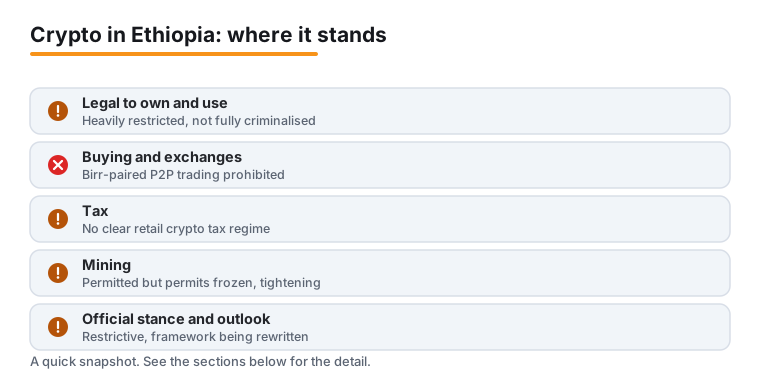
Bitcoin is not legal tender in Ethiopia; the Ethiopian birr remains the only currency recognised for settling debts and everyday payments. Holding crypto in a personal wallet is not, by itself, the subject of a blanket criminal ban, but the activities most people associate with crypto, namely trading it for birr and using it as money, have been sharply restricted.
On 27 February 2026 the National Bank of Ethiopia published a notice stating that birr-paired P2P cryptocurrency trading through platforms, exchanges, or similar services is not permitted unless explicitly authorised by the central bank, and that any form of birr-denominated P2P trading or exchange involving cryptocurrencies is prohibited. Because no NBE-authorised domestic crypto exchange is operating, this effectively pushes retail trading outside the formal financial system. The NBE framed it as a transitional step while it develops a framework for safe and orderly participation, so the honest answer in 2026 is that crypto is heavily restricted, not fully criminalised, and the rules are being rewritten. Treat it as a moving target and verify before acting.
The regulators governing crypto
Several bodies share responsibility for digital assets in Ethiopia, and their roles overlap:
- National Bank of Ethiopia (NBE) is the central bank and the lead authority on monetary policy, foreign exchange, payments, and the legality of crypto trading. The 2026 restriction on birr-paired P2P trading came from the NBE. Official site: nbe.gov.et.
- Information Network Security Administration (INSA) is the cyber-security agency that, since 2022, has been mandated by law to regulate and control cryptographic products and their transactions, and which opened registration for crypto service and mining operators. Official site: insa.gov.et.
- Ethiopian Electric Power (EEP) controls the power contracts and tariffs that make or break large mining operations.
- Ministry of Revenue (and the tax administration) administers business and income tax that applies to mining and data-centre operators.
This division of labour is itself a source of confusion: INSA registers and acknowledges crypto-related operations, while the NBE restricts birr-paired trading, creating a grey area for ordinary users.
Key laws and frameworks
Three legal threads matter most in 2026:
- The NBE public notice of 27 February 2026 prohibiting birr-paired P2P crypto trading unless explicitly authorised. This is the operative restriction on retail activity. Read it directly: NBE notice on illegal birr-paired P2P transactions.
- National Bank of Ethiopia Proclamation No. 1359/2025 modernised the central bank's mandate and created the legal basis for a central bank digital currency, informally the "Digital Birr." See the text via the Ministry of Justice law portal or the NBE document page.
- The INSA mandate (from 2022) to regulate and control cryptographic products and transactions, under which crypto service and mining operators were told to register.
In its 27 February 2026 notice the NBE said it is actively working toward a comprehensive regulatory framework, through ongoing consultations with international peer regulators and domestic stakeholders to ensure alignment with global best practices, and that until such a framework is formally introduced the prohibition remains. No target date, draft text or consultation deadline has been published, and no virtual asset bill has been tabled in the House of People's Representatives as of August 2026. Until those rules are published, most retail crypto activity operates outside the law or in a grey zone. Anyone running a crypto business should obtain current copies of NBE directives and seek Ethiopian legal counsel.
Licensing and registration of exchanges and VASPs
Ethiopia does not yet have a dedicated licensing regime for virtual-asset service providers (VASPs) or crypto exchanges. There is no NBE-authorised retail crypto exchange operating in Ethiopia. Since the NBE public notice of 23 July 2026 the restriction is no longer limited to birr-paired trading. Exchange between virtual assets and fiat, exchange between one or more forms of virtual assets, transfer, safekeeping and administration, and financial services connected to a token issuer's offer or sale are all prohibited unless the NBE has expressly authorised them.
The one existing registration channel is narrow: From August 2022, acting under the Information Network Security Agency Reestablishment Proclamation No. 808/2013, INSA has registered individuals and entities involved in crypto-related activities, including mining and transfer services. INSA registration is not a financial licence and does not amount to the express NBE authorisation the July 2026 notice requires. That registration is a cyber-security and control measure rather than a financial-services licence, and it does not authorise birr-paired retail trading. In practice, major global platforms responded to the 2026 restriction by suspending or delisting Ethiopian-birr P2P services for local users. A proper, NBE-licensed exchange would only become the compliant on-ramp once the forthcoming digital-asset framework is published. Until then, assume there is no sanctioned domestic exchange and verify current status with the NBE.
Crypto and Bitcoin taxation
Ethiopia has no crypto-specific tax regime, so the general income tax defaults apply. Companies pay 30 per cent on adjusted business income. Income Tax Amendment Proclamation No. 1395/2025 reduced the capital gains rate to a unified 15 per cent, but published summaries describe that charge by reference to shares, bonds and buildings, and cryptocurrency is not one of those classes. Individuals are taxed in monthly bands from 15 per cent up to a top marginal rate of 35 per cent on income above 14,000 birr. Where crypto activity amounts to a trade, profits fall under business income. In general terms:
- Mining and data-centre operators are treated as businesses. Corporate entities are generally subject to Ethiopia's standard business income tax (a flat rate of 30 percent for companies), while individuals are taxed on a progressive scale. Operating costs such as electricity and hardware can typically be deducted, and miners are expected to obtain a Tax Identification Number and file with the tax administration.
- General income and capital-gains principles under Ethiopian tax law could in principle apply to disposals of assets, but how the authority characterises crypto for retail investors is not settled in public guidance.
- Foreign-exchange rules interact with any activity that converts value into or out of birr, a separate compliance area from income tax.
Because retail trading itself is restricted, the practical tax questions for most residents are unsettled. Do not assume gains are tax-free, and do not rely on a single rate you read online. Confirm your situation with the Ministry of Revenue or a licensed Ethiopian tax advisor. For general context, see our crypto taxes guide. This is not tax advice.
AML, KYC, and financial-crime rules
A central reason the NBE gave for restricting birr-paired P2P trading was the absence of anti-money-laundering (AML) and combating-the-financing-of-terrorism (CFT) safeguards around informal crypto channels, alongside concerns about fraud, scams, volatility, and exposure to foreign-exchange manipulation.
Ethiopia has a general AML/CFT and financial-intelligence framework that applies to regulated financial institutions, but there is no crypto-specific VASP regime yet that imposes formal KYC, transaction-monitoring, and reporting duties on virtual-asset businesses in the way that frameworks such as the EU's MiCA or FATF's VASP standards do elsewhere. The NBE has said its forthcoming digital-asset framework is being developed with international peer regulators, which points toward AML/KYC obligations being built into any future licensing regime. Until that framework exists, users transacting through informal channels have no KYC protections and no regulated recourse if funds are lost or frozen.
Buying and using crypto in practice
Buying crypto inside Ethiopia became materially harder in 2026. With birr-paired P2P trading prohibited unless authorised by the NBE, and with no domestically licensed exchange, the formal on-ramps have largely closed. Several major global platforms suspended or delisted Ethiopian-birr P2P services for local users, unwilling to operate in a grey zone.
This matters because P2P was the dominant way Ethiopians acquired crypto. Ethiopia's strict foreign-exchange controls meant most users traded by matching with other individuals rather than via card or bank transfer. Removing the compliant P2P rails leaves users with informal channels that carry greater exposure to fraud, frozen funds, and legal jeopardy. Key points for 2026:
- No NBE-authorised retail crypto exchange is operating domestically.
- Birr-denominated P2P trading is prohibited unless explicitly authorised by the central bank.
- Converting birr to crypto through informal or offshore channels falls outside the authorised dealing channels set by Foreign Exchange Directive No. FXD/01/2024, and since 23 July 2026 the conversion itself is prohibited under the NBE virtual asset notice unless expressly authorised. Legal analysis describes birr-paired crypto, especially stablecoins, as operating as a shadow FX market that the NBE views as circumventing authorised FX channels and creating rate signalling and manipulation risks.
- Bitcoin ATMs are not a sanctioned option; strict currency controls and the lack of a licensing framework make publicly operating crypto cash machines impractical and legally exposed.
Binance is a clear example of how the restriction played out. After the February 2026 notice, Binance said it would disable all Ethiopian birr (ETB) trading, with the change effective 15 May 2026. In June 2026 Binance restored access to its platform for Ethiopian users through Ethio Telecom, citing successful regulatory engagements, so reaching the site no longer required a VPN. Birr-denominated P2P trading stayed suspended, and the NBE notice of 23 July 2026 then extended the prohibition beyond birr pairs to virtual asset activity generally. Being able to open an app or website is not the same as being able to legally buy crypto with birr; the ETB P2P channel remained closed.
The responsible approach is to confirm the current legal status directly with the NBE before doing anything, prioritise secure self-custody if you already hold crypto, and wait for a properly licensed channel rather than relying on the continued availability of any particular app.
Bitcoin mining
Mining is the part of Ethiopia's crypto story that put the country on the global map. After a 2022 decision to register crypto operations through INSA, Ethiopia attracted a wave of large operators, many backed by foreign capital, drawn by abundant low-cost hydropower from projects such as the Grand Ethiopian Renaissance Dam. By 2025 the country hosted roughly two dozen significant operations, and Ethiopian Electric Power earned around 220 million US dollars from supplying the mining sector in one budget year.
That rapid growth created a problem: mining was on track to consume close to a third of national power output, while only about half of Ethiopians had reliable electricity access. Authorities tightened in response:
- Power permits: new permits for crypto miners were frozen in August 2025 amid grid-constraint concerns, with about 25 mining firms already operating and roughly 20 more awaiting approval at that point.
- Tariffs: EEP ended its flat-rate power tariff for data-mining customers and moved to time-of-use pricing effective 1 December 2025. Under the old flat rate of about 3.14 US cents per kilowatt-hour miners had flooded in; the new structure raised costs by up to about 107 percent during peak hours. EEP was reported to have earned around 220 million US dollars from mining power in a prior budget year, with revenue projected near 312.5 million US dollars for the budget year ending June 2026.
- Strategic direction: EEP signalled it would phase out mining as a long-term strategy, while state-linked entities explored running mining for national revenue directly.
The takeaway: industrial mining has been registered and even courted, but economics and policy are shifting toward higher costs, tighter power access, and greater state involvement. Prospective miners should secure written power agreements and confirm INSA registration, tax obligations, and the latest tariff schedule before committing capital.
Recent developments (2024 to 2026)
Several connected reforms reshaped the backdrop in a short span:
- July 2024 foreign-exchange overhaul: Ethiopia shifted to a market-based, floating birr, letting banks trade foreign currency at negotiated rates. The NBE also encouraged zero or reduced remittance fees and launched diaspora initiatives to pull more hard currency through formal channels. This reform is central context for any crypto activity that converts value into or out of birr.
- 2025 central bank law: National Bank of Ethiopia Proclamation No. 1359/2025 modernised the NBE's mandate and created the legal basis for a "Digital Birr" central bank digital currency, which remains in a research and study phase rather than live deployment.
- 2025 mining clampdown: frozen power permits, new time-of-use tariffs, and signals that EEP would phase out mining.
- February 2026 P2P restriction: the NBE notice prohibiting birr-paired P2P crypto trading, paired with a commitment to a forthcoming digital-asset framework.
- Mid-2026 exchange fallout: Binance disabled Ethiopian birr trading effective 15 May 2026 in response to the notice. Around 23 June 2026, network access to Binance was reported restored for Ethiotelecom users, but birr-denominated P2P trading stayed suspended, so the on-ramp for buying with birr remained closed.
The near-term direction looks like more structure, not less: continued enforcement of the P2P restriction, tightening mining economics, and ongoing CBDC study, all while a comprehensive crypto framework is drafted.
Consumer risks and protection
Ethiopian residents face a distinctive risk profile that goes well beyond Bitcoin's ordinary volatility, and there is currently no crypto-specific consumer-protection regime:
- Legal risk: with birr-paired trading restricted and no licensed exchange, simply buying, selling, or cashing out can mean operating outside the law.
- Access and liquidity risk: the withdrawal of major P2P services makes it hard to enter or exit positions, and informal channels carry fraud and counterparty risk.
- Currency and capital-control risk: moving value between birr and crypto intersects with strict foreign-exchange rules.
- Custody risk: without local consumer protections, lost keys, scams, or platform failures may leave you with no recourse.
Some Ethiopians have nonetheless viewed crypto, and stablecoins in particular, as a hedge against birr depreciation and inflation. That motivation is understandable, but it does not remove the hazards above. Before risking money, confirm the current legal status, never invest more than you can afford to lose entirely, beware of anyone promising guaranteed returns, and consider regulated alternatives. This is general information, not financial advice.
Official sources and how to verify
Because this area is changing fast, always confirm the current position against primary sources rather than secondary commentary or any single page online, including this one. Start here:
- National Bank of Ethiopia for monetary, payments, and crypto-trading rules: nbe.gov.et, and the specific 2026 P2P notice.
- National Bank of Ethiopia Proclamation No. 1359/2025 via the Ministry of Justice law portal.
- Information Network Security Administration (INSA) for crypto-operation registration and the mining mandate: insa.gov.et.
For tax, contact the Ministry of Revenue or a licensed Ethiopian tax advisor; for mining power terms, contact Ethiopian Electric Power. You can also browse our wider regulation hub and the crypto regulation explainer. This page is general information as of 2026 and is not legal, tax, or financial advice; verify the current rules with the National Bank of Ethiopia and a qualified local professional before acting.
What is changing: the 23 July 2026 virtual asset notice
The most important change since this page was last reviewed is a National Bank of Ethiopia public notice dated 23 July 2026. The February 2026 notice was narrow and only barred birr-paired peer-to-peer trading. The July notice drops the birr-pairing limit and prohibits virtual asset activity generally unless the NBE has expressly authorised it, as reported by state broadcaster Fana Media Corporation, the Ethiopian Monitor, Capital Market Ethiopia and Birr Metrics.
The NBE defines a virtual asset as a digital representation of value that can be electronically traded, transferred, exchanged or used for payments, investment or similar purposes, which is deliberately wider than cryptocurrency. The five prohibited limbs named in the notice are:
- exchange between virtual assets and fiat currencies
- exchange between one or more forms of virtual assets
- transfer of virtual assets
- safekeeping and/or administration of virtual assets, or of instruments enabling control over virtual assets
- participation in and provision of financial services related to an issuer's offer and/or sale of a virtual asset
Those five limbs track the FATF definition of a virtual asset service provider. No transition period, wind-down window or grandfathering was published, and Capital newspaper reports that the notice had immediate effects on global platforms, with major exchanges suspending Ethiopian birr trading pairs. The operative test is express NBE authorisation. Legal Eagles Law Firm advises that companies should not engage in these activities without explicit NBE licensing or sandbox approval.
On what comes next, the NBE's own words are the only reliable guide and they contain no date. Its February 2026 notice states that the bank is actively working toward a comprehensive regulatory framework, through ongoing consultations with international peer regulators and domestic stakeholders to ensure alignment with global best practices, and that until such a framework is formally introduced the prohibition remains. No draft text, scope or consultation deadline has been published, no virtual asset bill has been tabled in the House of People's Representatives, and the Ethiopian Capital Market Authority has issued no digital asset directive.
First enforcement: seven apps banned in August 2026
Until August 2026 the notices had produced no publicly reported enforcement. That changed on 6 August 2026, when Government Communication Service Minister Enatalem Melesse announced that seven cryptocurrency applications had been banned, saying they had been used to conceal unauthorised financial transactions and to defraud citizens. As Ethio Negari reports, the authorities did not disclose the names of the seven applications, and no legal instrument giving effect to the ban has been published.
Two things about this action are worth stating plainly:
- It was announced by the government communication service as part of a wider crackdown on economic crime covering gold smuggling, illegal fuel trade, money laundering and tax evasion, rather than issued as an NBE directive under the July notice.
- The same announcement covered the arrest of four senior Ethiopian Electric Power executives over allegedly unauthorised electricity supply contracts with cryptocurrency data mining companies. That touches mining rather than trading, and it is the first sign of legal risk attaching to the mining side.
Because the applications were not named, users have no way to tell which services are affected. No NBE fine, prosecution or account freeze arising from the February or July notices themselves has been publicly reported.
The named laws behind the ban
Ethiopia has no dedicated virtual asset statute. The NBE regulates by public notice resting on existing instruments, which is why the prohibition exists without a crypto law. The legal analysis by Afriwise, written by Dablo Law Firm, traces the July 2026 notice to the following instruments rather than treating it as standalone legislation.
| Instrument | Number | Why it matters for crypto |
|---|---|---|
| National Bank of Ethiopia Proclamation | No. 1359/2025 | Source of the NBE's mandate. Article 5 on financial system soundness, Article 6 on policy and supervision, Article 6(21) on a regulatory sandbox, Article 35 making the birr legal tender, Article 36 reserving issue of legal tender, Article 39 restricting foreign exchange dealing to banks and authorised dealers. |
| National Payment System Proclamation | No. 718/2011, amended by No. 1282/2023 | Gives the NBE licensing and prohibition powers over payment systems and payment instruments. |
| Payment Instrument Issuer Directive | No. ONPS/09/2023, amended by ONPS/10/2025 | Determines who may lawfully issue a payment instrument. Licensed birr denominated electronic money remains lawful and is legally distinct from a virtual asset. |
| Foreign Exchange Directive | No. FXD/01/2024 | Sets authorised FX dealing channels. Birr-paired crypto is treated as bypassing them. |
| Prevention and Suppression of Money Laundering and Financing of Terrorism Proclamation | No. 780/2013, amended by No. 1387/2025 | Modernises the AML and CFT framework, broadens definitions of criminal assets and expands the powers of the Financial Intelligence Service. |
| Capital Market Proclamation | No. 1248/2021 | Establishes the ECMA. Tokens marketed with a profit expectation can fall within securities rules in substance. |
| Computer Crime Proclamation | No. 958/2016 | Cited in the same analysis as part of the framework the notice rests on. |
| Information Network Security Agency Reestablishment Proclamation | No. 808/2013 | Basis on which INSA has registered crypto operators, including miners and transfer services, since August 2022. |
No penalty schedule was published with either the February or the July notice. Afriwise is explicit that the notice should not be treated as though it were a new proclamation containing a complete licensing, offence and penalty regime, so consequences have to be traced back to the applicable proclamation, directive and licence condition on the facts.
What tax actually applies to crypto in Ethiopia
There is no crypto-specific tax rule in Ethiopia and no Ministry of Revenue guidance on cryptocurrency. What applies instead are the general income tax defaults, and those carry real numbers.
- Corporate income tax is 30 per cent of adjusted business income, per PwC. Mining and data centre companies are taxed at this rate.
- Income Tax Amendment Proclamation No. 1395/2025 reduced the capital gains rate to a unified 15 per cent. PwC describes that charge as applying to shares, bonds and buildings. Cryptocurrency is not among those named classes and no guidance has been published extending the charge to it, though this is a reading of published summaries rather than a quoted statutory provision.
- Where crypto activity amounts to a trade rather than an isolated disposal, profits fall under business income. Ethiopian income tax reaches every form of economic benefit, including nonrecurring gains, in cash or kind, from whatever source derived, as Afriwise notes.
- Individuals are taxed in monthly bands, exempt to 2,000 birr, then 15 per cent to 4,000, 20 per cent to 7,000, 25 per cent to 10,000, 30 per cent to 14,000 and a top marginal rate of 35 per cent above 14,000 birr, per PwC.
- The 2025 amendment also raised the dividend rate to 15 per cent, applied 15 per cent to undistributed or repatriated profits, introduced a 2.5 per cent minimum alternative tax on turnover, and replaced the three taxpayer categories with two, Category A above 2 million birr turnover and Category B below.
- Mining companies licensed by the Ethiopian Investment Commission under data centre and cloud services can qualify for an income tax holiday of four years in Addis Ababa and five years elsewhere.
One caveat on status: PwC recorded that official gazetting of the amendment was still pending at its July 2026 review, even though the proclamation is reported to have taken effect from 7 July 2025.
The practical point for a holder is that the tax question is now largely academic. Since 23 July 2026 the disposal itself is prohibited without express NBE authorisation, so a gain realised through an unauthorised channel raises a regulatory problem before it raises a tax one.
Mining and the time-of-use tariff schedule
Mining is regulated separately from the NBE regime. Afriwise is precise on this point: the notice does not identify computation, mining or validation as a stand-alone category, but the transfer, sale, custody or conversion of outputs is separately captured. So mining the coin is not named, while selling or moving it is. Capital newspaper reports that mining remains legal and is expanding, supported by hydroelectric power. Licensing runs through the Ethiopian Investment Commission, which classifies the activity as data centre and cloud services.
- New data mining permits are frozen. Addis Fortune dates the licence suspension to March 2025, and Ethiopian Electric Power chief executive Ashebir Balcha said in August 2025 that from EEP's current assessment access appeared to be at capacity, as reported by Mariblock. Addis Fortune counts around 25 licensed firms with nearly 20 more awaiting licences.
- The flat tariff of roughly 3.14 US cents per kWh ended on 1 December 2025. Year one averages 4.0 cents, with 6.0 cents at peak between 18:00 and 22:00, 4.5 cents shoulder between 05:00 and 09:00 and 3.5 cents off-peak. Capital puts the December 2025 peak rate at a 91 per cent rise on the old flat rate, and the year three baseline at about 107 per cent above it.
- A second step is scheduled for 8 July 2026, taking the average to 5.0 cents per kWh, peak 6.3 cents, shoulder 5.55 cents and off-peak 4.65 cents. This is the published schedule. No report confirming that the step was actually applied has been located.
- A third step is scheduled for 8 July 2027, taking the average to 6.5 cents, peak 7.2 cents, shoulder 6.45 cents and off-peak 6.35 cents, roughly double the original flat rate.
- All rates include 15 per cent VAT and a 0.5 per cent regulatory fee. EEP earned about 220 million US dollars from mining supply in the prior year and projected 312.5 million for the budget year ending June 2026.
- Legal risk has now reached the sector. On 6 August 2026 the government announced the arrest of four senior EEP executives over allegedly unauthorised electricity supply contracts with cryptocurrency data mining companies, per Ethio Negari.
Frequently asked questions
Is cryptocurrency banned in Ethiopia in 2026?
Not as a blanket criminal ban on ownership, but it is heavily restricted. On 27 February 2026 the National Bank of Ethiopia published a notice prohibiting birr-paired peer-to-peer crypto trading unless explicitly authorised, and there is no domestically licensed exchange. Crypto is also not legal tender. The NBE has said it is preparing a formal digital-asset framework, so the rules may change. Always verify the current position with the NBE.
Who regulates cryptocurrency in Ethiopia?
The lead authority is the National Bank of Ethiopia (NBE), the central bank, which governs monetary policy, foreign exchange, payments, and the legality of crypto trading. The Information Network Security Administration (INSA) has a separate 2022 mandate to regulate cryptographic products and register crypto operations, including mining. Ethiopian Electric Power handles mining power contracts, and the Ministry of Revenue handles tax.
Can I legally trade Bitcoin for birr in Ethiopia?
Birr-denominated peer-to-peer crypto trading is prohibited unless the National Bank of Ethiopia explicitly authorises it, and at the time of writing no such authorised retail channel is operating. Several major global platforms have suspended or delisted Ethiopian-birr P2P services. Using informal channels to swap birr for crypto may breach both the NBE notice and Ethiopia's foreign-exchange rules.
Is Bitcoin mining legal in Ethiopia?
Registered crypto mining has been permitted since 2022, with operators expected to register with INSA, and it became a significant source of foreign-exchange revenue. However, authorities froze new power permits in 2025, raised electricity tariffs for miners, and signalled they would phase out mining as a long-term strategy. Confirm INSA registration, current tariffs, tax obligations, and a written power agreement before investing.
How is crypto taxed in Ethiopia?
There is no clearly published, crypto-specific tax regime for ordinary investors, so we do not quote retail rates. Mining and data-centre businesses are generally subject to standard Ethiopian business income tax (a flat 30 percent for companies; progressive rates for individuals) and must file with the tax administration. Because treatment for retail investors is unsettled and trading is restricted, confirm your situation with the Ministry of Revenue or a licensed Ethiopian tax advisor. This is not tax advice.
Does Ethiopia have a digital currency (CBDC)?
Not yet in circulation. National Bank of Ethiopia Proclamation No. 1359/2025 created the legal basis for a central bank digital currency, informally the "Digital Birr," and the NBE has included studying a CBDC in its strategy. As of 2026 it remains in a research and study phase rather than live deployment.
Can I still use Binance in Ethiopia in 2026?
Binance disabled Ethiopian birr (ETB) trading effective 15 May 2026 after the National Bank of Ethiopia's notice. Around 23 June 2026, reports said network access to Binance was restored for users on Ethiotelecom, so reaching the site no longer needed a VPN. However, birr-denominated P2P trading stayed suspended, so being able to open the platform is not the same as being able to legally buy crypto with birr. Verify the current status before relying on any app.
Why did Ethiopia raise electricity prices for crypto miners?
Crypto mining had grown fast on cheap hydropower, and by 2025 it was on track to consume close to a third of national electricity output while many Ethiopians still lacked reliable power. Authorities froze new mining power permits in August 2025 and, effective 1 December 2025, Ethiopian Electric Power ended its flat-rate tariff for data-mining customers and moved to time-of-use pricing, raising costs sharply on a three-stage schedule. The peak rate introduced on 1 December 2025 was about 91 per cent above the old flat tariff of roughly 3.14 US cents per kWh, while the 107 per cent figure describes the year three baseline average of 6.5 cents rather than a peak-hour rate. Confirm the latest tariff schedule with EEP before investing.
Is crypto legal in Ethiopia in August 2026?
No, not as an activity you can carry out freely. Since the National Bank of Ethiopia public notice of 23 July 2026, buying, selling, exchanging, transferring, settling, holding in custody for others and facilitating transactions in virtual assets are all prohibited unless the NBE has expressly authorised them. No such authorisation has been publicly granted to any retail platform. Bitcoin is not legal tender and the birr remains Ethiopia's monetary unit and legal tender.
What changed between the February 2026 and July 2026 NBE notices?
The February 2026 notice was narrow and banned only birr-paired peer-to-peer trading on platforms and exchanges. The July 2026 notice removed the birr-pairing limit. It now covers exchange between virtual assets and fiat, exchange between one or more forms of virtual assets, transfer of virtual assets, safekeeping and administration of virtual assets or instruments controlling them, and financial services connected to a token issuer's offer or sale. It also applies to digital representations of value generally, not only cryptocurrency.
When will Ethiopia license crypto exchanges?
No date has been published. The NBE says it is working toward a comprehensive regulatory framework and consulting international peer regulators and domestic stakeholders, and that the prohibition stands until that framework is formally introduced. As of August 2026 no virtual asset bill has been tabled in the House of People's Representatives, no draft directive has been released for comment, and the Ethiopian Capital Market Authority has issued no digital asset directive. Anyone quoting a specific date for Ethiopian crypto licensing is guessing.
Has anyone actually been penalised under the crypto ban?
No penalty schedule was published with either the February or the July 2026 notice, and legal commentary is explicit that the notice is not a standalone proclamation containing a complete offence and penalty regime. On 6 August 2026 the Government Communication Service announced that seven cryptocurrency applications had been banned for concealing unauthorised financial transactions and defrauding citizens, but the applications were not named and no instrument was published. No NBE fine, prosecution or account freeze arising from the notices themselves has been publicly reported.
Does the ban cover holding Bitcoin in my own wallet?
The notice prohibits safekeeping and administration of virtual assets and of instruments that enable control over them, which is written broadly enough that lawyers have read it as reaching wallet and custody services. The NBE has not published guidance on whether purely personal self-custody, with no exchange, transfer or facilitation, falls inside that limb. Treat this as unresolved rather than settled in either direction.
How much tax would I pay on a crypto gain in Ethiopia?
There is no crypto-specific rate. Income Tax Amendment Proclamation No. 1395/2025 reduced the capital gains rate to a unified 15 per cent, but published summaries describe that charge as applying to shares, bonds and buildings, and cryptocurrency is not among those classes. Companies pay 30 per cent on adjusted business income and individuals are taxed in monthly bands up to a top marginal rate of 35 per cent above 14,000 birr. If crypto activity amounts to a trade, profits fall under business income. Confirm your own position with the Ministry of Revenue or a licensed Ethiopian tax adviser.
Is Bitcoin mining still allowed in Ethiopia?
Yes. Mining is licensed by the Ethiopian Investment Commission under data centre and cloud services, and the July 2026 notice does not name computation, mining or validation as a stand-alone category, though the transfer, sale, custody or conversion of mined output is separately caught. New permits have been frozen since 2025, and Ethiopian Electric Power replaced the flat tariff with time-of-use pricing on 1 December 2025, with further scheduled steps on 8 July 2026 and 8 July 2027. In August 2026 four senior Ethiopian Electric Power executives were arrested over allegedly unauthorised power supply contracts with mining companies.
Does Ethiopia have a digital birr?
Not yet. National Bank of Ethiopia Proclamation No. 1359/2025 provides the legal basis for the NBE to issue a central bank digital currency, but the work is at study stage rather than pilot. Governor Eyob Tekalign said in December 2025 that the bank is examining possible models and implications, and indicated that cash will remain part of the system for decades. No implementation date or pilot launch timeframe has been announced.
Facts reviewed: 13 August 2026. Page updated: 13 August 2026.