Home › Crypto Regulation › Comoros
Bitcoin & Cryptocurrency Regulation in Comoros
Quick answer — Comoros, 2026
- Legal: Legal grey zone, not banned, not legal tender, largely unregulated
- Tax: No dedicated crypto tax; general tax law may still apply
- Buying: No domestic regulated exchange; use international platforms
The Union of the Comoros is a small island nation in the Indian Ocean, off the coast of East Africa between Mozambique and Madagascar. It has one of the world's smaller and lower-income economies, leaning heavily on agriculture and on money sent home by a large diaspora. Against that backdrop, cryptocurrency occupies a largely undefined legal space: as of 2026 there is no dedicated, comprehensive national law that specifically authorises, licenses, or bans Bitcoin and other digital assets at the level of the Union government.
This guide explains how digital assets are treated in the Comoros heading into 2026: whether Bitcoin is legal, who the relevant authorities are, the laws and frameworks that touch crypto, how exchanges and virtual-asset businesses are handled, tax basics, anti-money-laundering rules, buying and using crypto in practice, mining, recent developments, consumer risks, and how to verify the position with official sources. A recurring theme is the gap between the national legal position and the controversial, island-level Anjouan offshore licences marketed to crypto businesses. This is general information as of 2026 and is NOT legal, tax, or financial advice; Comoran rules are sparse and can change with little public notice, so confirm specifics with the official regulator, the Central Bank of the Comoros (Banque Centrale des Comores), or a qualified local lawyer before acting. See also our overview of crypto regulation and our country-by-country regulation hub.
On this page: Legal status · Who regulates it · Taxes · How to buy · Mining
Is Bitcoin and crypto legal in Comoros?
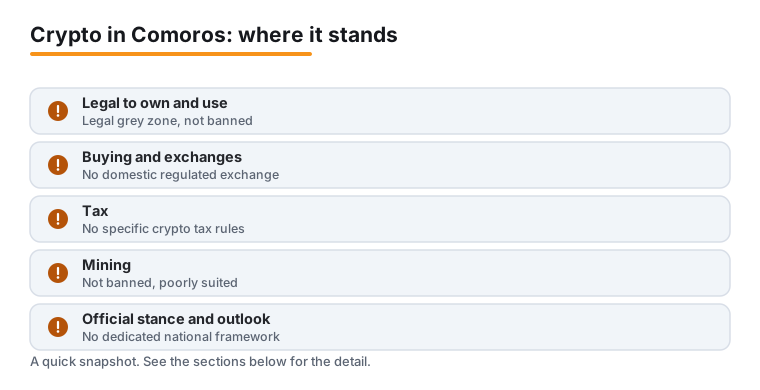
There is no law in the Comoros that explicitly makes owning or trading Bitcoin a crime, and there is no law that explicitly grants digital assets formal recognition either. In practice, cryptocurrency sits in a legal grey zone: individuals are not generally prohibited from buying, holding, or transferring digital assets, but those assets enjoy no legal-tender status and little to no domestic consumer protection.
The official currency is the Comorian franc (KMF), which is pegged to the euro under a long-standing monetary cooperation arrangement with France. Only the franc is legal tender; no merchant is obliged to accept Bitcoin, and crypto is not money in the eyes of Comoran law. Because the sector is essentially unregulated rather than expressly legalised, users carry the full risk themselves: if a platform fails, a transfer goes wrong, or a scam succeeds, there is unlikely to be a domestic regulator or compensation scheme to turn to. The safest approach is to treat crypto as a high-risk personal activity, use reputable international platforms, and keep careful records. This is general information as of 2026 and is not legal advice.
Who regulates crypto in Comoros? The Central Bank and Ministry of Finance
The Comoros does not have a single, dedicated crypto regulator. The most relevant authorities are the central bank and the finance ministry, neither of which has issued a comprehensive, crypto-specific framework.
Banque Centrale des Comores (BCC)
The Central Bank of the Comoros (Banque Centrale des Comores, BCC) is the monetary authority. It manages the Comorian franc, supervises banks and financial institutions, oversees financial stability, and approves the establishment of new financial institutions through an authorisation process known locally as the agrement. The franc's peg to the euro is maintained through a monetary cooperation arrangement with the French Treasury, and France participates on the BCC's board. The BCC has not issued cryptocurrency as legal tender and has not created a dedicated licensing regime for crypto-asset service providers. It publishes an official list of the financial institutions it has authorised, which is the reference point for checking whether a firm is genuinely regulated in the Comoros. Banking and anti-money-laundering supervision can still touch crypto activity indirectly, for example where a transaction passes through a regulated bank or money-transfer operator. The BCC's official website is banque-comores.km.
Ministry of Finance and offshore activity
Reporting on Comoran crypto and offshore licensing points to the Ministry of Finance as the body associated with offshore financial activity. However, there is no published, standalone virtual-asset service provider (VASP) statute; any business handling financial flows would be assessed under the general financial-supervision framework rather than a purpose-built crypto law. Because official, English-language guidance is limited, treat secondary descriptions cautiously and verify any specific requirement directly with the BCC or a qualified Comoran lawyer.
Key laws and frameworks
The Comoros has not enacted a bespoke digital-asset statute comparable to the frameworks seen in larger jurisdictions. As a non-EU African state, it is not covered by the European Union's Markets in Crypto-Assets Regulation (MiCA) or any equivalent regional crypto framework; do not assume EU-style rules apply. Understanding the landscape means separating three distinct layers.
Monetary and banking law
The franc, the banking system, and the licensing of financial institutions fall under the BCC and the country's monetary cooperation arrangement with France. These rules govern money and banks, not crypto specifically, but they shape how crypto can interact with the formal financial system.
AML/CFT law
The Comoros has anti-money-laundering and counter-terrorist-financing legislation and a financial intelligence unit, assessed internationally through its regional FATF-style body (see the AML/KYC section below). These obligations can apply where crypto interacts with banks or remittance operators.
The Anjouan and Mwali offshore-licence caveat
A major point of confusion is the so-called Anjouan crypto licence. Anjouan is one of the islands of the Comoros, and an island-level body, marketed as the Anjouan Offshore Finance Authority (AOFA), advertises low-cost, fast licences for crypto, banking, forex, and online-gambling firms targeting non-residents. A parallel scheme operates on the island of Mohéli (Mwali) through a body marketed as the Mwali International Services Authority (MISA). Multiple legal and industry sources state plainly that neither an Anjouan nor a Mwali crypto licence is officially recognised by the Union (national) government, which makes them a weak legal foundation. Treat any claim that a business is regulated in the Comoros via an AOFA or MISA licence with strong caution.
The reason is constitutional. Under the constitutional arrangement of the Union of the Comoros, banking and financial legislation falls to the Union government and its central bank, not to the individual islands, so an island-level authority cannot lawfully issue or supervise financial licences. The Central Bank of the Comoros publishes an official list of the financial institutions it has authorised; entities holding only an AOFA or MISA permit do not appear on it. The Central Bank names the problem on its own anti-money-laundering page, saying the Union has faced the problem of offshore banks on the island of Anjouan for several years and that it has taken measures including court action to close the sites. Separately, a Central Bank communique dated 8 December 2025, republished on its site on 24 February 2026, warns that some entities claim the status of a Comorian financial institution without authorisation, and states that only institutions duly licensed by the Banque Centrale des Comores may carry on financial or banking business under a Comorian licence. That communique does not itself name Anjouan, Mwali, AOFA or MISA, and reporting attributes the December 2025 re-circulation to the Ministry of Finance website. International bodies have flagged the wider offshore-licensing schemes as well, with critical commentary attributed to the World Bank, the IMF, the OECD, and the United States State Department. Verify any Comoros licensing claim against the central bank's own published list before relying on it.
Licensing and registration of exchanges and VASPs
There is no Comoros-specific licensing regime purpose-built for cryptocurrency exchanges or virtual-asset service providers, and no widely recognised, domestically regulated crypto platform serving residents. Where crypto businesses are described as licensed in the Comoros, this typically refers either to authorisation under the general financial framework supervised by the central bank, or to an offshore Anjouan licence.
The Anjouan and Mwali offshore route
The Anjouan (AOFA) offshore licence, and the parallel Mwali (MISA) licence, are marketed internationally as a fast, inexpensive way for crypto firms to obtain a permit, often for companies operating outside the Comoros. The critical caveat, repeated across legal-services and industry sources, is that these licences are not recognised by the Comoros national government and should not be relied upon as robust supervision. In November 2025, for example, one trading platform publicised an Anjouan offshore-finance licence valid into 2026; such announcements illustrate that these permits exist and are actively issued, but they do not establish that the entity is soundly regulated at a national level. Reporting also notes practical friction: because the central bank treats these island approvals as unauthorised, some international banks and payment providers reportedly decline or escalate onboarding once an AOFA or MISA document is identified as non-regulatory.
What this means for users
For an individual buying or holding crypto, the practical takeaway is that there is no domestic, regulated exchange to rely on and no Comoros investor-protection scheme. The Central Bank's published list of licensed institutions names four banks, Banque de Developpement des Comores, AFG Bank Comores, Exim Bank Comores and Banque Federale de Commerce, plus three decentralised financial institutions, l'Union des Meck, l'Union des Sanduk d'Anjouan and l'Union des Sanduk de Moheli, and no exchange or virtual-asset service provider appears on it. Use established, reputable international exchanges, and steer clear of any business whose only claim to being regulated in the Comoros rests on an Anjouan or Mwali offshore licence. To check a claim, look for the entity on the Central Bank of the Comoros list of authorised financial institutions; if it appears only on an island offshore-authority register, treat that as a red flag. Verify any licensing claim independently before sending funds.
Crypto and Bitcoin tax in Comoros
The Comoros has no crypto-specific tax rule. The governing text is the Code General des Impots, adopted by loi n°11-07 of 3 May 2011 and promulgated by decret n°11-151 of 23 July 2011, and administered by the Administration Generale des Impots et Domaines (AGID). That absence of a clear regime is itself the most important fact: it does not necessarily mean crypto gains are tax-free, only that there is no purpose-built framework spelling out how they are treated.
How crypto might be taxed
In the absence of crypto-specific provisions, any tax consequences would generally have to be inferred from existing general tax law, for instance rules on income, business profits, or corporate tax as applied by the Comoran tax authorities. With no crypto head in the tax code, the ordinary heads are what remain: impot sur les societes on company profits, BAAIC on agricultural, artisanal, industrial and commercial profits, BNC on non-commercial professional income, IRPP on individual income, and the taxe sur la consommation, all collected by AGID. No Comorian authority has published a ruling on how any of them applies to crypto, so this is the default position rather than a stated one. Whether a particular activity is taxed, and how, can depend on factors such as residency, whether the activity is occasional investing or a business, and how the proceeds are characterised. Because there is no clear, officially published crypto tax schedule for the Comoros, this guide does not quote specific rates, thresholds, or exemptions for individuals, as doing so would risk being inaccurate.
What matters in practice
- Do not assume no rules means no tax. General tax law can still reach crypto income or gains.
- Keep thorough records. Save dates, amounts, franc or euro values, fees, and counterparties for every transaction so any liability can be calculated and evidenced.
- Get local advice. A qualified Comoran tax professional or the national tax authority is the only reliable source for your specific situation.
For general background on how crypto is taxed around the world, see our guide to crypto taxes. This is general information, not tax advice; never rely on a tax figure for the Comoros seen online without confirming it with an official source or a professional.
AML, KYC, and the FATF/GIABA picture
The Comoros has anti-money-laundering and counter-terrorist-financing (AML/CFT) obligations, and these are the rules most likely to touch crypto in practice, because regulated banks and money-transfer operators must apply customer due diligence.
Financial intelligence unit and the central bank
The Comoros operates a financial intelligence unit (FIU) that receives and analyses suspicious transaction reports from financial-sector entities. To meet international standards on operational independence, the FIU was relocated out of the central bank. The BCC is responsible for AML/CFT supervision of much of the regulated financial sector, though assessments note resource and implementation gaps.
International assessment
The Comoros is assessed through GIABA, the FATF-style regional body for West Africa, and a Mutual Evaluation Report following an on-site visit in 2023 was adopted in May 2024. That evaluation found the country largely compliant on a small number of FATF Recommendations and partially or non-compliant on many others, reflecting an AML/CFT system still being built out. Importantly, as of the latest FATF listings the Comoros is not named on the FATF grey list of jurisdictions under increased monitoring. You can review the official position on the FATF Comoros country page and the GIABA Mutual Evaluation Report (May 2024).
Practical KYC
For a typical user, the AML/KYC reality is felt at the platform level: reputable international exchanges will require identity verification (KYC), and banks may scrutinise transfers connected to crypto. Informal, peer-to-peer channels carry higher risk and far less recourse.
Buying and using crypto in practice
There is no widely recognised domestic, regulated platform, so Comoran residents who buy crypto typically use international exchanges or peer-to-peer arrangements, subject to whatever access those platforms grant and to the country's banking and foreign-exchange realities.
Practical hurdles
- Foreign-exchange controls. The Comoros operates exchange controls around the franc's peg, and moving money in and out through formal channels can involve restrictions and documentation, which can complicate funding an overseas exchange account or converting crypto back into local currency.
- Banking and payment access. Card and bank-transfer support for crypto platforms may be limited; some international exchanges may not fully serve Comoran customers, and payment options can be narrow.
- Platform availability. Confirm in advance that a given exchange accepts users in the Comoros and supports a usable funding and withdrawal method before committing funds.
Remittances
Remittances are central to the Comoran economy; diaspora transfers, with a substantial community in France, have amounted to a large share of gross domestic product in recent years. This is the use case where crypto draws the most interest, since Bitcoin or euro- or dollar-pegged stablecoins can in principle settle quickly and may undercut some traditional fees. The bottleneck is converting to and from Comorian francs at each end, where local liquidity is thin and exchange controls bite. Many families still rely on established money-transfer operators.
Staying safe
Use established, reputable global exchanges where possible, complete identity (KYC) verification, enable strong security such as a unique password and two-factor authentication, and be especially cautious with peer-to-peer deals, which carry higher fraud and counterparty risk in a market with little regulatory recourse. This is not financial advice; assess each platform's security, fees, and access yourself.
Bitcoin mining in Comoros
There is no specific Comoran law that bans or licenses Bitcoin mining, but the country is poorly suited to it for practical reasons. Electricity supply is limited and historically unreliable, with periodic outages, and power is relatively expensive to generate on small island grids that depend significantly on imported fuel. Large-scale, energy-hungry proof-of-work mining is therefore difficult to operate economically or sustainably here.
Some commentary frames Comoran mining in terms of renewable energy, such as solar, as a way to reduce strain on the grid. While renewables are a sensible direction for the country's wider energy needs, they do not by themselves make industrial mining viable given the underlying cost and capacity constraints. For most people in the Comoros, mining is best understood as marginal or hobbyist at most, not an industrial opportunity. Anyone seriously considering it should weigh electricity availability and cost, grid reliability, equipment-import logistics, the uncertain tax treatment of any mined coins (verify locally), and any general business-registration or energy rules that might apply. This is general information, not advice.
Recent developments (2025-2026)
Several threads define the current moment for crypto in the Comoros, even though no comprehensive national crypto law has been enacted.
- AML/CFT assessment. The GIABA Mutual Evaluation Report adopted in May 2024 set out the country's compliance gaps and is the most authoritative recent benchmark for the AML/CFT system that indirectly governs crypto flows. As of the latest FATF listings into early 2026, the Comoros is not on the grey list.
- FIU independence. The financial intelligence unit was moved out of the central bank to strengthen operational independence in line with international expectations.
- Ongoing Anjouan and Mwali licensing. Offshore Anjouan (AOFA) and Mwali (MISA) crypto and finance licences continued to be issued and marketed through 2025, including publicised grants to trading platforms valid into 2026. This keeps alive the central caution that such licences are not nationally recognised.
- Central-bank pushback on offshore licences. The Central Bank restated its position in a communique dated 8 December 2025, republished on its own site on 24 February 2026, warning that entities claim Comorian financial-institution status without authorisation and that only institutions it has licensed may operate under a Comorian licence, with the warning also re-circulated via the Ministry of Finance around December 2025, and that some international payment and banking providers now decline entities relying on those permits.
- No dedicated national crypto framework. Up to 2026 there is still no published, comprehensive Union-level law authorising or licensing crypto-asset services for residents.
Because the picture is sparse and can shift quietly, always confirm the current position with the official sources listed below rather than relying on undated third-party summaries.
Consumer risks and protection
The Comoros combines the universal crypto risks, such as price volatility, scams and phishing, platform or custody failure, and lost private keys, with several country-specific ones.
- No clear legal framework. There is little consumer protection and no obvious domestic body to appeal to if something goes wrong; crypto has no legal-tender status and no investor-compensation scheme.
- Conversion friction. Foreign-exchange controls and thin local liquidity make converting between crypto and Comorian francs difficult.
- Infrastructure. Limited and sometimes unreliable electricity and connectivity constrain participation.
- Offshore-licence confusion. The disputed Anjouan offshore-licence ecosystem creates a real risk of dealing with entities whose Comoros regulation is more marketing than substance.
Sensible principles apply everywhere: invest only what you can afford to lose, avoid putting essential or remittance money at risk, be deeply sceptical of any scheme promising guaranteed returns or of unlicensed advisers, and use secure storage, whether a reputable platform with strong security or self-custody in a hardware wallet for larger holdings. This guide makes no price predictions. This is general information, not financial advice.
Official sources and how to verify
Because reliable, crypto-specific Comoran guidance is scarce and much of what circulates online comes from licence-selling intermediaries, it is essential to check the position against primary official sources before acting.
- Central Bank of the Comoros (Banque Centrale des Comores): the monetary authority and financial-institution supervisor. Official website: banque-comores.km.
- FATF Comoros country page: the official record of the country's AML/CFT status and listings, useful for confirming the grey-list position. See the FATF Comoros page.
- GIABA Mutual Evaluation Report (May 2024): the detailed regional assessment of the Comoros AML/CFT framework. See the GIABA report page.
For broader context, see our guide to crypto regulation and the regulation hub. Remember that this article is general information as of 2026 and is not legal, tax, or financial advice; for your specific situation, verify the current rules directly with the Central Bank of the Comoros or a qualified Comoran professional before acting.
Status at August 2026: what changed since this page was last reviewed
The Union of the Comoros still has no crypto-specific law, no virtual-asset service provider licence and no crypto tax rule. That has not changed. What has changed is the law around crypto, and one of the changes postdates the 30 June 2026 fact review on this page.
- A new anti-money-laundering, counter-terrorist-financing and counter-proliferation law was adopted on 30 June 2025 and promulgated by Decret N°25-077/PR of 24 July 2025. The Assemblee de l'Union adopted the bill unanimously on 30 June 2025. GIABA's 2026 follow-up report identifies it as AML/CFT/CPF Law No. 25-004/AU of 30 June 2025.
- The composition, organisation, functioning and mission of the national AML committee were set by Decret N°26-026/PR, published 5 February 2026. The committee itself is created by Article 40 of the 2025 law, not by the decree.
- A general consumer protection statute, Loi N°26-003/AU of 15 June 2026, was promulgated by Decret N°26-084/PR of 21 July 2026 and published on 24 July 2026, together with a companion internal trade law, Loi N°26-002/AU of the same date.
Against that, the Central Bank of the Comoros has published nothing on crypto. Its list of banking and financial laws, its own regulatory texts, its communiques back to 2023 and its news feed through 29 July 2026 contain no reference to crypto-assets, virtual assets or digital currency of any kind.
The named Comorian texts that actually apply to crypto
There is no crypto statute to cite, so these are the texts a Comorian bank, prosecutor or tax inspector would reach for instead. Each is named on a Comorian government or Central Bank page.
| Text | What it is | Why it matters if you hold or trade crypto |
|---|---|---|
| Decret N°25-077/PR of 24 July 2025 | Promulgates the 2025 law on money laundering, terrorist financing and proliferation financing, identified by GIABA as Law No. 25-004/AU of 30 June 2025 | The AML duties your Comorian bank applies when funds move to or from an exchange. It creates no crypto category and no crypto reporting line. |
| Loi N°20-005/AU on payment services and payment service providers | Licensing of payment services and providers | There is no crypto licence in the Comoros. A domestic on-ramp would have to fit itself into this regime. |
| Reglement n°01/2017/BCC/DSBR | Central Bank regulation on monnaie electronique | Electronic money is defined and supervised. The Central Bank's list of regulatory texts contains nothing on crypto-assets or virtual assets. |
| Decret n°15/026/PR of 3 March 2015 | Payment means, payment systems and payment incidents | The Central Bank lists the payment means it covers as the payment card, bill of exchange, promissory note, credit transfer and direct debit. Crypto is not among them. |
| Loi bancaire 13-003/AU | The banking law in force | Defines who may carry on banking business. GIABA cites its Articles 26 and 27 as the basis for Central Bank supervision. |
| Code General des Impots | The tax code, adopted by loi n°11-07 of 3 May 2011 and promulgated by decret n°11-151 of 23 July 2011 | No crypto-specific rule has been published under it. The ordinary heads apply instead: impot sur les societes, BAAIC, BNC, IRPP and the taxe sur la consommation, all collected by AGID. |
What the Central Bank has actually said, and when
The Central Bank of the Comoros has never issued a crypto warning. It has said two things that bear directly on the Anjouan and Mwali licence question.
First, on its own anti-money-laundering page, it names the island problem outright: L'Union des Comores est confrontee depuis plusieurs annees maintenant au probleme des Banques offshores sur l'Ile d'Anjouan. Afin de pallier a ce probleme la Banque Centrale des Comores a pris un certain nombre de mesures notamment des actions en justice pour la fermeture des sites. That page carries no date.
Second, a communique dated 8 December 2025, republished on the Central Bank's site on 24 February 2026, warns about entities claiming Comorian status without authorisation: Certaines entites revendiquent, sans autorisation, une qualite d'organisme ou d'institution financiere liee a l'Union des Comores. Le public est invite a faire preuve de la plus grande prudence face a ces allegations. Seules les institutions financieres dument agreees par la Banque Centrale des Comores sont habilitees a exercer des activites financieres ou bancaires sous couvert d'un agrement comorien. It does not name Anjouan, Mwali, AOFA or MISA, and it does not mention crypto. Industry reporting treats it as a restatement of a June 2022 Central Bank communique about fictitious structures selling Comorian licences, republished on the Ministry of Finance website in December 2025, and records fake virtual-asset licences circulating in the name of the Ministry of Finance, which does not issue them (Finance Magnates, 19 March 2026).
The verification test is concrete. The Central Bank's published list of licensed institutions names four banks, Banque de Developpement des Comores, AFG Bank Comores, Exim Bank Comores and Banque Federale de Commerce, plus three decentralised financial institutions, l'Union des Meck, l'Union des Sanduk d'Anjouan and l'Union des Sanduk de Moheli. No exchange and no virtual-asset service provider appears on it. The page carries a last-update date of 19 January 2023, so read it as the licence register rather than a live directory.
The pipeline: what is coming, and what is honestly not
There is no Comorian crypto bill. No draft law, no consultation paper, no central bank study and no parliamentary item on virtual assets appears in Comorian government decree records, Central Bank pages or ministry portals as at August 2026. What exists instead is one drafting procurement, one recorded international gap and one real date.
- A new banking law is being commissioned. The Central Bank published a call for an international consultant to draft la Loi Bancaire, with submissions closing 15 June 2026 at 14h00 (notice published 27 May 2026). The notice names no crypto or fintech scope, states no drafting or parliamentary timetable, and does not say which law it would replace. Treat it as a procurement, not a bill.
- Virtual assets are the recorded gap. GIABA's 2nd Enhanced Follow-Up Report, adopted at the GIABA May 2026 Plenary and published in July 2026, re-rates the Comoros upward on 13 FATF Recommendations, numbers 1, 2, 6, 7, 10, 17, 22, 24, 26, 28, 29, 35 and 40, taking it to 36 Compliant or Largely Compliant ratings out of 40. Recommendation 15 on new technologies is not among them. It stays Non-Compliant, and the report gives one reason: no provisions have been issued regarding virtual assets and VASPs. The FATF lists the same report as Comoros' progress in strengthening measures to tackle money laundering and terrorist financing.
- There is one published forward date. The same report states that the Comoros remains under enhanced follow-up and that the next enhanced follow-up report is expected in May 2027. That is the only scheduled moment at which the virtual-asset gap is due to be examined again.
So the realistic reading is this. The pressure to write virtual assets into Comorian law comes from the FATF standard rather than domestic demand, and it would travel through the AML file. The national committee whose composition was fixed in February 2026 is the body that would carry it. No Comorian authority has announced a crypto bill, a consultation or a date, and readers should not assume one exists.
How money actually moves in the Comoros in 2026
The practical obstacle to crypto in the Comoros has always been funding an offshore account, not legality. That plumbing is being rebuilt, and none of it is crypto.
- At a ceremony on 4 May 2026 presided over by President Azali Assoumani, with Central Bank Governor Dr Younoussa Imani presenting, the Central Bank launched four instruments: KomorPay, an automated transfer system settling interbank operations in under 24 hours instead of several days; Komor Switch, whose deployment is planned in three phases covering card withdrawals at any ATM in the country, then instant transfers from a bank account to mobile money, then card and phone payments at merchants; Mali Ya Wakazi, an agent network letting people deposit, withdraw and open accounts at local retailers; and a public securities market. Komor Switch is a phased programme rather than a delivered service, and the Central Bank was still training banking agents for the Mali Ya Wakazi launch on 2 June 2026.
- On 23 February 2026 the Central Bank licensed AXIAN to launch what the reporting calls la premiere institution financiere 100% digitale du pays. There is no crypto or blockchain element. The word decentralisee that appears in coverage of it is the Central Bank's existing category for mutualist networks such as the Meck and Sanduk unions, and has nothing to do with decentralised finance.
What this means for a crypto buyer: domestic card and mobile-money rails are improving, which makes the local leg of a transfer easier over time, but nothing launched in 2026 creates a domestic route to buy crypto, and none of these systems is a crypto service. Converting out of the Comorian franc remains the constraint.
Frequently asked questions
Is cryptocurrency legal in Comoros?
There is no specific law that makes owning or trading Bitcoin illegal in the Comoros, and equally no law that formally recognises it. Crypto therefore sits in a legal grey zone: it is not banned outright, but it is not legal tender (only the Comorian franc is) and carries little to no consumer protection. Because the space is essentially unregulated, users bear the full risk themselves. This is general information as of 2026, not legal advice; confirm the current position with the Central Bank of the Comoros or a local lawyer.
Who is the main crypto regulator in Comoros?
There is no dedicated crypto regulator. The most relevant authority is the Central Bank of the Comoros (Banque Centrale des Comores, BCC), which supervises banks and financial institutions and manages the Comorian franc, alongside the Ministry of Finance for offshore financial activity. Neither has published a comprehensive crypto-specific licensing framework. The BCC's official website is banque-comores.km. Verify any requirement directly with the BCC rather than with licence-selling intermediaries.
Is the Anjouan crypto licence a real Comoros regulator?
Treat it with strong caution. Anjouan is an island of the Comoros, and an island-level body markets fast, low-cost licences for crypto, banking, and gambling firms aimed at non-residents. Multiple legal and industry sources state that an Anjouan crypto licence is not officially recognised by the Union (national) government, which makes it a risky legal foundation. A business advertising that it is regulated in the Comoros purely on this basis should not be assumed to be soundly supervised.
Does EU MiCA or any regional framework apply in Comoros?
No. The Comoros is a sovereign African nation and is not part of the European Union, so the EU's Markets in Crypto-Assets Regulation (MiCA) does not apply. There is also no published comprehensive regional crypto framework binding the Comoros. The country's crypto position is shaped instead by the absence of a dedicated national law, general financial and AML/CFT rules, and the disputed Anjouan offshore-licence regime. Do not assume EU-style protections or rules apply.
How is crypto taxed in Comoros?
The Comoros does not appear to have published dedicated crypto tax rules. That does not necessarily mean gains are tax-free, since general tax law could still apply depending on residency and the nature of the activity, but it does mean there is no clear, officially published crypto tax schedule to cite. For that reason no specific rates or thresholds should be relied upon. Keep full records and confirm your situation with a qualified Comoran tax professional or the national tax authority. This is not tax advice.
Is Comoros on the FATF grey list?
As of the latest FATF listings into early 2026, the Comoros is not named on the FATF grey list of jurisdictions under increased monitoring. The country was assessed through GIABA, the FATF-style regional body, in a Mutual Evaluation Report adopted in May 2024, which found significant AML/CFT compliance gaps that the authorities are working to address. You can confirm the current status on the official FATF Comoros country page. This is general information, not legal advice.
What is the Mwali (MISA) crypto licence, and is it different from the Anjouan one?
It is the same kind of thing. Mohéli (Mwali) is another island of the Comoros, and a body marketed as the Mwali International Services Authority (MISA) advertises offshore crypto, forex, and gambling licences, much like the Anjouan Offshore Finance Authority (AOFA) does on Anjouan. Both are island-level schemes, and reporting is consistent that neither is recognised by the Union (national) government, because banking and financial licensing is reserved to the central bank rather than the islands. Treat a MISA or AOFA permit as marketing paperwork, not proof of sound national regulation.
How can I check whether a crypto firm is really regulated in Comoros?
Check the Central Bank of the Comoros (Banque Centrale des Comores) list of authorised financial institutions, published on its official website at banque-comores.km. If a firm claims to be regulated in the Comoros but appears only on an island offshore-authority register such as AOFA or MISA, and not on the central bank list, that is a warning sign. Reporting notes that some international banks and payment providers already refuse or escalate onboarding for entities relying on those island permits. When in doubt, verify directly with the central bank or a qualified Comoran lawyer before sending funds. This is general information, not legal advice.
Has the Comoros passed a crypto law?
No. No crypto bill, consultation paper or central bank study on virtual assets appears in Comorian government decree records, Central Bank pages or ministry portals as at August 2026. The laws that moved in 2025 and 2026 were the AML/CFT/CPF law adopted 30 June 2025 and promulgated by Decret N°25-077/PR of 24 July 2025, the decree fixing the national AML committee's composition published 5 February 2026, and the consumer protection law Loi N°26-003/AU of 15 June 2026. None of them mentions crypto.
Which law applies to my crypto if there is no crypto law?
Three in practice. The 2025 anti-money-laundering law, identified by GIABA as Law No. 25-004/AU and promulgated by Decret N°25-077/PR, governs what your bank must check when funds move to or from an exchange. Loi N°20-005/AU on payment services and payment service providers is the only licensing route a domestic on-ramp could realistically use. The Code General des Impots, adopted by loi n°11-07 of 3 May 2011, is the tax code, and no crypto-specific rule has been published under it.
What did GIABA's 2026 report say about virtual assets in the Comoros?
GIABA's 2nd Enhanced Follow-Up Report, adopted at its May 2026 Plenary and published in July 2026, upgraded the Comoros on 13 FATF Recommendations and took it to 36 Compliant or Largely Compliant ratings out of 40. Recommendation 15 on new technologies was not upgraded. It remains Non-Compliant, and the report states the reason plainly: no provisions have been issued regarding virtual assets and VASPs. That is the clearest official statement available that the Comoros has no virtual-asset rules.
Is a Comorian crypto licence or framework coming, and when?
No Comorian authority has published a date. The one visible drafting process is a new banking law: the Central Bank published a call for an international consultant to draft it on 27 May 2026, with submissions closing 15 June 2026, and the notice names no crypto or fintech scope and no timetable. The only real forward date in the file is GIABA's, which expects the next enhanced follow-up report on the Comoros in May 2027. Any virtual-asset rules would most plausibly arrive through the AML file rather than a standalone crypto act, but nothing has been scheduled.
Does the 2026 consumer protection law protect crypto buyers?
There is no basis to say it does. Loi N°26-003/AU of 15 June 2026 was promulgated on 21 July 2026 and published on 24 July 2026 alongside a companion internal trade law. It is a general consumer protection statute, not a crypto or financial services law, and the government platform publishes it only as a scanned image PDF whose text cannot be read, so its scope is unknown. No Comorian authority has said it applies to offshore exchanges.
Can I buy crypto from inside the Comoros?
Not through a domestic regulated exchange, because none exists and none appears on the Central Bank's list of licensed institutions. In practice people use international platforms. Local payment rails are improving: the Central Bank launched KomorPay, Komor Switch, Mali Ya Wakazi and a public securities market at a ceremony on 4 May 2026, and licensed AXIAN on 23 February 2026 to launch the country's first fully digital financial institution. Komor Switch is being deployed in three planned phases rather than all at once, none of these systems is a crypto service, and converting out of the Comorian franc remains the real constraint.
Facts reviewed: 12 August 2026. Page updated: 12 August 2026.