Home › Crypto Regulation › Burundi
Bitcoin & Cryptocurrency Regulation in Burundi
Quick answer — Burundi, 2026
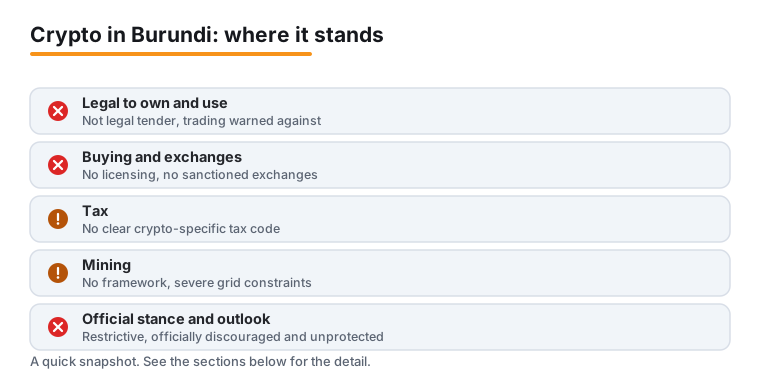
- Legal: Officially warned against and discouraged, not legal tender
- Tax: No crypto-specific tax rules
- Buying: No licensed local exchange, use international or P2P at own risk
Burundi has one of the most restrictive stances toward cryptocurrency in East Africa. The country's central bank, the Bank of the Republic of Burundi (Banque de la Republique du Burundi, or BRB), publicly warned against the use and trading of virtual currencies in September 2019, stating that cryptocurrencies are not regulated, are not issued or guaranteed by any government or central bank, and do not have legal tender in the territory of Burundi. A central bank official added that strong measures could be taken against anyone who ignored the decision. The measure was an avis au public dated 20 August 2019, publicised in early September that year under then governor Jean Ciza, naming Bitcoin, Ether, Litecoin, Dogecoin, OneCoin, BTC, Fahari Cash Coin and Ello Cash Coin. It has never been withdrawn, and as of August 2026 no licensing framework has replaced it.
Against this backdrop sit Burundi's broader realities: a cash-dominated economy, tight foreign-exchange controls, a scarce supply of US dollars, and a large diaspora that sends remittances home. Those conditions make people curious about Bitcoin even where the official position is discouraging. This guide explains, in plain language, what is known about the legal status of crypto in Burundi, how the rules around tax, buying, mining and cross-border transfers are generally understood, and the practical risks involved. Crypto policy across the region is unsettled and can change with a single central-bank communication, so treat everything here as a starting point and confirm the current position with the BRB before acting.
This article is general information as of 2026 and is NOT legal, tax, or financial advice. Verify the current rules directly with the named official regulator, the Bank of the Republic of Burundi, or a qualified Burundian lawyer. For broader context see our guide to crypto regulation and the main regulation hub.
On this page: Legal status · Who regulates it · Taxes · How to buy · Mining
Is Bitcoin and crypto legal in Burundi?
Cryptocurrency does not have legal status as money in Burundi, and the central bank has actively warned against it. In September 2019 the Bank of the Republic of Burundi stated that virtual currencies are not regulated, are not issued or guaranteed by any government or central bank, and do not have legal tender in the territory of Burundi. The warning was accompanied by a caution that strong measures could be taken against people who did not respect the decision. Independent regulation trackers report that this prohibition was still in force as of 2025.
It is important to separate two ideas that are easy to confuse:
- Legal tender means a currency the law obliges people to accept to settle debts. Bitcoin is not legal tender in Burundi. The Burundian franc (BIF) is the only legal tender.
- A warning and prohibition on trading and use is a stronger step. The BRB has discouraged and warned against crypto trading, positioning Burundi among the more restrictive jurisdictions rather than among those that have built a permissive licensing regime.
Because the official guidance was issued as a warning rather than a detailed statute, the precise legal consequences for an individual are not spelled out publicly, and enforcement has been described as case by case. The safe interpretation is that crypto activity in Burundi is officially unwelcome and unprotected: there is no consumer-protection backstop, no deposit insurance, and no clear legal recourse if a platform fails or funds are lost. Anyone considering crypto should assume they bear the full risk themselves and should verify the latest BRB position directly.
The regulator: Bank of the Republic of Burundi (BRB)
The lead authority on monetary and currency matters is the Bank of the Republic of Burundi (Banque de la Republique du Burundi, BRB). It is the country's central bank, responsible for monetary policy, issuing and protecting the Burundian franc, supervising banks and microfinance institutions, and operating the national payment system. The BRB's public warnings define the official stance on virtual currencies, and any future change in policy would most likely come from the BRB or from new legislation.
Other authorities also matter for crypto-adjacent activity:
- Ministere des Finances, du Budget et de l'Economie Numerique oversees fiscal policy and publishes the finance laws, with tax assessed and collected by the Office Burundais des Recettes (OBR). Any crypto-related income would be taxed under the general income tax law rather than under a crypto rule.
- Cellule Nationale de Renseignement Financier (CNRF) is the named financial intelligence unit that receives and analyses suspicious transaction reports. It was reorganised by décret n° 100/009 of 9 February 2026, which amended the décret of 16 March 2020 creating it, publishes at cnrf.gov.bi, and coordinates both the national risk assessment validated in November 2025 and Burundi's first ESAAMLG mutual evaluation.
The BRB has continued to modernise the financial system more broadly. In April 2026 it introduced BurundiPay, a national instant-payment system that lets people send money and pay in real time, at any hour, from either a bank account or a mobile wallet, and connects commercial banks, microfinance institutions and payment providers in one interoperable network. The project was supported by the World Bank through the Digital Economy Foundations Support Project (PAFEN) and made Burundi one of the African countries to adopt an instant-payment scheme. Importantly, BurundiPay is a system for moving the Burundian franc, not a cryptocurrency initiative, and it makes no reference to private crypto. None of this modernisation has, on the public record, reversed the 2019 warning against private cryptocurrencies, so the prudent assumption is that the restrictive stance stands until the BRB says otherwise.
Crypto laws and frameworks in Burundi
Burundi does not have a comprehensive, dedicated crypto law in the way some countries have created licensing regimes for exchanges and custodians. Instead, the landscape is shaped by central-bank warnings, the general framework for money and foreign exchange, and anti-money-laundering rules.
What governs the space
- The 2019 BRB warning remains the defining official statement: virtual currencies are unregulated, not legal tender, and trading is discouraged.
- Currency and foreign-exchange rules administered by the BRB govern how money moves into and out of the country, which directly affects any attempt to fund or cash out crypto.
- Loi n° 1/08 du 27 mars 2025, which replaced most of loi n° 1/02 du 4 février 2008, sets customer due diligence and suspicious transaction reporting obligations, and the National Assembly's record of the vote says cryptocurrency exchange platforms are now required to meet the same obligations as traditional financial institutions. The BRB implemented it through règlement n° 02/2026 of 30 January 2026 and five application circulars announced on 13 February 2026, all addressed to institutions subject to the banking law.
What this means in practice
Without a bespoke licensing pathway, there is no clear, official way for a domestic crypto exchange or custodian to operate as a fully sanctioned, supervised business. That regulatory gap is itself a risk: activity that is neither expressly licensed nor clearly permitted can be exposed to enforcement, banking de-risking, or sudden policy reversal. Some online summaries claim Burundi moved in 2024 to classify crypto as a distinct asset class with a full licensing regime, but those claims are not corroborated by the BRB or any verifiable official source and conflict with the standing warning, so they should not be relied upon. Always confirm the current rules with the BRB or a qualified Burundian lawyer.
Licensing and registration of exchanges and VASPs
As of 2026 there is no public, official licensing or registration regime in Burundi for cryptocurrency exchanges or virtual-asset service providers (VASPs). Because the central bank has warned against virtual currencies and has not published a licensing framework, there is no sanctioned route for a domestic exchange, broker, or custodian to operate as a supervised, regulated business.
The consequences are practical:
- There is no licensed local exchange operating under a Burundian crypto licence.
- A business offering crypto services has no clear legal status and could face enforcement, account closures, or banking refusals.
- Users dealing with any platform, local or foreign, have no Burundian regulator standing behind it and no domestic complaints channel if something goes wrong.
This is very different from jurisdictions that have created VASP registers and AML-supervised licences. In Burundi, the absence of a licence regime should be read as a sign that the activity is unregulated and discouraged, not as a loophole. If you see a service claiming to be "licensed in Burundi" for crypto, treat that claim with strong scepticism and verify it directly with the BRB.
Crypto and Bitcoin tax in Burundi
Burundi has no crypto-specific tax rule. The texts that do apply are loi n° 1/02 du 24 janvier 2013 on income taxes, amended by loi n° 1/14 du 24 décembre 2020; the VAT law n° 1/02 du 17 février 2009, revised by loi n° 1/12 of July 2013 and amended by loi n° 1/10 du 16 novembre 2020; and the finance law for 2026/2027, published as promulgated on 4 July 2026. None of them mentions virtual assets, and neither the Ministry of Finance law index nor the Burundi Legis tax code index lists a crypto tax text. What can be said responsibly is general:
- Burundi taxes income and certain gains under its general tax law, administered through the tax authority and the Ministry of Finance.
- Where a person earns income that the law treats as taxable, for example profit from trading or business activity, that income can fall within the existing tax framework regardless of whether it was denominated in francs or in a digital asset.
- Good record-keeping matters. Keeping dated records of acquisitions, disposals, amounts in local currency, and counterparties helps if you ever need to demonstrate the source and nature of funds.
We deliberately avoid stating any specific crypto tax rate or threshold because none has been verified as crypto-specific for Burundi, and crypto is officially discouraged in the first place. Tax treatment of crypto is unsettled in many countries, and applying general rules to digital assets is exactly the kind of question where professional advice pays for itself. See our overview of crypto taxes for general background, then consult a licensed Burundian tax adviser and confirm the current position with the tax authority before filing. Nothing here is tax advice.
AML and KYC rules
Burundi's anti-money-laundering and counter-terrorism-financing framework rests on loi n° 1/08 du 27 mars 2025, which rewrote the 2008 law, and on BRB règlement n° 02/2026 of 30 January 2026 with its application circulars. Suspicious transaction reports go to the Cellule Nationale de Renseignement Financier (CNRF). Burundi is an ESAAMLG member and is undergoing its first mutual evaluation, with the report due to be examined at the ESAAMLG plenary in Kigali from 31 August to 5 September 2026. Regulated financial institutions such as banks are expected to perform customer due diligence (know-your-customer, or KYC), monitor transactions, and report suspicious activity.
For crypto, the picture is shaped by the absence of a licensing regime rather than by crypto-specific AML rules:
- Because there is no sanctioned local VASP regime, there is no domestic crypto-specific KYC standard published for exchanges to follow.
- Banks applying general AML controls may scrutinise or decline transactions they associate with crypto, contributing to de-risking.
- Cross-border value transfer intersects with both AML obligations and foreign-exchange controls, so informal crypto transfers can attract compliance attention.
Globally, AML standards for virtual assets are set by the Financial Action Task Force (FATF) and applied regionally through bodies such as the Eastern and Southern Africa Anti-Money Laundering Group (ESAAMLG). The direction of travel internationally is toward bringing virtual-asset providers under AML supervision, but in Burundi that has not translated into a published crypto licensing or registration regime. Verify any current obligation with the BRB or the Ministry of Finance.
Buying and using crypto in practice
Given the central bank's warnings and the absence of a domestic licensing regime, there is no officially sanctioned local exchange operating under a Burundian crypto licence. In practice, people who acquire crypto in restrictive environments tend to rely on:
- International exchanges accessed online, though access, deposits, and verification for Burundian users can be limited, and using them may conflict with local rules and foreign-exchange controls.
- Peer-to-peer (P2P) trades, matching with another person directly, often settling in cash or mobile money. P2P carries significant counterparty and fraud risk and is a common vector for scams.
Several frictions are specific to Burundi: strict foreign-exchange controls and a scarcity of US dollars, limited card and international-banking access, and the risk that banks decline transactions linked to crypto. There is no consumer-protection mechanism if a trade goes wrong, and the activity runs counter to the official stance. There is also no evidence of a public Bitcoin ATM network in Burundi; crypto ATMs are concentrated in a few permissive markets and are rare across the region. Treat any platform, kiosk, or counterparty with heightened caution, never send funds before you understand exactly how a trade settles, and remember that engaging at all may conflict with the BRB's position.
Bitcoin mining in Burundi
Bitcoin mining is the process by which specialised computers validate transactions and secure the network in exchange for newly issued coins and fees. It is extremely energy-intensive and depends on cheap, reliable electricity to be viable.
Burundi is one of the world's lowest per-capita electricity consumers, with limited generation capacity, low rates of grid access (especially in rural areas), and infrastructure that struggles to meet existing demand. In that context, large-scale mining is not a natural fit:
- Grid strain, because continuous high-draw mining loads would compete with households, hospitals, schools, and businesses for scarce power and could worsen shortages.
- Cost and reliability, because frequent supply constraints undermine the steady, low-cost power that mining economics require.
- Renewables angle, because Burundi has hydropower and solar potential and in principle surplus or off-grid renewable generation could one day power small operations, though that would need substantial investment and clear policy.
There is no specific legal framework encouraging or licensing crypto mining in Burundi, and the central bank's general stance toward crypto makes a supportive environment unlikely in the near term. Anyone weighing it should also factor in environmental impact and regulatory uncertainty.
Recent developments and outlook
The 2019 BRB notice still stands, but it is no longer the only relevant text. Loi n° 1/08 du 27 mars 2025 rewrote the anti-money-laundering law and, on the National Assembly's own account of the vote, brought cryptocurrency exchange platforms into the compliance perimeter, while the BRB's implementing règlement n° 02/2026 of 30 January 2026 addresses banking-law institutions and creates no crypto licence. The BRB has published no signal of a move to a permissive regime. The next real trigger is Burundi's first ESAAMLG mutual evaluation, due to be examined at the plenary in Kigali from 31 August to 5 September 2026. Claims circulating on some third-party sites that Burundi adopted a 2024 crypto asset-class framework with consumer-protection and AML licensing rules are not corroborated by official sources and contradict the standing warning, so we treat them as unverified.
What is verifiable in this period is domestic-currency payments modernisation, not crypto liberalisation. In April 2026 the BRB launched BurundiPay, a real-time instant-payment system linking banks, microfinance institutions and mobile wallets, backed by the World Bank through the PAFEN project. The BRB also reported roughly 97.5 million mobile-money and digital transactions worth more than 4.4 trillion Burundian francs between April and June 2025, although cash still accounts for close to half of all transactions. These steps show growing digital-payment use inside the franc system, but none of them touches private cryptocurrency or changes its status.
The wider regional context is more dynamic. Across East Africa, several regulators are gradually moving from blanket warnings toward more defined frameworks, partly driven by remittance demand, financial-inclusion goals, and the spread of stablecoins. According to Chainalysis, Sub-Saharan Africa received more than 205 billion US dollars in on-chain value between July 2024 and June 2025, up roughly 52 percent on the year, and stablecoin transfers can cut the cost of a typical remittance from the region by around 60 percent versus traditional channels. Burundi could in time follow the regional direction, but as of 2026 there is no confirmed, published Burundian framework that licenses or legalises private crypto. The prudent assumption is that crypto remains officially discouraged and unprotected. Watch for formal BRB communications and any new legislation, and verify before relying on any claim about Burundi's crypto rules.
Consumer risks and protection
Burundi sits at the restrictive end of the spectrum, and the risks reflect that. Crucially, there is no domestic consumer-protection backstop for crypto: no deposit insurance, no regulated local venue, and limited or no legal recourse if a platform collapses or a trade is fraudulent. The 2019 warning itself was prompted partly by citizens losing money and asking the government to help recover it, which the central bank could not do.
Key risks to weigh:
- Legal and policy risk, because an official warning is in place, detailed rules are sparse, and the position could harden or shift with little notice.
- No recourse, because there is no regulated local exchange and no Burundian authority standing behind any platform you use.
- Fraud and scams, which thrive in informal P2P and cash-out arrangements and in anything promising guaranteed returns.
- Foreign-exchange and banking friction, because controls and dollar scarcity make moving money in and out difficult and can attract scrutiny.
- Market and technical risk, including extreme price volatility and permanent loss of funds from lost keys or failed platforms.
The standard, sober principles apply with extra force here: never put in money you cannot afford to lose, be deeply sceptical of guaranteed returns, protect your wallet recovery phrase and never share it, and remember that an asset's legality and your ability to recover funds matter as much as its price. This is general information, not financial advice.
Official sources and how to verify
Crypto rules in Burundi can change, and a lot of secondary commentary online is inaccurate or outdated. Always confirm the current position with primary, official sources before acting:
- The regulator: the Bank of the Republic of Burundi (BRB), the central bank, for the official stance on virtual currencies, currency rules, and foreign-exchange controls.
- The Ministry of Finance for taxation and for the country's financial-intelligence and AML coordination.
- Regional AML standards via the Eastern and Southern Africa Anti-Money Laundering Group (ESAAMLG) and the global standard-setter, the Financial Action Task Force (FATF).
How to verify a specific claim: check the BRB's official communications first, cross-reference with at least one reputable independent source, and where the stakes are real consult a licensed Burundian lawyer or tax adviser rather than relying on a website summary. This guide is general information as of 2026 and is NOT legal advice; the authoritative source is the BRB. For more background, see our crypto regulation guide and the regulation hub.
What is changing: crypto and Burundian law in August 2026
Between this page's last fact review on 30 June 2026 and August 2026, nothing changed in Burundi's crypto position itself. The change worth reporting happened in the eighteen months before that, in anti-money-laundering law, and this page did not carry it.
First, the standing measure. The Bank of the Republic of Burundi acted by avis au public dated 20 August 2019, publicised in early September that year under then governor Jean Ciza. It named Bitcoin, Ether, Litecoin, Dogecoin, OneCoin, BTC, Fahari Cash Coin and Ello Cash Coin, and stated that no entity or financial institution was authorised to offer remittance or other payment services using a virtual currency (Burundi Eco, Anadolu Agency). It has never been withdrawn. The governor is now Edouard Normand Bigendako (Burundi Eco, April 2026), and the BRB's news and communiqués feed and both of its legal texts indexes carry no 2025 or 2026 text mentioning virtual currencies at all (brb.bi).
Second, what did move. Loi n° 1/08 du 27 mars 2025 replaced most of loi n° 1/02 du 4 février 2008 on money laundering and terrorist financing. The National Assembly's own published account of the vote, carried unanimously in plenary on 3 February 2025, gives one reason as "le développement rapide des technologies, surtout les crypto-monnaies, a introduit de nouveaux moyens de blanchiment de capitaux", and says the bill covers cryptocurrency exchange platforms and monitoring of their transactions because "désormais ces plateformes sont obligés de se conformer aux mêmes obligations que les institutions financières traditionnelles" (Assemblée Nationale du Burundi). That is the first time a Burundian legislative text is reported to reach crypto businesses at all. The law number and date are confirmed by the central bank and by the financial intelligence unit, which both cite it (BRB, CNRF).
Third, the limit of that change. The BRB implemented the 2025 law through règlement n° 02/2026, edicted on 30 January 2026 and announced on 13 February 2026, together with five application circulars covering customer identification and KYC, regulatory thresholds, the typology of suspicious transactions, internal control and compliance, and the sanctions regime. Four are published by number on the BRB index as circulars n° 01, 03, 04 and 05/LBC-FT/2026 (BRB announcement, BRB banking legal texts). Their published titles are addressed to établissements assujettis à la loi bancaire, that is to institutions subject to the banking law. So the primary law is reported to reach crypto platforms while the central bank's implementing rulebook does not. In August 2026 there is no register, no application route and no assigned supervisor for a virtual asset service provider in Burundi, and no licence to apply for.
Legislation adopted and in the pipeline, with timing
Everything below is either in force or scheduled. No reachable official source records a crypto bill before parliament, a BRB consultation paper, or a ministerial proposal to license or prohibit virtual assets.
| Instrument | Stage | What it means for crypto | Timing |
|---|---|---|---|
| Loi n° 1/08 du 27 mars 2025, amending loi n° 1/02 du 4 février 2008 on money laundering and terrorist financing | In force | Extends reporting duties. The National Assembly record of the vote says cryptocurrency exchange platforms must now meet the same obligations as traditional financial institutions and have their transactions monitored. | Adopted unanimously 3 February 2025; law dated 27 March 2025 |
| Règlement BRB n° 02/2026, with five application circulars including n° 01, 03, 04 and 05/LBC-FT/2026 | In force | Implements the 2025 law for institutions subject to the banking law. No virtual asset chapter, so banks tighten on crypto-linked flows but no licence is created. | Regulation edicted 30 January 2026; announced 13 February 2026 |
| Décret n° 100/009 du 9 février 2026, amending décret n° 100/044 du 16 mars 2020 on the Cellule Nationale de Renseignement Financier | In force | Reorganises the financial intelligence unit that receives suspicious transaction reports, including any filed over crypto-linked activity. | 9 February 2026 |
| National money laundering and terrorist financing risk assessment (Évaluation Nationale des Risques) | Validated | Rates Burundi's overall risk as high. Sets the priorities the next round of rules will follow. | Validated at a workshop on 11 November 2025 |
| First ESAAMLG mutual evaluation of Burundi | Draft report under review | Not a law, but the most likely trigger for one. Scores Burundi against the FATF 40 Recommendations, including Recommendation 15 on virtual assets. | Onsite mission received 18 February 2026; draft reviewed with 11 assessors on 14 July 2026; plenary in Kigali 31 August to 5 September 2026 |
| Loi n° 1/05 du 27 février 2019 on the capital market, and loi n° 1/08 du 29 octobre 2020 establishing the ARMC | In force | A real licensing regime for investment products and intermediaries exists and licenses real firms. It has no virtual asset category, so a promoted crypto investment scheme is unlicensed rather than merely unregulated. | ARMC operational since 2021 to 2023; rulebook issued 2024 to 2025 |
| Loi n° 1/07 du 11 mai 2018 on the national payment system, with BRB circulars n° 001 de 2024, n° 007/SP and n° 008/SP/2026 | In force | Issuing electronic money, providing payment services and transmitting funds internationally all require a BRB licence. A commercial crypto cash-out service holds none. | Law 2018; circulars 2024 to 2026 |
| Tax: income tax loi n° 1/02 du 24 janvier 2013 as amended by loi n° 1/14 du 24 décembre 2020; VAT loi n° 1/02 du 17 février 2009 as revised in 2013 and amended by loi n° 1/10 du 16 novembre 2020; the finance law for 2026/2027 | In force | None mentions virtual assets. Crypto trading profits earned as a business fall under ordinary income tax by default. | Finance law for 2026/2027 published as promulgated on 4 July 2026 |
Sources for the table: Assemblée Nationale, BRB banking texts, BRB payment system texts, CNRF, ARMC, Burundi Legis tax code index, Ministry of Finance laws.
The one date to watch is 31 August to 5 September 2026. ESAAMLG holds its 26th Council of Ministers, 52nd Task Force of Senior Officials and 8th Public Private Sector Dialogue meetings in Kigali then, and its assessments calendar gives August or September 2026 as the possible plenary discussion of Burundi (ESAAMLG calendar). The CNRF says the country is preparing to finalise its report before examination and adoption at ESAAMLG plenary meetings expected in August and September 2026 (CNRF, July 2026). This is Burundi's first ever mutual evaluation, which is why the ESAAMLG calendar shows no previous evaluation for the country and there is no Burundi entry on the follow-up reports list (ESAAMLG follow-up reports). Assessors were received in Bujumbura on 18 February 2026 and worked through the draft with a team of 11 evaluators and Burundian officials on 14 July 2026 (CNRF, March 2026). FATF Recommendation 15 requires a country either to license or register and supervise virtual asset service providers, or to prohibit them and show it enforces the prohibition. A weak score there is the realistic route by which Burundi eventually writes crypto rules, and the earliest that pressure appears is from September 2026.
The other regulators: capital markets and payment services
Two named regulators shape crypto in Burundi more than the absence of a crypto law does, and neither appeared on this page before.
- The Autorité de Régulation du Marché des Capitaux (ARMC) is the securities regulator. Its own history page names the two founding texts: loi n° 1/05 du 27 février 2019 governing the capital market, and loi n° 1/08 du 29 octobre 2020 establishing the authority, with its board appointed in 2021 and its first Director General on 11 October 2023 (ARMC). It is operational, publishes a register of licensed intermediaries including the Bourse du Burundi (ARMC licensed actors), and publishes a rulebook: règlement n° 01/2024 of 26 January 2024 on agrément and autorisation, amended by n° 08/2024; n° 05/2024 of 20 May 2024 on complaints; n° 09/2024 of December 2024 on collective investment schemes; a règlement on anti-money-laundering and counter-terrorist financing; and a 2025 sanctions matrix circular (ARMC legal texts). None of it covers virtual assets. The ARMC has, however, published a communiqué on companies carrying out operations comparable to capital market operations without the right to do so (ARMC communiqué). If someone in Burundi offers you a crypto investment product with promised returns, that notice, not any crypto rule, is what it collides with.
- Payment services run on loi n° 1/07 du 11 mai 2018 portant système national de paiement, with BRB circular n° 001 de 2024 on payment establishments issuing electronic money, n° 007/SP on payment establishments transmitting funds internationally, and n° 008/SP/2026 on payment services within Burundi's national e-commerce ecosystem (BRB payment system texts). None mentions virtual assets. The practical effect is that running a commercial crypto to franc cash-out or remittance service is an unlicensed payment service under a law that does exist and has a named licensing route, which is a firmer enforcement hook than the 2019 notice.
BurundiPay is also further along than described elsewhere on this page. The project started inside the BRB on 30 August 2024, went into production on 5 March 2026 and launched to the public on 23 April 2026. It runs on the ISO 20022 standard and works on basic phones over USSD without an internet connection (Burundi Eco, 24 April 2026). By 4 August 2026 the BRB's head of payment systems reported roughly 224,000 users and about 4.29 billion Burundian francs of cumulative transactions. Seventy-eight institutions are authorised as potential participants, thirty have completed integration testing and seventeen are live: five commercial banks, ten microfinance institutions and two payment establishments. The rest must complete integration by 5 September 2026 or face a fine of one million francs per month of delay. East African Community central bank governors decided in Kampala in July 2026 that BurundiPay must be interconnected with other member states' payment systems, and the same report says the BRB has now joined the Pan-African Payment and Settlement System with four Burundian banks authorised to participate (Jimbere, 6 August 2026). In May 2026 the BRB had still described PAPSS membership as the logical next step, noting settlement in local currencies in under 120 seconds across the countries already connected (BRB, May 2026). None of this touches private crypto.
Frequently asked questions
Is cryptocurrency banned in Burundi?
In September 2019 the Bank of the Republic of Burundi publicly warned against the use and trading of cryptocurrencies, stating they are unregulated, not issued or guaranteed by any government or central bank, and not legal tender in Burundi, and that strong measures could be taken against those who ignored the decision. Independent trackers report the prohibition remained in effect into 2025. That places Burundi among the most restrictive countries. There is no consumer protection or legal recourse for crypto activity, and the position can change, so confirm the current rules with the BRB before acting.
Who regulates cryptocurrency in Burundi?
The lead authority is the Bank of the Republic of Burundi (Banque de la Republique du Burundi, BRB), the central bank, whose official website is brb.bi. The BRB oversees monetary policy, the franc, banking supervision, the payment system, and foreign-exchange controls, and issued the official warning against virtual currencies. The Ministry of Finance handles taxation and coordinates the country's financial-intelligence and anti-money-laundering functions.
Can crypto exchanges get a licence in Burundi?
No. As of 2026 there is no public, official licensing or registration regime in Burundi for crypto exchanges or virtual-asset service providers (VASPs). Because the central bank has warned against virtual currencies and has not published a licensing framework, there is no sanctioned way to operate a supervised crypto business, and there is no licensed local exchange. Be very sceptical of any service claiming to be licensed in Burundi for crypto, and verify with the BRB.
Do I have to pay tax on crypto in Burundi?
Burundi has not published a clear, crypto-specific tax regime, so there is no confirmed crypto rate or threshold. In general, income that the law treats as taxable can fall within existing tax rules regardless of whether it is denominated in francs or digital assets. Keep good records and consult a licensed Burundian tax adviser, and confirm the current position with the Ministry of Finance and the tax authority. This is not tax advice.
Can I use Bitcoin to send money to family in Burundi?
It is technically possible, and crypto can move value across borders quickly, but the practical hurdles are significant: the recipient must convert it into francs or mobile money, usually via risky informal channels, prices are volatile, and the activity sits in an officially discouraged grey area alongside foreign-exchange controls and AML rules. There is no consumer protection if something goes wrong. Many families find regulated remittance and mobile-money services more reliable. Verify the current rules with the BRB first.
Is BurundiPay a cryptocurrency or a digital franc?
Neither. BurundiPay is an instant-payment system that the Bank of the Republic of Burundi launched in April 2026 to move the ordinary Burundian franc in real time between banks, microfinance institutions and mobile wallets. It was supported by the World Bank through the PAFEN project. It is not a cryptocurrency and not a central-bank digital currency, and it does not change the standing 2019 warning against private virtual currencies.
Did Burundi legalise crypto in 2024?
There is no verified evidence that it did. Some third-party websites describe a 2024 Burundian framework that classifies crypto as an asset class with licensing and consumer-protection rules, but those claims are not corroborated by the Bank of the Republic of Burundi or any official source, and they conflict with the 2019 warning that independent trackers report was still in force into 2025. Until the BRB publishes something official, treat such claims as unverified and assume crypto remains officially discouraged. Confirm the current position with the BRB.
How can I check the current crypto rules in Burundi?
Go to primary official sources. Check the Bank of the Republic of Burundi (brb.bi) for the official stance and currency rules, and the Ministry of Finance for taxation and AML coordination. Cross-reference any claim with at least one reputable independent source, and for real decisions consult a licensed Burundian lawyer or tax adviser. Treat third-party website summaries with caution, as several contain outdated or uncorroborated claims about Burundi adopting a permissive framework. This guide is general information as of 2026 and is not legal advice.
Has Burundi passed a crypto law?
There is still no crypto licensing law. The closest thing is loi n° 1/08 du 27 mars 2025, which rewrote Burundi's 2008 anti-money-laundering law. The National Assembly's published account of the vote, taken unanimously on 3 February 2025, records that cryptocurrency exchange platforms must now meet the same obligations as traditional financial institutions and have their transactions monitored. The Bank of the Republic of Burundi implemented that law through règlement n° 02/2026 of 30 January 2026 and five application circulars announced on 13 February 2026, but those texts are addressed to institutions subject to the banking law, so there is still no register, no supervisor and no licence a crypto business can apply for.
What happens in September 2026, and why does it matter for crypto?
Burundi's first ever ESAAMLG mutual evaluation report is due to be examined at the ESAAMLG plenary meetings in Kigali between 31 August and 5 September 2026. Assessors were received in Bujumbura on 18 February 2026 and reviewed the draft report with Burundian officials on 14 July 2026. The report scores Burundi against the FATF's 40 Recommendations, one of which, Recommendation 15, requires a country either to license and supervise virtual asset service providers or to prohibit them and show it enforces that. A weak result there is the most likely thing to push Burundi into writing an actual virtual asset rulebook. Nothing has been proposed yet, so treat this as the trigger to watch rather than a change already coming.
Who is the CNRF and why does it matter to me?
The Cellule Nationale de Renseignement Financier is Burundi's financial intelligence unit, the body that receives and analyses suspicious transaction reports. It was reorganised by décret n° 100/009 of 9 February 2026, which amended the décret of 16 March 2020 creating it, and it publishes at cnrf.gov.bi. It organised the workshop of 11 November 2025 that validated the national money laundering and terrorist financing risk assessment, which found Burundi's overall risk to be high, and it is coordinating the ESAAMLG evaluation. If a Burundian bank files a report over a transfer it associates with crypto, the CNRF is where that report goes.
Does any Burundian regulator license crypto investments?
No. The Autorité de Régulation du Marché des Capitaux (ARMC) licenses capital market intermediaries and investment products under loi n° 1/05 du 27 février 2019, with the authority itself created by loi n° 1/08 du 29 octobre 2020. It publishes a register of licensed firms and a rulebook covering approvals, collective investment schemes, complaints, anti-money-laundering and sanctions, and none of it has a virtual asset category. The ARMC has published a communiqué on companies carrying out operations comparable to capital market operations without the right to do so. That notice, not any crypto rule, is what a promoted crypto investment scheme in Burundi would breach.
How is crypto taxed in Burundi?
There is no crypto-specific tax rule and no published crypto rate, threshold or reporting form. The governing texts are the income tax law n° 1/02 du 24 janvier 2013 as amended by loi n° 1/14 du 24 décembre 2020, the VAT law n° 1/02 du 17 février 2009 as revised in 2013 and amended by loi n° 1/10 du 16 novembre 2020, and the finance law for 2026/2027 published as promulgated on 4 July 2026. None mentions virtual assets, and neither the Ministry of Finance law index nor the Burundi Legis tax code index lists any crypto tax text. Profits from trading carried on as a business fall under ordinary income tax by default. Keep dated records of acquisitions, disposals and franc values, and confirm treatment with the Office Burundais des Recettes before filing. This is not tax advice.
Facts reviewed: 12 August 2026. Page updated: 12 August 2026.