Home › Crypto Regulation › Azerbaijan
Bitcoin & Cryptocurrency Regulation in Azerbaijan
Quick answer — Azerbaijan, 2026
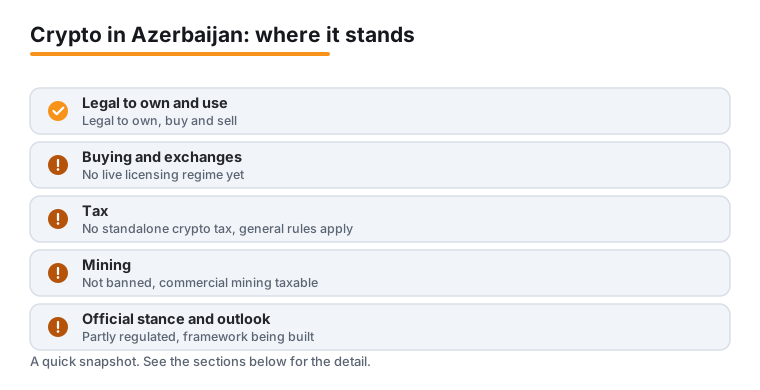
- Legal: Legal to own and trade, not legal tender; full crypto law still being finalised
- Tax: No standalone crypto tax; gains fall under existing income and profit tax rules
- Buying: Mostly via international exchanges and peer-to-peer, with KYC
Bitcoin and other cryptocurrencies are legal to buy, hold, and sell in Azerbaijan, but the sector is still only partly regulated. There is no comprehensive crypto law in force that licenses exchanges or fully defines digital assets, although the framework is actively being built. Crypto is not legal tender, only the Azerbaijani manat issued by the Central Bank of the Republic of Azerbaijan holds that status, and the authorities have repeatedly warned the public about the volatility and risks of unregulated digital assets.
This guide to Azerbaijan crypto regulation explains how digital assets are treated as of 2026: whether crypto is legal, which bodies oversee it, the laws and frameworks involved, how exchanges and virtual asset service providers are being brought under rules, how income and mining are taxed, anti-money-laundering and KYC expectations, and the practical and consumer-protection issues you should understand. The picture is evolving quickly, so where things are uncertain this guide says so and points you to the official source. This is general information as of 2026 and is not legal, tax, or financial advice; verify your situation with the named official regulators, in particular the Central Bank of the Republic of Azerbaijan, or a qualified local adviser before acting. For broader background see our overview of crypto regulation.
On this page: Legal status · Who regulates it · Taxes · How to buy · Mining
Is Bitcoin and crypto legal in Azerbaijan?
Yes. Owning, buying, selling, and trading Bitcoin and other cryptocurrencies is not prohibited in Azerbaijan. No law bans individuals from holding or exchanging digital assets, and residents use international exchanges, peer-to-peer marketplaces, and self-custody wallets in practice. At the same time, crypto is not recognised as legal tender, and merchants are under no obligation to accept it. The manat remains the only official currency.
Historically the sector was neither specifically regulated nor supervised, and digital-asset transactions happened mainly directly between individuals. That is now changing. The Central Bank of the Republic of Azerbaijan has approved rules for transactions with virtual assets, and a dedicated draft law on virtual assets and virtual asset service providers has been under development. Until that law and its supporting acts are fully in force, crypto remains permitted but operates without the complete protections of a finished licensing regime, so platform choice and personal security matter more.
Who regulates crypto in Azerbaijan?
The Central Bank of Azerbaijan is the financial-sector regulator and is the body that would license crypto firms. The Financial Market Supervisory Authority was abolished on 28 November 2019 under the president's decree on improving management, and its licensing, market supervision and investor protection responsibilities passed to the Central Bank. What does not yet exist is a crypto licensing regime for it to operate. Three official bodies shape the sector today: the Central Bank, the Financial Monitoring Service and the State Tax Service.
Central Bank of the Republic of Azerbaijan
The Central Bank of the Republic of Azerbaijan is the monetary authority and is leading the development of crypto rules. It has exclusive control over the national currency and the payment system, has approved rules for transactions with virtual assets, and is described as one of the authors of the draft law on virtual asset service providers, with a role in supervisory and regulatory-sandbox mechanisms. Its official website is cbar.az.
Financial Monitoring Service
The Financial Monitoring Service is Azerbaijan's financial intelligence unit and the body responsible for anti-money-laundering and counter-terrorism-financing supervision. It receives suspicious-transaction reports from obliged entities and is the main channel through which crypto-related activity is monitored. Its official website is fiu.gov.az.
State Tax Service
The State Tax Service under the Ministry of Economy administers how income connected to crypto is taxed under the Tax Code, and is the authority you confirm tax obligations with. Its official website is taxes.gov.az.
Key laws and frameworks
Azerbaijan does not belong to the European Union, so the EU markets-in-crypto-assets regime known as MiCA does not apply here. Instead, crypto is governed by a mix of existing national law and newer virtual-asset rules.
- Anti-money-laundering law: the Law on the Prevention of the Legalization of Criminally Obtained Funds or Other Property and the Financing of Terrorism, strengthened in recent years, underpins customer due diligence and reporting duties.
- Central Bank rules on virtual assets: the Governor of the Central Bank signed a decree approving rules for operations or transactions with virtual assets. A key point is that these rules are designed to take effect only after legal acts regulating the activity of virtual asset service providers are adopted, so the framework is staged rather than immediate.
- Draft law on virtual assets: a framework draft law on crypto assets and the virtual-asset market, intended to form the legal basis for crypto activity, was prepared by the Central Bank and, by 2026, submitted to government bodies for consideration. It would introduce mandatory Central Bank licensing for crypto-service companies. As of 4 August 2026 it has not been adopted. The Central Bank said on 29 June 2026 that the draft was finalised and had been submitted to state authorities for consideration, with adoption targeted before the end of 2026; no reading in the Milli Majlis and no gazette publication has been reported, and the precise final provisions are not all publicly confirmed, so treat any specific detail as provisional and check the Central Bank for the current status.
- Tax Code amendments: virtual assets have been discussed for inclusion in the list of intangible assets under the Tax Code, reflecting a move to define crypto for tax purposes.
Because several pieces are still being finalised, the safest assumption is that the rulebook is incomplete and shifting; rely on the official Central Bank source rather than secondhand summaries.
Licensing and registration of exchanges and VASPs
As of 2026 Azerbaijan does not yet operate a fully live licensing regime for crypto exchanges. Virtual asset service providers are already listed among the financial institutions covered by Law No. 781-VIQ on Combating Legalization of Criminally Obtained Property and Financing of Terrorism, adopted on 30 December 2022 and in force from 1 February 2023, so anti-money-laundering and counter-terrorist-financing duties already apply to them. What is missing is the licensing and supervision layer, and few or no domestic specialised crypto platforms have been formally identified, with most activity flowing through international exchanges and direct peer-to-peer trades.
That is the area the new framework is meant to change. In 2026 the Central Bank confirmed that a final version of a framework draft law on crypto assets had been prepared and submitted to government bodies for consideration. Under the proposal, every company offering crypto-related services would have to obtain a licence from the Central Bank before operating in the domestic market, and licensed providers would face ongoing supervision along with anti-money-laundering and customer-identification duties. Fidan Tofidi, director of the Central Bank's Financial Technologies and Innovations Department, said that if the process goes to plan a cryptocurrency law could be adopted by the end of 2026, though a bill being submitted is not the same as a law in force. Because the timing and final requirements were still being settled, anyone planning to operate or use a regulated provider in Azerbaijan should confirm the live status of licensing directly with the Central Bank of the Republic of Azerbaijan before relying on it. For users, this means most buying and selling still happens on established international platforms rather than locally licensed ones.
Crypto and Bitcoin tax in Azerbaijan
Azerbaijan does not have a standalone crypto tax. The State Tax Service applies the existing Tax Code directly to crypto. In guidance reported on 19 August 2025 it treats a gain on disposal as income from non-entrepreneurial activity under Article 99.3.8 and taxes it at 14 percent under Article 101.2, with the taxable amount being the increase in value between acquisition and disposal, and virtual assets have been moving toward formal recognition in the Tax Code as intangible assets.
In broad terms, gains from trading or selling crypto can be treated as taxable income, and crypto activity carried on as a business may fall under profit-tax and entrepreneurial rules. Azerbaijan taxes individual income under the Tax Code, and crypto gains are taxed at 14 percent under Article 101.2 as non-entrepreneurial income and do not run through the salary scale. Salary is taxed separately: in the non-oil and non-government private sector, monthly pay up to AZN 8,000 is taxed at 0 percent and the excess at 14 percent, while in the oil and gas and government sectors pay up to AZN 2,500 is taxed at 14 percent and the excess at AZN 350 plus 25 percent. Classifications, rates, thresholds, and any exemptions are set by national tax law and have been subject to change, so confirm the current figure rather than relying on a number seen online. Value-added tax can apply to certain related services.
Practical steps for anyone with crypto activity:
- Keep detailed records of every transaction, including dates, amounts, the value in manat at the time, fees, counterparties, and the platform used.
- Distinguish casual investing from activity that may count as a business, such as frequent trading, mining at scale, or providing services for payment.
- Confirm your obligations directly with the State Tax Service or a qualified local tax adviser before filing. See also our guide to crypto taxes.
This is general information, not tax advice; verify the current position with official sources.
AML and KYC rules
Anti-money-laundering and counter-terrorism-financing rules are the main way crypto activity is supervised in Azerbaijan today. The framework rests on the national law against the legalization of criminally obtained property and the financing of terrorism, which was tightened in recent years to align more closely with international standards.
Under this regime, obliged entities apply customer due diligence and identity verification, known as KYC, monitor transactions, report suspicious activity to the Financial Monitoring Service, and retain records for a set period. In practice this is why mainstream exchanges that serve Azerbaijani users require government identification and sometimes proof of address, and why banks may scrutinise large or unusual crypto-related transfers and ask about the source of funds.
As the dedicated virtual-asset rules and the virtual asset service provider law come fully into force, AML and KYC obligations are expected to apply more explicitly and directly to crypto businesses. The authoritative source for AML expectations is the Financial Monitoring Service.
Buying and using crypto in practice
Because there is not yet a live domestic exchange-licensing regime, most residents buy and sell using established international platforms and peer-to-peer marketplaces that accept manat or that bridge through bank cards and transfers. Using a reputable, well-established platform is generally the safest route.
- Identity verification: mainstream exchanges require you to verify your identity with a government ID and often proof of address, reflecting global AML practice and Azerbaijan's own financial-monitoring expectations.
- AML and monitoring: banks and obliged entities may scrutinise large or unusual transactions, so be prepared to explain the source of funds for sizeable amounts.
- Currency and payment rules: general foreign-exchange and currency-control rules sit in the background, so moving large sums or converting between currencies can involve banking limits and reporting.
- Custody: self-custody, holding your own keys, is legal and reduces counterparty risk, but puts security entirely on you; a hardware wallet is sensible for larger holdings.
- Spending: crypto is not legal tender, so merchants are not required to accept it, and everyday payment acceptance is limited.
Because protections are not yet crypto-specific and fully in force, do extra due diligence on any platform before depositing funds.
Bitcoin mining in Azerbaijan
Bitcoin mining is not banned in Azerbaijan, and the country's energy resources have drawn some interest from miners seeking competitive power. Mining carried out commercially is likely to be treated as an economic or entrepreneurial activity, which can bring registration and tax obligations, so it is not a purely informal pursuit at scale. Reporting has indicated that miners may be expected to register as individual entrepreneurs and face tax linked to their operations, with some discussion of approaches tied to electricity consumption; treat such specifics as evolving and confirm them with the tax authority.
Energy is the central practical issue. Proof-of-work mining is highly electricity-intensive, and Azerbaijan is historically a hydrocarbon producer that is also developing renewable capacity such as solar, wind, and hydropower. Miners weighing operations in the country should consider electricity tariffs and availability, grid connection and permitting, tax treatment, and the growing global emphasis on sustainable, lower-emission operations. Anyone mining beyond a hobby scale should seek local tax and legal advice before investing in hardware or facilities.
Recent developments (2025 to 2026)
Momentum picked up noticeably in this period as Azerbaijan moved from an unregulated environment toward a defined framework.
- The Governor of the Central Bank signed a decree approving rules for operations with virtual assets, defining virtual assets as a digital expression of value used for exchange, payment, or investment, while excluding digital forms of national or foreign currency, securities, and derivatives.
- These rules were structured to take effect only after the adoption of legal acts regulating virtual asset service providers, signalling a staged rollout rather than an immediate switch.
- By 2026 the Central Bank said a final version of a framework draft law on crypto assets had been prepared and submitted to government bodies for review. Fidan Tofidi, director of its Financial Technologies and Innovations Department, said adoption of a cryptocurrency law could follow by the end of 2026 if the process goes to plan. The proposal would require every company dealing in virtual assets to hold a Central Bank licence before operating domestically, to remain under continuous supervision, and to comply with anti-money-laundering requirements and perform customer identification procedures.
- Officials described the crypto framework as part of Azerbaijan's Financial Market Development Strategy for the 2027 to 2030 period, signalling a gradual, oversight-first approach rather than rapid market opening.
- Virtual assets were discussed for inclusion in the Tax Code's list of intangible assets, a step toward clearer tax treatment.
As of mid-2026 the bill had been submitted but was not yet reported as adopted or in force, so the timeline remains a plan rather than a settled outcome.
Given the pace of change, dates and details can move. Confirm the current status with the Central Bank of the Republic of Azerbaijan rather than relying on summaries, including this one.
Consumer risks and protection
Because no crypto licensing regime exists yet, there is no domestically licensed exchange to choose, no Azerbaijani deposit protection, no Azerbaijani conduct rules for platforms and no Azerbaijani complaints route if a platform fails. That is the specific gap the Central Bank draft is designed to close.
Risks to understand
Prices are highly volatile and can fall substantially, the market is still maturing, individual tokens and projects can fail outright, and recovering funds lost to fraud or a failed platform may be difficult. Common schemes include fake or cloned exchange websites and apps, investment scams promising guaranteed or unusually high returns, phishing messages that try to capture your login or recovery phrase, and so-called pig-butchering or romance scams that build trust before pushing a fake investment.
How to protect yourself
Use only well-established providers, double-check website addresses and app sources, enable two-factor authentication, never share your seed phrase, and treat any unsolicited opportunity with suspicion. A common conservative approach is to invest only money you can afford to lose, avoid leverage you do not understand, and ignore anything promising guaranteed profits. Suspected fraud can be reported to local law-enforcement authorities, and AML concerns relate to the Financial Monitoring Service. This is general information, not financial advice.
Official sources and how to verify
Crypto rules in Azerbaijan are developing, so the most reliable approach is to check the primary official sources before acting. The authorities below are the ones that govern or touch the sector.
- Central Bank of the Republic of Azerbaijan is the lead authority for monetary policy, the manat, the payment system, and the emerging virtual-asset rules: cbar.az. You can also review national legislation it hosts, such as the Law on Currency Regulation.
- Financial Monitoring Service is the financial intelligence unit responsible for AML and counter-terrorism-financing supervision: fiu.gov.az.
- State Tax Service under the Ministry of Economy administers taxation, including how crypto income is treated: taxes.gov.az.
To verify a claim, check the relevant authority's own website for the latest decree, rule, or guidance, and where money or legal exposure is significant, consult a qualified local lawyer or tax adviser. For wider context, see our overview of crypto regulation and the country listings on our regulation hub. This guide is general information as of 2026 and is not legal advice; the named regulators are the authoritative source for the current position.
Status as of 4 August 2026
Nothing in Azerbaijan's crypto rulebook changed between 30 June and 4 August 2026. This is the position a reader should work from today.
- Holding, buying, selling and trading crypto remains legal. Crypto is not legal tender; only the manat is.
- There is still no crypto-specific law in force. The Central Bank of Azerbaijan announced on 29 June 2026 that its draft law on virtual assets and crypto markets had been finalised and submitted to state authorities for consideration (Report.az, 29 June 2026, AzerNews, 29 June 2026).
- Adoption is targeted for the end of 2026. That is the Central Bank's stated aim, not a scheduled date, and no reading in the Milli Majlis, committee vote or gazette publication had been reported as of 4 August 2026.
- Tax is not waiting for the law. Crypto disposal gains are already taxed at 14 percent under Article 101.2 of the Tax Code (Trend.az, 19 August 2025).
- AML duties are not waiting for the law either. Law No. 781-VIQ, in force since 1 February 2023, already names virtual asset service providers among the financial institutions subject to AML and counter-terrorist-financing obligations (Mondaq legal analysis).
- There is no digital manat. Central Bank Governor Taleh Kazimov has said the bank has no immediate plans to issue a central bank digital currency, citing concerns about the effects on monetary policy (crypto.news, 30 June 2026).
The draft virtual assets law: what it would require and when
The Central Bank of Azerbaijan has written Azerbaijan's first comprehensive crypto framework and handed it to government. Here is what is actually known about it, and what is not.
| Item | What is known |
|---|---|
| Working title | Draft law on virtual assets and crypto markets. No bill number has been published. |
| Author | Central Bank of the Republic of Azerbaijan. Announced by Fidan Tofidi, Director of the Financial Technologies and Innovations Department, at the "Azerbaijan's Digital Finance Agenda" event in Baku. |
| Stage on 4 August 2026 | Drafting complete. Submitted to state authorities for consideration. Not reported as introduced in the Milli Majlis. |
| Core requirement | Every company dealing in virtual assets must obtain a licence before operating domestically. |
| Conditions on licensees | Continuous supervision; compliance with anti-money-laundering requirements; customer identification procedures. |
| Target adoption | Before the end of 2026, if the legislative process stays on schedule. |
| Entry into force | Not stated. No transition period, licence window or grandfathering arrangement has been published. |
| Wider context | Presented as incorporating the financial market development strategy for 2027 to 2030. |
What it would mean in practice. For an exchange or broker, a Central Bank licence becomes a precondition for serving customers in Azerbaijan, and unlicensed operation moves from a grey area to a breach. For a holder, identity verification becomes standard at any domestically licensed venue. For banks, a supervised counterparty class exists for the first time, which is normally what unlocks bank servicing of crypto firms. For taxpayers, nothing announced so far changes the 14 percent treatment described below.
Sources: crypto.news, 30 June 2026; Report.az, 29 June 2026; AzerNews, 29 June 2026.
How crypto is taxed in Azerbaijan today
Azerbaijan has no separate crypto tax, but the State Tax Service, which sits under the Ministry of Economy, set out in August 2025 how the existing Tax Code applies. This is in force now and does not depend on the pending law.
| Question | Answer | Basis |
|---|---|---|
| How is a crypto gain classified? | Income from non-entrepreneurial activity | Article 99.3.8, Tax Code |
| What rate applies? | 14 percent | Article 101.2, Tax Code |
| What is the taxable amount? | The increase in value between acquisition and disposal | State Tax Service guidance, August 2025 |
| When is the taxable event? | On acquisition and disposition of digital assets for profit | State Tax Service guidance, August 2025 |
| Do I need to register? | Yes. Individuals earning crypto income must register and obtain a taxpayer identification number | State Tax Service guidance, August 2025 |
| Filing deadline | Income tax declaration filed and tax paid by 31 March of the following year | State Tax Service guidance, August 2025 |
Do not confuse this with the salary scale. Employment income is taxed on a separate basis: in the non-oil and non-government private sector, monthly pay up to AZN 8,000 is taxed at 0 percent and the excess at 14 percent, while in the oil and gas and government sectors pay up to AZN 2,500 is taxed at 14 percent and the excess at AZN 350 plus 25 percent.
Cross-border reporting is coming but is not here yet. It was reported on 20 August 2025 that Azerbaijan had initiated the procedures to join the OECD Crypto-Asset Reporting Framework, after which foreign tax authorities would automatically provide information on crypto income earned by Azerbaijani citizens. No completion date and no first-exchange year have been published.
Sources: Trend.az, 19 August 2025; Tech.az, 19 August 2025; PwC Worldwide Tax Summaries, Azerbaijan, reviewed 9 January 2026; Report.az, 20 August 2025.
What already applies while there is no crypto law
Azerbaijan has no crypto-specific statute in force. That is said once here, and it does not mean nothing applies. Four things do.
- Anti-money-laundering law. Law No. 781-VIQ on Combating Legalization of Criminally Obtained Property and Financing of Terrorism was adopted on 30 December 2022, promulgated on 31 January 2023 and took effect on 1 February 2023, replacing the 2009 regime. It lists virtual asset service providers among the entities designated as financial institutions, so AML and counter-terrorist-financing duties already attach to them. What is missing is the licensing and supervision layer, which is what the Central Bank draft would add (Mondaq legal analysis).
- A single financial-sector regulator. The Financial Market Supervisory Authority was abolished on 28 November 2019 under the president's decree on improving management, and its responsibilities for licensing, market supervision and investor protection passed to the Central Bank of Azerbaijan, with the resulting structural changes reported in January 2020. There is no separate securities or capital markets authority to appeal to (AzerNews, 16 January 2020).
- A financial intelligence unit. The Financial Monitoring Service is the reporting body for suspicious activity and publishes the register of applicable laws, including the AML statute and the Law on the Securities Market (fiu.gov.az legal register).
- The tax default for asset disposals. Covered above: 14 percent under Article 101.2, declared by 31 March.
The practical consequence for a user in Baku is unchanged. There is no domestically licensed exchange to choose, because no licensing regime exists yet to license one. Buying happens on international platforms, under those platforms' own terms, with no Azerbaijani deposit protection, no Azerbaijani conduct rules and no Azerbaijani complaints route if a platform fails. That is the specific gap the draft law is designed to close, and until it is adopted the gap is real.
Frequently asked questions
Is Bitcoin legal in Azerbaijan?
Yes. Buying, holding, selling, and trading Bitcoin and other cryptocurrencies is not prohibited in Azerbaijan. Crypto is not legal tender, only the manat is, and a comprehensive crypto law is still being finalised, so the sector is only partly regulated. The Central Bank has approved rules for transactions with virtual assets, and a law on virtual asset service providers has been in development. Use reputable platforms and verify current rules with the Central Bank.
Which authority regulates crypto in Azerbaijan?
The Central Bank of the Republic of Azerbaijan leads, having approved rules for transactions with virtual assets and helped author the draft law on virtual asset service providers. The Financial Monitoring Service enforces anti-money-laundering and KYC rules that reach crypto activity, and the State Tax Service handles taxation. No single agency yet holds a complete dedicated crypto mandate, so the sector is governed by a combination of these bodies.
Do I have to pay tax on crypto in Azerbaijan?
There is no standalone crypto tax, but profits and income connected to cryptocurrency can fall within Azerbaijan's existing income and profit tax rules administered by the State Tax Service, and virtual assets have been moving toward recognition in the Tax Code. From 2026 individual income is taxed on a progressive scale, with fourteen percent being the top marginal rate on higher monthly income rather than a flat rate on everything, and rates and thresholds change, so confirm the current position with the tax authority or a local adviser. This is general information, not tax advice.
Are crypto exchanges licensed in Azerbaijan?
Not yet through a fully live regime. Historically the virtual asset service provider sector was not registered or supervised, and most activity used international platforms and peer-to-peer trades. The Central Bank's rules for transactions with virtual assets, together with the pending law on virtual asset service providers, are expected to introduce registration and supervision once fully in force. Confirm the live licensing status with the Central Bank of the Republic of Azerbaijan before relying on it.
Does EU MiCA apply in Azerbaijan?
No. Azerbaijan is not a member of the European Union, so the EU markets-in-crypto-assets regime known as MiCA does not apply. Azerbaijan is building its own national framework, led by the Central Bank of the Republic of Azerbaijan, alongside existing anti-money-laundering and tax law. Check the Central Bank for the current rules rather than assuming any EU regime applies.
Is crypto mining allowed in Azerbaijan?
Yes, mining is not banned, and the country's energy resources attract some interest. Mining at a commercial scale is likely treated as economic activity with registration and tax obligations, and reporting suggests miners may need to register as entrepreneurs and account for tax tied to their operations. The main practical hurdles are electricity cost, grid access, and sustainability. Seek local legal and tax advice before investing in mining operations.
When will Azerbaijan pass its crypto law?
There is no confirmed date. In 2026 the Central Bank said a final version of a framework draft law on crypto assets had been prepared and submitted to government bodies. Fidan Tofidi, director of its Financial Technologies and Innovations Department, said a cryptocurrency law could be adopted by the end of 2026 if the process goes to plan. That is a target, not a settled outcome, and as of mid-2026 the bill had not been reported as adopted or in force. Check the Central Bank of the Republic of Azerbaijan for the current status.
Will crypto companies need a licence in Azerbaijan?
Under the draft law submitted in 2026, yes. The proposal would require every company offering crypto-related services to obtain a licence from the Central Bank before operating in the domestic market, with ongoing supervision and anti-money-laundering and customer-identification duties. Until the law is adopted and in force, no such licensing regime is fully live, and most activity still runs through international platforms. Confirm the current position with the Central Bank of the Republic of Azerbaijan.
Is crypto legal in Azerbaijan in August 2026?
Yes. Owning, buying, selling and trading crypto is legal in Azerbaijan. It is not legal tender; only the manat is. As of 4 August 2026 there is still no crypto-specific law in force. The Central Bank's draft law on virtual assets and crypto markets was finalised and submitted to state authorities by 29 June 2026, with adoption targeted before the end of 2026.
How much tax do I pay on crypto profits in Azerbaijan?
14 percent. The State Tax Service treats a gain on disposal as income from non-entrepreneurial activity, a category defined in Article 99.3.8 of the Tax Code, and taxes it at 14 percent under Article 101.2. The taxable amount is the increase in value between acquisition and disposal. You must register with the tax authority and obtain a taxpayer identification number, and file the declaration and pay by 31 March of the following year.
When will Azerbaijan's crypto law take effect?
No entry-into-force date has been published. The Central Bank said on 29 June 2026 that it is aiming for adoption before the end of 2026, but that is a target rather than a scheduled date. As of 4 August 2026 the bill had not been reported as introduced in the Milli Majlis, and no transition period or licence application window has been announced.
Will I need a licence to run a crypto exchange in Azerbaijan?
Under the draft law, yes. Every company dealing in virtual assets would have to obtain a licence from the Central Bank of Azerbaijan before operating domestically, remain under continuous supervision, and comply with anti-money-laundering requirements and customer identification procedures. No licensing regime is open yet, so no firm can apply today.
Are crypto firms in Azerbaijan already covered by anti-money-laundering rules?
Yes. Law No. 781-VIQ on Combating Legalization of Criminally Obtained Property and Financing of Terrorism, adopted on 30 December 2022 and in force since 1 February 2023, lists virtual asset service providers among the entities designated as financial institutions subject to the AML and counter-terrorist-financing regime. What is missing is the licensing and supervision machinery, which is what the Central Bank draft would add.
Will foreign exchanges report my Azerbaijani crypto account to the tax office?
Not yet, but that is the direction of travel. It was reported on 20 August 2025 that Azerbaijan had initiated the procedures to join the OECD Crypto-Asset Reporting Framework. After that process is completed, foreign tax authorities would automatically provide information on crypto income earned by Azerbaijani citizens. No completion date and no first-exchange year have been published.
Who regulates crypto in Azerbaijan?
The Central Bank of Azerbaijan is the financial-sector regulator and is drafting the crypto law. The Financial Market Supervisory Authority was abolished on 28 November 2019 by presidential decree and its licensing, supervision and investor protection responsibilities passed to the Central Bank. The Financial Monitoring Service handles anti-money-laundering reporting, and the State Tax Service under the Ministry of Economy handles tax.
Does Azerbaijan have a digital manat or CBDC?
No. Central Bank Governor Taleh Kazimov has said the bank has no immediate plans to issue a central bank digital currency, citing concerns about the effects on monetary policy and noting that most global CBDC projects remain experimental. There is no announced launch date or pilot.
Facts reviewed: 4 August 2026. Page updated: 4 August 2026.