Home › Crypto Regulation › Mongolia
Bitcoin & Cryptocurrency Regulation in Mongolia
Quick answer — Mongolia, 2026
- Legal: Legal to own and trade, not legal tender; exchanges must be licensed
- Tax: Taxed under the general income tax laws: 10 percent on resident capital gains and property income, 20 percent for non-residents. No crypto-specific tax rule.
- Buying: Via FRC-licensed exchanges or international platforms
Mongolia regulates cryptocurrency rather than banning it. Owning and trading Bitcoin and other digital assets is legal, but crypto is not legal tender, and any business that offers crypto services (an exchange, a custody or transfer service) must be licensed and supervised by the state. The framework is built on the Law on Virtual Asset Service Provider, adopted in December 2021 and in force from 2022, with the Financial Regulatory Commission (FRC) as the lead supervisor and the Bank of Mongolia (Mongolbank) handling currency and payment-system matters.
This page explains, as of 2026, how Mongolia treats Bitcoin and other cryptocurrencies: the legal status, the regulators, the key laws, how exchanges are licensed, what we can and cannot say about tax, the AML and KYC regime, buying and using crypto in practice, mining, recent 2025 to 2026 developments, the main risks, and how to verify everything against official sources. This article is general information as of 2026 and is not legal, tax, or financial advice. Always confirm your situation with the Financial Regulatory Commission, the Bank of Mongolia, or a qualified Mongolian lawyer or tax adviser before acting. For background concepts, see our overviews of crypto regulation and crypto taxes.
On this page: Legal status · Who regulates it · Taxes · How to buy · Mining
Is Bitcoin and crypto legal in Mongolia?
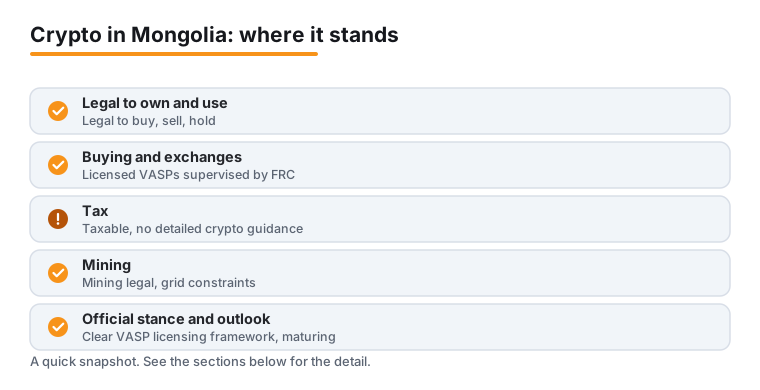
Yes. Buying, selling, and holding Bitcoin and other cryptocurrencies is legal for individuals and businesses in Mongolia. There is no general prohibition on crypto; instead, the country has chosen to bring the sector inside a formal regulatory perimeter.
Crypto is not legal tender. Under Mongolian law the togrog (MNT), issued by the Bank of Mongolia, is the only official currency. The Bank of Mongolia has repeatedly stated that crypto assets do not constitute an official means of payment and are not a means of payment under the Law on the National Payment System or the law on conducting settlement in the national currency. Merchants are under no obligation to accept Bitcoin or stablecoins.
The crucial distinction is between holding your own crypto, which is broadly unrestricted, and providing crypto services to others. Operating an exchange, custody service, or similar virtual-asset business requires a licence. That licensing layer, supervised by the Financial Regulatory Commission, is the core of Mongolia's approach.
Who regulates crypto in Mongolia
Two state bodies matter most:
- Financial Regulatory Commission (FRC). The FRC is the lead supervisor for virtual asset service providers. It issues licences, maintains the register of authorised providers, and oversees their compliance. The FRC also regulates Mongolia's securities and insurance markets and non-bank financial institutions.
- Bank of Mongolia (Mongolbank). The central bank is responsible for the togrog, monetary policy, and the national payment system. It has made clear that crypto is not official money.
Anti-money-laundering oversight runs through the Bank of Mongolia's Financial Information Unit (FIU), Mongolia's financial intelligence unit, which receives suspicious-transaction reporting and coordinates with the FRC on supervised entities. You can review the regulators directly at the Financial Regulatory Commission of Mongolia and the Bank of Mongolia.
Key crypto laws and frameworks in Mongolia
The central piece of legislation is the Law on Virtual Asset Service Provider (commonly called the VASP Law), adopted by Mongolia's parliament in December 2021 and effective from 2022. The English text of the law is published on the FRC's own site. The law defines a virtual asset as an intangible digital representation of value that can be digitally traded or transferred and used for payment or investment purposes, and it brings crypto businesses under FRC authority.
The framework rests on several pillars:
- Licensing of service providers. Exchanges and other virtual-asset businesses must register with and be authorised by the FRC before operating.
- AML and CFT compliance. Providers must follow Mongolia's Law on Anti-Money Laundering and Combating the Financing of Terrorism, consistent with Financial Action Task Force (FATF) standards.
- Capital markets overlap. Where a token or platform behaves like a security or derivative, the FRC's securities-market rules can also apply.
A defining feature of the Mongolian model is that the FRC licenses exchanges and platforms, not individual coins. Issuing a coin on its own is not the route; a project that wants its token traded generally applies through an authorised exchange. You can read the law itself via the Financial Regulatory Commission, which hosts the official Law on Virtual Asset Service Provider document.
Licensing and registration of exchanges (VASPs)
To operate legally, a virtual asset service provider in Mongolia must be a licensed company, not an individual. The FRC's requirements typically include:
- Registration as a legal entity and application for the specific VASP licence.
- Reliable IT infrastructure with security and automated transaction-monitoring systems.
- Demonstrable, legitimate sources of capital.
- Qualified personnel in fields such as finance, economics, law, IT, or corporate governance.
- AML and KYC programs in line with Mongolian law.
As of recent counts, around a dozen VASPs are supervised by the FRC, collectively offering access to a few hundred recognised virtual assets. Because the FRC registers platforms rather than coins, individual tokens are listed through these authorised venues. Before trusting any provider, verify it against the FRC's current published information rather than relying on the platform's own marketing. See our country regulation hub for how this licensing-led model compares with other jurisdictions.
Crypto and Bitcoin tax in Mongolia
Mongolia has no crypto-specific tax law, so crypto income is taxed under the general regime. For resident individuals, property income and capital gains are charged at 10 percent, and non-residents pay a flat 20 percent on income earned in or sourced from Mongolia; PwC's Mongolia summary, last reviewed 8 June 2026, records no separate rate or category for digital assets. Mongolia operates personal and corporate income taxes, and gains and income from crypto activity are taxed under those regimes, at 10 percent for resident individuals on property income and capital gains and a flat 20 percent for non-residents on Mongolian-source income; there is no blanket exemption simply because an asset is digital.
Mongolia has not published comprehensive, crypto-specific tax guidance, so the exact treatment depends on the facts: whether you are an individual or a business, whether the activity looks like occasional investing or ongoing trading or mining, and how the income is characterised under Mongolian tax law. Mongolian personal income tax splits taxable income into broad categories such as income from activities, income from property, and income from the sale of property, and crypto gains generally have to be fitted into one of those existing categories. There are no crypto-specific rates to quote, because Mongolia has not set any. The rates that apply are the ordinary personal and corporate income tax rates, and those are set out further down this page along with the date they change.
Tax rules are also in flux. On 30 December 2025 the government submitted a broad package of tax law amendments to parliament, covering corporate income tax, personal income tax, value added tax, and the General Tax Law, with a planned start date of 1 January 2027. The public summaries of that package do not call out crypto specifically, but a general overhaul of the income-tax rules can still change how crypto gains are taxed, so check the position again before you file.
Practical steps:
- Keep clear records of every purchase, sale, and transfer, with the MNT value at the time.
- Separate personal investing from business or mining activity, which may be taxed differently.
- Do not assume crypto gains are tax-free.
This is general information, not tax advice. Confirm your obligations with the Mongolian tax authority or a licensed local tax professional, and see our general guide to crypto taxes for how these rules tend to work internationally.
AML and KYC rules
Anti-money-laundering compliance is central to Mongolia's crypto regime. Licensed VASPs must comply with the Law on Anti-Money Laundering and Combating the Financing of Terrorism and apply the FATF-aligned obligations that come with it:
- Customer identification (KYC). Providers verify the identity of their users before and during the relationship.
- Transaction monitoring. Providers must run automated systems to detect suspicious activity.
- Suspicious-transaction reporting. Reports go to the Financial Information Unit at the Bank of Mongolia.
- Source-of-funds checks. Funding an account or cashing out can trigger questions about where money came from.
In practice this means that when you use a licensed Mongolian platform you should expect identity verification and record-keeping. The FATF Travel Rule logic, requiring originator and beneficiary information to accompany transfers between providers, is part of the international standard Mongolia is aligning with. You can read more about the AML mandate at the Mongolia Financial Information Unit.
Buying and using crypto in practice
Residents of Mongolia can buy and sell crypto, and the licensing framework is designed to channel that activity toward authorised platforms. A compliant local exchange must be FRC-registered and apply KYC and AML checks.
In practice, Mongolians access crypto through a mix of:
- Locally licensed exchanges authorised under the VASP framework.
- International exchanges that accept Mongolian users, subject to each platform's own onboarding rules.
- Peer-to-peer trades, which carry higher counterparty and fraud risk and offer less recourse.
Mongolia maintains a broader currency and foreign-exchange regime centred on the togrog, so moving value in and out of the country can involve banking and reporting steps. A sensible path is to choose a licensed or reputable platform, complete identity verification, fund the account (expecting possible source-of-funds questions), place your order after checking fees, and move larger holdings to a wallet you control while safeguarding the recovery phrase offline. Crypto is not legal tender, so do not rely on merchants accepting it for everyday payments.
Bitcoin mining in Mongolia
Crypto mining is legal in Mongolia, and the country's energy profile gives it theoretical appeal. Mongolia has large coal reserves and substantial untapped wind and solar potential across the steppe and Gobi regions, which periodically attracts miners seeking low-cost power.
The practical picture is more demanding than the resource headline suggests:
- Energy and grid constraints. Power supply, transmission, and reliability vary, and electricity policy affects whether large-scale mining is viable or welcome.
- Climate. Extreme winters can aid cooling but stress equipment and logistics.
- Remote logistics. Sites with the cheapest power are often far from infrastructure, raising connectivity and maintenance costs.
- Tax and regulatory exposure. Mining revenue is taxed under the ordinary corporate or personal income rules, with no mining-specific crypto rate, and the cost side is set by the Energy Regulatory Commission, which raised the average electricity tariff from 216 MNT/kWh to 280 MNT/kWh with effect from 15 November 2024 and increased tariffs for businesses and organisations by an average of 30 percent.
Anyone considering commercial mining should confirm current electricity rules, licensing expectations, and tax treatment with the relevant authorities, as energy and crypto policy can shift quickly.
Recent developments (2025 to 2026)
Mongolia's framework is actively maturing rather than static:
- Blockchain-based securities trading. The FRC announced on 12 September 2025 that Mongolia's over-the-counter (OTC) securities market would move to a 24-hour, five-day (24/5) continuous trading model on blockchain infrastructure, after roughly 18 months of testing in the FRC's regulatory sandbox. The system went live in December 2025. Settlement is automated and completes in under a minute. This was promoted as one of the first regulated blockchain-based OTC securities markets in the world. The 40 percent rise in secondary-market trading activity that is often quoted happened in the three months between the FRC's September 2025 announcement and the launch, not after it. The Mongolian Association of Securities Dealers operates the market; note this is a securities market rather than a crypto exchange, but it shows how far Mongolia's regulator is taking blockchain.
- Coin oversight and de-listings. Consistent with its platform-not-coin model, Mongolia has restricted or banned a number of locally issued tokens; reporting has noted that of dozens of coins issued domestically, roughly a third were banned under investor-protection rules. The authoritative current list sits with the FRC.
- Ongoing supervision. The FRC continues to refine its VASP register, sandbox programmes, and capital-market rules.
- Wider tax reform under way. On 30 December 2025 the government submitted a package of draft tax law amendments to parliament covering corporate income tax, personal income tax, value added tax, and the General Tax Law, with implementation planned for 1 January 2027. The package is a general tax overhaul and does not single out crypto in its public summaries, but anyone with crypto income should watch how the revised income-tax rules land, since crypto gains fall under the ordinary income-tax categories.
Because details change, always check the FRC's current publications rather than relying on a single news report or this summary.
Consumer risks and protection
The principal risks for crypto users in Mongolia combine the universal hazards of the asset class with local market realities:
- Price volatility and the potential for significant or total loss.
- Regulatory change, as Mongolia refines its framework, sandboxes new models, and adjusts supervision and token approvals.
- Limited local depth, meaning a small number of licensed venues and thinner liquidity than in larger markets.
- Fraud and security risk, including scams, phishing, and platform failure; self-custody mistakes can be irreversible.
- Tax uncertainty, given the lack of detailed crypto-specific public guidance.
The protections that do exist flow from the licensing regime: KYC and AML obligations, transaction monitoring, and FRC supervision of authorised providers. To benefit from them, stick to licensed, transparent platforms, verify a provider against the FRC, document every transaction, and be sceptical of any offer promising guaranteed returns or unusually easy cross-border transfers. None of this is legal, tax, or investment advice.
Official sources and how to verify
Because crypto rules in Mongolia continue to evolve, verify any specific point against primary sources before acting:
- Financial Regulatory Commission (FRC) for the VASP licensing regime, the register of authorised providers, the Law on Virtual Asset Service Provider text, and securities-market rules: frc.mn.
- Bank of Mongolia (Mongolbank) for the legal-tender position, the national payment system, and monetary matters: mongolbank.mn.
- Financial Information Unit (FIU) for AML and CFT obligations and suspicious-transaction reporting: fiu.mongolbank.mn.
This article is general information as of 2026 and is not legal, tax, or financial advice; readers should verify their situation with the Financial Regulatory Commission, the Bank of Mongolia, or a qualified Mongolian professional. For broader context, see our hub on crypto regulation by country.
Status as of August 2026: what has and has not moved
Mongolia's crypto-specific rulebook did not change between this page's last review on 30 June 2026 and August 2026. The Law on Virtual Asset Service Provider, carried on the parliamentary register as 21-h-34 and adopted on 17 December 2021, is still the operative statute. The consolidated text on legalinfo.mn carries exactly one amendment note, and that amending law of January 2024 changed a single phrase in Article 8.3, replacing "by official letter" with "in writing or in electronic form". Nothing else in the statute has been touched.
What did move in 2026 was tax and general business law, neither of which is crypto-specific:
- A package amending the corporate income tax, personal income tax, VAT and General Tax laws was submitted to Parliament on 30 December 2025 and, per KPMG Mongolia's newsletter of 22 July 2026, passed during the 2026 spring parliamentary session for implementation from 1 January 2027. KPMG describes the approved changes as largely amendments to existing tax legislation rather than a comprehensive reform.
- Parliament passed the Law on Economic Freedom on 3 July 2026, amending the Law on Investment, the Law on Permits and, on that source's count, 97 other laws; KPMG Mongolia puts the figure at over 110. Neither summary refers to virtual assets, digital assets or cryptocurrency.
- The Bank of Mongolia's English news feed carried no cryptocurrency, virtual asset or central bank digital currency item among the postings visible in August 2026. Its most recent items, to 22 July 2026, cover IFC climate risk cooperation, the June monetary policy report and renewal of the currency swap with the People's Bank of China.
The practical reading for anyone arriving with the question "is crypto legal in Mongolia": yes, it is legal and it is regulated, the statute has been stable since January 2024, and the next dated event on the calendar is a general tax change on 1 January 2027 rather than a crypto law.
The rules, by name and number
Mongolia's crypto regime is not one law. It is a statute, two subordinate FRC instruments and the AML framework, and each has a name and a number.
| Instrument | Number and date | What it does |
|---|---|---|
| Law on Virtual Asset Service Provider | 21-h-34, adopted 17 December 2021 | Makes FRC registration compulsory for the five virtual asset services listed in Article 6.1; defines a virtual asset so as to exclude fiat, securities and Bank of Mongolia licensed electronic money |
| Amending law | 24-ne-30, adopted 12 January 2024 | One article, one phrase, in Article 8.3. That is its entire content |
| Regulation on the Operations of Virtual Asset Service Providers | FRC Resolution No. 657 of 27 December 2024 | The consolidated operating rulebook for registered providers, adopted to align with FATF Recommendation 15 |
| On-Site Inspection and Supervision Guideline for VASPs | Order No. 370 of 2024 of the FRC Chairman | Inspection procedure. Six designated companies were inspected on site during 2024 |
| Law on Combating Money Laundering and Terrorism Financing | In force | Virtual asset service providers are a named category of reporting entity, with dedicated FIU guidance on suspicious transaction reporting, the risk-based approach for virtual assets, and red flag indicators |
Supervision is not paper-only. The FRC reports that it receives provider transaction data, user numbers and price data daily through an API system and uses a blockchain analytics monitoring platform for remote supervision. It has a standing Virtual Asset Service Providers Division in its organisational structure, and in September 2024 it was elected to represent the 42 member countries of the Asia/Pacific Group on Money Laundering at the FATF Virtual Asset Contact Group, which the APG's own follow-up report of February 2025 independently confirms.
What FRC registration does and does not give you
The statute is unusually explicit about the limits of the protection registration provides. From the FRC's own English text of the law:
- Your contract with a registered provider must disclose that virtual currency is not legal tender and is not backed by the central bank and government (Article 9.1.3), and that virtual assets are not subject to deposit insurance or any other insurance to protect securities investors (Article 9.1.4).
- Article 10.13 states that registration of a provider is not a guarantee for the virtual asset, and the State is not liable for damage caused as a result of virtual asset service activity.
- The contract must also disclose that transactions may be irreversible and that losses from fraudulent or accidental transactions may not be recoverable (Article 9.1.9), and that assets owned by the provider may not be sufficient to cover all customer losses (Article 9.1.13).
What registration does deliver is entry control and ongoing obligations. Applicants need a four-year business plan (Article 7.1.4), an automated system for monitoring suspicious transactions (Article 7.1.6), registration as a taxpayer with a taxpayer number (Article 7.1.11) and a reference from the General Department of Taxation confirming no overdue tax debt (Article 7.1.12). Providers must hold own capital equity in an amount set by the FRC that cannot include assets registered abroad (Articles 7.3 and 7.4), keep records for at least 10 years (Article 12.1) and have accounts audited annually under IFRS by an auditor registered with the FRC (Article 8.6). The FRC has six months to decide a complete application, extendable by up to six more (Articles 10.2 and 10.3), can restrict, temporarily suspend or deregister a provider (Article 11.1), and unregistered provision of virtual asset services is prohibited outright (Article 7.6), with liability under the Criminal Code or the Law on Infringement (Article 16.1).
The numbers inside FRC Resolution 657
The 2021 statute leaves the hard figures to the regulator. They are in the Regulation on the Operations of Virtual Asset Service Providers, approved by FRC Resolution No. 657 of 27 December 2024. The text is published in Mongolian only. The main quantified requirements are:
- Minimum contributed capital of 400.0 million MNT for each service an applicant wants to provide, across the five services listed in Articles 6.1.1 to 6.1.5 of the statute (clause 2.1.3). The capital must consist of funds other than borrowed sources, and where a provider combines services the minimums are added together (clause 2.2).
- A board of five or more directors, at least two of them independent (clause 2.3).
- A 3 million MNT transfer threshold. Above that value, the sending provider must pass originator and beneficiary details to the receiving provider, and the receiving provider must obtain them (clauses 3.4.1 and 3.4.2). This is how the FATF Travel Rule is implemented in Mongolia. Transfers also require at least two-step authentication and verification of the IP and wallet address (clause 3.4.10).
- A custody ceiling of 100 times own capital. A provider may hold and manage customer virtual assets up to, but not exceeding, 100 times its own capital, tested quarterly (clauses 3.5.1 and 3.5.2).
These are the figures that decide whether a business can enter the market and how much customer property it may hold. They are not in the statute, which is why reading the 2021 law alone gives an incomplete picture.
Tax: the rates that actually apply
Mongolia has no crypto-specific tax law, so virtual asset income is taxed under the general regime. The rates below are those recorded by PwC's Mongolia personal income tax summary and corporate income tax summary, both last reviewed 8 June 2026. Neither records a separate rate or category for digital or virtual assets.
| Situation | Rate |
|---|---|
| Resident individual, property income and capital gains | 10% |
| Non-resident, income earned in or sourced from Mongolia | 20% flat |
| Resident individual, salary and employment income | 10% up to MNT 120m, then 15% on income above that to MNT 180m, then 20% |
| Company, first MNT 6bn of taxable income | 10% |
| Company, taxable income above MNT 6bn | MNT 600m plus 25% of the excess |
| Company, annual revenue up to MNT 300m | 1% (excludes mining, petroleum, alcohol and tobacco) |
These rates change on 1 January 2027. The amending package was submitted on 30 December 2025 and passed in the 2026 spring session. Be careful with the figures circulating for it: the widely repeated numbers, including a 15 percent corporate band between MNT 6bn and MNT 10bn and a full personal exemption on monthly income up to MNT 500,000, describe the draft as submitted in December 2025 and were published in March 2026, before it passed. The enacted text has not been checked against them here. What is firm is the date and the fact that no published summary of the package mentions crypto or virtual assets.
Separately, the Law on Economic Freedom of 3 July 2026 cut withholding tax on interest income from 20 percent to 5 percent. It contains no reported virtual asset provision either.
On the mining side, the cost that matters is set by the energy regulator, not the financial one. The Energy Regulatory Commission raised the average electricity tariff from 216 MNT/kWh to 280 MNT/kWh with effect from 15 November 2024, with tariffs for businesses and organisations up by an average of 30 percent.
The sector in numbers
The Financial Regulatory Commission publishes virtual asset sector data in its annual report. The most recent edition available is for 2024. From the FRC Annual Report 2024:
- 12 legal entities operating as registered virtual asset service providers, with a combined total asset value of 77.9 billion MNT.
- 645 virtual assets actively traded on those platforms, of which 6.5 percent (42 assets) are domestic.
- Domestic virtual asset market valuation of 258.3 billion MNT, up 16.4 billion MNT or 6.8 percent on the previous year.
- 921,022 registered users on a duplicated count, of whom 1.5 percent (14,011) were actively trading.
- Sector total income of 73.7 billion MNT and net profit of 12.5 billion MNT.
One point of clarification on the blockchain trading launch often attributed to crypto. Mongolia's over-the-counter market moved to 24 hour, five day blockchain-based trading in late December 2025 after an 18 month period in the FRC's regulatory sandbox. Trading operations are supervised by the Mongolian Association of Securities Dealers, the FRC regulates, and the Central Securities Depository helped develop settlement automation. It is a securities market running on blockchain rails, not a cryptocurrency venue. The FRC's own report lists the blockchain-based OTC trading system as one of six products in its regulatory sandbox, alongside repo transactions between non-bank financial institutions, peer to peer lending, reward-based and donation-based crowdfunding, and short-term business to business financing intermediation.
Frequently asked questions
Is cryptocurrency legal in Mongolia?
Yes. Buying, selling, and holding crypto is legal in Mongolia, and the country regulates rather than bans the sector under the Law on Virtual Asset Service Provider (effective 2022). Crypto is not legal tender, and businesses that provide virtual-asset services, such as exchanges, must be licensed by the Financial Regulatory Commission.
Who regulates crypto in Mongolia?
The Financial Regulatory Commission (FRC) is the lead supervisor. It licenses and oversees virtual asset service providers and enforces AML and KYC requirements. The Bank of Mongolia (Mongolbank) handles the togrog and the payment system and has confirmed that crypto is not official money, while the Financial Information Unit at the central bank handles suspicious-transaction reporting.
Do I have to pay tax on crypto in Mongolia?
Crypto-related income is generally treated as taxable in Mongolia and is not automatically exempt. Mongolia has not published detailed crypto-specific tax guidance, so the treatment depends on your circumstances and can change. Keep detailed records and confirm your obligations with the Mongolian tax authority or a licensed local tax professional. This is not tax advice.
Do crypto exchanges in Mongolia need a licence?
Yes. A virtual asset service provider must be a licensed company, registered with and supervised by the Financial Regulatory Commission. It must meet requirements on IT security, capital, qualified staff, and AML and KYC. The FRC licenses platforms rather than individual coins, so tokens are listed through authorised exchanges. Around a dozen VASPs are currently supervised by the FRC.
Is Bitcoin mining allowed in Mongolia?
Yes, crypto mining is legal in Mongolia. The country has significant coal and renewable-energy potential, but miners face challenges around grid reliability, electricity policy, remote logistics, and taxation. Mining revenue can be taxable, so anyone planning commercial mining should verify current energy, licensing, and tax rules with the relevant authorities.
What changed for crypto in Mongolia in 2025 and 2026?
The most prominent development was the move of Mongolia's over-the-counter securities market to a 24-hour, five-day blockchain-based trading model. The FRC announced it on 12 September 2025 and the system went live in December 2025, after about 18 months of testing in the Financial Regulatory Commission's sandbox. Secondary-market trading activity rose by 40 percent in the three months between the September 2025 announcement and the launch, not in the three months after it. Mongolia also continues to refine token oversight under its platform-not-coin model and has restricted a number of locally issued coins. Check the FRC for the current position.
Is Mongolia's blockchain securities market the same as a crypto exchange?
No. The 24-hour, five-day blockchain-based market that went live in December 2025 is Mongolia's over-the-counter securities market, run by the Mongolian Association of Securities Dealers and supervised by the Financial Regulatory Commission. It uses blockchain infrastructure for trading and settlement, but it trades regulated securities, not Bitcoin or other cryptocurrencies. To buy crypto you still use an FRC-licensed virtual asset service provider or a reputable international exchange.
Will Mongolia's 2027 tax changes affect crypto?
Yes, but not because of anything crypto-specific. The tax package submitted to Parliament on 30 December 2025 passed in the 2026 spring session and takes effect on 1 January 2027, amending the corporate income tax, personal income tax, VAT and General Tax laws; KPMG Mongolia's summary of 22 July 2026 identifies no crypto-specific provision in it. On 30 December 2025 the government submitted a package of tax law amendments to parliament covering corporate income tax, personal income tax, value added tax, and the General Tax Law, with a planned start date of 1 January 2027. The published summaries do not mention crypto by name, but crypto gains are taxed under the ordinary income-tax categories, so a general change to those rules could still affect you. Confirm the current position with the Mongolian tax authority or a local tax professional before filing.
Is crypto legal in Mongolia in August 2026?
Yes. Buying, holding and selling crypto is legal, and exchanges and custodians are regulated rather than banned. Registration with the Financial Regulatory Commission is compulsory for anyone providing virtual asset services under the Law on Virtual Asset Service Provider, parliamentary reference 21-h-34, adopted 17 December 2021. Crypto is not legal tender and no merchant is required to accept it. Nothing in this position changed during 2026.
What tax do I pay on crypto gains in Mongolia?
There is no crypto-specific tax law, so gains fall under the general regime. Resident individuals are taxed at 10 percent on property income and capital gains; non-residents pay a flat 20 percent on income earned in or sourced from Mongolia. Companies pay 10 percent on the first MNT 6 billion of taxable income and MNT 600 million plus 25 percent on the excess, or 1 percent if annual revenue is under MNT 300 million. These rates come from PwC's Mongolia tax summaries, last reviewed 8 June 2026, which record no separate digital asset category. They change on 1 January 2027 under a general tax package that contains no reported crypto provision.
Is a new crypto law coming to Mongolia?
No crypto bill could be found in any source checked in August 2026, and the statute has been unchanged since a one-phrase amendment in January 2024. The dated change on the calendar is general, not crypto-specific: a package amending the corporate income tax, personal income tax, VAT and General Tax laws passed in the 2026 spring session and takes effect on 1 January 2027. Parliament also passed the Law on Economic Freedom on 3 July 2026, amending around a hundred other statutes, and published summaries of it contain no virtual asset provisions.
Does FRC registration mean my crypto is protected?
No. Article 10.13 of the Law on Virtual Asset Service Provider states that registration of a provider is not a guarantee for the virtual asset and that the State is not liable for damage caused as a result of virtual asset service activity. Your contract with a registered provider must itself disclose that virtual currency is not legal tender, is not backed by the central bank and government, and is not subject to deposit insurance or any insurance protecting securities investors.
How much capital does a Mongolian crypto exchange need?
Under clause 2.1.3 of the Regulation on the Operations of Virtual Asset Service Providers, approved by FRC Resolution No. 657 of 27 December 2024, an applicant needs minimum contributed capital of at least 400.0 million MNT for each of the five services it wants to provide, and the minimums are added together where services are combined. The capital cannot come from borrowed sources. A provider may also hold customer virtual assets only up to 100 times its own capital, measured quarterly.
Who regulates crypto in Mongolia, and under what rules?
The Financial Regulatory Commission registers and supervises providers under the 2021 statute and its own Regulation on the Operations of Virtual Asset Service Providers, approved by FRC Resolution No. 657 of 27 December 2024. On-site inspection follows Order No. 370 of 2024 of the FRC Chairman. Separately, virtual asset service providers are a named category of reporting entity under the Law on Combating Money Laundering and Terrorism Financing, with guidance issued by the Financial Information Unit at the Bank of Mongolia.
Facts reviewed: 13 August 2026. Page updated: 13 August 2026.