Home › Crypto Regulation › Georgia
Bitcoin & Cryptocurrency Regulation in Georgia
Quick answer — Georgia, 2026
- Owning, buying, selling and trading crypto is legal in Georgia. Paying with it is not: Article 39-1 of the Organic Law on the National Bank of Georgia states that a virtual asset is not a lawful means of payment and that payment with a virtual asset is prohibited, except in cases the National Bank of Georgia defines as essential for providing virtual asset services.
- Public Ruling N201 of the Minister of Finance, issued 28 June 2019, exempts an individual from personal income tax on income received from the supply of crypto assets and exempts the exchange of crypto for national or foreign fiat currency from VAT, which is the basis for the 0% figure; companies pay 15% on distributed profits and mining can attract VAT.
- Residents buy through NBG-registered exchanges, global platforms, or the many exchange offices and ATMs in Tbilisi.
Georgia (the country in the South Caucasus, not the U.S. state) is one of the most crypto-active places in the world relative to its size. Cheap, abundant hydroelectric power made it a major Bitcoin mining destination, and its capital, Tbilisi, is unusually dense with crypto exchange offices and ATMs. For years this activity happened with little formal oversight. That changed when Georgia introduced a dedicated regime for Virtual Asset Service Providers (VASPs) that took effect on 1 July 2023, placing crypto exchanges, custodians and related businesses under the supervision of the National Bank of Georgia (NBG).
This guide explains, in plain terms, where Georgia stands on crypto in 2026: whether Bitcoin is legal, who regulates the sector, the laws and rules that apply, how exchanges are registered, how crypto is generally taxed, and the practical realities around buying, mining and consumer risk. The framework is largely built but not finished: amendments to the Organic Law on the National Bank of Georgia adopted on 17 December 2025 expanded the NBG's powers, and the NBG must issue the subordinate normative acts setting minimum supervisory capital, operational standards and consumer protection rules for virtual asset service providers by 1 September 2026. Treat this as a starting point and confirm specifics with the National Bank of Georgia and the Georgian Revenue Service. This article is general information as of 2026 and is not legal, tax or financial advice; verify your own position with the named official regulator and a qualified local professional before acting. See also our broader guide to crypto regulation.
On this page: Legal status · Who regulates it · Taxes · How to buy · Mining
Is Bitcoin and crypto legal in Georgia?
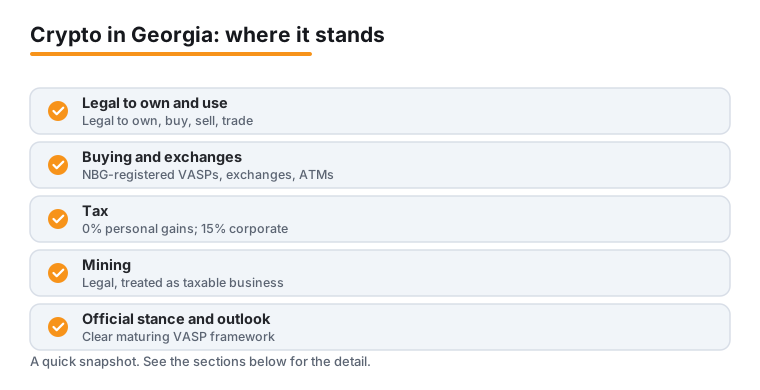
Yes. Owning, buying, selling and transferring cryptocurrencies such as Bitcoin is legal in Georgia. There is no ban on individuals holding or trading digital assets, and the country is widely regarded as crypto-friendly in practice.
An important distinction: crypto is not legal tender in Georgia. The national currency is the Georgian lari (GEL), and no business is obliged to accept Bitcoin or any other digital asset as payment. Crypto is treated as a virtual asset rather than as state-issued money. In day-to-day life this means you can legally buy, hold and spend crypto where a counterparty agrees to accept it, but you cannot demand that a debt be settled in Bitcoin.
Since 1 July 2023, running a crypto business for others, such as operating an exchange or holding customer funds, has been brought under a formal registration regime supervised by the National Bank of Georgia, which is covered in the sections below.
Who regulates crypto in Georgia?
The primary regulator is the National Bank of Georgia (NBG), the country's central bank. The NBG is the registration authority and supervisor for Virtual Asset Service Providers and is responsible for the related anti-money-laundering oversight of the sector.
The NBG's powers over crypto were significantly expanded by amendments to the Organic Law of Georgia on the National Bank of Georgia. A bill was submitted to Parliament in September 2025 and the amendments were adopted on 17 December 2025. They give the NBG full supervisory authority over VASPs, spanning prudential supervision, consumer-rights protection, cybersecurity and operational-risk management. The law requires the NBG to issue the detailed subordinate rules implementing these powers, including operational standards and capital requirements, by 1 September 2026.
For taxation, the relevant authority is the Georgian Revenue Service (rs.ge), part of the Ministry of Finance, which administers income tax, corporate tax and VAT. You can confirm the current registry of authorised providers and read the rules directly on the NBG website: National Bank of Georgia - Virtual Asset Service Providers.
Key laws and frameworks
Georgia is not a member of the European Union, so the EU's Markets in Crypto-Assets Regulation (MiCA) does not apply directly. Georgia has instead built its own domestic framework, broadly aligned with the international standards of the Financial Action Task Force (FATF).
The main building blocks are:
- The VASP registration regime, in force since 1 July 2023, which defines virtual asset services and requires the businesses that provide them to register with the NBG.
- The Organic Law on the National Bank of Georgia, amended on 17 December 2025 to give the NBG full supervisory authority over VASPs (prudential, consumer protection, cybersecurity and operational risk).
- Georgia's anti-money-laundering and counter-terrorist-financing legislation, which extends customer due diligence and reporting duties to VASPs.
- NBG subordinate acts, including a regulation on monetary fines against VASPs and their administrators, and the March 2026 rules on stablecoin offerings (covered below).
Because several detailed rules are due to be finalised by 1 September 2026, the precise compliance picture is still evolving. For the authoritative position, always check the latest acts published by the NBG rather than relying on summaries.
Licensing and registration of exchanges (VASPs)
Businesses that provide crypto services to the public must register with the NBG as a Virtual Asset Service Provider. The NBG's official list of regulated activities covers seven services:
- Exchange between convertible virtual assets and fiat currencies, or between different forms of virtual asset
- Transfer of convertible virtual assets
- Safekeeping and administration of convertible virtual assets (custody)
- Portfolio management of convertible virtual assets
- Administration of a virtual asset trading platform
- Lending of convertible virtual assets
- Initial Coin Offering (ICO) of convertible virtual assets
To register, a provider generally needs a Georgian legal entity, a local presence, fit-and-proper management and an AML/KYC compliance program acceptable to the NBG. Historically Georgia did not impose minimum capital requirements on VASPs, which made it cheaper to set up than many MiCA jurisdictions. That is changing: the December 2025 amendments give the NBG explicit power to set minimum supervisory capital and a calculation methodology, with the detailed thresholds expected in the subordinate acts due by 1 September 2026.
From 1 January 2026, every registered VASP must visibly display, or make easily accessible, the official NBG act confirming its registration across all service channels, including offices, branches, self-service kiosks, websites and mobile apps. This is intended to help consumers verify that a provider is genuinely authorised. Anyone setting up a crypto business should obtain a tailored legal opinion rather than assume their model is in or out of scope.
Crypto and Bitcoin tax in Georgia
Georgia has a reputation as a low-tax jurisdiction for crypto, but treatment depends on who you are and whether the activity is personal or a business. The summary below describes the broad principles commonly applied; it is not a substitute for advice from the Georgian Revenue Service or a local tax adviser, and you should verify your own position before relying on any of it.
Individuals. Income that a resident individual earns from supplying or exchanging crypto assets has generally been treated as not arising from a Georgian source, and therefore not subject to personal income tax. This is why Georgia is often described as offering a 0% rate on personal crypto gains. It is a general characterisation, not a guarantee for every situation: if trading is frequent, organised and looks like a business, the analysis can change, and tax residency matters.
Businesses. Companies operating in crypto are subject to Georgia's corporate tax system, which broadly follows a distributed-profit (Estonian-style) model. Profits are taxed at 15% when they are distributed rather than as they accrue, and crypto gains are folded into ordinary corporate profit rather than taxed under a separate capital-gains regime.
VAT. Because crypto assets are treated similarly to monetary funds, exchanging crypto for fiat or for other crypto is generally outside the scope of VAT. Mining is treated differently: it is regarded as the supply of computational power, that is, a service rather than a financial transaction, and can therefore fall within VAT. Georgia applies a standard VAT rate of 18%.
Rates, thresholds and definitions can change and turn on fine details, so confirm the current figures and your residency or business status directly with the Revenue Service or a qualified Georgian accountant. See our general explainer on crypto taxes for context.
AML and KYC rules
Anti-money-laundering and counter-terrorist-financing (AML/CFT) compliance is central to Georgia's crypto framework, reflecting FATF standards. Registered VASPs are obliged entities and must:
- Perform customer due diligence (KYC), verifying customer identity before providing services and applying enhanced checks for higher-risk customers or larger transactions.
- Monitor transactions and screen against sanctions lists.
- Identify and report suspicious activity to the relevant authorities.
- Keep records and report periodically to the NBG.
- Maintain an internal compliance function and policies acceptable to the regulator.
In practice this means that when you use a licensed Georgian VASP you should expect to provide identification and, for larger amounts, proof of address or source of funds. These checks are a regulatory requirement, not optional. The December 2025 amendments add consumer-protection and operational-risk supervision on top of the existing AML duties, so expect compliance expectations to tighten further as the NBG finalises its rules through 2026.
Buying and using crypto in practice
Buying crypto in Georgia is straightforward for residents and visitors. Common routes include:
- NBG-registered local exchanges and VASPs that support the Georgian lari and offer card or bank-transfer purchases.
- Major global exchanges, which Georgians commonly use; some international platforms have also established a regional presence.
- Physical exchange offices and crypto ATMs, which are notably common in central Tbilisi. Many ATMs are buy-only, and fees and spreads tend to be higher than on exchanges.
- Peer-to-peer arrangements, which carry the usual counterparty and fraud risks.
When you use a licensed VASP, expect standard KYC. Favour platforms that display proof of NBG registration (now required across their service channels from January 2026) or are well-established internationally, watch trading and withdrawal fees, and be cautious with informal or unlicensed services that promise to skip verification, as these are higher-risk and may not be operating lawfully. Crypto is not legal tender, and merchant acceptance is not simply optional. The National Bank of Georgia states in its public FAQ that a virtual asset is not legal tender and that it is therefore prohibited to make payments with a virtual asset, except for the exceptional cases defined by legal act of the National Bank which are essential for providing virtual asset services.
Bitcoin mining in Georgia
Mining is the activity that first put Georgia on the global crypto map. Thanks to abundant hydroelectric generation, which supplies most of the country's domestic power, and historically low electricity prices, Georgia attracted large industrial mining facilities as well as a long tail of small home setups. Industrial data centres, mainly mining, consumed hundreds of millions of kilowatt-hours in 2025, with usage rising sharply over the year.
Mining itself is legal, but in 2026 it is best understood as a business activity rather than a casual hobby once it reaches any meaningful scale. Key considerations include:
- Business registration and tax. Operating a mining venture generally means registering as a company or individual entrepreneur. As noted above, mining is commonly treated as a taxable service (the supply of computing power) and can fall within VAT, unlike pure crypto exchange.
- Energy and enforcement. Cheap power is the core economic advantage, but authorities have begun cracking down on illegal and unmetered mining. In the Mestia region, where unlawful mining drove 2025 electricity consumption far above comparable municipalities and caused grid problems, officials moved in 2026 to install meters and identify hidden operations.
- Practical risks. Volatile coin prices, rising difficulty, hardware and cooling costs, and policy changes toward heavy electricity consumers all weigh on returns.
Mining-only businesses may sit outside the VASP registration perimeter, but the tax, registration and electricity-supply obligations are real. Confirm current rules with local authorities and advisers before committing capital.
Recent developments (2025 to 2026)
The pace of regulatory change picked up noticeably in this period:
- Expanded NBG powers (December 2025). Amendments to the Organic Law on the National Bank of Georgia, adopted on 17 December 2025, gave the NBG full supervisory authority over VASPs, including prudential supervision, consumer protection, cybersecurity and operational risk, and the power to set minimum capital requirements.
- Mandatory registration display (1 January 2026). A regulation amendment now requires every registered VASP to visibly display the official NBG registration act across all service channels, to help consumers spot unregistered providers.
- Stablecoin rules (March 2026). On 6 March 2026 the Governor of the NBG signed Order No. 52/04 approving rules for the initial coin offering of a stablecoin by a VASP. A stablecoin issuer must register as a VASP, hold minimum capital of GEL 500,000 kept separate from reserves, back circulating stablecoins 100% with reserve assets and undergo regular independent audits. Tether's own announcement of the lari stablecoin states that Georgia's framework has been designed to achieve substantive compatibility with emerging US stablecoin regulation, including the GENIUS Act.
- Official lari stablecoin (May 2026). On 25 May 2026 Tether and the Government of Georgia announced GEL-T (GELT), described as the official stablecoin of Georgia, pegged 1:1 to the Georgian lari and built on Tether's stablecoin infrastructure under the new NBG stablecoin framework. It is one of the first cases of a government co-issuing a national-currency stablecoin with a private issuer rather than running a central bank digital currency in-house.
- Detailed rules due by 1 September 2026. The NBG is required to issue the remaining subordinate acts (operational standards and capital methodology) by this date, after which VASPs should have full clarity on the precise obligations.
Because the framework is actively changing, treat any specific figure or date here as accurate as of 2026 and confirm the latest position with the NBG.
Consumer risks and protection
Georgia combines genuine crypto adoption with a framework that has matured considerably since 2023, and the December 2025 amendments explicitly add consumer-rights protection to the NBG's mandate. Even so, the main risks are familiar ones:
- Market volatility. Crypto prices can fall sharply, and you can lose a substantial part or all of your money.
- Scams and fake platforms. Fraudulent exchanges, impersonation and social-engineering attacks are common across the industry. Check that any provider displays valid NBG registration before sending funds.
- Custody risk. Leaving assets on an exchange, or with an unregistered service, exposes you to platform failure or loss. The NBG warned in 2024 against using unregistered virtual asset services, including those operating in Free Industrial Zones.
- Changing rules. Tax and licensing treatment can shift; a favourable position today is not guaranteed forever.
Sensible practice: use NBG-registered or otherwise reputable providers, verify a firm's registration on the NBG website, secure your own keys where possible, enable two-factor authentication, keep good records for tax, and never share private keys, seed phrases or one-time codes with anyone.
Official sources and how to verify
This guide is general information as of 2026 and is not legal, tax or financial advice. Crypto law and tax rules in Georgia are evolving, so always confirm the current position with the official regulator before acting. The primary authoritative sources are:
- National Bank of Georgia - Virtual Asset Service Providers (VASPs), the official page listing regulated activities and the registration rules.
- NBG news - amendment requiring VASPs to display registration proof, setting out the 1 January 2026 transparency obligation.
- Georgian Revenue Service (rs.ge), the official tax authority for income tax, corporate tax and VAT questions.
To verify a provider, check whether it appears in the NBG's register of authorised VASPs and whether it displays the official NBG registration act on its website or premises. For your own tax or business situation, consult the Revenue Service or a qualified Georgian lawyer or accountant. You can also browse our wider country regulation hub for comparisons.
What is changing before 1 September 2026
The main pipeline item in Georgia is not a bill in parliament. It is secondary rulemaking the National Bank of Georgia is legally required to finish. Andersen in Georgia records that the bill amending the Organic Law on the National Bank of Georgia was submitted to the Georgian Parliament on 17 September 2025 and that the amendments require the NBG to issue all relevant subordinate normative acts by 1 September 2026. The NBG confirms in its 10 March 2026 news release that the amendments were adopted on 17 December 2025 and that it is working on this framework with technical assistance from the World Bank and the OSCE.
What those acts are expected to settle, and who is affected:
- Minimum supervisory capital. Andersen states plainly that no capital requirements currently exist for VASPs in Georgia, and that the specific thresholds and calculation methods will be detailed through these forthcoming acts. Exchanges, brokers and custodians registered in Georgia are the group directly exposed.
- Consumer rights protection. The NBG gains explicit authority over consumer disclosure and transparency, obligations that did not exist under the earlier AML-only framework.
- Operational risk and cybersecurity standards.
As of the NBG newsroom on 12 August 2026, no draft text, no proposed capital threshold and no transition arrangement for ordinary VASPs had been published.
Two other dated items run alongside it:
- Stablecoin issuers. NBG President's Order No. 52/04 was issued on 6 March 2026 and entered into force on publication on 9 March 2026. Article 20.2 gives providers already offering stable virtual assets 6 months from entry into force to submit the required documentation to the National Bank, so that window closes on 9 September 2026. Polaris describes the same transition as running to September 2026.
- The lari stablecoin. Tether and the Government of Georgia announced GEL-T on 25 May 2026. Tether's release states that further details regarding its structure, rollout and regulatory implementation will be announced at a later stage. No launch date, issuing entity or blockchain had been published at the time of writing.
For an individual holder or taxpayer, none of this changes personal obligations. It changes which platforms can legally serve customers from Georgia, and on what capital and conduct terms.
The named rules that actually apply
| Instrument | Number and dates | What it does |
|---|---|---|
| Organic Law on the National Bank of Georgia, Article 39-1 | Organic Law No. 1676 of 24 September 2009; in force | A virtual asset is not a lawful means of payment, and payment with a virtual asset is prohibited except in cases the NBG defines as essential for providing virtual asset services |
| Amendments to that Organic Law | Submitted 17 September 2025, adopted 17 December 2025 | Full prudential supervision of VASPs, NBG power to set minimum supervisory capital and its calculation methodology, consumer protection, cybersecurity and operational risk; subordinate acts due by 1 September 2026 |
| Rule on VASP registration, cancellation of registration and regulation | NBG President's Order No. 94/04, issued 13 June 2023, last amended by Order No. 5/04 of 15 January 2026 | The registration rulebook: application requirements, administrators and shareholders, service channels including self-service kiosks, AML/CFT obligations, grounds for cancelling registration |
| Registration display requirement | Announced 27 November 2025, effective 1 January 2026 | Every registered VASP must display or make easily accessible its individual NBG registration act in all spaces and channels where the service is provided |
| Rule on the initial offering of a stable virtual asset | NBG President's Order No. 52/04, issued 6 March 2026, in force 9 March 2026 | Minimum supervisory capital of not less than GEL 500,000, capital segregated from reserve assets, full reserve backing, redemption within 3 business days and 5 business days where the aggregate request exceeds GEL 300,000 |
| Rule on monetary fines against VASPs and their administrators | NBG President's Order No. 133/04, issued 29 May 2024, in force 1 August 2024; amended by Order No. 113/04 of 2 May 2025 and Order No. 308/04 of 29 December 2025 | Graded penalty schedule for less serious, serious and especially serious violations |
| Public Ruling N201 of the Minister of Finance | Issued 28 June 2019 | Defines crypto assets and sets out their income tax and VAT treatment |
The penalty bands are worth knowing because they show the register has teeth. Under Order No. 133/04 the Legislative Herald text sets GEL 100 for submitting documents up to 5 working days late, GEL 1,000 for providing a service without identification or verification, GEL 7,000 for failing to run continuous staff training, and GEL 20,000 for not carrying out or updating a money laundering and terrorist financing risk assessment. Violations that acquire systematic status run up to GEL 40,000. A separate provision allows the National Bank to fine a provider not less than GEL 10,000 and not more than GEL 100,000 where violations recur after a systematic violation penalty or create systemic money laundering risk. Order No. 308/04 of 29 December 2025 added a fine of GEL 3,000 per person for failing to update information about a person or to obtain management approval for establishing or continuing a business relationship.
Consumers can check whether a provider is registered against the VASP register the NBG publishes as a downloadable file on its Virtual Asset Service Providers page, alongside the list of the seven regulated virtual asset services.
Crypto tax in Georgia, in figures
Georgia has no crypto-specific tax statute. What governs is Public Ruling N201 of the Minister of Finance, issued 28 June 2019, read with the general Tax Code. A public ruling is binding on the authorities: where a person acts in accordance with it, monitoring and law enforcement authorities may not adopt a decision contradicting it or impose additional taxes or sanctions.
| Situation | Treatment |
|---|---|
| Resident individual sells or exchanges crypto assets | Ruling N201 exempts an individual from personal income tax on income received from the supply of crypto assets. Andersen in Georgia frames the same outcome as the income not qualifying as Georgian-source, giving a 0 percent rate |
| Individual converts crypto to lari or foreign currency | Exempt from VAT under Ruling N201 |
| Individual mining | Ruling N201 treats mining as the supply of computational power. Andersen reports income from crypto mining in Georgia as taxable at the standard 20 percent personal income tax rate |
| Mining supplied to a recipient in Georgia | VAT applies. Where the recipient is foreign with no Georgian presence, no Georgian VAT arises |
| Georgian company holding or trading crypto | Corporate income tax at 15 percent on distribution, with dividends subject to 5 percent withholding tax at source. Reinvested profit is not taxed until distribution |
Two honest limits. The individual exemption turns on the income not arising from a Georgian source, so it is about where income arises rather than a carve-out for crypto as such, and activity that looks like a trade or business is treated differently from a personal disposal. And Ruling N201 predates staking, DeFi, NFTs and token offerings as mass activities; no detailed Georgian interpretive guidance covering them could be found, so those areas are genuinely unsettled.
Sanctions listings and Georgia registered crypto firms
This is the material development since the page was last reviewed on 30 June 2026, and it matters to anyone choosing a Georgian platform.
On 23 July 2026 the EU adopted its 21st package of sanctions against Russia. Alongside extending the prohibition on Russian nationals owning, controlling or serving on the boards of any company offering crypto asset services, the package imposes a transaction ban on additional third country crypto platforms and creates a dedicated third country ban for crypto asset services intended to act as a deterrent. TRM Labs records the transaction ban as covering 14 crypto-related service platforms based in Georgia, Panama, the UAE, the Marshall Islands, Kyrgyzstan and Belarus.
Several of the listed entities are Georgia registered. Civil Georgia reported on 24 July 2026 that the National Bank named Aifory LLC, Abcex LLC and Rapira Group LLC, later adding Arvix LLC, and stated that none of their areas of activity was Georgia and that investigative actions had been launched against them. Aifory LLC, Rapira Group LLC and Arvix LLC had already been sanctioned by the United Kingdom in May 2026. Georgia Today reported the NBG describing its regulatory framework as an important filter and citing the 2024 Council of Europe MONEYVAL assessment, which rated Georgia largely compliant with FATF Recommendation 15 on the regulation of virtual asset service providers. Transliterations of the company names vary between outlets.
The pattern repeated in August 2026. The National Bank stated on 9 August 2026 that the entity sanctioned by the US Treasury's Office of Foreign Assets Control, LLC Shelbit (SHPS SHELBIT), had not applied to the National Bank of Georgia for registration as a virtual asset service provider and was consequently not an entity regulated by the NBG. Civil Georgia reported the designation as covering the company and its owner under Executive Order 13224, over alleged support to the IRGC and the Iranian exchange Nobitex, and reported that the company's business registration had since been cancelled.
The practical takeaway is narrow and useful: registration as a Georgian company is not the same thing as NBG registration as a virtual asset service provider. Every firm named in these actions was a Georgian company and none was on the NBG's VASP register. Check the register, not the company registry.
Frequently asked questions
Is cryptocurrency legal in Georgia?
Yes. Buying, holding and trading crypto such as Bitcoin is legal in Georgia. However, crypto is not legal tender, so no business is obliged to accept it as payment, and businesses providing crypto services to the public must register with the National Bank of Georgia under the VASP regime, in force since 1 July 2023.
Who regulates crypto in Georgia?
The National Bank of Georgia (NBG) is the main regulator and registration authority for Virtual Asset Service Providers. Amendments adopted on 17 December 2025 gave it full supervisory authority over VASPs, including prudential supervision, consumer protection, cybersecurity and operational risk. The Georgian Revenue Service handles tax matters. You can verify providers on the NBG website.
Do I have to pay tax on crypto in Georgia?
It depends on your circumstances. Income that resident individuals earn from supplying or exchanging crypto has generally been treated as not Georgian-source income and therefore not subject to personal income tax, which is why Georgia is often described as 0% for personal crypto gains. Businesses are taxed under the 15% distributed-profit corporate system, and mining can fall within VAT (standard rate 18%) because it is treated as a service. Confirm your position with the Georgian Revenue Service. This is not tax advice.
Does Georgia follow the EU MiCA rules?
No. Georgia is not an EU member, so MiCA does not apply directly. Georgia has its own domestic VASP framework supervised by the National Bank of Georgia and broadly aligned with FATF anti-money-laundering standards. The 2026 stablecoin rules reportedly drew on international frameworks including MiCA, but Georgian law, not MiCA, governs.
How do I check that a Georgian crypto exchange is licensed?
Look for the official National Bank of Georgia registration act, which every registered VASP has been required to display across its offices, websites, apps and kiosks since 1 January 2026, and check the NBG's register of authorised providers on nbg.gov.ge. The NBG has warned against using unregistered services, including some operating in Free Industrial Zones, so treat any platform that cannot show valid NBG registration with caution.
Can companies issue stablecoins in Georgia?
Yes, under conditions. On 6 March 2026 the National Bank of Georgia approved Order No. 52/04 setting rules for stablecoin offerings by VASPs. An issuer must register as a VASP, hold minimum capital of GEL 500,000 kept separate from reserves, back circulating stablecoins 100% with reserve assets and undergo regular independent audits.
What is GELT, the official stablecoin of Georgia?
GEL-T (GELT) is a stablecoin pegged 1:1 to the Georgian lari. On 25 May 2026 Tether and the Government of Georgia announced it as the official stablecoin of Georgia, issued under the National Bank of Georgia's March 2026 stablecoin rules. It is meant to put the lari on digital-asset rails with full reserve backing. As with any crypto asset, a stablecoin can still carry issuer, reserve and platform risks, so confirm the current terms before using it.
Can I pay for goods and services in Georgia with Bitcoin?
No, not as a general matter. Article 39-1 of the Organic Law on the National Bank of Georgia says a virtual asset is not a lawful means of payment and that payment with a virtual asset is prohibited, except in exceptional cases the National Bank of Georgia defines as essential for providing virtual asset services. The National Bank repeats the same wording in its own public FAQ. This is stronger than saying merchants may choose not to accept crypto. Buying, holding, selling and trading remain fully legal.
Do I pay tax when I sell crypto in Georgia as an individual?
Under Public Ruling N201 of the Minister of Finance, issued 28 June 2019, an individual is exempt from personal income tax on income received from the supply of crypto assets, and exchanging crypto for national or foreign fiat currency is exempt from VAT. The exemption turns on the income not arising from a Georgian source rather than on a crypto carve-out, so mining, business-like trading and receiving payment in crypto for work are taxed under the general rules instead. Income from crypto mining is reported as taxable at the standard 20 percent personal income tax rate. Confirm your own position with the Georgian Revenue Service.
What changes on 1 September 2026?
That is the deadline the December 2025 amendments to the Organic Law on the National Bank of Georgia set for the NBG to issue the subordinate normative acts implementing its new powers. Those acts are expected to fix the minimum supervisory capital a registered virtual asset service provider must hold and the methodology for calculating it, along with operational, cybersecurity and consumer protection standards. No capital requirement applies to an ordinary VASP registration today, and no draft or proposed figure had been published as of mid August 2026. Separately, the six month filing window under stablecoin Order No. 52/04 closes on 9 September 2026.
Are Georgian crypto companies affected by EU or US sanctions?
Some are. The EU's 21st sanctions package, adopted on 23 July 2026, imposed a transaction ban on additional third country crypto platforms, reported by TRM Labs as 14 platforms based in Georgia, Panama, the UAE, the Marshall Islands, Kyrgyzstan and Belarus, and created a new dedicated third country ban for crypto asset services. In August 2026 the US Treasury's OFAC designated the Georgia registered LLC Shelbit. In each case the National Bank of Georgia stated that the companies concerned were not entities it regulates, which underlines why the VASP register, and not Georgian company registration, is the check that matters.
Has GELT actually launched yet?
Not as far as has been published. Tether and the Government of Georgia announced GEL-T on 25 May 2026, and Tether's own release says further details regarding its structure, rollout and regulatory implementation will be announced at a later stage. No launch date, issuing entity or blockchain had been published at the time of writing. The rulebook it would operate under, NBG Order No. 52/04, has been in force since 9 March 2026.
Facts reviewed: 13 August 2026. Page updated: 13 August 2026.