Home › Crypto Regulation › Kazakhstan
Bitcoin & Cryptocurrency Regulation in Kazakhstan
Quick answer — Kazakhstan, 2026
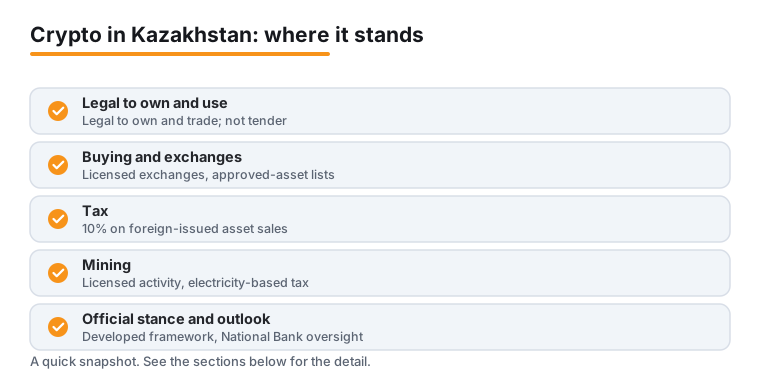
- Legal: Legal to own and trade, not legal tender, payments generally banned
- Tax: Sale income taxed, mining a taxable event, sales VAT-exempt
- Buying: Via AIFC or National Bank licensed exchanges, approved assets only
Kazakhstan has built one of Central Asia's most developed legal frameworks for cryptocurrency. Owning, trading and mining digital assets are permitted, but each activity sits inside a system of licensing, registration and anti-money-laundering rules that has been reshaped repeatedly in 2025 and 2026. This page explains the current state of Kazakhstan crypto regulation in plain terms: what is legal, who the regulators are, how exchanges and mining are licensed, how crypto is taxed, and where to verify the rules.
Crypto is not legal tender in Kazakhstan, and using cryptocurrency to pay for goods and services is generally not permitted across the country, although a limited pilot has been announced. The country has positioned itself as a regional hub for regulated digital-asset businesses and large-scale mining, originally anchored in the Astana International Financial Centre (AIFC) and now moving toward a nationwide framework supervised by the National Bank of Kazakhstan. Because the legal picture is still being implemented through new laws and by-laws, treat the details below as a starting point and confirm anything that affects you with the official sources named at the end of this page.
This article is general information as of 2026 and is not legal, tax or financial advice. Always verify the current position with the National Bank of Kazakhstan and the other named regulators before acting. For broader context, see our overview of crypto regulation.
On this page: Legal status · Who regulates it · Taxes · How to buy · Mining
Is Bitcoin and crypto legal in Kazakhstan?
Yes. Buying, holding and selling Bitcoin and other cryptocurrencies is legal for residents of Kazakhstan, and mining is permitted under a licensing regime. However, crypto does not have the status of money or legal tender, and using cryptocurrency to pay for goods and services is generally prohibited across the country. You cannot require anyone to accept it as payment.
Kazakh law divides digital assets into categories. So-called unsecured (or unbacked) digital assets, such as Bitcoin, are treated as property that can be owned and traded, but their circulation is restricted to licensed venues. Separately, the 2026 reforms introduced a new class of secured instruments known as digital financial assets (DFAs), which include stablecoins, tokenised real-world assets and financial instruments issued in digital form. DFAs are handled under banking and financial-services rules. Under the framework that took effect on 1 May 2026, unsecured digital assets such as Bitcoin are explicitly not recognised as a means of payment, a financial instrument or a financial asset in Kazakhstan.
The practical takeaway: it is legal to own crypto and to trade it through authorised channels, but you should not assume you can spend it freely in shops or use it interchangeably with the national currency, the tenge. Using only licensed, compliant platforms is the safest way to stay on the right side of the rules.
Who regulates crypto in Kazakhstan
Oversight is shared among several public bodies, and responsibilities shifted significantly with the 2025 and 2026 reforms:
- National Bank of Kazakhstan (NBK): Now the primary regulator for digital assets nationwide. It maintains registers of platform and exchange operators, sets licensing requirements, capital and infrastructure standards, and supervises anti-money-laundering compliance. Its official digital-assets page is the best starting point for current rules.
- Agency for Regulation and Development of the Financial Market (ARDFM): Regulates the turnover of digital financial assets, with the exception of stablecoins, which are handled by the National Bank. It sets requirements for the issuance and circulation of DFAs backed by an underlying asset, and supervises financial organisations, including banks that serve crypto exchanges.
- Astana Financial Services Authority (AFSA): The independent regulator inside the Astana International Financial Centre (AIFC). It authorises and supervises digital-asset trading facilities and custody providers under the AIFC's own English-law-based rulebook.
- Financial Monitoring Agency: Kazakhstan's financial intelligence unit, which leads anti-money-laundering and counter-terrorist-financing analysis and receives suspicious-transaction reports.
- Ministry of Artificial Intelligence and Digital Development: Responsible for licensing digital miners.
Because the division of duties is still being fine-tuned through by-laws, check the current allocation with the National Bank of Kazakhstan before relying on any specific point.
Key laws and frameworks
Kazakhstan has historically operated a dual system: a national regime, and a separate AIFC regime with its own rules. Recent reforms are pulling more activity into the national framework. Key legislative milestones include:
- 2020: Mining of cryptocurrencies recognised in law as a legitimate activity.
- 2023: The Law on Digital Assets in the Republic of Kazakhstan, No. 193-VII, dated 6 February 2023, took effect on 1 April 2023. It classified digital assets, defined mining as a licensed activity, and generally restricted the circulation of unsecured assets such as Bitcoin to exchanges licensed within the AIFC.
- 2025: Further amendments, including changes adopted in late 2025, repealed the earlier mandatory-sale rule for miners and advanced plans to open regulated crypto activity beyond the AIFC. The National Bank launched a regulatory sandbox on 30 June 2025 for controlled testing of digital-asset projects.
- 2026: Law No. 259-VIII of 16 January 2026, on regulation and development of the financial market, communications and bankruptcy, introduced digital financial assets (DFAs) as a regulated class, established the licensed digital asset service provider regime, confirmed the National Bank as the primary overseer of digital-asset issuance and circulation outside the AIFC, and added Article 47-2 to the National Bank Law recognising the digital tenge as a digital form of the national currency with effect from 18 July 2026. The comprehensive framework governing the circulation of digital assets outside the AIFC came into force on 1 May 2026, from which date the National Bank began licensing unsecured digital-asset exchange operators and registering operators of digital-asset and DFA trading platforms.
Note that Kazakhstan is not an EU member, so the EU's Markets in Crypto-Assets (MiCA) regulation does not apply here; the framework is entirely domestic. Several elements of the newer rules are still being implemented through regulations and by-laws, so timing and detail can shift. The official consolidated text of the 2023 law is published on the government's Adilet legal information system.
Licensing and registration of exchanges (VASPs)
The legality of trading depends heavily on the venue. For several years, the clearest lawful route was an exchange licensed within the AIFC and supervised by AFSA. Under the 2025 and 2026 reforms, the National Bank operates a national licensing regime, in force from 1 May 2026, so that approved exchanges can operate more broadly outside the AIFC, and it maintains registers of platform and exchange operators. From that date, unsecured digital-asset exchange operators apply for a National Bank licence, while operators of digital-asset and DFA trading platforms register with the National Bank.
What licensed operators face:
- Authorisation before operating: Platforms that want to serve Kazakhstan must obtain regulatory approval before listing assets or onboarding customers. Several large international exchanges have pursued authorisation linked to the AIFC.
- Approved-asset lists: Only crypto assets approved by the National Bank may be traded on exchanges based in the country, so the range of coins on a domestic-licensed venue can be narrower than on global platforms.
- Capital and conduct requirements: Within the AIFC, an operator of a digital-asset trading facility must meet a minimum capital requirement set at the higher of around USD 200,000 or enough working capital to run the business for twelve months, alongside custody, market-conduct and investor-protection obligations.
- Ongoing supervision: Licensed firms must maintain compliance, risk-management, cybersecurity and client-asset-protection policies.
You can review the AIFC trading-facility requirements on the Astana Financial Services Authority (AFSA) website. Using offshore platforms that are not authorised for Kazakhstan can leave you outside consumer protections and may create compliance and tax complications.
Crypto taxation in Kazakhstan
Crypto-related income is taxable, and the treatment was clarified in the recent reforms. The points below reflect the general position as of 2026, but rates, thresholds and methods can change, so confirm your own situation with the tax authorities or a qualified adviser.
- Individuals selling crypto: Income from the sale of a digital asset issued by a foreign issuer is generally subject to individual income tax at a rate of 10%. Under Article 389 of Tax Code No. 214-VIII, in force since 1 January 2026, taxable income arises when a digital asset is sold or transferred as a contribution to charter capital, and equals the positive difference between the disposal price and the documented initial cost. Article 389 sets no exemption keyed to the issuer's country. If you cannot document what you paid, or the asset came from a state with preferential taxation, the initial cost is treated as zero and the whole disposal price becomes the taxable amount, so keep purchase records.
- Mining as a taxable event: Receiving digital assets through mining is treated as generating income for tax purposes. For legal entities, mining income is reported as taxed at the standard corporate rate of 20%. For individual entrepreneurs, mining income falls under the progressive individual income tax scale that began on 1 January 2026: 10% on annual income up to 8,500 MCI and 15% on the amount above that threshold.
- Digital mining fee (electricity): Miners pay a digital mining fee of KZT 2 per kilowatt-hour of electricity consumed. A reduced rate of KZT 1 per kilowatt-hour applies where the electricity comes from renewable sources at the taxpayer's own power plants, or from generating units not connected to the unified power system of Kazakhstan. A penalty rate of KZT 25 per kilowatt-hour applies where the miner has no digital mining licence, has no electricity metering devices, or where those devices are faulty.
- Valuing digital assets: The Rules for Determining the Value of Digital Assets took effect on 1 January 2026. They broaden the list of digital assets subject to valuation and set a single methodology for valuing digital assets that are not on that list.
- VAT: From 1 January 2026 the VAT exemption is narrowed to services provided by digital asset exchanges licensed by the AIFC. Other digital asset transactions fall under the standard VAT rate, which rose from 12% to 16% on the same date. Mining pools must report distributions to participants to the tax authorities by the 25th of the month following the reporting month.
Keep detailed records of purchases, sales, transfers and mining output. For a general primer on how crypto is taxed, see our guide to crypto taxes, and confirm the current Kazakh figures with a professional.
AML and KYC rules
Anti-money-laundering and counter-terrorist-financing (AML/CFT) obligations sit at the centre of Kazakhstan's regime. The Financial Monitoring Agency acts as the country's financial intelligence unit and receives suspicious-transaction reports, while the National Bank, ARDFM and AFSA each supervise compliance within their areas.
If you use a licensed platform, expect requirements comparable to those at a bank:
- Identity verification (KYC): You will need to verify your identity and, in many cases, the source of your funds before trading.
- Customer due diligence: Licensed firms apply a risk-based approach with customer due diligence, beneficial-owner verification and ongoing transaction monitoring.
- Sanctions screening: Clients are screened against relevant sanctions and watchlists.
- Reporting: Operators must report suspicious transactions to the Financial Monitoring Agency and maintain internal AML/CFT, KYC, data-protection and client-asset-security policies.
These rules exist to keep transfers transparent and lawful, and they apply on both the on-ramp and off-ramp sides of any trade.
Buying and using crypto in practice
Residents can buy crypto, but choosing a venue authorised to serve Kazakhstan matters. A typical lawful path looks like this:
- 1. Choose a compliant platform. Look for an exchange licensed within the AIFC or under the National Bank's national regime, or a reputable global exchange that openly supports Kazakhstan.
- 2. Complete identity verification. Provide identification and, where requested, proof of source of funds, in line with KYC and AML rules.
- 3. Fund your account. Deposit tenge by bank transfer or card, subject to your bank's policies and the platform's accepted methods.
- 4. Place your order. Buy a permitted asset, watching fees and the spread between buy and sell prices.
- 5. Secure your holdings. For larger amounts, consider a wallet you control and protect your recovery phrase. Keep records for tax purposes.
Remember that everyday payments in crypto are generally not allowed across the country. A limited pilot project (a planned digitalised city, referred to as CryptoCity in the Alatau area) has been announced where crypto payments may be tested, but for most people crypto remains an asset to hold and trade rather than a means of payment. Start small while you learn a platform, and never share private keys or recovery phrases with anyone.
Bitcoin mining in Kazakhstan
Mining is one of the areas where Kazakhstan has been most active. Historically low electricity costs and abundant generating capacity made the country a major global mining destination, which strained the power grid and prompted tighter controls. Today, mining is a licensed activity.
- Licensing and registration: Commercial miners must obtain a licence from the Ministry of Artificial Intelligence and Digital Development, mining pools require accreditation, and hardware and operations are registered.
- Energy charges: Miners pay a fee on electricity consumed, reported at KZT 2 per kilowatt-hour and reduced to KZT 1 per kilowatt-hour for renewable energy or own generation, designed to manage grid demand and encourage cleaner power. A penalty rate of KZT 25 per kilowatt-hour applies where the miner has no digital mining licence, has no electricity metering devices, or where those devices are faulty. Grid pressure has also led to rationing and power cuts for miners at peak times.
- Taxation: Mining income is taxable, and the act of receiving mined assets is itself a taxable event. Confirm current rates with the tax authorities.
- Sale of mined coins: Earlier rules required miners to sell a large share of output through AIFC-linked exchanges. Reforms in 2025 repealed this mandatory-sale requirement, giving miners more freedom over how and where they sell. Verify the latest position before relying on this.
Anyone planning a mining operation should budget carefully for energy charges and licensing obligations, and obtain current legal and tax guidance before committing capital.
Recent developments (2025 to 2026)
Kazakhstan's direction of travel has been toward broader, more formalised crypto adoption rather than prohibition. Notable recent moves include:
- Digital financial assets in banking law: The January 2026 amendments brought DFAs, including stablecoins and tokenised assets, into the financial framework under National Bank oversight.
- Repeal of the mandatory-sale rule: Miners are no longer required to sell a fixed share of output through licensed exchanges.
- Regulatory sandbox: The National Bank launched a sandbox on 30 June 2025 to test digital-asset projects before full rollout.
- National crypto reserve: The authorities have discussed a state digital-asset fund, managed by a National Bank investment vehicle, to hold a strategic reserve of digital assets, partly funded by assets seized in criminal cases.
- CryptoCity pilot: A plan was announced for a digitalised city in the Alatau area where residents could use crypto payments, despite the general nationwide ban on crypto payments. Alatau is an urban area of roughly 52,000 residents in southeastern Kazakhstan. Binance Kazakhstan and Alatau City Bank have shown a live crypto payment flow that lets a user pay with digital assets and settle instantly in local currency.
- Framework in force from 1 May 2026: The national regime for licensing exchanges and registering trading platforms outside the AIFC took effect on 1 May 2026, moving the country from a mainly AIFC-based system toward nationwide supervision by the National Bank.
Most of these now have a named instrument and a date. The two exceptions to watch are the three-year individual income tax exemption on crypto gains, which is still a draft Tax Code amendment in public consultation and had not been submitted to parliament as of early August 2026, and the approach to regulating decentralised finance, which the National Bank has been directed to develop but has not yet published.
Consumer risks and protection
Crypto remains a high-risk area, and Kazakhstan's framework is still maturing. Weigh these risks before committing money:
- Volatility: Crypto prices can rise and fall sharply over short periods. Only consider money you can afford to lose.
- Regulatory change: Rules on approved assets, exchange licensing and taxation can change with relatively short notice while the new framework beds in.
- Unlicensed operators and scams: Fraudulent schemes and platforms that are not authorised for Kazakhstan are a real hazard. Favour providers that are transparent about their licensing status, ideally listed in the National Bank's registers or licensed by AFSA.
- Custody and security: You are responsible for safeguarding your holdings. Lost keys, scams and exchange failures are real risks; use reputable custody and strong security practices.
- Outside the protected perimeter: Using offshore or unlicensed venues can leave you without local consumer protections and create tax and compliance complications.
Consumer protection is strongest when you stay within the licensed perimeter and keep clear records of every transaction.
Official sources and how to verify
Because the rules are evolving, always confirm the current position with primary sources rather than secondary summaries. The most authoritative starting points are:
- National Bank of Kazakhstan, Regulation of the digital assets market, for the national framework, registers and licensing.
- Astana Financial Services Authority (AFSA), for licensing and supervision of digital-asset firms inside the AIFC.
- Adilet legal information system: Law on Digital Assets No. 193-VII (2023), for the consolidated text of the core law.
For background reading, see our explainers on crypto regulation and crypto taxes, and browse country guides on our regulation hub. This page is general information as of 2026 and is not legal, tax or financial advice; verify anything that affects you with the National Bank of Kazakhstan and the other named regulators, or consult a qualified local adviser.
What is changing: Kazakhstan crypto rules in August 2026
The national framework that started on 1 May 2026 has now produced its first real licences, and three further things moved during July 2026.
- 7 July 2026, presidential decree. The President signed a decree titled On measures to stimulate and develop the digital asset industry in the Republic of Kazakhstan. The National Bank described it the following day as the move from building a legal base to running practical projects, listing stablecoin based cross border payments, tokenised government bonds, an approach to regulating decentralised finance, expansion of Alatau City digital infrastructure and wider cooperation with the AIFC. A medium term development plan was still being drafted at that point, and the National Bank statement of 8 July 2026 gave no completion dates.
- 18 July 2026, digital tenge became legal tender. The digital tenge is now a legal form of the national currency alongside cash and non cash money, issued solely by the National Bank and distributed through banks and licensed payment providers. From August 2026 the government pays for public procurement of goods such as medicines and fuel in digital tenge, and mandates it for eight budget expenditure categories on projects above KZT 100 million. Around 340 billion digital tenge had been issued. See The Astana Times and its report on the August rollout.
- 1 August 2026, strategic digital mining programme. Government Resolution No. 638 of 18 July 2026 took effect, giving very large miners capped electricity tariffs in return for handing 10% of net output to the national crypto reserve.
None of this changes the answer for an ordinary holder. Buying, holding and selling crypto is legal through authorised venues. Paying for goods and services with an unsecured digital asset such as Bitcoin is still not permitted, and the tenge, now including its digital form, is the only legal tender. What is genuinely new is that there are named licence holders you can check, and a tax break sitting in draft.
Legislation adopted and in progress
This is the pipeline as it stands in early August 2026. Anything marked draft has not been adopted and should not be relied on.
| Instrument | Stage | What it does | Timing |
|---|---|---|---|
| Law No. 259-VIII of 16 January 2026 amending financial market, communications and bankruptcy legislation | In force | Creates digital financial assets as a regulated class, establishes the licensed digital asset service provider regime under the National Bank outside the AIFC, and adds Article 47-2 to the National Bank Law recognising the digital tenge as a digital form of the national currency | Digital asset framework from 1 May 2026; digital tenge from 18 July 2026 |
| National Bank resolution of 10 April 2026, stablecoin issuance rules | In force | Issuers must be a joint stock company or limited liability partnership with own capital of at least KZT 200 million, 100% backing in money before issuance, no yield paid, no redemption fee, maximum 50% of reserves in liquid low risk instruments such as government securities and first tier bank deposits | From 1 May 2026 |
| National Bank resolution of 29 April 2026, rules for operators of exchange of unsecured digital assets | In force | Sets the licence application route and ongoing notification duties for domestic exchanges and exchange offices | From 1 May 2026; updated licensing procedure from 12 July 2026 |
| Tax Code No. 214-VIII of 18 July 2025 | In force | Article 389 taxes the gain on disposal of digital assets, VAT rises to 16%, the digital asset VAT exemption narrows to AIFC licensed exchange services, individual income tax moves to a 10% and 15% progressive scale | From 1 January 2026 |
| Presidential decree of 7 July 2026 on stimulating the digital asset industry | In force | Directs stablecoin cross border settlement, tokenised government bonds, a DeFi regulatory approach, Alatau City infrastructure and closer AIFC cooperation | Delivery through a National Bank medium term plan and a separate action plan; no public deadlines published in the National Bank statement |
| Government Resolution No. 638 of 18 July 2026, Rules for conducting strategic digital mining | In force | Capped electricity tariffs for up to ten years in exchange for 10% of net mined output going to the National Strategic Crypto Reserve | From 1 August 2026 |
| Draft Tax Code amendments exempting individuals from income tax on digital asset gains | Draft, in public consultation | Would remove individual income tax on crypto gains where the transaction goes through a Kazakh licensed digital asset service provider, part of a 45 amendment package | Proposed to cover 1 January 2026 to 31 December 2028; published for consultation on 2 July 2026; not yet submitted to parliament |
Sources for this table: the National Bank digital assets framework page, its announcement of 30 April 2026 on the regime starting 1 May 2026, reporting on Resolution No. 638, and Informburo on the draft tax exemption.
Who holds a National Bank licence so far
The register is small and easy to check, which matters because an unlicensed platform claiming Kazakh authorisation is a common scam pattern. As of the start of August 2026 the named entrants are:
- KASE (Kazakhstan Stock Exchange). Registered on 20 May 2026 as both an operator of a digital financial assets platform and an operator of a digital asset trading platform, the country's first digital asset platform operator. Reported by The Astana Times.
- Pax Finance. Astana based, granted the country's first licence for exchange of unsecured digital assets on 2 July 2026. The licence covers buying, selling and holding digital assets, opening exchange offices and installing crypto ATMs. Reported by Kursiv.
- AUSU. Shymkent based, granted licence No. 1726001O on 30 July 2026, the second such licence issued nationwide. Its ausu.kz platform quotes USDT, BTC, ETH, SOL and XRP against the tenge with a minimum transaction of KZT 1,000. Reported by CNews.
That is two licensed exchange operators outside the AIFC and one registered platform operator. AIFC licensed venues supervised by AFSA continue to operate under their own rulebook. If a platform tells you it is licensed in Kazakhstan, confirm it appears in the National Bank registers before depositing anything.
Strategic digital mining from 1 August 2026
Government Resolution No. 638 of 18 July 2026 approved the Rules for conducting strategic digital mining, which took effect on 1 August 2026. This creates a second, optional tier above ordinary licensed mining, aimed only at very large operators.
To qualify for strategic digital miner status an applicant must show:
- An own data centre for digital mining with capacity of at least 150 MW
- Mining equipment with a hashrate of at least 150 TH/s per unit
- Connection through a transformer substation of 35 kV or above, with at least 1 MW of approved capacity
- No arrears on taxes or other budget payments, and no liens, seizures or restrictions on the property
- Contracts with at least two telecom operators for data transmission, and an on site repair centre with staff certified by the equipment manufacturer
In return, an approved strategic miner may buy electricity at a price not exceeding the producing organisation's ceiling tariff, under supply contracts of up to ten years. The counter obligation is a transfer in kind: 10% of the digital assets remaining after the cost of purchasing and transmitting the electricity consumed, handed over by the 25th of the month following the reporting period to the Astana Hub autonomous cluster fund. Astana Hub passes those assets to the National Investment Corporation of the National Bank, which holds them in trust for the National Strategic Crypto Reserve. The opening quota is 300 MW supplied by Ekibastuz GRES-1.
Applications are checked for completeness by the authorised body within three working days, assessed by a commission attached to the Ministry of Artificial Intelligence and Digital Development within five working days, and the applicant is notified within two further working days. Details are set out in Zakon.kz and in Kursiv. Nothing here changes the position of small and mid sized miners, who remain on ordinary licensing and the standard digital mining fee.
Frequently asked questions
Is cryptocurrency legal in Kazakhstan?
Yes. Owning, buying, selling and mining cryptocurrency is legal under a licensing and registration framework. However, crypto is not legal tender, and using it to pay for goods and services is generally prohibited across the country, aside from a limited announced pilot. The safest approach is to use platforms authorised to serve Kazakhstan. This is general information, not legal advice.
Who regulates crypto in Kazakhstan?
The National Bank of Kazakhstan is now the primary regulator for digital assets nationwide, maintaining registers of exchange and platform operators. The Agency for Regulation and Development of the Financial Market (ARDFM) sets rules for certain backed digital financial assets, the Astana Financial Services Authority (AFSA) supervises firms inside the AIFC, and the Financial Monitoring Agency handles anti-money-laundering oversight. Mining is licensed by the Ministry of Artificial Intelligence and Digital Development.
How is crypto taxed in Kazakhstan?
As of 2026, individual income from selling a digital asset issued by a foreign issuer is generally taxed at 10%, while income from a Kazakh-issued asset has been reported as exempt. Mining is a taxable event, miners pay a digital mining tax of about KZT 2 per kilowatt-hour (KZT 1 for renewable energy), and the sale of digital assets has been reported as VAT-exempt. Confirm current figures with the tax authorities or a qualified tax professional.
Can I mine Bitcoin in Kazakhstan?
Yes, but mining is a licensed activity. Commercial miners need a licence from the Ministry of Artificial Intelligence and Digital Development, mining pools require accreditation, and operations are registered. Miners pay an electricity-based tax, with a lower rate for renewable energy. The earlier rule requiring miners to sell a large share of output through AIFC-linked exchanges was repealed in 2025. Verify current licensing and tax requirements before starting.
Can I pay for things with crypto in Kazakhstan?
Generally no. Crypto is not legal tender, and using cryptocurrency to pay for goods and services is prohibited across the country. A limited pilot has been announced for a planned digitalised city (referred to as CryptoCity in the Alatau area) where crypto payments may be tested, but for most people crypto remains an asset to hold and trade rather than a means of payment. Check the current position with the National Bank of Kazakhstan.
Are crypto exchanges restricted to the AIFC?
Historically, most legal trading was concentrated in AIFC-licensed exchanges supervised by AFSA. The 2025 and 2026 reforms moved toward a national licensing regime under the National Bank, which maintains registers of exchange and platform operators and approves which assets may be listed. The set of permitted coins and authorised venues can differ between domestic-licensed platforms and global exchanges, so check a provider's status before using it.
When did Kazakhstan's national crypto framework take effect?
The comprehensive framework governing the circulation of digital assets outside the AIFC came into force on 1 May 2026, under Law No. 259-VIII dated 16 January 2026. From that date the National Bank of Kazakhstan began licensing unsecured digital-asset exchange operators and registering operators of digital-asset and DFA trading platforms. Some by-laws are still being implemented, so confirm current detail with the National Bank.
Are stablecoins regulated differently in Kazakhstan?
Yes. Stablecoins are treated as a type of digital financial asset (DFA). The turnover of DFAs is generally regulated by the Agency for Regulation and Development of the Financial Market (ARDFM), but stablecoins are handled by the National Bank of Kazakhstan rather than the ARDFM. Rules for DFAs sit within the banking and financial-services framework rather than the rules for unsecured assets such as Bitcoin.
Is Bitcoin a means of payment or a financial instrument in Kazakhstan?
No. Under the framework in force from 1 May 2026, unsecured digital assets such as Bitcoin are not recognised as a means of payment, a financial instrument or a financial asset. They can be owned and traded through authorised venues as a form of property, but you cannot require anyone to accept them as payment. A limited pilot in the Alatau area has been announced to test crypto payments.
Is Kazakhstan scrapping income tax on crypto profits?
Not yet. A draft amendment to the Tax Code would exempt individuals from individual income tax on income from digital asset operations for the period 1 January 2026 to 31 December 2028, but only where the transactions go through a Kazakh licensed digital asset service provider. It was published for public consultation on 2 July 2026 as part of a 45 amendment package and had not been submitted to parliament as of early August 2026. Until it is adopted, the existing individual income tax rules apply.
How is crypto taxed when I sell it in Kazakhstan in 2026?
Article 389 of Tax Code No. 214-VIII, in force since 1 January 2026, taxes the gain rather than the gross proceeds: the positive difference between the disposal price and your documented acquisition cost. If you cannot document what you paid, or the asset came from a state with preferential taxation, the initial cost is treated as zero and the full disposal price becomes the taxable amount, so keep exchange statements and purchase records. Article 389 itself sets the taxable amount but not the rate. Individual income tax since 1 January 2026 runs on a progressive scale of 10% on annual income up to 8,500 MCI and 15% above that. Confirm your own position with the State Revenue Committee or a Kazakh tax adviser.
Which crypto exchanges are licensed by the National Bank of Kazakhstan?
As of early August 2026 two companies hold a National Bank licence for exchange of unsecured digital assets: Pax Finance in Astana, licensed on 2 July 2026, and AUSU in Shymkent, licensed on 30 July 2026 under licence No. 1726001O. KASE, the Kazakhstan Stock Exchange, registered on 20 May 2026 as an operator of a digital financial assets platform and of a digital asset trading platform. AIFC licensed venues supervised by AFSA operate separately under the AIFC rulebook. Check the National Bank registers before using any platform that claims Kazakh authorisation.
Is the digital tenge the same as cryptocurrency?
No. The digital tenge is a central bank digital currency issued only by the National Bank of Kazakhstan, and since 18 July 2026 it is a legal form of the national currency alongside cash and non-cash money. Bitcoin and other unsecured digital assets are not legal tender and cannot be used to pay for goods and services. Digital tenge accounts cannot be opened as savings accounts, they support smart contracts that restrict what the money can be spent on, and they can be seized or restricted on the same basis as ordinary bank accounts. From August 2026 the government uses digital tenge for public procurement and for eight budget expenditure categories on projects above KZT 100 million.
What changed for crypto miners on 1 August 2026?
Government Resolution No. 638 of 18 July 2026 introduced strategic digital miner status, effective 1 August 2026. It applies only to operators with an own data centre of at least 150 MW, equipment of at least 150 TH/s per unit and connection through a substation of 35 kV or above with at least 1 MW of approved capacity. Those approved can buy electricity at no more than the producer's ceiling tariff under contracts of up to ten years, and must transfer 10% of the digital assets left after electricity purchase and transmission costs by the 25th of the following month to the Astana Hub fund for the National Strategic Crypto Reserve. Smaller miners are unaffected and remain on ordinary licensing and the standard KZT 2 per kilowatt-hour fee.
Facts reviewed: 5 August 2026. Page updated: 5 August 2026.