Home › Crypto Regulation › Armenia
Bitcoin & Cryptocurrency Regulation in Armenia
Quick answer — Armenia, 2026
- Legal: Legal to own and trade, not legal tender; providers licensed by CBA
- Tax: Individuals largely untaxed on trading; companies pay 18% profit tax
- Buying: Via exchanges, licensed providers, P2P or capped cash
Armenia has moved from a lightly regulated grey zone to one of the most clearly defined crypto jurisdictions in its region. In 2025 the National Assembly adopted a dedicated Law on Crypto-Assets (HO-159-N), modeled on the European Union's Markets in Crypto-Assets (MiCA) regulation, and the first package of supporting rules from the Central Bank of Armenia took effect on 31 January 2026. The result is a framework where owning and using cryptocurrency remains legal for individuals, while businesses that provide crypto services to the public must now be registered and licensed by the Central Bank and meet capital, governance, and anti-money-laundering obligations. This guide explains the current legal status, who regulates the sector, how tax generally works, and the practical realities of buying, sending, mining, and investing in Bitcoin in Armenia as of 2026.
This article is general information as of 2026 and is not legal, tax, or financial advice. Armenia's crypto rules are new and still being implemented in stages, so always verify current requirements with the Central Bank of Armenia and the State Revenue Committee, and consult a qualified local professional before acting. See also our overview of crypto regulation.
On this page: Legal status · Who regulates it · Taxes · How to buy · Mining
Is Bitcoin and crypto legal in Armenia?
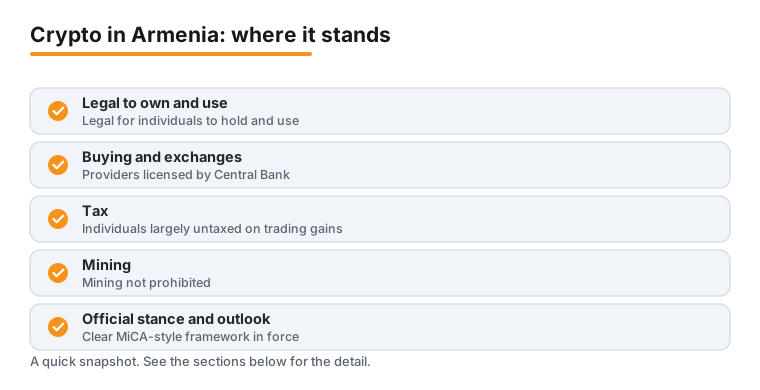
Yes. Buying, holding, selling, and using Bitcoin and other crypto-assets is legal for individuals in Armenia. There is no ban on personal ownership, and residents can trade on domestic or international platforms.
Two qualifications apply:
- Crypto is not legal tender. The Armenian dram (AMD) remains the only official currency. Merchants are not obliged to accept crypto, and crypto cannot be used to discharge tax or other obligations to the state.
- Crypto-assets are recognised as a distinct category of asset rather than as money or a conventional security. The Law on Crypto-Assets defines the asset classes and the services around them, which shapes how they are issued, offered, and traded.
The major change in 2025 and 2026 has been on the business side. Companies that provide crypto services to the public, such as exchanges, exchange points, brokers, and custodians, now fall under a Central Bank licensing regime rather than operating informally. For broader context on how countries approach this, see our crypto regulation guide.
Who regulates crypto in Armenia?
The primary regulator is the Central Bank of Armenia (CBA). Under the Law on Crypto-Assets, the CBA is the authorised body for regulating and supervising the crypto-asset market. It licenses and registers crypto-asset service providers, issues the detailed secondary (implementing) regulations, sets capital and governance thresholds, and enforces compliance, including the power to audit providers at any time.
Tax matters fall to the State Revenue Committee (SRC) of the Republic of Armenia, which administers the Tax Code and has been holding consultations with industry on how crypto activity is taxed and reported. The two bodies have complementary roles: the CBA supervises market conduct and licensing, while the SRC handles taxation and reporting.
You can verify rules directly with the regulator at the Central Bank of Armenia and check tax guidance with the State Revenue Committee of Armenia.
Key laws and frameworks
Armenia's crypto framework is built on its Law on Crypto-Assets (HO-159-N). The National Assembly adopted the law on 29 May 2025, and it entered into force on 4 July 2025. The law is broadly modeled on the EU's MiCA regulation, making Armenia among the first countries in the South Caucasus to put a comprehensive, standalone crypto regime in place rather than relying on patchwork guidance.
The law alone set the architecture; the operational detail came from the Central Bank. The first package of CBA implementing regulations was published on 21 January 2026 and entered into force on 31 January 2026. The package published on 21 January 2026 contained four regulations: Regulation 7/01 governing licensing (authorisation) and the acquisition of a qualifying holding, Regulation 7/02 on minimum total capital requirements, Regulation 7/05 on the registration of managers (fit-and-proper), and Regulation 7/04 on the form and content of the crypto-asset offer document.
The law was also amended in late 2025 to address transitional arrangements, including the treatment of cash-based crypto transactions. Because the rulebook is being rolled out in stages, the exact obligations for any given activity should be checked against current CBA publications.
Licensing and registration of exchanges and providers
Any legal entity that intends to provide crypto-asset services to the public in Armenia must be registered and licensed by the Central Bank before starting operations. The Law on Crypto-Assets defines ten categories of regulated services, broadly covering:
- operating a crypto-asset trading platform;
- custody and administration of crypto-assets on behalf of clients;
- buying or selling crypto-assets on the provider's own account;
- buying or selling crypto-assets on behalf of clients;
- transmitting orders for crypto-assets;
- placement of crypto-assets;
- crypto-asset portfolio management;
- providing advice on crypto-assets;
- transfer (execution of transfers) of crypto-assets; and
- issuance of asset-referenced tokens.
A single licence can cover one or more (or all) of these activity types, is granted for an indefinite term, and is non-transferable; each licence specifies the services authorised. To be licensed, the entity must complete CBA registration, meet capital requirements that vary by service type, maintain written internal policies and procedures, and complete a managers' registration (fit-and-proper) process. Reported minimum capital requirements range from roughly the equivalent of 30,000 US dollars to about 530,000 US dollars depending on the activity; treat any single figure as indicative and confirm the current threshold with the CBA.
Transition period: firms that were already providing crypto-asset services before the law took effect (4 July 2025) generally have until 31 January 2027 to obtain a licence or cease operations. Issuers or distributors that had previously made public offerings were required to publish compliant offer documents within a short transitional window. Lighter-touch activities, such as advice, face less intensive supervision than custodial or exchange operations.
Crypto and Bitcoin tax in Armenia
Armenia is widely described as relatively tax-friendly toward crypto for individuals, but the picture differs sharply between personal and business activity, and the rules are still being clarified. The following reflects what is commonly reported as of 2026, not a guarantee for your situation.
- Individuals (non-entrepreneurs): gains from standard crypto-asset trading are reported as not subject to income tax. Income from mining, staking, or NFTs is reported as taxed at a low rate (commonly cited as around 1 percent on alienation). Acting as a business changes this.
- Companies: profits from crypto activity are generally subject to the standard profit (corporate income) tax, reported at 18 percent on taxable profit. Licensed providers are reported to be excluded from simplified, turnover, or micro-enterprise tax regimes.
- VAT: the alienation (sale) of crypto-assets is reported as VAT-exempt, while service fees such as exchange commissions, custody, and brokerage charges can attract standard VAT (20 percent).
- Reporting: Armenia has committed to the OECD Crypto-Asset Reporting Framework (CARF), with automatic exchange of crypto account information expected to take effect around 2027, and the SRC has been consulting industry on documentation and reporting.
Because treatment depends on your residency, whether activity is personal or a business, and the type of token, we avoid presenting any rate as definitive. Confirm your position with the State Revenue Committee or a qualified Armenian tax adviser, and keep clear records of acquisition costs, disposals, and the value of any crypto received as income. For general background see our crypto taxes guide. This is not tax advice.
AML, KYC, and reporting obligations
The Law on Crypto-Assets brings licensed providers fully within Armenia's anti-money-laundering and counter-terrorist-financing (AML/CFT) regime. In practice, licensed crypto-asset service providers are expected to:
- identify and verify customers (KYC) before providing services;
- monitor transactions on an ongoing basis and file suspicious activity reports;
- keep records of transactions and customer identification data;
- maintain risk-management, governance, and internal control policies; and
- report periodically to the Central Bank, which can audit compliance at any time.
These obligations align with international AML/CFT standards and mirror the direction of MiCA-style supervision in Europe. For everyday users this means that buying or cashing out through a licensed provider will involve identity verification, and large or unusual transactions may be scrutinised.
On the enforcement side, the State Revenue Committee announced in 2024 that it would acquire blockchain-analysis software from the US firm Chainalysis to monitor crypto-asset transactions, with a reported budget of 85 million drams. This signals that tax and compliance authorities are building tools to trace on-chain activity, so keeping accurate records is prudent.
Buying and using crypto in practice
There are several practical routes to acquiring crypto in Armenia. With any regulated provider, expect to complete identity verification (KYC).
- Centralised exchanges. Many Armenians use established international exchanges that support card or bank-transfer funding. As the CBA regime matures, watch which platforms are licensed or registered to serve Armenian customers.
- Local and licensed providers. Domestic businesses operating under, or applying for, CBA authorisation offer buying and selling with formal compliance in place.
- Peer-to-peer (P2P). P2P marketplaces let buyers and sellers trade directly. They can be convenient but carry higher counterparty risk; use escrow features and deal only with well-rated counterparties.
- Cash and exchange points. Cash crypto purchases are permitted only under restrictions, including mandatory customer identification and a per-transaction cap of 300,000 drams, in place only until the end of 2026 (roughly a few hundred US dollars). A transitional authorisation for cash transactions was reported as extended into 2026; verify the current limit and end date with the CBA.
A typical first-time path: choose a reputable, compliant platform; complete KYC; fund the account; place an order; then move significant holdings to a wallet you control. Always double-check withdrawal addresses and enable two-factor authentication. Crypto is not legal tender, so merchants are never obliged to accept it.
Sending remittances with crypto
Remittances are economically significant for Armenia, with substantial inflows from its global diaspora and from Armenians working abroad. That makes the cost and speed of cross-border transfers a real concern, and it is one reason Bitcoin and stablecoins attract attention as transfer rails.
A borderless crypto transfer can settle quickly and may avoid some layered intermediary fees, but the benefits are nuanced:
- On- and off-ramp costs add up. Moving crypto between wallets is cheap, but converting to and from drams at each end carries exchange spreads and fees that can erode savings, especially on small amounts.
- Volatility risk. Holding value in Bitcoin during transfer exposes both parties to price swings; many users favour stablecoins to reduce this, though stablecoin and asset-referenced-token activity is itself a focus of the new rules.
- Compliance at the edges. Cashing out through a licensed provider means identity checks and record-keeping; informal routes may be cheaper but carry legal and counterparty risk.
Crypto can be a useful remittance tool for tech-comfortable users, particularly for larger transfers, but it is not automatically cheaper than established services once conversion costs and risk are counted. Compare the all-in cost for your corridor and amount.
Bitcoin mining in Armenia
Bitcoin mining is not prohibited in Armenia, and the country has periodically attracted miner interest thanks to its energy mix and developing technology sector. Several factors shape the picture:
- Electricity is the key variable. Mining profitability hinges on power costs and supply reliability. Armenia draws on nuclear, hydro, and thermal generation, but miners should evaluate current tariffs and grid stability before committing capital.
- Business and tax obligations. Mining at meaningful scale is an economic activity that can bring company registration, electricity-supply, and tax considerations into play. Income from mining is reported to be taxable on alienation even though there is no separate crypto-specific mining statute.
- Regulatory overlap. Self-mining is generally not the same as offering a service to the public, so it does not by itself require a CBA licence. But if you also exchange, custody, or sell mined coins to others as a business, those activities can trigger the licensing regime.
For small-scale or home miners, the practical hurdles are usually economic (hardware, electricity, heat, and noise) rather than legal. Larger operations should take local legal and tax advice and confirm power arrangements before scaling.
Recent developments (2025 to 2026)
Armenia's crypto regime is young and moving quickly:
- 2024: the State Revenue Committee announced it would acquire Chainalysis blockchain-analysis software (reported budget 85 million drams) to monitor crypto transactions.
- 2025: the National Assembly adopted the Law on Crypto-Assets (HO-159-N) on 29 May 2025; it entered into force on 4 July 2025, establishing the Central Bank as supervisor.
- Late 2025: amendments addressed transitional issues, including the treatment and extension of cash-based crypto transactions into 2026.
- 21 January 2026: the Central Bank published the first package of implementing regulations (licensing, capital, manager registration, and offer-document standards).
- 31 January 2026: those regulations entered into force, opening the licensing process; pre-existing providers generally have until 31 January 2027 to become licensed or stop operating.
- 3 June 2026: the State Revenue Committee held its first reported meeting with market participants on crypto taxation, chaired by Deputy Head Hamlet Sahakyan and joined by the Union of Crypto-Business Entities. The agenda covered how companies are assessed and their tax base determined, VAT for service providers, income declaration and transaction documentation for individual traders, and detecting unlicensed activity. No new tax rates were announced; the parties agreed to continue cooperation.
- 2026 onward: the State Revenue Committee continues consulting market participants on the tax base, VAT treatment, and reporting, and Armenia is preparing for OECD CARF reporting expected around 2027.
Expect further secondary rules and clarifications. Treat the framework as a moving target and revisit official sources periodically.
Consumer risks and protection
Regulation reduces some risks but does not remove the inherent dangers of crypto. Keep these in mind:
- Volatility. Prices can fall sharply and quickly. Only commit capital you can afford to lose.
- Use regulated venues. Favour providers that are licensed, or in the process of licensing, under the CBA regime, and be cautious of platforms promising guaranteed returns.
- Scams and fraud. Phishing, fake investment schemes, and impersonation remain common. The CBA and SRC will not contact you to demand transfers or seed phrases.
- Self-custody. For meaningful holdings, consider a reputable hardware or software wallet and protect your keys and recovery phrase; lost keys cannot be recovered.
- Limited recourse. Even with a licensed provider, deposit-insurance-style protection that applies to bank accounts does not generally extend to crypto holdings.
If something looks too good to be true, it usually is. Do your own research and, where needed, consult an independent adviser. This guide does not make price predictions and is not financial advice.
Official sources and how to verify
Because the rules are new and still being implemented, always confirm the current position against primary sources rather than relying on summaries:
- Central Bank of Armenia (CBA): the supervisor for crypto-asset service providers, where licensing rules, capital requirements, and the regulation package are published.
- State Revenue Committee of Armenia (SRC): the tax authority for guidance on how crypto activity is taxed and reported.
- US Library of Congress, Global Legal Monitor: an independent legal summary of the Law on Crypto-Assets, useful for an overview of the framework.
For more general background, see our crypto regulation and country regulation hubs. This page is general information as of 2026, not legal advice; verify with the Central Bank of Armenia and the State Revenue Committee before acting.
What is changing in Armenia: the crypto pipeline and when it takes effect
As of early August 2026 Armenia's crypto statute book is settled and the action is in two deadlines that have not yet arrived, plus three items that are still only announced. Nothing in the law changed between 30 June 2026 and today.
| What | Stage | When | What it means in practice |
|---|---|---|---|
| Cash ban for crypto purchases | Transitional exemption in force, ban pending | Cash exemption valid January 2026 to January 2027 | You can still pay cash at an Armenian provider up to 300,000 drams per transaction, with identification and full record-keeping, for the rest of 2026. The Central Bank Governor has said that starting 1 January 2027 cash transactions in this sector will be banned, so purchases move to bank transfer or card |
| Licensing deadline for existing providers | In force, deadline pending | 31 January 2027 | Any firm that was already providing crypto-asset services on 4 July 2025 must be registered and licensed by the Central Bank by this date, or cease providing and offering those services |
| Crypto tax rules in the Tax Code | Announced only, no draft published | No target date stated | The State Revenue Committee met market participants on 3 June 2026 to discuss the tax base, VAT for service providers and profit tax. No bill has been published |
| Stablecoin regulation | Announced only | No date stated | The IMF plans to assist the Central Bank with regulation of stablecoin transactions under the existing law. No obligations exist yet |
| Tokenization framework | Announced only | Explicitly uncertain | A subsection of the Central Bank's digital asset strategy. The Governor has said he does not know whether it becomes law |
| OECD CARF reporting | Committed, legislation still needed | First exchange targeted 2027 | Armenia committed in November 2023 and still has to enact domestic implementing legislation |
Sources: ARMENPRESS quoting Central Bank Governor Martin Galstyan, Central Bank of Armenia, ArmBanks on the 3 June 2026 State Revenue Committee meeting, ArmBanks on IMF stablecoin assistance and ArmBanks on the Central Bank tokenization strategy.
How much capital a Central Bank crypto licence actually requires
Regulation 7/02, published by the Central Bank on 21 January 2026 and in force since 31 January 2026, sets minimum total capital by service type. This is the real barrier to entry in Armenia.
| Service | Minimum capital |
|---|---|
| Advisory services only | 10,000,000 drams |
| Order reception and transmission, placement, portfolio management, transfers | 20,000,000 drams |
| Own-account dealing, custody | 50,000,000 drams |
| Operating a crypto-asset trading platform | 70,000,000 drams |
| Issuance of asset-linked tokens | 200,000,000 drams |
Licensing also requires registration with the Central Bank, internal policies and procedures, and separate registration of the firm's managers under Regulation 7/05. The regulator has not published an official review deadline. Practitioners estimate roughly two to three months for the licence review itself once a complete application is filed, and three to five months from company formation to licence.
Capital figures confirmed against Andersen in Armenia, June 2026 and Vardanyan and Partners, April 2026, against the Central Bank's own publication notice.
MONEYVAL's July 2026 assessment of Armenia's crypto supervision
On 9 July 2026 the Council of Europe's MONEYVAL published its 6th round mutual evaluation report on Armenia, the first comprehensive assessment in a decade. This is the only significant development since this page was last reviewed on 30 June 2026.
- Armenia was placed in the enhanced follow-up process and is required to report back to MONEYVAL on progress, working to a roadmap of recommended actions over the next three years.
- On crypto specifically, MONEYVAL found that further steps are needed in the supervision of virtual asset service providers and non-public investment funds, which it noted were recently regulated.
- The report recommends deeper analysis of external threats, terrorist financing risks and vulnerabilities associated with virtual assets.
- It acknowledged Armenia's strong targeted financial sanctions framework while identifying weaknesses in the effectiveness of money laundering prosecutions and asset recovery.
Enhanced follow-up is a MONEYVAL monitoring category requiring regular progress reports. None of the reporting describes Armenia as having been added to the FATF list of jurisdictions under increased monitoring.
Reported by A1plus and PanARMENIAN, both 9 July 2026, and summarised in the ArmBanks weekly digest of 20 July 2026.
The crypto tax gap: what is still not settled
Armenia's crypto tax position is the weakest documented part of the framework, and readers should understand why the figures they see quoted carry a caveat.
- The IMF's 2024 technical assistance report on tax compliance and crypto assets found that no crypto-asset specific provisions, including an explicit definition, existed in Armenia's domestic tax code, and that the resulting uncertainty over the tax treatment of crypto transactions was amplified by the lack of financial regulation of the sector.
- Armenia enacted a large Tax Code amendment package, Law HO-234-N, on 6 May 2026, with most amendments in force from 1 July 2026. EY's summary of that package describes changes to foreign currency accounting, VAT exemptions, cost basis and profit tax, and no crypto-asset provisions.
- The State Revenue Committee met crypto market participants on 3 June 2026 to discuss the taxation of companies working with crypto-assets, determining the tax base, VAT assessment for service providers and the application of current profit tax provisions. No draft law followed and no timetable was announced.
- Armenian advisers do not agree on the current position. One firm cites specific Tax Code articles for a zero rate on non-entrepreneur trading gains and a 1 percent rate on alienation of mined assets and NFTs. Another, writing in June 2026, states that there is still no tax base or rate for either individuals or legal entities.
The practical effect is that the commonly quoted treatment rests on general Tax Code provisions and practitioner interpretation rather than on a settled crypto tax statute. Anyone with a material position should get written confirmation from the State Revenue Committee for their own facts.
See the IMF technical assistance report, EY Armenia on the 2026 Tax Code amendments and ArmBanks on the June 2026 State Revenue Committee consultation.
Frequently asked questions
Is cryptocurrency legal in Armenia in 2026?
Yes. Individuals can legally buy, hold, sell, and use crypto-assets in Armenia. Crypto is not legal tender, and the dram remains the only official currency. Businesses that provide crypto services to the public must be registered and licensed by the Central Bank of Armenia under the Law on Crypto-Assets (HO-159-N), which entered into force on 4 July 2025.
Who regulates crypto in Armenia?
The Central Bank of Armenia (CBA) is the main regulator. It licenses and supervises crypto-asset service providers, issues the detailed implementing rules, sets capital and governance requirements, and enforces AML/KYC and market-conduct standards. The first package of CBA regulations entered into force on 31 January 2026. The State Revenue Committee handles taxation. Verify directly at cba.am and src.am.
Do exchanges need a licence in Armenia?
Yes. Any legal entity providing crypto-asset services to the public, including operating an exchange or trading platform, custody, brokerage, or transfers, must be registered and licensed by the Central Bank before operating. The law defines ten regulated service categories, and a single licence can cover one or more of them. Firms that were already operating before 4 July 2025 generally have until 31 January 2027 to obtain a licence or cease operations.
Do I have to pay tax on Bitcoin in Armenia?
It depends on whether you act as an individual or a business. As of 2026 it is widely reported that non-entrepreneur individuals are not taxed on gains from standard crypto trading, while income from mining, staking, or NFTs is taxed at a low rate on alienation, and companies pay the standard 18 percent profit tax. VAT treatment differs between the sale of crypto (exempt) and service fees (standard rate). Treatment depends on your residency and activity, so confirm with the State Revenue Committee or a qualified adviser. This is not tax advice.
Can I buy crypto with cash in Armenia?
Cash crypto transactions are permitted only under restrictions, including mandatory customer identification and a per-transaction cap reported at 300,000 drams. A transitional authorisation for cash transactions was reported as extended into 2026. Because the limits and timelines are evolving, verify the current cash rules with the Central Bank of Armenia before relying on them.
Is Bitcoin mining allowed in Armenia?
Mining is not banned. There is no separate crypto-specific mining law, so profitability depends mainly on electricity costs and grid reliability, and income from mining is reported to be taxable on alienation. Self-mining is generally distinct from offering services to the public, but selling, exchanging, or custodying coins for others as a business can trigger Central Bank licensing.
When must existing crypto firms in Armenia get a licence?
Firms that were already providing crypto-asset services before the law took effect on 4 July 2025 generally have until 31 January 2027 to obtain a Central Bank licence or stop operating. The licensing process opened when the first regulation package (Regulations 7/01, 7/02, 7/04, and 7/05) entered into force on 31 January 2026. Confirm current deadlines and requirements with the Central Bank of Armenia.
Does Armenia track crypto transactions for tax?
The authorities are building the capacity to. The State Revenue Committee announced in 2024 that it would acquire Chainalysis blockchain-analysis software (reported budget 85 million drams) to monitor crypto transactions, and Armenia is preparing for OECD CARF automatic reporting expected around 2027. In June 2026 the SRC also began direct consultations with market participants on taxation and reporting. Keep clear records of your acquisitions, disposals, and any crypto received as income.
Can I still buy crypto with cash in Armenia in August 2026?
Yes, for the rest of 2026. A transitional exemption valid from January 2026 to January 2027 allows crypto providers to accept cash of up to 300,000 drams per transaction, roughly 785 to 790 US dollars, on condition that the individual buying or selling is properly identified and the provider keeps full records of all transactions. Central Bank Governor Martin Galstyan has stated that starting 1 January 2027 cash transactions in this sector will be banned, so from that date purchases will need to go through a bank transfer or card.
How much capital do you need for a crypto licence in Armenia?
Central Bank Regulation 7/02, in force since 31 January 2026, sets minimum total capital by service type: 10 million drams for advisory services only, 20 million drams for order reception and transmission, placement, portfolio management and transfers, 50 million drams for own-account dealing or custody, 70 million drams for operating a trading platform, and 200 million drams for issuing asset-linked tokens. Licensing also requires internal policies and procedures and separate registration of the firm's managers.
Does Armenia have a specific crypto tax law yet?
Not a settled one. The IMF found in 2024 that no crypto-asset specific provisions, including an explicit definition, existed in Armenia's tax code. The large Tax Code amendment package enacted on 6 May 2026 as Law HO-234-N, mostly in force from 1 July 2026, is summarised by EY without any crypto-asset provisions, and the State Revenue Committee met crypto market participants on 3 June 2026 to discuss the tax base, VAT for service providers and profit tax. No draft law has been published and no timetable announced. Armenian advisers themselves disagree on the current position, so confirm your own facts with the State Revenue Committee.
Is Armenia on the FATF grey list because of crypto?
The reporting does not say so. On 9 July 2026 the Council of Europe's MONEYVAL published its 6th round mutual evaluation of Armenia and placed the country in enhanced follow-up, which is a MONEYVAL monitoring category requiring regular progress reports over about three years against a roadmap of recommended actions. That is not the same as the FATF list of jurisdictions under increased monitoring. MONEYVAL did say further steps are needed in the supervision of virtual asset service providers, and recommended deeper analysis of vulnerabilities associated with virtual assets.
Which crypto companies are licensed by the Central Bank of Armenia?
I could not find any public announcement that a specific company has been granted a crypto-asset service provider licence. The Central Bank published a list of about a dozen crypto service providers in April 2026, but that list relates to providers subject to the Law on Non-Cash Transactions and the Central Bank's website specifically notes that the brand names are not verified by the regulator. Because existing providers have until 31 January 2027 to be licensed, the licensed population is still forming. Check the Central Bank's crypto-asset service providers page for the current position before dealing with any firm.
Facts reviewed: 3 August 2026. Page updated: 3 August 2026.