Home › Crypto Regulation › Bulgaria
Bitcoin & Cryptocurrency Regulation in Bulgaria
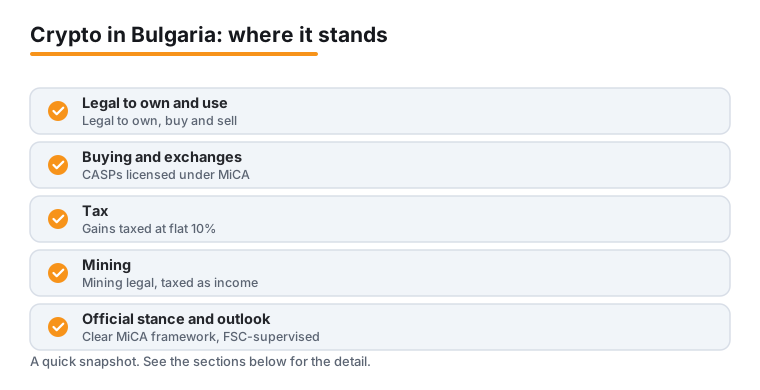
Quick answer — Bulgaria, 2026
- Legal: Legal to own and trade, not legal tender
- Tax: Gains taxed at flat 10 percent income tax
- Buying: Via MiCA-authorised exchanges, in euro
Bulgaria is a European Union member state and, since 1 January 2026, a member of the euro area, having adopted the euro in place of the Bulgarian lev (at the fixed rate of EUR 1 = BGN 1.95583). This matters for anyone using cryptocurrency in the country, because Bulgaria's crypto rules are now shaped mainly by directly applicable EU law and its national implementing act rather than by a standalone, crypto-specific national framework built from scratch. Buying, holding, selling and mining Bitcoin and other crypto-assets is legal in Bulgaria, and the sector is regulated under the EU's Markets in Crypto-Assets Regulation (MiCA, Regulation (EU) 2023/1114) together with Bulgaria's national Markets in Crypto-Assets Act, which entered into force on 8 July 2025.
This page explains, in plain terms, the current legal status of crypto in Bulgaria, who regulates it, how it is generally taxed, and practical points about exchanges, registration, mining and consumer protection. This is general information as of 2026 and is not legal, tax or financial advice. Rules, deadlines and rates change, so verify specifics with the Financial Supervision Commission (FSC), the Bulgarian National Bank (BNB) and the National Revenue Agency (NRA), or with a licensed Bulgarian professional, before acting. For background you can also read our crypto regulation guide and our crypto taxes overview.
On this page: Legal status · Who regulates it · Taxes · How to buy · Mining
Is Bitcoin and crypto legal in Bulgaria?
Yes. Owning, buying, selling and trading Bitcoin and other crypto-assets is legal in Bulgaria. There is no ban on private individuals or businesses holding or transacting in crypto, and there are no broad foreign-exchange or capital controls that prohibit it. As an EU member that joined the euro area in 2026, Bulgaria applies the EU's harmonised rules on crypto-asset services, anti-money-laundering (AML) and financial markets.
What crypto is not in Bulgaria is legal tender. The only legal currency is the euro; the lev ceased to be legal tender from 1 February 2026. Merchants may choose to accept Bitcoin voluntarily, but no one is obliged to accept it as payment, and crypto carries no state guarantee. In practice crypto is treated as a private asset and, when offered as a service, a regulated financial activity, not as money issued by the state.
Who regulates crypto in Bulgaria?
Supervision is split between three authorities, each with a defined role:
| Authority | Main role for crypto |
|---|---|
| Financial Supervision Commission (FSC / KFN) | National competent authority for authorising and supervising crypto-asset service providers (CASPs) under MiCA, and for public offerings of crypto-assets and issuers of asset-referenced tokens (ARTs) |
| Bulgarian National Bank (BNB) | Competent authority for issuers of electronic money tokens (EMTs), which are treated as electronic money under the Payment Services and Payment Systems Act |
| National Revenue Agency (NRA / NAP) | Taxation and reporting of crypto income and gains |
AML supervision and suspicious-activity reporting involve the State Agency for National Security through its Financial Intelligence Directorate (FID). The FSC has published guidance and a frequently-asked-questions section to explain how it applies MiCA in practice, available on its official site: FSC: Crypto-assets (MiCA) FAQ.
Key laws and frameworks
Bulgaria's crypto regulation rests on two layers: directly applicable EU regulation, and Bulgarian implementing law.
- MiCA (Regulation (EU) 2023/1114): The EU's Markets in Crypto-Assets Regulation applies directly in all member states, including Bulgaria. It sets harmonised rules for CASPs such as exchanges, custodians and brokers, and for issuers of asset-referenced tokens and e-money tokens, covering authorisation, governance, disclosures and consumer protection. You can read the official text on EUR-Lex: Regulation (EU) 2023/1114 (MiCA).
- National implementing act: The Bulgarian Parliament adopted the Markets in Crypto-Assets Act (the BG MiCA Act) on 20 June 2025; it entered into force on 8 July 2025. It designates the competent authorities, sets administrative procedures and sanctions, and governs public offerings of crypto-assets, their admission to trading, and the licensing and supervision of CASPs.
- AML/KYC: Before MiCA, crypto businesses were registered under the Measures Against Money Laundering Act regime, then supervised in connection with the National Revenue Agency. The new framework moved crypto from a simple registration system to a comprehensive licensing regime under the FSC, while AML obligations continue to apply.
Because the licensing regime is new and timelines can shift, always confirm current details against the FSC's official publications rather than relying on secondary summaries.
Licensing and registration of exchanges and CASPs
Under MiCA and the BG MiCA Act, any firm offering crypto-asset services to Bulgarian customers on a professional basis (for example exchange between crypto and fiat or between crypto-assets, custody, operating a trading platform, order execution or advice) must be authorised as a crypto-asset service provider (CASP). Authorisation in Bulgaria is granted by the FSC; a CASP licensed in any EU member state can also serve Bulgarian residents through MiCA's passporting mechanism after notifying its home regulator.
A transitional (grandfathering) period applies. Providers that were already entered in the National Revenue Agency's virtual-asset service provider register before 30 December 2024 could continue the activity for which they were registered only until 1 July 2026, under paragraph 3(1) of the transitional provisions of the Markets in Crypto-Assets Act. That window closed on 1 July 2026 and was not extended. The FSC has confirmed that an unlicensed provider has no right to provide new services and may carry out crypto-asset transactions only in connection with the way the client chooses to end the relationship, and that it must prepare a plan for ceasing its activity and help clients move assets to a licensed provider, keep them in their own wallet, or close their positions. The FSC granted Bulgaria's first MiCA CASP authorisation by decision of 22 December 2025, to Alaric Securities OOD, an existing Bulgarian investment intermediary, and announced it on 8 January 2026. By August 2026 four Bulgarian firms appeared in the FSC register of licensed providers: Alaric Securities OOD, Belayer OOD (28 April 2026), and Altcoins BG EOOD and Digital Assist OOD (both 21 July 2026). By early February 2026 eight firms had applied and the FSC had refused four at the completeness stage; the head of its directorate for investment intermediaries and crypto-asset service providers said those files were missing between 60 and 70 percent of the required documents. There is no longer a transitional process to be in. Since 1 July 2026 a provider is either authorised or it may not serve you, so check the name against the FSC register of licensed providers, the FSC list of notifications received from firms licensed in other EU member states, and the ESMA MiCA register. Do not rely on the FSC register under paragraph 5(3) of the Markets in Crypto-Assets Act: the FSC labels that list as persons who are not licensed and have no right to provide crypto-asset services. The FSC maintains official registers; see the Financial Supervision Commission and its registers and checks section. For a broader view of how licensing differs by country, see our global regulation hub.
Crypto taxation in Bulgaria
Bulgaria does not have separate crypto-specific tax legislation; the National Revenue Agency applies the general tax rules, and it has stated that profits from trading cryptocurrencies are taxable. For individuals, gains from disposing of crypto-assets are generally treated as income from the sale of financial assets and taxed at Bulgaria's flat personal income tax rate of 10 percent, which is among the lowest in the EU.
- Taxable events: Selling crypto for fiat and exchanging one crypto-asset for another are generally taxable; mining and staking rewards are typically taxed as income at their value when received. Simply holding crypto is not, by itself, a taxable event.
- Net gain: The National Revenue Agency calculates the gain or loss on each transaction as the sale price less the acquisition price of the asset. The year's gains less the year's losses give the taxable amount, which is then reduced by 10 percent statutory recognised expenses under Article 33(3) of the Personal Income Tax Act. No advance tax is due during the year on this income. Losses can be set against gains in the same category within the same calendar year, but they are not carried forward to later years; an unused loss expires at year end.
- Filing: Individuals report crypto gains on the annual income tax return, on the appendix for income from the disposal of financial assets (Appendix 5), generally by 30 April of the year following the gains, and should keep transaction records.
The rate turns on how the National Revenue Agency characterises your activity. Occasional disposals by an individual are taxed at the flat 10 percent rate and reported in Appendix 5 of the annual return. If you trade as a merchant within the meaning of the Commerce Act, the financial-asset rules do not apply even if you never registered a business: taxable income is then determined under the sole-trader rules, reported in Appendix 2, and taxed at 15 percent. Confirm your situation with the National Revenue Agency (NRA) or a licensed Bulgarian tax adviser. This is general information, not tax advice; see also our crypto taxes guide.
AML and KYC rules
Crypto-asset service providers are obliged entities under Bulgaria's anti-money-laundering framework, which implements the EU AML directives. In practice this means:
- Customer due diligence (KYC): Providers must identify and verify customers, typically requiring an official ID document and often proof of address; enhanced due diligence applies to higher-risk customers.
- Ongoing monitoring: Transactions are monitored for unusual patterns, and providers must keep detailed records.
- Reporting: Suspicious activity is reported to the Financial Intelligence Directorate (FID).
For users, this means you should expect full identity verification when opening accounts on compliant exchanges, and that larger or unusual activity may trigger additional checks. The EU's Transfer of Funds (travel rule) requirements also apply to crypto transfers handled by regulated providers, attaching originator and beneficiary information to transactions.
Buying and using crypto in practice
Bulgarian residents can buy crypto on EU-authorised and international exchanges, through brokers, and via peer-to-peer platforms. A typical, compliant route looks like this:
- Choose a regulated provider: Use a MiCA-authorised provider. Since 1 July 2026 there is no transitional status to rely on, so check the firm in the FSC register of licensed providers, in the FSC list of notifications from firms licensed elsewhere in the EU, or in the ESMA MiCA register.
- Open and verify your account: Complete KYC with an ID document and, usually, proof of address.
- Fund in euro: Since the euro changeover, deposits, withdrawals and pricing are normally in euro, with SEPA bank transfers and cards the usual on-ramps.
- Place your order and review fees: Compare trading fees, spreads and withdrawal costs before confirming.
- Decide on custody: Leave assets with the platform for convenience, or withdraw to a private wallet you control (hardware wallets offer stronger security).
- Keep records: Save transaction histories and cost-basis details for your tax return.
Self-custody (holding your own private keys) remains legal and widely used. Bitcoin ATMs and peer-to-peer trades exist in larger cities but generally cost more and carry extra counterparty or fraud risk, so a regulated exchange is usually cheaper and better for record-keeping.
Bitcoin mining in Bulgaria
Bitcoin mining is legal in Bulgaria. There is no specific prohibition on running mining hardware, and the activity is treated like any other business that consumes electricity and generates taxable income.
- Electricity cost and supply: Profitability depends heavily on power prices, which have been volatile across Europe. Bulgaria has a mix of nuclear, coal, hydro and growing renewables; miners should secure realistic, contracted rates rather than assume cheap power.
- Tax and registration: Mining rewards are generally taxable income at the 10 percent rate, recognised at their value when received. If carried out as a business, normal registration, accounting and tax obligations apply.
- Grid and environmental rules: Larger operations may face grid-connection requirements and scrutiny over energy use, and EU-level sustainability disclosure expectations for crypto activity are increasing.
Mining is the case where the 10 percent rate most often does not apply. The National Revenue Agency gives buying specialised computer systems to mine crypto with a view to systematic profit from selling it as its own example of activity carried on by occupation, which makes the person a merchant under the Commerce Act. Taxable income is then determined under the sole-trader rules at 15 percent and reported in Appendix 2 rather than Appendix 5.
Recent developments (2025-2026)
The last two years brought two major changes for crypto in Bulgaria:
- National MiCA implementation (2025): The Markets in Crypto-Assets Act was adopted on 20 June 2025 and entered into force on 8 July 2025, moving crypto from AML-based registration to FSC-supervised licensing. The FSC opened MiCA licensing and, on 28 January 2026, published an extensive FAQ for firms seeking authorisation, covering service categories, application requirements, governance, operational-presence expectations and the transitional arrangements.
- First MiCA licence (2026): Bulgaria's first MiCA authorisation was granted to Alaric Securities OOD by FSC decision No. 783 of 22 December 2025 and announced by the FSC on 8 January 2026. Three more followed: Belayer OOD on 28 April 2026, and Altcoins BG EOOD and Digital Assist OOD on 21 July 2026. Providers grandfathered from the pre-2025 register must still obtain their own FSC licence before the transitional window closes on 1 July 2026.
- Euro adoption (2026): Bulgaria joined the euro area on 1 January 2026, becoming the 21st member; the lev and euro circulated in parallel for cash during January 2026, and from 1 February 2026 the euro became the sole legal tender. As a result, fiat on-ramps and pricing for crypto are now in euro.
The transitional period ended on 1 July 2026. Of the 214 firms on the register the FSC took over from the National Revenue Agency, about 170 remained after deregistrations, eight had applied by early February 2026, and two held a licence when the deadline passed. Two more were licensed on 21 July 2026. The live item is now tax reporting rather than licensing: Bulgaria missed the 31 December 2025 deadline to transpose the EU DAC8 directive, received a European Commission letter of formal notice on 30 January 2026, and the transposing amendment to the Tax and Social Insurance Procedure Code was approved by the Budget and Finance Committee on 2 July 2026 but had not completed second reading or been promulgated by early August 2026.
Consumer risks and protection
MiCA raises the standards expected of authorised providers (on governance, disclosures, custody and complaints handling), but it does not guarantee the value of any crypto-asset or protect you from market losses. Key risks remain:
- Market volatility: Prices can rise or fall sharply; you can lose part or all of your money.
- Scams and fraud: Fake exchanges, phishing, impersonation and "guaranteed return" schemes are common. Be wary of unsolicited offers and never share private keys or seed phrases.
- Custody and platform risk: Funds held on a platform depend on its security and solvency.
- Irreversibility: On-chain transactions generally cannot be reversed if sent in error or to a scammer.
- Regulatory and tax change: The licensing transition is finished, but the tax reporting rules are not. A bill transposing the EU crypto reporting directive into the Tax and Social Insurance Procedure Code was still before parliament in August 2026 and would require Bulgarian providers to report each user and their transaction totals to the National Revenue Agency by 30 June each year.
A sensible approach is to use authorised providers, invest only what you can afford to lose, understand what you are buying, and consider speaking with a licensed Bulgarian financial adviser before committing significant funds. You can check whether a provider is authorised or warned about through the FSC's official registers and notices.
Official sources and how to verify
Because this is sensitive financial and legal information that changes over time, always confirm the current position with primary, official sources rather than third-party summaries:
- Financial Supervision Commission (FSC) and its Crypto-assets (MiCA) FAQ for CASP authorisation, registers and supervisory guidance.
- Bulgarian National Bank (BNB) for e-money tokens and payments matters.
- National Revenue Agency (NRA) for taxation and reporting of crypto income and gains.
- EUR-Lex: Regulation (EU) 2023/1114 (MiCA) for the EU regulation itself.
This page is general information as of 2026 and is not legal, tax or financial advice; verify your specific situation with the named official regulators, in particular the FSC, or with a licensed Bulgarian professional before acting.
What Changed on 1 July 2026
The MiCA transitional period in Bulgaria closed on 1 July 2026 and was not extended. In a statement published on 30 June 2026 the Financial Supervision Commission confirmed that from that date only licensed providers may offer crypto-asset services in the EU, that an unlicensed provider has no right to provide you with new services, and that it may carry out crypto-asset transactions only in connection with the way you choose to end the relationship. An unlicensed firm must prepare a plan for ceasing its activity and assist clients, who can transfer their crypto-assets to a licensed provider, keep them in their own wallet, or close their positions. See the FSC statement of 30 June 2026.
Few firms made it through. The register the FSC took over from the National Revenue Agency held 214 companies, of which about 170 remained after deregistrations, and the FSC managed to reach around 60 of them. On 4 February 2026 the FSC asked companies to file by 16 February 2026, warning that reviewing an application takes four to five months and that any suspension of the statutory deadlines would make a decision before 1 July 2026 impossible (FSC notice, 4 February 2026). By early February eight companies had filed: one had been licensed, three were under review, and four had been refused at the completeness check. Desislava Laskova, who heads the FSC directorate for investment intermediaries and crypto-asset service providers, said the refused files were missing between 60 and 70 percent of the required documents and that in some cases the regulator could not reach the applicant on the contact details supplied (reported 2 February 2026).
Two firms held a Bulgarian licence on the day the deadline passed. Speaking on 10 July 2026, Laskova said five applications had been filed and that the FSC expected around 20 applications by the end of the year (Dnes.bg, 10 July 2026). Two more licences followed on 21 July 2026, bringing the total to four. Incomplete files are still being turned away: on 28 July 2026 the FSC refused to consider an application from Boneks EOOD on the merits because the documents submitted were incomplete (FSC decisions of 28 July 2026).
Which Providers Are Authorised in Bulgaria
Four Bulgarian companies appear in the FSC register of licensed crypto-asset service providers as of early August 2026. The register gives the licensing decision number and date and itemises the services each firm may provide.
| Company | Licensing decision | Services authorised |
|---|---|---|
| Alaric Securities OOD, an established Bulgarian investment intermediary | No. 783 of 22 December 2025, announced by the FSC on 8 January 2026 as the first MiCA licence in Bulgaria | Custody and administration of crypto-assets for clients; exchange of crypto-assets for funds; exchange of crypto-assets for other crypto-assets; execution of orders; placing of crypto-assets; reception and transmission of orders; advice on crypto-assets; portfolio management |
| Belayer OOD (Билеър ООД in the register) | No. 276 of 28 April 2026 | Custody and administration of crypto-assets for clients; execution of orders for clients; portfolio management |
| Altcoins BG EOOD, Varna, trading as Altcoins.bg | No. 499 of 21 July 2026 | Custody and administration; exchange of crypto-assets for funds; exchange of crypto-assets for other crypto-assets; transfer services. Reported as the first Bulgarian crypto exchange licensed under MiCA |
| Digital Assist OOD | No. 500 of 21 July 2026 | Exchange of crypto-assets for funds only |
Sources: the FSC register of licensed crypto-asset service providers, the FSC announcement of 8 January 2026, the FSC decisions of 21 July 2026, and Darik Business Review, 24 July 2026.
This is only the list of firms the FSC licensed itself. Most large platforms available to Bulgarian residents are licensed in another EU member state and passport in under MiCA, which requires a notification rather than a Bulgarian licence. The FSC tells consumers to check three places: its own register of licensed providers, its list of notifications received for firms licensed elsewhere in the EU, and the ESMA MiCA register, which ESMA updates weekly. Note the trap in a fourth list: the FSC also publishes the old transitional-regime register under paragraph 5(3) of the Markets in Crypto-Assets Act, which its own registers index labels as the list of persons who are not licensed and have no right to provide crypto-asset services, and that page repeats the point. Appearing on it is not authorisation.
What the Tax Office Will Start Seeing: DAC8 and CARF
Bulgaria still has no crypto-specific tax law and the flat 10 percent rate is unchanged. What is changing is the reporting machinery behind it. Two tracks are moving.
- The OECD track is done. On 18 February 2026 the National Assembly ratified, in two readings at a single sitting, the Multilateral Competent Authority Agreement on automatic exchange of information under the Crypto-Asset Reporting Framework, together with an addendum to the equivalent agreement covering financial accounts under the Common Reporting Standard. Bulgaria signed both in Asunción on 26 November 2024 and the ratifying act was promulgated in State Gazette No. 23 of 27 February 2026 (see also BTA, 18 February 2026). This is what extends reporting to platforms in participating non-EU jurisdictions.
- The EU track is late. Bulgaria missed the 31 December 2025 deadline to transpose Council Directive (EU) 2023/2226 (DAC8), and on 30 January 2026 the European Commission sent letters of formal notice to Bulgaria and eleven other member states, namely Belgium, Cyprus, Czechia, Estonia, Greece, Luxembourg, Malta, the Netherlands, Poland, Portugal and Spain (KPMG EU Tax Centre). The transposing bill amends the Tax and Social Insurance Procedure Code. The Budget and Finance Committee approved it on 2 July 2026 by 21 votes to 1, and the committee chair asked that Ministry of Environment representatives be invited at second reading, so the bill had not completed its passage. It had not been promulgated as of early August 2026.
As drafted, the bill requires crypto-asset service providers registered and licensed in Bulgaria to file once a year, electronically, by 30 June of the year following the year the data relates to, reporting for each user the name, address, date and place of birth, jurisdiction of tax residence and tax number, plus the total gross amount received from completed transactions, the number of units traded, and the counts of crypto-to-fiat and crypto-to-crypto transactions (Investor.bg, 2 July 2026). No published source states which year would be the first reported, so that remains open.
For an individual holder nothing about the rate changes. What changes is that the return you file becomes checkable against data the agency holds, so keeping acquisition costs and transaction histories stops being optional housekeeping.
How the Revenue Agency Says to Declare Crypto Income
The National Revenue Agency set out its position in guidance reported on 4 May 2026. Income from the sale or exchange of crypto-assets falls under income from the transfer of rights or property in Article 10(1)(5) of the Personal Income Tax Act, and is declared in Appendix 5 of the annual return.
- The gain or loss on each transaction is the sale price less the acquisition price of the asset.
- The annual taxable amount is the total of the year's gains less the total of the year's losses, and that difference is then reduced by 10 percent statutory recognised expenses under Article 33(3) of the Act.
- No advance tax is due during the year on income from the sale or exchange of crypto-assets.
- No supporting documents have to be attached to the return, but you must keep the records for five years after the limitation period for the related liability expires.
The agency also draws the line to commercial activity. If a person trades as a merchant within the meaning of the Commerce Act, the financial-asset rules do not apply even if the person never registered as a sole trader, and the test is what was actually done. Buying specialised computer systems to mine crypto with a view to systematic profit from selling it on exchanges is the agency's own example of activity carried on by occupation. In that case the taxable income is determined under the sole-trader rules, taxable profit is formed under the Corporate Income Tax Act, and the income is declared in Appendix 2 (NRA guidance reported 4 May 2026). The annual tax on sole-trader activity is 15 percent.
Penalties, Blocking Powers and Licence Fees
The Markets in Crypto-Assets Act backs the licensing regime with more than fines. Under Article 36(1), where there is no other effective way to stop a breach, the FSC can order a hosting provider to remove, block or restrict access to an online interface or a mobile application, order domain registries to delete a domain name and let the FSC register it, order third parties including electronic communications operators to remove content or display a warning to clients, and order online platforms to remove or restrict profiles that advertise crypto-asset services in breach of the Act. That last set is what most often reaches a consumer, who simply loses access to a platform.
Money penalties run in tiers. For breaches of the MiCA authorisation and conduct articles, a legal person faces from BGN 20,000 up to the greater of BGN 5 million or 6.25 percent of annual turnover, rising on a repeat breach to the greater of BGN 10 million or 12.5 percent (Article 37(3)). The heaviest tier is Article 38(3)(2), for the MiCA market-abuse articles 89 to 92: from BGN 50,000 up to the greater of BGN 15 million or 7.5 percent of annual turnover, and on a repeat breach up to the greater of BGN 30 million, about EUR 15.3 million at the fixed conversion rate, or 15 percent of annual turnover. The figures are in the promulgated text in State Gazette No. 54 of 4 July 2025.
Fees are set not in the Act but in Ordinance No. 76 of 12 June 2025 on the fees collected by the FSC. The FSC explains in its published note on fees due under the Act that the Annex to Article 27(1) of the Financial Supervision Commission Act was repealed by the 2025 State Budget Act, so the ordinance governs. In the FSC fee tables the licence fee is EUR 5,112.92 for a class 1 provider, EUR 10,225.84 for class 2 and EUR 30,677.51 for class 3, and annual supervision is charged as the sum of per-service amounts, for example EUR 409.03 for custody and administration and EUR 6,135.50 for operating a trading platform, plus a variable component. The FSC amended the ordinance at second reading on 24 February 2026, so check the tables as published.
Frequently asked questions
Is cryptocurrency legal in Bulgaria?
Yes. Buying, holding, selling and mining crypto is legal in Bulgaria. It is regulated mainly under the EU's MiCA Regulation and Bulgaria's Markets in Crypto-Assets Act (in force since 8 July 2025), supervised by the Financial Supervision Commission. Crypto is not legal tender, however; the euro has been Bulgaria's official currency since 1 January 2026.
Who regulates crypto in Bulgaria?
The Financial Supervision Commission (FSC) is the national competent authority for authorising and supervising crypto-asset service providers under MiCA. The Bulgarian National Bank (BNB) is the competent authority for e-money tokens, and the National Revenue Agency (NRA) handles taxation. You can verify provider status on the FSC's official registers at fsc.bg.
How is crypto taxed in Bulgaria?
Bulgaria has no separate crypto tax law; the NRA applies general rules. For individuals, gains from disposing of crypto are generally taxed at the flat 10 percent income tax rate, and mining or staking rewards are taxed as income. Selling for fiat or swapping one crypto for another can be taxable, while simply holding is not. You report on the annual income tax return, generally by 30 April. This is general information, not tax advice; confirm with the NRA.
Do crypto exchanges need a licence in Bulgaria?
Yes. Under MiCA and the Bulgarian Markets in Crypto-Assets Act, firms offering crypto services on a professional basis must be authorised as crypto-asset service providers (CASPs) by the FSC, or be licensed elsewhere in the EU and passport in. A transitional period for previously registered providers runs until 1 July 2026, after which unlicensed firms must stop the relevant activities.
Can I buy Bitcoin with euros in Bulgaria?
Yes. Since Bulgaria adopted the euro on 1 January 2026, exchanges serving Bulgarian residents typically support euro deposits via SEPA transfer or card. Use a MiCA-authorised provider and complete identity verification before buying.
Has Bulgaria issued any MiCA crypto licences yet?
Yes. The Financial Supervision Commission granted Bulgaria's first MiCA crypto-asset service provider authorisation to Alaric Securities OOD by decision of 22 December 2025, announcing it on 8 January 2026, and three more firms have been licensed since. Reports indicate the FSC has also rejected some applications for incomplete documentation, so the regime is active but applies strict standards. Firms that were on the National Revenue Agency register before 30 December 2024 can keep operating during the transitional period until 1 July 2026, or until they obtain or are refused a licence.
Can I carry forward crypto losses on my Bulgarian tax return?
No. For individuals, crypto losses can be set against gains in the same category only within the same calendar year, and any unused loss cannot be carried forward to future years. Gains and losses are reported on the appendix for income from the disposal of financial assets (Appendix 5) of the annual income tax return, filed generally by 30 April. This is general information, not tax advice; confirm with the National Revenue Agency.
Where can I check the official rules for crypto in Bulgaria?
Use primary sources: the Financial Supervision Commission (fsc.bg), including its crypto-assets MiCA FAQ; the Bulgarian National Bank (bnb.bg) for e-money tokens; the National Revenue Agency (nra.bg) for tax; and EUR-Lex for the MiCA Regulation text. These are the authoritative places to confirm current requirements, deadlines and a provider's authorisation status.
Can I still use a Bulgarian exchange that was only on the old National Revenue Agency register?
No. That transitional regime ended on 1 July 2026 and was not extended. A firm holding only the old registration has no right to provide you with new services and may carry out crypto-asset transactions only in connection with the way you choose to end the relationship. The FSC labels the register kept under paragraph 5(3) of the Markets in Crypto-Assets Act as a list of persons who are not licensed and have no right to provide crypto-asset services, so appearing on it is not authorisation.
Which crypto companies actually hold a Bulgarian licence?
Four appear in the FSC register as of August 2026: Alaric Securities OOD, licensed by decision of 22 December 2025 and announced on 8 January 2026 as the first in Bulgaria; Belayer OOD on 28 April 2026; and Altcoins BG EOOD and Digital Assist OOD, both on 21 July 2026. Scope varies by firm, and Digital Assist is authorised only to exchange crypto-assets for funds. Separately, platforms licensed elsewhere in the EU can serve Bulgarian residents by passporting in after notifying the FSC, which is how most large exchanges operate here.
Do I pay 10 percent or 15 percent tax on crypto in Bulgaria?
It depends on how the National Revenue Agency characterises your activity. Occasional disposals by an individual are taxed at the flat 10 percent rate and reported in Appendix 5 of the annual return. The agency works out the gain per transaction as sale price less acquisition price, nets the year's gains against the year's losses, and then reduces the result by 10 percent statutory recognised expenses. If you trade or mine as a merchant within the meaning of the Commerce Act, the agency taxes you under the sole-trader rules at 15 percent and you report in Appendix 2, even if you never registered a business. This is general information, not tax advice; confirm your position with the NRA or a licensed Bulgarian adviser.
Will the Bulgarian tax authority receive data about my crypto?
That is the direction of travel. Parliament ratified the OECD Crypto-Asset Reporting Framework exchange agreement on 18 February 2026 and the ratifying act was promulgated in State Gazette No. 23 of 27 February 2026. A bill transposing the EU crypto reporting rules into the Tax and Social Insurance Procedure Code was approved by the Budget and Finance Committee on 2 July 2026 by 21 votes to 1, with second reading still to come. As drafted it would require Bulgarian providers to report each user, including tax residence and tax number, along with gross transaction proceeds and transaction counts, by 30 June each year. Bulgaria missed the 31 December 2025 transposition deadline and received a European Commission letter of formal notice on 30 January 2026, so the start date depends on when parliament finishes the bill.
What happens to my coins if the platform I used lost its licence?
The FSC set this out on 30 June 2026. An unlicensed provider must prepare a plan for ceasing its activity and assist you in ending the relationship, and may carry out transactions only in connection with the route you choose. Your three options are to transfer the assets to a licensed provider, keep them in a wallet you control, or close your positions. If a provider is not doing this, you can raise it with the FSC through its electronic complaint form or at [email protected].
Facts reviewed: 12 August 2026. Page updated: 12 August 2026.