Home › Crypto Regulation › Czech Republic
Bitcoin & Cryptocurrency Regulation in Czech Republic
Quick answer — Czech Republic, 2026
- Legal: Legal to own and use under EU MiCA, not legal tender
- Tax: Taxed as property; exemptions for long holds and small amounts
- Buying: Via MiCA-authorised exchanges with KYC, or Bitcoin ATMs
The Czech Republic is one of the more crypto-friendly economies in the European Union. Owning, buying, selling and using Bitcoin and other crypto-assets is legal, and the country has a long-standing community of users, businesses and miners. Crypto is, however, firmly inside the regulatory perimeter: the EU's Markets in Crypto-Assets Regulation (MiCA) now governs how crypto-asset service providers operate, the Czech National Bank (CNB) is the national competent authority that licenses and supervises them, and the Financial Analytical Office (FAÚ) enforces anti-money-laundering rules. This page explains the current legal status of crypto in the Czech Republic, who regulates it, the key laws, how licensing and taxation work, and the practical picture for buying, mining and using crypto as of 2026.
This article is general information as of 2026 and is not legal, tax or financial advice. Crypto rules and tax treatment change frequently. Always verify your situation with the Czech National Bank, the Czech tax authority (Finanční správa), or a qualified Czech adviser before acting. See our general guide to crypto regulation for wider context.
On this page: Legal status · Who regulates it · Taxes · How to buy · Mining
Is Bitcoin and crypto legal in the Czech Republic?
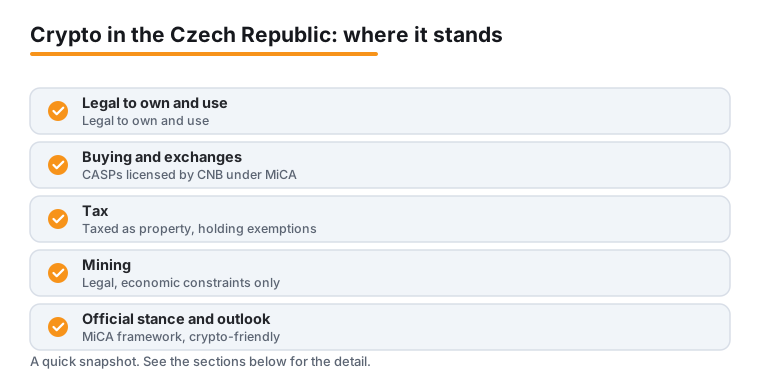
Yes. Buying, holding, selling and using Bitcoin and other crypto-assets is legal in the Czech Republic. There is no ban on individuals or businesses dealing in crypto, and the country has historically been seen as open and pragmatic toward the sector.
Legal does not mean unregulated, and crypto is not legal tender. The Czech koruna (CZK) remains the only official currency, and no merchant is obliged to accept Bitcoin. Crypto may be used for payment where a business chooses to accept it, but it is treated as an asset rather than as money. Businesses that provide crypto services to the public, such as exchanges, custodial wallets and brokers, must comply with EU and Czech financial-market rules, including authorisation and anti-money-laundering obligations described below.
Who regulates crypto in the Czech Republic?
Two authorities matter most:
- Czech National Bank (CNB / ČNB): The CNB is the national competent authority for crypto-assets under MiCA. Since 15 February 2025 it has been responsible for receiving MiCA notifications and licence applications, authorising crypto-asset service providers (CASPs), and supervising issuers, public offerings and the broader crypto market. It is the central bank and integrated financial-market supervisor.
- Financial Analytical Office (FAÚ): The FAÚ is the Czech financial intelligence unit. It supervises anti-money-laundering and counter-terrorist-financing (AML/CFT) compliance under the Czech AML Act and receives suspicious-transaction reports from crypto firms. It is not the licensing authority.
You can confirm a provider's status and read official guidance on the CNB's crypto-asset pages: Czech National Bank (CNB) crypto / MiCA. AML guidance for crypto firms is published by the Financial Analytical Office (FAÚ).
Key crypto laws and frameworks
The Czech framework is built primarily on EU law, applied and supervised domestically.
- MiCA (the EU Markets in Crypto-Assets Regulation): This EU-wide regime sets harmonised rules for crypto-asset service providers, stablecoin (asset-referenced and e-money token) issuers, and public offerings of crypto-assets. As an EU regulation it applies directly across the Czech Republic.
- The Czech Digital Finance Act (Act No. 31/2025 Coll.): This national adaptation law came into force on 15 February 2025. It implements MiCA into Czech law, designates the CNB as the competent authority, and sets out transition arrangements for existing crypto businesses.
- AML/CFT law: The Czech Republic has transposed the EU's anti-money-laundering directives through its AML Act. Crypto exchanges and wallet providers are obliged entities that must run customer due diligence (KYC), monitor transactions and report suspicious activity to the FAÚ.
- Income Tax Act: Crypto income is taxed under the Czech Income Tax Act, with specific crypto exemptions added from February 2025 (see Taxation below).
The CNB maintains an English-language list of the applicable laws and regulations: CNB: crypto-asset laws and regulations.
Licensing and registration of exchanges (CASPs)
Under MiCA, any platform that offers custody, exchange, brokerage, placement, transfer or similar crypto services to customers in the Czech Republic must be authorised as a crypto-asset service provider (CASP), either licensed by the CNB or operating in the country through an EU passport from another member state. Authorised providers are expected to maintain capital, safeguard client assets, disclose risks and follow conduct rules.
The licensing regime is well underway. The CNB received 248 MiCA authorisation applications, the highest number of any supervisory authority in the European Union, with the vast majority filed just before the end-July 2025 deadline. On 11 February 2026 the CNB issued its first six CASP authorisations under MiCA. Firms that previously operated under an older Czech trade licence (živnostenské oprávnění) were given a transitional regime: provided they applied for MiCA authorisation by 31 July 2025, they could continue operating until a final decision, but no later than 1 July 2026.
That transitional period has now ended. By 1 July 2026 the CNB had assessed 251 applications and granted MiCA licences to 11 entities. The CNB reported that a large share of applications were incomplete or came from firms with no verifiable track record, virtual registered offices, or plans to operate abroad, and that only a small proportion had a transparent business model, ownership structure and financing. Entities that did not obtain authorisation by that date may no longer offer crypto-asset services in the EU and must stop taking on new clients and inform existing clients about winding down. Providing services without authorisation after the deadline breaches MiCA and can trigger supervisory and enforcement action.
Before using any provider, check that it appears in ESMA's register of authorised crypto-asset service providers or in the CNB's lists of regulated and registered entities. The CNB's own advice at the end of the transitional period was that clients should verify their provider's status in the ESMA register and, where appropriate, transfer their assets to an entity holding the relevant authorisation or to their own crypto-asset wallet. You can read the CNB's announcements here: CNB: first six MiCA authorisations and CNB: crypto licences granted to 11 entities.
How crypto is taxed in the Czech Republic
Crypto is generally treated as property (an asset) for Czech tax purposes, and disposing of it (selling for fiat, swapping one crypto for another, or spending it) can be a taxable event. For individuals, gains are typically taxed as other income under Section 10 of the Income Tax Act at the personal rate of 15 percent, with a 23 percent rate applying to higher income.
From 15 February 2025 the Czech Republic introduced two exemptions intended to be more favourable to ordinary holders:
- Time test (holding period): Income from crypto-assets held for more than three years can be exempt, subject to an overall cap reported at CZK 40 million of exempt income per year. The holding period can include time before the rules took effect. From 2026 this CZK 40 million cap was removed for securities and shares but kept for crypto-assets, so crypto income above the cap can remain taxable even after the three-year test is met. The exemptions are set out in Section 4 of the Income Tax Act.
- Value test (small amounts): If total gross income from crypto-asset disposals does not exceed CZK 100,000 in a tax year, it can be exempt from income tax.
The two exemptions sit in Section 4(1)(zj) and Section 4(1)(zk) of the Income Tax Act, inserted by Act No. 32/2025 Coll. Section 4(1)(zj) is the CZK 100,000 value test and Section 4(1)(zk) is the three-year time test, and neither applies to electronic money tokens, the MiCA category covering fiat-referenced stablecoins such as USDT and USDC. Verify current rules, rates and exemptions with the Czech tax authority: Finanční správa (Czech Financial Administration), or a qualified Czech tax adviser. For more general background, see our overview of crypto taxes. This is not tax advice.
AML and KYC rules
Crypto-asset service providers are obliged entities under the Czech AML Act and must build a compliance programme. In practice this means identity verification (KYC) for customers, ongoing transaction monitoring, customer due diligence (and enhanced due diligence for higher-risk situations), record-keeping, and reporting suspicious transactions to the FAÚ.
Each obliged entity must designate a contact person responsible for the reporting obligation and ongoing contact with the FAÚ, and notify the FAÚ of that designation. The FAÚ has increased enforcement against crypto firms in recent years. For users, this is why a reputable platform will ask for ID documents and sometimes proof of address or source of funds before letting you trade or withdraw. AML guidance for virtual-asset service providers is published by the Financial Analytical Office (FAÚ).
Buying and using crypto in practice
Czech residents can buy crypto through several channels: EU and international exchanges, domestic brokers, peer-to-peer trades and Bitcoin ATMs. Bank transfers, cards and instant SEPA payments in koruna or euros are commonly used to fund purchases. A typical, compliant path looks like this:
- Choose an authorised provider. Prefer an exchange or broker that is authorised under MiCA (by the CNB or passported from another EU state). Compare fees, supported assets, payment methods and security.
- Verify your identity (KYC). Have a photo ID ready, and possibly proof of address and source-of-funds information.
- Fund your account and place an order. Deposit CZK or EUR and buy with a market or limit order; start small while you learn the platform.
- Secure your holdings. For larger or longer-term amounts, consider a wallet you control (including a hardware wallet) and back up your recovery phrase safely.
- Keep records. Save confirmations and statements, especially acquisition dates, which matter for the holding-period tax test.
The Czech Republic, and Prague in particular, has long had one of Europe's denser networks of Bitcoin ATMs. ATM operators that sell or exchange crypto are CASPs and apply the same authorisation and AML obligations; machines typically run identity checks above certain limits and charge higher fees and spreads than online exchanges.
Bitcoin mining in the Czech Republic
Bitcoin mining is legal in the Czech Republic. There is no specific prohibition on running mining hardware, and both hobbyist and commercial operations exist. The main constraints are economic and environmental rather than legal: electricity prices in Central Europe are relatively high, and the wider EU has been tightening expectations around the energy footprint and reporting of crypto activity.
Practical considerations include the cost and sourcing of electricity (profitability depends heavily on power prices, so some operators pursue cheaper or renewable supply and off-peak usage), the option to reuse waste heat, and tax and business rules. Mining income can have tax and, where conducted as a business, registration and accounting implications. Anyone planning a larger operation should confirm current energy, business-registration and tax obligations with Czech authorities or an adviser.
Recent developments (2025-2026)
Several developments stand out:
- Digital Finance Act in force (15 February 2025): Act No. 31/2025 Coll. made the CNB the national competent authority for crypto and set the MiCA transition timetable.
- Crypto tax exemptions (from 15 February 2025): The three-year time test and the CZK 100,000 annual value test took effect.
- First MiCA authorisations (11 February 2026): The CNB granted its first six CASP authorisations out of roughly 248 applications, with the transitional regime running until 1 July 2026 at the latest.
- Transitional period ended (1 July 2026): The CNB reported it had assessed 251 applications and granted MiCA licences to 11 entities. Firms not authorised by that date may no longer offer crypto-asset services in the EU and must wind down.
- CNB digital-asset test portfolio (late 2025): The CNB's Bank Board approved a roughly USD 1 million experimental portfolio on 30 October 2025, including Bitcoin, a USD stablecoin and a tokenised deposit, held outside the country's official international reserves. The CNB described it as a learning exercise to build operational experience, to be assessed in two to three years, and stressed it does not plan to add Bitcoin to its reserves in the near future. See CNB: test portfolio of digital assets.
Consumer risks and protection
MiCA improves consumer protection by requiring authorisation, disclosures, asset safeguarding and conduct standards from licensed providers, but it does not remove the underlying risks of crypto. Key risks to understand:
- Market risk: Prices are highly volatile; losses can be severe and rapid. Crypto is not covered by deposit-guarantee schemes.
- Custody and security risk: Hacks, scams, phishing and lost keys are common ways people lose funds. Use reputable, authorised providers and strong security.
- Counterparty risk: Using unauthorised or offshore platforms increases the chance of failure or fraud with limited recourse. Confirm authorisation before depositing.
- Regulatory and tax change: MiCA implementation is still maturing and tax rules can be revised; what is true in 2026 may change.
Only commit what you can afford to lose, prefer providers authorised within the EU, and treat unusually high returns or pressure to act quickly as warning signs of a scam.
Official sources and how to verify
Because this is fast-moving legal and tax territory, always check the primary sources rather than relying on summaries. The most reliable Czech and EU references are:
- Czech National Bank (CNB) crypto / MiCA pages for licensing status, supervised firms and guidance.
- Financial Analytical Office (FAÚ) for AML/CFT obligations affecting crypto businesses.
- Finanční správa (Czech Financial Administration) for current crypto tax rules and exemptions.
To verify a specific exchange or broker, check whether it appears as an authorised CASP with the CNB or is properly passported from another EU state, and confirm any claimed exemption directly with the tax authority. This page is general information as of 2026 and is not legal, tax or financial advice; readers should verify their situation with the Czech National Bank and the Czech tax authority, or a qualified Czech adviser. For more background, see our hub on crypto regulation by country.
What is changing: Czech crypto rules as of August 2026
The legal position in the Czech Republic did not change between the end of June 2026 and early August 2026. Buying, holding and selling crypto-assets remains legal, the koruna remains the only legal tender, and the Czech National Bank remains the licensing authority. What did move is who may lawfully serve Czech customers, what the tax administration will shortly be able to see, and where crypto supervision may sit in future.
The most visible consequence of the 1 July 2026 deadline was Binance. It withdrew its MiCA application in Greece on 25 June 2026 and emailed customers that it would not hold a licence in time, halting new registrations and restricting services from 1 July while saying assets remain accessible. It has signalled it will apply in France instead (CoinDesk, 26 June 2026; Euronews, 25 June 2026). The CNB named Binance directly, confirming it applied through the Greek regulator, did not obtain authorisation before the end of the transitional period, and must cease providing crypto-asset services across the entire European Union including the Czech Republic (Czech National Bank, 1 July 2026).
The CNB has not published the names of all eleven authorised entities. Czech firms identified in press reporting on the first six authorisations are Anycoin, Coinmate, Invity and Coinero (Lupa.cz, 11 February 2026). The authoritative check is ESMA's EU register or the CNB's lists of regulated and registered entities, not a press list.
Four measures are in the pipeline. Only the first is Czech, and it is the one that reaches ordinary holders soonest.
| Measure | Stage on 3 August 2026 | Timing | What it would mean |
|---|---|---|---|
| Bill amending Act No. 164/2013 Coll. (sněmovní tisk 98), transposing DAC8 and DAC9 | General debate at first reading held 14 July 2026; the Chamber refused fast-track approval and referred it to committees. The budget committee had not dealt with it as of 5 August 2026 | Listed on the invitation to the budget committee meeting of 2 September 2026; further proceedings possible from 13 September 2026. Would take effect the day after publication, with three points from 1 January 2028 | Czech crypto operators register with the tax administration and report each user's transactions |
| Regulation (EU) 2024/1624 (AMLR) | Adopted, not yet applying | Applies from 10 July 2027 | Crypto providers become directly obliged entities and customer checks bite at EUR 1,000 for occasional transactions |
| Directive (EU) 2024/1640 (AMLD6) | Adopted; no Czech transposition bill identifiable in the parliamentary record | Main transposition deadline 10 July 2027 | Act No. 253/2008 Coll. and the Financial Analytical Office's powers get restructured |
| Market Integration and Supervision Package | European Commission proposal of 4 December 2025; ECON committee hearing 5 May 2026, rapporteur draft reports 11 June 2026 | No completion date stated by the sources consulted | Authorisation and supervision of crypto-asset service providers would move from the CNB to ESMA |
Separately, the European Commission opened a targeted consultation on the MiCA review on 20 May 2026 with responses due 31 August 2026, covering whether decentralised finance, staking, lending and borrowing, NFTs and tokenised deposits should be brought into scope. The report required by Article 140 of MiCA is due by 30 June 2027 (Latham and Watkins MiCA tracker; DLA Piper, 9 December 2025).
The crypto tax reporting law the Czech Republic has not passed yet
Directive (EU) 2023/2226, known as DAC8, requires every EU member state to make crypto-asset service providers report their users' transactions to the tax authorities. Member states had to adopt and publish transposition measures by 31 December 2025. The Czech Republic missed that deadline. On 30 January 2026 the European Commission sent letters of formal notice to twelve member states that had not notified transposition measures, and Czechia was one of them; on KPMG's review of 3 June 2026, Czechia had still not transposed, alongside Bulgaria and Spain (KPMG EU Tax Centre, 3 June 2026).
The implementing bill amends Act No. 164/2013 Coll. on international cooperation in tax administration and also carries DAC9. It is dated Prague, 2 February 2026, and was circulated to deputies on 5 February 2026 as sněmovní tisk 98. At first reading on 14 July 2026 the Chamber of Deputies refused the government's request to approve it in first reading and referred it to committees. The budget committee, as guarantee committee, had not dealt with it as of 5 August 2026; the record lists it on the invitation to the committee meeting of 2 September 2026 and shows further proceedings possible from 13 September 2026 (Chamber of Deputies, print 98).
The Ministry of Finance said in December 2025 that despite the delay the Czech Republic is still working to the original DAC8 schedule, including exchanges with non-EU states under the CARF and revised CRS standards (Ministry of Finance, 16 December 2025), and the Financial Administration's guidance points to a first reporting deadline of 30 April 2027 to the Specialised Tax Office (Financial Administration, 17 December 2025).
What the bill as submitted would do (bill text and explanatory memorandum, print 98/0):
- Reportable events are exchange transactions, whether crypto for crypto or crypto for fiat, transfers to or from a user's address or account, and retail payment transactions above USD 50,000 (Deloitte dReport).
- Providers must verify user identity and tax residence and keep records for ten years. If a user does not supply the self-certification identifying them and their tax residence, the provider must not carry out reportable transactions for that user.
- Reports are due by 30 April of the year following the reported period, and the transitional provisions make calendar year 2026 the first reported period. That means the first filing would fall on 30 April 2027 and would cover a year already largely elapsed before the act takes effect.
- Operators already established in the Czech Republic acquire the registration duty on the day the act takes effect. The Specialised Tax Office would publish a list of non-cooperating crypto operators, could ban a listed operator from providing services, and, if that fails, could issue a measure of general nature banning users from using it.
- Proposed penalties are up to CZK 1,500,000 for a provider that breaches the reporting duty or fails to register, up to CZK 500,000 for a business or company that uses a banned operator, and up to CZK 5,000 for an individual who does.
- The Chamber of Tax Advisers has questioned whether the authorities can require data covering periods before the Czech act was in force (Chamber of Tax Advisers of the Czech Republic, 8 January 2026).
None of this is law yet. The figures above come from the bill as submitted and can change in committee.
Stablecoins are excluded from the Czech crypto tax exemptions
The two exemptions introduced by Act No. 32/2025 Coll. sit in Section 4(1)(zj) and Section 4(1)(zk) of the Income Tax Act (Act No. 586/1992 Coll.). Section 4(1)(zj) is the value test, exempting income from disposals of crypto-assets where the total does not exceed CZK 100,000 in the tax period. Section 4(1)(zk) is the time test, exempting income where more than three years passed between acquisition and disposal. Neither applies to electronic money tokens (Deloitte dReport, 27 May 2025; Forvis Mazars; Grant Thornton, 28 January 2025).
An electronic money token is the MiCA category for a token referencing a single official currency, which covers the mainstream fiat-pegged stablecoins such as USDT and USDC. A gain on disposing of one qualifies for neither test, however long it was held and however small it was.
The practical difficulty is that Czech tax law does not itself define which tokens are electronic money tokens, and there is no methodology or public register letting a taxpayer verify whether a given token falls in that category. Decentralised stablecoins without a central issuer are the least clear case, and a token's classification can change over time, which creates uncertainty about past tax periods (Právní prostor, 16 May 2025).
On rates, the standard Czech personal income tax rate is 15 percent, rising to 23 percent on annual gross income above CZK 1,762,812 for 2026 (PwC Worldwide Tax Summaries, reviewed 27 July 2026).
Which regulator covers what, and what the penalties are
Two authorities split the work, and the boundary is not obvious.
- The Czech National Bank authorises and supervises crypto-asset service providers that fall inside MiCA, under Act No. 31/2025 Coll. That covers exchanges, trading platforms, custody, brokerage and transfer services for fungible crypto-assets.
- The Financial Analytical Office runs its own permit procedure for services relating to crypto-assets that are outside MiCA, meaning assets that are unique and not fungible with other crypto-assets. It is also the AML supervisor and the recipient of suspicious transaction reports for the whole sector. The FAU notes that it does not maintain any register of virtual asset service providers (Financial Analytical Office).
Under Act No. 253/2008 Coll., Section 2(1)(b)(15) treats virtual asset service providers as financial institutions and therefore obliged entities. An obliged entity must notify the FAU of a designated contact person, produce a written risk assessment and an internal rules system within 60 days of becoming an obliged entity, and file suspicious transaction reports without undue delay. Submissions to the FAU must be in Czech or Slovak. Failure to report a suspicious transaction carries a fine of up to CZK 30,000,000. A missing risk assessment, a missing internal rules system, or failure to notify a contact person carries up to CZK 1,000,000 each.
The CNB has been explicit that a licence is not an endorsement. Bank Board member Jan Procházka said that granting an authorisation under MiCA does not mean the CNB considers a specific investment in crypto-assets to be safe, nor that it recommends any particular product (Czech National Bank, 11 February 2026).
Frequently asked questions
Is Bitcoin legal in the Czech Republic?
Yes. Owning, buying, selling and using crypto is legal. Bitcoin is not legal tender, however; the Czech koruna is the only official currency, and businesses that offer crypto services to the public must be authorised under EU MiCA rules and follow anti-money-laundering obligations.
Who regulates cryptocurrency in the Czech Republic?
The Czech National Bank (CNB) is the national competent authority for crypto-assets under MiCA and the Czech Digital Finance Act (Act No. 31/2025 Coll.), in force since 15 February 2025. It licenses and supervises crypto-asset service providers. The Financial Analytical Office (FAÚ) oversees anti-money-laundering compliance and receives suspicious-transaction reports.
Do crypto exchanges need a licence in the Czech Republic?
Yes. Under MiCA, exchanges and other crypto-asset service providers must be authorised by the CNB or passported from another EU state. The CNB received around 248 applications and issued its first six authorisations on 11 February 2026. The transitional regime ended on 1 July 2026; by that date the CNB had assessed 251 applications and granted licences to 11 entities. Firms not authorised by the deadline may no longer offer crypto-asset services in the EU.
Can crypto exchanges still operate in the Czech Republic after 1 July 2026?
Only if authorised. The MiCA transitional regime ended on 1 July 2026. Providers that hold a CNB authorisation, or a passport from another EU state, can continue. Those that did not obtain authorisation by that date may no longer offer crypto-asset services in the EU and must stop onboarding new clients and wind down. Before depositing, check that a platform is an authorised crypto-asset service provider with the CNB or is properly passported.
How is crypto taxed in the Czech Republic?
Crypto is treated as an asset, and disposals are taxable as other income at 15 percent, rising to 23 percent on annual gross income above CZK 1,762,812 in 2026. Since 15 February 2025 there are exemptions: a three-year holding-period time test (capped, reported at CZK 40 million of exempt income per year) and a value test for total crypto disposal income up to CZK 100,000 per year. Thresholds and conditions can change, so verify with the Czech Financial Administration (Finanční správa) or a qualified adviser. This is not tax advice.
Did the Czech central bank buy Bitcoin?
Yes, on a small experimental basis. In late 2025 the CNB's Bank Board approved a roughly USD 1 million test portfolio of digital assets, including Bitcoin, a USD stablecoin and a tokenised deposit, held separately from the country's official international reserves. The CNB described it as a learning exercise, not an addition of Bitcoin to national reserves and not investment advice for the public.
Is Bitcoin mining legal in the Czech Republic?
Yes. Mining is legal, with no specific prohibition on running hardware. The main constraints are economic and environmental, chiefly electricity costs. Mining income can carry tax and, if run as a business, registration and accounting obligations, so confirm current rules with the tax authority or an adviser.
Do Czech crypto exchanges report my transactions to the tax office?
Not yet under Czech law, but a bill is in parliament. The EU directive requiring it, DAC8, had a transposition deadline of 31 December 2025, which the Czech Republic missed, and the European Commission sent a letter of formal notice on 30 January 2026. The implementing bill amends Act No. 164/2013 Coll., was circulated to deputies on 5 February 2026 as print 98, had its first reading on 14 July 2026 and was referred to committees; the budget committee had not dealt with it as of 5 August 2026 and further proceedings are possible from 13 September 2026. As submitted, the bill makes calendar year 2026 the first reported period with reports due by 30 April 2027, which matches the Financial Administration's published guidance. Reportable events include crypto-to-crypto and crypto-to-fiat exchanges, transfers in and out, and retail payments above USD 50,000.
Are stablecoin profits tax free after three years in the Czech Republic?
No. The three-year time test in Section 4(1)(zk) of the Income Tax Act and the CZK 100,000 value test in Section 4(1)(zj), both added by Act No. 32/2025 Coll., do not apply to electronic money tokens. That is the MiCA category for tokens referencing a single official currency, which covers the mainstream fiat-pegged stablecoins. Czech law does not define which specific tokens count and there is no public register, so decentralised stablecoins are the least clear case. Check with the Financial Administration or a Czech tax adviser.
Can I still use Binance in the Czech Republic?
Not for new business. Binance withdrew its MiCA application in Greece on 25 June 2026 and told EU customers it would restrict services from 1 July 2026, stopping new registrations. It said assets remain accessible and that it intends to seek authorisation in France. The Czech National Bank confirmed that Binance did not obtain authorisation before the end of the transitional period and must cease providing crypto-asset services across the EU, including the Czech Republic. Check the current position in ESMA's register before assuming any platform can lawfully serve you.
Will the Czech National Bank always be the crypto regulator?
Possibly not. On 4 December 2025 the European Commission adopted the Market Integration and Supervision Package, which would transfer authorisation, monitoring and supervision of all crypto-asset service providers, including market abuse oversight, from national authorities to ESMA through a new chapter in MiCA. The European Parliament's ECON committee held a public hearing on 5 May 2026 and its rapporteurs published draft reports on 11 June 2026. It is a proposal, not law, and it does not change the current CNB authorisation regime.
Facts reviewed: 5 August 2026. Page updated: 5 August 2026.