Home › Crypto Regulation › Belarus
Bitcoin & Cryptocurrency Regulation in Belarus
Quick answer — Belarus, 2026
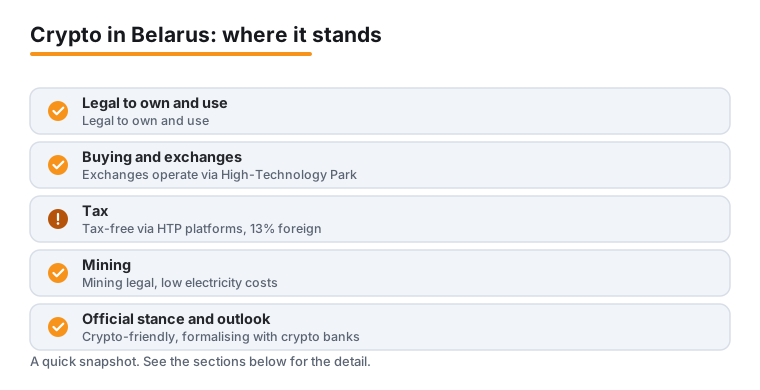
- Legal: Legal to own, trade and mine, not legal tender; regulated business runs via the HTP
- Tax: Tax-free through HTP platforms; foreign or P2P turnover reported taxed at 13 percent
- Buying: Via HTP-regulated domestic venues or international platforms, with KYC
Belarus was one of the earliest countries to give cryptocurrency a clear legal home. Through Presidential Decree No. 8 of 2017, "On the Development of the Digital Economy," it recognized owning, mining, buying, selling, and exchanging digital tokens, and channeled most regulated crypto business through the High-Technology Park (HTP), a special legal regime near Minsk. The framework keeps evolving: in January 2026 the President signed Decree No. 19 creating a path for licensed "crypto banks" supervised by the National Bank, and from 2025 the once blanket personal tax exemption was narrowed. This guide explains how Bitcoin and other cryptocurrencies are treated in Belarus today, who regulates them, the key laws, exchange and licensing rules, taxation, anti-money-laundering duties, mining, recent developments, the risks, and how to verify everything against the official sources.
This page is general information as of 2026 and is not legal, tax, or financial advice. Belarusian crypto rules have changed materially in recent years and continue to change, so always confirm the current position with the named official regulators, the High-Technology Park administration and the National Bank of the Republic of Belarus, or a qualified Belarusian adviser before acting. See also our guide to crypto regulation.
On this page: Legal status · Who regulates it · Taxes · How to buy · Mining
Is Bitcoin and crypto legal in Belarus?
Yes. Owning and using cryptocurrency is legal in Belarus, and the country was an early mover in giving digital assets a clear legal footing. Decree No. 8 of 2017 explicitly permitted individuals and companies to hold tokens and to engage in mining, exchange, and other token-related activity rather than leaving them in a legal grey zone.
- Crypto is legal to hold and transact, but it is not legal tender. The Belarusian ruble (BYN) remains the only official currency. Merchants are not obliged to accept Bitcoin, and most everyday commerce is conducted in rubles.
- In Belarusian law, cryptocurrencies are treated as "digital tokens" and broadly as property or assets, not as money issued by the state.
- Regulated crypto business is concentrated in the High-Technology Park. Exchanges, exchange operators, and token issuers that want to operate formally generally do so as HTP residents under the conditions the Park sets.
So an individual in Belarus can lawfully buy, hold, and sell Bitcoin. The heavier rules apply to businesses that provide crypto services to the public. For background on how this compares with other jurisdictions, see our crypto regulation overview.
Who regulates crypto in Belarus?
Belarus does not have a single dedicated crypto regulator. Oversight is split across a few bodies:
- The High-Technology Park (HTP) administration authorizes and supervises most crypto-service businesses, including crypto exchanges and exchange operators, that operate under its special legal regime. Its official site is park.by.
- The National Bank of the Republic of Belarus (NBRB) runs monetary policy and the banking system and, under the 2026 decree, maintains the register of "crypto banks" and supervises them. Its official site is nbrb.by.
- Tax and financial-monitoring authorities handle taxation and anti-money-laundering supervision.
Because the framework spans presidential decrees, HTP rules, and central-bank regulation, the practical detail can shift through subordinate acts. Treat the descriptions here as a high-level map and verify specifics with the relevant body.
Key crypto laws and frameworks
Belarus is not in the European Union, so the EU's Markets in Crypto-Assets (MiCA) regulation does not apply. Its regime instead rests on a small number of high-level presidential decrees plus supporting regulations, rather than a single comprehensive "crypto act." The key building blocks are:
- Decree No. 8 (2017), "On the Development of the Digital Economy." The foundational measure, signed in December 2017. It legalized token activity, granted the High-Technology Park authority over much of the crypto sector, and created favorable legal and tax conditions intended to attract blockchain businesses.
- The High-Technology Park (HTP) regime. A special legal zone, originally focused on IT and software, that became the framework for licensed crypto activity. Crypto exchanges, exchange operators, and certain token issuers register as HTP residents and follow the Park's requirements, including know-your-customer (KYC) and anti-money-laundering (AML) obligations.
- Decree No. 19 (2026), "On crypto banks and some issues of regulation in digital tokens." Signed on 16 January 2026, it created a legal path for institutions that combine traditional banking with cryptocurrency operations, requiring HTP residency and inclusion in the National Bank's register. The decree began entering into force on 25 January 2026, with its full provisions reported to take effect on 18 July 2026.
Because the rules are layered across decrees, Park acts, and central-bank regulation, the operative detail is in subordinate legislation that is updated over time.
Licensing and registration of exchanges (VASPs)
Belarus does not run a standalone EU-style VASP licence; instead, the right to provide crypto services flows from High-Technology Park residency. Token turnover for the public is permitted essentially only to HTP residents holding the status of a crypto exchange (cryptobirzha) or crypto exchange operator (kriptoplatforma/exchanger).
- HTP residency is the gateway. A business typically forms or uses a Belarusian legal entity, then applies to the HTP Supervisory Board with a business model, technical architecture, information-security measures, and internal compliance procedures.
- Approved domestic platforms operating as HTP residents have included exchanges and exchangers such as Whitebird, Bynex, Dzengi, and Free2Ex.
- Crypto banks are a new, separate category. Under Decree No. 19, a crypto bank is a joint-stock company that may combine digital-token activity with banking and payment operations. It must be an HTP resident and be entered in the National Bank's dedicated crypto-bank register, and it faces dual supervision by the NBRB and HTP bodies. National Bank officials have indicated crypto banks would be authorized to work with a defined set of cryptocurrencies (reported as 26, including Bitcoin and Ethereum) across roughly 11 categories of operations such as deposits and loans.
Before using any platform, check its current HTP-resident status; before launching a service, confirm the latest residency and registration requirements with the HTP and, for crypto banks, the National Bank.
Crypto and Bitcoin taxation
This is the area that has changed the most, so be especially careful. Under the original 2017 framework, Belarus offered an unusually generous position: individuals' mining and trading of tokens were generally not treated as taxable activity, and HTP residents enjoyed broad exemptions. For HTP-resident companies, those token-related tax benefits have been extended through 2049.
For individuals, the position was narrowed from 1 January 2025, introducing a distinction based on where you transact:
- Through Belarusian HTP-resident platforms: transactions made with HTP-resident crypto companies (for example Whitebird, Bynex, Dzengi, Free2Ex) have remained free of personal income tax.
- Foreign platforms or peer-to-peer: the Ministry of Taxes and Duties applies personal income tax of 13% to income from permitted crypto operations with foreign trading platforms, foreign organisations and foreign sole traders, declared by 31 March of the following year with the tax payable by 1 June. The Ministry of Taxes and Duties states that standard, social and property deductions do not apply and that expenses connected with acquiring the tokens are not taken into account in determining the tax base, so the 13% falls on the gross amount rather than on the gain.
- Non-compliance or prohibited activity: the rate is 26% where the income comes from unlawful or prohibited activity, and where the individual did not file a declaration and did not pay the tax. For unlawful token activity the tax base is computed using an annual profitability coefficient set by the Ministry of Taxes and Duties, fixed at 0.0367 for 2026 by a resolution of 18 February 2026, down from 0.0570 for 2025.
These rates rest on Article 202-1 of the Tax Code, which has applied since 1 January 2025, and are what the Ministry of Taxes and Duties still publishes for 2026. The annual profitability coefficient used for unlawful activity is reset each year, so check the current figure before calculating. Confirm your own position with the Ministry of Taxes and Duties or a local adviser. Our general crypto tax guide explains the concepts in plain terms.
AML and KYC rules
Belarus applies anti-money-laundering and counter-terrorist-financing (AML/CFT) controls to regulated crypto activity. Crypto exchanges and exchangers that are HTP residents are required to follow customer-identification and AML/CFT procedures, broadly including:
- Identity verification (KYC) of customers before and during use of the service.
- Record-keeping of customers and of customer funds.
- Monitoring and prevention of anonymous and suspicious transactions, with reporting to the authorities where required.
Under Decree No. 19, crypto banks must also comply with AML/CFT obligations and other prudential rules applicable to non-bank financial institutions, alongside capital-adequacy and risk-management requirements set by the National Bank. In practice this means anonymous, large-volume trading on regulated Belarusian venues is not the norm, and you should expect to verify your identity.
Enforcement has also become more visible. In October 2025 the National Bank set up a working group to counter illegal cryptocurrency circulation and unauthorized cross-border transfers, and the State Control Committee has reported maintaining a register of cryptocurrency wallets tied to criminal proceeds, described as part of preparations for the country's next assessment against Financial Action Task Force (FATF) standards.
Buying and using crypto in practice
Buying cryptocurrency is legal for individuals, and there are two broad routes:
- Domestic, HTP-regulated venues. Belarusian exchanges and exchangers with HTP-resident status are the formally sanctioned way to buy and sell tokens inside the country. They apply KYC and AML checks, and transacting through them has carried the more favorable personal tax treatment described above.
- International exchanges and peer-to-peer. Some Belarusians also use global exchanges or P2P marketplaces. This can carry different (and potentially higher) tax consequences for individuals after the 2025 changes, and it puts you outside the Belarusian regulatory perimeter for consumer protection. Access has also become harder: in December 2025 the Ministry of Information added several large foreign exchanges, including Bybit, OKX, Bitget, BingX, Gate and Weex, to the national restricted-access list, and users on state provider Beltelecom reported being unable to reach those sites. The stated basis was advertising rules under the Law on Mass Media rather than a blanket ban on holding crypto.
Practical points: expect identity verification on any reputable platform; funding usually involves Belarusian rubles via bank transfer or card, subject to your bank's policies; and keep your own records of purchases, sales, and transfers, because declaration rules now apply to individuals. Crypto is not legal tender, so merchants are not required to accept it, though digital tokens may be used as a settlement instrument in some foreign-trade arrangements conducted through a crypto bank under the 2026 decree. If compliance and tax efficiency matter to you, an HTP-regulated Belarusian venue is generally the cleaner choice; always check a platform's current registration before depositing funds.
Bitcoin mining in Belarus
Mining is legal and was explicitly permitted under the 2017 decree. For individuals it was historically not treated as taxable business activity, which made the country attractive to hobbyist and small-scale miners.
- Electricity. Belarus has relatively low industrial electricity costs and significant generating capacity, including nuclear power, which is a key input for mining economics. Power availability and tariffs are the main driver of whether mining is worthwhile.
- Tax and reporting. The favorable individual treatment was narrowed from 2025, so mining proceeds may now carry declaration or tax obligations depending on your status and how and where you convert them to fiat. Larger or commercial mining operations should expect to operate as businesses, potentially within the HTP framework.
Before setting up mining in Belarus, confirm the current tax position for your situation, check electricity supply terms with your provider, and clarify whether your scale is treated as personal activity or a business.
Recent developments (2025-2026)
Two shifts define the current period:
- Personal taxation tightened (2025). From 1 January 2025 the blanket personal exemption was narrowed, distinguishing tax-free transactions through HTP-resident platforms from taxable transactions on foreign platforms or peer-to-peer, and introducing annual declaration duties for individuals.
- Crypto banks (2026). On 16 January 2026 the President signed Decree No. 19, "On crypto banks and some issues of regulation in digital tokens," creating a regulated category of joint-stock companies that combine banking and payment services with digital-token activity. Such entities require HTP residency and entry in the National Bank's register and face dual NBRB and HTP supervision. Its main provisions took effect on 18 July 2026, six months after official publication, alongside National Bank resolutions Nos. 156, 157, 158, 162, 163 and 167 that implement them. As at August 2026 the National Bank register of crypto banks records that no crypto banks are entered in it, so no licensed crypto bank yet exists. Whitebird said in January 2026 that it intends to register one.
- Crypto payments in retail (2025). The Russian e-commerce platform Wildberries began a pilot letting Belarusian shoppers pay for orders with cryptocurrencies such as Bitcoin, Ethereum and Tether, processed through HTP resident Whitebird. Buyers purchase ruble-denominated certificates with crypto, and the feature started in test mode before a wider rollout.
- Enforcement stepped up (2025). In October 2025 the National Bank announced a working group to combat illegal cryptocurrency circulation and unauthorized cross-border transfers, and the State Control Committee said Belarus keeps a register of crypto wallets linked to criminal proceeds ahead of the country's next FATF-related assessment. In December 2025 several large foreign exchanges were added to the national restricted-access list. President Lukashenko said cross-border Belarusian crypto transfers reached about 1.7 billion US dollars in the first seven months of 2025.
Belarus has signaled a continued intention to position itself as a crypto-friendly jurisdiction, anchored by the HTP and reinforced by the move toward licensed crypto banks. The likely trajectory is a more formalized, supervised sector paired with tighter accounting and taxation than the early "tax-free haven" image suggested. Watch official announcements from the HTP, the National Bank, and the President's portal for the next round of detail.
Consumer risks and protection
Even within a legal framework, crypto carries real risks. Keep these in mind:
- Regulatory change. Belarus has revised crypto tax and added new institutional categories within short windows. Rules you rely on today may change.
- Tax exposure. The era of blanket personal tax exemption has ended in important respects; misunderstanding your obligations is a genuine risk.
- Geopolitical and sanctions context. Sanctions affecting Belarus can complicate fiat banking, on and off ramps, and access to some international platforms.
- Market and security risk. Price volatility, exchange failures, scams, and loss of keys apply as everywhere. Enable two-factor authentication, verify destination addresses, and never share private keys or recovery phrases.
Consumer protection is strongest when you transact through an HTP-regulated Belarusian venue, because those platforms operate under the Park's KYC, AML, and conduct requirements. Using foreign or P2P services puts you outside that perimeter. Only commit money you can afford to lose, and treat crypto as a high-risk part of any plan. This is general information, not investment advice.
Official sources and how to verify
Because the rules change through subordinate acts, always confirm the current position against primary official sources rather than secondary summaries:
- High-Technology Park administration: park.by, the authority for crypto exchanges, exchangers, and token issuers operating under its regime, including the list of residents.
- National Bank of the Republic of Belarus: nbrb.by, which maintains the crypto-bank register and supervises crypto banks under Decree No. 19.
- Official Internet Portal of the President of the Republic of Belarus: president.gov.by, where the text and announcements of presidential decrees, including the 2026 crypto-bank decree, are published.
For taxation, check with the Belarusian tax authorities, and for legal specifics consult a qualified Belarusian adviser. You can also browse our wider regulation hub for country-by-country context. Remember that this guide is general information as of 2026 and not legal advice, and the authoritative position is whatever the named regulators state at the time you act.
Status as of August 2026
Belarus now has an operative crypto bank framework on paper and no licensed crypto bank in practice. The main provisions of Decree No. 19 took effect on 18 July 2026, together with the National Bank resolutions that implement them, confirmed by the National Legal Internet Portal on 20 July 2026.
- The register is empty. The National Bank register of crypto banks states that as at the current date there are no crypto banks in it. Until a company appears there, no Belarusian crypto bank legally exists.
- One applicant has declared itself. Whitebird, an HTP-resident exchange operator, said on 19 January 2026 that it would create a new legal entity meeting the crypto bank requirements and apply for High Technologies Park residency and entry in the National Bank register. No later report of an application being granted has been found.
- Nothing changed for ordinary holders on 18 July. Individuals still buy and sell only through HTP-resident platforms, and the personal tax rules that began on 1 January 2025 still apply.
- The next dated event is external. From 25 August 2026 an EU restriction on Belarusian nationals and residents owning or controlling MiCA-authorised crypto firms begins to apply.
What took effect on 18 July 2026
Decree No. 19 was the framework. The operating detail came from resolutions of the Board of the National Bank, which took effect on the same day as the decree's main provisions.
| Act | Date | What it governs |
|---|---|---|
| Resolution No. 156 | 25 June 2026 | Measures implementing Decree No. 19: how the Board decides on recovery to the budget or return of the crypto bank's deposit, criteria for finding it economically inexpedient to expand the number of crypto banks, and extension of remote identification rules to digital token transactions |
| Resolution No. 157 | June 2026 | Approves the administrative procedure regulations |
| Resolution No. 158 | June 2026 | Form, content and maintenance of the crypto bank register, including inclusion, amendment and exclusion |
| Resolution No. 162 | June 2026 | Instruction on accounting for digital tokens at crypto banks |
| Resolution No. 163 | June 2026 | How token exchange rates against the ruble are set: market data from major exchanges including Binance, Bybit and OKX, and contractual terms for tokens created by HTP residents |
| Resolution No. 167 | 10 July 2026 | Prudential requirements and the minimum list of permitted banking operations |
The money thresholds are in the decree itself. Founders must form a charter fund of at least 20 million Belarusian rubles before applying for inclusion in the register, and no later than ten working days after inclusion the crypto bank must place 10 million rubles with the National Bank in a conditional irrevocable deposit, as set out in a legal review of the decree. Under Resolution No. 167 a crypto bank complies with the prudential regime written for non-bank credit and financial organisations, with modifications, and must observe daily a ratio of at least 1 between funds on its correspondent account at the National Bank in Belarusian rubles and balances on current accounts of resident individuals in Belarusian rubles. Resolution No. 156 also lets the National Bank treat expanding the number of crypto banks as economically inexpedient, so admission is not automatic even for an applicant that meets every financial test.
Who crypto banks may serve, and what they may hold
The minimum list of banking operations in Resolution No. 167 covers opening and maintaining accounts for non-resident individuals, sole proprietors and legal entities, along with currency exchange, settlement operations, attracting funds to accounts, and settlement and cash services. Analysis of the resolution notes that the minimum list does not include opening and maintaining accounts for Belarusian resident individuals. The specific set of operations each crypto bank may perform is fixed in the National Bank decision admitting it to the register, so permissions can differ between institutions, and the resolution's own daily ratio requirement is framed around balances on current accounts of resident individuals. A legal review of the decree reads the framework as also allowing crypto banks to serve legal entities, resident and non-resident, for specified operations including foreign trade contracts.
One point matters before trusting a crypto bank with money: funds on accounts and deposits of non-resident individuals at a crypto bank are not an object of guaranteed compensation of bank deposits, which is the scheme that protects ordinary Belarusian bank deposits.
On the asset side, a regulation approved with the High Technologies Park Supervisory Board sets the tokens a crypto bank may transact in. The list of 26 is AAVE, ADA, ARB, AVAX, BCH, BNB, BTC, DAI, DOGE, DOT, ETH, HYPE, LINK, LTC, NEAR, PAXG, POL, SHIB, SOL, SUI, TON, TRX, USDC, USDT, XAUT and XRP. Permitted operations include crypto deposits, crypto loans, pledging crypto as collateral, staking, transfers between persons, issuance of a crypto bank's own tokens, exchange and storage. Announcing the parameters on 23 April 2026, the First Deputy Chairman of the National Bank said the list of operations is not yet closed and the document will be supplemented as work with investors progresses.
What individuals may and may not do
The rule that governs ordinary holders is not the tax code but Decree No. 367 of 17 September 2024, "On the circulation of digital signs (tokens)", in force from 20 September 2024. Individuals, including sole proprietors who are High Technologies Park residents, may acquire and dispose of tokens only through operators of crypto platforms and crypto exchangers that are HTP residents. Token transactions carried out in breach of that requirement are unlawful.
- Holding crypto is legal. Owning, storing and transferring tokens is not prohibited, and crypto is not legal tender.
- Buying and selling outside HTP-resident venues is unlawful, which covers direct person-to-person deals. Reported consequences include a fine of 20 to 50 base units and confiscation of up to the full amount of the income, on top of tax at the 26 per cent rate.
- The lawful route is an HTP-resident operator such as Whitebird, Bynex, Dzengi or Free2Ex.
- Involving other people in your token operations makes the activity unlawful. The Ministry of Taxes and Duties states that if other individuals are engaged in carrying out token operations, that activity is unlawful.
The stated purpose of the decree is to protect citizens in token transactions and to stop money stolen from bank accounts leaving the country through foreign crypto platforms.
EU sanctions: what changes on 25 August 2026
Belarus is outside the EU and MiCA does not apply there, but two EU measures now shape what Belarusian crypto businesses and nationals can do.
- In force since 24 May 2026. The EU's 20th package, adopted 23 April 2026, inserted Article 1zf into Regulation 765/2006, prohibiting transactions with crypto-asset service providers and platforms established in Belarus. Law firm analysis of the package sets out the measure. Belarusian industry commentary reported that existing clients had until 25 June 2026 to close positions.
- Applies from 25 August 2026. Council Decision (CFSP) 2026/1847 and Council Regulation 2026/1846, adopted 24 July 2026, amend Article 1u of Regulation 765/2006 so that Belarusian nationals and residents may not own or control an EU-established provider of any crypto-asset service under MiCA, nor hold a post on its governing body. The earlier restriction covered only wallet, account and custody services; the new one reaches trading platforms, exchange, order transmission, portfolio management and advice.
For a retail holder in Belarus this changes little directly, because access to EU platforms was already constrained. It matters most to Belarusian founders, shareholders and directors of crypto firms established in the EU, who must be out of those positions by 25 August 2026. It also caps the crypto bank project: industry commentary reports that the sanctions block access to European financial infrastructure and push the sector toward domestic, Asian and Middle Eastern markets.
Frequently asked questions
Is cryptocurrency legal in Belarus?
Yes. Belarus legalized owning, mining, buying, selling, and exchanging digital tokens through Decree No. 8 of 2017. However, cryptocurrency is not legal tender; the Belarusian ruble (BYN) remains the only official currency, and merchants are not required to accept crypto.
Who is the main regulator for crypto in Belarus?
There is no single dedicated regulator. The High-Technology Park (HTP) administration authorizes and supervises most crypto-service businesses, while the National Bank of the Republic of Belarus maintains the register of crypto banks and supervises them under the 2026 decree. Tax and financial-monitoring authorities cover taxation and anti-money-laundering. Verify details at park.by and nbrb.by.
Do individuals pay tax on crypto in Belarus?
It depends, and the position changed from 1 January 2025. Transactions through Belarusian HTP-resident platforms have remained free of personal income tax, while reporting indicates a 13% tax on turnover from foreign platforms or peer-to-peer trades, with an annual declaration due and a higher rate (around 26%) for non-compliance. Rates have been revised, so confirm your exact obligations with the Belarusian tax authorities or a local adviser.
Do I need a licence to run a crypto exchange in Belarus?
In practice you need High-Technology Park residency. Token turnover for the public is permitted essentially only to HTP residents holding crypto-exchange or exchange-operator status, who must meet the Park's KYC and AML requirements. The separate "crypto bank" category created by Decree No. 19 (2026) additionally requires entry in the National Bank's register and dual NBRB and HTP supervision.
What are crypto banks in Belarus?
Under Decree No. 19, signed on 16 January 2026, a crypto bank is a joint-stock company that may combine banking and payment services with digital-token activity. It must be an HTP resident and be entered in the National Bank's register, and it is supervised jointly by the National Bank and the HTP. A regulation approved with the High Technologies Park Supervisory Board fixes the 26 tokens a crypto bank may transact in: AAVE, ADA, ARB, AVAX, BCH, BNB, BTC, DAI, DOGE, DOT, ETH, HYPE, LINK, LTC, NEAR, PAXG, POL, SHIB, SOL, SUI, TON, TRX, USDC, USDT, XAUT and XRP. Permitted operations include crypto deposits, crypto loans, collateral, staking, transfers, token issuance, exchange and storage, and officials say that list is not yet closed. The framework took effect on 18 July 2026, but the National Bank register of crypto banks still records no entries, so no crypto bank is licensed.
Can I mine Bitcoin in Belarus?
Yes, mining is legal and was permitted under the 2017 decree, and relatively low electricity costs have made it attractive. But the favorable individual tax treatment was narrowed from 2025, so mining income may now carry declaration or tax obligations depending on your status and scale. Larger operations should expect to be treated as businesses, potentially within the HTP framework.
Can I use foreign crypto exchanges like Bybit or OKX in Belarus?
Access has become harder. In December 2025 the Ministry of Information added several large foreign exchanges, including Bybit, OKX, Bitget, BingX, Gate and Weex, to the national restricted-access list, and users on the state provider Beltelecom reported being unable to reach those sites. This was framed under advertising rules rather than a blanket ban on holding crypto, but it pushes activity toward HTP resident venues. Using foreign platforms can also trigger the 13% personal income tax on turnover. Confirm the current position before relying on any foreign service.
Can I pay for goods with crypto in Belarus?
Crypto is not legal tender, so ordinary merchants are not required to accept it. However, in 2025 the Russian e-commerce platform Wildberries began a pilot allowing Belarusian shoppers to pay with cryptocurrencies such as Bitcoin, Ethereum and Tether, processed through HTP resident Whitebird. Buyers purchase ruble-denominated certificates with crypto. Separately, Decree No. 19 (2026) permits digital tokens as a settlement instrument in foreign-trade deals conducted through a licensed crypto bank.
Do I have to declare crypto to the Belarusian tax authorities?
Since 1 January 2025 individuals face an annual declaration duty for taxable crypto activity, commonly due by the end of March. Transactions through HTP resident platforms have remained free of personal income tax, while turnover on foreign platforms or peer-to-peer trades has been reported as taxed at 13%, with a higher rate (around 26%) where a return is not filed and the tax is unpaid. Keep records of purchases, sales and transfers, and confirm your exact obligations with the tax authorities or a local adviser.
Has any crypto bank actually opened in Belarus?
No. The framework took effect on 18 July 2026, but the National Bank register of crypto banks states that as at the current date no crypto banks are entered in it. Whitebird, an HTP-resident exchange operator, said in January 2026 that it would create a new legal entity meeting the requirements and apply for entry in the register. No report of an application being granted has been found. Until a company appears in that register, no Belarusian crypto bank legally exists.
Can Belarusian residents open an account at a Belarusian crypto bank?
Not under the minimum list of operations. Resolution No. 167 of 10 July 2026 lists opening and maintaining accounts for non-resident individuals, sole proprietors and legal entities, but does not include accounts for Belarusian resident individuals. The exact permissions for each crypto bank are set in the National Bank decision admitting it to the register, and the resolution separately requires a daily ratio calculated against balances on current accounts of resident individuals, so this can vary by institution. Legal analysis reads the framework as also covering resident legal entities for specified operations, including foreign trade contracts.
Is peer-to-peer crypto trading legal in Belarus?
No. Decree No. 367 of 17 September 2024, in force from 20 September 2024, allows individuals, including sole proprietors who are High Technologies Park residents, to acquire and dispose of tokens only through operators of crypto platforms and crypto exchangers that are HTP residents. Transactions in breach of that are unlawful. Reported consequences include a fine of 20 to 50 base units, confiscation of up to the full amount of the income, and tax at the 26 per cent rate.
Is money held at a Belarusian crypto bank protected?
No. Under Decree No. 19, funds on accounts and deposits of non-resident individuals at a crypto bank are not an object of guaranteed compensation of bank deposits, the scheme that covers ordinary Belarusian bank deposits. A crypto bank must hold a charter fund of at least 20 million Belarusian rubles and place 10 million rubles with the National Bank in a conditional irrevocable deposit no later than ten working days after joining the register, but that is prudential capital, not a client guarantee.
What happens on 25 August 2026 for Belarusians in the EU crypto sector?
From 25 August 2026 the EU bars Belarusian nationals and residents from owning or controlling an EU-established provider of any crypto-asset service under MiCA, and from holding a post on its governing body. The measure is in Council Decision (CFSP) 2026/1847 and Council Regulation 2026/1846, adopted 24 July 2026, amending Article 1u of Regulation 765/2006. It widens an earlier restriction that covered only wallet, account and custody firms. It affects company ownership and directorships, not personal holdings.
Can EU crypto firms deal with Belarusian platforms?
No. Since 24 May 2026, Article 1zf of Regulation 765/2006, inserted by the EU's 20th sanctions package adopted on 23 April 2026, prohibits transactions with crypto-asset service providers and platforms established in Belarus. Belarusian industry commentary reported that existing clients had until 25 June 2026 to close positions. In practice this cuts Belarusian platforms off from EU liquidity and means a Belarusian crypto bank could not settle with EU counterparties.
Facts reviewed: 6 August 2026. Page updated: 6 August 2026.