Home › Crypto Regulation › Hungary
Bitcoin & Cryptocurrency Regulation in Hungary
Quick answer — Hungary, 2026
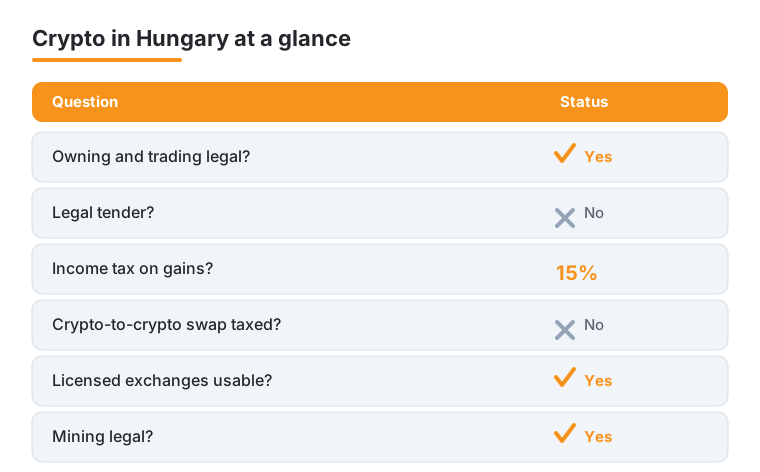
- Yes, owning, buying, selling and holding crypto is legal for individuals; it is not legal tender.
- Gains are taxed at a flat 15% personal income tax rate, generally when you cash out to fiat or spend.
- Residents buy through MiCA-authorised exchanges or Bitcoin ATMs. Hungary's separate validation certificate requirement and the two crypto offences in the Criminal Code were repealed by Act XXXVIII of 2026, promulgated on 30 July 2026 and in force from 7 August 2026.
Hungary lets individuals own, buy, sell and use Bitcoin and other crypto-assets, but it has built one of the European Union's strictest and most unusual frameworks for the businesses that handle crypto. As an EU member state, Hungary applies the EU Markets in Crypto-Assets Regulation (MiCA), implemented nationally through the Crypto-Asset Market Act (Act VII of 2024), with the central bank, Magyar Nemzeti Bank (MNB), acting as the licensing authority for crypto-asset service providers. On top of MiCA, a 2025 law (Act LXVII of 2025) added a uniquely Hungarian "crypto-asset conversion validation" regime backed by new criminal offences, supervised by a separate body, the Supervisory Authority of Regulated Activities (in Hungarian, Szabalyozott Tevekenysegek Felugyeleti Hatosaga, or SZTFH). This guide explains the current legal status, the regulators, taxation, and the practicalities of buying, mining and using crypto in Hungary as of 2026, and points you to the official sources to verify each point.
This article is general information as of 2026 and is not legal, tax or financial advice. Hungary's rules have changed rapidly, the validation regime only took full effect in late December 2025, and the European Commission has opened an infringement case questioning whether parts of it are even compatible with EU law. Always confirm the current position with the MNB, the SZTFH, the National Tax and Customs Administration (NAV) and a qualified Hungarian adviser before acting. See our general crypto regulation guide for wider context.
On this page: Legal status · Who regulates it · Taxes · How to buy · Mining
Is Bitcoin and crypto legal in Hungary?
Yes. Owning, buying, selling, holding and transferring Bitcoin and other crypto-assets is legal for individuals in Hungary. There is no ban on personal ownership, and residents can hold crypto in self-custody wallets or with regulated providers.
Bitcoin is not legal tender. The Hungarian forint (HUF) is the official currency, and no business is obliged to accept crypto as payment, although merchants may choose to. For most purposes crypto-assets are treated as a form of property or financial asset rather than as money.
The crucial nuance in Hungary is that while holding crypto is unrestricted, the exchange of crypto is tightly controlled. The validation obligation introduced by Act LXVII of 2025 was repealed by Act XXXVIII of 2026 with effect from 7 August 2026. Existing validator licences lapse on the same day under the new Section 16/B of the Crypto-Asset Market Act (Act VII of 2024), and conversions now sit under MiCA and MNB supervision alone. Since the repeal took effect Hungary is an ordinary MiCA jurisdiction, so the check that matters is the same one as elsewhere in the EU: whether your provider is MiCA-authorised (see the laws, licensing and buying sections below).
Who regulates crypto in Hungary?
Hungary used a dual-track supervisory structure until the validation regime was repealed with effect from 7 August 2026. Since then the MNB is the only crypto supervisor, alongside a separate tax authority:
- Magyar Nemzeti Bank (MNB), the central bank, is the competent authority for licensing and supervising crypto-asset service providers (CASPs) under the EU MiCA regime. The MNB maintains official guidance and registers on its supervision pages.
- Supervisory Authority of Regulated Activities (SZTFH) licensed and supervised the category of "crypto-asset conversion validation service providers" created by the 2025 validation regime. Act XXXVIII of 2026 removed crypto validation from the SZTFH's statutory remit, and SZTFH Decree 7/2026 (VII. 30.) repealed the implementing decrees from 2 August 2026, so the SZTFH no longer has a role in crypto and its validator register is no longer published.
- National Tax and Customs Administration (NAV) administers personal income tax and other taxes, including the tax treatment of crypto gains.
Since 7 August 2026 only one regulator licenses crypto services in Hungary, the MNB, and providers no longer deal with the SZTFH on crypto matters. Always check a firm's current status directly with the relevant authority rather than relying on marketing claims.
Crypto laws and frameworks in Hungary
Hungary's framework has two layers: the EU-wide MiCA rulebook and a distinctive national overlay.
MiCA and the Crypto-Asset Market Act. MiCA (Regulation (EU) 2023/1114) is directly applicable across the EU and creates a single rulebook for issuing crypto-assets and for licensing service providers such as exchanges, brokers and custodians. Hungary enacted the national accompanying legislation, the Crypto-Asset Market Act (Act VII of 2024), and designated the MNB as the competent supervisory authority for CASPs. A licence granted in one EU country can in principle be passported across the bloc. Firms active before MiCA took full effect were given a transition window that ran until 1 July 2025, after which they must be MNB-authorised to keep serving Hungarian customers.
The validation regime and new criminal offences. Act LXVII of 2025, which entered into force on 23 June 2025, amended both the Crypto-Asset Market Act and the Criminal Code. It requires every exchange of crypto-assets, whether for funds or for other crypto-assets, to be checked by a newly created, separately licensed entity (a crypto-asset conversion validation service provider) that performs purpose-built due diligence and issues a declaration of conformity (often called a validation or compliance certificate). Without it, the conversion is treated as unauthorised and the related transfer is deemed legally invalid. The detailed rules were set out in SZTFH Decree 10/2025 (issued 27 October 2025), and the validation certificate requirement took full effect on 27 December 2025. Hungary registered its first authorised validation service provider in January 2026.
Standard MiCA elements also apply, including stricter requirements for asset-referenced and e-money tokens (stablecoins) on reserves, disclosure and approval, plus market-abuse and conduct rules. For a plain-English primer on how MiCA works, see our crypto regulation guide.
Licensing and registration of exchanges and validators
Two separate authorisations matter in Hungary.
MiCA CASP authorisation (MNB). Exchanges, brokers, custodians and similar providers serving Hungary must hold (or be transitioning to) a MiCA CASP authorisation from the MNB, or passport in a licence obtained in another EU member state. The MNB publishes an authorisation guideline for CASPs and maintains a public register of supervised institutions at intezmenykereso.mnb.hu, where kriptoeszkoz szolgaltato (crypto-asset service provider) and hataron atnyulo kriptoeszkoz szolgaltato (cross-border crypto-asset service provider) are separate searchable institution types. On 20 July 2026 the MNB granted its first authorisation to a Hungarian-headquartered provider, Tiwala Solutions Kft, operator of CoinCash. Before using a provider, cross-check its status against the MNB's official registers.
Validation service provider authorisation (SZTFH). SZTFH Decree 10/2025 (X. 27.) and the related fee decree 12/2025 (XI. 28.) were both repealed by SZTFH Decree 7/2026 (VII. 30.), which entered into force on the third day after promulgation, that is 2 August 2026. There is no longer a validator licence to apply for and no validator capital, insurance or personnel conditions to meet. The validator's due diligence goes beyond ordinary KYC and is reported to cover the origin of the crypto-asset, verification of ownership of the device or wallet, identification of associated persons, a profile-based risk assessment of the user, and checks against external databases. The SZTFH maintains a public register of authorised validators so counterparties and users can confirm who is licensed.
Crypto and Bitcoin tax in Hungary
Hungary taxes crypto for individuals under Section 67/C of the Personal Income Tax Act (Act CXVII of 1995), which NAV's own guidance names as the governing provision. NAV administers personal taxes. The principles below are general; rates and thresholds can change, so verify current figures with NAV or a tax adviser, and see our crypto taxes guide for wider background.
- Flat 15% rate: NAV states that 15 percent personal income tax is payable on the transaction profit realised in the tax year from crypto-asset transactions, under Section 67/C of the Personal Income Tax Act. NAV also applies a de minimis: no income has to be established where the revenue from a transaction does not exceed 10 percent of the minimum wage, provided no other such transaction is made on the same day and the total of that revenue in the tax year does not exceed the minimum wage. Confirm any surcharges for your own situation.
- Tax on cashing out: A taxable event generally arises when you convert crypto into fiat or use it to buy goods, services or other property. Exchanging one crypto-asset for another is generally not an immediate taxable event under this regime.
- Net gains and loss offset: Tax is calculated on the net annual result of crypto transactions, deducting costs from revenue. Loss relief runs backwards, not forwards. NAV describes it as an adokiegyenlites (tax equalisation) credit worth 15 percent of the loss declared on crypto transactions in the tax year or in either of the two preceding years, reduced by any credit already claimed in an earlier return.
- Mining and business income: Income from mining or business-scale activity may be treated differently from simple investment gains; take professional advice.
- Filing deadline: Crypto income is reported in the annual personal income tax return, with the general deadline of 20 May of the year following the transactions (for example, 20 May 2026 for trades made in 2025). Confirm the current deadline with NAV.
- Automatic reporting (DAC8): Under the EU DAC8 directive, crypto-asset service providers are being brought into automatic exchange-of-information rules, so exchanges are expected to report user data to tax authorities including NAV. Assume your activity will become more visible to the tax office.
Keep detailed records of dates, amounts, forint values and counterparties. Crypto-tax software is widely used, but confirm the figures against NAV's official guidance.
AML, KYC and the validation due-diligence layer
Anti-money-laundering (AML) and know-your-customer (KYC) obligations apply throughout the Hungarian crypto sector. Licensed providers must verify customer identity, monitor transactions and comply with EU AML rules, including the "travel rule" that requires originator and beneficiary information to accompany transfers above set thresholds.
Hungary then layers its own validation due diligence on top. Where the validation regime applies, a conversion cannot proceed legitimately until a licensed validator has run its checks (identity, wallet or device ownership, source of the crypto-asset, user risk profile and database screening) and issued a declaration of conformity. This is deliberately stricter and broader than ordinary KYC and is unique to Hungary among EU states. Expect identity verification, document requests and, for exchanges, source-of-funds questions, especially for larger amounts.
Buying and using crypto in practice
Residents can buy crypto through EU-based exchanges, brokers and apps that serve the market. Practical points when using a regulated provider:
- Choose a compliant provider: Prefer firms that are MiCA-authorised as CASPs and check status in the MNB's registers.
- Verify your identity (KYC): You must complete identity checks before trading or withdrawing.
- Funding: SEPA euro transfers, card payments and, where supported, forint deposits are common.
- Fees and spreads: Compare trading fees, deposit and withdrawal costs and spreads, which vary widely.
- Custody: Decide whether to leave assets with the provider or withdraw to your own wallet (a hardware wallet for larger holdings) and safeguard your recovery phrase.
Hungary's validation requirement adds an important wrinkle: because converting crypto for fiat or for another crypto can require a Hungarian validation certificate to be considered authorised, the safest course is to use providers that are clearly compliant with the current regime and to confirm how the validation rules apply to your transactions. Cash buyers can use a Bitcoin ATM (mostly in Budapest), accepting higher fees and the same legal cautions; ATM numbers and operators change frequently, so verify a machine's operator and compliance before use. This is one of the few EU markets where using a non-compliant exchange service could, in principle, carry legal risk for the user.
Bitcoin mining in Hungary
Bitcoin mining is legal in Hungary. There is no specific prohibition on running mining hardware, but miners operate within the general legal, tax, energy and (for larger operations) business-registration frameworks.
The dominant practical factor is electricity cost. Hungary's power prices are not among the lowest in Europe, which makes large-scale proof-of-work mining economically challenging compared with low-cost-energy jurisdictions. A significant share of Hungary's electricity comes from nuclear and other low-carbon sources, so efficient or off-peak mining can have a relatively lower carbon footprint, but profitability remains tied to energy prices and Bitcoin's market value.
For tax, mining rewards are generally treated as taxable income and may be handled differently from simple investment gains (see the tax section). Anyone mining at scale should consider business registration, VAT, electricity-supply and environmental compliance, and take professional advice. Hobby miners should still record the forint value of rewards when received.
Recent developments: the EU infringement case and provider exits
The defining story heading into 2026 is the clash between Hungary's national validation regime and EU law. In early 2026 the European Commission opened an infringement proceeding (INFR(2025)2174) against Hungary, sending a letter of formal notice that argues the validation regime introduced by Act LXVII of 2025 has no basis under MiCA and conflicts with MiCA's harmonised, single-market framework. Hungary was given two months to reply. The national measure the Commission objected to has since been repealed by Act XXXVIII of 2026, in force from 7 August 2026, so any decision to close the case now rests with the Commission.
The practical fallout has been significant. Around the validation certificate's entry into force on 27 December 2025, several providers suspended or withdrew crypto services for Hungarian users rather than navigate the new requirements, reducing consumer choice in the short term. Because the regime's compatibility with EU law is now formally contested, its scope, enforcement and even survival are uncertain.
A change of government in 2026 has now put the whole regime in question. Parliamentary elections on 12 April 2026 ended Viktor Orban's long period in office, and Peter Magyar of the Tisza party became prime minister in May 2026. On 11 June 2026 the government announced that it would dismantle the validation certificate system and remove the crypto-related criminal penalties, and put a draft bill out for public consultation with comments invited until 19 June 2026. That plan is now law. Parliament adopted the repeal on 28 July 2026 as Act XXXVIII of 2026 on the repeal of certain statutory provisions concerning crypto-asset conversion services. It was promulgated in Magyar Kozlony 2026/102 on 30 July 2026 and, under its Section 6, enters into force on the eighth day after promulgation, which is 7 August 2026. This is a fast-moving situation: check the MNB and SZTFH for the latest guidance and any amendments before transacting, and see our broader crypto regulation hub for related coverage.
Consumer risks and protection
MiCA brings a more standardised, supervised market for providers, with conduct standards, disclosure rules and protections against market abuse, and the MNB and SZTFH supervise the firms operating in Hungary. But important risks remain:
- Market risk: Crypto is highly volatile, can suffer steep drawdowns, and carries risks of platform failure, hacking, lost keys, scams and total loss of capital.
- Compliance risk unique to Hungary: The validation regime and new criminal offences mean that how and where you transact carries legal weight, not just whether you hold crypto. Using an unauthorised exchange service above the value thresholds can expose users to criminal liability.
- Regulatory uncertainty: With the EU infringement case open, rules may change at short notice.
Prudent practice includes investing only what you can afford to lose, diversifying, using reputable and compliant providers, securing your private keys, being sceptical of guaranteed-return promises, and keeping accurate records. None of this is financial advice; consider speaking to a licensed Hungarian adviser. Hungary is also moving toward greater tax transparency, with provider obligations to identify users and report data under EU and OECD standards, so expect your activity to become more visible to tax authorities.
Penalties for unauthorised crypto exchange
The 2025 amendments to the Criminal Code created tiered, value-based offences for crypto-asset conversions made through an unauthorised (non-validated) service. Both offences were deleted by Section 1 of Act XXXVIII of 2026 with effect from 7 August 2026: the subtitle Kriptoeszkozzel visszaeles (misuse of crypto-assets) following Section 394 of the Criminal Code (Act C of 2012), and the subtitle Jogosulatlan kriptoeszkoz-atvaltasi szolgaltatas nyujtasa (provision of unauthorised crypto-asset conversion services) following Section 408. The bands below are kept for historical context and no longer apply:
- For users who exchange crypto via an unauthorised service: above roughly HUF 5 million in value, imprisonment of up to two years; for higher value bands (reported around HUF 50 million and HUF 500 million), longer terms rising toward five and up to eight years.
- For providers who carry on conversion activity in breach of the validation requirements: a felony with imprisonment reported at up to three years for lower-value activity, rising toward eight years for higher value.
In addition, an unauthorised conversion is treated as legally invalid and cannot be the basis of a money-transmission service. These figures and bands are drawn from legal commentary and are summarised here for orientation only; because the law is new, contested at EU level and still being applied, confirm the exact current thresholds and penalties with an official source and a Hungarian lawyer before relying on them.
Official sources and how to verify
This guide is general information as of 2026 and is not legal advice. Hungary's crypto rules are unusually strict, recently changed and currently the subject of an EU infringement case, so always verify the current position with the named official regulators before acting. Start with these official sources:
- Magyar Nemzeti Bank (MNB) crypto market licensing for CASP authorisation, guidance and registers.
- SZTFH register of crypto-asset conversion validation service providers to check which validators are licensed.
- National Tax and Customs Administration (NAV) for the official tax position.
For the underlying EU rules, MiCA is Regulation (EU) 2023/1114. For the national framework, see the Crypto-Asset Market Act (Act VII of 2024) and the 2025 validation amendments (Act LXVII of 2025) together with SZTFH Decree 10/2025. For our own related pages, see the crypto regulation guide and the regulation hub. Where this guide says rules are evolving or uncertain, treat that as a prompt to check the official source rather than rely on summaries.
August 2026 update: the validation regime has been repealed
Hungary's separate national crypto validation regime has been repealed. Parliament adopted the repeal on 28 July 2026 and it was promulgated two days later in Magyar Kozlony 2026/102 of 30 July 2026, the official gazette. The act's own preamble gives the reason: validation, as a competition-restricting requirement in crypto services, is not sustainable for the realisation of the internal market.
| Date | What happens |
|---|---|
| 28 July 2026 | Parliament adopts Act XXXVIII of 2026 on the repeal of certain statutory provisions concerning crypto-asset conversion services. The date is recorded in the gazette footnote to the act. |
| 30 July 2026 | Act XXXVIII of 2026 and SZTFH Decree 7/2026 (VII. 30.) are promulgated in Magyar Kozlony 2026/102. |
| 2 August 2026 | SZTFH Decree 7/2026 takes effect on the third day after promulgation, repealing SZTFH Decree 10/2025 (X. 27.) on validator licensing and SZTFH Decree 12/2025 (XI. 28.) on validator licensing fees. |
| 7 August 2026 | Act XXXVIII of 2026 takes effect on the eighth day after promulgation, under its Section 6. Validator licences lapse the same day, the two Criminal Code offences are deleted, and the SZTFH must terminate pending validator licensing and supervisory proceedings. |
| Within three working days of entry into force | The SZTFH and former validators must irrecoverably delete all data they collected on crypto-asset conversions and unauthorised crypto transactions, under the new Section 16/B(2) of the Crypto-Asset Market Act. |
What survives is the ordinary EU framework. Act VII of 2024, the Hungarian act implementing MiCA, remains in force; only its validation provisions were deleted (Section 1 d), the definitions at Section 2 points 5a, 5b, 7a, 7b and 9a, Section 9/A, subtitles 4/A and 4/B, Section 13(1a) and (3), and Section 16/A). The Magyar Nemzeti Bank stays the licensing and supervisory authority for crypto-asset service providers, and it is now the only one. CMS set out the same repeal at draft bill stage, and Schoenherr reaches the same conclusion on the enacted law.
Crypto rules with dates still ahead
The repeal is not the last dated step. Three further measures are already adopted or issued and bite later in 2026 and in 2027.
| Measure | Stage | What it does | When it bites |
|---|---|---|---|
| Act XXXV of 2026, Sections 1 to 9 (tax measures for the Recovery and Resilience Plan) | Adopted 28 July 2026, promulgated 30 July 2026, not yet in force | Inserts the first statutory definition of a crypto-asset into the Personal Income Tax Act as new Section 3 point 102, bars an asset value increment under Section 65/C when crypto is placed into a trust or a private foundation, and treats that placement as a crypto transaction under Section 67/C(3) valued at the amount the receiving estate books. | 31 August 2026, under Section 58(5) of the act |
| MNB Recommendation 4/2026 (III. 25.) | Issued 25 March 2026, supervisory expectation rather than binding law | Procedures and internal policies for crypto-asset transfer services carried out on behalf of clients, transposing ESMA guidance. | MNB expects compliance from 1 October 2026 (CMS) |
| MNB Recommendation 5/2026 (III. 25.) | Issued 25 March 2026, supervisory expectation rather than binding law | Certain aspects of the suitability requirements and the format of the periodic statement for crypto-asset portfolio management. | MNB expects compliance from 1 October 2026 (CMS) |
| DAC8 reporting under Section 21/J of Act XXXVII of 2013 (Aktv.) | In force since 1 January 2026 | Crypto-asset service providers must register with NAV through the DACentral platform and collect and verify customer declarations of tax residence and tax identification number (NAV). | Registration was due within 45 days from 1 January 2026; due diligence on pre-existing customers must be completed by 1 January 2027 |
On the EU side, the Commission's infringement case INFR(2025)2174 was still at the letter of formal notice stage, with a two month reply window, when the repeal was passed (CMS). The national measure the Commission objected to has now been removed from the statute book, so whether the case is closed is a decision for the Commission to publish.
MiCA licensing after the repeal, and the first Hungarian licence
With validation gone, a single question decides whether a provider may lawfully serve you in Hungary: does it hold a MiCA crypto-asset service provider authorisation from the MNB, or a licence passported in from another EU member state?
On 20 July 2026 the MNB granted its first such authorisation to a Hungarian-headquartered firm, Tiwala Solutions Kft, which operates CoinCash. The company gives the decision number as H-EN-III-450/2026 and says the authorisation covers six MiCA services: custody and administration of crypto-assets, exchange of crypto-assets for funds, exchange of crypto-assets for other crypto-assets, advice on crypto-assets, portfolio management of crypto-assets, and crypto-asset transfer services. The firm voluntarily suspended its services in December 2025 while it pursued authorisation, and says services will return gradually (Daily News Hungary, Cointelegraph).
Check any provider's status yourself in the MNB's public register of supervised institutions at intezmenykereso.mnb.hu, where kriptoeszkoz szolgaltato (crypto-asset service provider) and hataron atnyulo kriptoeszkoz szolgaltato (cross-border crypto-asset service provider) are separate searchable institution types.
What the repeal changes for you in practice
- If you only hold crypto: nothing changes. Owning, holding, self-custody and transfer were never restricted in Hungary, and crypto has never been legal tender.
- If you convert crypto to forint or to another crypto-asset: from 7 August 2026 there is no Hungarian validation certificate to obtain and no separate criminal offence for converting through a non-validated service. The relevant check is whether the provider is MiCA-authorised.
- If you held or applied for a validator licence: licences lapse by operation of law on the day Act XXXVIII of 2026 takes effect, and the SZTFH must terminate pending licensing and supervisory proceedings under Section 47(1)(c) of Act CL of 2016 on general administrative procedure.
- If you are a taxpayer: the crypto tax rules are untouched by the repeal. A flat 15 percent personal income tax applies under Section 67/C of the Personal Income Tax Act, and the trust and private foundation changes in Act XXXV of 2026 arrive on 31 August 2026.
- What the repeal did not touch: Act XXXVIII of 2026 amends only three statutes, the Criminal Code (Act C of 2012), the SZTFH Act (Act XXXII of 2021) and the Crypto-Asset Market Act (Act VII of 2024). It does not amend Hungary's anti-money-laundering legislation, and EU anti-money-laundering and travel rule obligations on crypto-asset service providers are unaffected by it.
Frequently asked questions
Is Bitcoin legal in Hungary?
Yes. Buying, holding, selling and transferring Bitcoin and other crypto-assets is legal for individuals in Hungary. Crypto is not legal tender (the forint is), so no one is required to accept it. The validation certificate requirement, and the two Criminal Code offences that backed it, were repealed by Act XXXVIII of 2026 with effect from 7 August 2026. Hungary now relies on MiCA alone, so the check that matters is whether your provider holds an MNB crypto-asset service provider authorisation or a licence passported from another EU member state, which you can verify in the MNB institution register at intezmenykereso.mnb.hu.
Who regulates crypto in Hungary?
The central bank, Magyar Nemzeti Bank (MNB), licenses and supervises crypto-asset service providers under the EU MiCA regulation, implemented nationally via the Crypto-Asset Market Act (Act VII of 2024). A separate body, the Supervisory Authority of Regulated Activities (SZTFH), licenses the validation service providers created by the 2025 validation regime. The National Tax and Customs Administration (NAV) handles tax. Check current status directly with these authorities.
How is crypto taxed in Hungary?
Crypto gains for individuals are taxed under a dedicated personal-income category at Hungary's flat 15% personal income tax rate, commonly described as without the additional social-contribution charge. Tax generally arises when you convert crypto into fiat or spend it, while crypto-to-crypto swaps are typically not an immediate taxable event, and losses can generally be offset against gains. Rates and rules can change, so confirm the current treatment with NAV or a tax adviser.
What is Hungary's crypto validation regime?
Introduced by Act LXVII of 2025, it requires every exchange of crypto-assets (for fiat or for other crypto) to be checked by a separately licensed validation service provider, which performs enhanced due diligence and issues a declaration of conformity. Without it, the conversion was treated as unauthorised and legally invalid. That regime was repealed by Act XXXVIII of 2026 with effect from 7 August 2026. The detailed rules came in SZTFH Decree 10/2025 and the certificate requirement took full effect on 27 December 2025, with Hungary's first licensed validator registered in January 2026.
Why is the EU taking action against Hungary over crypto?
In early 2026 the European Commission opened an infringement proceeding (INFR(2025)2174) against Hungary, arguing that the national validation regime has no basis under MiCA and conflicts with MiCA's harmonised single-market framework. Hungary was given roughly two months to respond, with the deadline reported around early April 2026. Around the same time, several providers suspended crypto services for Hungarian users. A change of government after the April 2026 election added further uncertainty, because the new administration announced in June 2026 that it intends to dismantle the validation regime and align with MiCA. Check official sources for the latest.
Is Hungary repealing its crypto validation regime and criminal penalties?
The government elected in April 2026 announced in June 2026 that it plans to abolish the validation certificate system and remove the crypto-related criminal penalties introduced under the previous government, and to align Hungary's rules with the EU MiCA framework. Parliament then passed the repeal on 28 July 2026 as Act XXXVIII of 2026, promulgated in Magyar Kozlony 2026/102 on 30 July 2026 and in force from 7 August 2026. The validation requirement and both Criminal Code offences are gone. Confirm the current position with the MNB, the SZTFH and a Hungarian lawyer before relying on any change.
Where can I buy Bitcoin in Hungary?
You can use MiCA-authorised exchanges and apps that serve Hungary, or buy via Bitcoin ATMs (mostly in Budapest), accepting higher ATM fees. Because of Hungary's validation rules and criminal offences for unauthorised exchange, it is especially important to confirm that any provider or conversion service you use is properly authorised; check the MNB's CASP registers and the SZTFH validator register. This is information, not an endorsement of any provider.
Is Hungary's crypto validation certificate still required?
No. Parliament adopted Act XXXVIII of 2026 on 28 July 2026, it was promulgated in Magyar Kozlony 2026/102 on 30 July 2026, and Section 6 puts it in force on the eighth day after promulgation, which is 7 August 2026. The act repeals the validation obligation, the validator licensing regime and the rule that treated an unvalidated conversion as legally invalid. Existing validator licences lapse on the day the act takes effect, and SZTFH Decree 7/2026 (VII. 30.) had already repealed the implementing decrees 10/2025 and 12/2025 from 2 August 2026.
Can I still be prosecuted in Hungary for exchanging crypto through a non-validated service?
Not for conduct from 7 August 2026 onward. Section 1 of Act XXXVIII of 2026 deletes both offences from the Criminal Code (Act C of 2012): the subtitle Kriptoeszkozzel visszaeles (misuse of crypto-assets) following Section 394, and the subtitle Jogosulatlan kriptoeszkoz-atvaltasi szolgaltatas nyujtasa (provision of unauthorised crypto-asset conversion services) following Section 408. If you think you may be exposed for conduct before that date, take Hungarian legal advice rather than relying on a guide.
Which crypto exchange holds a Hungarian MiCA licence?
On 20 July 2026 the Magyar Nemzeti Bank granted its first crypto-asset service provider authorisation to a Hungarian-headquartered firm, Tiwala Solutions Kft, which operates CoinCash. The company says it covers custody and administration, exchange of crypto-assets for funds, exchange for other crypto-assets, advice, portfolio management and transfer services. Other providers serve Hungary on licences passported in from elsewhere in the EU. Check current status in the MNB institution register at intezmenykereso.mnb.hu.
How do crypto losses work in Hungarian tax?
Backwards rather than forwards. NAV treats it as an adokiegyenlites, a tax equalisation credit equal to 15 percent of the loss declared on crypto transactions in the tax year or in either of the two preceding years, less any credit already claimed in an earlier return. It is claimed in the annual personal income tax return.
Are any further crypto rules coming in Hungary?
Yes, three dated items. Sections 1 to 9 of Act XXXV of 2026 enter into force on 31 August 2026, adding the first statutory definition of a crypto-asset to the Personal Income Tax Act and treating a transfer of crypto into a trust or private foundation as a crypto transaction under Section 67/C. The MNB expects compliance with Recommendations 4/2026 (III. 25.) and 5/2026 (III. 25.), which transpose ESMA guidance on transfer services and on portfolio management, from 1 October 2026. Under DAC8, implemented in Section 21/J of Act XXXVII of 2013, crypto-asset service providers must complete tax residence due diligence on pre-existing customers by 1 January 2027.
Facts reviewed: 13 August 2026. Page updated: 13 August 2026.