Home › Crypto Regulation › Moldova
Bitcoin & Cryptocurrency Regulation in Moldova
Quick answer — Moldova, 2026
- Legal: Legal to own and trade, not legal tender, MiCA law being prepared
- Tax: Draft law would tax gains and income at 12 percent, holding untaxed
- Buying: Via international exchanges, P2P and a few local services
Moldova is moving from an unregulated treatment of cryptocurrency toward a formal, EU-aligned framework. For years the National Bank of Moldova warned that virtual currencies sit outside its supervision and that users carry the full risk themselves, while individuals were free to buy and hold crypto and businesses offering crypto services had no legal basis to do so. That picture is now changing. The Ministry of Finance and the National Bank of Moldova have prepared a draft law on the crypto-asset market built around the European Union's Markets in Crypto-Assets (MiCA) regulation, as part of Moldova's EU-accession commitments. The plan is to legalise ownership, trading, and conversion of crypto through authorised providers, set licensing, capital, and anti-money-laundering requirements for those providers, and tax gains, while keeping the Moldovan leu as the only legal tender and barring crypto as a means of payment. Officials have set a target of adopting the law by December 2026, with the rules taking effect around six months after publication. This guide explains the current legal status, who regulates the sector, how tax is expected to work, and the practical realities of using crypto in Moldova. For broader context see our overview of crypto regulation.
This is general information as of 2026 and is not legal, tax, or financial advice. Moldova's crypto rules are changing quickly and the headline law was still being finalised at the time of writing, so always verify current requirements with the named official regulators, including the National Bank of Moldova, the National Commission for Financial Markets, the Ministry of Finance, and the State Tax Service, and consult a qualified local professional before acting.
On this page: Legal status · Who regulates it · Taxes · How to buy · Mining
Is Bitcoin and crypto legal in Moldova?
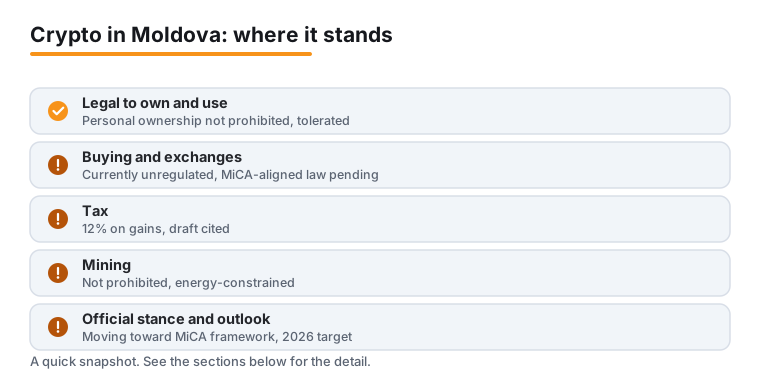
For individuals, owning and using Bitcoin and other crypto-assets is not prohibited in Moldova. Residents can buy, hold, and trade crypto, including on international platforms, and there is no ban on personal ownership. Officials have publicly stated that a decentralised technology like crypto cannot simply be banned, which is one reason Moldova has chosen to regulate the sector rather than outlaw it.
Two important qualifications apply today:
- Crypto is not legal tender. The Moldovan leu remains the only official currency. Merchants are not obliged to accept Bitcoin, and the draft framework is explicit that crypto cannot be used to pay for goods and services in Moldova.
- The activity is currently unregulated, and offering crypto services has no clear legal basis. In a notice published on 10 July 2017 the National Bank of Moldova stated that the use of virtual currencies is not regulated in the Republic of Moldova, that they do not represent a form of electronic money within the meaning of Law no. 114 of 18 May 2012 on payment services and electronic money, that the activity of issuing and transacting them is not subject to the competent authority's supervision, and that users' funds are not protected. The financial-markets regulator has similarly indicated that providing virtual-asset services is not currently authorised. In short, personal ownership is tolerated, but you act at your own risk and without the safeguards that apply to regulated financial products.
The biggest change underway is on the business side: once the planned law is adopted, companies offering crypto services to the public, such as exchanges, brokers, and custodians, will move from this grey or restricted zone into a formal licensing regime.
Who regulates crypto in Moldova?
There is no single crypto regulator yet. The incoming framework is being shaped by several public authorities working together:
- Ministry of Finance (mf.gov.md) and the National Bank of Moldova (BNM) (bnm.md) led the drafting of the bill. The BNM is the central bank and has issued the standing warnings about virtual-currency risks.
- National Commission for Financial Markets (CNPF) (cnpf.md) is Moldova's non-bank financial-markets supervisor. It has warned the public about fraudulent crypto schemes spread on WhatsApp, Telegram, and social media.
- Office for Prevention and Control of Money Laundering is Moldova's financial-intelligence body, reflecting the central role of anti-money-laundering rules in the new framework.
Under the draft, the supervisory roles are expected to be split: the National Bank would be responsible for electronic money, while the National Commission for Financial Markets would oversee the rest of the crypto-asset market. Because the law was not yet finalised when this guide was written, confirm the final allocation of powers against the official text and current BNM and CNPF publications before relying on it.
Crypto laws and frameworks in Moldova
As of 3 August 2026 Moldova has no crypto-asset statute in force, but one is in Parliament. The Law on the crypto-asset market, draft unique number 338/MF/BNM/2026, was approved by the Government on 22 July 2026 and passed its first reading in July 2026; a second reading is still required. The defining development is the preparation of the country's first dedicated crypto-asset law, drafted to align with the European Union's MiCA (Markets in Crypto-Assets) regulation, EU Regulation 2023/1114. Aligning with MiCA fits Moldova's wider EU-accession agenda.
Reporting on the draft describes a new legal regime covering three categories of crypto-asset, mirroring MiCA: digital money in the form of tokens pegged to a single currency (electronic-money tokens), tokens pegged to an asset or a basket of assets (asset-referenced tokens), and other crypto-assets such as Bitcoin. The bill is reported to set out obligations for issuers, investors, and service providers, along with supervision and liability mechanisms.
Based on official reporting around the draft, the framework is expected to:
- Legalise ownership, trading, and conversion of crypto-assets into lei or foreign currency through authorised organisations.
- Introduce licensing, capital, and conduct requirements for crypto-asset service providers, modelled on MiCA.
- Impose AML and market-integrity obligations, including reporting of suspicious transactions and protection of client funds.
- Keep the leu as sole legal tender and bar crypto as a means of payment.
Officials have targeted adoption by December 2026. Parliament passed the bill in first reading in July 2026. Article 104(1) of the government-approved text sets entry into force at six months after its publication. Until the bill is adopted and implementing rules are published, the precise obligations, thresholds, and timelines remain provisional and should be checked against the official text.
Licensing and registration of crypto exchanges and providers
Today there is no Moldovan authorisation that distinguishes a regulated domestic crypto exchange from an informal one, which is exactly the gap the new law is meant to close. Under the draft, crypto-asset service providers, such as exchanges, brokers, and custodians, would need to be authorised and meet ongoing requirements modelled on MiCA. Reported features of the draft include:
- Authorisation. Providers would need a licence to offer services to the public, with the National Commission for Financial Markets overseeing most of the market and the National Bank handling electronic money.
- Capital requirements. Annex 4 to the government-approved draft sets minimum capital by service category, from EUR 50,000 to EUR 150,000 for service providers, depending on the type of service. Issuers of asset-backed tokens are reported to face stricter thresholds, cited as minimum equity of EUR 350,000, or 2% of the average value of their asset reserve, or 25% of their fixed overheads, whichever applies.
- Internal controls and client-fund protection. Providers would be required to implement internal control systems and safeguard client funds.
- Sanctions. Penalties for breaches are reported to include licence revocation, administrative and criminal penalties, and fines, with figures cited up to 15% of annual turnover for legal entities and fines that can exceed EUR 1 million for individuals.
These figures come from coverage of a draft that was not yet adopted at the time of writing, so treat them as indicative. Anyone planning to operate a crypto business in Moldova should confirm the final requirements directly with the National Commission for Financial Markets and the National Bank of Moldova.
Crypto and Bitcoin tax in Moldova
Crypto taxation is one of the areas most directly affected by the incoming framework, and it should be treated as developing rather than settled. Reporting around the draft law sets out a clear principle: simply holding crypto would not be taxed, but income and capital gains realised from crypto transactions would be. The crypto bill does not amend the Fiscal Code, so tax runs on the general rules. The flat personal income tax rate for residents is 12% on such income and gains, consistent with other income categories and applying to Moldovan tax residents. Because the law was not yet adopted when this guide was written, treat that figure as provisional rather than final.
General points to keep in mind:
- Tax is expected to attach to realised gains and income from crypto activity, not to mere ownership.
- How a rule applies depends on your residency status and the nature of your activity (occasional disposals, trading as a business, mining, or crypto received as payment for work or services).
- Even before a crypto-specific regime, general Moldovan tax principles can apply to income, so the absence of a dedicated rule has never meant activity is automatically tax-free.
Confirm your position with the State Tax Service of Moldova or a qualified local tax adviser once the final rules are published, and keep clear records of acquisition costs, disposals, and the value of any crypto received as income. See also our general guide to crypto taxes. This is not tax advice.
AML and KYC rules in Moldova
Anti-money-laundering and counter-terrorist-financing rules are at the core of Moldova's new framework, reflecting both MiCA alignment and the involvement of the Office for Prevention and Control of Money Laundering in the draft. Today, the National Bank has flagged that virtual currencies can be exploited for money laundering and terrorist financing precisely because the space is unsupervised.
Under the planned regime, authorised crypto-asset service providers are expected to:
- Identify and verify customers (KYC) before providing services, in line with MiCA-style customer-due-diligence principles.
- Monitor and report suspicious transactions to the relevant authorities.
- Keep records and maintain internal compliance systems.
In practice, reputable international exchanges already apply KYC checks to Moldovan users. As the domestic rules formalise, expect identity verification to become a standard, legally required part of buying, selling, or converting crypto through any provider operating in or into Moldova. Be wary of any service that offers to bypass identity checks; that is a common feature of scams and unlicensed operators.
Buying and using crypto in practice
In practice, Moldovans access crypto much as residents of other unregulated or newly regulating markets do: through international exchanges, peer-to-peer trades, and a small number of local services. A typical first-time path is to choose a reputable platform, complete identity verification, fund the account by card or bank transfer, place an order, and then move significant holdings to a wallet you control.
- Centralised exchanges. Access to foreign platforms is capped by AML law. Banks and payment service providers may route a resident client to a foreign VASP only where that provider is authorised in its home jurisdiction, only through a dedicated special account with enhanced due diligence and transaction traceability, and only up to approximately 50,000 MDL (about EUR 2,600) per client per month under Law no. 308/2017. As licensing matures, watch for which platforms become authorised to serve Moldovan customers.
- Peer-to-peer (P2P). P2P marketplaces let buyers and sellers trade directly, often with local payment methods, but carry higher counterparty risk. Use escrow features and deal only with well-rated counterparties.
- Banking interface. Funding and cashing out through a Moldovan bank or card is possible only inside that special-account gateway. The National Bank's communication of 28 October 2022 told banks and payment service providers to stop intermediating payments to and from accounts used by virtual currency exchange platforms and to terminate services for companies exchanging virtual currency for fiat. Because the central bank has flagged virtual-currency risks, individual banks may apply their own caution to crypto-related transfers.
- Bitcoin ATMs. Law no. 308/2017 has prohibited the provision of virtual asset services on Moldovan territory since 1 July 2023, and the national risk assessment records the absence of local virtual asset service providers. The draft law defines crypto ATMs in Article 3(1) point 7 and would bring them inside the authorisation regime once it takes effect. Such cash-desk services are the kind of activity that will fall under licensing once the framework is in force.
Remember that crypto cannot be used to pay for goods and services in Moldova, so its practical role is investment, trading, and cross-border transfers rather than everyday spending. Always double-check withdrawal addresses and enable two-factor authentication.
Bitcoin mining in Moldova
Bitcoin mining is not specifically prohibited in Moldova, but it is shaped heavily by the country's energy situation. Moldova has historically depended on imported electricity and gas and has faced periods of energy stress, which makes power cost and supply reliability the decisive factors for any mining operation.
- Electricity is the key variable. Profitability hinges on tariffs and uninterrupted supply. Given Moldova's import dependence and exposure to regional energy shocks, miners should evaluate current commercial power rates and grid stability carefully before committing capital.
- Business and tax obligations. Mining at meaningful scale is an economic activity and can bring company registration, electricity-supply, environmental, and tax considerations into play, even without a crypto-specific mining statute.
- Regulatory overlap. Self-mining is generally distinct from offering services to the public. But if you also exchange, custody, or sell mined coins to others as a business, those activities may fall under the incoming licensing regime.
For small-scale or home miners, the main hurdles are economic: hardware, electricity cost, heat, and noise. Larger operations should take local legal and tax advice and secure power arrangements before scaling up.
Recent developments (2025 to 2026)
The headline development is Moldova's shift from an unregulated, partly restrictive stance toward a MiCA-aligned framework, driven by EU-accession commitments:
- The Ministry of Finance and the National Bank of Moldova developed a draft law on the crypto-asset market based on the EU's MiCA regulation, working with the National Commission for Financial Markets and the Office for Prevention and Control of Money Laundering.
- Officials confirmed a target to adopt the law by December 2026, with the framework entering into force roughly six months after publication.
- The draft would legalise ownership, trading, and conversion through authorised providers, introduce licensing, capital, and AML requirements, tax gains (a 12% rate has been cited), and keep crypto barred as a means of payment.
- Reporting describes a legal regime covering three MiCA-style categories: electronic-money tokens, asset-referenced tokens, and other crypto-assets such as Bitcoin, with the National Bank supervising electronic money and the National Commission for Financial Markets supervising the rest.
- Regulators have continued to warn the public about crypto fraud, including schemes promoted through WhatsApp, Telegram, and social media.
Because the law was still being finalised at the time of writing, reported figures and dates can change. Treat the framework as a moving target and revisit official sources periodically.
Consumer risks and protection
Until the new regime is live, consumer protection in Moldova's crypto market is limited. The National Bank's warning still stands: virtual-currency activity is unsupervised, and users' funds are not protected. Key risks to weigh:
- No current safeguards. If a platform fails or defrauds you, there is no crypto-specific compensation scheme, and ordinary financial-product protections do not apply.
- Scams and fraud. The financial-markets regulator has warned about fake investment schemes spread on WhatsApp, Telegram, and social media. Be sceptical of promises of guaranteed returns or pressure to act quickly.
- Volatility. Crypto prices can fall sharply and quickly. Only commit money you can afford to lose.
- Self-custody risk. If you hold your own keys, losing your recovery phrase can mean permanent loss. Use a reputable wallet and protect your keys.
- Cross-border transfers. Crypto and stablecoins are sometimes used for remittances, which matter given Moldova's significant inflows from citizens abroad. Transfers can be fast, but conversion spreads at each end and volatility can erode any savings, so compare the all-in cost before assuming crypto is cheaper.
Until domestic licensing is in force, favour well-established, reputable platforms, complete identity checks honestly, keep records of your transactions, and avoid any service asking you to bypass standard verification. None of this is financial advice; do your own research.
Official sources and how to verify
Because Moldova's crypto rules are evolving, always confirm the current position against primary official sources rather than secondary coverage:
- National Bank of Moldova (BNM) for its virtual-currency risk warning and any updates on the regulatory framework and electronic-money supervision.
- National Commission for Financial Markets (CNPF) for non-bank financial-market supervision, provider licensing, and consumer fraud warnings.
- Ministry of Finance of Moldova for the draft law and the legislative timeline.
- State Tax Service of Moldova for how crypto income and gains are taxed once rules are finalised.
When the law is adopted, look for the published official text and any implementing regulations, and note its effective date, which is expected around six months after publication. For more context, see our country regulation hub. This guide is general information as of 2026 and not legal advice; verify your specific situation with the named regulators and a qualified Moldovan professional.
What is changing: the crypto-asset law reached Parliament in July 2026
Moldova's first dedicated crypto statute is now a live bill rather than a plan. The Ministry of Finance and the National Bank of Moldova published it as draft unique number 338/MF/BNM/2026 on 20 November 2025. The Government approved it on 22 July 2026, and Parliament passed it in first reading, reported by Moldovan outlets on 24 and 27 July 2026. A second reading is still required.
The bill is called Lege privind piata criptoactivelor, the Law on the crypto-asset market. Its opening clause states that it partially transposes Regulation (EU) 2023/1114 (MiCA), as last amended by Regulation (EU) 2023/2869. Moldova is not an EU member, so MiCA does not apply directly; this is a national statute that copies the MiCA architecture as part of EU accession alignment.
- Government approval on 22 July 2026, confirmed in the Government press release.
- First reading in Parliament, with a second reading still to come, reported by politik.md, sinteza.org and Logos Press. None of the three states the date of the vote itself, and no date for the second reading has been published.
- Article 104(1) of the approved text: the law enters into force six months after publication in Monitorul Oficial.
- Article 106(1): anyone intending to issue, publicly offer, admit to trading or provide crypto-asset services has six months from entry into force to file a notification or an authorisation application. Filing confers no right to operate. Activity may begin only once the authorisation is granted, and operating without it is prohibited and punishable under the Criminal Code.
- The Government, the CNPF, the National Bank and the Service for Prevention and Combating of Money Laundering must adopt the implementing normative acts within six months of publication.
- A second legislative track exists. During the consultation the Service for Prevention and Combating of Money Laundering stated that a separate new AML draft law is intended to repeal Law no. 308/2017, and that designating crypto-asset service providers as reporting entities will be handled in that draft. No timetable for it has been published.
The draft and its annexes are published by the Ministry of Finance on the project page for draft no. 338/MF/BNM/2026, and the Government meeting version is on gov.md.
On arithmetic from Article 104(1), publication late in 2026 would mean entry into force around mid 2027 and the end of the filing window in late 2027. No official has published a fixed calendar, so treat those as a calculation from the statute, not an announced date.
What actually applies in Moldova right now
There is no crypto licensing law in force, but the position is stricter than simply unregulated. Amendments to Law no. 308/2017 on preventing and combating money laundering and terrorist financing, in force since 1 July 2023, introduced the concepts of virtual asset and virtual asset service provider into Moldovan law and prohibited the provision of virtual asset services on the territory of the Republic of Moldova. Moldova's own national risk assessment of virtual assets records the outcome: no local virtual asset service providers, overall residual money laundering and terrorist financing risk rated High, and activity displaced into peer to peer trading and messaging-app channels.
- Owning, buying and selling crypto as a private individual is not an offence. The prohibition targets providing services inside Moldova, not holding coins.
- Under Article 5 of Law no. 308/2017, in the paragraphs inserted in 2023, banks and payment service providers may not open or maintain accounts for foreign VASPs, may not hold accounts at foreign VASPs, may not open accounts for non-resident clients to transact with foreign VASPs, and may not conduct occasional transactions for or at foreign VASPs.
- Resident clients may deal only with foreign VASPs that are authorised in their home jurisdiction, up to approximately 50,000 MDL (about EUR 2,600) per client per month, through dedicated special accounts, with enhanced due diligence and transaction traceability required under Article 8.
- Article 4(11) of the same law makes breaching those prohibitions punishable under Article 263(9) of the Contravention Code or Article 241(1)(b) of the Criminal Code.
- The National Bank's communication of 28 October 2022 told banks and payment service providers to stop intermediating payments to and from accounts used by virtual currency exchange platforms and to terminate services for companies exchanging virtual currency for fiat. Banks reported that transaction volumes with VASPs fell by 99.69% as of September 2024 compared with 2023.
- Individuals subject to the asset declaration regime must report virtual assets, including virtual currencies, where the value exceeds ten average monthly salaries in the economy.
- Crypto is not legal tender. The leu remains the only official currency and no merchant can be compelled to accept digital assets.
- The National Bank's standing notice of 10 July 2017 confirms virtual currencies are not electronic money under Law no. 114/2012, that their issuance and transaction are not supervised, and that users' funds are not protected.
Tax runs on the general Fiscal Code, not a crypto rule, and the crypto-asset bill does not amend the Fiscal Code at all. Two things need separating. The rate is 12%, Moldova's flat personal income tax rate for residents (PwC Worldwide Tax Summaries), and Finance Minister Andrian Gavrilita has said publicly that merely holding crypto is not taxed while a Moldovan tax resident who realises income from crypto transactions pays 12% like any other income (bani.md, 15 January 2026). The base is narrower than that headline suggests. The national risk assessment records that Moldovan tax legislation does not explicitly state whether crypto income is taxable, that the State Tax Service has clarified that a resident individual's income from selling cryptocurrency is taxable with crypto classified as a capital asset, and that under Article 40(7) of the Fiscal Code the taxable growth in a tax period equals 50% of the excess of recognised capital gains over capital losses. On that reading the 12% rate applies to half the net gain, not the whole gain. Confirm your own position with the State Tax Service before filing.
What the law will require of exchanges, issuers and banks
Article 85 of the approved text splits supervision between two regulators. The National Commission for Financial Markets (CNPF) authorises and supervises offerors, persons seeking admission to trading, issuers of asset-referenced tokens, crypto-asset service providers, and market abuse prevention. The National Bank of Moldova is the authority in respect of issuing, publicly offering and admitting to trading electronic money tokens.
Annex 4 sets minimum capital for crypto-asset service providers, payable in lei at the National Bank's official rate:
| Category | Services covered | Minimum capital |
|---|---|---|
| 1 | Execution of orders, placing crypto-assets, transfer services, reception and transmission of orders, advice, portfolio management | EUR 50,000 |
| 2 | All Category 1 services plus custody and administration, exchange of crypto-assets against funds, exchange against other crypto-assets | EUR 125,000 |
| 3 | All Category 2 services plus operating a crypto-asset trading platform | EUR 150,000 |
Under Article 35, issuers of asset-referenced tokens must hold own funds equal to the highest of EUR 350,000, 2% of the average value of the reserve assets, or one quarter of the previous year's fixed overheads, and the CNPF may require up to 20% more where its risk assessment warrants it.
- Out of scope: crypto-assets that are unique and non-fungible, financial instruments, deposits, funds other than electronic money tokens, securitisation positions, general and life insurance products, and pension products under Law no. 198/2020.
- Threshold exemptions: a public offer whose total value stays under EUR 1,000,000 over 12 months falls outside the white paper regime, and an asset-referenced token whose average outstanding value stays under EUR 5,000,000 over 12 months is exempt from the issuer authorisation regime.
- Sanctions under Article 97: up to EUR 700,000 for an individual, and for a legal person the greater of EUR 5,000,000 or 3%, 5% or 12.5% of annual net turnover depending on the breach.
- Market abuse carries its own scale: for individuals EUR 1,000,000 for insider dealing breaches under Article 80 and EUR 5,000,000 for breaches of Articles 81 to 84; for legal persons EUR 2,500,000 or 2% of annual net turnover, rising to EUR 15,000,000 or 15%.
- Annex 5 opens the market to incumbents: banks under Article 14 of Law no. 202/2017 may issue asset-referenced and electronic money tokens and provide crypto-asset services; payment institutions may provide crypto-asset services under Article 25 of Law no. 114/2012; and electronic money institutions may both issue electronic money tokens and provide crypto-asset services under Article 88.
- Article 6 of Law no. 192/1998 is amended so the CNPF may charge up to 0.1% of annual revenue from crypto-asset services.
- Crypto ATMs are defined in Article 3(1) point 7 as physical or online electronic terminals allowing a provider mainly to carry out crypto-asset transfer services, which places them inside the authorisation regime.
- No EU passporting either way until accession. Authorisations issued in Moldova produce legal effects only on Moldovan territory, and authorisations issued by EU member state authorities do not apply automatically in Moldova, until Moldova's EU Accession Treaty enters into force. On that date Chapters II to VI of the Moldovan law are repealed, MiCA applies directly, and the Moldovan statute is reduced to implementing measures.
Frequently asked questions
Is cryptocurrency legal in Moldova in 2026?
For individuals, owning and trading crypto is not banned: residents can buy, hold, and trade crypto-assets, including on international platforms. However, crypto is not legal tender, it cannot be used to pay for goods and services, and providing virtual-asset services has no clear legal basis yet. As of 2026 the sector is still unregulated, with a MiCA-aligned law being prepared. The National Bank of Moldova warns that virtual-currency activity is unsupervised and that users' funds are not protected.
Who regulates crypto in Moldova?
No single regulator yet. The incoming framework is being shaped by the Ministry of Finance, the National Bank of Moldova (the central bank), the National Commission for Financial Markets (the non-bank financial supervisor), and the Office for Prevention and Control of Money Laundering. Under the draft, the National Bank would oversee electronic money and the National Commission for Financial Markets would oversee the rest of the crypto-asset market.
When will Moldova's crypto law come into force?
Officials have targeted adopting the law by December 2026, and reporting indicates it would enter into force roughly six months after its publication. Until the bill is adopted and implementing rules are published, the timeline and details remain provisional, so confirm the status with the Ministry of Finance and the National Bank of Moldova.
Will I have to pay tax on Bitcoin in Moldova?
Reporting around the draft law indicates that holding crypto would not be taxed, but income and capital gains from crypto transactions would be, with a 12% rate cited. Because the law was not finalised at the time of writing, you should not rely on any single figure. Confirm your position with the State Tax Service of Moldova or a qualified local adviser, and keep clear records. This is not tax advice.
Can businesses run a crypto exchange in Moldova?
Currently there is no licensing regime, and providing virtual-asset services to the public has no clear legal basis. Under the planned law, crypto-asset service providers would need authorisation and would face capital requirements (cited at roughly EUR 50,000 to EUR 150,000), internal-control and client-fund-protection rules, AML obligations, and sanctions for breaches. Confirm final requirements with the National Commission for Financial Markets and the National Bank of Moldova.
Is crypto legal tender in Moldova?
No. The Moldovan leu is the only legal tender, and the draft framework explicitly keeps it that way. Crypto cannot be used to pay for goods and services, so merchants are not obliged to accept it. The planned law legalises ownership, trading, and conversion through authorised providers rather than turning crypto into official money.
What types of crypto-asset would Moldova's law cover?
Reporting on the draft describes three categories, in line with the EU's MiCA regulation: digital money in the form of tokens pegged to a single currency (electronic-money tokens), tokens pegged to an asset or a basket of assets (asset-referenced tokens), and other crypto-assets such as Bitcoin. The National Bank of Moldova would supervise electronic money, and the National Commission for Financial Markets would supervise the rest of the market. Confirm the final classification against the official text once adopted.
What penalties could crypto businesses face in Moldova?
Reporting around the draft indicates that breaches could bring licence revocation, administrative and criminal penalties, and fines, cited at up to 15% of annual turnover for legal entities and figures that can exceed EUR 1 million for individuals. Issuers of asset-backed tokens are also reported to face higher capital thresholds than ordinary service providers. These figures come from coverage of a bill that was not yet adopted at the time of writing, so confirm the final rules with the National Commission for Financial Markets and the National Bank of Moldova.
Is crypto legal in Moldova in 2026?
For an individual, yes. Owning, buying and selling crypto is legal, and crypto is not legal tender. What is prohibited is providing virtual asset services inside Moldova: amendments to AML Law no. 308/2017 in force since 1 July 2023 ban that, and Moldova's national risk assessment records the absence of local providers. Parliament passed a crypto-asset law in first reading in July 2026 that would replace the ban with an authorisation regime, but it is not yet in force.
When will Moldova's crypto law take effect?
Not before it passes a second reading and is published in Monitorul Oficial, and then only after a further six months, under Article 104(1) of the government-approved text. As of 3 August 2026 no date for the second reading has been published. Operators then get six months from entry into force to file for authorisation under Article 106, and may not trade until the authorisation is granted.
Can I buy crypto with a Moldovan bank card or bank transfer?
Only through the narrow route the AML law allows. Banks and payment service providers may route a resident client to a foreign platform that is licensed in its home jurisdiction, through a dedicated special account with enhanced due diligence, capped at approximately 50,000 MDL (about EUR 2,600) per client per month. The National Bank told banks and payment providers in a communication of 28 October 2022 to stop general intermediation with virtual currency exchange platforms.
How much tax do I pay on crypto gains in Moldova?
The rate is 12%, Moldova's flat personal income tax rate for residents, but it does not apply to the whole gain. The State Tax Service treats crypto as a capital asset, and under Article 40(7) of the Fiscal Code only 50% of the excess of capital gains over capital losses in the tax period enters taxable income. Holding is not taxed. The crypto-asset bill does not amend the Fiscal Code, so there is no crypto-specific rate or relief. Keep records of acquisition cost and disposal proceeds, and confirm the calculation with the State Tax Service, because Moldova's own national risk assessment notes that the tax law does not explicitly address crypto.
Who will regulate crypto companies in Moldova?
Under Article 85 of the approved draft, the National Commission for Financial Markets (CNPF) will authorise and supervise crypto-asset service providers, offerors, issuers of asset-referenced tokens and market abuse. The National Bank of Moldova will be the authority in respect of electronic money tokens.
Will a MiCA licence from an EU country let a company serve Moldovan clients?
No, not until Moldova joins the EU. The approved draft states that authorisations issued by EU member state authorities do not apply automatically in Moldova, and that Moldovan authorisations produce legal effects only on Moldovan territory, until Moldova's EU Accession Treaty enters into force. On that date Chapters II to VI of the Moldovan law are repealed and MiCA applies directly.
How much capital will a crypto exchange need in Moldova?
Annex 4 to the government-approved draft sets three tiers, payable in lei at the National Bank's official rate: EUR 50,000 for order execution, placing, transfers, reception and transmission of orders, advice and portfolio management; EUR 125,000 if custody and administration or exchange against funds or other crypto-assets is added; and EUR 150,000 if the firm operates a trading platform. Issuers of asset-referenced tokens need the highest of EUR 350,000, 2% of average reserve assets, or one quarter of prior-year fixed overheads, and the CNPF may require up to 20% more.
Facts reviewed: 13 August 2026. Page updated: 13 August 2026.