Home › Crypto Regulation › Liechtenstein
Bitcoin & Cryptocurrency Regulation in Liechtenstein
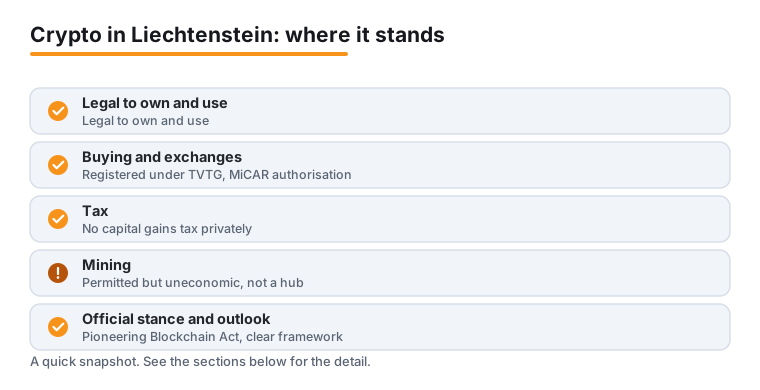
Quick answer — Liechtenstein, 2026
- Legal: Legal to own and use, not legal tender; Swiss franc official
- Tax: Private capital gains generally not taxed, business trading taxed as income
- Buying: Via FMA-registered or MiCAR-authorised providers after KYC
Liechtenstein is one of Europe's most deliberately crypto-friendly jurisdictions. The small Alpine principality sits in a customs and monetary union with Switzerland and is a member of the European Economic Area (EEA). It was among the first countries in the world to pass a comprehensive law for the token economy: the Token and TT Service Provider Act, commonly called the TVTG or "Blockchain Act", which entered into force on 1 January 2020. Since then Liechtenstein has implemented the EU's Markets in Crypto-Assets Regulation (MiCAR) through its EEA membership, so businesses and individuals now navigate two complementary frameworks.
This guide explains how Bitcoin and other cryptocurrencies are treated in Liechtenstein, who regulates them, how they are taxed, the licensing rules for service providers, and the practical realities of buying and using crypto. It is general information as of 2026 and is NOT legal, tax or financial advice. Crypto law is evolving quickly here, especially during the MiCAR transition, so always confirm the current position with the Financial Market Authority (FMA) and a qualified local adviser before acting. For broader context, see our guide to crypto regulation and our country regulation hub.
On this page: Legal status · Who regulates it · Taxes · How to buy · Mining
Is Bitcoin and crypto legal in Liechtenstein?
Yes. Owning, buying, selling and using Bitcoin and other cryptocurrencies is legal in Liechtenstein for individuals and companies. There is no ban on holding digital assets or transacting in them. Crypto is not, however, legal tender. The Swiss franc (CHF) is the official currency, and no merchant is obliged to accept Bitcoin.
What distinguishes Liechtenstein is that it does not leave crypto in an unregulated grey zone. It built a deliberate legal foundation, the TVTG, that gives "tokens" a recognised place in civil and commercial law and licenses the businesses that handle them. The country has since layered on the EU's MiCAR framework. The result is that ordinary personal use is free and open, while providing crypto services to the public as a business triggers registration or authorisation obligations supervised by the regulator.
Who regulates crypto in Liechtenstein
The principal regulator is the Financial Market Authority Liechtenstein (FMA), an integrated supervisor based in Vaduz. The FMA handles registration under the TVTG, authorisation under MiCAR and ongoing supervision of crypto-asset service providers, covering activities such as custody, operating a trading platform, exchanging crypto for funds or other crypto, executing orders and providing advice.
The FMA has supported newcomers through informal preliminary discussions and a preliminary-application process for MiCAR, and works alongside the wider Liechtenstein financial-centre infrastructure. Tax matters are handled separately by the Liechtenstein Tax Administration (Steuerverwaltung). The official regulator site is fma-li.li.
Key laws and frameworks
Liechtenstein operates two complementary regimes that together cover most crypto activity.
The TVTG (Blockchain Act)
The Token and TT Service Provider Act, in force since 1 January 2020, introduced a deliberately technology-neutral framework. Rather than naming specific blockchains, it refers to "Trustworthy Technology" (TT) systems and uses a "Token Container Model" in which a token can represent rights of any kind, from a currency or security to property or access to a service. The Act provides a civil-law basis for owning, transferring and enforcing rights in tokens, defines the roles of TT service providers (such as token issuers, custodians, exchange operators and token generators) and sets out their duties, including registration in the official TT Service Provider Register supervised by the FMA.
MiCAR and the EEA dimension
Because Liechtenstein is an EEA member, the EU's Markets in Crypto-Assets Regulation (MiCAR) applies. It was implemented domestically through the EEA MiCA Implementation Act (EWR-MiCA-DG), which entered into force on 1 February 2025. MiCAR harmonises the rules for crypto-asset services across the EEA and introduces categories such as e-money tokens, asset-referenced tokens and other crypto-assets. A firm authorised as a crypto-asset service provider (CASP) under MiCAR can in principle "passport" its services across member states.
The two regimes coexist. Where an activity falls under MiCAR, MiCAR's harmonised rules lead, while the TVTG continues to govern matters outside MiCAR's scope, such as non-fungible tokens (NFTs) and the civil-law aspects of token ownership. See the official FMA pages on the TVTG and MiCAR.
Licensing and registration of exchanges and service providers
Businesses that provide crypto services in or into Liechtenstein face registration or authorisation requirements, and the MiCAR transition period closed on 1 July 2026, and TVTG registrations for MiCAR-scope activities lapsed the following day.
- Under the TVTG, TT service providers offering services such as token issuance, custody or exchange professionally must register in the FMA's TT Service Provider Register. Liechtenstein uses the term "TT service provider" rather than the FATF term "virtual asset service provider" (VASP), and the FMA has had three months to respond to registration applications.
- Under MiCAR, firms carrying out in-scope crypto-asset services need a CASP authorisation. Regular applications under Article 63 MiCAR have been possible since the implementation act took effect on 1 February 2025, and existing banks may obtain MiCAR permissions through a simplified procedure under Article 60.
- Transition deadline. TT service providers whose business fell under MiCAR could continue operating under their TVTG registration only until 1 July 2026. The FMA confirmed on 7 July 2026 that the transition period under Article 143(3) of MiCAR ended on 1 July 2026 and that TVTG registrations expired on 2 July 2026 in respect of activities that require authorisation under MiCAR. To continue those activities beyond that date, they must obtain MiCAR authorisation. Services delivered under transitional relief are no longer lawful after the deadline.
For users, the practical takeaway is to favour platforms that are FMA-registered or MiCAR-authorised, and to confirm a provider's status before depositing funds. The first MiCAR CASP licences for Liechtenstein-based firms began appearing in 2026, including Bitcoin Suisse (Europe) AG and Sygnum Europe, so the register of authorised providers is growing. The FMA maintains public registers in German and English.
Crypto taxation in Liechtenstein
Liechtenstein is generally regarded as having a favourable tax environment for private crypto holders, but the treatment depends on whether you act privately or professionally and on the type of token involved. The notes below are general and not tax advice.
- Private investors and capital gains. Art. 15(2)(m) of the Steuergesetz (SteG), LGBl. 2010 Nr. 340, lists capital gains from the disposal of components of movable and immovable private assets as tax-free income, so a private sale of crypto at a profit does not itself trigger income tax. Where the activity amounts to a business rather than management of private wealth, the profit falls into the ordinary tax base. The top national band in Art. 19(1)(a) SteG applies from CHF 211,401 of taxable income at 8 percent, on top of which each commune levies its own surcharge.
- Wealth treatment. Crypto holdings form part of the wealth base. Liechtenstein integrates wealth into income tax through a notional yield (Sollertrag) rather than levying a separate standalone wealth-tax return. The notional yield is set at 4 percent of taxable wealth and is then taxed within income tax, and the effective rate varies by municipality because of the municipal surcharge.
- Companies and miners. Crypto activity carried on as a business can have corporate income-tax and registration consequences.
- International reporting. Liechtenstein signed the Multilateral Competent Authority Agreement on the OECD Crypto-Asset Reporting Framework (CARF-MCAA) on 26 November 2024, with CARF reporting obligations phasing in from 2026. This means greater automatic exchange of crypto tax information going forward.
Because rates, thresholds and definitions change and depend on personal circumstances, this guide deliberately avoids stating specific figures for your situation. Confirm your position with the Liechtenstein Tax Administration (Steuerverwaltung) or a qualified adviser. For background, see our crypto taxes guide.
AML, KYC and the Travel Rule
Anti-money-laundering (AML) and know-your-customer (KYC) obligations are central to the regime. Crypto service providers are treated as obliged entities under Liechtenstein's Due Diligence Act (Sorgfaltspflichtgesetz, SPG) and its implementing ordinance, reflecting Financial Action Task Force (FATF) standards. Notably, the FMA has described TVTG-registered providers as not classified as financial intermediaries (unless they also conduct other licensed activities) and as subject to ad hoc rather than continuous supervision, which the FMA itself notes means the level of client protection differs from that of a fully licensed financial intermediary.
In practice, regulated exchanges and custodians must verify customer identity, identify beneficial owners, monitor transactions on a risk basis, keep records and report suspicious activity. The FATF "Travel Rule" also applies, requiring identifying information about the originator and beneficiary to accompany qualifying crypto transfers. For everyday users, the visible effect is that compliant platforms ask for identity documents and may request source-of-funds information.
Buying and using crypto in practice
Residents of Liechtenstein can buy crypto through international exchanges and brokers as well as locally established providers. Because the country is in the EEA and shares a currency and close banking ties with Switzerland, residents typically access a broad range of platforms and can fund purchases in Swiss francs or euros by bank transfer or card. A general path looks like this:
- Choose a regulated provider that is permitted to serve Liechtenstein residents, ideally FMA-registered or MiCAR-authorised, and compare fees, supported assets and security.
- Verify your identity (KYC), typically with a government ID and proof of address, before trading or withdrawing.
- Deposit funds in CHF or EUR. Bank transfers usually carry lower fees on larger amounts.
- Place your order and review the total cost, including fees and spread.
- Secure your holdings. Decide between platform custody and a personal wallet (a hardware wallet for larger amounts), and safeguard your recovery phrase. Whoever controls the private keys controls the coins.
- Keep records of dates, amounts and values for tax purposes.
Crypto can also be used for cross-border transfers, which can settle quickly. Note that transfers through regulated providers carry Travel Rule and AML checks, that on- and off-ramp costs and price volatility matter, and that the receiving country's rules apply on the other end. Going digital does not exempt a transfer from financial-crime rules.
Bitcoin mining in Liechtenstein
Bitcoin mining is not prohibited, but Liechtenstein is not a natural mining hub. The principality is small and densely built, electricity is relatively expensive compared with regions that attract large-scale miners, and it imports a significant share of its power while emphasising sustainability and efficient energy use. There is little surplus cheap energy of the kind industrial mining seeks.
As a result, mining tends to be modest in scale, typically hobbyists or small operations rather than large data-centre farms. There is no special mining-licence regime aimed at individuals, but mining conducted as a commercial enterprise may be treated as business activity with corresponding registration, energy and tax consequences. Anyone planning more than a hobby setup should weigh electricity economics and seek local advice.
Recent developments (2025-2026)
The defining theme of this period is the MiCAR transition. The EEA MiCA Implementation Act (EWR-MiCA-DG) entered into force on 1 February 2025, opening regular CASP applications under Article 63 MiCAR. The FMA had been available for informal preliminary discussions from June 2024 and accepting preliminary application documents from October 2024.
- 1 July 2026 deadline. TVTG-registered providers whose activities fall under MiCAR must obtain MiCAR authorisation by this date to continue those services.
- First CASP authorisations. As at early November 2025 no company headquartered in Liechtenstein had yet obtained a MiCAR CASP authorisation. That changed in the following months. Bitcoin Suisse (Europe) AG was granted a MiCAR CASP licence by the FMA, building on its earlier TVTG registration, and Sygnum Europe activated its FMA CASP licence as the MiCAR transition period under Article 143(3) MiCAR ended on 1 July 2026. Reporting also indicated that Bank Frick, long active in blockchain banking, received MiCAR authorisation from the FMA in January 2026. Status changes over time, so verify the current register with the FMA.
- Tax reporting. The OECD Crypto-Asset Reporting Framework (CARF) takes effect from 1 January 2026, following Liechtenstein's signing of the CARF-MCAA in November 2024, so crypto providers move toward reporting user information to the tax authority.
Because these dates and statuses are time-sensitive and evolving, always check the official FMA pages for the latest position rather than relying on a snapshot.
Consumer risks and protection
Clear regulation reduces some risks but does not remove them. Keep the following in view:
- Market risk. Crypto prices are highly volatile and speculative, and capital can be lost quickly. This guide makes no price predictions.
- Uneven supervision. The FMA itself notes that TVTG-registered TT service providers are subject to ad hoc rather than continuous supervision, so the protection differs from a fully licensed financial intermediary. Favouring MiCAR-authorised providers can offer clearer protections.
- Counterparty and security risk. Scams, hacks, platform failures and lost keys are persistent threats in every jurisdiction. Use reputable, regulated platforms and secure your private keys.
- Regulatory change. Rules under MiCAR and domestic law continue to evolve, and obligations around AML and reporting can tighten.
Sensible principles apply: only commit what you can afford to lose, verify a provider's registration or authorisation status, understand what you are buying, and seek licensed advice for anything beyond modest sums.
Official sources and how to verify
This article is general information as of 2026 and is NOT legal, tax or financial advice. For current and binding information, always verify with the named official regulator and authorities before acting:
- Financial Market Authority Liechtenstein (FMA), the supervisor for crypto-asset activity, registrations and authorisations.
- FMA: Token and TT Service Provider Act (TVTG), the official overview of the Blockchain Act.
- FMA: MiCAR, the official page on MiCAR implementation, scope and the transition timeline.
For tax questions, consult the Liechtenstein Tax Administration (Steuerverwaltung) and a qualified local adviser. To check whether a specific provider is permitted to serve you, look it up in the FMA's public registers and confirm its registration or MiCAR authorisation status directly. You can also explore our wider regulation hub for comparisons with other countries.
What changed on 1 July 2026
On 7 July 2026 the Financial Market Authority announced that the transition period under Article 143(3) of MiCAR ended on 1 July 2026, and that TVTG registrations expired on 2 July 2026 in respect of activities that require authorisation under MiCAR. The FMA notice points readers to the ESMA register for an overview of authorised crypto-asset service providers.
That deadline was itself an extension. Under the original implementing package the grandfathering window ran only to 31 December 2025, the government having used the shortened national option in Article 143(3) second subparagraph MiCAR. In Bericht und Antrag Nr. 84/2025 of 7 October 2025 the government proposed moving the deadline back six months to 1 July 2026, the period allowed by the first subparagraph, because MiCAR was only legally incorporated into the EEA Agreement on 24 June 2025 following the EEA Joint Committee decision of 20 February 2025, leaving firms too little time. The report proposed entry into force on 31 December 2025 so that affected firms would not have to stop trading on 1 January 2026.
The practical result for August 2026: a Liechtenstein firm offering custody, exchange, transfer, order execution, placement, advice, portfolio management or a trading platform for crypto-assets needs an FMA authorisation under Article 63 of Regulation (EU) 2023/1114. A TVTG entry no longer substitutes for it.
- Bitcoin Suisse (Europe) AG announced on 23 June 2026 that it had received a MiCAR crypto-asset service provider authorisation from the Liechtenstein FMA, covering trading, custody and staking.
- Damoon Technology (Europe) AG, Vaduz (FL-0002.682.952-0), was authorised on 10 July 2026 under Article 63 MiCAR for the exchange of crypto-assets for money and for the provision of crypto-asset transfer services for clients.
The FMA does not publish a running total of authorised firms. Its crypto-asset service provider page links to the FMA register at register.fma-li.li. Check there, or the ESMA register, before using any provider.
Named laws and where each one stands
| Instrument | Reference | Status in August 2026 |
|---|---|---|
| Token- und VT-Dienstleister-Gesetz (TVTG) | LGBl. 2019 Nr. 301, LR 950.6, law of 3 October 2019 | In force. Latest consolidated version dated 31 December 2025. Still governs TT roles outside MiCAR scope. |
| EWR-MiCA-Durchführungsgesetz (EWR-MiCA-DG) | LGBl. 2025 Nr. 112, LR 950.7, law of 5 December 2024 | In force since 1 February 2025 under its Art. 38(1). Art. 20 names the FMA as the authority competent for Liechtenstein under Art. 93(1) MiCAR. |
| Amendment to the EWR-MiCA-DG | LGBl. 2025 Nr. 406, law of 13 June 2025 | Published 25 August 2025. Commencement date not stated in the chronological record. |
| Extension of the TVTG transitional provisions | Bericht und Antrag Nr. 84/2025 of 7 October 2025 | Proposed moving the deadline from 31 December 2025 to 1 July 2026, with entry into force on 31 December 2025. That deadline has now passed. |
| CARF-Gesetz | LGBl. 2025 Nr. 589, LR 356, law of 7 November 2025 | In force since 1 January 2026 under its Art. 37. Reports due within six months of each calendar year end. |
| Geldwäschegesetz (GwG), draft | Consultation report adopted 3 March 2026 | Consultation closed 4 June 2026. Not adopted. Commencement tied to EEA incorporation of the EU AML package. |
What the TVTG still covers now that the transition has ended
The end of the transition does not repeal the TVTG. The FMA states that the TVTG has been amended several times, most recently to ensure that MiCAR and TVTG can continue to exist alongside each other while their respective areas of application remain mutually exclusive.
Bericht und Antrag Nr. 84/2025 names which TVTG roles were caught by the MiCAR transition and therefore now need an Article 63 authorisation: token issuers under Art. 2(1)(k) TVTG where the token falls within Regulation (EU) 2023/1114, TT depositaries under Art. 2(1)(n) for fungible tokens, TT exchange service providers under Art. 2(1)(q), TT trading platform operators under Art. 2(1)(w), TT managers for crypto-assets under Art. 2(1)(x) and TT transfer service providers under Art. 2(1)(y). In the consolidated TVTG now in force, letters (q), (w), (x) and (y) are shown as repealed, so those categories no longer exist in the Blockchain Act at all.
Roles defined in Art. 2(1) TVTG that sit outside MiCAR scope stay on the TVTG track, including the token generator (Bst. l), tokenisation service provider (Bst. m), physical validator (Bst. p), TT verifying authority (Bst. r), TT price service provider (Bst. s), TT identity service provider (Bst. t) and token lending undertaking (Bst. v). Art. 12 TVTG requires a person with a domestic seat or residence who intends to provide such services professionally to apply to the FMA in writing for entry in the TT Service Provider Register before providing the service for the first time.
The distinction matters for consumers. A MiCAR authorisation carries ongoing supervision. A TVTG registration does not: the FMA states that TT service providers are not subject to ongoing supervision and that it takes supervisory action only on the basis of the ad hoc reporting system provided for in the TVTG or on a third-party notification.
Crypto tax in Liechtenstein: the actual articles
There is no crypto-specific tax in Liechtenstein. Crypto is taxed through the ordinary rules of the Steuergesetz (SteG), LGBl. 2010 Nr. 340, LR 640.0, the law of 23 September 2010.
- Private capital gains are exempt. Art. 15(2)(m) SteG lists Kapitalgewinne aus der Veräusserung oder Aufgabe von Bestandteilen des beweglichen und unbeweglichen Privatvermögens, capital gains from the disposal of components of movable and immovable private assets, as tax-free income. Crypto held privately falls under movable private assets, so selling at a profit does not itself trigger income tax.
- Holdings are taxed as wealth, through a notional yield. Art. 5 SteG fixes the interest rate for determining the standardised return on assets, the Sollertrag, at 4 percent. Net taxable wealth is multiplied by that rate and the result is added to taxable income.
- The national income tax scale is progressive. The top band in Art. 19(1)(a) SteG applies from CHF 211,401 of taxable income at 8 percent.
- Each commune adds a surcharge on top of the national tax. The combined rate therefore depends on where you live, and each commune sets its own surcharge. Confirm the current figure with your commune or the Steuerverwaltung.
- Trading as a business is different. Where activity amounts to a business rather than management of private wealth, profits fall into the ordinary tax base.
CARF: crypto tax reporting began on 1 January 2026
The Gesetz vom 7. November 2025 über den internationalen automatischen Informationsaustausch in Steuersachen in Bezug auf Transaktionen mit Kryptowerten (CARF-Gesetz), LGBl. 2025 Nr. 589, LR 356, entered into force on 1 January 2026 under its Art. 37. It implements the OECD Crypto-Asset Reporting Framework.
Under Art. 6, a reporting Liechtenstein crypto-asset service provider must report to the Steuerverwaltung, for each crypto-asset user who is a reportable person, identification and address details, states of residence and tax identification numbers, together with transaction details for each relevant type of crypto-asset, including the total gross amounts paid, the units and the number of transactions. Art. 2(1)(11) defines a reportable retail payment transaction as a transfer of relevant crypto-assets in exchange for goods or services worth more than USD 50,000.
Art. 6(6) requires reports to reach the Steuerverwaltung within six months of the end of the relevant calendar year. Since the law applies from 1 January 2026, the first reports, covering the 2026 calendar year, fall due by 30 June 2027.
For a private holder this is not a new tax. It means providers will ask for tax residence self-certifications, and that holdings and trades routed through a Liechtenstein provider become reportable.
Frequently asked questions
Is cryptocurrency legal in Liechtenstein?
Yes. Buying, holding, selling and using cryptocurrencies such as Bitcoin is legal in Liechtenstein for individuals and businesses. Crypto is not legal tender, since the Swiss franc is the official currency, and businesses that provide crypto services to the public must be registered under the TVTG or authorised under MiCAR. Everyday personal use is unrestricted. This is general information, not legal advice; verify with the FMA.
Who regulates crypto in Liechtenstein?
The Financial Market Authority Liechtenstein (FMA), based in Vaduz, is the main regulator. It administers registration under the TVTG (Blockchain Act) and authorisation under the EU's MiCAR, which applies in Liechtenstein through its EEA membership. Tax matters are handled separately by the Liechtenstein Tax Administration (Steuerverwaltung). The official site is fma-li.li.
What is the TVTG or Blockchain Act, and how does it relate to MiCAR?
The TVTG (Token and TT Service Provider Act), often called the Blockchain Act, is Liechtenstein's pioneering law for the token economy, in force since 1 January 2020. It gives tokens a recognised civil-law status through a Token Container Model and requires many service providers to register with the FMA. MiCAR, implemented domestically via the EEA MiCA Implementation Act on 1 February 2025, now leads for in-scope crypto-asset services, while the TVTG continues to govern areas outside MiCAR such as NFTs and the civil-law aspects of tokens.
Do crypto exchanges need a licence in Liechtenstein?
Yes. Providers must register as TT service providers under the TVTG and, for in-scope activities, obtain a crypto-asset service provider (CASP) authorisation under MiCAR via Article 63. TVTG-registered providers whose activities fall under MiCAR may continue during a transitional period that ends on 1 July 2026, after which MiCAR authorisation is required to keep operating those services. Existing banks may use a simplified procedure under Article 60. Always check a provider's status in the FMA's public registers.
How is crypto taxed in Liechtenstein?
Liechtenstein is generally seen as favourable for private holders. Gains on privately held movable assets, including crypto, are generally not subject to a separate capital gains tax for individuals, while professional or business trading can be taxed as income. Crypto holdings are part of the wealth base, integrated into income tax through a notional yield (Sollertrag) rather than a separate wealth-tax return. From 2026, OECD Crypto-Asset Reporting Framework (CARF) obligations phase in. Because details depend on your circumstances, confirm with the Steuerverwaltung or a qualified adviser. This is not tax advice.
Can I mine Bitcoin in Liechtenstein?
Mining is permitted but uncommon at scale. The country is small, electricity is relatively expensive, and there is a strong sustainability focus, so large industrial mining is generally uneconomic. Hobby mining is possible, while commercial operations should consider business registration, energy rules and tax treatment, and should seek local advice.
Are any crypto providers now MiCAR-authorised in Liechtenstein?
Yes. As at early November 2025 no Liechtenstein-based firm had a MiCAR crypto-asset service provider (CASP) licence, but the first authorisations followed. Bitcoin Suisse (Europe) AG received a MiCAR CASP licence from the FMA, and Sygnum Europe activated its FMA CASP licence as the MiCAR transitional period ended on 30 June 2026. Bank Frick was also reported to have received MiCAR authorisation in January 2026. Because the register keeps changing, confirm a provider's current status in the FMA's public registers before depositing funds.
When does the Liechtenstein MiCAR transition period end?
The transitional period ended on 1 July 2026. TVTG-registered TT service providers whose activities fall under MiCAR could keep operating under their TVTG registration until that date, but to continue those services afterward they must hold a MiCAR CASP authorisation under Article 63. Existing banks can use a simplified procedure under Article 60. Firms without MiCAR authorisation must stop the affected services after the deadline.
How is crypto wealth taxed in Liechtenstein?
Crypto held privately is part of the wealth base. Rather than a separate wealth-tax return, Liechtenstein applies a notional yield (Sollertrag) set at 4 percent of taxable wealth, which is then taxed within income tax. The effective rate varies by municipality because of the municipal surcharge. Private capital gains on crypto are generally not subject to a separate capital gains tax, while professional or business trading can be taxed as income. This is general information, not tax advice; confirm with the Steuerverwaltung.
Did the Liechtenstein MiCAR transition period actually end?
Yes. The FMA announced on 7 July 2026 that the transition period under Article 143(3) of MiCAR ended on 1 July 2026, and that TVTG registrations expired on 2 July 2026 in respect of activities that require authorisation under MiCAR. From that date a provider needs an FMA authorisation under Article 63 of Regulation (EU) 2023/1114.
Why was the deadline 1 July 2026 and not 31 December 2025?
The original Liechtenstein implementing package used the shortened national option in Article 143(3) second subparagraph MiCAR and set 31 December 2025. In Bericht und Antrag Nr. 84/2025 of 7 October 2025 the government proposed extending it by six months to 1 July 2026, the period allowed by the first subparagraph, because MiCAR was only incorporated into the EEA Agreement on 24 June 2025. The report proposed that the change enter into force on 31 December 2025.
Which Liechtenstein law implements MiCAR?
The EWR-MiCA-Durchfuehrungsgesetz (EWR-MiCA-DG), law of 5 December 2024, LGBl. 2025 Nr. 112, LR 950.7, in force since 1 February 2025 under its Art. 38(1). Its Art. 20 names the FMA as the authority competent for Liechtenstein under Art. 93(1) MiCAR. It was amended by the law of 13 June 2025, LGBl. 2025 Nr. 406.
Is the TVTG still in force after July 2026?
Yes. The TVTG, LGBl. 2019 Nr. 301, LR 950.6, remains in force, with the latest consolidated version dated 31 December 2025. The FMA states that MiCAR and the TVTG continue to exist alongside each other with mutually exclusive areas of application. TVTG registration still applies to roles outside MiCAR scope, such as token generators, tokenisation service providers, physical validators, TT verifying authorities, TT price service providers, TT identity service providers and token lending undertakings.
Will my Liechtenstein crypto account be reported to my home tax authority?
Potentially yes. The CARF-Gesetz, LGBl. 2025 Nr. 589, entered into force on 1 January 2026. Reporting crypto-asset service providers must report reportable users' identification and address details, states of residence and tax identification numbers plus transaction data to the Liechtenstein Steuerverwaltung. Reports are due within six months of the end of each calendar year, so the first reports, covering 2026, fall due by 30 June 2027.
Is any new crypto law being discussed in Liechtenstein right now?
The main pipeline item is not crypto-specific but covers crypto firms. On 3 March 2026 the government adopted a consultation report on a new Geldwaeschegesetz (GwG) that would repeal the Sorgfaltspflichtgesetz (SPG, LGBl. 2009 Nr. 47) and implement the EU AML package. The consultation closed on 4 June 2026 and no bill has followed. Art. 64 of the draft ties entry into force to the EEA Joint Committee decisions incorporating Directive (EU) 2024/1640, Regulation (EU) 2024/1624 and Regulation (EU) 2024/1620. No Liechtenstein date is fixed; the report notes the EU package is to apply from July 2027.
What would the new GwG change for crypto users?
Substantive due diligence rules would move from Liechtenstein law into the directly applicable Regulation (EU) 2024/1624, with the national law focused on supervision and on cooperation alongside the EU Anti-Money Laundering Authority (AMLA) seated in Frankfurt am Main. The draft brings crypto-asset service providers operating in Liechtenstein under freedom of services through agents, distributors or other infrastructure under FMA host-state supervision, naming machines for the purchase and sale of crypto-assets among the examples, and notes that the AMLR introduces a general cash ceiling of EUR 10,000 or equivalent.
How much crypto profit is tax free in Liechtenstein?
There is no threshold, because private capital gains on movable assets are exempt outright under Art. 15(2)(m) SteG. What is taxed is the holding itself: net wealth is multiplied by the 4 percent notional yield in Art. 5 SteG and added to taxable income, which is then taxed on the national scale in Art. 19 SteG, topping out at 8 percent from CHF 211,401, plus the communal surcharge.
Facts reviewed: 13 August 2026. Page updated: 13 August 2026.