Home › Crypto Regulation › Lebanon
Bitcoin & Cryptocurrency Regulation in Lebanon
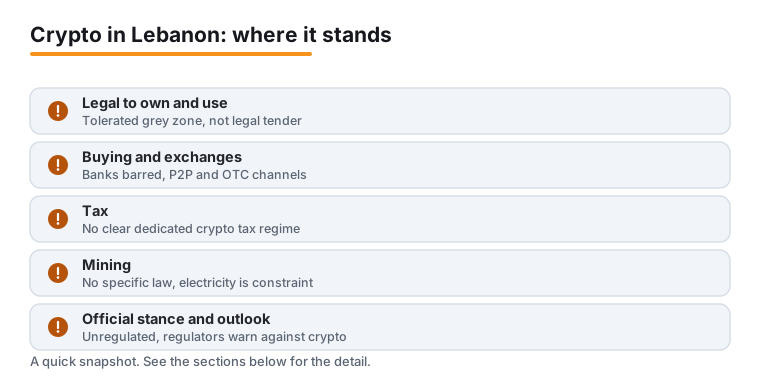
Quick answer — Lebanon, 2026
- Legal: Not banned for individuals, tolerated grey area, not legal tender
- Tax: No clear crypto tax regime, treatment unsettled
- Buying: No local exchange, via P2P and OTC dealers, banks barred
Lebanon occupies an unusual place on the global crypto map. The country has no dedicated law that explicitly legalizes or bans cryptocurrency, yet digital assets, and US dollar stablecoins in particular, have quietly become part of everyday economic life. Against the backdrop of a banking collapse that began in 2019, a sharply devalued Lebanese pound, and tight informal limits on accessing dollars, many Lebanese turned to Bitcoin and stablecoins such as Tether (USDT) for saving, getting paid, and receiving money from relatives abroad.
The result is a market that runs largely outside the formal financial system. The central bank, Banque du Liban (BDL), and the Capital Markets Authority (CMA) have warned against virtual currencies and barred licensed banks and financial institutions from dealing in them, while individuals trading peer-to-peer have faced little direct enforcement. This page explains where Lebanon's crypto rules stand in 2026, how people buy and use crypto in practice, the risks to weigh, and how to verify the rules yourself with the official regulators. It is general information as of 2026, not legal, tax, or financial advice; always confirm the current position with the named official regulators or a qualified Lebanese professional before acting. For broader context, see our overview of crypto regulation.
On this page: Legal status · Who regulates it · Taxes · How to buy · Mining
Legal status: is Bitcoin and crypto legal in Lebanon?
For ordinary individuals, owning, buying, selling, and holding cryptocurrency in Lebanon is not explicitly illegal. No statute criminalizes personal use of Bitcoin or other digital assets, and no law recognizes them as legal tender or as a regulated financial instrument. The Lebanese pound (LBP) remains the only legal tender. Crypto therefore sits in a legal gray zone: tolerated in practice for individuals, but unregulated and unsupervised.
The picture is different for the formal financial sector. The Capital Markets Authority prohibits licensed financial institutions from issuing, marketing, or trading digital currencies, and Banque du Liban has cautioned the public against virtual currencies. In practice, you generally cannot buy crypto through a Lebanese bank, and banks are not supposed to process crypto-related payments. That gap, between what individuals may do informally and what the regulated banking system is permitted to do, is the defining feature of Lebanon's crypto landscape.
Because the legal status is undefined rather than settled, it can change. Readers should not treat "not banned" as the same as "protected by law." There is no dedicated consumer-protection regime for crypto users in Lebanon, and disputes with exchanges or counterparties may have little legal recourse domestically.
Who regulates crypto: Banque du Liban, the CMA, and the SIC
No single authority has a comprehensive crypto mandate in Lebanon. Three bodies shape the landscape:
- Banque du Liban (BDL), the central bank. BDL oversees the banking and payment system and has publicly warned against virtual currencies, citing the absence of any central-bank backing and the potential for misuse such as money laundering and terrorist financing. Its electronic-banking framework, Basic Circular No. 69, governs how licensed institutions may handle electronic financial operations.
- Capital Markets Authority (CMA). An independent regulator established under Capital Markets Law No. 161 of 2011, the CMA supervises Lebanon's capital markets and the licensed financial institutions operating in them. It has formally prohibited those institutions from dealing in digital currencies.
- Special Investigation Commission (SIC). The SIC is Lebanon's Financial Intelligence Unit (FIU), the body responsible for anti-money-laundering and counter-terrorism-financing oversight under Law No. 44 of 2015. It receives suspicious-transaction reports and coordinates with international partners.
There is no separate crypto-specific regulator, and as of August 2026 no authority is yet issuing crypto licences. Banque du Liban is the body that would do so: each of its 2026 decisions bars dealing in virtual assets except as authorised by regulations issued by BDL, and An-Nahar reported in July 2026 that BDL is preparing that licensing circular in coordination with the World Bank, France, the United States and other countries. You can verify each body directly: Banque du Liban, the Capital Markets Authority, and the Special Investigation Commission.
Key laws and regulatory framework
Lebanon does not have a comprehensive, purpose-built cryptocurrency law. Instead, the framework is assembled from existing financial regulation and regulator guidance:
- CMA prohibition (2018). The Capital Markets Authority published an announcement in the Official Gazette on 12 February 2018 prohibiting licensed financial institutions from issuing or marketing electronic or digital currencies and from trading them for their own account or on behalf of clients. The CMA cited that trading platforms are not governed by any law or regulation, that such currencies lack central-bank issuance or guarantee and are highly volatile, that they can be used for money laundering and terrorist financing, and that erroneous transactions cannot be reversed.
- BDL Basic Circular No. 69. This central-bank circular governs electronic banking and financial operations for licensed institutions and has been amended over time; it underpins BDL's restrictive posture toward virtual currencies in the regulated sector.
- AML/CFT Law No. 44 of 2015. Lebanon's principal anti-money-laundering and counter-terrorism-financing statute imposes customer due diligence, record-keeping, and suspicious-transaction reporting duties on financial institutions and designated non-financial businesses, supervised by the SIC.
- No bespoke crypto law (yet). As of August 2026 no statute defines, licenses or taxes crypto, and no VASP regime is in force. What does exist is a matched set of Banque du Liban decisions issued in 2026 that prohibit supervised institutions from dealing in virtual assets unless authorised by regulations issued by BDL: Basic Decision No. 13790 of 9 January 2026 for electronic payment services providers (Article 17(3) and 17(5)), Intermediate Decision No. 13791 of 9 January 2026, which repealed the articles of Basic Decision No. 7548 behind Basic Circular No. 69 and replaced them with a text carrying an Article 10 headed Prohibition of Virtual Assets for banks and financial institutions, and Basic Decision No. 13819 of 21 May 2026 for finance companies (Article 7(3)).
Lebanon is not an EU member, so the EU's Markets in Crypto-Assets Regulation (MiCA) does not apply. Any future Lebanese framework would be domestic. Because the rules are evolving, confirm the current position through the regulators rather than secondary summaries.
Licensing and registration of exchanges and VASPs
As of 2026, Lebanon has no domestic licensing or registration scheme specifically for crypto exchanges, custodians, brokers, or other virtual-asset service providers (VASPs). There is no local regulator that issues a crypto exchange license, and no public register of approved crypto platforms.
Because licensed banks and CMA-supervised financial institutions are barred from dealing in digital currencies, no regulated Lebanese fiat-to-crypto exchange operates in the way one might in a country with a VASP regime. Activity instead takes place through international platforms and informal channels (see the section on buying crypto in practice). Any entity that did handle virtual assets within Lebanon's financial system would still fall under the general AML/CFT expectations supervised by the SIC.
The Financial Action Task Force (FATF) recommends that countries register or license VASPs and apply AML/CFT rules to them. Lebanon's placement under increased FATF monitoring (see recent developments) is often assumed to be driving a VASP framework, but the published Lebanon action plan does not support that. Its ten items, restated at the FATF plenary of 19 June 2026, cover risk assessments, mutual legal assistance and asset recovery, DNFBP supervision, beneficial ownership, financial intelligence, investigations and prosecutions, cross-border currency movement, terrorist financing, targeted financial sanctions and high-risk non-profits. None of the ten mentions virtual assets or VASPs. The licensing push is coming from Banque du Liban instead, and nothing of the kind is in force today.
Crypto taxation in Lebanon
Lebanon does not have a dedicated crypto tax regime, and because crypto is not a defined asset class in Lebanese law, no published rate attaches to a crypto disposal. The general rates that do exist, as published and last reviewed on 1 July 2026, are 15 percent on capital gains from disposal of fixed assets, 17 percent corporate income tax, progressive rates of 2 percent to 25 percent on salaries and wages, progressive rates of 4 percent to 25 percent on business profits of sole proprietorships and general partnerships, and 11 percent VAT. Which of these could catch a crypto gain depends on a characterisation Lebanese law has not yet made. Lebanon's tax system is broadly territorial, meaning income with a Lebanese source is the primary focus of taxation, but how that principle applies to individual crypto trading has not been authoritatively settled by published official guidance.
You will see secondary websites quote specific figures, such as a fixed capital-gains percentage, for crypto in Lebanon. Treat those claims with caution: we could not confirm a specific crypto tax rate in official BDL, CMA, or Ministry of Finance sources, and you should not rely on an unofficial number when planning. General tax obligations on income and business activity may still apply regardless of the asset involved.
The practical takeaway: keep detailed records of every transaction (dates, amounts, counterparties, and LBP or USD values), and confirm your specific obligations with the Lebanese Ministry of Finance or a qualified local tax professional before filing. For background on how other jurisdictions approach this, see our guide to crypto taxes.
AML and KYC rules
Anti-money-laundering (AML) and know-your-customer (KYC) obligations are taken seriously in Lebanon's financial system, even though crypto itself is largely unregulated. The framework rests on Law No. 44 of 2015 on Fighting Money Laundering and Terrorist Financing, supervised by the Special Investigation Commission, Lebanon's Financial Intelligence Unit. The law requires financial institutions and designated non-financial businesses to verify customer identity, keep records, and file suspicious-transaction reports.
While these duties bind regulated institutions rather than individual peer-to-peer traders, they matter for crypto users in several ways. Reputable international exchanges apply their own KYC checks, so Lebanese users typically must verify their identity to use them. Converting larger sums to or from cash can attract scrutiny under general AML expectations. And cash that originates from or returns to the banking system remains subject to the bank's own compliance and reporting.
Lebanon has also moved to broaden financial transparency. Reforms have eased aspects of banking secrecy to allow authorities and supervisors greater access to account information, part of the country's commitment to strengthen its AML/CFT regime. Anyone using crypto should keep clear personal records and be prepared to explain the source and purpose of funds.
Buying and using crypto in practice
Because banks are walled off from crypto, most buying and selling in Lebanon happens through informal and peer-to-peer (P2P) channels rather than a regulated local exchange. In practice this commonly means:
- P2P marketplaces: The P2P sections of large international exchanges match buyers and sellers directly, often settling in cash or available payment methods, with the platform holding funds in escrow.
- Over-the-counter (OTC) dealers and brokers: Informal OTC desks facilitate larger USDT-for-cash and crypto-for-cash trades, particularly in Beirut and other urban centers.
- Messaging-app communities: A meaningful share of activity is coordinated through community groups, which carries elevated counterparty and fraud risk.
- International exchanges: Some users access global platforms directly, though availability of card payments, products, and Lebanese-pound on-ramps is limited and changes over time. Always verify whether a platform currently serves Lebanese residents.
Stablecoins, especially USDT, dominate this market and function as an informal digital dollar for saving and for moving value, including diaspora remittances. Anyone buying through P2P or OTC channels should know that these venues offer little to no formal consumer protection, that spreads and fees vary widely, and that cash meetups carry physical-safety and scam risks. Verifying counterparties, using platform escrow where available, choosing public meeting locations, and starting with small test amounts are basic precautions.
Bitcoin mining in Lebanon
There is no specific law in Lebanon that authorizes or prohibits cryptocurrency mining, so it falls into the same general gray area as other crypto activity. The decisive constraints are practical rather than legal:
- Electricity supply: Lebanon's chronic electricity shortages and heavy reliance on private generators make the cheap, stable, round-the-clock power that mining needs difficult and often expensive to secure. Power cost and reliability are the dominant factors in whether mining is viable.
- Hardware and import costs: Acquiring and importing specialized mining equipment, and paying for it amid currency instability and limited banking access, adds significant friction.
- Heat, noise, and space: Standard operational challenges apply, especially for home-scale setups.
Anyone considering mining should treat electricity sourcing, including any rules on generator use and grid connections, as the key issue, and should confirm their setup does not run afoul of utility, customs, or local regulations. Mining economics are highly sensitive to power prices and to coin values, so profitability is far from guaranteed.
Recent developments (2024 to 2026)
The regulatory mood in Lebanon has been shifting, even though the formal rules have not yet changed:
- FATF grey list (October 2024, still in force). The Financial Action Task Force added Lebanon to its list of jurisdictions under increased monitoring (the "grey list") on 25 October 2024, after finding strategic deficiencies in its AML/CFT framework. Lebanon made a high-level political commitment to an action plan to address them. As of the FATF's June 2026 update Lebanon remained on the grey list, with the action plan due to run to the end of 2026. This raises the prospect that virtual-asset oversight, including a VASP regime, could be introduced as part of broader reform.
- Banking-secrecy reform. Law No. 1 of 2025 was approved by parliament on 24 April 2025 and published in the Official Gazette on 25 April 2025. It allows Banque du Liban, the Banking Control Commission of Lebanon, the National Deposit Guarantee Institution and audit firms appointed by the central bank to lift banking secrecy, including by general request covering all accounts and clients without naming a particular account holder, with retroactive effect of ten years.
- Government engagement with the industry (2026). The Minister of Economy and Trade, Amer Bisat, met senior officials of the exchange Binance to discuss a regulatory framework for digital assets, reported on 27 February 2026. Bisat publicly stated that crypto trading among Lebanese is significant and growing and referred to stablecoins such as Tether (USDT) functioning as a de facto currency. He described an inter-ministerial effort developing a digital-asset framework while stressing the financial, legal, and cross-border risks involved.
Crucially, as of August 2026 no comprehensive crypto statute or licensing regime has been published and parliament has passed no digital-asset law. The ministerial meetings remain signals. The binding developments came from Banque du Liban instead: the virtual-asset prohibitions of January and May 2026, and the amended cash KYC regime in force from 30 June 2026 requiring Forms RF1-A and RF1-B at USD 1,000 and source-of-funds documentation at USD 10,000 per month for licensed non-bank financial institutions. A BDL licensing circular for crypto service providers was reported in July 2026 as due during the year, with no draft text published and no commencement date fixed.
Consumer risks and protection
Crypto in Lebanon carries a stacked set of risks, and there is no dedicated local safety net:
- No domestic regulator standing behind holdings: there is no deposit insurance for crypto, no licensed-exchange recourse, and limited legal remedy if a platform fails or funds are stolen.
- Informal-market exposure: reliance on P2P and OTC venues exposes users to fraud, theft, counterparty default, and physical-safety risk at cash meetups.
- Volatility and conversion friction: Bitcoin and most tokens can swing sharply; converting back to usable cash relies on informal markets that can be costly or illiquid. Stablecoin users additionally depend on the issuer's soundness and the peg holding.
- Irreversibility and self-custody: sending to a wrong address is permanent, and holding your own keys makes you solely responsible for security and backups.
- Regulatory uncertainty: today's tolerance is not guaranteed; future rules could change what is permitted.
Practical protection comes from the user: prefer established platforms with KYC and escrow, treat promises of guaranteed or unrealistic returns and pressure to act fast as scam red flags, never share private keys or seed phrases, keep meaningful holdings in offline (cold) storage, and seek qualified advice for significant sums or business use.
Official sources and how to verify
Because crypto rules in Lebanon are unsettled and evolving, always confirm the current position with primary official sources rather than secondary summaries. The most authoritative are:
- Banque du Liban (central bank): bdl.gov.lb for circulars and public warnings on virtual currencies and the payment system.
- Capital Markets Authority (CMA): cma.gov.lb for rules applying to licensed financial institutions, including the prohibition on dealing in digital currencies.
- Special Investigation Commission (SIC), the FIU: sic.gov.lb for AML/CFT laws and guidance, including Law No. 44 of 2015.
- Financial Action Task Force (FATF): the FATF lists of monitored jurisdictions for Lebanon's current AML/CFT monitoring status.
For broader context, see our hub on crypto regulation by country. This article is general information as of 2026 and is not legal, tax, or financial advice; the rules described here can change, so verify the current position with the named official regulators or a qualified Lebanese professional before acting.
What is changing: Lebanon in August 2026
The short answer has not changed: there is still no Lebanese crypto law, and parliament has passed none. What changed during 2026 is that Banque du Liban stopped relying on warnings and wrote an explicit virtual-asset prohibition into three of the rulebooks it maintains. All three carry near-identical wording, and all three point at the same future authorisation as the only way in.
- 9 January 2026. Basic Decision No. 13790 (Basic Circular No. 1) licenses electronic payment services providers. Article 1(12) defines Virtual Assets. Article 17(3) prohibits providers from issuing, dealing in or facilitating dealings in virtual assets in any way, unless as authorized by regulations issued by BDL. Article 17(5) names trading in virtual assets as an example of a prohibited activity.
- 9 January 2026. Intermediate Decision No. 13791 (Intermediate Circular No. 750) repealed the articles and annexes of Basic Decision No. 7548 of 30 March 2000, the text behind Basic Circular No. 69, and replaced them. The replacement carries a new Article 10, headed Prohibition of Virtual Assets, binding banks and financial institutions.
- 21 May 2026. Basic Decision No. 13819 (Basic Circular No. 4) governs finance companies and repeats the prohibition at Article 7(3). It also replaces the term Financial Institutions with Finance Companies across BDL and Banking Control Commission texts.
Read together, banks, financial institutions, finance companies and electronic payment services providers may not deal in crypto today. One category sits outside this set: exchange institutions, the licensed money changers, are expressly excluded from the scope of Decision 13790 by its Article 1(3) and carry no equivalent virtual-asset prohibition in any of the three texts. Penalties differ by instrument. Under the replaced Circular 69 text and under Decision 13819, breach draws administrative sanctions under Article 208 of the Code of Money and Credit and is also a crime under Article 770 of the Penal Code. Decision 13790 instead routes breaches to the Higher Banking Commission, allows the Central Council to impose a fine of up to LBP 1,500,000,000 per violation under its Article 40, and makes violation an offence under Article 770. The Official Monetary and Financial Institutions Forum wrote in July 2026 that dollar stablecoins appear to fall within the framework's broad definition of virtual assets, and that the published circulars do not appear to include stablecoin-specific authorisation rules. None of this restricts an individual from holding or transferring crypto.
The licensing regime that is being prepared, and what it would mean
The prohibition in each 2026 decision ends with the same escape clause: unless authorised by regulations issued by BDL. Those regulations are reported to be in preparation. An-Nahar reported on 8 July 2026 that Banque du Liban is working on Lebanon's first crypto regulatory framework in coordination with the World Bank, France, the United States and other countries, and that it will issue a circular during the year under which any entity wishing to provide cryptocurrency-related services must obtain a BDL licence under strict conditions. Officials in the same report said trading volume cannot be estimated precisely but is not small, and that the aim is to bring activity under supervision rather than leave it outside the legal framework.
Two further points from that reporting matter for readers. Capital Markets Authority sources said licensed Lebanese financial companies do not deal in crypto because current law does not permit it, and that the central difficulty is that most Lebanese who trade digital currencies deal directly with foreign platforms, chiefly Binance, so Lebanese authorities have no power to reach those platforms' data or identify users. BDL sources said the previously floated digital lira is a central bank digital currency, entirely different from cryptocurrencies, and that priority today remains restoring confidence in the national currency.
Where this sits: announced in a newspaper, not drafted in public. As of 3 August 2026 no draft text, consultation paper or Official Gazette entry exists, and no commencement date has been fixed. The sentence announcing the circular is the newspaper's own, not a quoted commitment from a named official. If it is issued as described, the concrete effects would be a licence requirement and AML and KYC duties for service providers, a lawful route for banks, finance companies and payment firms through the authorisation carve-out already written into the 2026 decisions, and no direct licensing obligation on individual holders. Until it is published, the prohibitions are the rule and the licence regime is an intention.
Cash, KYC and the USD 1,000 threshold that took effect on 30 June 2026
Because the banking system is closed to crypto, the cash leg is where most Lebanese users meet formal rules, and that layer tightened at the end of June. Basic Decision No. 13769 of 14 November 2025 (Basic Circular No. 3) was amended by Intermediate Decision No. 13815 of 4 May 2026 (Intermediate Circular No. 761), and the circular's own footnotes state that those amendments come into force as of 30 June 2026. It binds finance companies, specialized lending entities (comptoirs), exchange institutions and electronic payment services providers, together defined as Non-Banking Financial Institutions.
| Trigger | Threshold | Obligation |
|---|---|---|
| Cash transaction, Form RF1-A | USD 1,000 or above | Completed once per customer, updated at least every five years |
| Cash transaction, Form RF1-B | USD 1,000 or above | Completed per transaction, except for cash withdrawals |
| Signature | Both forms | Signed physically by customer and institution |
| Electronic signature allowed | Up to USD 10,000 per month, natural persons only | Above that, physical signature required |
| Source of funds documented | USD 10,000 or above per month, or on suspicion | Supporting documentation must be produced |
| Record keeping | All covered transactions | Retained at least five years |
| Reporting to BDL | Daily reports | Submitted within two business days |
| Cross-border cash carried in person | Exceeding USD 15,000 | Written declaration to Customs under Law No. 42 of 24 November 2015 |
Two honest limits. First, these duties bind licensed institutions, not the unlicensed P2P and OTC dealers where much Lebanese crypto activity actually happens, which is part of why that activity stays there. Second, Law No. 42 defines what must be declared as banknotes and coins, commercial papers, securities, means of payment and other types of negotiable movable assets including prepaid cards. Crypto held in a self-custodied wallet is not on that list. That is a description of the current text, not a suggestion to rely on the gap.
Tax: the rates that actually exist in Lebanese law
There is no crypto-specific tax rule in Lebanon, no Ministry of Finance guidance on digital assets that we could locate, and no crypto capital-gains rate. Anyone quoting one is inventing it. What does exist is the general rate structure, which is what any future characterisation of a crypto disposal would have to be fitted into. The figures below are the current published rates, each last reviewed 1 July 2026.
| Tax | Rate |
|---|---|
| Capital gains on disposal of fixed assets | 15 percent |
| Corporate income tax | 17 percent |
| Salaries and wages, progressive | 2 percent to 25 percent |
| Business profits of sole proprietorships and general partnerships, progressive | 4 percent to 25 percent |
| Value added tax | 11 percent |
Why this still does not give you a number for crypto: which of these applies depends on a characterisation Lebanese law has not made. Someone trading actively could be treated as carrying on a business and taxed on profits at the progressive business rates. A one-off disposal by a private individual has no obvious home, because crypto is not a defined asset class and the 15 percent rate attaches to disposals of fixed assets rather than to an undefined intangible. Lebanon also taxes on a broadly territorial basis, which raises a further unresolved question for gains realised on foreign platforms. Keep transaction-level records and get the characterisation confirmed by the Ministry of Finance or a qualified Lebanese tax professional before filing.
What the Capital Markets Authority said about digital platforms in February 2026
On 18 February 2026 the Capital Markets Authority issued a public announcement under Capital Markets Law No. 161/2011 that reaches considerably further than the 2018 prohibition aimed at licensed institutions. It warns influencers, holders of social media accounts and pages, and unlicensed websites and applications against conducting or promoting any financial-market activity within the Lebanese market without a prior CMA licence, naming investment advice and recommendations, advertising or marketing financial products or services, and soliciting investors.
The reach asserted is the notable part. The CMA states that any natural or legal person, including digital platforms, websites or applications, that conducts or promotes investment activity directed at the Lebanese market or its residents, whether from inside Lebanon or from abroad, breaches Law 161/2011 and exposes itself to legal prosecution. It instructs influencers to stop immediately, tells the public to verify licensing against the official lists published on cma.gov.lb, and says it will take all necessary legal, administrative and judicial measures.
One caveat stated plainly, and checked against the Arabic original: the announcement does not use the words cryptocurrency or virtual asset anywhere. It catches crypto promotion by category rather than by name. Its practical relevance is to referral schemes, influencer trading pitches and the marketing arms of offshore exchanges targeting Lebanese users.
FATF: what the Lebanon action plan actually requires
Lebanon was added to the FATF list of jurisdictions under increased monitoring in October 2024 and remained on it at the plenary statement issued in Paris on 19 June 2026. Lebanon was among the countries whose progress the FATF reviewed since February 2026, and unlike Bulgaria, Monaco and Cote d'Ivoire it did not receive an initial determination that its action plan was substantially complete.
One detail is worth correcting, because it is widely assumed the other way. The published Lebanon action plan has ten items, covering terrorist financing and money laundering risk assessments, mutual legal assistance, extradition and asset recovery, supervision and sanctioning of designated non-financial businesses and professions, beneficial ownership information, use of financial intelligence, investigations and prosecutions, illicit cross-border movements of currency and precious metals and stones, terrorist financing investigations, targeted financial sanctions, and monitoring of high-risk non-profit organisations. None of the ten items mentions virtual assets or virtual asset service providers. The same statement shows the FATF does write such items when it means to: the Bulgaria entry expressly requires market entry controls for VASPs.
So the pressure to build a Lebanese VASP regime is not coming from the text of the FATF action plan. It is coming from Banque du Liban, which has written the authorisation hook into its own 2026 decisions and is reported to be preparing the licensing circular described above. That distinction matters for anyone trying to judge how firm the timeline is.
Frequently asked questions
Is cryptocurrency legal in Lebanon?
There is no law that explicitly legalizes or bans crypto for individuals, so personal ownership and trading sit in a tolerated legal gray area, and the Lebanese pound remains the only legal tender. Regulators have warned the public against virtual currencies, and the Capital Markets Authority prohibits licensed financial institutions from dealing in them. Crypto is neither legal tender nor a recognized, regulated financial instrument. Verify the current position with Banque du Liban and the CMA.
Can I buy crypto through a Lebanese bank?
Generally no. The CMA prohibits licensed financial institutions from issuing, marketing, or trading digital currencies, and Banque du Liban discourages their use, so the formal banking system is effectively closed to crypto. In practice, people buy and sell through peer-to-peer marketplaces and over-the-counter dealers rather than through banks.
Who regulates crypto in Lebanon?
No single body has a comprehensive crypto mandate. Banque du Liban (the central bank) oversees banking and payments and warns against virtual currencies; the Capital Markets Authority supervises licensed financial institutions and bars them from dealing in crypto; and the Special Investigation Commission, Lebanon's Financial Intelligence Unit, handles anti-money-laundering oversight under Law No. 44 of 2015. There is no dedicated crypto licensing authority as of 2026.
How is crypto taxed in Lebanon?
Lebanon has no clear, dedicated crypto tax regime, and because crypto is not a defined asset class in Lebanese law, the treatment of gains and income is unsettled. Be wary of unofficial sites quoting specific rates; we could not confirm a crypto tax rate in official sources. General tax obligations may still apply. Keep detailed records and confirm your situation with the Ministry of Finance or a qualified Lebanese tax professional.
Is Bitcoin mining allowed in Lebanon?
There is no specific law authorizing or banning mining, so it falls into the same gray area as other crypto activity. The main obstacles are practical: unreliable and costly electricity, heavy reliance on private generators, and the expense of importing hardware. Confirm any setup complies with utility, customs, and local rules before starting.
Why is USDT so popular in Lebanon?
After the banking crisis that began in 2019 and the sharp fall in the Lebanese pound, many people sought a stable, dollar-denominated way to save and transact. The US dollar stablecoin Tether (USDT) became a de facto digital dollar, used to preserve value and to send and receive money, often through peer-to-peer trades. It is widely used, but it still carries risks tied to the issuer and the peg, and offers no formal consumer protection locally.
Is Lebanon planning to regulate crypto?
There is early engagement but no enacted law as of mid-2026. In early March 2026 the Minister of Economy and Trade, Amer Bisat, met senior officials of the exchange Binance to discuss a possible framework for digital assets, and he described an inter-ministerial effort exploring one. These are signals rather than published rules. No comprehensive crypto statute or licensing regime is in force, so confirm the latest status through official regulators before assuming any change.
Is Lebanon on the FATF grey list, and does it affect crypto?
Yes. The Financial Action Task Force added Lebanon to its list of jurisdictions under increased monitoring (the grey list) on 25 October 2024, and Lebanon remained on it as of the June 2026 update, with its action plan running to the end of 2026. The listing concerns anti-money-laundering and counter-terrorism-financing shortcomings generally rather than crypto specifically, but it increases the chance that virtual-asset oversight, such as a VASP registration regime, is introduced as part of broader reform.
Is crypto legal in Lebanon in August 2026?
For individuals, yes in the sense that nothing criminalizes owning, buying, selling or holding it, and there is still no Lebanese crypto statute. For supervised institutions, no. Banque du Liban decisions issued in 2026 prohibit banks, financial institutions, finance companies and electronic payment services providers from issuing, dealing in or facilitating dealings in virtual assets in any way, unless as authorized by regulations issued by BDL. Those authorising regulations do not yet exist. Crypto is not legal tender; the Lebanese pound is.
Has Lebanon passed a crypto law yet?
No. Parliament has not passed any digital-asset law as of 3 August 2026, and we could not identify any published bill. The rules that changed in 2026 are central bank decisions, not legislation: Basic Decision No. 13790 of 9 January 2026, Intermediate Decision No. 13791 of 9 January 2026 which rewrote the text behind Basic Circular No. 69, and Basic Decision No. 13819 of 21 May 2026.
When will Lebanon license crypto exchanges?
No date has been fixed. An-Nahar reported on 8 July 2026 that Banque du Liban is preparing Lebanon's first crypto regulatory framework in coordination with the World Bank, France, the United States and other countries, and will issue a circular during the year requiring any entity providing crypto-related services to obtain a BDL licence under strict conditions. No draft text, consultation or Official Gazette entry has been published, so treat 2026 as a press-reported intention rather than a commencement date.
What is the crypto tax rate in Lebanon?
There is none. Lebanon has no crypto-specific tax rule and no Ministry of Finance guidance on digital assets that we could locate, so any site quoting a Lebanese crypto capital-gains rate is inventing it. The general rates that exist are 15 percent on capital gains from disposal of fixed assets, 17 percent corporate income tax, 2 percent to 25 percent progressive on salaries, 4 percent to 25 percent progressive on business profits, and 11 percent VAT. Which one could apply to a crypto disposal has not been settled, and Lebanon taxes on a broadly territorial basis, which complicates gains realised on foreign platforms.
Did anything change for cashing out crypto in Lebanon on 30 June 2026?
Yes, for the licensed cash channel. Banque du Liban Basic Decision No. 13769, as amended by Intermediate Decision No. 13815 of 4 May 2026, states that the amendments come into force as of 30 June 2026. Licensed exchange institutions, finance companies, comptoirs and payment providers must complete Form RF1-A for any cash transaction of USD 1,000 or more, and Form RF1-B per transaction at the same threshold except for cash withdrawals. They must document source of funds at USD 10,000 or more per month, keep records at least five years and report daily to BDL within two business days. These duties bind licensed institutions, not unlicensed P2P or OTC crypto dealers.
Can an offshore exchange legally advertise to Lebanese users?
The Capital Markets Authority says no without its licence. In a public announcement dated 18 February 2026 under Capital Markets Law No. 161/2011, the CMA stated that any person or entity, including digital platforms, websites and applications, operating from inside or outside Lebanon and conducting or promoting investment activity directed at the Lebanese market or its residents without a prior CMA licence breaches the law and is exposed to prosecution. The announcement does not use the word cryptocurrency anywhere, so it catches crypto promotion by category rather than by name.
Does the FATF grey listing require Lebanon to regulate crypto?
Not according to the published action plan. Lebanon was listed in October 2024 and remained listed at the FATF plenary statement of 19 June 2026. The ten action plan items cover risk assessments, mutual legal assistance and asset recovery, supervision of designated non-financial businesses, beneficial ownership, financial intelligence, investigations and prosecutions, cross-border currency movement, terrorist financing, targeted financial sanctions and high-risk non-profits. None of the ten mentions virtual assets or virtual asset service providers, even though the same statement does impose VASP market entry controls on Bulgaria.
Do I have to declare crypto when entering or leaving Lebanon?
Law No. 42 of 24 November 2015 requires a written declaration to Customs when physically carrying currency or negotiable instruments across the border whose value exceeds USD 15,000. Its definition covers banknotes and coins, commercial papers, securities, means of payment and other negotiable movable assets including prepaid cards. Crypto held in a self-custodied wallet is not on that list. That is a description of the current text, not advice to rely on the gap.
Facts reviewed: 3 August 2026. Page updated: 3 August 2026.