Home › Crypto Regulation › Iran
Bitcoin & Cryptocurrency Regulation in Iran
Quick answer — Iran, 2026
- Legal: Owning and trading tolerated, not legal tender, domestic payments banned
- Tax: No clear crypto tax code, treatment not transparently defined
- Buying: Via CBI-licensed, monitored domestic exchanges; major ones now sanctioned
Iran runs one of the most distinctive and tightly controlled cryptocurrency regimes in the world. Bitcoin mining was formally legalised and even harnessed by the state to help fund imports under sanctions, yet ordinary residents cannot legally use crypto to pay for everyday goods, and the Central Bank polices every on-ramp and off-ramp. Since early 2025 the Central Bank of Iran has been the single authority over the market, tightening licensing, capping stablecoin holdings and channelling exchange activity through monitored, government-controlled systems. This guide explains how crypto is treated in Iran as of 2026: the legal status, the regulator, the laws and framework, licensing, taxation, anti-money-laundering rules, mining, recent developments and the practical risks.
This is general information as of 2026 and is not legal, tax or financial advice. Iranian rules change frequently and enforcement can shift quickly, so always verify the current position directly with the Central Bank of Iran and a qualified local professional before acting. For broader context see our overview of crypto regulation.
On this page: Legal status · Who regulates it · Taxes · How to buy · Mining
Is Bitcoin and crypto legal in Iran?
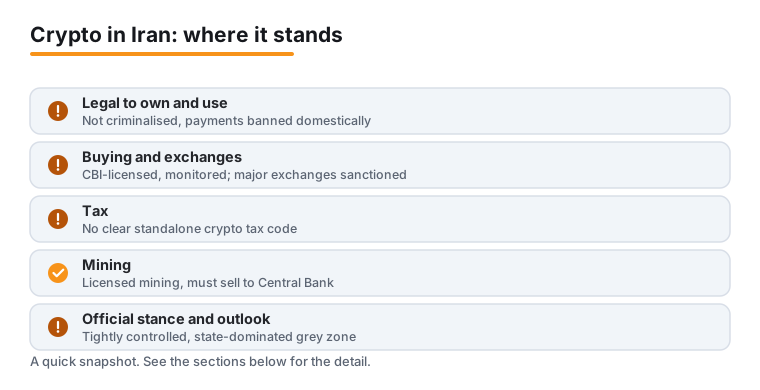
The answer is nuanced. Holding and trading cryptocurrency is not criminalised in itself, and the state actively participates in the sector through licensed mining. However, Iran does not recognise Bitcoin or any cryptocurrency as legal tender, and using crypto as a means of payment inside the country is prohibited. In late December 2024 the authorities went further and blocked crypto-to-rial and rial-to-crypto payments through ordinary internet platforms, before reopening conversion only through controlled, monitored channels.
In practice this creates a split system:
- Permitted in principle: mining under a licence, and converting crypto to and from rials through state-approved, licensed exchanges that share transaction data with the authorities.
- Restricted or prohibited: using Bitcoin or stablecoins such as USDT to pay merchants, rent or daily expenses domestically; moving crypto through unlicensed channels; and crypto advertising, which authorities moved to ban in early 2025.
So crypto sits in a controlled grey zone: tolerated as an investment and sanctions-coping tool, but boxed in as a payment instrument. The clear direction of travel has been toward more state control, not less.
The regulator: Central Bank of Iran
In January 2025 the government of President Masoud Pezeshkian designated the Central Bank of Iran (CBI) as the sole authority responsible for regulating the cryptocurrency market. That consolidation gave the CBI direct control over exchange licensing, on-ramps and off-ramps, and the conditions under which digital assets may be held and exchanged.
Other bodies retain roles in related areas. The Ministry of Industry, Mine and Trade issues mining licences, the Ministry of Energy oversees the electricity miners consume, and Iran's Financial Intelligence Unit handles suspicious-transaction reporting under the country's anti-money-laundering regime. But the CBI is now the central decision-maker for the crypto market itself.
The Central Bank publishes official information through its website. You can confirm the current position via the Central Bank of Iran (English).
Key laws and the regulatory framework
Iran's rules have been built piecemeal rather than through a single comprehensive crypto statute. The most important recent step was the CBI's approval, on 7 December 2024, of a Policy and Regulatory Framework for Cryptocurrencies, developed with the Ministry of Economic Affairs and Finance. The framework reaffirmed the CBI as primary regulator and set out expectations to license crypto brokers and custodians, enforce anti-money-laundering and counter-terrorist-financing rules, and bring activity within tax obligations.
Key milestones in the current regime include:
- 7 December 2024: the CBI approves the Policy and Regulatory Framework for Cryptocurrencies.
- Late December 2024: the CBI blocks crypto-to-rial and rial-to-crypto payments through internet platforms.
- January 2025: conversion reopens, but only through a government-controlled API that gives the authorities access to user and transaction data, alongside the CBI being named sole regulator.
- February 2025: a ban on cryptocurrency advertising in physical and digital spaces.
- 27 September 2025: caps on stablecoins, with reported limits of around 5,000 US dollars per person per year for purchases and a holding ceiling near 10,000 US dollars.
Because rules have been tightened, loosened and re-tightened repeatedly, the regulatory picture is genuinely fluid. Treat any specific rule as provisional and verify it against current CBI guidance.
Licensing and registration of exchanges
The intended legal path for trading is through domestic, CBI-licensed exchanges that operate under direct oversight and perform identity verification. Under the current regime, platforms that convert between crypto and rials are expected to be licensed, route rial transactions through CBI-approved accounts, and provide the authorities with transparent access to transaction data (reportedly via API integration) so activity can be monitored.
This monitoring requirement has been contentious: industry groups have publicly objected to the breadth of data-sharing expected of platforms. For users, the practical effect is that the legitimate route is a licensed, heavily supervised exchange rather than an anonymous one.
Two external realities complicate access. First, sanctions: in June 2026 the US Treasury sanctioned several of Iran's largest exchanges (see the recent developments section), which severs much of the bridge to the global crypto system. Second, many foreign exchanges restrict or block Iranian users under sanctions, and attempting to reach them via VPNs typically breaches both the platform's terms and Iran's own rules. For the basics of how this fits into the wider regulatory picture, see our guide to crypto regulation.
Crypto and Bitcoin taxation in Iran
Iran does not have a standalone crypto tax code, but crypto is explicitly taxed under a general statute. The 28 article Law on Taxation of Speculation and Profiteering was passed by parliament on 29 June 2025, approved by the Guardian Council on 22 July 2025 and signed by President Masoud Pezeshkian on 16 August 2025. It names cryptocurrencies alongside real estate, vehicles, gold, jewellery, silver, platinum and foreign currency. Assets sold within one year are taxed at 20 to 40 percent of the gain, with lower rates for longer holding periods, and the tax base includes the profit plus 50 percent of the price increase attributable to inflation.
What remains genuinely undefined is the executive bylaw for crypto: how a gain is valued, which cost basis method applies, the filing mechanics, and whether licensed exchanges report positions to the Iranian National Tax Administration automatically. We could find no published guidance on any of that, and TRM Labs describes implementation of the law as phased, so treat the rate band as the law on paper and the collection machinery as still being built. Two further points are firm:
- Licensed mining is treated as a regulated commercial activity, with miners required to sell output to the Central Bank (a state monetisation channel rather than a conventional income tax).
- Caps were announced on the stablecoin side. The Central Bank's High Council decided in late September 2025 that individuals may buy no more than 5,000 US dollars of stablecoins per year and hold no more than 10,000 US dollars at any time, with Asghar Abolhasani, secretary of the High Council, setting a one month compliance deadline. We could not verify how strictly those caps are enforced in 2026. Large or visible crypto-to-rial flows may in any case attract scrutiny under anti-money-laundering and capital-control rules.
If you have a tax question about crypto in Iran, consult a qualified Iranian tax adviser and confirm the current position directly with the authorities. For general background on how crypto is taxed elsewhere, see our overview of crypto taxes.
AML, KYC and sanctions compliance
Iran's anti-money-laundering framework rests on the Anti-Money Laundering Act of 2008, amended in 2018, with reporting handled by the country's Financial Intelligence Unit. Regulated entities are required to identify and verify customers (know-your-customer and customer due diligence) before establishing a relationship and to report suspicious transactions. The CBI's crypto framework folds licensed exchanges into these obligations, requiring identity verification and the sharing of transaction data.
The international backdrop is severe. The Financial Action Task Force (FATF) has long placed Iran on its high-risk "blacklist" for deficiencies in its anti-money-laundering and counter-terrorist-financing controls, calling for enhanced countermeasures by other jurisdictions. You can confirm Iran's standing via the FATF list of high-risk jurisdictions. This status, combined with US sanctions, means foreign platforms and banks apply heavy scrutiny to anything connected to Iran, which is central to why off-ramping crypto cleanly is so difficult.
Buying and using crypto in practice
Iranians do buy and trade crypto in significant volumes, but how matters enormously. The legitimate route is a CBI-licensed Iranian exchange that converts between rials and crypto through approved banking channels and performs identity checks. Using crypto to pay for goods or services inside the country is not a legitimate route: domestic crypto payments are banned.
This is a general, educational description of the channels people use, not a recommendation, and not a guarantee that any route is legal or available to you:
- Licensed domestic exchanges: the intended legal path, though several of the largest were sanctioned by the US in June 2026, affecting their international standing.
- Peer-to-peer arrangements: trading directly with individuals avoids some platform constraints but greatly increases fraud and counterparty risk, with little recourse if a deal goes wrong.
- Foreign exchanges: many global platforms restrict Iranian users under sanctions; reaching them via VPNs typically violates the platform's terms and local rules and risks account freezes.
Sensible safeguards regardless of route: complete identity checks honestly where required, use reputable wallets with strong security and two-factor authentication, keep records, never move more than you can afford to lose, and stay current on rule changes. Most importantly, confirm that your chosen method is permitted under both Iranian law and any sanctions that may apply to you before proceeding.
Bitcoin mining in Iran
Mining is the most developed and most contradictory part of Iran's crypto story. Iran moved to recognise and license cryptocurrency mining as an industrial activity around 2018 to 2019, seeing it as a way to monetise abundant, heavily subsidised energy and earn hard value despite sanctions. For a time Iran was among the largest Bitcoin-mining jurisdictions in the world.
The licensed model works roughly like this:
- Miners obtain a licence (historically through the Ministry of Industry, Mine and Trade) and must use approved hardware at registered sites.
- Licensed miners face electricity tariffs intended to reflect industrial or premium rates rather than the cheapest subsidised household power.
- Crucially, licensed miners are required to sell their mined coins to the Central Bank (reported to run through the NIMA foreign-exchange system), channelling output into the state's foreign-currency and import-funding efforts.
The friction is severe. Premium tariffs make official mining marginal for many operators, so a very large share of activity is estimated to be unlicensed. Illegal mining draws on cheap or subsidised power and has been repeatedly blamed for straining the national grid, prompting crackdowns and seasonal bans during peak demand. The result: mining is legal on paper and strategically useful to the state, but operationally hard, politically sensitive and entangled with the country's electricity crisis.
Crypto as a sanctions workaround
A large part of why Iran treats crypto the way it does is sanctions. Cut off from much of the global banking system, the state has used digital assets both to earn value (through mined Bitcoin sold to the Central Bank) and to hold and move dollars it cannot access through normal reserves. Blockchain analytics firm Chainalysis put Iran's crypto ecosystem at more than 7.78 billion US dollars for 2025. TRM Labs, using a different methodology, attributed 9.9 billion US dollars of 2025 volume to Iran, of which about 7.7 billion, or 78 percent, ran through the four exchanges sanctioned in June 2026.
The clearest example of state involvement came in 2025. Blockchain-analytics firm Elliptic reported that the Central Bank of Iran itself acquired at least 507 million US dollars in Tether (USDT) in April and May 2025, paid for in UAE dirhams, and routed much of it through the exchange Nobitex, apparently to inject dollar liquidity and defend the collapsing rial. This is unusual: a central bank using a private US-dollar stablecoin as a de facto reserve and intervention tool because sanctions block its official reserves.
For ordinary residents, the practical takeaway is that Iran's crypto rules are shaped first by the state's sanctions strategy and only second by consumer needs. Rules that look restrictive to an individual investor (payment bans, stablecoin caps, monitored conversion) are consistent with a system built to keep crypto flows visible and under government control.
Recent developments (2025 to 2026)
The period since late 2024 has been one of rapid tightening and escalating sanctions pressure:
- December 2024 framework and payment block: the CBI approved its Policy and Regulatory Framework for Cryptocurrencies and briefly blocked crypto-rial payment rails before reopening them through a monitored government API.
- January 2025 consolidation: the CBI was named the sole crypto regulator amid a deepening currency crisis.
- February 2025 advertising ban: a prohibition on crypto advertising in physical and digital spaces.
- April and May 2025 stablecoin purchases: blockchain-analytics firm Elliptic reported that the Central Bank of Iran itself acquired at least 507 million US dollars in Tether (USDT), paid in UAE dirhams, apparently to inject dollar liquidity and support the rial. See the Elliptic analysis.
- June 2025 Nobitex hack: a group calling itself Gonjeshke Darande (Predatory Sparrow) drained roughly 90 million US dollars from Nobitex on 18 June 2025 and, unusually, sent much of it to unspendable "burn" addresses, framing the attack as politically motivated rather than a theft for profit.
- September 2025 stablecoin caps: the CBI's High Council approved reported limits of about 5,000 US dollars per person per year for stablecoin purchases and a holding ceiling near 10,000 US dollars, announced as the rial fell to record lows.
- June 2026 US sanctions: on 2 June 2026 the US Treasury's Office of Foreign Assets Control (OFAC) designated Nobitex, Wallex, Bitpin and Ramzinex, four of Iran's largest exchanges, citing sanctions evasion, terrorist financing and support for the regime, including transactions linked to the Islamic Revolutionary Guard Corps. Nobitex was said to have processed more than half of all Iranian digital-asset inflows in 2025, with Wallex and Bitpin reported at roughly 12 percent and 10 percent. OFAC also designated four individuals tied to Nobitex, including its chairman and co-founders, and attached secondary-sanctions risk, so foreign institutions dealing with these platforms risk being cut off from the US financial system. You can read the action via the US Treasury press release.
OFAC has also updated its designation of the Central Bank of Iran itself with crypto addresses. Because the landscape is moving fast, treat any single rule or access channel as something to re-check rather than assume.
Consumer risks and protection
Iran's crypto landscape concentrates more risk into one place than almost anywhere else, and consumer protections are thin. Key themes to keep in view:
- Off-ramp and liquidity risk: getting back into usable funds is complicated by sanctions on major domestic exchanges and by foreign-platform restrictions, so a hedge that cannot be cashed out cleanly offers limited protection.
- Regulatory whiplash: conversion channels, advertising rules and stablecoin caps have shifted repeatedly, so access cannot be assumed.
- Custody and platform risk: funds held on local platforms can be exposed to hacks, freezes and sudden policy changes, with little formal recourse.
- Counterparty and fraud risk: peer-to-peer and informal-broker deals carry significant risk of scams and disputes.
- Legal and sanctions risk: methods residents use to reach global markets may breach local rules or expose users and counterparties to sanctions.
Because the state prioritises control and sanctions resilience over a free consumer market, individuals carry most of the downside. Never invest more than you can afford to lose, verify the legality of any route before using it, and re-check the rules regularly. None of the above is legal, tax or financial advice.
Official sources and how to verify
Iranian crypto rules change frequently and are often communicated through directives rather than a single public law page, so verifying the current position matters. Start with the official and authoritative sources below, and consult a qualified Iranian professional for advice on your specific situation:
- Central Bank of Iran (CBI) for the sole crypto regulator's official site.
- Financial Action Task Force (FATF) for Iran's anti-money-laundering standing and high-risk status.
- US Department of the Treasury for the June 2026 OFAC sanctions on Iranian exchanges and related designations.
For how this fits into the wider picture, see our country hub on crypto regulation by country. This article is general information as of 2026, not legal advice; confirm anything you intend to act on with the Central Bank of Iran and a qualified local professional.
What is changing: Iran crypto status as of August 2026
Between 30 June and 3 August 2026 we found no change to any Iranian domestic crypto rule. Movement on Iran was entirely external. Four things happened that a reader arriving today should know about.
- On 14 July 2026 the US Office of Foreign Assets Control added four Tron wallet addresses as identifiers on its existing designation of the Central Bank of Iran. Those wallets had received more than 165 million US dollars in stablecoins, and Tether froze 131 million US dollars of USDT held in them, per CoinDesk and Chainalysis. That brings the total blocked across the April and July actions to roughly 475 million US dollars.
- On 29 July 2026 OFAC designated Persian Gulf Marine Insurance Company and HormuzSafe Marine Services Authority, plus eight tankers and their operators, over a transit insurance scheme for the Strait of Hormuz that accepted Bitcoin over the Lightning Network, Tether and USDC. See Holland and Knight and Decrypt.
- On 24 July 2026 Dubai's Virtual Assets Regulatory Authority ordered Shelbit, an unlicensed Dubai based exchange, to halt all unlicensed activity. Reuters reported on 31 July 2026 that at least 4 billion US dollars had passed through Shelbit, including at least 125 million US dollars connected to Iran's central bank, and at least 676 million US dollars onward to Binance since May 2024. See Iran International.
- At its plenary of 19 June 2026 the FATF kept Iran on the list of high risk jurisdictions subject to a call for action, alongside North Korea and Myanmar, and reinforced its call for countermeasures against Iran specifically. See the FIAU summary of the FATF public statements.
The practical position for an individual in Iran is unchanged from June. Buying, holding and selling crypto through a licensed exchange connected to the Central Bank monitoring interface is permitted. Paying a merchant, landlord or service provider inside Iran in Bitcoin or USDT is not. The friction is on the way out, not the way in.
Crypto tax in Iran: the 2025 speculation and profiteering law
Iran does have a statute that taxes gains on cryptocurrency. It is the 28 article Law on Taxation of Speculation and Profiteering, and it is the single most useful concrete fact for an Iranian holder.
- Passed by parliament on 29 June 2025, approved by the Guardian Council on 22 July 2025, and signed by President Masoud Pezeshkian on 16 August 2025, per NCRI, with the signing also reported by Iran International.
- It covers real estate, vehicles, gold, jewellery, silver, platinum, foreign currency and cryptocurrencies. Crypto is named in the statute, not read into it by analogy.
- Assets sold within one year are taxed at 20 to 40 percent of the gain. NCRI reports 10 to 15 percent for holdings of one to two years, and reduced rates or exemptions beyond two years.
- The tax base is unusual. Tax is levied on the profit plus 50 percent of the increase in the asset price attributable to inflation. The US State Department criticised the law on that basis in September 2025, noting Iranian annual inflation above 42 percent, per Iran International.
- TRM Labs describes it as the first time Iran has imposed capital gains tax on cryptocurrency trading, with implementation phased.
What we could not find published, and will not guess at, is the executive bylaw setting out how a crypto gain is valued, which cost basis method applies, what the filing mechanics are, and whether licensed exchanges report positions to the Iranian National Tax Administration automatically. Treat the rate band as the law on paper and assume the assessment machinery is still being built.
What is in the pipeline, and roughly when
| Item | Stage as of 3 August 2026 | Timing | What it would mean |
|---|---|---|---|
| Ratification and implementation of the Palermo and Terrorist Financing Conventions | Stuck. Iran gave the FATF an update in January 2026, but the FATF considers Iran's reservations overly broad and implementation not aligned with its standards | No date. Reviewed at each FATF plenary; the last was 19 June 2026 | The FATF has reinforced its call for countermeasures against Iran. Until the conventions are ratified and implemented to its standards, foreign banks and exchanges keep blanket restrictions on Iranian counterparties, which is the real reason off ramps fail |
| Executive bylaw for crypto under the speculation and profiteering tax law | Not published in any source we could verify | No date stated. TRM Labs says implementation is phased | Would determine how gains are calculated, what exchanges must report, and whether the 20 to 40 percent band is actually collectible on crypto |
| Strait of Hormuz management bill, which authorises digital currency payment of transit fees | Bill, not law. A parliamentary committee approved a toll plan on 31 March 2026, the National Security and Foreign Policy Commission finalised a text on 13 May 2026, and lawmakers formally presented the bill to the full parliament on 14 July 2026 | No date. It still needs a full parliamentary vote, Guardian Council review and presidential signature, per Anadolu | Nothing for retail holders. It matters because it would write digital currency settlement into a state revenue mechanism, and because OFAC has already designated the entities collecting those fees |
| Central Bank stablecoin caps of 5,000 US dollars annual purchase and 10,000 US dollars holding | Adopted by the Central Bank's High Council in late September 2025. We could not verify current enforcement from a reliable 2026 source | Asghar Abolhasani, secretary of the High Council, set a compliance deadline of one month from the announcement | Binding on licensed platforms as announced, which is where most Iranian retail activity is channelled |
| Further US designations of Iranian crypto infrastructure | Ongoing. Five distinct actions between January and July 2026 | No announced schedule | Each action further narrows the set of foreign venues willing to touch Iranian linked flows, whether or not the user is a sanctions target |
One thing worth stating plainly: we could not identify any bill before the Iranian parliament in 2026 that would create a standalone crypto markets act. Iran regulates this sector by Central Bank decision and by folding crypto into general statutes such as the tax law above, not through dedicated crypto legislation.
The 2026 sanctions sequence, in dates
| Date | Action | Authority and figures |
|---|---|---|
| January 2026 | Zedcex and Zedxion designated, exchange branded stablecoin infrastructure | E.O. 13224 and E.O. 13902. Roughly 1 billion US dollars routed through the platform |
| April 2026 | Two wallets designated as property of the Central Bank of Iran | Tether coordinated with US law enforcement to freeze 344 million US dollars in USDT |
| 2 June 2026 | Nobitex, Wallex, Bitpin and Ramzinex designated, plus four Iranian nationals: chairman and co founder Amir Hossein Rad, co founders Ali Aghamir and Mohammad Aghamir, and chief executive Seyed Ali Khoee | E.O. 13902 for operating in the Iranian financial sector, plus E.O. 13599 and E.O. 13224. The four exchanges accounted for about 7.7 billion US dollars, or 78 percent of Iran's 9.9 billion US dollars in attributed 2025 crypto volume |
| 14 July 2026 | Four further Tron addresses added to the Central Bank of Iran designation | Wallets had received more than 165 million US dollars in stablecoins; Tether froze 131 million US dollars of USDT, taking the total blocked across April and July to about 475 million US dollars |
| 29 July 2026 | Persian Gulf Marine Insurance Company and HormuzSafe Marine Services Authority designated, plus eight tankers and their operators, over a Strait of Hormuz transit insurance scheme | The entities took payment in Bitcoin over the Lightning Network, Tether and USDC |
Sources for this timeline: TRM Labs, Elliptic, Chainalysis and Holland and Knight. Elliptic notes that Iranian digital asset exchanges are blocked as Iranian financial institutions under E.O. 13599 whether or not they are individually listed, and designation under E.O. 13902 carries secondary sanctions exposure, which is why foreign venues withdraw from Iranian counterparties well beyond the named entities.
Frequently asked questions
Is it legal to own Bitcoin in Iran?
Holding cryptocurrency is not criminalised in itself, and the state participates in the sector through licensed mining. However, crypto is not legal tender, and using it to pay for goods or services inside Iran is banned. The legitimate route for converting between crypto and rials is through CBI-licensed, monitored exchanges. Because rules change often, confirm the current position with the Central Bank of Iran before relying on it.
Who regulates cryptocurrency in Iran?
Since January 2025 the Central Bank of Iran (CBI) has been the sole authority for regulating the crypto market, controlling exchange licensing and the conditions for holding and exchanging digital assets. Other bodies have related roles, such as the Ministry of Industry, Mine and Trade for mining licences and the Financial Intelligence Unit for suspicious-transaction reporting. The CBI's official site is cbi.ir.
What law governs crypto in Iran?
There is no single comprehensive crypto statute. The key recent instrument is the CBI's Policy and Regulatory Framework for Cryptocurrencies, approved on 7 December 2024, which names the CBI as primary regulator and sets expectations for licensing, anti-money-laundering compliance and tax obligations. Iran's wider anti-money-laundering rules rest on the Anti-Money Laundering Act of 2008 (amended 2018), and the country remains on the FATF high-risk blacklist.
Is Bitcoin mining legal in Iran?
Yes. Iran recognised and licensed crypto mining as an industrial activity around 2018 to 2019. Licensed miners must use approved hardware, pay higher electricity tariffs and sell their mined coins to the Central Bank, reportedly through the NIMA foreign-exchange system. In practice a large share of mining is unlicensed, which strains the power grid and triggers periodic crackdowns and seasonal bans.
Why were Iranian crypto exchanges sanctioned in 2026?
On 2 June 2026 the US Treasury's OFAC designated four major Iranian exchanges, Nobitex, Wallex, Bitpin and Ramzinex, citing sanctions evasion, terrorist financing and support for the Iranian regime. Nobitex was said to have processed more than half of all Iranian digital-asset inflows. The designations expose foreign platforms and service providers to secondary-sanctions risk for dealing with them, cutting much of Iran's bridge to the global crypto system even if the exchanges keep operating locally.
Can I cash out or send crypto out of Iran easily?
No. Domestic crypto payments are banned, the CBI limits how foreign-sourced crypto can be converted, stablecoin holdings are capped, and major domestic exchanges are now sanctioned while many foreign platforms block Iranian users. The transfer itself may be technically possible, but cashing out cleanly is the hard and risky part. Verify the current rules with the Central Bank of Iran and any sanctions that may apply to you before acting.
Is there a limit on how much stablecoin I can hold in Iran?
Yes. In September 2025 the Central Bank of Iran's High Council approved caps of about 5,000 US dollars per person per year for stablecoin purchases and a holding ceiling of around 10,000 US dollars, announced as the rial hit record lows. Many Iranians had been using Tether (USDT) to protect savings, and the caps drew public criticism. Treat the exact figures as provisional and confirm the current limits with the Central Bank of Iran before relying on them.
Did the Central Bank of Iran itself buy cryptocurrency?
According to blockchain-analytics firm Elliptic, yes. Elliptic reported that the Central Bank of Iran acquired at least 507 million US dollars in Tether (USDT) in April and May 2025, paid for in UAE dirhams and routed largely through the exchange Nobitex, apparently to inject dollar liquidity and support the rial while sanctions block its official reserves. This reflects Iran's wider use of crypto as a sanctions workaround rather than a change in the rules for ordinary residents.
Is crypto legal in Iran in August 2026?
Yes for holding and trading, no for spending. Buying, holding and selling cryptocurrency through an exchange licensed by the Central Bank of Iran and connected to its monitoring interface is permitted. Using Bitcoin or a stablecoin such as USDT to pay a merchant, landlord or service provider inside Iran is prohibited, and crypto is not legal tender. In February 2025 the Ministry of Culture and Islamic Guidance also barred all local media, legacy and digital, from carrying cryptocurrency advertising. We found no change to any Iranian domestic crypto rule between 30 June and 3 August 2026.
Do I pay tax on crypto gains in Iran?
Yes. The Law on Taxation of Speculation and Profiteering, signed on 16 August 2025, explicitly covers cryptocurrencies alongside gold, foreign currency, vehicles and property. Assets sold within one year are taxed at 20 to 40 percent of the gain, with lower rates for longer holding periods, and the tax base includes the profit plus 50 percent of the price increase attributable to inflation. We could find no published executive bylaw setting out how crypto gains are valued and filed, so the collection mechanics remain unclear and TRM Labs describes implementation as phased.
How much stablecoin can I legally hold in Iran?
The Central Bank's High Council decided in late September 2025 to cap individual stablecoin purchases at 5,000 US dollars per year and total holdings at 10,000 US dollars, applying to users of licensed platforms. Asghar Abolhasani, secretary of the High Council, gave users one month to comply. We could not verify from any reliable source how strictly those caps are enforced in 2026, so treat them as the stated rule rather than a confirmed current practice.
Are Iranian crypto exchanges sanctioned?
Yes. On 2 June 2026 OFAC designated Nobitex, Wallex, Bitpin and Ramzinex, plus four Iranian nationals, under Executive Orders 13902, 13599 and 13224. On 14 July 2026 OFAC added four more Tron wallet addresses to its Central Bank of Iran designation and Tether froze 131 million US dollars of USDT in them, and on 29 July 2026 OFAC designated two Iranian marine insurance entities that took Bitcoin, Tether and USDC for Strait of Hormuz transit fees. Because E.O. 13902 carries secondary sanctions exposure, foreign banks and exchanges dealing with these platforms risk designation themselves, which is why off ramps out of Iran have become harder rather than easier.
Will Iran be removed from the FATF blacklist?
Not on any announced timetable. At its plenary of 19 June 2026 the FATF kept Iran on the list of high risk jurisdictions subject to a call for action and reinforced its call to members and all jurisdictions to implement effective countermeasures against Iran. Iran provided an update in January 2026 on ratifying the Palermo and Terrorist Financing Conventions, but the FATF considers Iran's reservations overly broad and its implementation not aligned with FATF standards.
Facts reviewed: 6 August 2026. Page updated: 6 August 2026.