Home › Crypto Regulation › Kuwait
Bitcoin & Cryptocurrency Regulation in Kuwait
Quick answer — Kuwait, 2026
- Legal: Effectively prohibited, not legal tender, no licensed use
- Tax: No personal income tax, but dealing is prohibited anyway
- Buying: No legal route, banks barred from processing crypto
Kuwait is one of the strictest jurisdictions in the world for cryptocurrency. Rather than welcoming Bitcoin and other digital assets, the country's financial authorities have imposed a sweeping prohibition that covers almost every use of crypto: payments, investment, trading, brokerage, the licensing of service providers and even mining. If you live in or travel to Kuwait, the practical reality is that there is no legal, locally licensed way to buy, sell, hold or transact in cryptocurrency.
This page explains, in plain language, what the rules say as of 2026, who enforces them, and how taxation, mining and remittances are treated. The cornerstone is a coordinated set of circulars issued in July 2023 by Kuwait's main regulators, which together announced an absolute prohibition on dealing in virtual assets. This is general information as of 2026 and is not legal, tax or financial advice. Always verify the current position with the named official regulators, the Central Bank of Kuwait and the Capital Markets Authority, and consult a licensed Kuwaiti lawyer before acting. For background, see our general guide to crypto regulation.
On this page: Legal status · Who regulates it · Taxes · How to buy · Mining
Is Bitcoin and crypto legal in Kuwait?
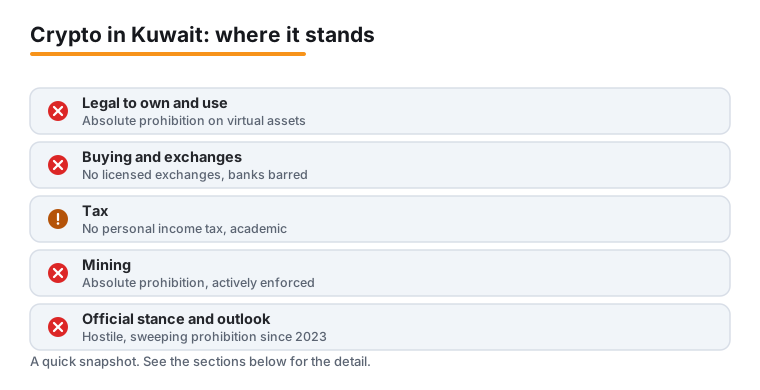
Cryptocurrency is effectively prohibited in Kuwait. There is no recognised legal status for Bitcoin or any other virtual asset, and no licensed pathway to use them. In July 2023 Kuwait's regulators issued a coordinated set of circulars announcing what they described as an absolute prohibition on dealing in virtual assets. This built on years of caution: the Central Bank had already warned that virtual currencies are not legal tender and barred local banks from processing crypto transactions.
In practical terms this means:
- Crypto cannot be used as a means of payment, and it is not recognised as a currency in the State of Kuwait.
- Dealing in virtual assets as a means of investment is prohibited through licensed channels.
- No person or company can be granted a licence to provide virtual asset services as a business in Kuwait.
- Mining is subject to an absolute prohibition (see the dedicated section below).
It is important to separate the law from technical reachability. International exchanges and apps may still be accessible over the internet from inside Kuwait, but using them to buy or sell crypto runs against the regulators' prohibition and carries legal and financial risk. Accessibility is not the same as legality. One narrow carve-out exists: securities and financial instruments that are already regulated by the Central Bank of Kuwait or the Capital Markets Authority are exempted from the prohibition.
Who regulates crypto in Kuwait?
Kuwait does not have a single dedicated crypto regulator. Instead, the prohibition was delivered jointly by several authorities, each covering the sector it supervises. The two most prominent are the Central Bank of Kuwait and the Capital Markets Authority.
| Authority | Role in the crypto prohibition |
|---|---|
| Central Bank of Kuwait (CBK) | Issued a circular on 17 July 2023 barring banks, finance companies and exchange companies from handling virtual assets; reiterates that virtual currencies are not legal tender. |
| Capital Markets Authority (CMA) | Issued Circular No. 10 of 2023 prohibiting the use of virtual assets for investment and the licensing of related activities, and requiring firms to warn clients of the risks. |
| Ministry of Commerce and Industry (MoCI) | Issued Ministerial Circular No. 1 of 2023 (17 July 2023) barring commercial activity and licensing connected to virtual assets. |
| Insurance Regulatory Unit (IRU) | Extended the prohibition to the insurance entities it supervises. |
You can verify each regulator directly: the Central Bank of Kuwait (cbk.gov.kw), the Capital Markets Authority (cma.gov.kw) and the Ministry of Commerce and Industry (moci.gov.kw). Because the framework is delivered through circulars rather than one consolidated statute, individual regulators can update the exact wording and scope, so always check their latest publications.
Key laws and frameworks
There is no standalone Kuwaiti crypto act. The prohibition rests on the July 2023 circulars, which themselves draw authority from existing law and international standards.
- The July 2023 circulars (CBK circular dated 17 July 2023, CMA Circular No. 10 of 2023, and MoCI Ministerial Circular No. 1 of 2023) set out the absolute prohibition on using virtual assets as payment, dealing in them as investment, licensing virtual asset service providers, and mining.
- Law No. 106 of 2013 on combating money laundering and the financing of terrorism. The MoCI circular expressly references penalties under Article 15 of this law for violations.
- FATF Recommendation 15 on virtual assets and virtual asset service providers (VASPs) is cited as part of the rationale, reflecting Kuwait's commitment to international anti-money-laundering standards.
- Decree-Law No. 76 of 2025 amended Law No. 106 of 2013, strengthening the legal framework for implementing Kuwait's international AML and counter-terrorism-financing obligations.
Officials have justified the prohibition by pointing to the highly speculative and volatile nature of virtual assets, the need to prevent money laundering and terrorist financing, the absence of legal-tender status, and alignment with bodies such as the Financial Action Task Force (FATF). Because the rules live in circulars rather than one consolidated law, always confirm the latest wording with the issuing regulator before relying on any summary, including this one.
Licensing and registration of exchanges and VASPs
There is no licensing or registration regime for crypto exchanges or virtual asset service providers (VASPs) in Kuwait, because providing such services is prohibited. The July 2023 circulars state plainly that no natural or legal person may be granted a licence to provide virtual asset services as a business in the State of Kuwait, whether for themselves or on behalf of others.
This is the opposite of the approach taken by some neighbouring Gulf jurisdictions, where dedicated frameworks license VASPs under anti-money-laundering supervision. In Kuwait there is simply no application to make. Local banks, finance companies and exchange companies are also barred from processing virtual asset transactions, which removes the banking rails that exchanges depend on. The only carve-out is for securities and financial instruments already regulated by the CBK or the CMA, which fall outside the virtual asset prohibition.
For the broader picture of how different countries license exchanges, see our overview of crypto regulation and the country pages under our regulation hub.
Crypto and Bitcoin tax in Kuwait
Kuwait does not levy personal income tax on individuals, whether citizens or residents. There is therefore no personal income tax, capital gains tax or wealth tax that specifically targets an individual's crypto gains. On paper this sounds attractive, but in practice it is largely academic: if you cannot lawfully buy, sell or hold crypto through a licensed channel in the first place, the question of a personal tax rate on those gains does not arise in a legitimate way.
Corporate income tax in Kuwait is a flat 15 percent under Decree No. 3 of 1955 and is imposed on foreign corporate bodies carrying on business or trade in Kuwait; companies wholly owned by Kuwaiti or other GCC nationals fall outside it, except to the extent of any foreign ownership. A separate Domestic Minimum Top-up Tax of 15 percent has applied from 1 January 2025 to multinational groups with consolidated global revenues of 750 million euros or more. Neither reaches crypto activity, because the prohibition is the controlling factor and a company cannot be licensed to run crypto operations domestically. This is general information, not tax advice. Tax treatment depends on your residency, the source of your income and your specific circumstances, and rules can change. Verify your position with a qualified Kuwaiti tax adviser rather than relying on claims that crypto is simply tax-free, and read our general primer on crypto taxes.
AML and KYC rules
Kuwait's anti-money-laundering and know-your-customer obligations flow from Law No. 106 of 2013 on combating money laundering and the financing of terrorism, as amended by Decree-Law No. 76 of 2025. Financial institutions and designated non-financial businesses and professions are required to perform customer due diligence (KYC), monitor transactions and report suspicious activity. These rules are built around FATF standards.
The crypto prohibition itself is framed as an AML measure: the July 2023 circulars cite FATF Recommendation 15 on virtual assets and VASPs, and violations are tied to penalties under Law No. 106 of 2013. Kuwait's mutual evaluation report found that Kuwait had only a basic understanding of money laundering risks and a low understanding of terrorist financing risks at a national level. On that basis the FATF added Kuwait to its list of jurisdictions under increased monitoring, the grey list, at its February 2026 plenary in Mexico, and decided at its June 2026 meeting to retain Kuwait on the list. MENAFATF's Second Enhanced Follow-up Report, issued in May 2026, upgraded seven of Kuwait's technical ratings to Largely Compliant, and Kuwait's third follow-up report is scheduled for the 43rd plenary meeting in November 2026. You can review the FATF assessment on the FATF Kuwait Mutual Evaluation page. Because crypto dealing is prohibited rather than licensed, there is no crypto-specific Travel Rule or VASP registration regime in Kuwait at this time.
Buying and using crypto in practice
There is no licensed, regulated way to buy or use cryptocurrency in Kuwait. Local banks and payment institutions are barred from processing crypto transactions, which removes the most common on-ramps used elsewhere, including card purchases and direct bank transfers to exchanges. No domestic exchange or brokerage can be licensed to serve Kuwaiti customers, and merchants cannot lawfully accept crypto as payment.
The prohibition is broad. It covers domestic and international centralised exchanges used to buy or sell crypto from within Kuwait, peer-to-peer (P2P) trading between individuals, and brokerage, advisory and investment services tied to virtual assets. Some global platforms may remain technically reachable, but on 20 May 2026 Kuwait's Court of Appeals issued its first final and unappealable ruling in cryptocurrency mining cases, affirming that trading and mining cryptocurrencies without obtaining a licence from the competent authorities constitutes a criminal offence for which the penalty may reach two years' imprisonment with hard labour. Anyone doing so would be operating outside the legal framework, with potential legal exposure and limited recourse if funds are lost, frozen or stolen. There is no consumer-protection regime, deposit guarantee or local dispute mechanism for crypto users. Holding crypto acquired in another jurisdiction does not create a licensed pathway to transact within Kuwait, so treat any cross-border situation carefully and seek professional advice.
Bitcoin mining in Kuwait
Bitcoin mining is subject to an absolute prohibition in Kuwait, and it is one of the most actively enforced parts of the policy. The July 2023 circulars expressly banned all virtual asset and virtual currency mining activities. The decisive practical factor has been electricity: mining is energy-intensive, Kuwaiti power is heavily subsidised, and large clandestine operations were straining the national grid.
In late April 2025 the government launched a wide-ranging crackdown on illegal mining, citing the risk of blackouts ahead of peak summer demand and a heatwave straining the grid. Reporting from that period described:
- A security operation led by the Ministry of Interior targeting homes suspected of being used for mining, with more than 60 individuals reported under investigation.
- Clusters of homes, notably in the southern sector of the Al-Wafrah area, where roughly 100 houses were said to be used for mining, some drawing up to about 20 times the normal household electricity load.
- The Ministry of Electricity disconnecting power to mining-linked properties, with reconnection requiring clearance from the Ministry of Interior.
- A reported fall of about 55 percent in energy consumption in Al-Wafrah after the enforcement operation.
The Interior Ministry described the activity as an unlawful exploitation of electrical power that could cause outages affecting residential, commercial and service areas and pose a threat to public safety.
The takeaway is unambiguous: mining crypto in Kuwait carries serious legal and financial risk, including investigation, equipment seizure and loss of electricity supply. Claims that Kuwait runs a sustainable or officially encouraged mining sector do not reflect the current reality of a prohibition backed by active enforcement.
Remittances and using crypto to send money
Kuwait has a very large expatriate workforce, so cross-border remittances are economically important, and some people look at Bitcoin or stablecoins as a potentially fast, low-fee way to send money home. However, using crypto for remittances in Kuwait runs directly into the prohibition. Dealing in virtual assets is barred and banks cannot process crypto-linked transactions, so there is no compliant on-ramp or off-ramp to convert between the dinar and crypto.
For lawful money transfers, Kuwait has a well-developed network of regulated banks and licensed exchange and money-transfer companies, which are supervised by the Central Bank of Kuwait. These channels cover most major remittance corridors and give senders consumer protections and recourse that crypto does not. Fees and rates vary, so it is worth comparing several licensed providers. Attempting crypto remittances despite the prohibition exposes both sender and recipient to legal risk and the irreversibility of on-chain transfers.
Recent developments (2025 to 2026)
Kuwait's stance has been consistent and, if anything, enforcement has tightened rather than loosened since the July 2023 prohibition.
- 2024: The FATF and MENAFATF published their Mutual Evaluation of Kuwait in October 2024, assessing the country's AML and counter-terrorism-financing framework.
- April to May 2025: A crackdown on illegal crypto mining, driven by pressure on the electricity grid during a heatwave, with the Ministry of Interior and Ministry of Electricity disconnecting power to mining sites and more than 60 people reported under investigation. Energy use in the Al-Wafrah area was reported to fall by about 55 percent after the operation. Kuwait also issued Decree-Law No. 76 of 2025 amending its AML law (Law No. 106 of 2013).
- CBDC vs private crypto: While private decentralised cryptocurrencies remain prohibited, the Central Bank of Kuwait has been studying the separate concept of a central bank digital currency (a potential digital Kuwaiti dinar), with no CBDC update published among the Central Bank of Kuwait's 2026 announcements or press releases, so the project should be treated as dormant in public terms rather than imminent. A state-issued CBDC would be very different from decentralised crypto and would not change the prohibition on private virtual assets.
As of August 2026 no crypto bill has been published in Kuwait, and the Central Bank of Kuwait's 2026 announcements and press releases contain no virtual asset item. Kuwait's elected National Assembly has been dissolved since 2024, so any change would most likely arrive as a decree-law published in the Official Gazette rather than as a parliamentary bill debated in public. The next dated checkpoint on the record is Kuwait's third enhanced follow-up report, scheduled for the 43rd plenary meeting in November 2026.
Consumer risks and protection
The principal risk in Kuwait is legal, not just market-related. Operating against a clear prohibition can expose individuals and businesses to investigation and penalties, and, in the case of mining, to equipment seizure and loss of electricity supply. On top of that sit the usual crypto risks: price volatility, scams, hacks and the irreversibility of on-chain transactions, all without any local safety net.
There is no consumer-protection regime, deposit insurance or local dispute-resolution mechanism for crypto in Kuwait. If a platform fails or you are defrauded, there is no licensed Kuwaiti body to turn to for recovery. If you want exposure to digital-asset themes, do so only through fully regulated channels and products lawfully available to you, and seek independent, licensed financial advice first. For payments, savings and remittances within Kuwait, use only lawful, supervised financial services.
Official sources and how to verify
Because crypto law in Kuwait is delivered through regulator circulars that can be updated, you should always confirm the current position against primary sources rather than secondary summaries. The most authoritative starting points are:
- Central Bank of Kuwait (cbk.gov.kw) for banking, exchange companies and the not-legal-tender position on virtual currencies.
- Capital Markets Authority (cma.gov.kw) for investment-related rules and board resolutions and circulars.
- Ministry of Commerce and Industry (moci.gov.kw) for the commercial-licensing prohibition (Ministerial Circular No. 1 of 2023).
- FATF Mutual Evaluation of Kuwait (2024) for the AML context.
This page is general information as of 2026 and is not legal advice. Laws and enforcement practices change, so always verify the current rules with the named official regulators, above all the Central Bank of Kuwait and the Capital Markets Authority, and consult a licensed Kuwaiti professional before acting. For more country guides, visit our regulation hub.
What is changing: Kuwait crypto status, August 2026
The prohibition itself has not moved. The July 2023 circulars remain the controlling instruments, and the Ministry of Commerce and Industry still publishes the full text of Ministerial Circular No. 1 of 2023 on virtual assets, including the absolute prohibition on mining and the carve-out for securities regulated by the Central Bank of Kuwait and the Capital Markets Authority, on its own website. The Central Bank of Kuwait published no virtual asset item among its 2026 press releases.
Four things did move between late 2025 and mid 2026, and none of them loosens the ban:
- The FATF added Kuwait to its grey list at the February 2026 plenary in Mexico and decided at its June 2026 meeting to retain Kuwait on the list.
- MENAFATF issued its Second Enhanced Follow-up Report on Kuwait in May 2026, upgrading seven technical ratings to Largely Compliant, with a third follow-up report due at the 43rd plenary meeting in November 2026.
- Decree-Law No. 162 of 2025 criminalised unlicensed money exchange and informal remittance.
- On 20 May 2026 the Court of Appeals issued its first final and unappealable ruling in cryptocurrency mining cases.
There is still no crypto-specific statute in Kuwait, no licensing pathway and no published draft law.
Kuwait on the FATF grey list since February 2026
At its February 2026 plenary meeting in Mexico the Financial Action Task Force added Kuwait to its list of jurisdictions under increased monitoring, commonly called the grey list. Kuwait made a high-level political commitment that month to work with the FATF and MENAFATF on an action plan, and the FATF decided at its June 2026 meeting to retain Kuwait on the list.
The underlying mutual evaluation report found that Kuwait had only a basic understanding of money laundering risks and a low understanding of terrorist financing risks at a national level. The reported action plan commitments centre on tighter oversight of high-risk sectors, specifically real estate agents and dealers in gold and other precious metals. The reporting does not mention virtual assets among them.
What this means in practice:
- Grey listing is not a sanction, and inclusion on the list does not automatically trigger enhanced due diligence requirements. It acts as a signal for other jurisdictions and institutions to take a risk-based approach in dealings with Kuwait.
- Expect more documentation, stricter onboarding and slower processing on cross-border transfers involving Kuwait, from banks and licensed exchange companies alike.
- Countries that follow through on reforms typically exit the list within two to three years. The UAE was placed on the grey list in March 2022 and removed in February 2024.
- Kuwait has since made measurable progress. MENAFATF's Second Enhanced Follow-up Report of May 2026 upgraded seven recommendations to Largely Compliant, covering targeted financial sanctions related to terrorism, proliferation financing, oversight of non-profit organisations, transparency of legal entities, supervision of financial institutions, oversight of designated non-financial businesses and professions, and international legal cooperation.
For a crypto reader the practical takeaway is directional: Kuwait is under international pressure to tighten control over financial flows, not to open a licensing window.
Kuwait's courts have now ruled on crypto mining
Until late 2025 the prohibition was enforced administratively, through power disconnections and investigations. It has since produced criminal judgments with named penalties.
- 22 November 2025, Criminal Court. The court acquitted a Kuwaiti citizen of the charge of directly engaging in activity that can harm the interests of the country, finding no criminal intent and no danger, but fined him KD 1,000 for two violations: operating a cryptocurrency mining project without a licence, and using residential electricity to run it. The judgment cited energy consumption regulations under Law 43 of 1964.
- 20 May 2026, Court of Appeals. In its first final and unappealable ruling in cryptocurrency mining cases, the court affirmed that trading and mining cryptocurrencies without obtaining a licence from the competent authorities constitutes a criminal offence, and that the penalty may reach two years' imprisonment with hard labour. It imposed fines of KD 1,000 on each defendant and ordered confiscation of the seized mining equipment, computers and receivers. It acquitted the defendants of the charge of harming national security, and acquitted one defendant of all charges.
Two points matter for anyone assessing risk. The maximum exposure stated by the court is two years with hard labour plus confiscation, not merely a utility disconnection. And the ruling covers trading as well as mining, so it is not limited to people running rigs.
Decree-Law No. 162 of 2025: unlicensed money exchange is now a crime
In December 2025 Kuwait issued Decree-Law No. 162 of 2025, adding a new Article 12 bis to the Law Regulating Commercial Shop Licences, Law No. 111 of 2013. It criminalises buying, selling, exchanging or transferring local or foreign currencies, inside or outside Kuwait, without a licence.
| Natural persons | Imprisonment of up to six months, a fine of up to KD 3,000, or both |
| Private legal entities | Fine of KD 5,000 to KD 20,000, with possible closure of the establishment |
| Repeat or commercial offences | Closure of the establishment or its branches, confiscation of the funds and tools used, and publication of the court judgment in the Official Gazette |
| Prosecuting authority | The Public Prosecution has jurisdiction to investigate and prosecute offences under the article |
| Commencement | One month after publication in the Official Gazette |
Reporting frames the measure as an attack on the alternative remittance system, the informal broker networks that receive money in Kuwait and deliver its equivalent abroad through unlicensed networks, outside the official financial system.
Be clear about the limit of this law: neither the article as reported nor the coverage of it mentions virtual assets. It is about fiat currency and hawala. Its relevance to crypto is indirect, because the informal cash and transfer channels that peer to peer trading typically relies on for settlement are now criminal in their own right, in addition to the 2023 virtual asset prohibition that already covers the trade.
What is in the legislative pipeline, and what is not
There is no published Kuwaiti crypto bill, no public consultation on a virtual asset framework, and no announced timetable for one. That is the honest state of the pipeline in August 2026. Three things shape what would have to happen for it to change.
- There is no sitting parliament to pass one. Kuwait's elected National Assembly was dissolved in 2024 and has not been restored, as recorded in Freedom House's 2026 country report. In its absence, new law has been arriving as decree-laws published in the Official Gazette. Decree-Law No. 162 of 2025 is an example of exactly that route, and any crypto framework would most likely appear the same way, with little or no public debate beforehand.
- The only public push to regulate rather than ban came from outside government. At a May 2025 symposium titled The Future of the Digital Economy in Kuwait: Between Investment and Legislation, co-hosted by the Kuwait Economic Society, the Kuwait Lawyers Association, the Economic Platform and the Chairman's Club, speakers called for a clear legal framework for crypto mining covering licensing, electricity usage controls, taxation and oversight, a law defining crypto assets, a regulatory authority for digital assets, and expansion of the anti-money laundering law to include crypto. No ministry, the Central Bank of Kuwait or the Capital Markets Authority has adopted any of it. Treat it as advocacy, not policy.
- The pressure is running the other way. Kuwait is on the FATF grey list and is working through an action plan, with a third enhanced follow-up report scheduled for the 43rd plenary meeting in November 2026. Governments in that position generally tighten controls on unsupervised value transfer rather than open new licensing categories.
The next dated checkpoint on the public record is that November 2026 follow-up report. Nothing between now and then is scheduled to touch the virtual asset prohibition.
The tax that actually applies in Kuwait
Crypto gains have no Kuwaiti tax treatment of their own because the activity is prohibited, so there is no licensed way to realise them. The rules that do apply to money in Kuwait are these.
| Personal income tax | None. There is no personal income tax imposed on individuals in Kuwait |
| Corporate income tax | Flat 15 percent, under Decree No. 3 of 1955, imposed on foreign corporate bodies carrying on business or trade in Kuwait. Companies wholly owned by Kuwaiti or other GCC nationals are outside it, except to the extent of any foreign ownership |
| Tax retention | 5 percent retention requirement on contract payments |
| Domestic Minimum Top-up Tax | 15 percent minimum effective rate, introduced by Decree by Law No. 157 of 2024 and applying from 1 January 2025, for multinational groups with consolidated global revenues of 750 million euros or more in at least two of the four financial years immediately preceding. In-scope entities had nine months from the effective date, until 30 September 2025, to register |
Rates and scope are set out in PwC's Kuwait corporate tax summary. The practical conclusion for a reader is unchanged but should be stated plainly: Kuwait is a zero personal income tax jurisdiction, and that is irrelevant to crypto, because the prohibition removes the licensed channel in which a gain could lawfully be realised in the first place. This is general information, not tax advice.
Frequently asked questions
Is cryptocurrency legal in Kuwait in 2026?
No. Kuwait maintains a broad prohibition on virtual assets covering payments, investment, dealing, the licensing of service providers and mining, and banks are barred from processing crypto transactions. Cryptocurrencies are not legal tender, and there is no licensed way to use them locally. The prohibition stems from coordinated regulator circulars issued in July 2023. Confirm the latest position with the Central Bank of Kuwait and the Capital Markets Authority.
Who regulates cryptocurrency in Kuwait?
There is no single dedicated crypto regulator. The prohibition was issued jointly by the Central Bank of Kuwait (cbk.gov.kw), the Capital Markets Authority (cma.gov.kw), the Ministry of Commerce and Industry (moci.gov.kw) and the Insurance Regulatory Unit, each covering the sector it supervises. The CBK and CMA are the most relevant for individuals.
Can I use international exchanges or P2P trading from Kuwait?
Some global platforms may remain technically reachable, but using them, or trading peer-to-peer, to buy or sell crypto from within Kuwait conflicts with the regulators' prohibition. Technical accessibility does not make the activity legal, and there is no consumer protection or local recourse if something goes wrong.
Is Bitcoin mining allowed in Kuwait?
No. Mining is subject to an absolute prohibition under the July 2023 circulars and has been actively targeted. A 2025 crackdown, driven largely by strain on the electricity grid, involved the Ministry of Interior and Ministry of Electricity disconnecting power to suspected mining sites and questioning those involved. Mining carries serious legal and financial risk.
Are crypto gains taxed in Kuwait?
Kuwait does not impose personal income tax on individuals, so there is no personal tax specifically on crypto gains. In practice this is largely academic, because the activity itself is prohibited and there is no licensed way to realise such gains locally. This is general information, not tax advice; confirm your situation with a qualified Kuwaiti adviser.
What is the safest legal way to send money abroad from Kuwait?
Use Kuwait's regulated banks and licensed exchange and money-transfer companies, which are supervised by the Central Bank of Kuwait. These channels cover most remittance corridors and offer protections and recourse that crypto transfers do not. Crypto-based remittances run against the prohibition and expose both sender and recipient to legal and financial risk.
What happened in Kuwait's 2025 crypto mining crackdown?
In late April 2025, during a heatwave that strained the power grid, the Ministry of Interior ran a security operation against homes suspected of hosting mining rigs, with more than 60 people reported under investigation. Attention centred on the Al-Wafrah area, where about 100 houses were said to be used for mining, some drawing up to roughly 20 times the normal household load. The Ministry of Electricity disconnected power to mining-linked properties, and energy use in Al-Wafrah was reported to fall by about 55 percent afterwards. Reconnection required clearance from the Interior Ministry.
Is Kuwait planning a digital currency or CBDC?
The Central Bank of Kuwait has been studying a central bank digital currency, a potential digital Kuwaiti dinar, with reporting describing the work as at a feasibility stage and moving more slowly than in some neighbouring Gulf states. A CBDC would be a state-issued digital form of the dinar and is very different from decentralised crypto such as Bitcoin. It would not change the prohibition on private virtual assets. There is no published indication of an imminent reversal of that prohibition.
Is Kuwait on the FATF grey list?
Yes. The Financial Action Task Force added Kuwait to its list of jurisdictions under increased monitoring, the grey list, at its February 2026 plenary meeting in Mexico, and decided at its June 2026 meeting to retain Kuwait on the list. Grey listing is not a sanction and does not automatically trigger enhanced due diligence requirements, but it acts as a signal for other jurisdictions and institutions to take a risk-based approach, which usually means more documentation and slower cross-border transfers. Kuwait is working through an action plan whose reported commitments focus on high-risk sectors such as real estate agents and dealers in gold and other precious metals. Countries that follow through on reforms typically exit the list within two to three years.
Is Kuwait planning a crypto law or a licensing regime?
There is no published crypto bill, no public consultation and no announced timetable as of August 2026. Kuwait's elected National Assembly has been dissolved since 2024, so any new law would most likely be issued as a decree-law and published in the Official Gazette, as Decree-Law No. 162 of 2025 was, rather than debated in parliament. The only public push to regulate rather than ban crypto came from a May 2025 symposium of economists and lawyers, who called for a legal framework covering licensing, electricity usage controls, taxation and oversight of mining, a law defining crypto assets, a regulatory authority for digital assets, and expansion of the anti-money laundering law to include crypto. No government body has adopted those proposals.
What is the actual penalty for crypto mining or trading in Kuwait?
On 20 May 2026 the Court of Appeals issued Kuwait's first final and unappealable ruling in cryptocurrency mining cases, affirming that trading and mining cryptocurrencies without obtaining a licence from the competent authorities constitutes a criminal offence and that the penalty may reach two years of imprisonment with hard labour. In that case the court imposed fines of KD 1,000 on each defendant and ordered confiscation of the seized mining equipment, computers and receivers, while acquitting them of harming national security and acquitting one defendant of all charges. In an earlier case decided on 22 November 2025 the Criminal Court fined a citizen KD 1,000 for operating an unlicensed mining project and using residential electricity to run it, while acquitting him of engaging in activity that can harm the interests of the country.
Does Decree-Law No. 162 of 2025 apply to cryptocurrency?
Not directly. Decree-Law No. 162 of 2025 added Article 12 bis to the Law Regulating Commercial Shop Licences, Law No. 111 of 2013, and criminalises buying, selling, exchanging or transferring local or foreign currencies without a licence, including informal hawala remittance networks. Penalties are up to six months in prison and a fine of up to KD 3,000 for individuals, and KD 5,000 to KD 20,000 plus possible closure for companies. Neither the article as reported nor the coverage of it mentions virtual assets. It matters to crypto users indirectly, because the informal cash and transfer channels often used to settle peer to peer trades are now criminal in their own right, on top of the separate 2023 virtual asset prohibition.
Facts reviewed: 13 August 2026. Page updated: 13 August 2026.