Home › Crypto Regulation › Israel
Bitcoin & Cryptocurrency Regulation in Israel
Quick answer — Israel, 2026
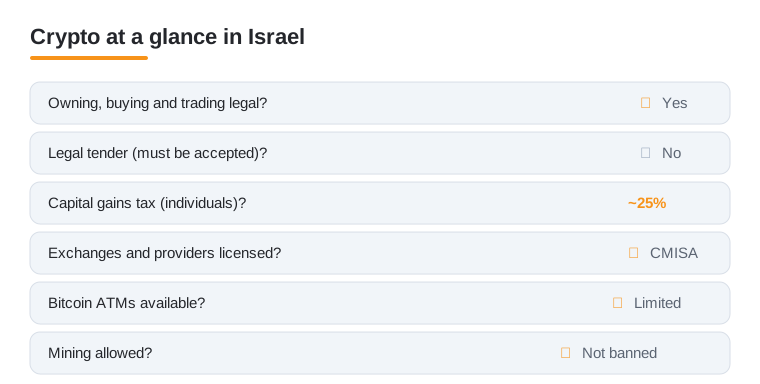
- Legal: owning, buying, selling and trading crypto is legal, but it is not legal tender.
- Taxed: yes; investors pay 25 percent capital gains tax, rising to as much as 30 percent once the 3 percent and 2 percent surtaxes on income above NIS 721,560 apply, while business activity is taxed as ordinary income at rates reaching 50 percent.
- How to buy: use licensed local exchanges, regulated investment accounts or large international platforms, completing KYC.
Israel is one of the most technologically advanced economies in the Middle East, with a deep blockchain and digital-asset industry. Cryptocurrency is legal to own, buy, sell and trade in Israel, but it is not legal tender, and it sits inside a framework that has tightened steadily. Rather than one consolidated crypto statute, Israel governs digital assets through existing laws, regulator guidance and anti-money-laundering rules, with several authorities sharing oversight. In mid 2026 that framework moved fast: the Ministry of Finance published a stablecoin licensing bill on 29 June 2026, the Bank of Israel put a liberalising amendment to banking Directive 411 out for comment on 14 July 2026, the Capital Market, Insurance and Savings Authority signed binding capital and client asset safekeeping circulars in the week beginning 19 July 2026, and on 28 July 2026 it published a draft circular setting which coins licensed Israeli platforms may sell.
This page explains how Bitcoin and other cryptocurrencies are treated in Israel as of 2026: their legal status, the regulators, the key laws and frameworks, licensing and registration of service providers, taxation, AML and KYC duties, buying and using crypto in practice, mining, the latest developments, consumer risks, and how to verify everything against official sources. The information here is general and current as of 2026; it is NOT legal, tax or financial advice, and you should confirm anything important with the named official regulator or a qualified Israeli professional before acting. For wider context see our crypto regulation guide and the country regulation hub.
On this page: Legal status · Who regulates it · Taxes · How to buy · Mining
Is Bitcoin and crypto legal in Israel?
Yes. Owning, buying, selling, holding and trading Bitcoin and other cryptocurrencies is legal in Israel for individuals and businesses. There is no prohibition on private use of digital assets, and a substantial domestic industry of exchanges, custodians, blockchain startups and institutional participants operates openly.
What crypto is not is legal tender. Only the new shekel (ILS), issued by the Bank of Israel, has that status. Merchants may accept Bitcoin if they choose, but no one is obliged to take it in settlement of a debt. Instead, Israeli authorities classify a virtual currency as a type of financial asset rather than as money or foreign currency. That classification, set out in financial-services and tax rules, shapes how the assets are taxed, how service providers are supervised and which consumer-protection duties apply.
The practical takeaway: using crypto is permitted, but it is treated as an investment asset and a regulated financial activity, not as everyday currency.
Who regulates crypto in Israel
Israel does not have a single crypto regulator. Oversight is split among several bodies, each responsible for a different slice of activity:
- Israel Securities Authority (ISA): supervises digital assets that behave like securities and the structure of regulated trading. The ISA has driven much of the work to bring trading, custody and investment products into a clearer framework, and it has proposed amendments to the Securities Law that would classify tokens by category using tests similar to the US Howey test.
- Capital Market, Insurance and Savings Authority (CMISA, also called the Capital Market Authority or CMA): licenses and supervises non-bank financial-services providers, including firms that hold, safekeep, manage, transfer or exchange financial assets such as crypto.
- Bank of Israel: the central bank, responsible for the shekel and financial stability, the body that supervises banks dealing with crypto-linked funds, and the team researching a possible digital shekel.
- Israel Tax Authority (ITA): sets and enforces how crypto gains and income are taxed.
- Israel Money Laundering and Terror Financing Prohibition Authority (IMPA): receives the reporting that crypto service providers are required to file under anti-money-laundering rules.
You can confirm each authority's current position on its official site, listed in the sources section below.
Key laws and frameworks
A recurring theme is the use of existing financial law rather than crypto-specific carve-outs:
- The Supervision of Financial Services (Regulated Financial Services) Law classifies a virtual currency as a financial asset and requires firms that provide services in financial assets to hold a licence from CMISA. Crypto was brought within this regime from 2016 onward.
- The Prohibition on Money Laundering Law and the dedicated AML and counter-terrorist-financing orders impose customer identification (KYC), record-keeping and suspicious-activity reporting on crypto service providers.
- The Regulation of Payment Services and Payment Initiation Law, which came into effect with associated rules updated through 2024 and 2025, expanded oversight of payment-service providers and payment initiators, with the ISA taking a central supervisory role.
- Tax treatment flows from the Income Tax Ordinance, with draft legislation introduced in late 2024 aiming to write the treatment of digital assets directly into the tax code.
Because several of these measures are recent, temporary or still evolving, the exact requirements for a given business can shift. Anyone operating in the space should check the current position with the ISA, CMISA and a regulatory lawyer. For a plain-language overview of how rules differ between countries, see our crypto regulation explainer.
Licensing and registration of exchanges and service providers
Entities that provide services for holding, safekeeping, managing, transferring or exchanging financial assets, including cryptocurrencies, are generally required to obtain a licence from the Capital Market, Insurance and Savings Authority (CMISA). The licensing process sets financial and operational standards. That NIS 1 million equity floor has been superseded. Under the additional equity capital circular signed in the week beginning 19 July 2026, a licensee that does not offer custody must hold total equity of at least NIS 2 million, a licensee offering custody must hold at least NIS 2.5 million, and custodians must hold additional capital equal to 0.25 percent of the client assets in their custody as measured on 31 December of the previous year. That capital must sit in shekels in cash and cash equivalents, deposits at banking corporations or short term government bonds, free of any lien, so it cannot be held in crypto. The requirement applies six months after publication, so from around January 2027.
Separately, in August 2024 the ISA approved an amendment letting non-bank members of the Tel Aviv Stock Exchange, such as brokerage and investment firms, offer crypto trading and custody to clients. This is a controlled, walled-garden approach: customers can buy, sell and hold an approved set of assets, initially limited to well-established coins such as Bitcoin and Ethereum, through regulated investment-account providers, with transactions routed through licensed exchanges or custodians. The ISA also approved the launch of several Bitcoin mutual funds at the end of 2024, giving Israeli investors regulated, exchange-traded exposure.
The July 2026 circulars set the current figures: NIS 2 million equity without custody, NIS 2.5 million with custody, plus 0.25 percent of assets under custody, in force six months after publication, so around January 2027. The draft listing circular published on 28 July 2026 is still open for comment, with Israeli trade press reporting a 3 September 2026 deadline, so the coin eligibility rules are not yet final.
Crypto and Bitcoin tax in Israel
Crypto is taxable in Israel. Because the Israel Tax Authority treats a digital asset as property rather than as currency, disposing of it is generally a taxable event. Disposal is broad: selling crypto for shekels or another fiat currency, swapping one token for another, and using crypto to pay for goods or services can all trigger a tax calculation based on the change in value since you acquired the asset. Moving coins between your own wallets is generally not a disposal.
In general terms:
- Individual investors typically face capital gains tax on profits when they dispose of crypto held as an investment. The headline rate on the real capital gain for an individual is 25 percent. On top of that, a 3 percent surtax applies to annual taxable income from all sources above NIS 721,560 in 2026, and since 2025 a further 2 percent surtax applies to income from capital sources, which includes capital gains, above that same threshold. A high earning individual can therefore pay up to 30 percent on a crypto gain. These are Israel's general capital gains rules rather than crypto specific guidance, so confirm your own position with the Israel Tax Authority or a professional.
- Frequent, business-like or professional activity, such as running a trading operation or a crypto business, may instead be taxed as ordinary income, which can carry different rates. Companies face corporate tax on disposals.
- Mining and staking rewards, and crypto received as payment for work, are generally treated as income at receipt, with a separate gain or loss calculated when the coins are later sold.
- VAT can be relevant for businesses depending on how they use crypto, even where simple investment gains for individuals are not subject to VAT.
Israel's tax system distinguishes investors from dealers, and the line is fact-specific, so confirm rates and your own status with the ITA or a professional rather than relying on a headline figure. The ITA expects accurate reporting and has pursued information from exchanges and taxpayers; in August 2025 it opened a Voluntary Disclosure Procedure (a temporary order running to 31 August 2026) that for the first time expressly covers crypto and requires applicants to disclose wallet addresses and balances. Holding assets above certain values can also trigger an annual reporting obligation, so check with the ITA or a professional whether your holdings require you to file a return. Keep detailed records of every transaction: dates, amounts, shekel values, counterparties and fees. See our crypto tax guide for general principles. This is general information, not tax advice.
AML and KYC rules
Anti-money-laundering and counter-terrorist-financing duties are central to Israel's approach. Crypto service providers fall under the Prohibition on Money Laundering Law and dedicated AML orders, which require customer due diligence and identification (KYC), ongoing monitoring, record-keeping, and reporting of routine and suspicious activity to IMPA. The order applicable to providers of services in crypto-related financial assets is detailed: it has, for example, required keeping records of the IP addresses and public keys used by customers.
Israel also applies the international Travel Rule. For crypto transfers above a set threshold, a service provider is expected to collect and pass on identifying information about the sender and the recipient, such as names, identification numbers and account or wallet details, alongside the usual customer checks. Exact thresholds and details can change, so a provider should confirm the current rule with the regulator.
Banks are also drawn in. The Bank of Israel's Banking Supervision Department has directed banks to take a risk-based, case-by-case approach to funds linked to virtual currencies rather than issuing blanket refusals. Where funds originate from a licensed virtual-asset service provider and the customer can document their source and tax treatment, banks are expected to perform due diligence and process the transfer. In practice some friction can still arise, so keep clear evidence of where your crypto came from.
Buying and using crypto in practice
Israelis can buy crypto through licensed local exchanges and brokers, through large international platforms that serve Israeli users, through regulated investment-account providers under the walled-garden model, and via peer-to-peer trades. Whatever the venue, expect identity verification: AML and KYC rules mean reputable services will ask for government ID and other documentation before allowing meaningful deposits, trading or withdrawals.
A typical path looks like this: choose a reputable, appropriately licensed platform and compare fees, security and supported assets; complete KYC; fund the account with shekels and keep proof of the source of funds; place a market or limit order after reviewing the fees and spread; move meaningful balances to a wallet you control (a hardware wallet for larger amounts) and safeguard your recovery phrase; and log every transaction in shekels for tax. Start small while you learn the process, and never share private keys or seed phrases with anyone.
Bitcoin ATMs and mining in Israel
Bitcoin ATMs (BTMs) let people buy, and sometimes sell, crypto for cash at a physical kiosk. A limited number have operated in cities such as Tel Aviv, run by private operators. They sit squarely within AML rules, so operators are expected to be licensed and to apply identity checks, with verification often increasing with transaction size. Convenience comes at a price: ATM fees and spreads are frequently much higher than on an exchange, and the paper trail is weaker for tax purposes.
Mining is not banned, but it is not a natural fit for Israel. Large-scale proof-of-work mining is electricity-intensive, and Israel's relatively high power costs and limited cheap surplus energy make industrial mining hard to run profitably compared with regions that have abundant low-cost power. Israel's real strength in the crypto economy lies in software, security, blockchain infrastructure and startups, where its technology talent is a genuine advantage. Anyone mining commercially should consider that rewards are generally taxed as income, plus any business-licensing, electricity-contract and environmental obligations. Rules and incentives here are still developing.
Recent developments in 2025 and 2026
Israel's framework moved noticeably in 2025 and into 2026:
- The National Crypto Strategy Committee, chaired by former Bank Hapoalim CEO Arik Pinto, presented an interim report to the Knesset in 2025 built around five pillars, including a single unified regulator, clear token-issuance rules and integration of banking with digital-asset activity. Those steps arrived in mid 2026, but as regulator circulars and a stablecoin bill rather than as the single unified crypto statute the committee proposed, and no unified regulator has been created. The committee, drawing on KPMG research, suggested the changes could add up to about 120 billion US dollars to the economy over the next decade and create tens of thousands of jobs.
- The Bank of Israel sharpened its stance on stablecoins. In December 2025 Governor Amir Yaron said stablecoins had become systemically significant and could no longer be treated as marginal, pointing to their scale and concentration, and outlining priorities such as full one-to-one reserve backing and liquid reserves. That policy turned into action on 28 April 2026, when the Capital Market, Insurance and Savings Authority (CMISA) approved Israel's first regulated shekel-pegged stablecoin, BILS, issued by Bits of Gold after a roughly two-year sandbox pilot. BILS is built on Solana, uses Fireblocks custody, is audited by EY, and is backed one-to-one by shekels held in segregated accounts at Israeli banks. It launched in a restricted, fixed-scale format rather than fully public, under close supervision.
- The digital shekel project, led by Yoav Soffer, published a 2026 roadmap describing the central bank digital currency as central bank money for everything, with official recommendations signalled around year-end 2025.
- The Israel Tax Authority opened its crypto-inclusive Voluntary Disclosure Procedure in August 2025, removing the previous anonymity option; uptake was low, with the authority reporting only tens of filings.
Stage matters here. The two Capital Market Authority circulars on equity capital and client asset safekeeping are binding and take effect around January 2027. The listing circular published on 28 July 2026 and the Bank of Israel Directive 411 amendment published on 14 July 2026 are drafts open for public comment. The stablecoin bill is a Ministry of Finance memorandum that has not yet reached the Knesset. Amendment No. 18 to the Supervision of Financial Services (Regulated Financial Services) Law was tabled in the Knesset for first reading on 11 May 2026. Always check the current status with the relevant authority.
Consumer risks and protection
The headline risks in Israel are the same as elsewhere, with some local texture. Market risk is significant: crypto prices are volatile and you can lose money quickly. Regulatory risk is live because the framework is still being assembled from existing laws and new measures, some temporary, so obligations can change. Tax risk is real given the ITA's focus on reporting and the investor-versus-dealer distinction. Banking friction can complicate moving money even though guidance now discourages blanket refusals. And the usual security and fraud risks, including hacks, scams, lost keys and failed platforms, remain ever-present.
To protect yourself: prefer licensed or clearly compliant platforms; verify a provider's licence status with CMISA or the ISA where relevant; keep most holdings in a wallet you control; enable strong security and beware of impersonation and investment scams; and keep thorough records for tax. Consumer protections exist mainly through the AML and licensing regimes rather than a blanket deposit guarantee, so do your own due diligence and consider a licensed Israeli adviser before committing significant sums.
Official sources and how to verify
Crypto rules in Israel evolve, so always confirm the current position with the responsible authority before acting. The primary official sources are:
- Israel Securities Authority (ISA), for securities-like tokens, regulated trading and custody, and proposed Securities Law amendments.
- Bank of Israel, for the shekel, banking supervision of crypto-linked funds, stablecoin policy and the digital shekel.
- Capital Market, Insurance and Savings Authority (CMISA), for licensing and supervision of financial-asset service providers.
- Israel Tax Authority digital-assets information, for how crypto income and gains are taxed and reported.
For background and to compare jurisdictions, see our crypto regulation guide and the regulation hub. This article is general information current as of 2026 and is NOT legal, tax or financial advice; verify anything important with the named official regulator or a qualified Israeli professional.
What is changing in August 2026
This page was last fact checked on 30 June 2026. In the five weeks that followed, five separate Israeli crypto measures landed across four dates, and they pull in the same direction: bring crypto inside the supervised financial system rather than keep it at arm's length.
- 29 June 2026. The Ministry of Finance published the Draft Bill for the Supervision of Financial Services (Issuance of Stablecoins), 2026 for public comment, Israel's first attempt to regulate stablecoin issuance in dedicated primary legislation (Herzog Fox and Neeman, Barnea Jaffa Lande).
- 14 July 2026. The Bank of Israel Banking Supervision Department put a draft amendment to Proper Conduct of Banking Business Directive 411 out for public comment. It would scrap the NIS 100,000 trigger on crypto sourced deposits, ban blanket refusals and stop banks tracing a coin's entire history (Crypto Jungle).
- Week beginning Sunday 19 July 2026. The Capital Market, Insurance and Savings Authority signed two binding circulars, one on additional equity capital for digital asset licensees and one on safekeeping client financial assets. Both take effect six months after publication, so around January 2027 (Jerusalem Post, Walla Finance, Crypto Briefing).
- 28 July 2026. The same Authority published a draft circular deciding, for the first time, which digital assets a licensed Israeli platform may offer (Calcalist). Crypto Jungle reports that comments close on 3 September 2026.
Eli Tobul, Senior Deputy Commissioner of the Capital Market Authority, put it this way: "We are moving from individual processes of approving each asset to broad and clear rules." (Calcalist, 1 August 2026). Crypto Jungle reports that nine companies currently hold a licence to provide crypto services in Israel. What has not happened: the single unified crypto regulator recommended by the National Crypto Strategy Committee has not been created, and no consolidated crypto statute has passed the Knesset.
Israeli crypto legislation: adopted, pending and in consultation
Stage matters more than headline. Two of these measures are binding and already have a compliance clock running. Three are drafts that could still change. One is a bill sitting in the Knesset.
| Measure | Type and stage | Date | What it does | When it bites |
|---|---|---|---|---|
| Additional equity capital circular for digital asset licensees (CMISA) | Binding circular, adopted | Signed week beginning 19 July 2026 | NIS 2 million equity for a licensee that does not offer custody; NIS 2.5 million for a custodian, plus 0.25 percent of client assets in custody measured at 31 December of the prior year. Capital must be held in shekels in cash, bank deposits or short term government bonds, free of liens, so it cannot sit in crypto. | Six months after publication, around January 2027 |
| Safekeeping of client financial assets circular (CMISA) | Binding circular, adopted | Signed week beginning 19 July 2026 | Client fiat and crypto held in trust in a dedicated separate client account beyond the reach of company creditors in insolvency. Dedicated client asset officer who is not a director, quarterly independent accountant controls, multi signature approval for wallet transfers, daily register, free online personal area, guaranteed withdrawal capability, foreign custodians only if FCA or MiCA supervised. | Six months after publication, around January 2027 |
| Draft listing circular for digital assets (CMISA) | Draft circular, public consultation | Published 28 July 2026 | Coin eligibility for regulated Israeli platforms: 500 million US dollar market cap and global top 50 for six consecutive months, listed at five or more licensed venues in the EU or New York State, no holder above 15 percent of supply, top ten holders below 50 percent. Privacy coins and NFTs excluded. Israeli licensed stablecoins exempt from the size tests. | Trade press reports comments close 3 September 2026; final text to follow |
| Draft Bill for the Supervision of Financial Services (Issuance of Stablecoins), 2026 | Ministry of Finance legislative memorandum, out for comment | Published 29 June 2026 | Licence required to issue a stablecoin, unlicensed issuance a criminal offence. Backing at no less than 100 percent of liabilities in segregated reserves, fee free prompt redemption at reference asset value, board of at least three, CEO, auditor and compliance officer, Hebrew disclosure document 30 days before issuance. Captures foreign issuers that target Israeli clients. | Not yet a Knesset bill; no enactment date published |
| Supervision of Financial Services (Regulated Financial Services) Law (Amendment No. 18), 2026 | Government bill, tabled for first reading | 11 May 2026 | Extended, tailored Israeli licence for foreign providers of financial asset services, credit provision and credit mediation systems where the home regime is an adequate substitute, with possible exemption from the governance, control permit and holding permit chapters. | Awaiting further readings; no date set |
| Draft amendment to Proper Conduct of Banking Business Directive 411 (Bank of Israel) | Draft directive, public consultation | Published 14 July 2026 | Removes the NIS 100,000 threshold and the external expert opinion requirement, bans blanket refusals, treats funds that passed through a CMISA licensee as risk reducing, ends full chain tracing, drops the automatic high risk label on coin issuances and UTXO based transactions. | Draft; not yet final and no deadline published |
| Israel Tax Authority Voluntary Disclosure Procedure (temporary order) | Regulator procedure, in force | Opened August 2025 | First voluntary disclosure track expressly covering crypto. Applicants must disclose wallet addresses and balances, with no anonymous route. | Closes 31 August 2026 |
What the new Capital Market Authority rules mean if you hold or buy crypto in Israel
The July 2026 circulars change the practical experience of using a licensed Israeli platform in three concrete ways.
- Your coins get legally separated from the firm's. From around January 2027, a licensee must hold client fiat and client crypto in trust in a dedicated client account, must not use them for anything other than providing the custody service, and must disclose the arrangement to third parties so creditors cannot recover from those assets if the company enters insolvency. Firms must appoint an officer responsible for safeguarding client assets who is not a board member, and custody providers must have an independent accountant run quarterly controls (Jerusalem Post, Walla Finance).
- The coin menu is set to widen, then get policed. Nir Hirschmann, CEO of the Crypto Companies Forum in Israel, says the new rules allow licensed companies to expand their offerings to the 50 largest currencies in the world, "compared with only eight or nine currencies offered so far" (Calcalist). The trade off is a hard exclusion of anonymity coins such as Monero and Zcash, and of NFTs, from regulated Israeli venues.
- Delisting comes with notice. Under the draft, licensees must monitor listed coins quarterly. A coin that stops meeting the criteria must be removed from purchase within three days, and holders get 30 days notice first so they can sell or transfer (Crypto Jungle, Calcalist).
Adding a coin will also require sign off from the licensee's risk manager, cyber protection manager and AML officer, board approval of the listing policy at least annually, and 60 days advance notice to the Authority before launch. The listing rules are still a draft, so treat them as the likely direction rather than settled law.
Getting crypto money into an Israeli bank account
Banking access, not legality, has been the real obstacle in Israel. Proper Conduct of Banking Business Directive 411 governs how banks handle funds linked to virtual assets. In practice banks applied a NIS 100,000 trigger, demanded external expert opinions on the source of funds, and traced a coin's full transaction history.
On 14 July 2026 the Banking Supervision Department published a draft amendment to Directive 411 for public comment. If adopted it would ban blanket refusal policies and require individual assessment of each customer, remove the NIS 100,000 ceiling, cancel the external expert opinion requirement, require banks to examine their own customer rather than the whole preceding chain, and define activity that passed through a CMISA licensed entity as a risk reducing factor. Only coins that structurally conceal the user's identity, such as Monero, would be classed as high risk, and Bitcoin and Ethereum would not meet that definition. The automatic high risk label on coin issuances and on UTXO based transactions, the model Bitcoin uses, would be removed (Crypto Jungle).
Figures published alongside the draft by the Crypto Companies Forum give a sense of the scale of the problem: about 95 percent of Israeli crypto turnover does not pass through banks, a BDO survey found roughly 80 percent of sector firms had suffered direct losses from bank conduct, and Israelis withdrew around NIS 2 billion from bank accounts during 2025 to buy crypto. The forum's own survey estimates about 1.5 million Israelis already hold digital assets. These are industry figures, not official statistics.
This is a draft, not a rule in force, and no comment deadline or effective date has been published. Until it is finalised, keep documentary proof of the source of your funds and of the tax treatment of your gains before moving crypto proceeds into a bank account.
Frequently asked questions
Is Bitcoin legal in Israel?
Yes. Buying, holding, selling and trading Bitcoin and other cryptocurrencies is legal in Israel. However, crypto is not legal tender; only the new shekel issued by the Bank of Israel is. Digital assets are generally classified as financial assets rather than money or foreign currency.
Who regulates cryptocurrency in Israel?
Oversight is shared. The Israel Securities Authority (ISA) handles securities-like tokens and regulated trading and custody, the Capital Market, Insurance and Savings Authority (CMISA) licenses financial-asset service providers, the Bank of Israel covers the shekel, banking supervision and the digital shekel, and the Israel Tax Authority sets the tax rules. Crypto businesses must also meet anti-money-laundering and KYC duties and report to IMPA.
Do I have to pay tax on crypto in Israel?
Generally yes. Because the Israel Tax Authority treats crypto as property, disposing of it, by selling, swapping or spending, is usually a taxable event, typically as a capital gain for investors (a rate of around 25 percent is commonly cited) or as income for business-like activity, mining and staking. Moving coins between your own wallets is generally not taxed. Specific rates and your investor-versus-dealer status depend on your circumstances and can change, so keep detailed records and consult an Israeli tax professional. This is not tax advice; verify with the Israel Tax Authority.
Do crypto exchanges need a licence in Israel?
Generally yes. Firms that hold, safekeep, manage, transfer or exchange crypto as a financial asset usually need a licence from the Capital Market, Insurance and Savings Authority (CMISA) and must meet AML and KYC obligations. Separately, since 2024 the ISA has allowed non-bank Tel Aviv Stock Exchange members to offer trading and custody in an approved, initially limited set of assets through a controlled, walled-garden model. Confirm current licensing rules with CMISA and the ISA.
What changed for crypto regulation in Israel in 2025 and 2026?
Several things. A National Crypto Strategy Committee presented an interim report to the Knesset in 2025 proposing a unified regulator, token-issuance rules and banking integration, with legislative steps expected in 2026. The Bank of Israel said in December 2025 that stablecoins had become systemically significant and tightened its policy focus, and in April 2026 CMISA approved BILS, the first regulated shekel-pegged stablecoin, for a restricted launch. The Bank's digital shekel team also published a 2026 roadmap. The Tax Authority also opened a crypto-inclusive Voluntary Disclosure Procedure running to 31 August 2026. Many of these are proposals or temporary measures, so verify the current status with the relevant authority.
Are there regulated shekel stablecoins in Israel?
Yes, as of 2026 there is one. On 28 April 2026 the Capital Market, Insurance and Savings Authority (CMISA) approved BILS, Israel's first regulated shekel-pegged stablecoin, issued by Bits of Gold after a roughly two-year supervised pilot. BILS runs on Solana, uses Fireblocks custody, is audited by EY, and is backed one-to-one by shekels held in segregated Israeli bank accounts. It launched in a restricted, fixed-scale format under close supervision rather than as a fully public token, so ordinary users may find access limited while the regulator monitors how it performs.
Is Bitcoin mining allowed in Israel?
Mining is not prohibited, but high electricity costs make large-scale proof-of-work mining hard to run profitably, so Israel's role in the crypto economy is stronger in software, security and blockchain startups than in mining itself. Mining rewards are generally taxed as income, and commercial operations may face additional licensing, energy and environmental considerations.
Does the Travel Rule apply to crypto transfers in Israel?
Yes. Israel applies the international Travel Rule to virtual-asset transfers. Above a set threshold, a licensed service provider is expected to collect and share identifying details about both the sender and the recipient, such as names, identification numbers and account or wallet information, on top of normal KYC. Thresholds and details can change, so confirm the current rule with the regulator or your provider.
Do I have to report my crypto holdings to the Israel Tax Authority?
Often yes. Beyond paying tax when you dispose of crypto, holding assets above certain values can create an annual reporting duty, so it is worth checking with the ITA whether your holdings require you to file a return. The Israel Tax Authority has also pushed taxpayers to regularise unreported crypto, including a Voluntary Disclosure Procedure running to 31 August 2026 that requires disclosing wallet addresses and balances. Thresholds and rules can change and depend on your circumstances, so confirm your obligation with the Israel Tax Authority or a professional. This is not tax advice.
What crypto legislation is Israel actually passing in 2026?
Two things are binding: Capital Market, Insurance and Savings Authority circulars on additional equity capital and on safekeeping client financial assets, signed in the week beginning 19 July 2026 and taking effect six months after publication, so around January 2027. Three things are still drafts open for comment: the Ministry of Finance Draft Bill for the Supervision of Financial Services (Issuance of Stablecoins), 2026, published 29 June 2026; the Bank of Israel draft amendment to Proper Conduct of Banking Business Directive 411, published 14 July 2026; and the Capital Market Authority draft listing circular, published 28 July 2026, with Israeli trade press reporting that comments close on 3 September 2026. One bill is in the Knesset: Supervision of Financial Services (Regulated Financial Services) Law (Amendment No. 18), 2026, tabled for first reading on 11 May 2026, which would let adequately regulated foreign providers hold a tailored Israeli licence. There is still no single consolidated Israeli crypto statute.
Which cryptocurrencies will licensed Israeli platforms be allowed to sell?
Under the draft circular published on 28 July 2026, a coin must have a market capitalisation of at least 500 million US dollars and rank in the global top 50 for at least six consecutive months, and must be listed at five or more licensed entities in the European Union or the State of New York. No single party may hold more than 15 percent of circulating supply, and the ten largest holders may not hold more than 50 percent between them. Coins granting full anonymity, named as Monero and Zcash, are excluded outright, as are NFT type assets. Stablecoins issued by an Israeli licensed and supervised issuer are exempt from the market cap and international listing tests. The head of the Crypto Companies Forum says licensed Israeli firms have offered only about eight or nine coins so far, so for most users the practical effect would be more choice, not less, with privacy coins the exception. This is a draft and the final text may change.
Will Israeli banks accept money that came from crypto?
The rule that governs this is Bank of Israel Proper Conduct of Banking Business Directive 411. On 14 July 2026 the Banking Supervision Department published a draft amendment that would ban blanket refusals, remove the NIS 100,000 trigger on crypto sourced deposits, cancel the requirement for an external expert opinion on source of funds, require banks to check their own customer rather than the entire preceding blockchain chain, and define funds that passed through a licensed Israeli provider as a risk reducing factor. Only coins that structurally conceal identity, such as Monero, would be flagged high risk; Bitcoin and Ethereum would not. This is a draft and is not yet in force, so keep clear documentary proof of where your crypto came from and how it was taxed.
How much capital does an Israeli crypto company need in 2026?
Under the additional equity capital circular signed in the week beginning 19 July 2026, a licensee that does not offer custody needs total equity of at least NIS 2 million. A licensee that offers custody needs at least NIS 2.5 million, plus additional capital equal to 0.25 percent of the client assets it holds in custody as measured on 31 December of the previous year. If client asset values change by more than 50 percent against that figure, the firm must adjust its total capital requirement by 30 June of that year. The capital must be held in shekels in cash, bank deposits or short term government bonds, free of liens, so it cannot be held in crypto. This replaces the earlier figure of roughly NIS 1 million and takes effect six months after publication, so around January 2027.
When does the Israel Tax Authority crypto voluntary disclosure window close?
31 August 2026. The Voluntary Disclosure Procedure opened in August 2025 as a temporary order and is the first Israeli disclosure track to expressly cover crypto. There is no anonymous route, and applicants must disclose wallet addresses and balances. If you have unreported crypto gains, that deadline is weeks away as of August 2026. Confirm the current position with the Israel Tax Authority or an Israeli tax professional before filing.
Facts reviewed: 3 August 2026. Page updated: 3 August 2026.