Home › Crypto Regulation › Bahrain
Bitcoin & Cryptocurrency Regulation in Bahrain
Quick answer — Bahrain, 2026
- Legal: Legal to own and trade, licensed by CBB, not legal tender
- Tax: No personal income or capital gains tax on individual gains
- Buying: Via CBB-licensed exchanges and brokers after KYC
Bahrain is one of the most clearly regulated jurisdictions for digital assets in the Gulf region. The Kingdom moved early: the Central Bank of Bahrain (CBB) published a dedicated framework for crypto-asset services in 2019 as the Crypto-Asset (CRA) Module within Volume 6 of the CBB Rulebook, and it has refined that regime since, expanding it in 2023 to cover digital token offerings and, in July 2025, launching a Stablecoin Issuance and Offering (SIO) Framework. The result is a market where buying, holding and trading crypto is legal, where licensed exchanges and service providers operate under formal CBB supervision, and where individuals currently benefit from the absence of personal income and capital gains tax.
This page explains, in plain terms, how Bahrain treats Bitcoin and other crypto-assets in 2026: who regulates the sector, what the licensing regime looks like, how tax applies, and the practical realities around exchanges, AML rules, remittances and mining. For broader context, see our overview of crypto regulation.
This article is general information as of 2026 and is not legal, tax or financial advice. Rules in this area change and depend on your specific circumstances, so verify current requirements with the Central Bank of Bahrain and a qualified local adviser before acting.
On this page: Legal status · Who regulates it · Taxes · How to buy · Mining
Is Bitcoin and crypto legal in Bahrain?
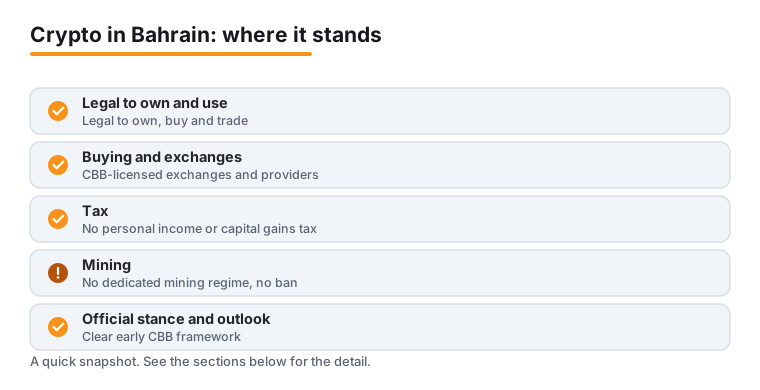
Yes. Owning, buying, selling and trading Bitcoin and other crypto-assets is legal in Bahrain. The activity is not banned; instead it is brought inside a formal regulatory perimeter. Any firm that offers crypto-asset services to the public, such as an exchange, broker, custodian or adviser, must be licensed and supervised by the Central Bank of Bahrain (CBB).
What crypto is not in Bahrain is legal tender. The Bahraini dinar remains the only legal tender, and merchants are under no obligation to accept Bitcoin. Under the CBB framework, a crypto-asset is defined broadly as a digital representation of value or rights that can be transferred and stored electronically using distributed ledger or similar technology, and it specifically excludes central bank digital currency. Crypto-assets are treated as regulated investments rather than as official money.
Bahrain has positioned this clarity as a competitive advantage, marketing itself as a fintech and digital-asset hub for the Middle East and North Africa. For consumers, the practical upside of using a licensed venue is access to disclosure standards, custody safeguards, AML controls and formal complaint channels that unregulated offshore platforms may not provide.
Who regulates crypto in Bahrain?
The single, central regulator for licensed crypto activity is the Central Bank of Bahrain (CBB). The CBB is both the country's central bank and its integrated financial-services regulator, supervising banking, insurance, capital markets and crypto-asset services under a single rulebook.
For crypto specifically, the CBB licenses service providers, sets capital, governance, conduct, custody and cybersecurity standards, enforces anti-money-laundering rules, and maintains the public register of licensed financial institutions. It also publishes notices when it grants new crypto licences; as of early 2025 it had licensed several crypto-asset service providers across different activity categories. Because the authoritative position is always the CBB's own rulebook and register, secondary summaries (including this page) should be checked against the CBB before you rely on them.
Crypto laws and frameworks in Bahrain
The core framework sits in the CBB Rulebook, Volume 6 (Capital Markets). The key components are:
- The Crypto-Asset (CRA) Module. First issued in February 2019, this is the main rulebook for regulated crypto-asset services. In March 2023 the CBB amended it to expand the scope to cover digital token offerings, including tokens that exhibit the characteristics of a security, and to strengthen investor-protection and asset-safeguarding measures. The CBB describes its approach as risk-based and proportionate to the activity undertaken.
- The Stablecoin Issuance and Offering (SIO) Module. Announced on 4 July 2025 and following a consultation paper issued in October 2024, this added a dedicated licensing regime for issuers of single-currency, fiat-backed stablecoins pegged to the Bahraini dinar, the US dollar or another currency acceptable to the CBB. It requires issuers to be incorporated in Bahrain as a Bahraini Joint Stock Company (BSC), to fully back tokens with reserve assets at a 1:1 ratio with the circulating supply, and to grant holders perpetual redemption rights so tokens can be exchanged for fiat at any time. Key executives, including the CEO, compliance officer and head of risk management, must be pre-approved by the CBB, and there is a non-refundable licence application fee of BHD 100.
- The Anti-Money Laundering (AML) Module, which imposes FATF-aligned AML, counter-terrorist-financing and Travel Rule obligations on licensees.
The exact licence categories, capital thresholds and fees are set by the CBB and are revised periodically, so the authoritative source is always the current CBB Rulebook rather than third-party guides. You can read the CRA Module (Volume 6) on the CBB website.
Licensing and registration of exchanges and VASPs
Firms that provide crypto-asset services to the public, often called virtual asset service providers (VASPs), must hold a CBB crypto-asset licence. The regime is tiered into four licence categories under the CRA Module, each covering a wider scope of activity and carrying a higher minimum-capital requirement:
- Category 1 (advisory and reception or transmission of orders), minimum capital of BHD 25,000. This covers investment advice on crypto-assets and passing client orders on to other firms.
- Category 2 (agency, portfolio management and custody), minimum capital of BHD 100,000. This covers trading as agent, managing crypto portfolios and holding clients' crypto-assets in custody.
- Category 3 (dealing as principal), minimum capital of BHD 200,000. This adds trading on the firm's own account and market-making to the Category 2 activities.
- Category 4 (operating a crypto-asset exchange), minimum paid-up capital of BHD 300,000. This covers running a licensed exchange or trading platform and providing custody.
In addition to minimum capital, licensees must hold enough liquid assets to cover at least three months of estimated operating expenses, keep capital in a local Bahraini bank account for the life of the licence, and pay annual fees calculated as a percentage of operating expenses subject to a floor and a cap. Foreign firms already operating elsewhere can apply to operate as an overseas crypto-asset service licensee, subject to broadly the same requirements as a Bahraini joint-stock company. Licensed firms must meet ongoing standards on governance, risk management, client-asset safeguarding, conflicts of interest, cybersecurity and regulatory reporting.
Before depositing funds with any platform, confirm whether it is actually licensed, and for which activities, against the CBB's official records rather than relying on the platform's own marketing. Exact capital figures and category definitions should be verified in the current CRA Module.
Crypto and Bitcoin tax in Bahrain
Bahrain has a notably light personal tax environment, and this extends to crypto held by individuals. The Kingdom has no personal income tax and no general capital gains tax. As a result, profits an individual makes from trading, investing in or holding crypto-assets are generally not subject to income tax or capital gains tax in Bahrain, and there is no specific personal crypto tax in force. For general context on how different countries treat crypto, see our guide to crypto taxes.
The tax picture is not entirely empty, particularly for businesses:
- VAT. Bahrain applies value-added tax at a standard rate of 10% (in place since 2022), administered by the National Bureau for Revenue. How VAT interacts with specific crypto activity and service fees can be technical, so businesses should take advice.
- Corporate and minimum tax. Bahrain has historically not levied a broad corporate income tax on most companies (with hydrocarbons being the long-standing exception). However, a Domestic Minimum Top-Up Tax (DMTT) ensuring a 15% effective rate took effect from 1 January 2025 for very large multinational groups (those with consolidated annual revenue of at least EUR 750 million), in line with the OECD global minimum-tax rules. In late December 2025 Bahrain moved closer to a broader corporate income tax: the Cabinet referred a 61 article draft Corporate Income Tax law to the legislative authorities on 29 December 2025, with the National Bureau for Revenue set to administer the tax if it passes, proposing a 10% tax on taxable income above BHD 200,000 (the portion up to BHD 200,000 is taxed at 0%), with the charge applying where a company's annual revenue exceeds BHD 1 million or its taxable income exceeds BHD 200,000, expected to apply for fiscal years beginning 1 January 2027. It remains a draft, with the final law and executive regulations still pending, and it targets businesses rather than individuals. The personal exemption from income and capital gains tax is unchanged, so individual crypto investors are not affected by this proposed CIT. Confirm scope, thresholds and timing against official sources, as the draft can still change.
Because outcomes depend on whether you are an individual or a business, on residency and on activity, confirm your position with Bahrain's National Bureau for Revenue and a qualified tax adviser. Nothing here is tax advice.
AML, KYC and the Travel Rule
Anti-money-laundering compliance is a central pillar of Bahrain's crypto regime, and it is why identity verification is standard on Bahraini platforms. Licensees must run AML and counter-terrorist-financing programmes rooted in the FATF standards, including customer due diligence (KYC), ongoing monitoring, sanctions screening and suspicious-transaction reporting.
Bahrain has also implemented the FATF Travel Rule for crypto transfers. Under the CBB's AML rules, licensed crypto-asset firms must collect and transmit originator and beneficiary information (such as names and account or wallet identifiers) alongside transfers. Notably, these obligations apply regardless of the transaction amount, with no minimum threshold, and crypto-asset transfers are generally treated as cross-border. For transfers involving self-hosted (unhosted) wallets, firms must still gather the required customer information.
In practice this means you should expect to verify your identity (typically government ID and proof of address) before trading or withdrawing, to face source-of-funds questions on larger activity, and to keep records of your transactions in case a bank or platform asks.
Buying and using crypto in practice
Residents can buy crypto through CBB-licensed exchanges and brokers operating in the Kingdom, as well as through some international platforms that serve Bahraini users. A straightforward, lower-risk path looks like this:
- Choose a regulated platform. Prefer a CBB-licensed exchange or broker, and check what it is authorised to do before depositing.
- Open and verify your account. Complete KYC with ID and proof of address, and enable strong security such as two-factor authentication.
- Deposit funds. Platforms commonly support bank transfers in Bahraini dinar and card payments; available methods vary by provider, so note any deposit or conversion fees.
- Place your order. Buy Bitcoin or another asset using a market or limit order, and start small while you learn the platform.
- Secure your holdings. For larger or longer-term holdings, consider moving assets to a private wallet (hardware wallets offer strong protection) and back up your recovery phrase offline. Leaving large balances on an exchange concentrates custody risk.
Remember that crypto is not legal tender, so no merchant is obliged to accept it. Keep clear records of purchases, sales and transfers, both for your own tracking and for any source-of-funds checks.
Sending remittances with crypto
Bahrain is home to a large expatriate workforce, and remittances are a significant part of everyday financial life. Crypto and stablecoins are sometimes promoted as a faster, lower-fee alternative to traditional bank wires for sending value across borders. There can be genuine advantages: crypto transfers can settle quickly and may cost less than conventional channels, and they do not depend on correspondent-banking hours.
There are important caveats for Bahraini users:
- On and off ramps still touch regulated finance. Converting dinar to crypto and back to a local currency on the other side runs through licensed platforms and banks subject to AML, KYC and the Travel Rule. The end-to-end process is rarely as frictionless as the on-chain step alone.
- Volatility. Holding value in Bitcoin during transfer exposes you to price swings; stablecoins reduce but do not eliminate this risk and carry their own issuer and regulatory considerations.
- Recipient access. The benefit only materialises if the recipient can convert to usable local currency cheaply and legally in their country.
For larger amounts, expect source-of-funds questions and keep documentation. Crypto remittances can be useful, but they are not automatically cheaper or simpler once fees, spreads and conversion at both ends are included.
Crypto mining in Bahrain
Bahrain does not have a high-profile, dedicated crypto-mining licensing regime in the way it regulates exchanges and custodians, and there is no widely publicised blanket prohibition on mining either. In practice, the viability of mining in the Kingdom is shaped less by a single mining law and more by general considerations: electricity costs and supply, the hot climate (which raises cooling demand and energy use), import rules for hardware, and the general business, tax and AML rules that apply to any commercial activity.
Anyone considering mining at commercial scale should treat it as a business and check the specific position with the relevant authorities, including any requirements around electricity supply, business licensing and customs for equipment. Because mining sits in a less explicitly codified area than licensed crypto services, confirming the current rules directly with Bahraini authorities is especially important before investing.
Recent developments (2025-2026)
Bahrain's recent direction has been one of structured expansion rather than restriction. The most significant developments include:
- Stablecoin framework (announced 4 July 2025). The CBB introduced its Stablecoin Issuance and Offering (SIO) Module, creating a dedicated licensing regime for single-currency, fiat-backed stablecoin issuers, with a 1:1 reserve-backing requirement and perpetual redemption rights for holders. It positions Bahrain among the first GCC jurisdictions to regulate stablecoins comprehensively.
- New crypto licences. The CBB has continued to grant crypto-asset service provider licences across categories, expanding the pool of supervised platforms operating in the Kingdom.
- Domestic Minimum Top-Up Tax (from 1 January 2025). A 15% minimum tax now applies to very large multinational groups. This is aimed at large businesses rather than ordinary individual investors, but it marks a notable shift in Bahrain's historically tax-light corporate environment.
- Draft Corporate Income Tax (December 2025). The National Bureau for Revenue referred a draft Corporate Income Tax law to the legislative authority, proposing a 10% tax on taxable income above BHD 200,000, expected to apply for fiscal years beginning 1 January 2027. It is still a draft and targets businesses, so individual crypto investors remain exempt from income and capital gains tax.
As of 3 August 2026 that continuity has held. No new crypto-specific law, module or circular has been identified since the Stablecoin Issuance and Offering Module of 4 July 2025, and the position for the rest of the year remains the same: legal, supervised crypto activity within the CBB framework, a tax environment that remains light for individuals, and incremental rule-tightening focused on AML, consumer protection and market integrity. None of this is a forecast of prices, and details and timing should be confirmed against official sources.
Consumer risks and protection
The main risks for Bahraini users fall into a few buckets: market volatility and potential loss of capital; platform and custody risk (hacks, insolvency, loss of keys); scams and fraud, which remain common across the sector; and regulatory or tax change. The fact that Bahrain regulates licensed providers reduces some of these risks but does not guarantee returns or eliminate the possibility of loss.
Whether crypto belongs in your portfolio is a personal decision that depends on your goals, time horizon and risk tolerance. Sensible principles apply everywhere: understand what you are buying, use CBB-licensed platforms where possible, be wary of guaranteed-return promises, never invest more than you can afford to lose, and consider diversification. Using a supervised venue also gives you access to formal complaint and recourse channels that offshore platforms may lack.
If you encounter a platform claiming to be regulated, verify it against the CBB's official register before sending any money, and report suspected fraud to the relevant authorities. See our regulation hub for guides covering other jurisdictions.
Official sources and how to verify
Because crypto and tax rules evolve, always confirm the current position against primary official sources rather than secondary summaries:
- Central Bank of Bahrain (CBB) - the regulator's main website, including its register of licensees and media-center announcements of new crypto licences.
- CBB Rulebook Volume 6 - Crypto-Asset (CRA) Module - the core rules for regulated crypto-asset services.
- CBB media center: digital tokens framework - the official announcement of the 2023 expansion to cover digital token offerings.
- Bahrain National Portal (bahrain.bh) - government information, including VAT administered by the National Bureau for Revenue.
This page is general information as of 2026 and is not legal, tax or financial advice. Verify any rule that affects you directly with the Central Bank of Bahrain and a qualified local professional before acting.
What happened to the corporate tax bill in Parliament
The page already records that a draft Corporate Income Tax law was referred to the legislative authority in late December 2025, that it proposes 10% above BHD 200,000, and that it is expected to apply from 1 January 2027. What it does not yet record is that the bill ran into difficulty in Parliament in May 2026.
On 1 May 2026 a parliamentary committee flagged a potential constitutional issue in the draft corporate income tax and business activities law and placed it under further scrutiny. Reporting on the review two weeks later, the Gulf Daily News set out the objection: the Legislative and Legal Affairs Committee, chaired by MP Mahmood Fardan, held that "Taxes are not fees. They must be stated precisely in the law itself", rather than being left to executive regulations. The bill moved to the Financial and Economic Affairs Committee chaired by MP Ahmed Al Salloom, and the same report described proceeding before the parliamentary recess as difficult. No revised timetable has been published, so 1 January 2027 is best read as a target rather than a settled date.
| Date | Step |
|---|---|
| 29 December 2025 | Cabinet refers the draft law to the legislative authorities |
| 23 February 2026 | Bahrain Chamber of Commerce and Industry shares a copy of the draft text |
| 1 May 2026 | Parliamentary committee flags a potential constitutional issue, bill placed under further scrutiny |
| 14 May 2026 | Objection reported, bill with the Financial and Economic Affairs Committee |
| 1 January 2027 | Intended start date, not confirmed |
The same report sets out mechanics of the 61 article draft that matter to a crypto business considering Bahrain. It was referred to Parliament by the Cabinet, though the National Bureau for Revenue would administer the tax if it passes. Withholding tax of 5% would apply on interest, royalties and services paid to non-residents, while dividends stay at 0%. It reaches resident companies operating inside or outside Bahrain, individuals conducting business activities, and non-residents with a permanent establishment. Personal salaries and private real estate income are explicitly excluded, but investment gains are not named in that exclusion list, so an individual whose crypto activity amounts to a business should follow the bill rather than assume it cannot apply. Penalties run to jail terms of three months to five years and fines of up to three times the unpaid tax.
The text has still not been officially published. KPMG records that the Bahrain Chamber of Commerce and Industry shared a copy of the draft law on 23 February 2026, and advisers have worked from that copy since. For an individual holding crypto as an investment the position is unchanged, because Bahrain has no personal income tax regime for the bill to build on.
How many crypto firms are actually licensed in Bahrain
The page sets out the four CBB licence categories and their minimum capital requirements. It does not say how many firms actually hold a licence, which is useful context before accepting any platform's claim to be regulated in Bahrain.
When the CBB licensed Fasset Financial Services W.L.L. on 23 January 2025 with a Crypto Asset Service Provider Category 3 licence allowing it to provide crypto-asset trading services, the regulator stated that this was "the fifth Category 3 crypto service license to be granted by CBB since the first license of this type was granted in 2020, bringing the total number of Crypto Asset Service Providers of all categories to eight".
That is a January 2025 figure and the CBB may have granted more since, so treat it as a sense of scale rather than a current count: single digits, built up over five years from the first grant of this type in 2020.
- Check the CBB register directly before relying on a platform's marketing claim to be regulated in Bahrain. With a licensed population this small, the claim is quick to verify.
- A platform that is not on the CBB register is not covered by the CRA Module's conduct and client-asset rules, so Bahraini regulatory recourse is not available to you if something goes wrong.
Frequently asked questions
Is cryptocurrency legal in Bahrain?
Yes. Buying, holding and trading crypto-assets is legal, and crypto services offered to the public must be licensed and supervised by the Central Bank of Bahrain (CBB). Crypto is regulated as an investment, not recognised as legal tender, so the Bahraini dinar remains the only official money.
Who regulates crypto in Bahrain?
The Central Bank of Bahrain (CBB). Its rules sit in the CBB Rulebook Volume 6, with crypto activity governed mainly by the Crypto-Asset (CRA) Module first issued in 2019, expanded in 2023 to cover digital token offerings, and supplemented by a Stablecoin Issuance and Offering Framework effective July 2025. The CBB licenses exchanges, brokers, custodians and advisers and sets AML, capital, conduct and cybersecurity standards.
Do I pay tax on crypto profits in Bahrain?
Bahrain has no personal income tax and no general capital gains tax, so individual crypto gains are generally untaxed. A 10% VAT (administered by the National Bureau for Revenue) and business-level measures exist, including a 15% Domestic Minimum Top-Up Tax that took effect from 1 January 2025 for very large multinational groups, and a draft 10% Corporate Income Tax (referred to the legislative authority in December 2025, proposed for fiscal years from 1 January 2027) that targets businesses and would not affect individual investors. Businesses in particular should confirm their position with the National Bureau for Revenue and a tax adviser. This is not tax advice.
What licence does a crypto exchange need in Bahrain?
A crypto exchange, broker, custodian or adviser must hold a CBB crypto-asset licence under the CRA Module. The regime is tiered by activity (custody, operating an exchange, dealing or brokerage, and advisory), each with its own requirements and minimum capital. Foreign firms can apply to operate as an overseas crypto-asset service licensee. Always verify a platform's licence against the CBB's official register before depositing funds.
Does Bahrain apply KYC and the Travel Rule to crypto?
Yes. Licensed crypto firms must run FATF-aligned AML and KYC programmes, including identity verification, monitoring and reporting. Bahrain also applies the crypto Travel Rule, requiring firms to transmit originator and beneficiary information with transfers. These obligations apply regardless of the transaction amount, so expect identity checks and possible source-of-funds questions.
Is Bitcoin mining allowed in Bahrain?
There is no widely publicised blanket ban on mining, but Bahrain does not have a high-profile dedicated mining licence regime either. Mining viability is shaped mainly by electricity costs, the hot climate, equipment import rules and general business and tax rules. Anyone mining at scale should confirm the current requirements directly with the relevant Bahraini authorities.
Are stablecoins regulated in Bahrain?
Yes. In July 2025 the Central Bank of Bahrain introduced a Stablecoin Issuance and Offering (SIO) Module in Volume 6 of its Rulebook. It lets licensed issuers offer single-currency stablecoins backed by the Bahraini dinar, the US dollar or another currency the CBB accepts. Issuers must be incorporated as a Bahraini Joint Stock Company, hold reserves at a 1:1 ratio with tokens in circulation, and let holders redeem for fiat at any time. Bahrain was among the first Gulf jurisdictions to set out a dedicated stablecoin regime.
What are the crypto licence categories in Bahrain?
The CBB's Crypto-Asset (CRA) Module uses four licence categories. Category 1 covers advisory and passing on client orders (minimum capital BHD 25,000); Category 2 adds agency dealing, portfolio management and custody (BHD 100,000); Category 3 adds dealing as principal and market-making (BHD 200,000); and Category 4 covers operating a crypto-asset exchange with custody (minimum paid-up capital BHD 300,000). Firms must also keep liquid assets covering at least three months of operating expenses. Verify a platform's category against the CBB register before depositing.
Where has Bahrain's draft corporate income tax got to, and would it apply to crypto businesses?
It is still a draft and it has stalled. The Cabinet referred the 61 article bill to Parliament on 29 December 2025, and the Bahrain Chamber of Commerce and Industry shared a copy of the text with members on 23 February 2026, but the law has never been officially published. On 1 May 2026 a parliamentary committee flagged a potential constitutional issue and placed the bill under further scrutiny. The Legislative and Legal Affairs Committee, chaired by MP Mahmood Fardan, held that tax rates and calculation methods must be stated in the law itself rather than left to executive regulations. The bill passed to the Financial and Economic Affairs Committee chaired by MP Ahmed Al Salloom, and proceeding before the parliamentary recess was described as difficult. The intended 1 January 2027 start date has not been formally revised but should be treated as uncertain. If it passes it would apply to companies established in Bahrain above the threshold, including crypto exchanges, brokers and custodians, and to individuals conducting business activities.
How many licensed crypto companies are there in Bahrain?
Eight crypto-asset service providers across all licence categories as at January 2025, according to the Central Bank of Bahrain's own announcement when it licensed Fasset Financial Services W.L.L. on 23 January 2025. That announcement described the grant as the fifth Category 3 crypto service licence issued since the first licence of that type in 2020, and Category 3 was described as allowing the company to provide crypto-asset trading services. The CBB may have licensed more firms since, so check the CBB register directly rather than relying on this figure or on a platform's own claim to be regulated in Bahrain.
Did anything change for crypto in Bahrain in 2026?
No crypto-specific law or rule change in 2026 could be verified as of 3 August 2026. The newest crypto instrument identified remains the Stablecoin Issuance and Offering Module issued on 4 July 2025, and the Crypto-Asset Module in Rulebook Volume 6 continues to govern licensing of crypto-asset services. The only moving piece is the draft Corporate Income Tax law, which a parliamentary committee placed under further scrutiny on constitutional grounds on 1 May 2026. Note that the CBB publishes its press releases through a dynamically loaded page that could not be enumerated during this check, so the absence of a mid 2026 announcement is a well supported inference rather than a confirmed reading of the regulator's release index.
Facts reviewed: 3 August 2026. Page updated: 3 August 2026.