Home › Crypto Regulation › Jordan
Bitcoin & Cryptocurrency Regulation in Jordan
Quick answer — Jordan, 2026
- Legal: Legal within regulated framework since 2025, not legal tender
- Tax: Still settling, general income tax may apply, no crypto-specific rate
- Buying: Via JSC-licensed VASPs; many still use international platforms
Jordan's approach to Bitcoin and other crypto-assets changed fundamentally in 2025. For more than a decade the Central Bank of Jordan (CBJ) had warned the public against virtual currencies and prohibited banks and payment providers from dealing in them. That restrictive era ended with a dedicated statute, the Law Regulating Dealings in Virtual Assets, Law No. 14 of 2025, which brings virtual assets inside a formal, licensed regulatory perimeter overseen mainly by the Jordan Securities Commission (JSC).
This page explains, in plain terms, how Jordan treats crypto in 2026: whether it is legal, who regulates it, how the new licensing regime for virtual asset service providers (VASPs) works, what can reasonably be said about tax, and the practical realities around exchanges, AML/KYC, mining and investing. The licensing regulation is in force, but the conduct rulebook behind it is not. The JSC's draft Executive Instructions for Virtual Assets Activities for the Year 2026, a 127 article text covering platform operation, custody, trading, client protection, governance, outsourcing, auditing and cyber security, was opened for public comment through the government Tawasal platform and had not been issued in final form as of August 2026.
This article is general information as of 2026 and is not legal, tax or financial advice. Verify current rules directly with the Jordan Securities Commission and the Central Bank of Jordan, and consult a qualified Jordanian adviser, before acting. See also our overviews of crypto regulation and crypto taxes.
On this page: Legal status · Who regulates it · Taxes · How to buy · Mining
Is Bitcoin and crypto legal in Jordan?
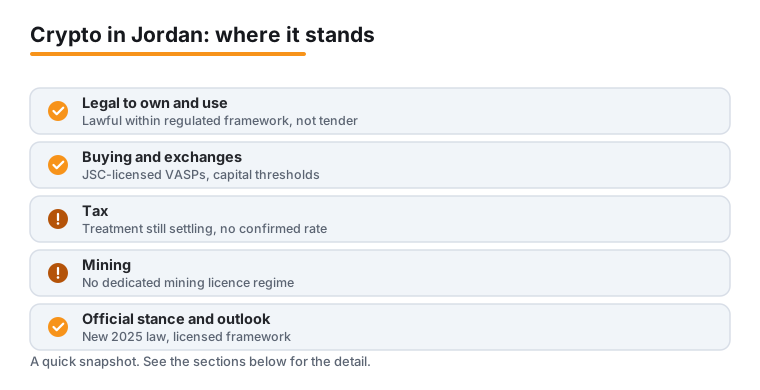
Owning, buying, selling and trading crypto-assets is now lawful in Jordan, but within a regulated framework rather than as an unrestricted free-for-all. This is a notable shift. For around a decade the Central Bank of Jordan took a restrictive line: it issued public warnings (its first dates back to 2014), declared that virtual currencies are not legal tender, and barred banks and other financial institutions from facilitating crypto transactions. Individuals were not criminalised for holding crypto, but the regulated banking sector was walled off from it.
That position was replaced in 2025 by a purpose-built legal regime for virtual assets. Under the new law, crypto services offered to the public, such as operating an exchange, brokerage, custody and services around token offerings, must be licensed and supervised. The activity is regulated, not banned.
One important distinction remains: crypto is not legal tender. The Jordanian dinar is the only official money, no business is obliged to accept Bitcoin, and the use of virtual assets for payment purposes is treated as a separate, tightly controlled matter reserved to the Central Bank rather than being automatically permitted. In short, you can legally invest in and trade crypto through licensed channels, but you should not assume it works as a general means of payment.
Who regulates crypto in Jordan?
Two authorities share responsibility, with distinct roles:
- Jordan Securities Commission (JSC) is the primary licensing and supervisory authority for virtual asset service providers. Operating a trading platform (exchange), brokerage, custody, and services connected to virtual-asset offerings fall under the JSC's regime. The JSC reviews applications, grants licences, supervises licensees and can act against unlicensed activity. Its official website is jsc.gov.jo.
- Central Bank of Jordan (CBJ) retains authority over monetary and payment matters. The use of virtual assets for payment purposes is reserved to the CBJ, so service providers cannot facilitate crypto payments unless the CBJ authorises it. The CBJ also continues to supervise banks and the wider financial system, and its earlier consumer warnings about volatility and fraud remain relevant. Its official website is cbj.gov.jo.
Implementation has been coordinated across government, including the JSC, the CBJ and the national cybersecurity body, reflecting that crypto touches markets, payments and security at once. When in doubt, the JSC and the CBJ are the bodies whose published rules govern, not third-party commentary.
Key laws and frameworks
The cornerstone is the Law Regulating Dealings in Virtual Assets, Law No. 14 of 2025. According to official and legal-industry reporting it was published in the Official Gazette on 16 June 2025, in issue No. 5996 at pages 3084 to 3090. Article 1 provides that it comes into force ninety days after the date of its publication, which gives an effective date of 14 September 2025. It establishes a comprehensive regime under which core virtual-asset activities require authorisation from the JSC, and it empowers the authorities to act against entities operating without a licence.
Subsidiary regulation fills in the detail. A dedicated VASP licensing regulation was issued in 2025 (reported as the Regulation of Licensing Virtual Assets Services Providers, with accompanying capital adequacy instructions), setting out activity categories, minimum capital, fees and ongoing obligations. A recurring theme throughout is anti-money-laundering and counter-terrorist-financing (AML/CFT) compliance, including customer identity verification and alignment with Financial Action Task Force (FATF) standards such as the travel rule for transfers.
Because the regime is new and is implemented through instructions that can be revised, the authoritative reference is always the current law and the JSC's and CBJ's official publications. You can review the JSC's announcement of the licensing regulation at jsc.gov.jo.
Licensing and registration of exchanges and VASPs
No entity may carry on virtual-asset activities for the public without a licence from the JSC. The detailed rules sit in the Virtual Asset Service Providers Licensing Regulation, Regulation No. 94 of 2025, issued under Law No. 14 of 2025. It sets out four activity categories, each with its own minimum paid-up capital. Per the regulation as published, these are:
- Platform operator or manager (exchange) with minimum capital of JOD 3,000,000.
- Custody and asset management with minimum capital of JOD 2,000,000.
- Brokerage in virtual-asset trading with minimum capital of JOD 1,000,000.
- Participation in, or financial services for, virtual-asset offerings with minimum capital of JOD 500,000.
Where a company applies for more than one activity, the capital requirements are cumulative. Licences are granted only to joint-stock companies (public or private) whose sole purpose is virtual-asset activity, not to individuals. Applicants seek preliminary approval first, supported by a feasibility study and documentation on corporate form, governance, technology, risk management, cybersecurity and AML policies, then submit the full licence application after preliminary approval. Licensees face ongoing obligations on capital, conduct, custody, cybersecurity, reporting, complaint-handling and consumer protection, and the JSC can inspect and enforce. Before depositing funds with any provider that claims to be authorised in Jordan, verify its status against JSC records via the licensing pages at jsc.gov.jo. Figures above reflect the regulation as published and may be amended, so confirm the current text.
Licence fees and ongoing costs
Beyond minimum capital, Regulation No. 94 of 2025 sets out the fees a licensed provider pays. As published, these include a non-refundable application fee of JOD 1,000, one-off licensing fees that vary by activity, and annual renewal fees:
- Platform operator: licensing fee JOD 100,000, annual renewal JOD 50,000.
- Custody and asset management: licensing fee JOD 50,000, annual renewal JOD 25,000.
- Brokerage: licensing fee JOD 50,000, annual renewal JOD 25,000.
- Participation or financial services for offerings: licensing fee JOD 30,000, annual renewal JOD 15,000.
In addition, the regulation provides for a transaction commission set at 0.0005 of each contract or order value. These costs, on top of the capital thresholds, mean the licensed market is aimed at well-funded companies rather than small operators. Fees can be revised, so confirm the current schedule with the JSC. This detail matters mainly to firms applying for a licence; ordinary users are affected indirectly through the platforms they use.
Crypto and Bitcoin tax in Jordan
Tax is where the most caution is warranted. Because Jordan's virtual-asset framework is recent, the treatment of crypto under the general tax system is still settling, and there is no widely confirmed crypto-specific rate or threshold that can be quoted reliably, so this page deliberately avoids stating figures.
In general terms, Jordan operates an income tax system administered by the Income and Sales Tax Department, alongside a general sales tax on goods and services. Personal income tax is charged at progressive rates that run from 5 percent on the first band of taxable income up to 30 percent on higher income, with a further national contribution of 1 percent on income above JOD 200,000 per year. Individuals benefit from allowances (a personal allowance of JOD 9,000 and a further JOD 9,000 for dependants, subject to limits), and returns are filed within four months after the end of the tax year. Residents are, in principle, taxed on worldwide income. Personal income tax runs in bands of 5%, 10%, 15% and 20% on each of the first four tranches of JOD 5,000 of taxable income, then 25% on income over 20,000 and up to 1,000,000 and 30% on the remaining balance, with a 1% national contribution tax on annual taxable income above JOD 200,000. A business trading virtual assets professionally is taxed on its profits at the ordinary corporate rate of 20%, or 24% for sectors such as financial intermediation, rather than under any crypto specific regime. How sales tax interacts with crypto transactions or platform fees can be technical and fact-specific.
Because the rules are evolving and depend on your residency, your status and the nature of your activity, confirm your position with the Income and Sales Tax Department and a qualified Jordanian tax adviser before relying on any treatment. Nothing here is tax advice, and you should not assume crypto gains are tax-free. Our general crypto tax guide explains the concepts, not Jordan-specific rates.
AML, KYC and the travel rule
Anti-money-laundering and counter-terrorist-financing compliance sits at the heart of Jordan's new regime. Licensed VASPs are required to implement robust AML/CFT controls aligned with FATF standards. In practice this means:
- Customer due diligence and KYC. Providers must verify customer identity, typically using a national ID or passport and proof of address, before allowing trading or withdrawals.
- The travel rule. For virtual-asset transfers, providers are expected to collect and share required originator and beneficiary information and make it available to authorities, in line with FATF's travel rule.
- Ongoing monitoring and reporting. Source-of-funds checks for larger activity, transaction monitoring, record-keeping and suspicious-activity reporting are standard obligations, and licensees must maintain governance and cybersecurity controls.
For users, the practical effect is that genuine licensed platforms will ask for identity documents and may query large or unusual flows. Anonymous, no-questions-asked conversion is not consistent with the regulated model, and platforms that promise it are a warning sign.
Buying and using crypto in practice
With the framework in place, the intended route for residents is to use VASPs licensed under JSC supervision. Licensed venues must meet conduct, custody and AML standards, which means mandatory identity verification, source-of-funds checks for larger activity, and clearer consumer protections than unregulated platforms offer. Practical points:
- Expect KYC. You will need to verify your identity before trading or withdrawing, and enable strong account security such as two-factor authentication.
- Transition period. As licensing is rolled out, the set of fully authorised local providers may still be developing. Many Jordanians have historically used international platforms; an offshore venue is not supervised by Jordanian regulators and may carry higher counterparty and recovery risk.
- Verify authorisation. Where a provider claims to be licensed in Jordan, check its status against JSC records before depositing funds.
- Payment use is restricted. Using crypto to pay for goods and services is a separate matter reserved to the Central Bank, so do not assume crypto works as everyday money. The dinar remains legal tender.
- Banking interface. Funding and cashing out ultimately touch the regulated banking system; banks apply AML controls, and large or unusual flows can attract questions.
Keep clear records of purchases, sales and transfers. Being able to explain the source of funds matters increasingly as the framework beds in.
Bitcoin mining in Jordan
Jordan does not have a high-profile, dedicated crypto-mining licensing regime in the way it now licenses exchanges and custodians, and there is no widely publicised blanket criminal prohibition on mining either. In practice, viability is shaped less by a single mining law and more by general factors, of which energy is decisive.
Jordan imports most of its energy and electricity costs are significant, which directly affects mining economics. At the same time, the country has invested heavily in renewables, particularly solar and wind. Whether mining is commercially attractive depends on power tariffs, equipment import rules and the general business, tax and AML rules that apply to any enterprise.
Anyone mining at scale should treat it as a regulated business activity and confirm the current position on electricity supply and tariffs, equipment customs, business licensing and energy-sector requirements directly with the relevant Jordanian authorities before investing. Because mining sits in a less explicitly codified area than licensed crypto services, verifying the rules first-hand is especially important.
Recent developments (2025-2026)
The decisive change is recent. In early 2025 the government approved a plan to build a full regulatory framework for virtual and digital assets, led by the JSC and coordinated with the CBJ and the national cybersecurity body. Law No. 14 of 2025 followed, published in the Official Gazette on 16 June 2025 and taking effect on 14 September 2025, replacing the previous effective banking-sector ban with a licensing regime.
Through 2025 the JSC issued the subsidiary VASP licensing regulation, Regulation No. 94 of 2025, together with capital adequacy instructions that operationalise the law, defining the four activity categories, capital thresholds (from JOD 500,000 to JOD 3,000,000), application and licensing fees, and the two-stage application process. The official Jordan News Agency (Petra) and the JSC reported these steps as they were taken; you can follow updates at petra.gov.jo and jsc.gov.jo.
The next step on the record is the final version of the Executive Instructions for Virtual Assets Activities for the Year 2026, a 127 article text the JSC published in draft to coincide with Regulation No. 94 of 2025 taking effect in mid January 2026. As of August 2026 it does not appear in final form on the JSC register of issued instructions, and the JSC has announced no date for issuing it. Until it issues, the detailed standards a licensed platform must meet are not fixed, which is the practical reason applicants are at the preliminary approval stage rather than holding licences. None of this is a price forecast, and because the regime is young and fast-moving, the official sources are the only reliable guide to the current position.
Consumer risks and protection
Regulation reduces some risks but does not remove them. The main risks for Jordanian users fall into a few buckets:
- Market risk. Crypto-asset prices are highly volatile and can fall sharply; some tokens fail entirely. The CBJ's longstanding warnings about volatility and potential total loss still apply.
- Platform and custody risk. Exchanges and custodians can be hacked, fail or freeze withdrawals, and losing your private keys means losing your funds. For larger or longer-term holdings, consider self-custody with a hardware wallet and an offline backup of your recovery phrase.
- Fraud and scams. Guaranteed-return schemes, fake exchanges and impersonation of licensed firms remain common. Verify any Jordan licence claim against JSC records.
- Regulatory and tax uncertainty. The framework is new; licensed-provider availability, detailed instructions and tax treatment are still developing.
Sensible principles apply: understand what you are buying, prefer regulated platforms as they become available, never invest more than you can afford to lose, and keep documentation. This page is general information, not a recommendation, and makes no price predictions. For background, see our general guide to crypto regulation.
Official sources and how to verify
Because Jordan's framework is recent and evolving, always confirm the current position against primary, official sources rather than secondary commentary:
- Jordan Securities Commission (JSC), the primary VASP regulator, for the licensing regulation, capital adequacy instructions, licensee status and announcements: jsc.gov.jo. The JSC's announcement of the VASP licensing regulation is at jsc.gov.jo/News/en/12582.
- Central Bank of Jordan (CBJ), for payment-use rules, banking supervision and consumer warnings: cbj.gov.jo.
- Jordan News Agency (Petra), the official government news service, for announcements on the law and regulations: petra.gov.jo.
- Income and Sales Tax Department, for tax questions, alongside a qualified Jordanian tax adviser.
For our broader coverage, see the regulation hub. To verify a provider, do not rely on the provider's own marketing: check the JSC's licensing records directly, and treat any firm that refuses identity verification or promises guaranteed returns as a red flag.
Where Jordan's crypto rules stand in August 2026
Jordan moved from statute to an operating licensing regime over the winter of 2025 to 2026, and nothing in the public record has changed the legal position since this page was last reviewed. The Jordan Securities Commission announced on 16 December 2025 that the Official Gazette had published the Virtual Asset Service Providers Licensing Regulation No. (94) for the Year 2025, issued under Article 7 of the Virtual Assets Dealing Regulation Law No. (14) for the Year 2025. Article 1 of the regulation itself states that it comes into effect thirty days of its publication in the Official Gazette, which puts it in force from mid January 2026.
- 16 December 2025. Regulation No. 94 of 2025 is published in the Official Gazette.
- Mid January 2026. The licensing regulation takes effect, thirty days after gazette publication.
- To coincide with that commencement, the JSC published a 127 article draft of the Executive Instructions for Virtual Assets Activities for the Year 2026 for public comment through the government Tawasal platform.
- August 2026. The JSC publishes an online form for preliminary approval to carry on virtual asset activities. Its register of issued instructions lists no virtual asset instructions in final form, and no licensed provider is named on its virtual assets page.
- August 2026. The Central Bank of Jordan news feed carries no virtual asset announcement during 2026. Licensing and supervision of service providers sits with the JSC, not the central bank.
What is still outstanding
One item remains outstanding, and it is the one that matters most to anyone planning to operate.
- Executive Instructions for Virtual Assets Activities for the Year 2026. The JSC published the draft to coincide with Regulation No. 94 of 2025 taking effect. It runs to 127 articles and covers licensing requirements, platform operation, custody services, trading, client protection, governance, marketing, outsourcing, financial standards, auditing and cyber security, and the JSC states it was prepared with the Central Bank of Jordan, the Anti Money Laundering and Counter Terrorist Financing Unit, the National Cyber Security Center and the Ministry of Digital Economy and Entrepreneurship. Comments were invited through the government Tawasal platform. The announcement states no closing date for comments, and as of August 2026 no final version appears on the JSC register of issued instructions.
No date has been announced for the final instructions, so any specific timing you see quoted elsewhere is not coming from the JSC. For a reader, the honest summary is that the gateway is open and the rulebook behind it is not finished. A Jordanian resident can lawfully hold and trade virtual assets today, but there is no JSC licensed domestic platform named on the public record to trade on.
What Regulation No. 94 of 2025 actually requires of a licence applicant
The JSC publishes an English reference translation of the Virtual Asset Service Providers Licensing Regulation No. (94) for the Year 2025. The document carries a notice that it is for reference and explanatory purposes only and that the original Arabic text is the authoritative and legally binding version, so the figures below should be read as the JSC's own English rendering rather than as the operative text. Article 3 sets four licensable activities, each with its own minimum paid up capital, and Article 13 sets the fees.
| Licensable activity | Minimum paid up capital | Issuance fee | Annual renewal fee |
|---|---|---|---|
| Operating and managing virtual asset platforms | JOD 3,000,000 | JOD 100,000 | JOD 50,000, or 5% of annual operating expenses, whichever is higher |
| Custody and management of virtual assets, or of instruments enabling control over them | JOD 2,000,000 | JOD 50,000 | JOD 25,000 |
| Providing brokerage services in virtual asset trading | JOD 1,000,000 | JOD 50,000 | JOD 25,000 |
| Participating in and providing financial services related to an issuer's offering or sale of virtual assets | JOD 500,000 | JOD 30,000 | JOD 15,000 |
An applicant seeking two or more of these activities must hold paid up capital of at least the sum of the minimums for each activity requested. The application fee is a non refundable lump sum of JOD 1,000 collected on submission, and the JSC also collects an annual fee of JOD 50 for each accreditation granted to a natural person registered by a provider.
On eligibility, Article 3 allows a public shareholding company, a private shareholding company, a limited liability company, or a branch of a foreign company licensed in its home jurisdiction, provided the corporate purpose is limited to virtual asset activities. The route is therefore not restricted to joint stock companies, but it is closed to individuals in every case. Article 24 adds one further route: in special and justified cases the JSC may permit a legal person that has passed its regulatory sandbox requirements to practise one or more activities while completing the remaining requirements on a timetable the JSC sets.
There is no crypto tax rule in Jordan, so here is what does apply
Jordan has no crypto specific tax rate, threshold or filing regime, and the Income and Sales Tax Department publishes no virtual asset guidance. What applies instead is the general Income Tax Law, and those figures are published and current.
- Personal income tax runs in bands: 5% on the first JOD 5,000 of taxable income, 10% on the second 5,000, 15% on the third, 20% on the fourth, 25% on income over 20,000 and up to 1,000,000, and 30% on the remaining balance. A national contribution tax of 1% applies to any amount of annual taxable income above JOD 200,000.
- Capital gains generated within the Kingdom are exempt from tax, except for gains realised from the sale of depreciable assets. Gains realised by individuals on the sale of listed and unlisted shares follow the treatment applied to companies on the sale of those shares. No published ruling settles whether a disposal of virtual assets sits inside that general exemption, so this is the single biggest open question for an ordinary Jordanian holder.
- A business trading virtual assets professionally is taxed on its profits under the ordinary corporate rules: 20% for all other companies, 24% for sectors including financial intermediation, telecommunications and insurance, and 35% for banks, plus a national contribution tax that runs from 1% for most companies to 4% for financial intermediation and brokerage firms.
- As last reviewed on 5 July 2026, there had been no significant corporate tax developments in Jordan during the past year. Nothing on the tax side has moved since this page was last checked.
Anti money laundering duties come from the Anti Money Laundering and Counter Terrorist Financing Law No. 46 of 2007 and its amendments, administered by the Anti Money Laundering and Counter Terrorist Financing Unit, which runs the goAML reporting system. The unit publishes no virtual asset specific instruction, so identification, record keeping and suspicious transaction reporting for licensed providers flow from that general law and, in due course, from the executive instructions still in draft.
Practical consequence for a reader today: keep dated records of every purchase, disposal and transfer with the JOD value at the time, because the treatment of your position may be determined after the fact, and reconstructing it later is far harder than recording it now.
Frequently asked questions
Is cryptocurrency legal in Jordan in 2026?
Yes. Following Law No. 14 of 2025 (Regulating Dealings in Virtual Assets), which took effect on 14 September 2025, crypto-assets are lawful within a regulated framework, and crypto services offered to the public must be licensed by the Jordan Securities Commission. This reversed the earlier era in which the Central Bank of Jordan barred banks and financial institutions from dealing in crypto. Crypto is regulated as an asset, not recognised as legal tender, so the Jordanian dinar remains the only official money. This is general information, not legal advice; verify with the JSC and CBJ.
Who regulates crypto in Jordan?
Two bodies share responsibility. The Jordan Securities Commission (JSC) is the primary licensing and supervisory authority for virtual asset service providers such as exchanges, brokers, custodians and providers of services around token offerings; see jsc.gov.jo. The Central Bank of Jordan (CBJ) retains authority over monetary and payment matters, including the use of virtual assets for payment, and continues to oversee banks; see cbj.gov.jo. Confirm current rules with both regulators before acting.
Do exchanges need a licence in Jordan?
Yes. No entity may offer virtual-asset services to the public without a licence from the Jordan Securities Commission. Regulation No. 94 of 2025 sets four activity categories with their own minimum capital: platform operator (JOD 3,000,000), custody and asset management (JOD 2,000,000), brokerage (JOD 1,000,000) and participation in or financial services for offerings (JOD 500,000), along with governance, AML and cybersecurity obligations. Requirements are cumulative for multiple activities. Licences go to joint-stock companies whose sole purpose is virtual-asset activity, not individuals. Verify any provider's status against JSC records before depositing funds, and confirm current figures, which may be amended.
Do I pay tax on crypto in Jordan?
Treatment is still settling under the new framework, and there is no widely confirmed crypto-specific rate or threshold that can be quoted reliably, so this page does not state figures. General income-tax and sales-tax principles may apply depending on whether you are an individual or a business and on the nature and frequency of your activity, with professional trading more likely to be taxed. Jordan's personal income tax is progressive, running from 5 percent up to 30 percent, with allowances and a 1 percent national contribution on income above JOD 200,000, so where crypto is taxable those general rules are the starting point. Do not assume gains are tax-free; confirm your position with the Income and Sales Tax Department and a tax adviser. This is not tax advice.
Can I use Bitcoin to pay for things in Jordan?
Not as a matter of course. Using crypto as a means of payment is treated as a separate, controlled matter reserved to the Central Bank of Jordan, so it is not automatically permitted, and the dinar remains legal tender. No business is obliged to accept Bitcoin. You can legally invest in and trade crypto through licensed platforms, but treating it as everyday money is restricted, so understand the rules and check the CBJ's position first.
Is Bitcoin mining allowed in Jordan?
There is no widely publicised blanket ban on mining, but Jordan does not have a dedicated mining licence regime either. Mining economics are dominated by electricity costs in a country that imports most of its energy, balanced against growing renewable capacity. Anyone mining at scale should treat it as a business and confirm current requirements on electricity tariffs, equipment imports, licensing, tax and AML directly with the relevant Jordanian authorities.
What does it cost to get a crypto licence in Jordan?
Regulation No. 94 of 2025 sets minimum paid-up capital by activity: JOD 3,000,000 for a platform operator, JOD 2,000,000 for custody and asset management, JOD 1,000,000 for brokerage and JOD 500,000 for participation in or financial services for offerings, with requirements cumulative across multiple activities. On top of that there is a non-refundable application fee of JOD 1,000, one-off licensing fees from JOD 30,000 to JOD 100,000 depending on activity, annual renewal fees, and a transaction commission of 0.0005 of each order value. Figures may be amended, so confirm the current schedule with the Jordan Securities Commission.
Can individuals get a VASP licence in Jordan?
No. Under Regulation No. 94 of 2025 a licence is granted only to a joint-stock company, public or private, whose sole purpose is virtual-asset activity. Natural persons cannot be licensed to run a crypto service as a business. Applicants go through a two-stage process of preliminary approval followed by the full licence, and must meet governance, risk-management, cybersecurity, AML and consumer-protection requirements. This is general information, not legal advice; confirm the current rules with the JSC.
When did Jordan's crypto licensing rules take effect?
Article 1 of Regulation No. 94 of 2025 on licensing virtual asset service providers states that it comes into effect thirty days of its publication in the Official Gazette. The Jordan Securities Commission announced gazette publication on 16 December 2025, which puts the regulation in force from mid January 2026. It was issued under Article 7 of the Virtual Assets Dealing Regulation Law No. 14 of 2025.
Is Jordan's crypto rulebook finished?
No. The licensing regulation is in force, but the detailed conduct rules are not. The Jordan Securities Commission published a 127 article draft of the Executive Instructions for Virtual Assets Activities for the Year 2026 and invited comments through the government Tawasal platform. As of August 2026 no final version appears on the JSC register of issued instructions, and the JSC has not announced a date for issuing it.
Has any company been licensed as a crypto service provider in Jordan yet?
None is named on the public record. The JSC publishes an online form for preliminary approval to carry on virtual asset activities, but its virtual assets page lists no licensed providers and no grant of a VASP licence was found in its published announcements. In practice that means there is no JSC licensed domestic platform to trade on yet.
Do I pay capital gains tax on crypto in Jordan?
There is no crypto specific tax rule and the Income and Sales Tax Department publishes no virtual asset guidance. Under the general Income Tax Law, capital gains generated within the Kingdom are exempt from tax, except for gains realised from the sale of depreciable assets, and share sales by individuals follow the treatment applied to companies. Whether a virtual asset disposal falls inside that exemption has not been settled by any published ruling, so keep dated records of purchases and disposals with their JOD values.
What legal form do I need to apply for a VASP licence in Jordan?
Under Article 3 of Regulation No. 94 of 2025, a public shareholding company, a private shareholding company, a limited liability company, or a branch of a foreign company licensed in its home jurisdiction, with its corporate purpose limited to virtual asset activities. Individuals cannot be licensed. The application fee is a non refundable lump sum of JOD 1,000, and an applicant seeking two or more activities must hold at least the sum of the minimum capital for each.
Facts reviewed: 13 August 2026. Page updated: 13 August 2026.