Home › Crypto Regulation › Iraq
Bitcoin & Cryptocurrency Regulation in Iraq
Quick answer — Iraq, 2026
- Legal: Banned for banks and payment firms, individual owning in grey area
- Tax: No dedicated crypto tax regime, general taxes may apply
- Buying: No legal domestic route, informal P2P and foreign platforms only
Iraq is one of the most restrictive jurisdictions in the world for cryptocurrency. The Central Bank of Iraq (CBI) warned against dealing in digital, encrypted and virtual currencies on 14 November 2021, stating that it does not guarantee them, gives no legal protection to those who deal in them and has licensed none of them. It then issued Circular No. 125/5/9 of 29 March 2022, announced publicly on 30 March 2022, which prohibits the use of payment cards and electronic wallets for speculation and trading in digital currencies of all kinds. The CBI reaffirmed that circular on 6 February 2023, requiring all licensed banks, all licensed non-bank financial institutions and all electronic payment companies to take the administrative, legal and technical measures needed to prevent and trace such transactions and to warn their customers, with legal action under Anti-Money Laundering and Counter Terrorist Financing Law No. 39 of 2015 in the event of non-compliance. The CBI also aligned its position with Financial Action Task Force (FATF) recommendations dated 26 March 2022 that aligned its position with Financial Action Task Force (FATF) recommendations on money-laundering and terrorist-financing risks. As a result, there is no legal on-ramp through the regulated banking system, and Iraq is regularly listed among the small group of countries maintaining a broad ban on crypto transactions.
Despite this, peer-to-peer (P2P) activity persists, driven by a young, connected population, periodic dinar instability and a large diaspora that moves money across borders. This page explains Iraq's current legal status, who regulates financial activity, and how licensing, tax, AML rules, everyday use, mining and recent developments stand as of 2026. This article is general information as of 2026 and is not legal, tax or financial advice; anyone in Iraq should verify the current position with the named official regulator, the Central Bank of Iraq, and a qualified local lawyer before acting. For wider context see our guide to crypto regulation and the country regulation index.
On this page: Legal status · Who regulates it · Taxes · How to buy · Mining
Is Bitcoin and crypto legal in Iraq?
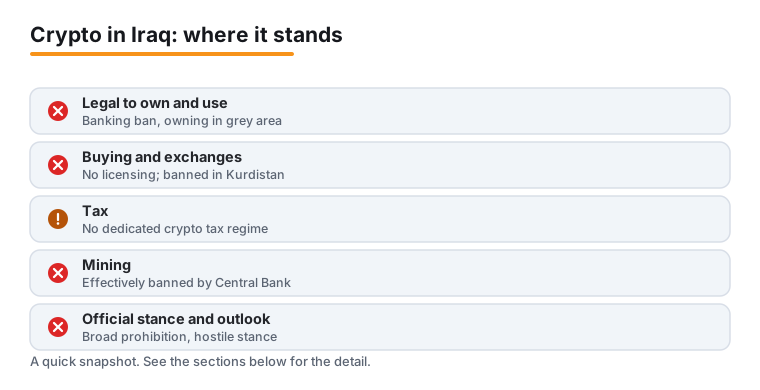
Crypto in Iraq sits in a legal grey area that tilts heavily towards prohibition. The Central Bank of Iraq has banned licensed financial institutions, meaning banks, money-transfer firms and electronic-payment providers, from handling cryptocurrency. That ban is the backbone of Iraq's stance: you cannot legally buy, sell or settle crypto through a regulated Iraqi bank, card or payment service. Reporting in 2025 and 2026 places Iraq among roughly ten countries that maintain a broad ban on crypto transactions.
The position of an ordinary individual is less clear-cut. There is no single statute that explicitly criminalises simply owning Bitcoin, so individual possession and informal P2P trading occupy an unregulated, ambiguous space rather than being a clearly defined crime. In practice, the absence of a clear permission is not a green light: because formal channels are closed, anyone transacting risks scrutiny under the country's anti-money-laundering framework if funds are traced back into the banking system. Enforcement has intensified in the Kurdistan Region, where authorities moved in 2025 to ban and shut down crypto and forex businesses. Treat crypto in Iraq as unsanctioned, increasingly policed in some areas, and legally risky, and verify the latest position before assuming anything.
Who regulates crypto in Iraq
The primary authority is the Central Bank of Iraq (CBI), which supervises banks and payment institutions and has issued the directives forbidding them from dealing in virtual assets. The CBI does not license or authorise crypto exchanges, custodians or any other virtual-asset service providers. Its official website is the first place to verify the current rules.
Several other bodies shape the picture:
- Iraqi AML/CFT authorities, operating under the Anti-Money Laundering and Counter-Terrorism Financing Law No. 39 of 2015 and the associated Anti-Money Laundering and Countering the Financing of Terrorism Office, apply to suspicious flows. Crypto activity that surfaces through banks can attract investigation.
- Kurdistan Regional Government (KRG): in the semi-autonomous north, the KRG Interior Ministry and Erbil's Asayish (security) and General Security directorates separately announced bans on cryptocurrency and forex trading in 2025, reinforcing the federal stance with on-the-ground enforcement.
Because there is no authorisation regime, there are no legally licensed crypto businesses in Iraq and no formal investor-protection or dispute-resolution mechanism for crypto users. Confirm the current status through official channels rather than relying on secondary summaries.
Key laws and frameworks
Iraq does not have a modern, purpose-built crypto statute with licensing, disclosure and consumer-protection rules. Instead, digital assets are governed by central-bank prohibitions layered on top of the country's general banking and anti-money-laundering controls.
The main building blocks are:
- CBI Circular No. 125/5/9 (29 March 2022): prohibits the use of payment cards and electronic wallets for speculation and trading in digital currencies of all kinds, binding licensed banks, licensed non-bank financial institutions and electronic payment companies. Reaffirmed by the CBI on 6 February 2023.
- CBI follow-up directive (26 March 2022): reaffirmed the prohibition and aligned the CBI's position with FATF recommendations on the money-laundering and terrorist-financing risks of virtual assets.
- Anti-Money Laundering and Counter-Terrorism Financing Law No. 39 of 2015: the country's core AML/CFT framework, under which dealings in virtual assets outside sanctioned channels can be treated as exposing participants to money-laundering and terrorist-financing risk.
There is no equivalent of a dedicated EU-style framework such as MiCA in Iraq, and no licensed virtual-asset service providers (VASPs). That gap is now something the government has formally committed to close: the action plan Iraq agreed with the FATF, published by the Central Bank on 19 June 2026, requires it to establish a legislative framework for virtual asset service providers, and the Central Bank convened a National Higher Committee for Regulating Virtual Assets on 14 December 2025 to design one. No draft text and no deadline have been published. Rules and enforcement can change with limited public notice, so confirm the current text of any directive through the CBI and official legal sources rather than relying on this summary alone.
Licensing and registration of exchanges and VASPs
There is no licensing or registration regime for crypto exchanges or virtual-asset service providers in Iraq. The CBI does not authorise crypto trading platforms, custodians, brokers or wallet providers, and the prohibition on financial institutions dealing in virtual assets means there is no compliant route for a domestic exchange to operate, settle or fund customer accounts through Iraqi banks.
In the Kurdistan Region, authorities have gone further than passive non-licensing: in 2025 the Erbil security directorates stated that digital currencies and forex platforms, including stablecoins such as Tether (USDT), are not licensed to operate in the region and are explicitly banned, and a KRG Interior Ministry committee was formed to enforce the closure of crypto and foreign-exchange companies. Authorities also reported arrests connected to forex and crypto fraud.
The practical consequence is that any platform marketing itself as a licensed Iraqi crypto exchange should be treated with extreme caution, because no such licence exists. International platforms accessed remotely operate outside the Iraqi authorisation regime and may restrict or freeze accounts linked to Iraq.
Crypto and Bitcoin tax in Iraq
Because crypto is restricted rather than formally regulated, Iraq does not publish a clear, dedicated tax regime for cryptocurrency gains, trading or mining. There is no official guidance that assigns specific capital-gains, income or sales-tax treatment to digital assets in the way some countries have done.
That absence should not be read as tax-free. Iraq operates general income and business taxes, and in principle any income or business activity could fall within their scope regardless of the asset involved. But there is no verified, crypto-specific rate, allowance or threshold to cite, and for most people the more immediate exposure is legal rather than fiscal, because funds moving outside sanctioned channels can attract AML scrutiny.
There is no crypto-specific rate in Iraq, so the general rules are what a disposal would be measured against. Iraq taxes individual income progressively at 3 percent up to IQD 250,000, 5 percent from 250,000 to 500,000, 10 percent from 500,000 to 1,000,000 and 15 percent above 1,000,000, and companies at 15 percent, rising to 35 percent for foreign oil and gas companies. Capital gains on sales of depreciable assets are taxed at the normal corporate rate, while gains on shares and bonds sold outside a trading activity may be exempted. Crypto fits none of those categories in any published Iraqi text, and the General Commission of Taxes has issued no guidance on it. If your situation involves Iraqi tax residency or income, do not assume any particular treatment; get advice from a qualified Iraqi tax professional and confirm against the latest official rules. For general background see our guide to crypto taxes. This section is informational only and is not tax advice.
AML and KYC rules
Anti-money-laundering and know-your-customer obligations are central to why Iraq restricts crypto. Under the Anti-Money Laundering and Counter-Terrorism Financing Law No. 39 of 2015, financial institutions must carry out customer due diligence, identify and verify customers, and report suspicious activity. The CBI has justified its prohibition on virtual assets by pointing to the money-laundering and terrorist-financing risks the FATF associates with crypto and the absence of a robust framework to supervise virtual-asset service providers.
For individuals, the key implication is that there is no compliant, KYC-checked domestic crypto platform to use. When crypto-related funds touch the regulated banking system, for example when someone tries to cash out, banks are required to apply AML controls and report suspicious transactions, which is how informal crypto activity can come to the attention of authorities. The KRG bans in 2025 were explicitly framed around fraud, the lack of a legal framework and the absence of protection for participants.
In short, Iraq applies AML/KYC duties to its regulated financial sector, and those duties are part of the reason crypto is pushed outside formal channels rather than supervised within them.
Buying and using crypto in practice
There is no legal route to buy crypto through a licensed domestic exchange in Iraq, and you cannot use Iraqi bank accounts, cards or payment apps to fund crypto purchases without running into the central bank's prohibition on financial institutions dealing in virtual assets. The regulated on-ramps common elsewhere, such as bank transfers to a licensed platform, card purchases and local exchanges, are not available in a compliant form.
What persists instead is informal and unauthorised: private peer-to-peer deals, cash trades and the use of foreign platforms accessed remotely. Each carries layered risks:
- Legal and AML risk: transactions outside sanctioned channels are not authorised and can be flagged.
- Counterparty risk: P2P trades offer no recourse if the other party defrauds you, and there is no regulator to complain to. Iraq has already seen sizeable crypto and forex fraud cases.
- Access risk: international platforms may restrict users connecting from Iraq, and account freezes can strand funds.
Using crypto to settle everyday purchases is equally unsupported, because no merchant acquirer or payment provider can legally process it. Articles describing growing interest in dinar-to-Bitcoin trading are describing informal demand, not a regulated market. We are not recommending any method of buying or using crypto in Iraq; the realistic picture is that it is neither sanctioned nor safe through formal means.
Bitcoin mining in Iraq
Bitcoin mining is not a sanctioned activity in Iraq and falls under the same restrictive stance that covers trading. Reporting indicates the CBI has effectively banned crypto mining, citing financial risk, the lack of regulatory control and energy consumption. Templated articles that highlight Iraq's cheap or subsidised energy as a mining opportunity ignore both the legal status and the practical constraints.
Several barriers reinforce the legal one:
- Electricity reliability: Iraq's grid suffers chronic shortages and load-shedding, especially in summer. Inconsistent supply undermines the uptime that profitable mining requires, and diverting subsidised power to mining is politically and legally sensitive.
- Regulatory exposure: with no licensing pathway, a mining operation has no legal footing, and visible energy use can draw the attention of authorities.
- Hardware and capital: importing and financing equipment is harder under banking restrictions.
In the Kurdistan Region in particular, authorities have moved against crypto businesses, raising the risk for any visible operation. Claims that Iraq could become a regional mining hub describe a hypothetical, not a present-day lawful industry. Until the legal stance changes and a proper framework exists, mining should be regarded as both unauthorised and impractical. This is not a recommendation to mine.
Recent developments (2025 to 2026)
The most significant recent moves are not a loosening of the crypto ban but two parallel trends. First, enforcement has tightened, especially in the Kurdistan Region: during 2025 the KRG Interior Ministry and Erbil's security directorates announced bans on cryptocurrency and forex trading, named platforms such as Tether (USDT) as unlicensed and prohibited, formed a committee to close crypto and forex companies, and reported fraud-related arrests.
Second, the CBI is pursuing a state-controlled alternative to private crypto. In February 2025 the CBI governor announced that the central bank is developing a central bank digital currency, often described as a digital dinar, intended to gradually replace cash, reduce printing costs, improve oversight of financial flows and support anti-money-laundering efforts. In a December 2025 update on its banking-sector reform programme, CBI governor Ali Al-Allaq described the digital dinar as still under implementation and needing time and infrastructure before launch, so as of 2026 the digital dinar has still not launched. The clearest official statement located is governor Ali Mohsen Al-Alak's remark in December 2025 that the digital dinar project is under implementation but requires time and robust infrastructure before launch. A CBDC is a state liability and is not the same as decentralised cryptocurrency, so its development does not legalise private crypto and in some respects reflects the authorities' preference for a controlled digital system over open virtual assets.
Third, the CBI's wider drive to clean up financial flows has squeezed the informal channels crypto tends to rely on. Through 2024 and 2025 the central bank, working with the US Treasury, barred a number of Iraqi banks from US dollar transactions over money-laundering and dollar-smuggling concerns, and it has pushed a formal banking-reform programme that all Iraqi banks signed, including a move towards a minimum paid-up capital of 400 billion Iraqi dinars, phased in at 50 billion dinars a year with the deadline extended to the end of 2027 after pressure from private banks. The CBI has also reported rising use of digital payments, with e-wallets and ATMs helping lift financial inclusion. None of this legalises private crypto; the direction of travel is towards tighter, state-supervised digital finance rather than open virtual assets.
Because this area is fast-moving and unevenly documented in English, treat any specific claim as provisional and confirm it against the official sources below.
Consumer risks and protection
The defining features of Iraq's crypto landscape are restriction, uneven enforcement and a lack of consumer protection. There is no local regulator overseeing crypto platforms, no deposit insurance, and no formal dispute-resolution or complaints process if a platform fails or a counterparty defrauds you. Authorities in the Kurdistan Region explicitly cited public losses, fraud and the absence of any legal framework when banning crypto and forex trading in 2025.
The main risks for residents include:
- Legal and AML exposure: formal channels are closed and transactions can be flagged or investigated.
- Fraud and counterparty loss: informal P2P deals and unlicensed platforms offer no recourse, and Iraq has seen multimillion-dollar fraud cases.
- Volatility and liquidity risk: prices can swing sharply, and converting back to usable dinars or dollars depends on informal channels that can be disrupted or shut down.
- Custody risk: self-custody mistakes such as lost keys or phishing are irreversible.
Because there is no official safety net, the practical conclusion is caution. Do not treat any single article, including this one, as the final word, and seek qualified local advice before considering any action.
Official sources and how to verify
Crypto rules in Iraq are evolving and are poorly documented in English, so always confirm the current position directly with official sources rather than relying on secondary summaries. The most authoritative starting points are:
- Central Bank of Iraq (CBI), the primary financial regulator, which issued the directives prohibiting financial institutions from dealing in virtual assets and is developing the proposed digital dinar.
- Iraq Anti-Money Laundering and Countering the Financing of Terrorism Office, for the AML/CFT framework under Law No. 39 of 2015 that underpins the restrictions, including the published AML/CFT Law of Iraq.
- Kurdistan24 report on the KRG Interior Ministry ban, documenting the 2025 enforcement action in the Kurdistan Region, which the KRG Ministry of Interior restated on 3 May 2026 when it again warned that foreign exchange and digital currency trading is unauthorised and that businesses offering it face closure and legal accountability.
For broader context, see our crypto regulation guide and country regulation index. This page is general information as of 2026 and is not legal, tax or financial advice; verify the current rules with the Central Bank of Iraq and a qualified Iraqi professional before acting.
What is changing: Iraq has committed to a virtual assets law
The most important change since this page was last reviewed is not a rule. It is a commitment. On 19 June 2026 the Central Bank of Iraq published the nine point action plan Iraq agreed with the Financial Action Task Force. The second item commits Iraq to enhance detection of informal money transfer or value services, to establish a legislative framework for virtual asset service providers, and to apply effective, proportionate and deterrent penalties for AML/CFT violations. Iraq was added to the FATF list of jurisdictions under increased monitoring, commonly called the grey list, at the same time.
That is a genuine reversal. The MENAFATF assessors had written in May 2024 that, on the information available to them, there was "currently no inclination in Iraq to regulate this activity". The groundwork was laid six months before the listing, when the Central Bank convened the first meeting of the National Higher Committee for Regulating Virtual Assets on 14 December 2025, chaired by then governor Ali Mohsen Al-Alak. Its stated aims are clear definitions, accurate classifications and a flexible, risk-based regulatory approach, AML/CFT compliance, mitigation of cyber risks, and a modern licensing environment.
Leadership changed in the middle of this. Nizar Nasser Hussein took charge as governor on 23 June 2026, succeeding Al-Alak, and the Central Bank's own site records him as governor in August 2026.
Where the pipeline actually stands:
| Step | Status in August 2026 | Timing |
|---|---|---|
| Commitment to a VASP legislative framework | Given, published by the CBI on 19 June 2026 | No deadline published |
| Drafting body | National Higher Committee convened 14 December 2025 | No second meeting or output found |
| Draft law or consultation paper | None found | Not stated |
| Licensing window for exchanges or custodians | None | Not open |
| CBI prohibition on cards and electronic wallets | Still in force, no repeal found | No repeal announced |
Read that as direction, not permission. Nothing in the action plan legalises anything today, and no Iraqi authority has invited licence applications. One clarification for readers who have seen headlines about a digital IQD: the design published in April 2026 is a third party proposal by a private firm, not Central Bank policy, and is not a CBDC launch.
What the FATF assessors actually found about holding crypto in Iraq
The most detailed official description of Iraq's crypto position is not a Central Bank statement. It is the MENAFATF mutual evaluation report of Iraq, dated May 2024. Its findings are more precise than the phrase grey area.
- "There are no officially recognized virtual asset service providers in Iraq. Trading or dealing in virtual assets in Iraq is not prohibited by any legal provisions."
- Virtual asset services are "not included among the financial activities that fall within the scope of the AML/CFT Law", and there are "no legal texts regulating or expressly prohibiting all activities of the VASPs as defined by the FATF".
- The Central Bank's warning and its decision "apply only to some subject entities, and do not apply to all natural persons and legal persons". The two documents the assessors cite in footnotes are the CBI public warning and the CBI decision barring cards and electronic wallets from digital currency trading.
- On Recommendation 15, criterion 15.1 was rated partly met and 15.2 met, while 15.3, 15.4, 15.5, 15.6 to 15.10 and 15.11 were all rated not met. Criterion 15.4 records that Iraq "has not taken the necessary measures by requiring VASPs to be registered or licensed", and 15.11 that there is no legal basis for international cooperation on virtual asset cases.
The practical reading is narrow and worth stating plainly. The prohibition binds supervised institutions, which is why there is no legal route to buy. On the face of the published texts it does not criminalise a private individual for holding coins. That gap is what the promised VASP framework is meant to close, and closing it will bring obligations for holders and platforms, not a new freedom.
No other Iraqi regulator has filled the gap meanwhile. The Iraqi Securities Commission, established under Law No. 74 of 2004, regulates the capital market and publishes nothing on virtual assets. Its most recent supervisory move was a risk based oversight guide for brokerage companies issued in May 2026, which does not mention crypto.
The tax rules that apply because no crypto tax rule exists
The General Commission of Taxes publishes no guidance on digital assets, and no Iraqi form names them. Stopping there leaves a reader with nothing, so these are the general rules a disposal would be measured against under Iraq's income tax framework.
| Base | Rate or treatment |
|---|---|
| Individual income up to IQD 250,000 | 3 percent |
| IQD 250,000 to 500,000 | 5 percent |
| IQD 500,000 to 1,000,000 | 10 percent |
| Above IQD 1,000,000 | 15 percent |
| Corporate income | 15 percent, and 35 percent for foreign oil and gas companies |
| Capital gains on sales of depreciable assets | Taxed at the normal corporate rate |
| Shares and bonds sold outside a trading activity | May be exempted from tax |
| Shares and bonds sold in the course of a trading activity | Taxed at the normal corporate rate |
Rates as summarised by PwC for individuals and companies, and the capital gains treatment, all last reviewed 24 June 2026.
Crypto is not a share, not a bond and not a depreciable asset, so none of these categories maps onto it cleanly, and no published Iraqi source states how a crypto disposal is classified. What is documented is that all income derived from Iraq is taxable regardless of where the recipient resides. There is no published exemption for private crypto gains and no published rule taxing them either. That is a gap in the law rather than a rate of zero, and it is one of the things a VASP framework would have to settle.
Kurdistan Region: the ban was restated in May 2026
Enforcement in the Kurdistan Region is more recent than this page indicates, and it is a sequence rather than a single event.
- June 2025: the Kurdistan Regional Government ordered the closure of all forex and cryptocurrency companies operating in the region.
- 3 May 2026: the KRG Ministry of Interior restated the position, saying there is no legal framework that protects the rights and interests of citizens, that no company operating in electronic currencies or forex trading has official authorization in the Kurdistan Region and federal Iraq, and that all such transactions are prohibited under applicable laws. It warned that any individual or group operating under a company name in these areas would face closure and legal accountability. Reporting on the same directive named USDT among the digital currencies covered.
This matters for anyone reading from Erbil or Sulaymaniyah rather than Baghdad. The federal prohibition is aimed at financial institutions. The Kurdistan directive is addressed to traders and to businesses offering the service, and it has been acted on.
Frequently asked questions
Is cryptocurrency legal in Iraq in 2026?
No, not in any regulated sense. The Central Bank of Iraq prohibits banks and payment firms from dealing in virtual assets through Circular No. 125/5/9 of November 2021, reaffirmed in 2022, so there is no legal on-ramp through the formal financial system, and Iraq is listed among the countries with a broad crypto ban. No single statute clearly criminalises an individual simply owning Bitcoin, so individual possession sits in an unregulated grey area, but transacting outside sanctioned channels can attract anti-money-laundering scrutiny. Confirm the current position with the Central Bank of Iraq before acting.
Who regulates crypto in Iraq?
The Central Bank of Iraq (CBI) is the main authority and has prohibited licensed financial institutions from handling virtual assets. There is no dedicated crypto licensing regime, so no exchanges or custodians operate legally. Iraq's AML/CFT framework under Law No. 39 of 2015 applies to suspicious flows, and in the north the Kurdistan Regional Government and Erbil security directorates separately banned crypto and forex trading and enforced company closures during 2025.
Can crypto exchanges get a licence in Iraq?
No. There is no licensing or registration regime for crypto exchanges or virtual-asset service providers in Iraq, and the Central Bank of Iraq does not authorise crypto platforms, custodians or wallet providers. In the Kurdistan Region, authorities have stated that crypto and forex platforms, including stablecoins such as USDT, are unlicensed and banned, and have moved to close such companies. Any platform claiming to be a licensed Iraqi crypto exchange should be treated as a red flag.
Are there crypto taxes in Iraq?
There is no clear, published crypto-specific tax regime, because digital assets are restricted rather than formally regulated. That does not make activity safely tax-free; general income and business taxes could in principle apply, and the bigger exposure is often legal. We do not cite specific rates because no credible official source defines them for crypto in Iraq; consult a qualified Iraqi tax professional. This is informational only and is not tax advice.
Is Bitcoin mining allowed in Iraq?
No. Mining is unauthorised under Iraq's restrictive stance, and reporting indicates the Central Bank of Iraq has effectively banned it, citing financial risk, regulatory control and energy consumption. It also faces serious practical barriers, chiefly an unreliable electricity grid with frequent shortages, plus regulatory exposure and import constraints. Regional authorities have acted against crypto businesses, so it should not be treated as a viable activity for residents.
Is Iraq launching its own digital currency?
The Central Bank of Iraq announced in early 2025 that it is developing a central bank digital currency, often called a digital dinar, intended to gradually replace cash and improve oversight of financial flows. As of 2026 it remains in the research and development phase with no confirmed public launch date. A CBDC is state-issued and is not the same as decentralised cryptocurrency, so its development does not legalise private crypto. Check the Central Bank of Iraq for the latest status.
Can I use Tether (USDT) or stablecoins in Iraq?
There is no licensed, legal route to use stablecoins in Iraq. In the Kurdistan Region, authorities stated during 2025 that digital currencies and forex platforms, including Tether (USDT), are not licensed to operate and are banned, and they moved to close crypto and forex companies. Any stablecoin activity happens through informal or foreign channels outside the regulated system and carries the same legal, AML and fraud risks as other crypto. Confirm the current position with official sources before assuming anything.
Why does Iraq restrict crypto so tightly?
The Central Bank of Iraq frames its prohibition around money-laundering and terrorist-financing risks and the absence of a framework to supervise virtual-asset providers. This sits within a wider push to clean up financial flows: through 2024 and 2025 the CBI, working with the US Treasury, barred several Iraqi banks from US dollar transactions over dollar-smuggling and money-laundering concerns, and it has pursued a banking-reform programme and a state-controlled digital dinar. The overall direction is towards tighter, supervised digital finance rather than open private crypto.
Is Iraq getting a crypto law?
A commitment exists but a bill does not. The action plan Iraq agreed with the FATF, published by the Central Bank of Iraq on 19 June 2026, requires Iraq to establish a legislative framework for virtual asset service providers, and the Central Bank convened a National Higher Committee for Regulating Virtual Assets on 14 December 2025 to design one. As of August 2026 no draft text or consultation paper has been published, and no deadline has been published either.
Does Iraq's FATF grey listing change anything for crypto users?
Not directly, and not yet. The listing on 19 June 2026 obliges the state rather than individuals. Its practical effects are that Iraqi banks face heavier correspondent scrutiny, so moving crypto proceeds through the banking system is more likely to be questioned, and that Iraq now has an international reason to write virtual asset rules instead of only issuing warnings.
Is it a crime to hold Bitcoin in Iraq?
No published Iraqi law located for this review criminalises it. The MENAFATF mutual evaluation of Iraq, dated May 2024, states that trading or dealing in virtual assets in Iraq is not prohibited by any legal provisions, and that the Central Bank's warning and decision apply only to some subject entities and do not apply to all natural persons and legal persons. What is prohibited is banks and non-bank financial institutions allowing cards and electronic wallets to be used for trading digital currencies, which is why there is no lawful way to buy. In the Kurdistan Region the Ministry of Interior went further on 3 May 2026 and told citizens and businesses that such trading is unauthorised and prohibited.
Which Iraqi regulator would license a crypto exchange?
None today. The Central Bank of Iraq chairs the committee designing the virtual assets framework and is the likely future licensing authority. The Iraqi Securities Commission, established under Law No. 74 of 2004, regulates the capital market and publishes nothing on virtual assets. Any platform claiming an Iraqi licence in August 2026 is misrepresenting itself.
Facts reviewed: 13 August 2026. Page updated: 13 August 2026.