Home › Crypto Regulation › Egypt
Bitcoin & Cryptocurrency Regulation in Egypt
Quick answer — Egypt, 2026
- Legal: Dealing prohibited without central bank approval, none granted; not legal tender
- Tax: No crypto tax rate and no way to declare crypto to the Tax Authority; the only defaults are personal income tax up to 27.5 percent and corporate tax at 22.5 percent
- Buying: No approved local exchanges, residents use P2P and offshore platforms
Egypt has one of the most restrictive cryptocurrency frameworks in the Middle East and North Africa. Under the Central Bank and Banking Sector Law No. 194 of 2020, issuing, trading, promoting or operating platforms for crypto assets without prior approval from the Central Bank of Egypt (CBE) is prohibited, and no such approval is publicly known to have been granted. The CBE is the lead authority, with the Financial Regulatory Authority (FRA) covering non-banking financial markets and the Egyptian Money Laundering and Terrorist Financing Combating Unit (EMLCU) handling anti-money-laundering enforcement. A widely cited religious ruling from Egypt's Dar al-Ifta has reinforced public caution. This guide explains, in plain language, how crypto is treated in Egypt as of 2026, covering legal status, the regulators, the key laws, exchange and licensing rules, tax, AML/KYC, mining, recent developments, consumer risks and how to verify the rules yourself.
This page is general information as of 2026 and is NOT legal, tax or financial advice. Egyptian rules in this area are strict and can change. Always confirm the current position directly with the Central Bank of Egypt and, where relevant, a qualified Egyptian lawyer or licensed tax adviser before acting. For broader context, see our guide to crypto regulation and our country index at crypto regulation by country.
On this page: Legal status · Who regulates it · Taxes · How to buy · Mining
Is Bitcoin and crypto legal in Egypt?
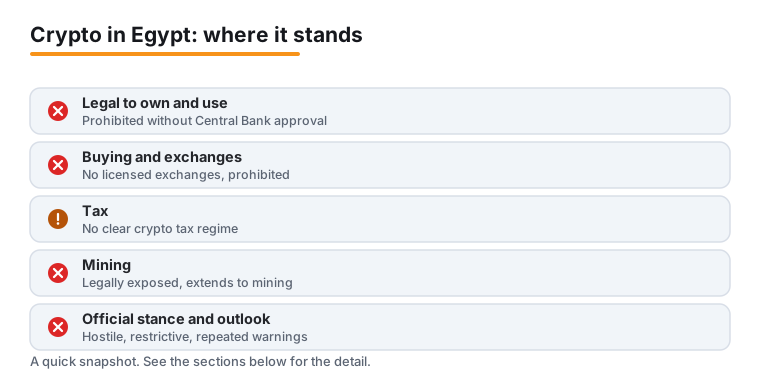
In practical terms, dealing in cryptocurrency in Egypt is prohibited unless it is done with prior approval from the Central Bank of Egypt, and no such approval is publicly known to exist. Egyptian law does not recognise Bitcoin or any other crypto asset as legal tender or as an official means of payment.
It helps to separate two things that are often confused:
- The law on the books. Issuing, trading, promoting or operating platforms for crypto assets, or brokering related transactions, without prior CBE approval is prohibited under Law No. 194 of 2020. Because the CBE is not known to have authorised any crypto activity, there is currently no compliant domestic route for an ordinary business or individual.
- Reality on the ground. Many Egyptians still acquire crypto, typically through peer-to-peer (P2P) trades and offshore exchanges. This activity is widespread, but it does not make it lawful, and participants carry the legal and financial risk themselves.
Because there is no licensed domestic market, there is also no domestic consumer-protection backstop and no clear legal recourse if funds are lost, stolen or frozen. Treat any crypto activity in Egypt as legally exposed, and verify the latest CBE position before doing anything.
Who regulates crypto in Egypt?
Several authorities are involved, but one is clearly in the lead.
- Central Bank of Egypt (CBE) is the primary authority for crypto and for the banking and payments system generally. It administers the prohibition under Law No. 194 of 2020 and has issued repeated public warnings against dealing in crypto. Official site: Central Bank of Egypt.
- Financial Regulatory Authority (FRA) supervises Egypt's non-banking financial markets (capital markets, insurance, leasing, mortgage finance and similar). The FRA has also publicly warned the public against dealing in unlicensed crypto and virtual-asset offerings. Official site: Egyptian Financial Regulatory Authority.
- Egyptian Money Laundering and Terrorist Financing Combating Unit (EMLCU) is the country's financial intelligence unit, responsible for anti-money-laundering and counter-terrorist-financing supervision and suspicious-transaction reporting under Law No. 80 of 2002.
Enforcement is not limited to financial regulators. Egyptian authorities, including law-enforcement and telecommunications bodies, have at times acted against crypto-related operations and access. The CBE remains the body whose stance and warnings define the legal baseline.
Key laws and frameworks
The cornerstone of Egypt's approach is the Central Bank and Banking Sector Law No. 194 of 2020. Its provisions on digital assets, widely referenced as Article 206, prohibit the issuance, trading or promotion of crypto assets (broadly described as "cryptographic units"), and the operation of related platforms or brokering of related transactions, without prior approval from the Central Bank of Egypt.
Two further frameworks matter:
- Anti-Money Laundering Law No. 80 of 2002 (with later amendments) criminalises money laundering, requires suspicious-transaction reporting and customer due diligence, and is enforced through the EMLCU. Executive-regulation updates have aligned Egypt more closely with Financial Action Task Force (FATF) standards and extended reporting obligations toward fintech and virtual-asset activity.
- A religious ruling (fatwa) from Dar al-Ifta. Egypt's leading Islamic authority issued a fatwa around 2017 to 2018 describing dealing in Bitcoin as haram, citing speculation, lack of clear rules and risk of misuse. A fatwa is religious guidance, not a statute, but it has strongly shaped public opinion and sits alongside the legal prohibition.
Egypt has shown openness to blockchain technology in controlled, regulated settings (for example banking infrastructure and digital-government work). That is distinct from permitting open trading of cryptocurrencies and should not be read as a relaxation of the prohibition.
Licensing and registration of exchanges and VASPs
Egypt does not operate an open licensing or registration regime for crypto exchanges or virtual-asset service providers (VASPs) the way some permissive jurisdictions do. Law No. 194 of 2020 sets out, in principle, that crypto activity requires prior approval from the CBE, but the CBE is not publicly known to have granted any such approval. The practical result is that there is no clearly compliant, CBE-authorised domestic crypto exchange.
What this means in practice:
- No licensed domestic platforms. Global exchanges may be reachable from Egypt, and many residents use them, but doing so without authorisation runs against the prohibition and is not endorsed here.
- AML obligations sit on regulated entities. Banks, exchange houses and other reporting entities operate under CBE oversight and AML Law No. 80 of 2002, which makes them generally unwilling to facilitate crypto transactions.
- The position can evolve. Because the statute contemplates an approval route in principle, any future change would most likely be announced by the CBE. Always confirm the current licensing position with the regulator before relying on any service.
Crypto and Bitcoin tax in Egypt
Because trading cryptocurrency without approval is prohibited, Egypt does not operate a clear, dedicated tax regime for everyday crypto trading. There is no published, crypto-specific capital-gains rate or filing mechanism that can be relied upon, and the Egyptian Tax Authority does not provide a section to declare crypto gains. We will not state a rate that cannot be verified.
Points to keep in mind:
- The absence of a published crypto tax rate does not automatically mean income or gains are tax-free. Egypt's general income tax law, Law No. 91 of 2005 as most recently amended by Law No. 151 of 2026 which took effect on 29 July 2026, taxes individual income on a progressive scale that reaches 27.5 percent above EGP 1.2 mn and company profits at a standard 22.5 percent, and any taxable crypto gain would have to be fitted into those general rules rather than a crypto-specific one, and profiting from digital assets can still attract scrutiny under general income and anti-money-laundering rules.
- Activity that is itself unlicensed sits in a prohibited zone, which makes "compliant" reporting genuinely complicated.
- Treatment can differ for individuals, registered businesses and any future authorised entities.
This section is informational only and is not tax advice. See our introduction to crypto taxes for general background, and consult a licensed Egyptian tax adviser and the Egyptian Tax Authority before assuming any treatment.
AML, KYC and reporting
Egypt has an established anti-money-laundering framework under Law No. 80 of 2002, enforced by the EMLCU and supported by the CBE and FRA. The law requires regulated entities (banks, exchange houses, insurers and other designated businesses) to carry out customer due diligence, monitor transactions, keep records and report suspicious activity.
For crypto specifically:
- Updates to the executive regulations have moved Egypt toward FATF standards and broadened reporting expectations toward fintech and virtual-asset activity, reflecting the EMLCU's role as the national financial intelligence unit.
- KYC requirements that apply to banks and payment providers make it difficult to move funds between Egyptian bank accounts and offshore crypto platforms without triggering scrutiny.
- Both the CBE and the FRA have framed crypto as carrying heightened money-laundering, fraud and terrorist-financing risk, which is part of the official rationale for the restrictive stance.
The takeaway: AML/KYC controls in Egypt are designed to channel funds through the regulated banking system, which works against informal crypto flows.
Buying and using crypto in practice
There are no CBE-approved domestic cryptocurrency exchanges in Egypt, and there is no clearly lawful retail route to buy crypto domestically. Many Egyptians nonetheless transact via P2P and offshore platforms, but several frictions shape whether and how that happens:
- Foreign-exchange controls. Egypt maintains tight controls on foreign currency and cross-border transfers. These directly complicate funding offshore accounts, converting Egyptian pounds and withdrawing proceeds.
- Banking access. Local banks operate under CBE oversight and generally avoid facilitating crypto purchases, so card and bank-transfer routes to exchanges are unreliable.
- P2P and informal channels. Much real-world activity happens peer-to-peer, which adds counterparty risk, the possibility of fraud and no recourse if a deal goes wrong.
- ATMs. Egypt does not have a recognised, lawful network of Bitcoin or crypto ATMs. Any device advertised as one should be treated with strong caution, as its legal standing is doubtful and there is no consumer-protection backstop.
For most readers, the responsible conclusion is to wait for a clear, authorised framework rather than rely on grey-market channels, and to verify the current CBE stance before acting.
Bitcoin mining in Egypt
Cryptocurrency mining is not carved out as a permitted activity. Egypt's Court of Cassation has settled this. In Appeal No. 18106, Judicial Year 92, it rejected the argument that merely possessing mining machines is not criminalised, holding that carrying out activities related to cryptocurrencies and electronic money without a licence from the Central Bank board falls under Articles 206 and 225/1 of Law No. 194 of 2020. The court also held that the law applied regardless of the absence of executive regulations, and that ignorance of the law or misunderstanding its provisions does not negate criminal intent. Authorities have at times acted against crypto-related operations.
Beyond the legal question, mining in Egypt also faces hard economics:
- Electricity and grid pressure. Power costs, tariff structures and periods of grid strain make large-scale mining difficult to run profitably and discreetly.
- Equipment and import constraints. Sourcing and importing specialised hardware is complicated by currency controls and customs considerations.
- Heat and cooling. Egypt's climate raises cooling demands, adding capital and running cost.
In short, mining is both legally exposed and operationally challenging, and there is no authorised framework that makes it clearly compliant for private operators today.
Recent developments (2025 to 2026)
The direction of travel through 2025 and into 2026 has been continuity of the restrictive stance, alongside growing official interest in a state-controlled digital currency.
- Renewed warnings. The most recent official public warning came from the Financial Regulatory Authority, not the CBE. In a statement in May 2025, issued after a surge in local online adverts for investment in these tools, the FRA said the absence of a regulatory body to protect investor rights makes dealing in these currencies risky, warned they could be used in fraud, money laundering and terrorist financing because their transactions are hard to track, noted they lack official financial backing that guarantees their stability, and urged citizens to report suspected crypto dealings to the FRA. The CBE has repeated this stance across several years, with prior warnings reported in 2018, 2021, 2022 and 2023 (the 2023 statement was described as its fourth warning). The FRA has issued parallel warnings about unlicensed crypto and virtual-asset offerings.
- Adoption despite the ban. Reporting through 2024 and 2025 describes rising informal crypto use, driven by currency devaluation and limits on moving money abroad. Estimates vary widely and are not official: some analyses put Egyptian holders in the low millions, and market trackers such as Statista have projected user-penetration figures in the region of roughly ten percent. Treat all such figures as rough estimates, not government data, since the activity is unlicensed and hard to measure.
- Digital pound (CBDC) exploration. The CBE has reported work on a central bank digital currency, sometimes called the digital or e-pound. Its 2024 financial-stability report noted that the bank had completed the first phase of its CBDC study and had begun preparing a proof-of-concept phase. As of July 2026 the CBE had completed its initial research phase and moved on to proof of concept, with official rollout broadly targeted for 2030. That timeline is anchored in a 2024 cabinet IDSC roadmap that ties the e-Pound to a state mandate of 100 percent financial inclusion and 80 million active e-wallets by the end of the decade. Official commentary has framed a future CBDC partly as a tool to reduce private crypto use. A CBDC is a state-controlled instrument, not a legalisation of private crypto.
- International cooperation. In mid-2025 the CBE announced an agreement with the People's Bank of China that included provisions to strengthen cooperation on central bank digital currencies.
- Stablecoin debate. There has been public discussion about whether Egypt should regulate or permit stablecoins to support trade and remittances, but no stablecoin issuance or trading approval has been disclosed, and the default prohibition still applies.
None of these developments, as of 2026, amounts to legalising private crypto trading. The realistic expectation is gradual, institution-first adoption of blockchain and a possible CBDC rather than a near-term opening of a retail crypto market.
Consumer risks and protection
Egypt combines several reinforcing pressures: a legal prohibition on unauthorised crypto activity, tight foreign-exchange controls, an influential (though non-binding) religious ruling, and active official warnings. Together these create a distinctive risk stack that goes well beyond ordinary market volatility:
- Legal risk. Unauthorised crypto activity is prohibited, exposing participants to penalties. Legal commentary on Article 206 of Law No. 194 of 2020 commonly cites imprisonment and a fine of not less than EGP 1 million and not more than EGP 10 million, set by Article 225 of the same law, which covers breaches of Articles 63, 184, 205 and 206. Treat any specific figure as indicative only and confirm current statutory amounts and enforcement practice with a qualified Egyptian lawyer.
- No domestic protection. Because there is no authorised domestic market, there is no consumer-protection scheme and no clear recourse if funds are lost, stolen or frozen.
- Access and exit risk. Currency controls and reluctant banks make it hard to move money in and, critically, to cash out cleanly.
- Fraud risk. Informal P2P and offshore channels are fertile ground for scams.
- Market risk. Crypto prices are highly volatile and assets can lose substantial value quickly.
If you encounter a promotion promising guaranteed crypto returns in Egypt, treat it as a red flag and check whether the entity is named in CBE or FRA warnings before engaging.
Official sources and how to verify
Because this area is restrictive and evolving, always confirm the current rules with primary, official sources rather than secondary summaries. The most authoritative references are:
- Central Bank of Egypt (CBE), the lead regulator, for warnings, the banking law and any licensing announcements.
- Egyptian Financial Regulatory Authority (FRA) for non-banking financial markets and investor warnings.
- General Authority for Investment (laws and regulations portal) for the text of Anti-Money Laundering Law No. 80 of 2002 and related instruments.
To verify the position yourself: check the CBE's news and warnings section for the latest statement, confirm whether any crypto approval or licence has actually been granted (rather than merely contemplated by the statute), and read the current AML obligations. For evolving points such as a possible digital pound or stablecoin rules, rely only on official CBE announcements.
This guide is general information as of 2026 and is not legal, tax or financial advice. Verify the current rules with the Central Bank of Egypt and a qualified Egyptian professional before acting. For more background see how crypto regulation works and our regulation by country index.
What is changing: Egypt in August 2026
Egypt's crypto position did not change between 30 June and 3 August 2026. Article 206 of the Central Bank and Banking Sector Law No. 194 of 2020 is still the whole of the crypto rulebook, and the Central Bank of Egypt has still created no licence for private crypto activity. Four dated developments around that position are worth knowing.
- The most recent official public warning came from the Financial Regulatory Authority, not the Central Bank. In a statement in May 2025, issued after a surge in local online adverts for investment in these tools, the FRA said the absence of a regulatory body to protect investor rights makes dealing in these currencies risky, warned they could be used in fraud, money laundering and terrorist financing because their transactions are hard to track, noted they lack official financial backing that guarantees their stability, and urged citizens to report suspected crypto dealings to the FRA. Reported by AGBI on 12 May 2025.
- An independent legal review published on 3 July 2026 confirms there is still no way in. The Egypt chapter of the ICLG Fintech Laws and Regulations 2026 guide, written by Shehata and Partners, states that no licensing framework has been made available for private cryptocurrency activities and that the regulatory position continues to reflect a firmly restrictive approach. See ICLG Fintech 2026, Egypt.
- Egypt rewrote large parts of its tax code in July 2026 and left digital assets out of it. President El-Sisi signed Laws 148 to 154 of 2026, covering state resource development fees, VAT, the Unified Tax Procedures Law, income tax, tax dispute settlement, stamp tax and state enterprise profits. The income tax law in that package, Law No. 151 of 2026, was published in Official Gazette No. 30 bis (a) of 28 July 2026 and took effect the day after publication. Its text contains no cryptocurrency or digital-asset provision. Reported by Business Today Egypt on 30 July 2026; the enacted text is published by the Egyptian Tax Authority.
- The digital pound moved from study to proof of concept. As of 7 July 2026 the CBE had completed its initial research phase and moved on to proof of concept, with rollout broadly targeted for 2030 under a 2024 cabinet IDSC roadmap that ties the e-Pound to 100 percent financial inclusion and 80 million active e-wallets by the end of the decade. See EnterpriseAM, 7 July 2026.
No crypto bill or crypto licensing framework for Egypt is recorded for 2026 by the Digital Policy Alert country tracker, whose most recent Egyptian entries concern artificial intelligence and data centres.
What the law actually punishes, and how Egyptian courts have applied it
The prohibition sits in Article 206 of Law No. 194 of 2020. The penalty sits in Article 225 of the same law, which punishes breaches of Articles 63, 184, 205 and 206 with imprisonment and a fine of not less than EGP 1 million and not more than EGP 10 million. That range is reported by Al-Masry Al-Youm and Al-Nahar. The ICLG Fintech 2026 Egypt chapter published on 3 July 2026 gives the same EGP 1 million to EGP 10 million range, though it does not name Article 225.
Egypt's Court of Cassation has applied Article 206 to crypto mining. In Appeal No. 18106, Judicial Year 92, the court rejected the defence that merely possessing mining machines is not criminalised, holding that carrying out activities related to cryptocurrencies and electronic money without a licence from the Central Bank board falls under Articles 206 and 225/1 of Law No. 194 of 2020. The court also held that the law was in effect before the case was brought and applied regardless of the absence of executive regulations, and that ignorance of the law or misunderstanding its provisions does not negate criminal intent, because knowledge of penal law is presumed. Reported on 10 August 2025. Separately, Sada El Balad reported on 8 November 2025 on a Court of Cassation ruling setting out the penalty for trading in cryptocurrencies and confirming that ignorance of the law does not negate criminal intent.
Two things follow for a reader. Mining is not an untested grey area in Egypt, it has been ruled on at the highest court. And two arguments that people commonly rely on, that no executive regulations were issued and that they did not know the rule, have both been rejected.
What tax rules apply when there is no crypto tax
Egypt has no crypto tax rule, no published crypto rate, and no line on an Egyptian Tax Authority return for declaring crypto gains. That is still true in August 2026, after the tax package that took effect on 29 July 2026. What does exist is the general income tax law, Law No. 91 of 2005, most recently amended by Law No. 151 of 2026. These are the rates that frame any Egyptian question about the disposal of an asset.
| What is being taxed | Rate | Source |
|---|---|---|
| Individual income, progressive scale | 0 percent up to EGP 40,000; 10 percent to EGP 55,000; 15 percent to EGP 70,000; 20 percent to EGP 200,000; 22.5 percent to EGP 400,000; 25 percent to EGP 1.2 mn; 27.5 percent above that | PwC, reviewed 4 February 2026 |
| Company profits, standard rate | 22.5 percent | PwC, reviewed 4 February 2026 |
| Gains on unlisted shares held by a resident individual | Subject to the individual income tax brackets, so up to 27.5 percent | PwC, reviewed 4 February 2026 |
| Gains on shares listed on the Egyptian Exchange | Capital gains tax cancelled by the 2026 amendments, which also waive unpaid capital gains tax for the period from 16 June 2023 to the law's commencement, leaving stamp duty. The bill as presented in May 2026 set a tiered stamp tax of 0.05 percent on market makers and blue chips and 0.1 percent on other shares | Law No. 151 of 2026, Article 5, EnterpriseAM, 10 May 2026 |
| Sale of real estate | 2.5 percent flat, payable within 60 days instead of the previous 30 | Parliament reporting, 29 June 2026 |
| Crypto disposals | No published rate, no filing mechanism, no Tax Authority guidance | None exists |
None of these rates is a crypto rate, and this table is not a statement that crypto is taxed at any of them. It is the set of rules an Egyptian adviser has to work with, and it shows what the 2026 reforms did and did not do. It also leaves one problem that no rate solves: an activity that is itself prohibited under Article 206 is not made lawful by declaring the profit.
What is coming, and roughly when
| Track | Stage on 3 August 2026 | Timing | What it would mean in practice |
|---|---|---|---|
| A CBE licensing framework for crypto under Article 206 | Not proposed. No draft, no consultation, no announcement found | None published | Article 206 allows the Central Bank board to license crypto activity. Until it does, there is no lawful domestic route for an exchange, a broker or a retail buyer |
| Digital pound (e-Pound) | Proof of concept at the Central Bank of Egypt | Rollout broadly targeted for 2030, per a 2024 cabinet IDSC roadmap | State-issued digital EGP. It is not a legalisation of Bitcoin or stablecoins. Analysts quoted in Egyptian financial press expect wholesale settlement use before any retail launch |
| New income tax law announced by the Ministry of Finance | Announced only. No published draft or opened consultation could be confirmed | The Ministry said in November 2025 that a draft would go to community dialogue in preparation for referral to the House of Representatives the following year. No enactment date published | The most plausible vehicle that could create an explicit crypto tax rule. Nothing published about it mentions digital assets |
| Tax package, Laws 148 to 154 of 2026 | In force | Gazetted 28 July 2026, effective from 29 July 2026 | Changes income tax, VAT, stamp tax, tax procedures and dispute settlement. Creates no crypto rule and no way to declare crypto gains |
On the published record the pipeline contains a state digital currency and a tax rewrite, and nothing that would open a retail crypto market. A reader planning around Egypt should assume the Article 206 prohibition holds until the Central Bank itself announces otherwise.
Frequently asked questions
Is it illegal to own Bitcoin in Egypt?
Egyptian law prohibits issuing, trading, promoting or facilitating cryptocurrency without prior approval from the Central Bank of Egypt, and no such approval is publicly known to have been granted. In practice this makes unauthorised crypto activity legally exposed. Many people still hold crypto via P2P and offshore platforms, but they carry the legal and financial risk themselves, with no domestic recourse. Confirm the current position with the CBE and a qualified lawyer.
Which law governs cryptocurrency in Egypt and who is the regulator?
The main instrument is the Central Bank and Banking Sector Law No. 194 of 2020. Its digital-asset provisions, commonly referenced as Article 206, prohibit dealing in crypto assets without prior approval from the Central Bank of Egypt (CBE), which is the lead regulator. The Financial Regulatory Authority (FRA) oversees non-banking financial markets and has also warned against crypto, while the EMLCU handles anti-money-laundering enforcement. Always check the latest statutory text with an Egyptian legal professional.
Can I get a crypto exchange licence in Egypt?
Law No. 194 of 2020 contemplates an approval route in principle, but the CBE is not publicly known to have granted any crypto licence or approval, so there is no open licensing or registration regime for exchanges or VASPs today. There is currently no clearly compliant, CBE-authorised domestic crypto exchange. Any future change would most likely be announced by the CBE, so verify the current licensing position directly with the regulator.
Do I have to pay tax on crypto gains in Egypt?
Egypt does not publish a clear, dedicated crypto tax regime, and the Egyptian Tax Authority provides no mechanism to declare crypto gains, so we will not state a rate that cannot be verified. That absence does not guarantee gains are tax-free, since general income-tax principles could be argued to apply depending on the facts, and profits can attract scrutiny under general income and anti-money-laundering rules. Because the underlying activity is itself prohibited, the position is genuinely complex. Consult a licensed Egyptian tax adviser.
What are the penalties for dealing in crypto in Egypt?
Breaching the prohibition can attract criminal sanctions. Legal commentary on Article 206 of Law No. 194 of 2020 commonly cites imprisonment of about three to six months and a fine in the range of EGP 200,000 to EGP 10 million. Treat any specific figure as indicative only and confirm the current statutory amounts and enforcement practice with a qualified Egyptian lawyer.
Is Egypt planning to legalise crypto or launch a digital pound?
As of 2026 there is no sign of Egypt legalising private crypto trading; the CBE renewed its warning in 2025 and the default prohibition still applies. Separately, the CBE has reported exploring a central bank digital currency (a digital or e-pound), including study and proof-of-concept work, and has framed it partly as a way to reduce private crypto use. A CBDC is a state-controlled instrument and is not the same as legalising Bitcoin. Rely only on official CBE announcements for updates.
Why do so many Egyptians use crypto if it is banned?
The prohibition applies to unauthorised issuing, trading and promotion, but reporting through 2024 and 2025 still describes rising informal use. The main drivers cited are devaluation of the Egyptian pound and tight limits on moving money abroad, which push some people toward crypto and stablecoins held via peer-to-peer and offshore platforms. Estimates of the number of holders vary widely and are not official figures. This activity remains legally exposed with no domestic recourse, so it does not make crypto lawful.
Is crypto mining illegal in Egypt?
Yes. Egypt's Court of Cassation, in Appeal No. 18106 of Judicial Year 92, rejected the argument that simply possessing mining machines is not a crime. It held that carrying out activities related to cryptocurrencies and electronic money without a licence from the Central Bank board falls under Articles 206 and 225/1 of Law No. 194 of 2020. The court also held that the law applied regardless of the absence of executive regulations, and that not knowing or misunderstanding the law does not remove criminal intent. Article 225 sets the penalty at imprisonment and a fine of not less than EGP 1 million and not more than EGP 10 million.
Did Egypt's 2026 tax reforms create a crypto tax?
No. President El-Sisi signed Laws 148 to 154 of 2026, a package covering state resource development fees, VAT, the Unified Tax Procedures Law, income tax, tax dispute settlement, stamp tax and state enterprise profits. The income tax law in that package, Law No. 151 of 2026, was published in Official Gazette No. 30 bis (a) of 28 July 2026 and took effect the following day. Its text contains no cryptocurrency or digital-asset provision. Egypt still has no crypto tax rate and no mechanism to declare crypto gains to the Egyptian Tax Authority. The general rates remain a progressive personal income tax topping out at 27.5 percent and a standard corporate rate of 22.5 percent.
Who issued Egypt's most recent official crypto warning?
The Financial Regulatory Authority, in May 2025, after a surge in local online adverts for investment in these tools. The FRA said the absence of a regulatory body to protect investor rights makes dealing in these currencies risky, warned they could be used in fraud, money laundering and terrorist financing because their transactions are hard to track, and urged citizens to report suspected crypto dealings to it. The Central Bank of Egypt's own most recent numbered warning statement was its fourth, released on 8 March 2023.
When will Egypt launch the digital pound?
There is no confirmed launch date. As of July 2026 the Central Bank of Egypt had completed its initial research phase and moved on to proof of concept, with rollout broadly targeted for 2030 under a 2024 cabinet IDSC roadmap that links the e-Pound to 100 percent financial inclusion and 80 million active e-wallets by the end of the decade. Analysts quoted in the Egyptian financial press expect wholesale settlement use before any retail launch. A digital pound is state money issued by the central bank and would not legalise Bitcoin or any private crypto asset.
Facts reviewed: 3 August 2026. Page updated: 3 August 2026.