Home › Crypto Regulation › Morocco
Bitcoin & Cryptocurrency Regulation in Morocco
Quick answer — Morocco, 2026
- Owning/trading: not officially authorized. A 2017 warning still stands; crypto remains in a legal grey zone in 2026, though ownership is widespread.
- Buying: no domestic licensed exchange yet, so residents use international or P2P platforms, which clashes with foreign-exchange controls.
- Tax: no confirmed crypto-specific rate; clearer rules are expected with draft law 42.25.
Morocco sits at an unusual crossroads in cryptocurrency policy. Since 2017 the authorities have officially treated crypto transactions as non-compliant with the country's foreign-exchange rules, yet Morocco consistently ranks among the most active crypto markets in North Africa, with industry estimates for 2024 suggesting around 6 million Moroccans, close to 16 percent of the population, own or use crypto despite the restriction. That contradiction is now being tackled directly: in 2025 the Ministry of Economy and Finance, working with the central bank Bank Al-Maghrib and the capital-markets regulator the AMMC, prepared a draft law, the avant-projet de loi 42.25, to bring crypto-assets out of the legal grey zone and into a supervised framework modeled on the European Union's Markets in Crypto-Assets (MiCA) regulation.
This guide explains where Morocco stands as of 2026: what is legal and what is not, who the regulators are, how the proposed framework would treat exchanges, taxation and anti-money-laundering rules, and the practical realities around buying crypto, mining and remittances. Because the law is in active transition, treat everything here as a starting point and confirm the current position with official Moroccan sources before acting. For broader context see our overview of crypto regulation.
This article is general information as of 2026 and is not legal, tax or financial advice. Crypto rules in Morocco are changing; verify any specific point with the named official regulators, Bank Al-Maghrib, the AMMC and the Office des Changes, or a qualified Moroccan professional before acting.
On this page: Legal status · Who regulates it · Taxes · How to buy · Mining
Is Bitcoin and crypto legal in Morocco?
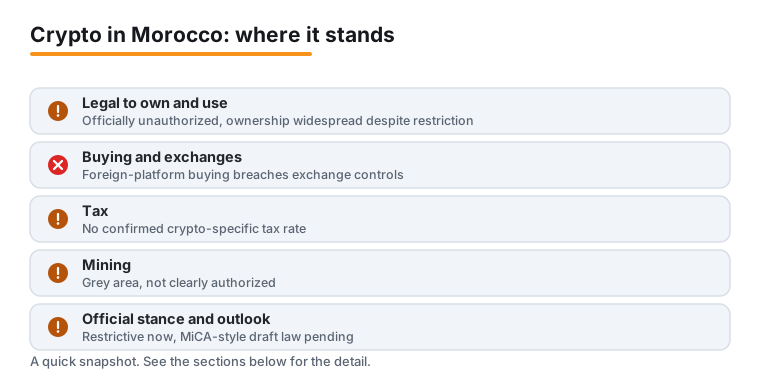
The short answer for August 2026 is that the restriction rests on a joint notice issued in November 2017 by the Ministry of Economy and Finance, Bank Al-Maghrib and the Office des Changes, backed by the foreign exchange rules the Office des Changes enforces, rather than on a crypto statute. That is also how it is enforced in practice: when the Office des Changes acted against crypto holders in 2026, it did so under the foreign exchange regulations, which limit the holding of assets abroad without prior authorisation. Holding is widespread, the official position remains restrictive, and the permissive new law has not yet taken effect.
In November 2017 the Ministry of Economy and Finance, Bank Al-Maghrib (the central bank) and the Office des Changes (the foreign-exchange authority) issued a joint public warning stating that transactions involving virtual currencies are not authorized in Morocco and run contrary to the exchange regulations. The authorities flagged volatility, fraud, money-laundering risk and the absence of consumer protection. That position has never been formally repealed.
Practically, the restriction works through Morocco's exchange-control regime: buying crypto on a foreign platform is treated as constituting assets abroad without prior authorization, which is an infraction under the foreign-exchange rules. Reported penalties range from fines of roughly MAD 20,000 to MAD 100,000 for individuals and up to about MAD 500,000 for businesses, with repeat offenders exposed to further proceedings. Enforcement against ordinary individuals has historically been limited, but it is not zero, and in 2026 the Office des Changes began actively targeting some holders (see Recent developments below).
So while a large informal market exists, that does not change the underlying legal status: until the new law is enacted, using crypto for payments or operating an unlicensed exchange carries real legal risk. The direction of travel is toward regulated legalization rather than continued prohibition, but the timing and final wording are not settled. Anyone relying on a definitive "legal" answer should check the most recent official guidance.
Who regulates crypto in Morocco?
No single agency owns crypto in Morocco today, and the responsibilities described below for service providers would only fully apply once the new law is in force. The key institutions are:
- Bank Al-Maghrib (BAM): the central bank. It co-authored the draft law and, under that framework, would supervise stablecoins and asset-referenced tokens, focusing on reserve backing and redemption. BAM has also been exploring a central bank digital currency (a digital dirham, sometimes called the e-dirham) since around 2019, a separate track from the private crypto-asset law; in July 2025 it announced work on an initial retail peer-to-peer payment experiment and a cross-border collaboration with the Central Bank of Egypt and the World Bank. Its public guidance on virtual currencies is on its official site.
- Autorite Marocaine du Marche des Capitaux (AMMC): the capital-markets regulator (the former CDVM). Under the draft, it would license crypto-asset service providers and oversee token issuance, public offerings, trading and market conduct. The AMMC has been building internal capacity, including dedicated training on digital-asset regulation and blockchain transaction analysis ahead of the new regime.
- Office des Changes: the foreign-exchange authority. It administers the exchange-control rules that currently make cross-border crypto flows non-compliant, and it has taken enforcement action against holders.
- National Financial Intelligence Authority (ANRF): under the draft law, it would enforce anti-money-laundering and counter-terrorism-financing obligations on service providers.
- Direction Generale des Impots (DGI): the tax administration, relevant to how any crypto income or gains are taxed.
The draft law was led by the Ministry of Economy and Finance in coordination with BAM and the AMMC.
Crypto laws and frameworks in Morocco
The centerpiece of Morocco's evolving approach is draft law (avant-projet de loi) 42.25 on crypto-assets, dated 5 August 2025 and published for public consultation by the Secretariat General du Gouvernement in late 2025. As published, the text is reported to run to roughly 79 articles across 6 titles. It was prepared by the Ministry of Economy and Finance with Bank Al-Maghrib and the AMMC, is explicitly inspired by the EU's MiCA regulation, and is aligned with recommendations from the Financial Action Task Force (FATF), the Bank for International Settlements (BIS) and the IMF.
As of 2026 this is still a draft. It had been published for public consultation, with parliamentary review and possible adoption discussed for 2026, but it had not completed legislative passage and implementing regulations would follow any adoption. Because timelines have shifted before, confirm the current status directly with the official sources.
The stated goals are to protect investors, combat fraud and money laundering, foster financial innovation and safeguard monetary and financial stability. Key features reported in the draft include:
- Licensed intermediaries: crypto-asset service providers, such as exchanges, custodians and brokers, would need authorization to operate.
- Division of supervision: the AMMC would oversee token issuance, licensing and market conduct, while Bank Al-Maghrib would supervise stablecoins and asset-referenced tokens, and the ANRF would enforce AML/CFT rules.
- Not legal tender or a payment method: crypto would be treated as a distinct class of regulated financial assets, not as currency for everyday payments.
- Token categories: the draft distinguishes utility tokens from asset-referenced tokens (stablecoins) indexed to a currency or basket of assets.
- Notable exclusions: reporting indicates the draft does not cover a central bank digital currency, non-fungible tokens (NFTs), or crypto mining within its main scope.
Licensing and registration of exchanges (VASPs)
Today there is no domestically licensed, fully regulated crypto exchange operating openly under Moroccan law, because the licensing framework does not yet exist. As a result, Moroccans who buy crypto typically do so through international exchanges or peer-to-peer (P2P) marketplaces.
Under draft law 42.25, that would change. Only authorized crypto-asset service providers would be permitted to offer services such as exchange, custody, brokerage and advice to Moroccan users. Licensing would sit primarily with the AMMC, with Bank Al-Maghrib supervising stablecoin issuers and the ANRF overseeing AML obligations. Authorized providers would be expected to implement identity verification (KYC), transaction monitoring and record-keeping (reporting indicates record retention obligations of around ten years and mandatory reporting of suspicious transactions).
Until the law and its implementing rules take effect, no domestic VASP authorization regime is operational. Any platform claiming to be "licensed in Morocco" should be treated with caution and verified against official sources, because the licensing machinery has not yet been issued. See our general guide to crypto regulation for how licensing regimes typically work.
Crypto and Bitcoin tax in Morocco
Crypto taxation in Morocco is closely tied to the unresolved legal status. Under the existing restriction there has been no clear, dedicated, published tax regime specifically for individual crypto gains, which has left taxpayers and advisers in uncertainty. The proposed law is expected to be accompanied by clearer tax treatment, since regulating crypto as a financial asset naturally raises the question of how gains, income and business activity are taxed.
Those figures are imported from Morocco's securities regime, not from any crypto rule. The Finance Law for 2026, Law 50-25, enacted by Dahir 1-25-67 of 10 December 2025 and published in the Bulletin Officiel on 16 December 2025, introduced no crypto-asset provision. What it did change is Article 84-I of the Code General des Impots: from 1 January 2026 individuals disposing of securities not registered with an authorised financial intermediary must pay the income tax due within 30 days of each transaction, instead of by 1 April of the following year, and must still file an annual summary return before 1 April. The liberatory rate on individual gains from securities disposals is 20 percent, and nothing in the 2026 finance law extends it to crypto. For that reason this guide deliberately does not state a single definitive crypto tax rate. Doing so before the rules are finalized would risk being wrong.
What you can reasonably assume is that, once a framework is in force, profits realized through licensed channels are likely to be reportable and taxable, and that businesses dealing in crypto would face record-keeping and reporting duties. General Moroccan tax principles around income, capital gains and professional activity may already be argued to apply to crypto profits depending on the facts. For background, see our explainer on crypto taxes.
Tax treatment depends on your specific circumstances and on rules that are changing. Consult the Direction Generale des Impots or a qualified Moroccan tax adviser rather than relying on a generic rate quoted online.
AML and KYC rules
Anti-money-laundering (AML) and know-your-customer (KYC) requirements are central to Morocco's planned framework, reflecting alignment with FATF standards. Morocco has worked to strengthen its AML/CFT regime more broadly in recent years, and the crypto draft law extends that approach to digital assets.
Under draft law 42.25, oversight of AML and counter-terrorism-financing for crypto-asset service providers would sit with the National Financial Intelligence Authority (ANRF). Reported obligations for authorized providers include verifying customer identity, keeping transaction records (reportedly for around ten years), monitoring activity and reporting suspicious transactions to the authorities.
In the current pre-law environment, the practical AML/KYC checks most Moroccans encounter come from the international exchanges and P2P platforms they use, which apply their own identity-verification procedures. There is no operational Moroccan VASP AML supervisor specific to crypto until the new framework takes effect. The Office des Changes, meanwhile, continues to apply exchange-control scrutiny to cross-border flows that may involve crypto.
Buying and using crypto in practice
Because no domestic licensed exchange exists yet, Moroccans who buy crypto generally use international exchanges or P2P marketplaces, often funding purchases via cards, bank transfers or cash deals arranged online. This carries real complications:
- Exchange-control friction: Morocco maintains strict foreign-exchange rules administered by the Office des Changes. Moving money abroad to fund purchases or to repatriate proceeds can run into these controls, and crypto-related flows were explicitly flagged as non-compliant from 2017 onward.
- Banking caution: domestic banks have historically been wary of crypto-linked flows, which can mean blocked or scrutinized transactions.
- No local consumer protection: using offshore platforms means limited recourse if something goes wrong.
On using crypto for payments: it is not legal tender, and the draft law would treat crypto-assets as regulated financial instruments rather than a means of payment. Using crypto to settle commercial transactions is not permitted, and traditional banking channels remain required for payments and international trade. Remittances are part of the backdrop too, since Morocco receives substantial inflows from its diaspora and blockchain transfers are often discussed as a cheaper channel, but using crypto for remittances today still runs into the same legal and exchange-control constraints. Once the new framework takes effect, only authorized providers would be permitted to serve Moroccan users, with KYC and AML checks built in. Until then, keep careful records and understand you are operating ahead of a formal regime.
Bitcoin mining in Morocco
Bitcoin mining occupies an awkward position. The 2017 restriction targeted crypto transactions generally, and reporting on draft law 42.25 indicates mining was not brought clearly within its main scope, leaving the activity in a continued grey area rather than being explicitly authorized.
Beyond the legal question, mining in Morocco raises distinctive energy and sustainability issues:
- Energy demand: proof-of-work mining is power-intensive. Large-scale operations would add load to the national grid and compete with other electricity needs.
- Renewable potential: Morocco has invested heavily in solar and wind capacity. In principle, surplus or off-peak renewable energy could power lower-carbon mining, an opportunity often highlighted in discussions of sustainable mining.
- Cost realities: profitability depends on electricity prices, equipment efficiency and cooling, a challenge in hot climates, and on the broader crypto market.
Because mining sits outside a clear legal authorization and intersects with electricity regulation and exchange controls, anyone considering it in Morocco should seek specific legal advice rather than assuming it is permitted.
Recent developments (2025 to 2026)
The pace of change has picked up sharply:
- 2024: the governor of Bank Al-Maghrib publicly confirmed that a crypto regulation law was in preparation, signaling a shift from prohibition toward a supervised framework.
- August to November 2025: draft law 42.25 was finalized (dated 5 August 2025) and published for public consultation by the Secretariat General du Gouvernement, the first structured attempt at a legal framework, inspired by the EU MiCA model and developed with BAM and the AMMC.
- Late 2025: the AMMC ran dedicated training in Rabat on regulating digital assets and analyzing blockchain transactions, part of building supervisory capacity ahead of the law.
- 2026: the Office des Changes stepped up enforcement, reportedly targeting individuals suspected of constituting assets abroad in the form of crypto and then reselling to people in Morocco, with transactions said to have occurred between March and August 2025. Those contacted were reportedly given around 30 days to provide explanations and supporting documents, with possible proceedings under the foreign-exchange rules.
- That timeline did not hold. Parliamentary review did not take place in the first part of 2026 and there was no adoption around mid-2026. On 22 July 2026 Bank Al-Maghrib said the bill was still under review, with coordination continuing between the Ministry of Economy and Finance, Bank Al-Maghrib and the AMMC, and gave no date for parliamentary submission. In April 2026 the Ministry Delegate in charge of the Budget had described the draft as still under review by the government's general secretariat. No date has been announced for adoption by the Conseil de gouvernement, for tabling in parliament, or for the first provider licences.
The overall direction is normalization through regulation rather than continued blanket prohibition, but as of August 2026 draft law 42.25 remains a draft under review and has not been tabled in parliament. Morocco holds legislative elections on 23 September 2026, set by a royal decree announced on 5 February 2026, which in practice makes it unlikely that a first reading happens before the new parliament is seated. Watch official announcements from Bank Al-Maghrib, the AMMC, the Office des Changes and the Ministry of Economy and Finance for the definitive picture.
Consumer risks and protection
Morocco's crypto landscape carries a particular combination of risks today, and most protections that a licensed regime would provide are not yet in place:
- Regulatory risk: crypto transactions remain officially unauthorized until a new law takes effect, and the final shape of that law is not guaranteed.
- Exchange-control exposure: foreign-exchange rules can complicate or penalize cross-border crypto-related flows, and enforcement against holders is now occurring.
- No local recourse: reliance on offshore platforms means limited protection against fraud, hacks or platform failure. Bank Al-Maghrib has specifically warned that there is no regulatory protection to cover losses if a trading platform fails.
- Market volatility: sharp price swings can produce large losses, independent of jurisdiction.
- Scams: unregulated environments attract fraudulent schemes, so treat guaranteed returns as a red flag.
Sensible principles apply everywhere: never invest more than you can afford to lose, be wary of guaranteed-return schemes, use secure storage such as a hardware wallet with a safely stored recovery phrase, enable two-factor authentication, beware phishing, and keep records for future tax compliance once a regime is in force. This guide does not give investment advice or price predictions.
Official sources and how to verify
Because the rules are changing, always confirm the current position against primary official sources rather than secondary summaries. The most authoritative Moroccan sources are:
- Bank Al-Maghrib (central bank): guidance on virtual currencies and any monetary or stablecoin rules. Bank Al-Maghrib, virtual currency page.
- Office des Changes (foreign-exchange authority): the official warning on virtual currencies and the exchange-control rules. Office des Changes, warning on virtual currencies.
- AMMC (capital-markets regulator): licensing and market-conduct supervision under the future framework. Autorite Marocaine du Marche des Capitaux.
- Draft law text: the avant-projet de loi 42.25 as published for consultation by the Secretariat General du Gouvernement. SGG, avant-projet de loi 42.25 (PDF, French).
For tax questions, consult the Direction Generale des Impots or a qualified Moroccan tax adviser. For our broader coverage, see the regulation hub. Remember: this page is general information as of 2026, not legal advice, and you should verify your specific situation with the named official regulators.
Status in August 2026: the timeline has slipped
The timeline reported after the November 2025 consultation has not held. Parliamentary review of draft law 42.25 was widely expected in the first part of 2026, with adoption around the middle of the year. Neither happened.
The most recent official signal came on 22 July 2026, when Bank Al-Maghrib presented its annual banking supervision report. It said the bill was still under review, with coordination continuing between the Ministry of Economy and Finance, Bank Al-Maghrib and the AMMC, and the report offered no firmer date for parliamentary submission. Three months earlier, in April 2026, the Ministry Delegate in charge of the Budget said the draft was still under review by the government's general secretariat, and framed the work as a response to Financial Action Task Force recommendations on money laundering and terrorist financing.
One calendar fact now shapes the pipeline. Morocco holds legislative elections on 23 September 2026, set by a royal decree announced on 5 February 2026, with the campaign running from 10 September to 22 September. A bill still described as under review in late July is unlikely to complete passage before that vote, which would leave first reading to the parliament seated afterwards. That is a reading of the electoral calendar, not an official statement, and no authority has confirmed a revised schedule.
| Step | Status in August 2026 | Timing on record |
|---|---|---|
| Draft prepared by Ministry of Economy and Finance with BAM and AMMC | Done | Text dated 5 August 2025 |
| Public consultation via the SGG | Done | Published November 2025 |
| Adoption by the Conseil de gouvernement | Not done | No date announced |
| Tabling and reading in parliament | Not done | No date announced; BAM gave none on 22 July 2026 |
| Publication in the Bulletin Officiel and entry into force | Not done | Not stated |
| Implementing texts and first AMMC licences | Not done | Not stated. Draft reportedly allows existing operators 18 months to comply after entry into force |
What draft law 42.25 would actually require
These are the obligations reported in the draft as published for consultation. None of them is law yet, and the text can still change before it reaches parliament.
- Two regulators, split by asset type. The AMMC would supervise token issuance and public offerings, while the central bank would oversee the use of stablecoins and the financial flows tied to asset-referenced tokens, as set out in reporting on the draft.
- No legal tender status. The bill does not legalise cryptocurrency as a form of payment but treats crypto-assets as a separate category of financial assets, to be handled only by authorised service providers.
- Prior authorisation, decided within 120 days. Applications would be processed by the AMMC within a maximum of 120 days.
- An 18 month transition. Operators already active would get 18 months from entry into force to comply and obtain the necessary approvals.
- Ten year record keeping. Providers would have to retain transaction records for at least ten years and report suspicious transactions.
- Stablecoins aimed at regulated issuers. Issuance and holding appear reserved to actors with strong balance sheets, principally banks and payment institutions, with a published white paper and a right for holders to redeem at nominal value.
- Out of scope. Central bank digital currencies, NFTs and mining activities are excluded from the draft, which leaves those where they are today.
- Penalties not quantified. Market abuse such as insider dealing, price manipulation or publishing misleading information would carry heavy fines or imprisonment, but the reporting gives no amounts and much of the operational detail is left to implementing decrees.
The official text is published by the Secretariat General du Gouvernement as Avant-projet de loi 42.25. It is a scanned document with no extractable text layer, so the detail above comes from Moroccan legal and financial reporting on the consultation rather than from a searchable version of the text.
What law applies to you in Morocco today, by name
There is no crypto-specific law in force. Two named texts that took effect on 1 January 2026 are what actually determine your exposure.
- Foreign exchange: Instruction Generale des Operations de Change 2026. Published by the Office des Changes at the end of December 2025 and in force since 1 January 2026. Moroccan financial press reporting on the instruction sets out the figures: the annual e-commerce foreign currency allowance for individuals rises to 20,000 dirhams from 15,000, and the personal travel allowance ceiling is 500,000 dirhams per calendar year, made up of a 100,000 dirham basic allowance plus up to 400,000 dirhams calculated on the basis of 30 percent of income tax paid. Neither the official release nor that reporting mentions crypto. The foreign exchange regime is nonetheless the rule the Office des Changes relied on in 2026 when it contacted individuals suspected of constituting assets abroad in the form of crypto-assets and reselling them in Morocco, giving them 30 days to provide explanations and supporting documents.
- Tax: Finance Law 50-25 for 2026, enacted by Dahir 1-25-67 of 10 December 2025 and published in the Bulletin Officiel on 16 December 2025. It introduced no crypto-asset provision. What it did change is Article 84-I of the Code General des Impots: from 1 January 2026, individuals disposing of securities not registered with an authorised financial intermediary must pay the income tax due within 30 days of each transaction rather than by 1 April of the following year, and must still file an annual summary return before 1 April. The liberatory rate on individual securities disposal gains is 20 percent. Nothing in the 2026 finance law extends that rate to crypto.
The 2017 joint notice from the Ministry of Economy and Finance, Bank Al-Maghrib and the Office des Changes remains the stated official position, and it is a notice rather than a statute. Practically, the exposure you face today is a foreign exchange enquiry, not a prosecution under a crypto law that does not exist.
Frequently asked questions
Is cryptocurrency legal in Morocco in 2026?
Not in the permissive sense many assume. A 2017 joint warning by the Ministry of Economy and Finance, Bank Al-Maghrib and the Office des Changes declared virtual-currency transactions unauthorized and contrary to the foreign-exchange rules, and that position has not been repealed. A new draft law (avant-projet 42.25) to regulate and supervise crypto-assets was published for consultation in late 2025 but had not completed legislative passage as of 2026. Ownership is widespread in practice, but the formal legal framework is still restrictive. Verify the current status with the Office des Changes and Bank Al-Maghrib.
Who regulates crypto in Morocco?
There is no single crypto regulator yet. The draft framework was developed by the Ministry of Economy and Finance with Bank Al-Maghrib (the central bank) and the AMMC (the capital-markets authority). Under draft law 42.25 the AMMC would license service providers and oversee market conduct, Bank Al-Maghrib would supervise stablecoins, and the National Financial Intelligence Authority (ANRF) would enforce anti-money-laundering rules. The Office des Changes administers the foreign-exchange rules that currently apply to crypto flows.
What is draft law 42.25?
It is Morocco's avant-projet de loi 42.25 on crypto-assets, dated 5 August 2025 and published for public consultation by the Secretariat General du Gouvernement in late 2025. Reported to span roughly 79 articles across 6 titles, it is inspired by the EU's MiCA regulation and aligned with FATF, BIS and IMF recommendations. It would license crypto-asset service providers, split supervision between the AMMC and Bank Al-Maghrib, and treat crypto as a regulated financial asset, not a means of payment. As of 2026 it remains a draft; check the SGG and regulators for the current status.
How much tax will I pay on crypto gains in Morocco?
There is no clearly confirmed, enacted crypto-specific tax rate as of 2026, so this guide does not quote a single figure. Some reporting mentions rates such as 15 percent or 20 percent tied to the broader finance-law framework, but this is not consistent or confirmed for crypto specifically. Clearer tax treatment is expected to accompany the new law, and general Moroccan tax principles may already apply depending on the facts. Consult the Direction Generale des Impots or a qualified Moroccan tax adviser for your situation.
Can I use Bitcoin to pay for goods in Morocco?
No. Crypto is not legal tender, and the proposed law treats crypto-assets as regulated financial instruments rather than a means of payment. Using crypto for commercial payments or settlements is not permitted, and traditional banking channels remain required for transactions and international trade.
Can the Office des Changes penalize me for holding crypto?
It can apply the foreign-exchange rules. Buying crypto on a foreign platform is treated as constituting assets abroad without prior authorization, which is an infraction under the exchange regulations, with reported fines from roughly MAD 20,000 to MAD 100,000 for individuals and up to about MAD 500,000 for businesses. In 2026 the Office des Changes began actively contacting some holders and requesting explanations, so this risk is not purely theoretical. Confirm your exposure with the Office des Changes or a qualified Moroccan adviser.
How many Moroccans own crypto?
There is no official government count, but industry estimates for 2024 put ownership at around 6 million people, close to 16 percent of the population, which would make Morocco one of the more active crypto markets in North Africa. That figure reflects an informal market that grew despite the 2017 restriction, and it is one of the reasons the authorities moved toward a supervised framework rather than continued prohibition. Treat the number as an estimate, not an audited statistic.
Is Morocco launching a digital dirham?
Bank Al-Maghrib has been exploring a central bank digital currency, sometimes called the digital dirham or e-dirham, since around 2019. In July 2025 it reported work on an initial retail peer-to-peer payment experiment and a cross-border collaboration with the Central Bank of Egypt and the World Bank. This is a separate track from the private crypto-asset draft law 42.25, and a central bank digital currency is a state-issued instrument, not a private cryptocurrency like Bitcoin. No firm public launch date has been confirmed; check Bank Al-Maghrib for the current status.
Has Morocco's crypto law passed yet, as of August 2026?
No. Draft law 42.25 was published for public consultation in November 2025 and has gone no further. On 22 July 2026 Bank Al-Maghrib said the bill was still under review, with coordination continuing between the Ministry of Economy and Finance, Bank Al-Maghrib and the AMMC, and gave no date for parliamentary submission.
Will Morocco's crypto law pass before the September 2026 election?
No authority has said so, and the calendar makes it unlikely. Legislative elections are set for 23 September 2026 by a royal decree announced on 5 February 2026, with the campaign running from 10 September to 22 September. A bill still described as under review in late July is unlikely to complete passage before then, which would leave first reading to the parliament seated after the vote. Treat that as a reading of the calendar rather than an official schedule.
Did Morocco's Finance Law for 2026 introduce a crypto tax?
No. Finance Law 50-25 for 2026, enacted by Dahir 1-25-67 of 10 December 2025 and published in the Bulletin Officiel on 16 December 2025, introduced no crypto-asset provision. Claims of a 15 percent flat crypto tax under that law are not supported by any verifiable source. The 15 and 20 percent figures belong to Morocco's securities regime, where the liberatory rate on individual securities disposal gains is 20 percent.
What changed for crypto holders on 1 January 2026?
The Office des Changes brought its new foreign exchange instruction, IGOC 2026, into force on 1 January 2026. Reporting on the instruction says it raised the annual e-commerce foreign currency allowance for individuals to 20,000 dirhams from 15,000 and set the personal travel allowance ceiling at 500,000 dirhams per calendar year. Neither the official release nor that reporting mentions crypto. Separately, in May 2026 the Office des Changes was reported to have contacted individuals suspected of holding crypto abroad and reselling it in Morocco, giving them 30 days to provide explanations and supporting documents.
Is holding crypto actually illegal in Morocco, or just discouraged?
The restriction comes from a joint notice issued in November 2017 by the Ministry of Economy and Finance, Bank Al-Maghrib and the Office des Changes, and it is enforced through the foreign exchange rules rather than through a crypto statute. When the Office des Changes acted against holders in 2026, it relied on the foreign exchange regulations, which strictly limit the holding of assets abroad without prior authorisation. The practical exposure is a foreign exchange enquiry, not prosecution under a crypto law.
How long would existing crypto businesses have to get licensed if 42.25 passes?
Reporting on the consultation text describes an 18 month transition period from entry into force for operators already active to comply and obtain the necessary approvals, and says the AMMC would process an application within a maximum of 120 days. Both figures come from reporting on the November 2025 draft and could change before the text reaches parliament.
Facts reviewed: 3 August 2026. Page updated: 3 August 2026.