Home › Crypto Regulation › Libya
Bitcoin & Cryptocurrency Regulation in Libya
Quick answer — Libya, 2026
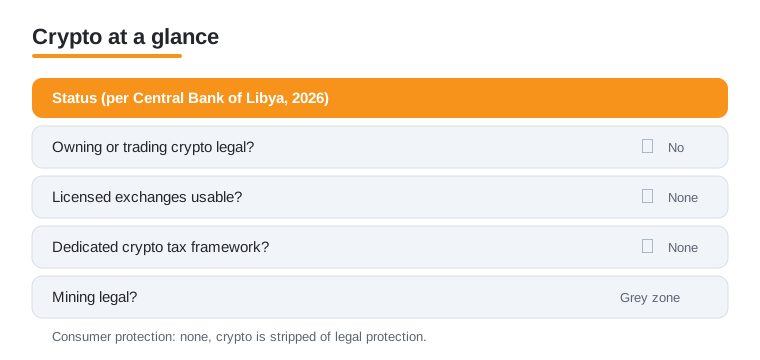
- No. The Central Bank of Libya declared virtual currencies illegal in 2018, and users get no legal protection.
- There is no recognised crypto tax framework and no licensed exchange, so there is no lawful way to buy crypto inside Libya.
- Bitcoin mining is widespread because of very cheap power, but enforcement is intensifying, with prison sentences handed down in 2025.
Libya occupies an unusual place on the cryptocurrency map. Bitcoin and other virtual currencies are officially prohibited, yet the country has become one of Africa's most active Bitcoin mining locations, driven by some of the cheapest electricity in the world. The result is a wide gap between what the law says and what happens in practice. This guide explains, in plain terms, what Libya's rules mean as of 2026 for residents, businesses and visitors: the legal status of crypto, the authorities involved, the laws applied, exchange and licensing reality, taxation, anti-money-laundering rules, buying and using crypto, mining, recent developments and consumer risks.
Libya's position is shaped by years of political division, parallel institutions and a fragile banking system, which is part of why informal crypto use has grown despite the ban. The official line comes from the Central Bank of Libya, the country's monetary authority, which declared virtual currencies illegal in 2018 and has maintained that stance since.
This article is general information as of 2026 and is NOT legal, tax or financial advice. Libya's rules are unsettled and enforcement has been intensifying, so anyone with a real situation should consult a qualified Libyan lawyer and verify the current position with the Central Bank of Libya before acting. For broader context, see our overview of crypto regulation.
On this page: Legal status · Who regulates it · Taxes · How to buy · Mining
Legal status: is Bitcoin and crypto legal in Libya?
No. Cryptocurrency is not legal in Libya. In 2018 the Central Bank of Libya (CBL) issued a public statement declaring that dealing in virtual currencies such as Bitcoin is illegal, and warning that anyone using or trading them would receive no legal protection. The CBL also noted that any financial activity in Libya, including dealing in virtual currencies, requires prior licensing from the central bank. That announcement remains the country's defining official position on digital assets.
However, the picture is more complicated than a simple ban. Libya has never followed the 2018 declaration with a comprehensive law that defines crypto offences, sets up licensing or creates supervision. This has produced a grey zone: the central bank treats crypto as prohibited and unprotected, while there is little detailed legislation spelling out exactly how each activity is handled. In practice, authorities use existing laws on currency control, smuggling, unauthorised electricity use, cybercrime and counter-terrorism financing to pursue crypto-related cases rather than a single dedicated crypto statute. Equipment is the exception, and it is specific: Decision No. 333 of 2023 of the Minister of Economy and Trade, issued on 4 July 2023, bans the import of all machinery and equipment used in digital currency mining, together with its components and spare parts, and requires the regulatory bodies to confiscate any brought in against it.
For an individual or business, the safest reading is that crypto activity carried out from within Libya is not legally sanctioned and carries no consumer protection. The absence of a detailed framework is not a green light. Anyone unsure how the rules apply should seek advice from a licensed Libyan lawyer rather than relying on general online guides, including this one.
The regulator: the Central Bank of Libya
The principal authority on crypto in Libya is the Central Bank of Libya (CBL), the country's monetary authority. The CBL is wholly owned by the Libyan state, controls the Libyan dinar and the banking system, and is headquartered in Tripoli with branches in Benghazi, Sabha and Sirte. It was the CBL that declared virtual currencies illegal in 2018, and it remains the body whose stance defines the official position.
There is no dedicated, purpose-built crypto regulator in Libya and no public licensing regime for exchanges, brokers or custodians. Enforcement is handled by law-enforcement and prosecution bodies. Because the country has experienced prolonged political division and parallel institutions, the way rules are applied can differ across regions.
On the financial-crime side, the Libyan Financial Information Unit (FIU) operates within the central bank and is the country's body for receiving suspicious-transaction reports. The CBL announced the launch of the FIU's official website, fiu.gov.ly, in December 2024, describing it as part of Libya's effort to align with Financial Action Task Force (FATF) standards.
Key laws and frameworks
Libya's approach is best understood as prohibition-by-declaration backed by general laws, rather than a tailored crypto regime:
- The 2018 Central Bank of Libya statement. The CBL announced that dealing in virtual currencies is illegal and that users and traders enjoy no legal protection. Its stated reasons centred on the risk that crypto could be used for money laundering and terrorism financing, and on protecting the dinar and the financial system.
- No comprehensive crypto law. Several years on, Libya still lacks a detailed statute that specifically authorises, licenses or precisely criminalises the full range of crypto activities. Notably, there is no law that explicitly criminalises the act of mining itself, which is a major reason enforcement relies on other charges.
- The cybercrime law (Law No. 5 of 2022). Libya's cybercrime law, passed by the House of Representatives in October 2021 and enacted as Law No. 5 of 2022, defines electronic money as prepaid monetary value stored on an electronic medium and not linked to a bank account. It does not explicitly prohibit, license or criminalise cryptocurrency mining or trading, so it adds a definition without resolving the status of crypto. This is part of why the legal position remains a grey zone rather than a clear statutory ban on mining.
- Law No. 2 of 2005 on combating money laundering. This is Libya's core anti-money-laundering framework. It established the Financial Information Unit and the National Committee for Combating Money Laundering and Terrorism Financing, chaired by the CBL governor or a deputy. It requires financial institutions to monitor and report suspicious transactions.
- General laws applied to crypto. In the absence of a dedicated statute, authorities lean on currency and foreign-exchange controls, anti-smuggling rules, cybercrime provisions, counter-terrorism-financing measures and offences such as unauthorised use of public electricity or illegal importation of equipment.
You can review the AML statute via the DCAF Libyan Security Sector Legislation database. Because the legal position is unsettled and can be interpreted differently across regions, always confirm the current rules through official Libyan channels or a qualified local lawyer.
Licensing and registration of exchanges (VASPs)
There is no licensed, lawful exchange market for crypto in Libya. The central bank does not authorise crypto exchanges, brokers or custodians, and there is no virtual-asset-service-provider (VASP) registration or licensing regime to apply for. Banks and regulated payment providers do not support crypto purchases. Because the CBL has stated that any financial activity requires its prior licensing and that virtual currencies are prohibited, there is no route through which an exchange could legally operate domestically.
As a result, no licence, registration number or supervisory framework exists for crypto firms in Libya, and buyers have no formal consumer recourse if something goes wrong. Any platform claiming to be a Libyan-licensed crypto exchange should be treated with strong scepticism, because no such licensing category exists. If Libya were to introduce a clear legal framework in future, a legitimate market would operate only through properly authorised and supervised providers, and that authorisation would come from the Central Bank of Libya.
Crypto taxation in Libya
Because crypto is officially banned rather than regulated, Libya does not operate a recognised, dedicated tax framework for cryptocurrency gains or income, and there is no licensed market for such a regime to attach to. There is no published crypto tax schedule for Libya, so treat any source quoting a precise Libyan crypto tax rate as unreliable. What does exist is the general tax code: personal income tax of 5 percent on annual income up to LYD 12,000 and 10 percent above that, charged only on income derived from employment in Libya, and corporate income tax at a flat 20 percent. There is no VAT in Libya.
This does not mean money is invisible to the authorities. Libya operates general income and corporate tax rules, and undeclared income or assets can still create exposure under those rules and under currency-control and anti-money-laundering provisions, regardless of how the funds were generated. For a Libyan company the relevant default is that chargeable gains on the sale of capital assets are taxed as ordinary income, so at the flat 20 percent corporate rate. For an individual, Libyan personal income tax reaches only income from employment in Libya, so it does not by its own terms tax an investment gain. If your wider financial situation may intersect with Libyan tax rules, consult a qualified local tax adviser. For general background on how crypto is taxed elsewhere, see our guide to crypto taxes. This is informational only and not tax advice.
AML and KYC rules
Libya's anti-money-laundering and counter-terrorism-financing (AML/CFT) framework is set out in Law No. 2 of 2005. Under that law, every bank operating in Libya must establish an internal anti-money-laundering unit to monitor transactions and report anything suspicious. Those reports go to the Financial Information Unit (FIU) housed within the Central Bank of Libya, which can share information with foreign counterparts under international agreements or reciprocity. The National Committee for Combating Money Laundering and Terrorism Financing oversees the wider system.
These obligations attach to regulated financial institutions, not to a licensed crypto sector, because no such sector legally exists. In practice, this means that crypto-related transactions touching the banking system, or flagged as suspicious, can fall within the AML/CFT net. The 2018 ban was itself justified partly on money-laundering and terrorism-financing grounds. Libya works toward FATF standards, and the FIU's official portal at FATF's Libya country page and fiu.gov.ly are the reference points for the current state of that effort. Libya is not on FATF's list of jurisdictions under increased monitoring, and it does not appear among the 22 jurisdictions on that list after the June 2026 plenary. The Financial Information Unit launched the goAML reporting system on 4 May 2025, and commercial banks have been registering reporting officers on it. The National Committee for Combating Money Laundering and Terrorism Financing, chaired by the CBL governor, is preparing the country for a third-phase MENAFATF mutual evaluation and warned on 9 April 2026 that the continued non-adoption of the draft AML and CFT law implies the absence of a legislative framework aligned with international standards. There is no separate crypto-specific KYC regime, because there is no authorised crypto industry to regulate.
Buying and using crypto in practice
There is no lawful, licensed way to buy or use crypto in Libya. The CBL prohibits dealing in virtual currencies and offers no protection to those who do, and there are no authorised exchanges, brokers or custodians operating under a Libyan licence. Banks and regulated payment providers do not facilitate crypto purchases.
Libya also maintains tight controls on the dinar and on moving money across borders, and access to hard currency through official channels has at times been restricted. These conditions have pushed some residents toward informal options such as peer-to-peer trades, cash deals and offshore platforms accessed online. While such activity clearly occurs, it sits within the prohibited, unprotected space the central bank described, and it can intersect with currency-control and anti-smuggling rules. The same applies to remittances: crypto is sometimes promoted as a cheaper way to send money to family in Libya, but it is not an officially sanctioned channel and does not exempt sender or recipient from currency rules.
We do not provide instructions for circumventing the ban. Informal trading in a prohibited market carries heightened fraud risk, with no regulator to turn to if a counterparty disappears or a platform fails. If your aim is to save, invest or move value lawfully, use regulated banking channels and official foreign-exchange options, and seek professional advice. This is informational only and not financial advice.
Bitcoin mining in Libya
Mining is where Libya's gap between law and reality is widest. Despite the official ban, the country has emerged as a major Bitcoin mining location, at times described as a leading hub in Africa and the Arab world. The draw is cheap, heavily subsidised electricity, reported at roughly $0.004 per kilowatt-hour, among the lowest-cost power anywhere, which makes it profitable to run even older, inefficient machines. Estimates suggest mining has consumed on the order of 2 percent of Libya's national electricity output, energy diverted from a strained grid. Retail ownership exists too: a 2022 study by the South Policy Centre estimated that about 1.3 percent of Libyans, roughly 54,000 people, held cryptocurrency, a figure that suggests informal use extends well beyond mining despite the ban.
That boom has come at a cost, and authorities have linked illegal operations to power shortages. In response, Libya has intensified enforcement. In June 2023, in one of the largest raids on the continent, authorities reportedly arrested around 50 Chinese nationals and seized an estimated 100,000 mining units in Zliten and Misrata. In April 2024, security forces in Benghazi dismantled a hub housing over 1,000 devices. In November 2025, the Tripoli Court of Appeals sentenced nine individuals to three years in prison over an industrial-scale mining farm found inside a steel factory in Zliten, ordering the seizure of machinery and the forfeiture of illicit profits to the state.
Legally, mining sits in a grey zone: no single law explicitly criminalises the act of mining itself. Instead, prosecutions rest on related conduct: importing mining hardware, which Decision No. 333 of 2023 prohibits outright for every category of mining machine and for its components and spare parts, diverting or stealing subsidised public electricity, smuggling, and operating without any sanction from the central bank. Anyone considering mining in Libya should treat it as legally hazardous and seek qualified local advice.
Recent developments (2025-2026)
The clearest recent trend is tighter enforcement rather than liberalisation. The November 2025 Zliten case, with three-year prison sentences and asset forfeiture, signalled that authorities are willing to pursue serious penalties against industrial mining operations, building on the 2023 and 2024 raids.
On the official side, the Central Bank of Libya has focused in 2025 and 2026 on broader digital transformation and currency stabilisation rather than on creating a crypto framework. The CBL has reported that electronic transactions exceed 80 percent of market activity, with a target near 95 percent, and has expanded electronic payment services and QR-code payments at points of sale. By value, the bank put electronic transactions at about 500 billion dinars by the end of July 2026, with projections exceeding 800 billion by year end. On 31 March 2026 the governor urged banks to meet business demand for point-of-sale terminals and to keep sufficient inventory, and said work was being accelerated to launch foreign currency account-to-account transfer services under the ONEPAY and LY PAY projects. In 2026 the CBL also announced measures to support the dinar and regulate the foreign-exchange market. The CBL's published laws, circulars, electronic-payment and news pages carry no crypto content, and no CBL announcement proposes authorising it. The bank's stated legislative priorities, agreed with the IMF on 14 April 2026, are the draft AML and CFT law, an update of Banking Law No. 1 of 2005 as amended by Law No. 46 of 2012, and an updated licensing regulation for electronic payment companies. None of the three is a crypto licensing regime.
In short, as of 2026 the 2018 ban still stands, there is still no comprehensive crypto law, and the official energy is going into electronic payments and currency policy, not crypto authorisation. Treat any claim that the rules have been loosened or that an activity is now approved with caution, and confirm it through official Libyan government sources.
Consumer risks and protection
The risks in Libya are unusually broad, and consumer protection is effectively absent. Because crypto is banned and explicitly stripped of legal protection, there is no domestic regulator to complain to, no licensed custodian to safeguard assets, and no formal recourse if a counterparty or platform fails. The security burden of self-custody falls entirely on the user.
Layered on top of that is legal exposure. Activities such as importing mining hardware, using subsidised public electricity for mining, or trading through informal channels can intersect with currency-control, smuggling, cybercrime and counter-terrorism-financing rules, and enforcement has been ramping up. Because institutions operate differently across a politically divided country, how the law is applied can vary by region.
Scams are a particular danger in this kind of prohibited, informal market. Be sceptical of offers promising easy crypto access, guaranteed returns, cheap remittances, quick mining profits, or a supposed Libyan crypto licence, none of which has a legal basis here. For a broader view of how different countries handle these issues, see our regulation hub. This is informational only and not financial advice.
Official sources and how to verify
Because Libya's situation is unsettled and online guides often lag or oversimplify, verify any claim against primary sources before acting:
- Central Bank of Libya is the monetary authority and the body whose 2018 statement defines the ban. Check its news and announcements at cbl.gov.ly.
- Libyan Financial Information Unit (FIU) handles AML/CFT reporting and operates within the CBL. See the launch announcement at the CBL FIU page (portal: fiu.gov.ly).
- Law No. 2 of 2005 on combating money laundering is available through the DCAF Libyan Security Sector Legislation database.
- FATF tracks Libya's AML/CFT standing on its Libya country page.
To repeat the core caveat: this page is general information as of 2026 and is NOT legal advice. Libya's rules are evolving, and the only authoritative confirmation of your situation comes from the Central Bank of Libya and a qualified Libyan lawyer.
What is changing: Libya's legislative pipeline as of August 2026
There is no crypto bill anywhere in the Libyan legislature. The financial legislation that is actually moving is anti-money-laundering legislation, and one crypto-specific rule is already in force and rarely reported. This is the honest state of the pipeline, with the stage each item has reached.
| Instrument | Stage | Timing | What it means in practice |
|---|---|---|---|
| Decision No. 333 of 2023, Minister of Economy and Trade | In force | Issued 4 July 2023, effective from issue | Import of every category of mining machine, plus components and spare parts, is banned. Regulatory bodies must confiscate equipment brought in against it. |
| Draft law on combating money laundering and terrorist financing | Before the House of Representatives, at committee level | Discussed 7 June 2026 in Benghazi. No vote date announced. | A new AML and CFT statute drafted to FATF standards. Affects banks and reporting entities. Published accounts do not say whether virtual assets are in scope, so it is not a route to a licensed exchange. |
| Update of Banking Law No. 1 of 2005, as amended by Law No. 46 of 2012 | Initial drafting, with IMF technical support | Agreed 14 April 2026. No timetable published. | Governance and banking supervision, plus an updated licensing regulation for electronic payment companies. Not a crypto licensing regime. |
| Recommendations on regulating or prohibiting cryptocurrency | Pre-legislative. Roundtable held, recommendations to be drafted. | 30 July 2026, Tripoli | Thirteen deputy prosecutors general, the CBL Financial Information Unit and the Ministry of Interior examined the obstacles to a Libyan regulatory framework. No bill exists. |
Two things sit behind this. The National Committee for Combating Money Laundering and Terrorism Financing, chaired by CBL Governor Naji Mohammed Issa, warned at its first meeting of 2026 on 9 April that the continued non-adoption of the draft law implies the absence of a legislative framework aligned with relevant international standards, and it reviewed preparations for the upcoming mutual evaluation. Libya has been preparing since 2025 for the third phase of evaluation by the Middle East and North Africa Financial Action Task Force, and no public date has been set for it. Separately, Libya is not on FATF's list of jurisdictions under increased monitoring: the June 2026 plenary added Bosnia and Herzegovina and Iraq and removed Algeria and Namibia, and Libya appears nowhere in the resulting list of 22 jurisdictions.
Decision No. 333 of 2023: the one crypto-specific rule in Libyan law
Libya has no crypto statute, but it does have one instrument that names digital currency directly. On 4 July 2023 the acting Minister of Economy and Trade, Suhayl Abdul-Muttalib Bushayah, issued Decision No. 333 of 2023, prohibiting the import of digital currency mining machines, their parts and accessories.
- Article 1 bans importing all machinery and equipment used in digital currency mining, whether cloud, CPU or GPU based, together with their components, spare parts and any other equipment used to mine or produce any type of currency.
- Article 2 requires the regulatory bodies to take the legal measures needed to confiscate any equipment covered by Article 1 that was imported in breach of the applicable laws and regulations.
- Article 3 tasks the General Authority for Communications and Information Technology with classifying prohibited equipment requiring prior authorisation and forwarding that classification to the ministry.
- Article 4 makes the decision effective from the date of issue. The Law Society of Libya legislation database records its status as executed and in effect, with no repeal or amendment noted.
This is why the practical legal exposure for a would-be miner is at the border and at the meter, not in the act of mining. The decision does not criminalise mining itself, it does not touch holding or trading, and it does not create any licence anyone can apply for. It does mean that a shipment of rigs is unlawful cargo and that seizure is the expected outcome.
What Libya's tax rules actually say, since there is no crypto tax
Libya publishes no crypto tax schedule and no tax authority guidance on digital assets. That does not mean there is no default. These are the general rates that would be the starting point for any Libyan tax question about a disposal or a profit, as recorded in PwC's Libya tax summary, last reviewed 31 May 2026.
| Tax | Rate | Note |
|---|---|---|
| Personal income tax | 5 percent up to LYD 12,000 a year, 10 percent above | Libyan and foreign nationals are subject to tax only on income derived from employment in Libya, after social insurance and personal exemptions |
| Corporate income tax | Flat 20 percent on taxable profits | Applies to companies, not to individuals |
| Capital gains | Taxed as ordinary income | Chargeable gains on the sale of capital assets fall into the ordinary corporate charge |
| VAT | None | There is no VAT in Libya |
| Stamp duty | 1 percent on main contracts, 0.1 percent on subcontracts | A further 0.5 percent applies to all payments made to the Tax Department |
The practical reading is narrow and worth stating plainly. Libyan personal income tax reaches employment income, so it does not by its own terms tax an investment gain made by an individual. A Libyan company that disposes of an asset at a gain is taxed on it as ordinary income at 20 percent. Neither of these is crypto guidance, and neither cures the fact that the underlying activity is prohibited by the central bank, which is a separate problem from tax.
Frequently asked questions
Is Bitcoin legal in Libya?
No. The Central Bank of Libya declared virtual currencies illegal in 2018 and stated that users and traders would have no legal protection. Libya has not since passed a comprehensive crypto law, which leaves some activities in a legal grey zone, but the official position is prohibition. For your specific situation, consult a qualified Libyan lawyer and verify with the Central Bank of Libya rather than relying on general guides.
Who regulates cryptocurrency in Libya?
The Central Bank of Libya (CBL), the country's monetary authority, is the body whose stance defines crypto policy, and it issued the 2018 ban. There is no dedicated crypto regulator and no licensing regime for exchanges. On financial crime, the Libyan Financial Information Unit operates within the CBL and handles suspicious-transaction reporting under Law No. 2 of 2005. You can verify the official position at cbl.gov.ly.
Can I legally buy crypto or use a licensed exchange in Libya?
No. There is no licensed exchange market and no VASP registration regime in Libya. Banks and regulated providers do not support crypto purchases, and any informal or peer-to-peer option falls within the prohibited, unprotected space with high fraud risk and no recourse. Any platform claiming a Libyan crypto licence should be treated as a red flag, because no such licence exists. Use regulated banking and official foreign-exchange channels for lawful needs. This is informational only and not financial advice.
Why is Bitcoin mining so common in Libya if crypto is banned?
Libya has very cheap, heavily subsidised electricity, at times reported around $0.004 per kilowatt-hour, which has made it one of Africa's most active Bitcoin mining locations despite the ban. The activity persists in a grey zone because no single law explicitly criminalises mining itself. However, related conduct such as unauthorised hardware imports and illegal use of public electricity does lead to prosecutions, and enforcement has intensified, including three-year prison sentences handed down in a November 2025 case in Zliten.
How is crypto taxed in Libya?
Because crypto is officially banned rather than regulated, Libya does not operate a recognised, dedicated tax framework for cryptocurrency, and there is no licensed market for such a regime to attach to. We do not cite specific rates or thresholds because there is no verified crypto tax schedule for Libya. General income, currency-control and anti-money-laundering rules can still create exposure for undeclared funds. Consult a qualified local tax adviser. This is informational only and not tax advice.
Has Libya changed its crypto rules in 2025 or 2026?
Not in the direction of legalisation. As of 2026 the 2018 ban still stands and there is still no comprehensive crypto law. The recent trend has been tighter enforcement against mining, including the November 2025 Zliten prison sentences, while the Central Bank of Libya has focused on electronic payments and supporting the dinar rather than authorising crypto. Treat any claim that crypto is now approved with caution and verify it via cbl.gov.ly.
Does the cybercrime law legalise crypto in Libya?
No. Libya's cybercrime law (Law No. 5 of 2022, passed by the House of Representatives in October 2021) defines electronic money as prepaid value stored on an electronic medium and not linked to a bank account, but it does not explicitly authorise, license or criminalise cryptocurrency mining or trading. It adds a definition without lifting the Central Bank of Libya's 2018 prohibition, which is one reason the status of activities such as mining stays in a grey zone. Confirm the current position with a qualified Libyan lawyer.
How many people in Libya own or use cryptocurrency?
There is no official register, so figures are estimates. A 2022 study by the South Policy Centre estimated that about 1.3 percent of Libyans, roughly 54,000 people, held cryptocurrency. Alongside retail holders, Libya has significant informal Bitcoin mining driven by cheap electricity. All of this activity sits within the prohibited, unprotected space described by the Central Bank of Libya, with no consumer recourse if something goes wrong. This is informational only and not financial advice.
Is Libya about to pass a crypto law?
No. There is no crypto bill in the Libyan legislature as of August 2026. The financial bill that is actually moving is the draft law on combating money laundering and terrorist financing, which the House of Representatives was working through at committee level on 7 June 2026, when Second Deputy Speaker Misbah Douma met the chairs of the Planning, Finance and Budget Committee and the Legislative and Constitutional Committee together with the head of the central bank's Financial Information Unit in Benghazi. No vote date has been announced. Published accounts of the bill do not say whether virtual assets are in scope, so it should not be read as a route to a licensed Libyan crypto exchange.
What is Decision No. 333 of 2023?
It is a decision of the Libyan Minister of Economy and Trade, issued on 4 July 2023, banning the import of all machinery and equipment used in digital currency mining, whether cloud, CPU or GPU based, together with their components and spare parts. It requires the regulatory bodies to confiscate prohibited devices brought in against it, and it tasks the General Authority for Communications and Information Technology with classifying equipment that needs prior import authorisation. It is the most specific crypto rule in Libyan law, and it targets hardware rather than trading or holding.
Is Libya on the FATF grey list, and is a new anti-money-laundering law coming?
No, Libya is not on FATF's list of jurisdictions under increased monitoring, and it does not appear among the 22 jurisdictions on that list following the June 2026 plenary. Libyan officials have been preparing since 2025 for a third-phase mutual evaluation by the Middle East and North Africa Financial Action Task Force, and no date for it has been made public. A replacement anti-money-laundering and counter-terrorist-financing law drafted to FATF standards is before the House of Representatives, and the National Committee chaired by the central bank governor warned on 9 April 2026 that its continued non-adoption leaves the country without a legislative framework aligned to international standards.
Can I see the Central Bank of Libya's crypto ban on its own website?
Not on the current site. cbl.gov.ly publishes laws, circulars, news and the list of licensed electronic payment companies, and its electronic payment section carries the National Payments Council regulation on electronic payment services, Circular No. 7 of 2020 on contracting with electronic payment companies and Circular No. 10 of 2017 on mobile payment services. None of these pages carries the 2018 virtual currency statement, and the laws page lists no crypto instrument at all. That statement is documented through 2018 news reporting rather than a live CBL page. It is worth knowing if you are ever asked to produce a primary source for the ban.
Facts reviewed: 13 August 2026. Page updated: 13 August 2026.