Home › Crypto Regulation › Sudan
Bitcoin & Cryptocurrency Regulation in Sudan
Quick answer — Sudan, 2026
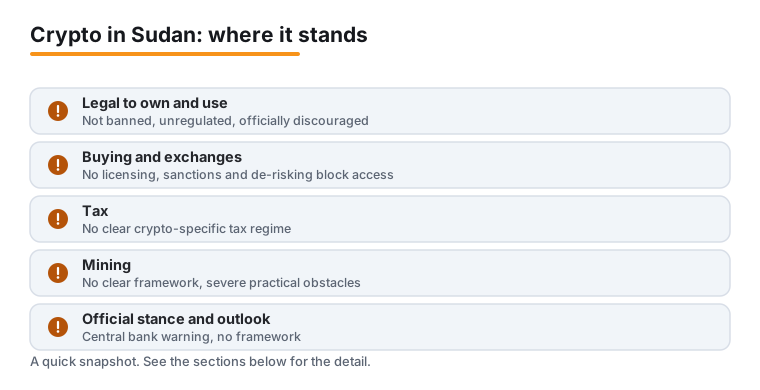
- Legal: Not banned but unregulated and officially discouraged, not legal tender
- Tax: No clear crypto tax regime; general categories may apply
- Buying: Mostly P2P with escrow and stablecoins, many exchanges geoblock Sudan
Cryptocurrency in Sudan sits in a legal grey zone. There is no comprehensive statute that defines, licenses or bans digital assets, no recognition of Bitcoin as legal tender, and no dedicated crypto regulator. Instead the space is shaped by warnings from the Central Bank of Sudan, the country's anti-money-laundering law, foreign-exchange controls and the heavy effects of international sanctions. On top of this sits a severe economic crisis: the armed conflict that began in April 2023 collapsed the value of the Sudanese pound and disrupted normal banking and remittance channels, pushing many Sudanese toward peer-to-peer Bitcoin and stablecoin trading out of necessity rather than speculation.
This guide explains what is and is not known about crypto's standing in Sudan as of 2026, who oversees the financial system, how anti-money-laundering and tax rules are likely to apply, and the practical realities of buying, mining and moving value across borders. Because the framework is thin and evolving, treat this as general information and confirm current rules directly with the Central Bank of Sudan. For wider background see our guide to crypto regulation and our country regulation hub.
On this page: Legal status · Who regulates it · Taxes · How to buy · Mining
Is Bitcoin and crypto legal in Sudan?
Owning, buying or trading Bitcoin and other cryptocurrencies is not specifically prohibited by a Sudanese statute, and there is no law that makes simply holding crypto a criminal act. At the same time crypto is not legal tender, is not officially recognised as money, and is not covered by any dedicated licensing regime. The accurate description is unregulated and officially discouraged rather than banned.
The clearest official signal came in March 2022, when the Central Bank of Sudan publicly warned the population against dealing in cryptocurrencies. The bank stated that such assets are not classified as money, nor even as private money and property, under the laws and regulations in force in the country, and it cited risks including loss of value, financial crime and electronic piracy. A warning is not a prohibition, but it tells you the authorities do not endorse crypto and that users act at their own risk.
Two further points matter. First, general laws still apply to crypto activity, including the anti-money-laundering framework, fraud provisions and foreign-exchange controls; using crypto to launder funds or evade currency rules can create liability under those existing laws even without a crypto-specific offence. Second, the conflict has disrupted governance and made enforcement uneven across the country. Activity that is tolerated today could be restricted, taxed or licensed later, so verify the position with the regulator before acting.
Who regulates crypto in Sudan?
There is no agency in Sudan that runs a dedicated cryptocurrency licensing regime. The most relevant authority is the Central Bank of Sudan (CBOS), the country's central bank and the body responsible for monetary policy, the banking system and access to foreign exchange. The CBOS is the institution that issued the public crypto warning and is the body most likely to introduce any future virtual-asset rules. Its official website is cbos.gov.sd.
Alongside the central bank, anti-money-laundering oversight runs through Sudan's Financial Information Unit (FIU) and a National Committee for combating money laundering and terrorism financing. The FIU receives and analyses suspicious transaction reports and was established in 2010 under central bank supervision; Sudan's FIU joined the Egmont Group of financial intelligence units in 2017. These bodies were not created for crypto, but their mandate can extend to crypto-linked transactions handled through banks and money-service businesses.
In short, crypto in Sudan is governed indirectly: the central bank through monetary and foreign-exchange authority, and the AML institutions through existing financial-crime law, rather than through any crypto-specific supervisor.
Key laws and frameworks
As of 2026, Sudan has no single, purpose-built cryptocurrency law. The framework that touches digital assets is assembled from broader sources:
- Central Bank authority. The CBOS oversees monetary policy, banking and foreign exchange, issues circulars to financial institutions, and has cautioned the public about crypto. It is the most likely source of any future virtual-asset licensing rules.
- Anti-money-laundering and counter-terrorism financing. The Money Laundering and Finance of Terrorism (Combating) Act of 2014 is the core AML statute, supported by the Criminal Act and the Counter Terrorism Act. Banks and money-service providers must apply customer due diligence and report suspicious activity, and crypto-linked transactions can fall within these duties.
- Foreign-exchange and capital controls. Sudan maintains controls on access to foreign currency and on cross-border transfers, which directly affect how crypto can be bought, sold and moved.
- General commercial, fraud and electronic-transaction law. Older provisions can be applied to crypto disputes by analogy, although they were not written with digital assets in mind.
There have been reports that authorities are studying a more formal fintech and virtual-asset approach, sometimes described as a draft fintech bill. These reports are not confirmed by official sources, and details such as licence categories, levies or effective dates should be treated with caution. The only safe assumption is that crypto-specific rules are minimal today and may change. Verify the current position directly with the CBOS.
Licensing and registration of exchanges (VASPs)
Sudan does not operate a licensing or registration regime for crypto exchanges or virtual-asset service providers (VASPs), so no platform runs under a domestic Sudanese crypto licence. In practice Sudanese users reach crypto through international platforms and, very heavily, through peer-to-peer (P2P) trading.
The dominant obstacle is international sanctions and bank de-risking. Many global exchanges and token issuers geoblock Sudan, decline Sudanese identity documents, or restrict access from Sudanese IP addresses and phone numbers. Banking rails are also limited and have been disrupted by the conflict, so funding an account by card or bank transfer is often impractical. This pushes activity toward P2P marketplaces with escrow, dollar-pegged stablecoins, and informal trusted intermediaries that carry higher counterparty risk.
Because there is no domestic registration framework and no licensed local venue, there is little formal consumer protection if a trade goes wrong. Anyone trading should prefer reputable escrow-based platforms, verify counterparties carefully, and confirm that a service actually accepts Sudanese users before committing funds. For how registration regimes work elsewhere, see our crypto regulation overview.
Crypto and Bitcoin tax in Sudan
Sudan has no clearly published, crypto-specific tax regime, and tax administration has been heavily disrupted by the conflict. That makes it difficult to state with confidence how gains from Bitcoin or other tokens are taxed in practice.
In general terms, where a country lacks dedicated crypto tax rules, profits can still potentially fall under existing categories such as income, business income or capital gains, depending on how an individual uses the asset and how local law characterises the activity. Trading as a business may be treated differently from occasional personal investment. The specific rates, thresholds, filing requirements and whether any of this is actively enforced for crypto in Sudan are not reliably documented, and this guide will not quote figures that cannot be verified against an official Sudanese source.
Some online articles circulate exact percentages, levies and reporting thresholds for Sudanese crypto tax. Treat those claims with scepticism unless they can be traced to an official publication. Because the cost of getting tax wrong can be significant, anyone with meaningful crypto activity tied to Sudan should consult a qualified local tax professional. For general concepts see our crypto tax guide. This section is general information, not tax advice.
AML and KYC rules
Sudan's anti-money-laundering and counter-terrorism-financing rules flow mainly from the Money Laundering and Finance of Terrorism (Combating) Act of 2014. Under this framework, financial institutions and other obliged entities must perform customer due diligence (know-your-customer, or KYC), monitor transactions and file suspicious transaction reports with the Financial Information Unit. The National Committee for AML/CFT coordinates policy, and the FIU analyses reports and can refer matters for action.
These obligations were not written specifically for crypto, but they can reach crypto-linked flows that pass through banks, mobile-money services or money-service businesses. In practice this means a Sudanese user who converts crypto to local currency through a regulated channel may encounter KYC checks and reporting, and that using crypto to disguise the source of funds can expose a person to liability under the 2014 Act regardless of the absence of a crypto-specific law.
On the international side, Sudan was removed from the FATF list of jurisdictions with strategic AML/CFT deficiencies in 2015 and moved to follow-up status. The global FATF standards now expect countries to apply AML/CFT rules to virtual-asset service providers, which is one reason a future Sudanese framework could formalise crypto obligations. You can review Sudan's FATF country page at fatf-gafi.org and the central bank's AML/CFT overview on the CBOS AML/CFT page.
Buying and using crypto in practice
Buying Bitcoin or stablecoins from inside Sudan is possible but takes care, mainly because sanctions and de-risking limit access to mainstream platforms. A cautious, general approach looks like this:
- Use a method that works for Sudan. Peer-to-peer marketplaces with escrow are the most common route, letting buyers and sellers settle in cash, mobile money or local transfers without card or bank funding that may be blocked.
- Hold your own keys. A reputable self-custody wallet, ideally hardware-backed for larger amounts, keeps your assets in your hands rather than on a platform that might restrict Sudanese access without notice.
- Verify the counterparty. On P2P, check trade history and ratings, use the platform's escrow rather than settling off-platform, and start with a small test amount.
- Consider stablecoins. Many Sudanese users hold dollar-pegged tokens for relative stability during severe local-currency inflation, and convert to Bitcoin only when they specifically want that exposure.
- Protect yourself. Use strong, unique passwords and two-factor authentication, be wary of deals that look too good, and keep records of your transactions.
- Mind the rules. Converting between pounds, foreign currency and crypto can intersect with exchange controls and AML obligations.
Because platform availability changes frequently under sanctions, confirm that any service actually accepts Sudanese users before committing funds, and never send money outside an escrow arrangement to someone you cannot verify.
In practice, some Sudanese users reach offshore platforms through VPNs to get around geoblocking. This carries its own risks: it can breach a platform's terms and lead to account freezes or seizure of funds, and it does nothing to change the underlying sanctions position. Weigh that carefully, and understand that funds sitting on a foreign platform can become hard to withdraw if access is later cut off.
Using crypto for remittances
Remittances are one of the most important real-world uses of crypto for Sudanese people. A large diaspora supports families at home, and the conflict has badly damaged traditional transfer channels: some money-transfer operators have suspended services, formal banking is constrained, and the pound has lost much of its value. For many households, getting funds in quickly is a survival issue rather than a convenience.
The breakdown has been visible in the host countries where Sudanese refugees have fled. Reporting during the war has described money-transfer offices run by Sudanese in Egypt, a lifeline for a large refugee population there, halting transactions, and traders in some neighbouring host countries refusing to accept Sudanese pounds and insisting on US dollars. When these informal corridors seize up, families lean harder on whatever channel still moves value, and for a growing number that has meant dollar-pegged stablecoins settled through peer-to-peer trades.
Crypto, and stablecoins in particular, can offer a faster and sometimes cheaper way to move value across borders, settling in minutes and bypassing some bottlenecks in the formal system. A sender abroad can transfer a dollar-pegged token to a recipient in Sudan, who then converts to local cash through a P2P trade or trusted intermediary. The trade-offs are real: volatility if Bitcoin rather than a stablecoin is used, the off-ramp problem of converting back to spendable pounds, irreversibility of transfers if a counterparty cheats, and potential exposure under foreign-exchange and AML rules. Used carefully, with stablecoins, escrow-based platforms and trusted contacts, crypto can be a meaningful lifeline, but it is not risk-free.
Bitcoin mining in Sudan
Bitcoin mining in Sudan is not supported by any clear legal framework, and several secondary sources report that mining is not permitted; this has not been confirmed against a primary central-bank text, so treat the precise legal position as uncertain and verify it with the CBOS before investing. Either way, the practical obstacles are severe.
- Electricity reliability. Sudan has faced chronic power shortages and load-shedding, worsened by the conflict and damage to infrastructure. Mining needs power that is both cheap and stable, and unreliable supply undermines profitability and can damage equipment.
- Hardware and import barriers. Sanctions and a weak currency make importing mining rigs, spare parts and cooling equipment expensive and logistically hard.
- Regulatory uncertainty. With no clear rules, miners cannot be sure how future licensing, electricity policy or taxation might treat them, which discourages larger investment.
- Security and stability. Operating capital-intensive equipment in conflict-affected areas carries obvious physical and operational risk.
The result is that any mining tends to be small-scale and informal rather than an organised industry. Anyone considering it should weigh power costs and reliability realistically and recognise that the legal and security environment can change quickly.
Recent developments (2025-2026)
The most concrete official position remains the Central Bank of Sudan's public warning against dealing in cryptocurrencies, which has not been replaced by a formal framework. The defining backdrop since April 2023 has been the armed conflict, which collapsed the pound, disrupted banking and remittances, and increased reliance on peer-to-peer crypto and dollar-pegged stablecoins as a workaround.
Secondary analyses of on-chain activity have reported that crypto usage tied to Sudan rose sharply across 2024 and 2025, with much of it running through offshore exchanges reached over VPNs because sanctions and geoblocking cut off direct access. Chainalysis has separately noted that crypto adoption has been accelerating across parts of North Africa. These are third-party estimates rather than official Sudanese figures, so read them as direction of travel rather than precise measurement, but they line up with the picture of an informal, stablecoin-heavy market growing under pressure.
There have been reports during 2025 that Sudanese authorities are studying a more formal fintech and virtual-asset approach, sometimes described as a draft fintech bill that could introduce virtual-asset service provider licensing and related levies. These reports are not confirmed by official sources, and no detailed crypto licensing regime is verified as being in force as of 2026. Be cautious about secondary articles that cite precise bill provisions, tax percentages or effective dates, because these are not reliably documented.
For genuine changes, watch official communications from the central bank rather than speculative coverage. Until something concrete is enacted and confirmed, the practical reality is likely to remain informal, P2P-driven and sanction-constrained.
Consumer risks and protection
The dominant theme for crypto in Sudan is risk layered on uncertainty, with very little formal protection. The most important risks include:
- Legal ambiguity. With no clear framework, tolerated activity today could be restricted, licensed or taxed later, and rules can shift quickly.
- Sanctions and access. Geoblocking and bank de-risking can cut users off from platforms, on-ramps and off-ramps with little warning.
- Fraud and scams. The lack of consumer protection and the prevalence of informal trading make fraud a serious threat, and crypto transactions are irreversible.
- Volatility. Bitcoin's price can move sharply, which is dangerous when crypto is being used to preserve value; stablecoins reduce but do not remove this risk.
- Operational and security risk. Unreliable power, telecoms and the conflict environment complicate everything from mining to simply cashing out.
Because there is no domestic licensing or compensation scheme, protect yourself: use self-custody and strong security, prefer reputable escrow-based platforms, verify counterparties, only risk amounts you can afford to lose, and keep records. This is general information, not financial advice.
Official sources and how to verify
Crypto rules in Sudan are thin and evolving, so always confirm the current position against primary sources rather than relying on secondary articles. The most authoritative references are:
- Central Bank of Sudan (CBOS) for monetary policy, foreign-exchange rules, official circulars and any future virtual-asset announcements.
- CBOS AML/CFT overview for Sudan's anti-money-laundering law, the Financial Information Unit and the National Committee for AML/CFT.
- FATF Sudan country page for Sudan's international AML/CFT status and the global standards that may shape future crypto obligations.
This guide is general information as of 2026 and is not legal advice. Crypto's legal, tax and AML treatment in Sudan is uncertain and may change, so verify the current rules directly with the Central Bank of Sudan and seek advice from a qualified Sudanese lawyer or tax professional before acting. For broader context, see our crypto regulation guide and country regulation hub.
Frequently asked questions
Is cryptocurrency banned in Sudan?
No. There is no comprehensive law that bans owning or trading cryptocurrency in Sudan, but crypto is also not legal tender and not formally regulated. In its 2022 warning the Central Bank of Sudan said crypto is not classified as money or even private money and property under Sudanese law, and it advised against dealing in it because of fraud and volatility risk. It is best described as unregulated and officially discouraged rather than illegal. Confirm the current position with the central bank before acting.
Which authority regulates crypto in Sudan?
No agency runs a dedicated crypto licensing regime. The Central Bank of Sudan (CBOS) is the most relevant authority because it oversees monetary policy, banking and foreign exchange and issued the public crypto warning. Anti-money-laundering oversight runs through the Financial Information Unit and a National Committee for AML/CFT under existing law rather than crypto-specific legislation. The CBOS website is cbos.gov.sd.
Do I have to pay tax on crypto in Sudan?
There is no clearly published crypto-specific tax regime, and tax administration has been disrupted by the conflict. Gains might in principle fall under existing income or business-income categories depending on how the activity is characterised, but reliable rates and thresholds are not documented. Be wary of websites quoting exact percentages, and consult a qualified local tax adviser. This is general information, not tax advice.
Can I send money to family in Sudan using Bitcoin or stablecoins?
Many people do, especially using dollar-pegged stablecoins, because traditional remittance channels have been badly disrupted by the war. It can be faster and sometimes cheaper, but it carries risks: converting to spendable cash usually relies on peer-to-peer or informal networks, transfers are irreversible, scams exist, and transfers can intersect with foreign-exchange and AML rules. Use reputable escrow-based platforms and trusted contacts.
Why do many exchanges block users in Sudan?
Because of international sanctions and bank de-risking, many global exchanges and token issuers restrict or geoblock Sudan, decline Sudanese documents, or block local IP addresses and phone numbers. That is why peer-to-peer trading and stablecoins dominate. Always check that a platform actually accepts Sudanese users before depositing funds.
Is there a new crypto law coming in Sudan?
There have been reports during 2025 that authorities are studying a more formal fintech and virtual-asset framework, sometimes described as a draft fintech bill, but these are not confirmed by official sources and no detailed crypto licensing regime is verified as being in force as of 2026. Treat secondary articles citing specific provisions, levies or dates with caution, and watch official Central Bank of Sudan communications for genuine changes.
Has crypto use in Sudan grown during the war?
Third-party analyses of on-chain activity have reported that crypto usage tied to Sudan rose sharply across 2024 and 2025, much of it running through offshore exchanges reached over VPNs, and Chainalysis has noted accelerating adoption in parts of North Africa. These are outside estimates, not official Sudanese figures, so treat them as direction of travel rather than exact numbers. They are consistent with the wider picture of an informal, stablecoin-heavy market growing under sanctions and currency collapse.
Is it safe to use a VPN to access a crypto exchange from Sudan?
Some users do this to get around geoblocking, but it carries real risks. Using a VPN to hide your location can breach a platform's terms of service and lead to account freezes or loss of funds, and it does not change the underlying sanctions position. Funds held on a foreign platform can also become hard to withdraw if access is cut off later. Understand these risks before relying on that route.
What happened to money transfers to Sudan during the conflict?
The war badly damaged traditional remittance channels. Reporting has described money-transfer offices run by Sudanese in Egypt halting transactions, and traders in some neighbouring host countries refusing Sudanese pounds and demanding US dollars. With formal banking constrained and the pound sharply devalued, more families have turned to dollar-pegged stablecoins settled through peer-to-peer trades as a workaround, though that route carries its own volatility, off-ramp and fraud risks.
Facts reviewed: 30 June 2026. Page updated: 3 August 2026.