Home › Crypto Regulation › Tunisia
Bitcoin & Cryptocurrency Regulation in Tunisia
Quick answer — Tunisia, 2026
- Legal: Restricted grey zone, not legal tender; unauthorised dealing treated as a currency rules breach
- Tax: No dedicated or confirmed crypto tax regime; ordinary rules do not cleanly apply
- Buying: No licensed domestic exchange; informal P2P, foreign accounts, hard due to FX and card limits
Tunisia is one of the more restrictive countries in the world for Bitcoin and cryptocurrency. There is no licensed domestic crypto exchange, no legal way for merchants to accept digital assets as payment, and no live regulatory regime that authorises Tunisians to trade virtual assets freely. The framework rests on tight foreign-exchange controls and a directive from the Central Bank of Tunisia (Banque Centrale de Tunisie, BCT) that treats unauthorised dealing in virtual money as a breach of currency rules. In practice, buying, selling and moving crypto sit in a legally exposed grey zone rather than a regulated market.
At the same time, the position is changing. A draft overhaul of Tunisia's decades-old exchange regime, first published in 2024, has been working its way through government and parliament, and ministers have publicly said that holding and exchanging crypto could become possible under strict conditions and prior BCT authorisation once new texts are enacted. This page explains the current rules, the authorities involved, how taxation and anti-money-laundering obligations work in practice, what is genuinely new in 2025 and 2026, and how to verify everything against primary official sources.
This article is general information as of 2026 and is NOT legal, tax or financial advice. The law here is evolving unevenly and enforcement can be unpredictable. Always confirm the current position with the Central Bank of Tunisia and a qualified Tunisian lawyer or tax adviser before acting. See also our overview of crypto regulation.
On this page: Legal status · Who regulates it · Taxes · How to buy · Mining
Is Bitcoin and crypto legal in Tunisia?
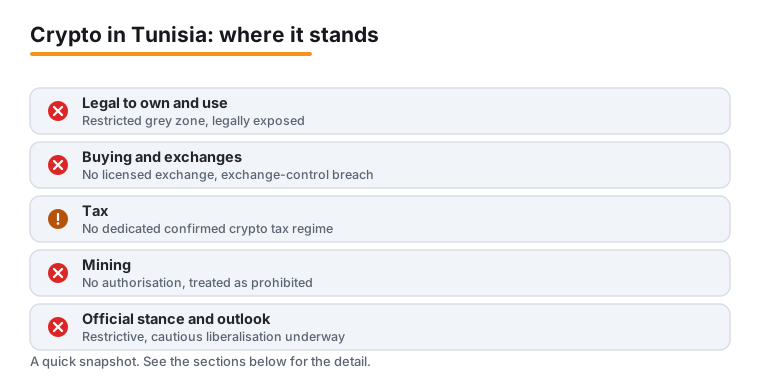
Bitcoin is not legal tender in Tunisia, and using crypto to pay for goods and services is not permitted. The only lawful currency for settling transactions is the Tunisian dinar (TND), and merchants cannot legally accept Bitcoin or other tokens.
The decisive issue is foreign exchange. A 2018 directive from the Central Bank of Tunisia treats unauthorised dealings in virtual money as a breach of currency rules, citing capital-flight and money-laundering concerns. Because the dinar is a tightly controlled, non-freely-convertible currency, converting dinar to crypto and moving value across borders can be characterised as an exchange-control violation rather than an ordinary consumer matter.
So is it legal? The accurate answer is that crypto occupies a restricted, prohibited grey zone. There is no clean statute that simply criminalises owning a coin, but the combination of the BCT directive and Tunisia's exchange-control framework means most real-world activity, especially buying and selling, can expose a person to legal risk. Reported enforcement cases, including a widely covered 2021 incident in which a teenager was detained after a small Bitcoin-related transaction, show how aggressively the rules can be applied. Treat crypto in Tunisia as restricted and legally exposed, not as a safe, regulated activity, unless and until a new framework is formally in force.
Who regulates crypto in Tunisia?
No single agency owns crypto in Tunisia; oversight is shared among several authorities, none of which currently licenses retail crypto activity:
- Central Bank of Tunisia (Banque Centrale de Tunisie, BCT) is the lead authority. It sets monetary policy, administers exchange controls and issued the 2018 directive restricting virtual-money transactions. Any future authorisation regime for holding or exchanging crypto is expected to run through the BCT. Official site: Banque Centrale de Tunisie.
- Conseil du Marche Financier (CMF), the Financial Market Council, regulates and supervises Tunisia's securities market and would be relevant to any token treated as an investment instrument. Official site: Conseil du Marche Financier.
- Commission Tunisienne des Analyses Financieres (CTAF) is Tunisia's financial-intelligence unit, hosted at the central bank. It receives and analyses suspicious-transaction reports and is frequently the basis on which crypto cases are pursued. Official site: Commission Tunisienne des Analyses Financieres.
The Ministry of Finance and the ministry responsible for the digital economy also shape policy, and parliament must enact any new framework. For anything official, the BCT remains the primary regulator to consult.
Key laws and frameworks
Tunisia does not yet have a dedicated, modern crypto statute. The treatment of digital assets is built from existing instruments:
- The Foreign Exchange Code (Code des Changes), rooted in the 1976 framework. Built on restriction and prior authorisation, it governs currency conversion and cross-border money flows and is the legal backbone for treating unsanctioned crypto transfers as exchange-control breaches.
- The 2018 Central Bank of Tunisia directive on virtual money. This is the instrument that discourages and penalises unauthorised virtual-currency transactions.
- Anti-money-laundering and counter-terrorism-financing law. Organic Law n. 2015-26 of 7 August 2015, as amended and completed by Organic Law n. 2019-9 of 23 January 2019, established and reinforced the CTAF and the AML/CFT reporting regime that crypto activity is often assessed against.
A major reform is in progress but not fully in force. A draft overhaul of the Foreign Exchange Code was published in 2024 and has been moving through government and parliament. Officials have said it would, for the first time, allow Tunisians to hold and exchange crypto, but only under prior BCT authorisation and within financial thresholds to be set in later regulatory texts. Until those texts are enacted and the licensing details are actually live, the restrictive status quo applies. Always check the latest position with the named regulators.
Licensing and registration of exchanges and VASPs
There is currently no licensing or registration regime for crypto exchanges or virtual-asset service providers (VASPs) in Tunisia, and no licensed domestic exchange operates legally in the country. This is the central obstacle for anyone trying to buy or sell digital assets locally.
The draft Foreign Exchange Code and ministerial statements point toward a future, tightly controlled model in which crypto exchange would require prior authorisation from the Central Bank of Tunisia and compliance with financial thresholds and conversion-to-fiat conditions. Parliamentary discussion has referenced conditional exchange licences and on-shore know-your-customer (KYC) requirements as part of a possible phased rollout. Those are proposals and roadmaps, not enacted rules, and reported timelines have not been confirmed in law.
The practical takeaway: do not assume any platform is licensed in Tunisia, because none currently is. If and when a regime goes live, the BCT and, where relevant, the CMF would be the bodies issuing authorisations, so verify any future licence directly with them rather than relying on a platform's own claims.
Crypto taxation in Tunisia
Because crypto trading is not authorised, Tunisia has no dedicated, confirmed crypto tax regime, and ordinary tax categories do not cleanly apply to an activity that is itself restricted. There is no enacted capital-gains rule specific to virtual assets, and we do not quote speculative figures here. Any specific rates, thresholds or filing rules circulating online for a future framework should be treated as draft proposals, not law.
If a regulated regime is eventually enacted, taxation would likely be defined alongside it, potentially routing individual gains through the personal income tax (impot sur le revenu) and company gains through corporate tax. None of that is in force today. For your actual obligations, consult the Tunisian tax administration and a qualified adviser, and read our general guide to crypto taxes for context. Do not rely on secondhand summaries for decisions with tax or legal consequences.
AML and KYC rules
Anti-money-laundering and counter-terrorism-financing rules are central to how crypto is policed in Tunisia. The CTAF, established under Organic Law n. 2015-26 (2015) and reinforced by Organic Law n. 2019-9 (2019), is the national financial-intelligence unit that receives suspicious-transaction reports from banks and other reporting entities and refers confirmed cases to prosecutors.
Because there is no licensed crypto sector, there is no crypto-specific KYC regime for exchanges; instead, crypto activity tends to surface through the banking system's general AML obligations. Converting crypto proceeds into dinar, or making cross-border transfers, can trigger suspicious-transaction reporting and scrutiny. Tunisian authorities, including the financial-intelligence unit, the National Guard and customs, have also undertaken training specifically on investigating money laundering involving cryptocurrencies, which signals rising enforcement capability.
If a regulated VASP framework is enacted, mandatory on-shore KYC and AML compliance are expected to be core requirements. For now, anyone moving crypto-linked value through Tunisian banks should expect that AML monitoring applies and that informal workarounds carry real legal exposure.
Buying and using crypto in practice
There is no compliant, straightforward way to buy or use Bitcoin inside Tunisia today, and this section is descriptive, not a recommendation. Two layers of friction stack up. First, exchange controls: the dinar is not freely convertible, so funding an overseas crypto account from a Tunisian bank or repatriating proceeds can run into currency rules. Second, payment-card restrictions: Tunisian cards are heavily limited for international online spending, which makes funding global exchanges with a local card difficult.
As a result, Tunisians who hold crypto often rely on informal peer-to-peer arrangements, foreign accounts, or assets acquired while abroad. Each route carries legal and counterparty risk: peer-to-peer trades can attract money-laundering scrutiny, using crypto to bypass exchange controls is exactly the conduct the BCT directive targets, and there is no consumer-protection backstop if a trade goes wrong. Merchants cannot lawfully accept crypto as payment, so day-to-day spending in crypto is not a realistic option. Until a licensing regime exists, treat any buying, selling or spending activity as unregulated and legally exposed, and confirm the current rules with the BCT and a qualified lawyer first.
Bitcoin mining in Tunisia
Mining sits under the same cloud as trading. There is no licensing regime that authorises commercial crypto mining, and unauthorised mining can be treated as part of the broader prohibition on unsanctioned virtual-money activity. There is no clear legal green light for running mining as a business.
The economics are also challenging. Electricity is largely supplied through the national utility, and energy costs plus grid constraints make large-scale proof-of-work mining less attractive than in jurisdictions with cheap, surplus power. Tunisia has strong solar potential, and there is global interest in pairing mining with renewables, but converting that into compliant, grid-approved mining would require a framework that does not currently exist. For now, treat mining in Tunisia as legally unsupported rather than as an opportunity, and verify the position with the authorities before committing any capital.
Recent developments (2024 to 2026)
The clearest momentum is around reforming Tunisia's exchange regime. A draft overhaul of the Foreign Exchange Code was published in 2024, and ministers stated that it would, for the first time, allow Tunisians to hold and exchange crypto, but only under prior authorisation from the Central Bank of Tunisia and within financial thresholds to be defined in later regulatory texts. Crypto would have to be converted to fiat under controlled conditions.
In parallel, on 2 December 2025 Tunisia's parliament approved a measure, attached to the 2026 Finance Law, allowing resident individuals to open foreign-currency bank accounts for the first time in roughly five decades. The amendment passed with 69 votes in favour, 17 against and 17 abstentions, and it reversed a similar proposal that parliament had rejected during the 2025 Finance Bill debate in November 2024. Lawmakers framed the change as a way to let young people and freelancers in the digital sector receive income from international platforms legally. This is a notable liberalisation of the currency regime, but the article itself makes no mention of cryptocurrency or virtual assets, it concerns conventional foreign-currency accounts in euros or dollars, and it still requires the BCT to issue implementing circulars defining caps, eligibility criteria and checks on the source of funds. Banks are to verify the lawful origin of deposits, and overdrafts on these accounts are not allowed. Parliamentary discussion has also floated a phased crypto roadmap with sandboxes, conditional licences and progressive taxation, but those remain proposals with unconfirmed timelines. The BCT already runs a fintech regulatory sandbox for testing controlled financial innovation, which is the kind of vehicle a future crypto pilot could use, though no retail crypto licensing is live today.
The honest summary for 2026: the direction of travel is toward cautious, controlled liberalisation, but the crypto-specific framework is not yet fully enacted or operational. Be sceptical of claims that crypto is now freely legal in Tunisia until you can verify them against primary sources from the BCT and parliament.
Consumer risks and protection
The dominant risk in Tunisia is legal, not just financial. Unauthorised crypto activity can be treated as an exchange-control or money-laundering matter, and enforcement, while uneven, is real. On top of that sit the universal hazards: price volatility, exchange failures, scams and irreversible transactions. Crucially, there is no domestic investor-protection scheme or consumer-recourse mechanism for crypto, because no licensed sector exists. If funds are lost to a failed platform, a fraudulent peer or a stolen wallet, there is generally no local body to make you whole.
Anyone who nonetheless chooses to take on that risk should only ever commit money they can afford to lose entirely, use strong self-custody and operational security, and obtain advice from a qualified Tunisian professional first. Be especially wary of platforms or individuals claiming crypto is already fully legal or licensed in Tunisia, as that is not the case as of 2026. This page is general information, not investment advice. For broader context, see our regulation hub.
Official sources and how to verify
The law here is evolving, so always confirm the current position against primary sources rather than secondhand summaries. The authorities to consult are:
- Central Bank of Tunisia (Banque Centrale de Tunisie), the lead regulator for monetary policy, exchange controls, the 2018 virtual-money directive and any future authorisation regime. Check its circulars and notices for the latest position.
- Conseil du Marche Financier (CMF), Tunisia's financial-market regulator, relevant to any token treated as an investment instrument.
- Commission Tunisienne des Analyses Financieres (CTAF), the financial-intelligence unit responsible for AML/CFT, where you can find the governing organic laws and guidance.
This article is general information as of 2026 and is not legal advice. Because Tunisia's crypto rules are changing and enforcement can be unpredictable, you should verify the current position with the Central Bank of Tunisia and a qualified Tunisian lawyer or tax adviser before acting. For wider background, see our guide to crypto regulation.
Frequently asked questions
Is it legal to own Bitcoin in Tunisia?
Crypto sits in a restricted, prohibited grey zone rather than a clearly regulated market. Bitcoin is not legal tender, merchants cannot accept it, and a 2018 Central Bank of Tunisia directive treats unauthorised virtual-money transactions as a breach of currency rules. Converting dinar to crypto or moving value across borders can be treated as an exchange-control or money-laundering offence. There is no clean statute that simply bans holding a coin, but real-world activity is legally exposed. Confirm the current position with the BCT and a qualified Tunisian lawyer before acting.
Who regulates cryptocurrency in Tunisia?
The lead authority is the Central Bank of Tunisia (Banque Centrale de Tunisie, BCT), which administers exchange controls and issued the 2018 directive on virtual money. The Conseil du Marche Financier (CMF) supervises the securities market, and the Commission Tunisienne des Analyses Financieres (CTAF) is the financial-intelligence unit handling anti-money-laundering enforcement. No agency currently licenses retail crypto activity. For anything official, start with the BCT at bct.gov.tn.
Can I use a crypto exchange or get a licence in Tunisia?
No. There is no licensing or registration regime for crypto exchanges or virtual-asset service providers in Tunisia, and no licensed domestic exchange operates legally. Restricted banking and payment-card rules also make funding foreign exchanges difficult. A draft Foreign Exchange Code points toward a future model requiring prior BCT authorisation and financial thresholds, but that framework is not yet live. Do not assume any platform is licensed in Tunisia, because none currently is.
Are there crypto taxes in Tunisia?
Because crypto trading is not authorised, Tunisia has no dedicated, confirmed crypto tax regime, and ordinary tax categories do not cleanly apply to a restricted activity. There is no enacted virtual-asset capital-gains rule, and any specific rates or thresholds quoted online for a future framework are draft proposals, not law. We do not state specific figures here. Verify your obligations with the Tunisian tax administration and a qualified adviser.
What changed in 2025 and 2026?
A draft overhaul of the Foreign Exchange Code, published in 2024, would allow Tunisians to hold and exchange crypto under prior BCT authorisation and financial thresholds once later texts are enacted. Separately, on 2 December 2025 parliament approved a measure in the 2026 Finance Law, by 69 votes to 17 with 17 abstentions, letting residents open foreign-currency accounts for the first time in about five decades. That reversed a similar proposal rejected in November 2024, but it concerns conventional currency accounts rather than crypto, makes no mention of virtual assets, and still needs BCT implementing circulars. The direction is cautious liberalisation, but the crypto-specific framework is not yet fully in force. Verify the latest position with the BCT.
Is Tunisia going to legalise crypto?
Possibly, but it has not fully happened yet. Officials have signalled that holding and exchanging crypto could become permitted under strict BCT-authorised conditions through the new Foreign Exchange Code, and parliamentary discussion has floated sandboxes, conditional licences and phased taxation. These remain proposals and roadmaps with unconfirmed timelines. Until a framework is formally enacted and licensing is operational, the restrictive status quo applies. Watch official Central Bank of Tunisia announcements rather than secondhand reports.
Does the 2026 Finance Law let Tunisians buy crypto?
No. The measure approved on 2 December 2025 in the 2026 Finance Law lets resident individuals open conventional foreign-currency bank accounts in euros or dollars, ending a restriction that had stood for roughly five decades. It passed by 69 votes to 17 with 17 abstentions and reversed a similar proposal rejected in November 2024. The text makes no mention of cryptocurrency or virtual assets, and it still needs the Central Bank of Tunisia to issue implementing circulars setting caps, eligibility and source-of-funds checks. It does not authorise buying or trading crypto.
Can Tunisian banks or cards be used to fund a crypto exchange?
In practice this is difficult. The Tunisian dinar is not freely convertible, so moving money to an overseas crypto platform can run into exchange-control rules, and Tunisian payment cards are heavily restricted for international online spending. Using either route to buy crypto can be treated as the kind of unauthorised currency dealing the 2018 Central Bank of Tunisia directive targets. There is no licensed domestic exchange, so there is no compliant local funding path today. Confirm the current position with the BCT and a qualified Tunisian professional before acting.
Facts reviewed: 30 June 2026. Page updated: 3 August 2026.