Home › Crypto Regulation › Algeria
Bitcoin & Cryptocurrency Regulation in Algeria
Quick answer — Algeria, 2026
- Legal: Banned; owning, trading and mining criminalised under Law 25-10
- Tax: No crypto tax regime; activity is illegal
- Buying: No legal way to buy; banks block crypto transactions
Algeria has one of the most restrictive cryptocurrency regimes in the world. Bitcoin and all other crypto assets are not simply unregulated here, they are explicitly prohibited by law, and dealing in them can carry criminal penalties. The country first banned what it calls virtual currencies in its 2018 Finance Law, and in 2025 it went considerably further with Law No. 25-10 of 24 July 2025, which criminalises the issuance, purchase, sale, possession, use, exchange, mining and promotion of digital assets. This guide explains, in plain terms, what the current rules mean for residents, businesses and visitors, covering legal status, the authorities involved, the key laws, exchange and licensing questions, tax, anti-money-laundering rules, mining, recent developments, consumer risks and how to verify the law through official sources.
This article is general information as of 2026 and is not legal, tax or financial advice. Cryptocurrency law in Algeria is strict and enforcement-oriented, so anyone with a real situation should consult a qualified Algerian lawyer and verify the current text of the law with the named official regulators, above all the Bank of Algeria, before acting. For broader background see our guide to crypto regulation and our country regulation hub.
On this page: Legal status · Who regulates it · Taxes · How to buy · Mining
Is Bitcoin and crypto legal in Algeria?
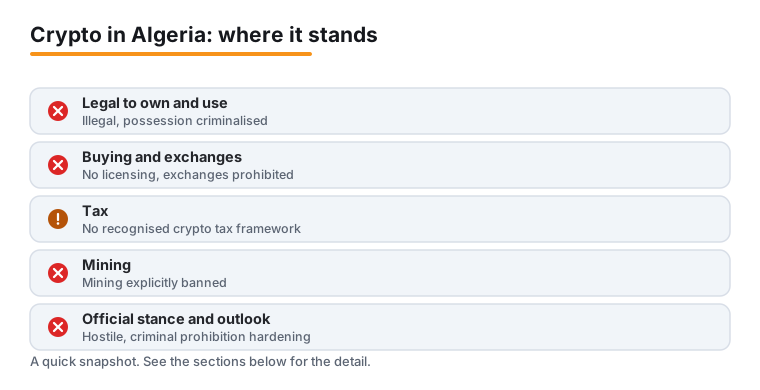
No. Bitcoin and other cryptocurrencies are illegal in Algeria. The country does not recognise crypto as money or as a lawful financial instrument, and it does not license crypto exchanges, brokers or custodians. Rather than regulating the sector, Algeria has chosen to prohibit it outright.
The prohibition has two layers. The 2018 Finance Law introduced the original ban on dealing in virtual currencies. In 2025, Law No. 25-10 went much further by embedding a comprehensive crypto ban into Algeria's anti-money-laundering and counter-terrorist-financing framework and attaching criminal liability to a wide range of activities. In practical terms, there is no lawful way for an individual or company in Algeria to buy, sell, hold, trade, mine or advertise crypto.
Because the rules are strict and framed around financial crime, the safest assumption is that any crypto activity conducted from within Algeria is unlawful. If you are unsure how the law applies to your circumstances, seek advice from a licensed Algerian lawyer rather than relying on general online guides.
The regulators that govern crypto in Algeria
Algeria has no dedicated crypto regulator, because its policy is prohibition rather than supervision. Instead, several existing financial authorities enforce the ban:
- The Bank of Algeria is the central bank. It controls the dinar and the banking system, supervises banks through its Banking Commission, and issues binding instructions and guidelines that banks must follow. It is the primary authority enforcing the crypto prohibition through the financial system.
- The Banking Commission (Commission Bancaire), operating within the Bank of Algeria, supervises banks and financial institutions and can sanction non-compliance.
- The Financial Intelligence Processing Unit (Cellule de Traitement du Renseignement Financier, or CTRF) is Algeria's financial-intelligence unit. Created in 2002 and placed under the Ministry of Finance, it receives suspicious-transaction reports and combats money laundering and terrorism financing, the framework into which the crypto ban is now written.
- The Ministry of Finance oversees fiscal and financial policy and the CTRF.
You can verify the central bank's role at the official Bank of Algeria site and the financial-intelligence unit at the CTRF site.
Key crypto laws and frameworks in Algeria
Two pieces of legislation define Algeria's position, both reinforced by central-bank rules:
- 2018 Finance Law (Article 117). This established the first explicit ban, stating that the purchase, sale, use and possession of virtual currencies is prohibited. It reflected the authorities' concern that digital assets could undermine control of the dinar and facilitate capital flight.
- Law No. 25-10 of 24 July 2025. Published in the Official Journal of the Algerian Republic in Official Journal No. 48 of 24 July 2025, this law amends and supplements Law No. 05-01 on the prevention of and fight against money laundering and the financing of terrorism. As reported on the text, it criminalises issuing or creating digital assets; buying, selling, possessing and using them; trading and operating wallets and platforms; mining, both commercial and individual; promoting or advertising crypto products; and providing related intermediary services.
Algeria is not an EU member, so EU frameworks such as MiCA do not apply here. Laws and their interpretation can change, so always confirm the current wording and scope through official Algerian channels or a qualified local lawyer before relying on any summary, including this one.
Licensing and registration of exchanges and VASPs
There is no licensing or registration regime for crypto exchanges or virtual-asset service providers (VASPs) in Algeria, because the underlying activity is banned rather than authorised. The law prohibits operating trading platforms and wallet services and providing intermediary services for crypto, so there is no register to join and no authorisation to obtain.
This contrasts sharply with jurisdictions that have built VASP licensing under frameworks such as the EU's MiCA or the recommendations of the Financial Action Task Force. In Algeria, a business cannot become a compliant, supervised crypto provider; the only compliant position is not to offer such services at all.
Centralised exchanges therefore do not operate lawfully in Algeria, and banks and licensed payment providers do not support crypto purchases. Any platform claiming to offer licensed crypto services to Algerian residents is operating outside Algerian law.
Crypto and Bitcoin tax in Algeria
Because crypto activity is prohibited rather than regulated, Algeria does not operate a recognised tax framework for cryptocurrency gains, income or trading. There is no lawful, licensed crypto market for the tax system to attach to, so you will not find an official capital-gains or income-tax regime designed specifically for Bitcoin in the way some other countries have.
This is not the same as crypto being tax-free in a beneficial sense. The absence of a tax regime reflects the fact that the underlying activity is illegal. Engaging in prohibited crypto activity does not become safer because it is untaxed; it remains exposed to the penalties set out in the criminal law.
We do not state specific rates or thresholds here because there is no verified, dedicated crypto tax schedule to cite. If your situation involves general income, foreign assets or money movements that might intersect with Algerian tax rules, consult a qualified Algerian tax adviser. For general background see our crypto tax guide. This section is informational only and is not tax advice.
AML and KYC rules around virtual assets
Algeria's crypto ban sits inside its anti-money-laundering and counter-terrorist-financing (AML/CTF) framework. Law No. 25-10 amends Law No. 05-01, the core AML/CTF law, so virtual-asset activity is treated through the lens of financial crime rather than ordinary commerce.
This built on earlier central-bank rules. Regulation No. 24-03, reported as dated August 2024, extended the Bank of Algeria's AML/CTF supervision across banks, Algeria Post and virtual-asset providers, requiring risk-based customer due diligence, transaction monitoring and controls on digital assets and anonymous transactions. The 2025 law and the later banking guidelines tightened this into an outright prohibition. Algeria's stated rationale is alignment with the standards of the Financial Action Task Force (FATF), which sets the global framework for combating money laundering and terrorist financing.
In November 2025 the Bank of Algeria's Banking Commission reinforced this by issuing AML guidelines, Guidelines No. 06-2025 of 12 November 2025, on the identification, blocking and prohibition of operations linked to virtual assets. Under these directives, banks and financial institutions, including Algeria Post, are required to implement detection systems, apply enhanced due diligence and continuous transaction monitoring, and refrain from establishing relationships or processing transactions suspected of being linked to virtual assets. The move was reported by the official Algerian state news agency (APS) in late November 2025.
For account holders this means standard know-your-customer (KYC) checks apply to ordinary banking, and transactions that appear connected to crypto, including transfers to or from foreign platforms, can be flagged, blocked or reported to the CTRF. Verify the latest guidelines on the Bank of Algeria website.
Buying and using crypto in practice
There is no legal way to buy or use crypto in Algeria. Centralised exchanges are not licensed to operate, banks do not support crypto purchases, and the law prohibits buying, selling, exchanging, holding and using digital assets as well as providing intermediary services.
Algeria also enforces tight controls on the dinar and on cross-border money movements. Foreign-exchange rules limit how money can leave the country, and the authorities have explicitly linked the crypto ban to concerns about capital flight. Attempting to route funds abroad to buy crypto can therefore raise both crypto-law and foreign-exchange issues, and the November 2025 banking guidelines specifically target transfers connected to foreign crypto platforms.
Peer-to-peer trading, informal swaps and use of offshore platforms occur in many banned markets, but in Algeria these fall within the prohibited conduct and can expose participants to criminal penalties. We do not provide instructions for circumventing the ban. To move or hold value lawfully, use regulated banking channels and seek professional advice.
Bitcoin mining in Algeria
Bitcoin mining is prohibited in Algeria. Law No. 25-10 is reported to ban mining explicitly, covering both commercial mining operations and individual mining. This means setting up rigs at home, running a small farm, or operating a larger facility are all treated as unlawful activities, regardless of scale.
Operational considerations that matter elsewhere, such as hardware efficiency, cooling, joining mining pools or timing electricity use, are effectively moot in a legal sense in Algeria, because the activity itself is not permitted. Energy is also state-managed, and using subsidised power for prohibited purposes adds further exposure.
The key point is that mining is not a grey area here: it is named among the banned activities. Anyone affected should seek qualified legal advice rather than relying on operational guides written for jurisdictions where mining is allowed.
Recent developments (2025 to 2026)
Algeria's recent trajectory has been toward tighter prohibition, not liberalisation. The two most important recent steps are:
- Law No. 25-10 (24 July 2025). Published in the Official Journal, this law moved Algeria from a general 2018 ban to a comprehensive criminal prohibition covering issuance, purchase, sale, possession, use, exchange, mining, promotion and intermediary services, with defined penalties.
- Banking Commission Guidelines No. 06/2025 (reported 12 November 2025). The Bank of Algeria's Banking Commission directed banks and Algeria Post to identify, block and refrain from processing operations linked to virtual assets, with particular attention to transactions routed through foreign platforms.
These followed Regulation No. 24-03 of August 2024, which had already brought banks, Algeria Post and virtual-asset providers under the Bank of Algeria's AML/CTF supervision, and they sit alongside continued work on the state-backed digital dinar. Together they mark a clear hardening of policy through 2025 and into 2026. Some neighbouring states are moving differently: Morocco, for example, has been reported to be preparing a draft framework to regulate rather than ban crypto, so the regional picture varies. Government policy can change over time, but as of 2026 the prohibition stands. Treat any claim that the rules have loosened with caution and confirm it through official government sources.
The digital dinar: Algeria's state-backed alternative
While private crypto is banned, Algeria has been working on its own central bank digital currency (CBDC), commonly called the digital dinar. This is a state-issued digital form of the national currency, not a decentralised cryptocurrency, and it would be issued and controlled by the Bank of Algeria rather than by any private network.
The digital dinar was given a legal basis under Law No. 23-09 of 2023, and officials have described it as a way to improve the transparency of transactions and reduce the informal cash economy. As of the most recent public reporting in April 2026, the project was still preparatory, with no bill number, no parliamentary reading, no pilot and no published timetable rather than a public rollout, so there is no live digital dinar in general circulation at the time of writing.
The contrast is deliberate. Algeria's approach is to prohibit private, decentralised crypto while developing a centralised, state-controlled digital currency it can supervise. For residents this means the only digital-money direction the authorities endorse is the future digital dinar, not Bitcoin or stablecoins. Confirm the current status through the Bank of Algeria.
Consumer risks and protection
The central risk in Algeria is legal. Under Law No. 25-10, Article 31 bis punishes a breach of Article 6 bis with imprisonment of two months to one year and fines between 200,000 and 1,000,000 Algerian dinars (broadly equivalent to around 1,500 to 7,700 US dollars at recent exchange rates), with tougher penalties where offences are linked to organised crime, money laundering or terrorism financing. We cite these figures as reported and recommend verifying the exact amounts and terms against the official text, as currency conversions and provisions can shift.
Beyond criminal exposure, there is no consumer protection: no recourse for fraud or platform failure through Algerian regulators, no licensed custodian to safeguard assets, and no compensation scheme. Scams that promise easy crypto access or guaranteed returns are a particular danger in banned markets, and travellers should treat any in-person offer to buy or sell crypto as carrying both legal and fraud risk.
Because there is no domestic investor-protection regime, the practical downside of crypto activity in Algeria extends beyond market volatility to fines, prosecution and frozen bank accounts. This is informational only and not legal or financial advice.
Official sources and how to verify
Because this is sensitive legal information, always confirm the current position through official Algerian sources rather than relying solely on summaries. The most authoritative starting points are:
- The Bank of Algeria, the central bank, for banking instructions and the Banking Commission's AML guidelines on virtual assets.
- The Financial Intelligence Processing Unit (CTRF), for the anti-money-laundering and counter-terrorist-financing framework into which the crypto ban is written.
- The Algerian Ministry of Finance, for fiscal and financial policy and links to the official texts.
For the precise legal wording, the Official Journal of the Algerian Republic (Journal Officiel) is the definitive source for Law No. 25-10 and the 2018 Finance Law. This page is general information as of 2026 and is not legal advice; readers should verify their situation with the Bank of Algeria and a qualified Algerian lawyer. See also our crypto regulation overview.
What is changing in August 2026
Nothing in Algeria's crypto rules has changed since Law No. 25-10 took effect. In early August 2026, issuing, buying, selling, holding, using, trading, promoting or mining virtual assets remains a criminal offence, there is no licensing regime, no crypto bill before parliament and no tax treatment. Two developments since this page was last reviewed sit alongside the ban rather than inside it.
- Algeria left the FATF grey list on 19 June 2026. The Financial Action Task Force removed Algeria from its list of jurisdictions under increased monitoring at a plenary held at the OECD headquarters in Paris, as reported by the state news agency APS on the day. Financial Afrik reports that Algeria had been listed in October 2024 and that Namibia was delisted at the same session, with no new country added. This affects correspondent banking and the level of enhanced due diligence applied to Algerian payments. It does not soften the crypto ban, and the APS report of it does not mention virtual assets.
- Bank of Algeria Instruction No. 07-2026 of 13 July 2026 entered into force on 19 July 2026, reworking the annual foreign exchange travel allowance. It is set out in full below because it is the legal channel readers usually compare crypto against.
The Finance Law for 2026 is Law No. 25-17 of 14 December 2025, published in Official Journal No. 88 of 31 December 2025. Its 176 articles contain no reference to virtual assets, virtual currency, crypto, tokens or a digital dinar. The securities regulator COSOB was publishing market notices normally, its most recent dated 3 August 2026 on its site, and has issued nothing on crypto assets, tokens or ICOs. The CTRF's published guidelines page lists only guidelines from 2015 and nothing on virtual assets; the virtual asset instructions came from the Bank of Algeria, not the financial intelligence unit.
The two articles of Law 25-10 that carry the ban
Law 25-10 works by inserting articles into the 2005 anti money laundering law rather than by creating a standalone crypto statute. The text below is taken from the official gazette, Official Journal No. 48 of 24 July 2025, published on the Secretariat General of the Government's portal, where readers can check it themselves.
- Article 4 was amended first, to add a definition. Virtual assets are digital values that can be exchanged digitally, transferred, or used for payment or investment purposes. The definition expressly excludes operations on the digital values of fiat currencies, financial securities and other financial assets.
- Article 6 bis sets the prohibition. It is forbidden to issue, buy, sell, use or hold virtual assets, to trade in them, to promote them, or to create or operate exchange platforms for them, where they serve as a means of payment or recognised currency, or as an investment instrument. A final sentence adds that the prohibition includes activities linked to cryptocurrency mining.
- Article 31 bis sets the penalty. Without prejudice to more severe penalties elsewhere in law, anyone who breaches Article 6 bis is punished by imprisonment of two months to one year and a fine of 200,000 to 1,000,000 dinars, or by one of those two penalties. In other words a court may impose both, or only one.
Two points of precision are worth making because secondary coverage gets them wrong. The gazette text does not mention digital wallets anywhere, so descriptions of the ban as expressly covering wallets go beyond the statute. And the prohibition is framed around use as payment or as an investment instrument rather than as an unqualified ban on the mere existence of a private key. Because the ban lives inside the anti money laundering law, a crypto transaction is handled as an AML matter, which is why the Bank of Algeria's response took the form of bank facing guidelines and why suspicious activity goes to the CTRF. Law 25-10 also repealed articles 18 bis 2, 18 bis 3, 18 bis 4 and 28 of the 2005 law.
The legislative pipeline as of August 2026
Readers usually want to know what is coming, not only what exists. The honest answer for Algeria is that the pipeline is empty on the permissive side and settled on the enforcement side. This is the full set of instruments in force or in preparation.
| Instrument | Stage | Timing | What it means in practice |
|---|---|---|---|
| Article 117 of Law No. 17-11, the Finance Law for 2018 | In force | Since December 2017, not repealed | The original prohibition on virtual currency, with no penalty figures of its own |
| Bank of Algeria regulation of 24 July 2024, cited here as Regulation No. 24-03 | In force | Applies now | The AML monitoring and reporting duties banks operate under |
| Law No. 25-10 of 24 July 2025, amending Law No. 05-01 | In force | Official Journal No. 48 of 24 July 2025, no amendment announced | The criminal ban itself, via Articles 6 bis and 31 bis |
| Bank of Algeria Guidelines No. 06-2025 of 12 November 2025 | In force | Applies now to banks and Algerie Poste | Identify, block and report virtual asset transactions |
| Law No. 25-17, the Finance Law for 2026 | In force | From 1 January 2026, next window is the Finance Law for 2027 | Contains no crypto tax and no digital asset measure |
| Bank of Algeria Instruction No. 07-2026 of 13 July 2026 | In force | Effective 19 July 2026 | Foreign exchange travel allowance moves onto international payment cards |
| Digital dinar central bank currency | Announced only | No bill number, no reading, no pilot, no published timetable | A state issued digital currency if it arrives, not a route to legal private crypto |
There is no draft licensing framework for exchanges, no virtual asset service provider registration scheme, no sandbox and no consultation paper. Anyone saying Algeria is about to regulate rather than prohibit is not describing a published document.
Tax: what applies when there is no crypto tax
There is no crypto tax in Algeria, no rate, no declaration line and no cost basis rule. Under Law 25-10 the activity is a criminal offence, so it is suppressed rather than taxed. Saying that once is more useful than listing rates that do not exist.
What does apply:
- Article 117 of Law No. 17-11 of 27 December 2017, the Finance Law for 2018, published in Official Journal No. 76 of 28 December 2017. It prohibits the purchase, sale, use and holding of so called virtual currency and provides that breaches are punished under the laws and regulations in force. Neither Law 25-10 nor the Finance Law for 2026 repeals or amends it.
- Law No. 25-17, the Finance Law for 2026, which is the annual instrument that would have created a digital asset tax and did not. Its full text contains no virtual asset provision. The next realistic window is the Finance Law for 2027.
- Law No. 05-01 on money laundering and terrorist financing as amended by Law 25-10, which supplies the offence and the penalty.
The Direction Generale des Impots has published no crypto guidance, and COSOB, the market regulator, has published nothing on digital assets. There is no lawful way to report a crypto gain in Algeria, because reporting one would be reporting a criminal offence. If you moved to Algeria holding crypto acquired lawfully elsewhere, this is a question for an Algerian lawyer rather than a tax adviser.
The legal foreign currency channel, and why it matters here
Most people who search for crypto in Algeria are really asking about access to convertible currency. That channel changed in July 2026.
Bank of Algeria Instruction No. 07-2026 of 13 July 2026 took effect on 19 July 2026. Per Algerie Eco and AlgaTedz, the travel allowance now works like this:
- 750 euros a year for adults, or the equivalent in another convertible currency, and 300 euros for minors aged 12 to 18, limited to two children per family.
- Paid onto an international payment card issued by an Algerian bank. An existing card may be used, but it must have at least three years of validity remaining.
- Granted only once per calendar year.
- Not transferable between spouses. A spouse must hold their own international payment card.
- If the trip is cancelled, or the traveller returns to Algeria within seven days, the entire amount must be repaid. This is a full restitution obligation, not a reduced allowance.
- Requires a return transport ticket or a land travel tax receipt, a valid passport, a copy of its first page, a copy of a valid visa where one is required, and proof of income.
The connection to crypto is direct. These are the same card rails that Guidelines No. 06-2025 instruct banks to screen for virtual asset transactions, so using the allowance to fund an exchange account is precisely the behaviour the monitoring is built to detect. Reporting on the informal reality, such as this April 2026 account, describes people continuing to buy USDT through peer to peer channels and loading it onto cards, and describes enforcement as selective, with attention going to large transfers while small retail users go unnoticed. That is a gap in enforcement, not a gap in the law. The statutory text is unambiguous, and the users described are in breach of Law 25-10.
Frequently asked questions
Is it illegal to own Bitcoin in Algeria?
Yes. Algeria prohibits the possession and use of crypto assets, alongside buying, selling, trading, mining and promoting them. The 2018 Finance Law introduced the ban and Law No. 25-10 of 24 July 2025 reinforced it with criminal penalties as part of the anti-money-laundering framework. There is no lawful way to hold Bitcoin in Algeria, and you should consult a qualified Algerian lawyer about your specific situation.
Who regulates crypto in Algeria?
There is no dedicated crypto regulator because crypto is banned, not licensed. Enforcement runs through the Bank of Algeria (the central bank) and its Banking Commission, the Financial Intelligence Processing Unit (CTRF) under the Ministry of Finance, and law-enforcement bodies. The Bank of Algeria is the lead authority; you can verify its role at bank-of-algeria.dz.
What are the penalties for using crypto in Algeria?
According to reporting on Law No. 25-10, individuals can face prison terms of roughly two months to one year and fines between 200,000 and 1,000,000 Algerian dinars (approximately 1,500 to 7,700 US dollars), with harsher penalties when offences involve organised crime, money laundering or terrorism financing. Verify the exact figures and terms through official Algerian sources, as conversions and provisions may change.
Are there licensed crypto exchanges in Algeria?
No. Algeria does not license crypto exchanges, brokers or custodians, and there is no VASP registration regime. Operating a trading platform or wallet service and providing intermediary services for crypto are prohibited. Banks and licensed payment providers do not support crypto purchases. For lawful saving, investing or transfers, use regulated Algerian financial institutions.
Can tourists use Bitcoin in Algeria?
No. The prohibition applies within Algeria regardless of nationality, so visitors should not assume that buying, selling or transacting in crypto is permitted just because it is legal in their home country. There is no consumer-protection framework for crypto here, and any in-person offer to trade carries both legal and fraud risk. This is informational only and not legal advice.
Can I send money to family in Algeria using Bitcoin?
Using crypto for remittances into or out of Algeria is not a lawful workaround, because transferring and exchanging digital assets is prohibited and intersects with strict foreign-exchange controls. The Bank of Algeria's November 2025 guidelines also direct banks to block transactions linked to foreign crypto platforms. Use authorised banks, licensed money-transfer operators and official channels instead. This is informational only and not legal or financial advice.
Does Algeria have a digital dinar or CBDC?
Algeria has been developing a central bank digital currency known as the digital dinar, given a legal basis under Law No. 23-09 of 2023 and issued by the Bank of Algeria. It is a state-controlled digital form of the national currency, not a decentralised cryptocurrency. As reported, it has stayed in a research and preparation phase rather than general public use, so there is no live digital dinar in circulation at the time of writing. Confirm the current status through the Bank of Algeria.
When did Algeria ban cryptocurrency?
Algeria first prohibited dealing in virtual currencies in its 2018 Finance Law. It went much further with Law No. 25-10 of 24 July 2025, published in the Official Journal (reported as No. 48), which criminalised issuing, buying, selling, holding, using, exchanging, mining and promoting digital assets as part of the anti-money-laundering framework. The Bank of Algeria's Banking Commission then issued guidelines in November 2025 directing banks and Algeria Post to identify and block virtual-asset transactions.
How does Algeria compare with its neighbours on crypto?
Algeria is among the strictest, with an outright criminal ban. The regional picture is not uniform: Morocco, which had banned crypto since 2017, has since published a draft law (reported as Bill 42.25) prepared with its central bank, Bank Al-Maghrib, to regulate rather than prohibit digital assets. This means rules can differ sharply from one country to the next, so never assume Algeria's position matches a neighbour's. Always verify the law for the specific country involved.
Has anything changed for crypto in Algeria in 2026?
No. The criminal ban created by Law 25-10 of 24 July 2025 is unchanged as of early August 2026. There is no crypto bill in parliament, no licensing framework and no tax treatment. The two relevant changes nearby are that Algeria left the FATF grey list on 19 June 2026, and that Bank of Algeria Instruction No. 07-2026 of 13 July 2026 moved the annual foreign exchange travel allowance onto international payment cards from 19 July 2026.
Which articles of the law actually ban crypto in Algeria?
Law 25-10 inserted articles into the 2005 anti money laundering law. Article 6 bis prohibits issuing, buying, selling, using, holding, trading in and promoting virtual assets, and creating or operating exchange platforms for them, where they are used as a means of payment or recognised currency or as an investment instrument, and it states that the prohibition includes cryptocurrency mining. Article 31 bis sets the penalty at two months to one year in prison and a fine of 200,000 to 1,000,000 dinars, or one of those two penalties, so a court may impose both or only one.
Is there a tax on crypto gains in Algeria?
No. There is no crypto tax rate, no declaration line and no cost basis rule, because holding and disposing of virtual assets is a criminal offence rather than a taxable activity. The Finance Law for 2026, Law No. 25-17, published in Official Journal No. 88 on 31 December 2025, contains no virtual asset measure anywhere in its 176 articles, and the Direction Generale des Impots has published no crypto guidance. The next point at which a tax measure could appear is the Finance Law for 2027.
Was Algeria removed from the FATF grey list?
Yes. The Financial Action Task Force removed Algeria from its list of jurisdictions under increased monitoring on 19 June 2026, at a plenary held at the OECD headquarters in Paris, as reported by the Algerian state news agency APS. Algeria had been listed in October 2024, and Namibia was delisted at the same session. The delisting concerns the country's overall anti money laundering framework and does not change the prohibition on virtual assets.
How much foreign currency can I legally take out of Algeria in 2026?
Under Bank of Algeria Instruction No. 07-2026, in force since 19 July 2026, the allowance is reported as 750 euros a year for adults and 300 euros for minors aged 12 to 18, capped at two children per family. The money is credited to an international payment card issued by an Algerian bank rather than handed over in cash, it can be granted only once per calendar year, and the full amount must be repaid if the trip is cancelled or you return to Algeria within seven days.
Does Algeria's securities regulator have crypto rules?
No. COSOB, the Commission d'Organisation et de Surveillance des Operations de Bourse, regulates the Algerian financial market and was publishing market notices normally in early August 2026, but it has issued nothing on crypto assets, tokens or ICOs. The rules that apply to virtual assets come from the criminal and anti money laundering side, through Law 25-10 and the Bank of Algeria's guidelines to banks.
Did the 2018 ban on virtual currency disappear when Law 25-10 was passed?
No. Article 117 of Law No. 17-11, the Finance Law for 2018, prohibits the purchase, sale, use and holding of so called virtual currency, and it was not repealed or amended by Law 25-10 or by the Finance Law for 2026. It is narrower than Article 6 bis and carries no penalty figures of its own, which is why Law 25-10 is the instrument that matters in practice.
Facts reviewed: 4 August 2026. Page updated: 4 August 2026.