Home › Crypto Regulation › Monaco
Bitcoin & Cryptocurrency Regulation in Monaco
Quick answer — Monaco, 2026
- Legal: Legal to own and use, not legal tender; crypto services need a licence
- Tax: Residents generally no income or capital gains tax; French nationals excepted
- Buying: Via reputable international exchanges with KYC
Monaco is a small, wealthy principality on the French Riviera that has built one of Europe's more deliberate legal frameworks for cryptocurrency and other digital assets. Crypto is legal to own, buy, sell and use in Monaco, but businesses that issue, custody, exchange or advise on digital assets are tightly supervised and must be authorised before they operate. The cornerstone of the regime is Law No. 1.528 of 7 July 2022, which created a structured licensing system for digital-asset and crypto-asset service providers. Through 2025 and into 2026, Monaco has continued to tighten its anti-money-laundering rules, partly in response to being placed under increased international monitoring.
This guide explains, in plain language, the current state of crypto regulation in Monaco as of 2026: whether Bitcoin is legal, who the regulators are, the key laws, how exchanges and other providers are licensed, how digital assets are treated for tax, the AML and KYC rules, the practical reality of buying and using crypto, mining, recent developments, the risks to watch, and how to verify everything against official sources. It is general information, not legal, tax or financial advice. Monaco's rules are detailed and continue to evolve, so confirm your own situation with a qualified Monegasque advisor and the named official authorities before acting. For broader context, see our overview of crypto regulation.
On this page: Legal status · Who regulates it · Taxes · How to buy · Mining
Is Bitcoin and crypto legal in Monaco?
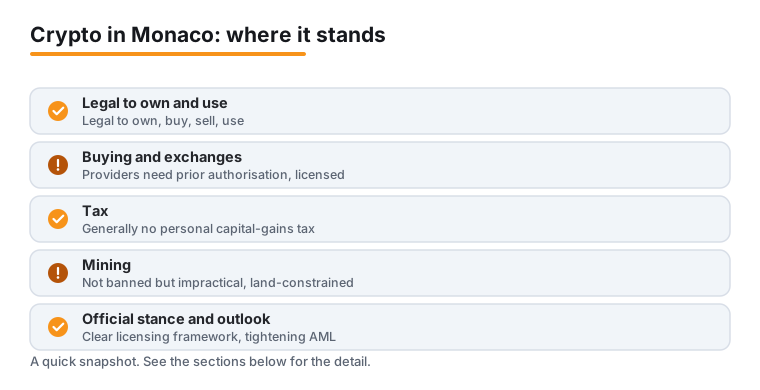
Yes. Owning, buying, selling and using Bitcoin and other cryptocurrencies is legal in Monaco for residents, businesses and visitors. There is no ban on holding crypto or transacting in it, and the principality has positioned itself as a jurisdiction that supports blockchain innovation within a clear legal framework rather than prohibiting it.
The crucial distinction is between using crypto and running a crypto business. Individuals are free to hold and trade digital assets for their own account. Firms that provide regulated services to third parties, however, must be authorised first. Under Law No. 1.528 of 7 July 2022, services such as issuing crypto-assets, custody of clients' assets, operating an exchange or trading platform, executing or transmitting orders, advising on crypto investments, and converting between crypto and traditional money are all regulated activities requiring prior approval. In short, crypto is legal, but offering crypto services to the public is a licensed, supervised activity.
Bitcoin is not legal tender in Monaco. The principality uses the euro under a monetary agreement with the European Union. Merchants are not obliged to accept crypto, so do not assume you can pay in Bitcoin anywhere; acceptance is voluntary and limited.
Who regulates crypto in Monaco?
Supervision in Monaco is shared between more than one authority, and there is no single blanket "crypto licence." Each regulated activity requires explicit prior approval from the relevant authority.
- The Minister of State (Ministre d'Etat) grants the prior authorisation for crypto-asset service providers under Law No. 1.528, after a reasoned opinion from a dedicated consultative commission. This covers activities such as issuing crypto-assets, custody, operating trading or negotiation platforms, and converting between crypto and fiat currency.
- The Commission de Controle des Activites Financieres (CCAF) is Monaco's independent authority supervising the conduct of financial activities, including investment-type services such as receiving and transmitting orders, executing orders and giving investment advice. Where a crypto activity overlaps with regulated investment services, the CCAF is the supervisor. Its official site is ccaf.mc.
- The Autorite Monegasque de Securite Financiere (AMSF) is Monaco's financial intelligence unit and anti-money-laundering supervisor. It became an independent authority in 2023, taking over from the former SICCFIN. The AMSF receives and analyses suspicious-transaction reports, supervises AML and counter-terrorist-financing compliance, and can impose sanctions. Its official site is amsf.mc.
If you are unsure which authority applies to a given activity, contact the regulator directly or take Monegasque legal advice. Providers already authorised by the CCAF for an equivalent financial activity may, in some cases, extend into crypto activities through prior notification rather than a fresh approval.
Key laws and frameworks
Monaco's centrepiece for digital assets is Law No. 1.528 of 7 July 2022, which amended various digital provisions and created a licensing regime for service providers on digital assets and crypto-assets. The law defines a crypto-asset broadly as a digital representation of value, property or a right of a patrimonial nature, including digital assets and financial tokens, and it sets conduct rules requiring providers to act honestly and professionally, to give clients clear and accurate information, to warn clients of the risks of crypto-assets, to publish their pricing policy, and to handle complaints. You can consult the official text on Monaco's legal portal: Loi n. 1.528 on Legimonaco.
Law No. 1.528 builds on earlier legislation, including the framework Law No. 1.383 of 2 August 2011 for a "Digital Principality" and Law No. 1.491 of 23 June 2020 on token offerings (initial coin offerings). It also operates alongside Monaco's anti-money-laundering legislation, such as Law No. 1.362, as amended, which governs AML and counter-terrorist-financing obligations.
Because Monaco is not a member of the European Union, the EU's Markets in Crypto-Assets Regulation (MiCA) does not apply directly in Monaco, even though MiCA has applied across the EU since 30 December 2024, with the transitional period for providers already operating under national law running until 1 July 2026 at the latest. A Monaco-based provider that serves clients inside the EU may still face MiCA-related expectations indirectly, and Monaco has broadly aimed to keep its rules consistent with international and European standards. There is also a hard date. Annex B to the Monetary Agreement between the European Union and Monaco, as replaced by a Commission communication published on 22 May 2025, lists MiCA (Regulation (EU) 2023/1114) and the EU transfer-of-funds regulation (Regulation (EU) 2023/1113) with an implementation deadline for Monaco of 31 December 2026.
Licensing and registration of exchanges and providers
A business that provides crypto-asset services to third parties on a habitual or professional basis in or from Monaco must obtain prior authorisation before operating. Under Law No. 1.528, the authorisation for the core activities (issuance, custody, trading platforms, crypto-to-fiat conversion) is delivered by the Minister of State after a reasoned opinion from a consultative commission, while investment-type services fall under the CCAF.
Conditions for approval typically include:
- registration of the service provider as an entity in Monaco;
- good reputation, honourability and appropriate skill of the managers and shareholders;
- implementation of robust AML and counter-terrorist-financing procedures, including asset-freezing obligations;
- adequate IT security, data protection and business-continuity arrangements.
There is no single all-purpose crypto licence. The required approval depends on the precise service, and a provider may need more than one. An exemption from a fresh approval can apply to financial institutions already authorised by the CCAF for an equivalent class of activity, subject to prior notification of the regulator. Because the application process is detailed and fact-specific, prospective providers should engage Monegasque legal counsel and approach the relevant authority early.
Crypto and Bitcoin tax in Monaco
Monaco is well known for its tax regime. As a general rule, Monegasque residents do not pay personal income tax or capital-gains tax, and this can extend to gains on personal crypto investments held as part of managing one's own private wealth. This is a major reason the principality attracts internationally mobile crypto investors. See our general guide to crypto taxes for wider context.
That headline comes with important caveats:
- French nationals are a key exception. Under the 1963 bilateral tax convention between France and Monaco, French nationals resident in Monaco generally remain subject to French tax rules, which can include French taxation of crypto gains.
- Business activity differs from personal investing. If crypto activity amounts to a commercial or professional business carried on in Monaco, it can fall within the scope of business-profits taxation rather than the zero-rate treatment for private wealth.
- Residency is decisive. The favourable treatment depends on being a genuine Monegasque tax resident. People who remain tax-resident elsewhere may owe tax in their home country regardless, and many countries tax crypto gains and scrutinise residency claims.
- Reporting and source-of-funds rules still apply, even where no tax is due.
Where tax does apply, the rates are published. Monaco's business profits tax (impot sur les benefices, ISB) is charged at 25% for financial years opened from 1 January 2022, and it catches businesses carrying on an industrial or commercial activity that realise more than 25% of their turnover outside Monaco. Outcomes still hinge on your nationality, residency, and whether the activity is personal or professional. Confirm your position with a qualified Monegasque tax advisor and the relevant authorities. This section is informational only and not tax advice.
AML, KYC and financial-crime rules
Anti-money-laundering and counter-terrorist-financing compliance is central to Monaco's crypto regime. The AMSF supervises AML and CFT obligations and acts as the country's financial intelligence unit, receiving and analysing suspicious-transaction reports. Crypto-asset service providers are subject to these obligations alongside banks, payment institutions and other regulated professionals.
In practice, any compliant provider operating in or serving Monaco will:
- verify customer identity (know-your-customer, or KYC), often including proof of address;
- request source-of-funds and source-of-wealth information, especially for larger amounts;
- monitor transactions and report suspicious activity to the AMSF;
- apply asset-freezing measures where required.
Expect these checks whether you use a domestic provider or a reputable international exchange that serves Monaco residents. Be wary of any platform that promises to bypass KYC; in a compliance-focused jurisdiction, that is a serious red flag. Monaco's banking sector is conservative, and some banks scrutinise crypto-related funds closely, so keeping a transparent paper trail of your transactions matters.
Buying and using crypto in practice
For an individual resident or visitor, buying and selling cryptocurrency in Monaco works much as it does elsewhere in Europe, typically through reputable international exchanges and brokers. There is no prohibition on acquiring crypto for personal use. What is regulated is the provision of exchange, custody and related services to the public from within Monaco.
A practical path looks like this:
- Choose a reputable, properly regulated exchange or broker that serves Monaco residents and takes compliance seriously.
- Complete identity verification (KYC) and be ready to provide proof of address and source of funds.
- Fund your account by bank transfer or card; a clear record helps with conservative banks.
- Place your order, watching fees and spreads.
- Secure your holdings. For anything beyond small amounts, move assets to a wallet you control, ideally a hardware wallet for larger sums, and safeguard your recovery phrase.
- Keep records of every purchase, sale and transfer for banking, compliance and any future reporting needs.
Using crypto for payments is voluntary on the merchant's side, so acceptance is limited. For cross-border transfers, crypto can move value quickly, but volatility, network fees, and on- and off-ramp costs all affect the real outcome, and the rules of the destination country also apply. Use established services and keep good records.
Bitcoin mining in Monaco
There is no specific ban on crypto mining in Monaco, but large-scale Bitcoin mining is impractical there, and the reasons are structural rather than purely legal. Monaco is one of the most densely populated and land-constrained places in the world, with very limited space and high costs. Large proof-of-work mining operations need cheap, abundant electricity and physical room for hardware and cooling, none of which Monaco can offer competitively.
Monaco also places strong emphasis on its environment and energy efficiency, which sits poorly with the heavy electricity consumption of proof-of-work mining. As a result, residents interested in this space typically look elsewhere or focus on lower-energy activities such as staking on proof-of-stake networks, which raise their own regulatory and tax questions. If you pursue any mining, staking or validation activity at scale, treat it as a potential business activity for tax and regulatory purposes and seek advice rather than assuming it is unregulated.
Recent developments (2025 to 2026)
The most significant recent development is Monaco's anti-money-laundering reform programme. In June 2024 the Financial Action Task Force (FATF) added Monaco to its list of "jurisdictions under increased monitoring," commonly called the grey list, reflecting shortcomings in its financial-crime defences. Monaco responded with a national strategy and action plan and intensified work through the AMSF.
At the FATF plenary held in Mexico from 9 to 13 February 2026, the FATF adopted Monaco's third progress report, recognising substantial progress and tangible results, particularly in the quality and speed of suspicious transaction reports, while the action plan was not yet complete. At the FATF plenary held in Paris from 17 to 19 June 2026, the FATF adopted Monaco's progress report and found that Monaco had substantially completed the action plan set in June 2024. Even so, Monaco was not removed from the grey list at that plenary and remained one of the jurisdictions under increased monitoring, because the FATF requires an on-site assessment to confirm that the reforms are embedded in practice before removal. No date for that on-site visit had been set as of mid-2026. The status can change at each plenary, so confirm the current position on the FATF country page rather than relying on any single date. Separately, the European Commission added Monaco to the EU list of high-risk third countries by Commission Delegated Regulation (EU) 2025/1184 of 10 June 2025, in force since 5 August 2025, which requires EU banks and MiCA-authorised exchanges to apply enhanced customer due diligence to Monaco-linked clients. That is the concrete reason source-of-funds questions have become sharper.
In parallel, the EU's MiCA framework moved into full application across the EU during 2026. Monaco, as a non-EU state, is not directly bound by MiCA but continues to feel indirect pressure to remain broadly consistent with European and international standards. That direction became concrete on 6 August 2026, when the Government deposited Bill No. 1131 to replace Law No. 1.528 with a MiCA-inspired regime authorised by the CCAF. For the latest, check the official FATF page on Monaco: FATF country profile for Monaco.
Consumer risks and protection
The main risks for crypto users in Monaco fall into a few buckets. Market risk is the obvious one: crypto prices are highly volatile and losses can be significant. Security risk covers hacks, scams, lost keys and fraud, which are common across the industry. Regulatory and compliance risk is especially relevant here, because Monaco's framework is detailed, AML expectations are demanding, and the rules continue to tighten. Banking-access risk can also arise, since conservative local banks may scrutinise crypto-related funds.
Consumer protection in Monaco comes mainly through the authorisation and conduct rules imposed on regulated providers: licensed firms must act honestly, give clear and non-misleading information, warn clients of the risks of crypto-assets, publish their pricing and handle complaints. These protections only apply when you deal with an authorised provider, so check authorisation status before committing funds against the CCAF's published list of authorised firms and the activities each is authorised for, stated to be current as of 30 June 2026. Be alert to phishing, impersonation and "too good to be true" investment schemes, never share your private keys or seed phrase, use strong unique passwords and two-factor authentication, and invest only what you can afford to lose. This guide is general information as of 2026 and is not legal, tax or financial advice; verify your situation with the named official regulators and a qualified Monegasque advisor.
Official sources and how to verify
Crypto rules change, and details depend on your circumstances, so always confirm against primary sources before acting. The most useful official references for Monaco are:
- Legimonaco, Monaco's official legal portal, where you can read the full text of Law No. 1.528 and related legislation: legimonaco.mc.
- Commission de Controle des Activites Financieres (CCAF), the supervisor of financial activities including investment-type crypto services: ccaf.mc.
- Autorite Monegasque de Securite Financiere (AMSF), the financial intelligence unit and AML supervisor: amsf.mc.
- FATF country profile for Monaco, for the current grey-list and AML status: fatf-gafi.org.
For wider context on this site, see our hub on crypto regulation and our country and topic index at the regulation directory. When in doubt about your own position, contact the relevant Monegasque authority directly and consult a qualified local advisor. This is general information as of 2026, not legal advice.
What is changing: Bill No. 1131, deposited 6 August 2026
Monaco's crypto law is being replaced. On 6 August 2026 the Princely Government deposited Bill No. 1131 on the regulation of crypto-asset service provider activities (projet de loi n. 1131 portant reglementation des activites de prestataires de services sur crypto-actifs) on the desk of the National Council. The Government announced this in a press release published on 12 August 2026, stating that the bill replaces the regime established by Law No. 1.528 of 7 July 2022, which it describes as having become obsolete in light of developments in the European regulatory framework, and that the text is inspired by the EU's Markets in Crypto-Assets Regulation (MiCA) and takes into account standards set by the FATF (gouv.mc, NEWS.MC).
The most consequential change is who licenses you:
- Authorisation would be granted by the CCAF. Under Bill No. 1131, prior authorisation for crypto-asset services would come from the Commission de Controle des Activites Financieres, after opinions from the AMSF and the Agence Monegasque de Securite Numerique (AMSN), the digital security agency. That replaces the existing Law No. 1.528 route described above.
- The list of permitted crypto-asset services is defined more precisely, and providers face professional obligations covering governance, prudential rules and business conduct.
- Implementing texts would follow to set the operational detail once the law is adopted.
What is not yet public matters just as much. No National Council vote date has been announced, no entry-into-force date has been published, and no transition or grandfathering arrangement for firms already authorised under Law No. 1.528 has been disclosed. Until the bill is voted and promulgated, Law No. 1.528 remains the law in force and applications still go through the existing route.
Monaco's MiCA deadline is 31 December 2026, and it is treaty-based
Monaco is not in the EU, but it is not free of MiCA either. Monaco uses the euro under a Monetary Agreement with the European Union, and Annex B to that agreement lists the EU financial legislation Monaco is required to implement, each with a deadline. Annex B was replaced by a Commission communication under Article 11(5) of the agreement, published on 22 May 2025. Three entries matter here (EUR-Lex):
| EU act | What it covers | Monaco implementation deadline |
|---|---|---|
| Regulation (EU) 2023/1114 (MiCA) | Markets in crypto-assets: authorisation and conduct rules for crypto-asset service providers, token issuers and stablecoins | 31 December 2026 |
| Regulation (EU) 2023/1113 | Information accompanying transfers of funds and certain crypto-assets, the EU travel rule | 31 December 2026 |
| Regulation (EU) 2024/1624, Directive (EU) 2024/1640, Regulation (EU) 2024/1620 | The 2024 EU AML package, including the new EU Anti-Money Laundering Authority | 31 December 2028 |
So the honest answer to "does MiCA apply in Monaco" has changed. MiCA does not apply directly of its own force, but Monaco has committed by treaty to implement it, and the deadline is 31 December 2026. The Government's press release on Bill No. 1131 does not cite the Annex B deadline, so treat the two as separate facts that point the same way rather than as one instrument. For readers, the practical expectations by the end of 2026 are MiCA-style authorisation categories for providers and travel-rule data, originator and beneficiary information, attached to crypto transfers handled by Monegasque providers.
Monaco on the EU high-risk list: why your bank asks more questions
Separately from the FATF grey list, the European Commission added Monaco to the EU list of high-risk third countries with strategic anti-money-laundering deficiencies. This was done by Commission Delegated Regulation (EU) 2025/1184 of 10 June 2025, published on 16 July 2025. Article 2 provides that it enters into force on the twentieth day following publication, which is 5 August 2025, and the Commission's own list gives Monaco that same listing date (EUR-Lex, European Commission).
The regulation's recital 12 is more balanced than the listing alone suggests. It records that Monaco made a high-level political commitment in June 2024 to the FATF and to MONEYVAL to strengthen the effectiveness of its AML/CFT regime, and that since its December 2022 mutual evaluation report Monaco has made significant progress on several recommended actions, including establishing a new combined financial intelligence unit and AML/CFT supervisor.
The consequence is felt at the account-opening desk rather than in Monegasque law. EU obliged entities, which includes EU banks and MiCA-authorised exchanges, must apply enhanced customer due diligence to business relationships and transactions involving a listed country. In practice, if you are a Monaco resident onboarding with an EU exchange or moving money between a Monaco bank and a crypto venue, expect deeper source-of-funds and source-of-wealth questions, more document requests and slower approvals than a comparable EU resident.
Monaco was still on the Commission's published list when this page was updated in August 2026. Removal typically follows FATF delisting rather than preceding it.
Crypto tax in Monaco: the rates that do exist
The page above explains why most individual residents pay nothing. Where tax does apply, the rates are published, so here they are.
Business profits tax (impot sur les benefices, ISB). Monaco's official business portal states that businesses carrying on an industrial or commercial activity that realise more than 25% of their turnover outside Monaco are liable to the ISB (monentreprise.gouv.mc).
| Financial years opened from | ISB rate |
|---|---|
| 1 January 2022 | 25% |
| 1 January 2021 | 26.5% |
| 1 January 2020 | 28% |
| 1 January 2019 | 31% |
| Before 1 January 2019 | 33.33% |
New businesses carrying on a genuinely new activity get a phased entry: no ISB in years one and two, then tax calculated on 25%, 50% and 75% of profits in years three, four and five, and on 100% from year six. Monaco levies no personal income tax or capital gains tax on Monegasque residents, other than French nationals covered by the 1963 France-Monaco convention.
What this means for crypto. There is no crypto-specific tax rate in Monaco, and no published Monegasque tax guidance dealing with crypto gains, staking or mining income could be located. The realistic reading is the general default: a resident individual managing private wealth is outside the income tax net because Monaco has none for them, while a crypto activity run as a commercial business through a Monegasque company falls to be assessed for ISB at 25% if it crosses the turnover test. Whether a given trading operation is private wealth management or a commercial activity is a question of fact, and it is exactly the question to put to a Monegasque tax advisor before you structure anything. This is general information, not tax advice.
FATF status corrected and dated
Monaco has been under FATF increased monitoring since June 2024. The 2026 sequence is:
- 9 to 13 February 2026, Mexico plenary. The FATF adopted Monaco's third progress report, recognising substantial progress and tangible results, particularly in the quality and speed of suspicious transaction reports submitted to the AMSF. The action plan was not complete (NEWS.MC).
- 15 to 19 June 2026, Paris plenary. The FATF reached what the Monegasque Government itself calls a preliminary conclusion that Monaco has substantially completed the action plan drawn up in June 2024. A visit to the Principality will be arranged to confirm that the reforms have been fully and sustainably embedded, and the Government states that the date is yet to be determined (gouv.mc, NEWS.MC).
Monaco therefore remains under increased monitoring as of August 2026. Any report putting the on-site visit in a specific month is not supported by the Government's own announcement, which says the date is still to be confirmed. Removal can only be decided at a plenary after that visit.
Frequently asked questions
Is cryptocurrency legal in Monaco?
Yes. Owning, buying, selling and using cryptocurrency is legal in Monaco for individuals and businesses. However, providing crypto-asset services to the public, such as running an exchange, custodying client assets, issuing tokens or giving investment advice, is a regulated activity that requires prior authorisation under Law No. 1.528 of 7 July 2022. Crypto is not legal tender; the official currency is the euro. This is general information, not legal advice; verify with the official Monegasque authorities.
Who regulates crypto in Monaco?
Supervision is shared. The Minister of State grants the prior authorisation for core crypto-asset service providers (issuance, custody, trading platforms, crypto-to-fiat conversion) under Law No. 1.528. The Commission de Controle des Activites Financieres (CCAF, ccaf.mc) supervises financial and investment-type services. The Autorite Monegasque de Securite Financiere (AMSF, amsf.mc), which replaced SICCFIN in 2023, is the financial intelligence unit and anti-money-laundering supervisor.
Do you pay tax on crypto in Monaco?
For many individual Monegasque residents managing their own private wealth, there is generally no personal income tax or capital-gains tax, and this can extend to personal crypto gains, which is a major reason the principality attracts crypto investors. Important exceptions apply, notably for French nationals under the 1963 France-Monaco tax convention, and professional or business-scale crypto activity can be taxed differently. Outcomes depend on your nationality and residency, so confirm with a qualified Monegasque tax advisor. This is not tax advice.
Does Monaco follow the EU's MiCA crypto rules?
Not directly. Monaco is not an EU member, so MiCA, the EU's crypto-asset regulation that moved into full application across the EU during 2026, does not automatically apply in Monaco. Monaco has its own framework under Law No. 1.528 and related laws. That said, Monaco firms serving EU-based clients can face MiCA-related expectations indirectly, and Monaco has broadly aimed to keep its rules consistent with international and European standards.
Do I need a licence to run a crypto exchange in Monaco?
Yes. A business providing crypto-asset services to third parties on a professional basis in or from Monaco must obtain prior authorisation under Law No. 1.528 before operating. Core activities such as custody, trading platforms and crypto-to-fiat conversion are authorised by the Minister of State, while investment-type services fall under the CCAF. Conditions include a Monaco-registered entity, fit-and-proper management, and robust AML and counter-terrorist-financing procedures. Take Monegasque legal advice and approach the relevant authority early.
Is Monaco on the FATF grey list?
Monaco was placed on the FATF list of jurisdictions under increased monitoring (the grey list) in June 2024 over anti-money-laundering shortcomings. At the FATF plenary in June 2026, the FATF found that Monaco had substantially completed its action plan, but Monaco was not removed and stayed on the list pending an on-site assessment to confirm the reforms work in practice. The status can change at each plenary, so check the official FATF country page for Monaco for the current position rather than relying on a fixed date.
Which authority replaced SICCFIN as Monaco's AML supervisor?
The Autorite Monegasque de Securite Financiere (AMSF) replaced the former SICCFIN in July 2023 under Law No. 1.549 of 6 July 2023. The change turned Monaco's financial intelligence unit from a state administrative service into an independent authority with its own powers of financial intelligence, supervision and sanctions. The AMSF supervises anti-money-laundering and counter-terrorist-financing compliance, including for crypto-asset service providers, and is a member of the Egmont Group of financial intelligence units. Its official site is amsf.mc.
Can I pay with Bitcoin in shops in Monaco?
Only where a merchant chooses to accept it. Bitcoin is not legal tender in Monaco, which uses the euro under a monetary agreement with the European Union, so no shop is obliged to take crypto. Acceptance is voluntary and limited in practice. You are free to own and trade crypto for your own account, but do not assume you can spend it directly at everyday businesses. This is general information, not financial advice.
What is Monaco's Bill No. 1131 and when does it take effect?
Bill No. 1131 is the Princely Government's draft law on the regulation of crypto-asset service provider activities, deposited with the National Council on 6 August 2026 and announced in a press release published on 12 August 2026. It would replace the regime established by Law No. 1.528 of 7 July 2022, with prior authorisation granted by the CCAF after opinions from the AMSF and the AMSN. The Government says the text is inspired by the EU's MiCA regulation and takes FATF standards into account. No vote date, entry-into-force date or transition arrangement for existing licensees has been published. Until it is voted and promulgated, Law No. 1.528 is still the law in force.
Does Monaco have to adopt MiCA?
Yes, by treaty rather than by EU membership. Annex B to the Monetary Agreement between the European Union and Monaco, replaced by a Commission communication published on 22 May 2025, lists Regulation (EU) 2023/1114 (MiCA) and Regulation (EU) 2023/1113 (the crypto travel rule) with an implementation deadline for Monaco of 31 December 2026. The 2024 EU anti-money-laundering package carries a deadline of 31 December 2028.
Is Monaco on the EU list of high-risk countries for money laundering?
Yes. Commission Delegated Regulation (EU) 2025/1184 of 10 June 2025 added Monaco to the EU list of high-risk third countries with strategic AML and counter-terrorist-financing deficiencies. It was published on 16 July 2025 and entered into force on the twentieth day after publication, 5 August 2025, which is also the listing date the European Commission shows for Monaco. The practical effect is that EU banks and MiCA-authorised exchanges must apply enhanced customer due diligence to clients and transactions linked to Monaco, which is why source-of-funds checks are heavier than for an EU resident. Monaco was still on the Commission's published list in August 2026.
How much tax would a crypto business pay in Monaco?
Monaco's business profits tax (ISB) is 25% for financial years opened from 1 January 2022, down from 26.5% for 2021, 28% for 2020, 31% for 2019 and 33.33% before that. It applies to businesses carrying on an industrial or commercial activity that realise more than 25% of their turnover outside Monaco. Genuinely new activities pay no ISB in years one and two, then tax calculated on 25%, 50% and 75% of profits in years three to five, and on 100% from year six. There is no crypto-specific rate and no published Monegasque tax guidance on crypto gains, so whether a trading operation counts as private wealth management or a commercial business is a question of fact for a Monegasque tax advisor.
Has Monaco left the FATF grey list?
Not yet. At the plenary held in Paris from 15 to 19 June 2026 the FATF reached what the Monegasque Government describes as a preliminary conclusion that Monaco has substantially completed the action plan drawn up in June 2024. A visit to the Principality will be arranged to confirm the reforms are fully and sustainably embedded, and the Government states the date is yet to be determined. Monaco remains under increased monitoring until a plenary decides otherwise after that visit.
Facts reviewed: 13 August 2026. Page updated: 13 August 2026.