Home › Crypto Regulation › Fiji
Bitcoin & Cryptocurrency Regulation in Fiji
Quick answer — Fiji, 2026
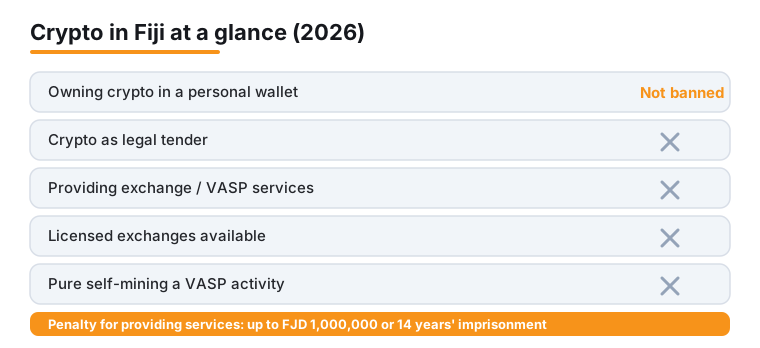
- Owning Bitcoin in a personal wallet is not the banned activity, but since 30 August 2025 providing virtual asset services in or to Fiji is prohibited.
- There is no licensed or legal way inside Fiji to buy, trade or cash out crypto, and it is not legal tender.
- No dedicated crypto tax regime exists; the general rules apply, and the published default for disposing of a capital asset is capital gains tax at 10 percent under the Income Tax Act 2015, with a capital gain not exceeding FJD 30,000 exempt for resident individuals and Fiji citizens.
Fiji has taken one of the strictest positions on digital assets in the Pacific. As of 30 August 2025, providing virtual asset services in or to Fiji is legally prohibited under an amendment to the Reserve Bank of Fiji Act 1983. This page explains what that means in practice for ordinary people, businesses and travellers in 2026: what is and is not allowed, who the regulator is, and how the rules touch buying, exchanges, taxation, mining and remittances. Fiji has not built a framework to license crypto activity; it has banned the business of offering it, and the central bank has reiterated that stance rather than softened it. For wider context see our guide to crypto regulation and the country hub at /regulation/.
This is general information checked against Fiji government sources in August 2026 and is not legal, tax or financial advice. Crypto law in Fiji is recent, and it did not change in the 2026 budget round: Parliament amended the Reserve Bank of Fiji Act in July 2026 for central bank accounting purposes, with no reported change to the virtual asset prohibition in section 22, so always verify your specific situation directly with the Reserve Bank of Fiji and a qualified local lawyer before acting.
On this page: Legal status · Who regulates it · Taxes · How to buy · Mining
Is Bitcoin and crypto legal in Fiji?
The honest answer for 2026 is nuanced. Holding or owning a cryptocurrency in a personal wallet is not the same activity that Fiji has outlawed, but the practical room to use crypto has been almost entirely closed off. Under section 22(2) of the Reserve Bank of Fiji Act 1983, the Reserve Bank of Fiji (RBF) has made it illegal to provide virtual asset services in or to Fiji. That covers running an exchange, transferring crypto on someone's behalf, custody or safekeeping, and marketing or settling such services for Fiji residents.
The amendment, on its face, does not create a criminal offence for a private individual who simply owns Bitcoin. However, because the surrounding services are banned, there is no legal, regulated way inside Fiji to acquire, trade, cash out or safeguard digital assets. In effect, crypto may exist on paper but has no legal commercial ecosystem to support it.
Bitcoin is also not legal tender in Fiji. Only the Fijian dollar (FJD), issued by the RBF, is legal tender. No business is obliged to accept crypto, and offering crypto payment services to the public would fall under the prohibition.
Who regulates crypto in Fiji?
The primary regulator is the Reserve Bank of Fiji (RBF), the country's central bank, which issued the prohibition and acts as the enforcement authority. The RBF supervises banks, payment systems, foreign exchange and now virtual asset services. Its official website is the authoritative place to check the current rules.
Two other bodies matter alongside the RBF. The National Anti-Money Laundering Council sets the policy rationale for the ban and has publicly reaffirmed it, citing money laundering, terrorist financing and Fiji's limited supervisory capacity. The Fiji Revenue and Customs Service (FRCS) handles taxation. The Reserve Bank of Fiji is the enforcing authority, acting under section 22(2) of the Reserve Bank of Fiji Act 1983 as inserted by the Reserve Bank of Fiji (Budget Amendment) Act 2025, and it runs no crypto licensing regime of any kind, because the policy is prohibition rather than licensing.
You can confirm the position at the Reserve Bank of Fiji and tax questions at the Fiji Revenue and Customs Service.
Key laws and frameworks
The core legal instrument is section 22(2) of the Reserve Bank of Fiji Act 1983, inserted by the Reserve Bank of Fiji (Budget Amendment) Act 2025 and in force from 30 August 2025. The RBF announced it in Press Release No. 15/2025, dated 5 September 2025.
Under the amendment, any natural or legal person, whether based in Fiji or overseas, must not:
- carry on the business of a virtual asset service provider (VASP) in Fiji;
- purport to, or hold themselves out as, carrying on that business in Fiji; or
- market, advertise, make or accept payment and settlement, or provide technical support or other related services, to Fiji residents.
A VASP is defined as anyone who, as a business, conducts activities such as exchanging between crypto and fiat, exchanging between cryptocurrencies, transferring crypto, safekeeping or administering crypto, or providing financial services connected to an issuer's offer and sale of a virtual asset.
A virtual asset is broadly defined as a digital representation of value that can be digitally traded or transferred and used for payment or investment. It expressly includes cryptocurrencies like Bitcoin, NFTs, utility tokens, stablecoins and security tokens. It excludes digital representations of fiat currencies and of securities and other financial assets already regulated under the RBF Act and the Companies Act 2015.
| Item | Position in Fiji (2026) |
|---|---|
| Regulator | Reserve Bank of Fiji |
| Legal basis | RBF Act 1983, s.22(2), as amended by the Budget Amendment Act 2025 |
| Effective date | 30 August 2025 |
| Crypto as legal tender | No, only the Fijian dollar |
| Providing VASP services | Prohibited |
Licensing and registration of exchanges and VASPs
There is no licensing or registration regime for crypto exchanges or VASPs in Fiji, because the activity is prohibited rather than regulated. The RBF has stated that no licences have been issued for crypto trading or investment services and that no organisation is permitted to operate in this field. Anyone considering setting up a digital wallet provider, exchange, broker or custody service in Fiji should understand there is no application path; the activity itself is an offence.
The prohibition is written to reach offshore providers too. An overseas exchange that markets to, accepts settlement from, or holds itself out as serving Fiji residents is also caught. In practice, many international platforms apply geo-restrictions to high-risk or prohibited jurisdictions, and the RBF has cautioned residents against using Fiji-based funds, including local debit or credit cards, to buy or invest in digital assets.
This is the opposite of the licensing approach taken in jurisdictions with formal VASP frameworks. If Fiji ever moves toward registration or a regulatory sandbox, it would require new legislation; until then, assume no VASP can lawfully be licensed.
Crypto and Bitcoin tax in Fiji
The tax authority in Fiji is the Fiji Revenue and Customs Service (FRCS). Fiji has not published a dedicated crypto tax regime, and the recent prohibition on virtual asset services makes a bespoke crypto tax framework unlikely in the near term, because the policy direction is to discourage the activity, not to tax it.
The absence of crypto-specific rules does not mean a complete absence of tax exposure. General principles around income, business profits and capital can still apply to gains or earnings depending on the facts, and Fiji operates a value added tax. Because there is real uncertainty here, and because some crypto activity may itself be unlawful, you should not assume any particular treatment, rate or threshold.
FRCS has published no crypto specific rate or threshold, so the only figures that can honestly be quoted are the general ones it applies to capital assets: capital gains tax at 10 percent on a self assessment basis, with the vendor liable, and an exemption where a capital gain made by a resident individual or Fiji citizen does not exceed FJD 30,000, because no verified crypto-specific figures exist. If you have realised any crypto-related gains or income with a Fiji connection, get written guidance from the FRCS and a qualified Fijian tax adviser before filing. For general background see our crypto taxes guide. This section is informational only and is not tax advice.
AML, KYC and financial integrity rules
Anti-money laundering concerns are the stated heart of Fiji's prohibition. The National Anti-Money Laundering Council has reaffirmed the ban, with its chairperson noting that cryptocurrencies enable rapid, cross-border transactions that are difficult to trace, making them attractive to criminal networks. The Council emphasises that Fiji lacks the technological and supervisory infrastructure to oversee virtual assets safely, and that the prohibition will remain until that capacity is strengthened.
In jurisdictions that license VASPs, providers must run customer due diligence, KYC identity checks, transaction monitoring and suspicious-transaction reporting. Fiji has chosen a different route: rather than imposing AML and KYC obligations on crypto businesses, it has prohibited the businesses outright. Fiji's broader AML framework, anchored by the Financial Transactions Reporting Act and overseen by the Financial Intelligence Unit, continues to apply to banks and other regulated financial institutions.
For individuals, the practical effect is that there is no compliant onboarding path for crypto inside Fiji. The financial-integrity rationale also explains why the RBF and the Council repeatedly warn that the anonymity and cross-border nature of crypto are treated as risks to be excluded, not managed.
Buying and using crypto in practice
There is no licensed or regulated way to buy crypto inside Fiji. Operating a crypto exchange, or facilitating the exchange of crypto for Fijian dollars or for other cryptocurrencies as a business, falls squarely within the banned VASP activities. The RBF has confirmed it has not licensed any entity to offer crypto trading in the country.
Using crypto day to day is equally constrained. Crypto is not legal tender, so no merchant must accept it, and a business that set up crypto acceptance for the public would be providing a prohibited service. The RBF has cautioned residents against using Fiji-based funds, including local debit or credit cards, to purchase or invest in digital assets, and many international platforms geo-block prohibited jurisdictions.
The practical takeaway: anyone in Fiji considering crypto faces both legal exposure and a lack of consumer protection. There is no local recourse, no licensed custodian, and no regulated venue. Treat any service claiming to let you buy, trade or spend crypto "in Fiji" with strong suspicion, as it may be operating unlawfully. Peer-to-peer deals carry high fraud risk and can themselves amount to facilitating a prohibited service.
Bitcoin ATMs in Fiji
A Bitcoin ATM is, in regulatory terms, a machine that exchanges cash for crypto or crypto for cash, which is exactly the kind of exchange and transfer activity that Fiji's VASP prohibition now bans. Operating a crypto ATM as a business in Fiji would therefore be unlawful.
Public crypto ATM trackers have historically shown little to no coverage of Fiji even before the ban, and the 2025 prohibition removes any legal basis for installing or running such machines. If you encounter a device or kiosk in Fiji advertising crypto buying or selling, treat it as a red flag rather than a convenience: it would conflict with the current law, and you would have no protection if funds were lost.
Bitcoin mining in Fiji
Mining sits in a more nuanced spot than buying or trading. The prohibition targets the business of providing virtual asset services, which means exchange, transfer, custody, administration and issuance-related financial services, rather than the act of validating a blockchain. Pure self-mining is not listed as a VASP activity in the amendment.
In practice, though, mining at any meaningful scale runs into the same wall. To realise mined coins you typically need to exchange, transfer or sell them, and providing or using those services in or to Fiji is prohibited. Hosted mining, mining-pool operation, or any service that handles or converts coins on a customer's behalf could be treated as a banned activity. There is no Fiji-specific framework offering incentives, energy tariffs or clarity for miners.
Fiji's electricity mix leans heavily on hydropower alongside imported diesel, and the country has clear renewable-energy ambitions that could, in a different regulatory climate, make it attractive for low-carbon mining. Under the current prohibition, the realistic outlook for commercial mining is closed, and anyone exploring it should obtain legal advice and not rely on the renewable-energy story alone.
Recent developments and remittances
The defining 2025 development was the prohibition itself, effective 30 August 2025 and announced by the RBF on 5 September 2025. Through late 2025 the National Anti-Money Laundering Council reaffirmed the ban and the RBF repeated public warnings about crypto investment schemes promoted on social media, stressing again that no entity is licensed to offer crypto trading in Fiji. The direction of travel has been reinforcement, not relaxation.
The most recent named development came in late December 2025, when the Consumer Council of Fiji issued a public alert about illegal virtual asset training schemes being promoted on social media, particularly TikTok. The Council pointed to a group operating as "VitiCrypto" that was charging participants around FJD 300 to attend online Zoom sessions and in-person meetings, and it warned that paying to take part in virtual asset training or trading in Fiji is both unsafe and unlawful under the prohibition. See the Consumer Council of Fiji alert for the full notice.
Remittances are a key part of the story. Money sent home by Fijians working abroad is a major source of household income, and the appeal of cheaper, faster crypto transfers is easy to understand. But transferring virtual assets on behalf of another person is a defined VASP activity, and marketing or settling such transfers for Fiji residents is prohibited, so crypto-based remittance services aimed at Fiji are not a legal option in 2026.
For now, regulated channels remain the compliant route for sending money to Fiji: licensed banks, money transfer operators and mobile-money services overseen by the RBF. These offer recourse and clear pricing. Anyone weighing a crypto remittance into Fiji should treat the legal restriction as the deciding factor, not just cost or speed.
Consumer risks and protection
The dominant risk in Fiji is legal: providing virtual asset services carries a penalty on conviction of a fine up to FJD 1,000,000 or up to 14 years' imprisonment. On top of that sit the universal crypto risks, namely volatility, scams, phishing, irreversible transfers and the loss of private keys, all made worse here by the absence of any licensed venue or local consumer protection.
Scam patterns are an active concern. Fiji's authorities have warned the public against illegal virtual asset training schemes, investment clubs and promises of "guaranteed returns" targeting residents, often promoted through social media. In a late December 2025 alert, the Consumer Council of Fiji named a scheme operating as "VitiCrypto" that charged around FJD 300 for online and in-person training, and warned that paying to join such training or trading is unlawful under the prohibition. A common misleading claim is that although banks cannot process crypto transactions, money exchange platforms can, which the Council rejected. Because there is no licensed crypto business in Fiji, any platform claiming to be authorised locally is misrepresenting its status. There is no local ombudsman or compensation scheme to recover crypto losses, and an intermediary you rely on may be operating unlawfully.
If you genuinely hold crypto, for example because you moved to Fiji with existing assets, get tailored legal advice on what you may lawfully do, how to handle custody, and any reporting obligations. Do not rely on generic "how to buy" checklists written for open markets; they do not fit Fiji's law.
Official sources and how to verify
The position was checked in August 2026 against the Reserve Bank of Fiji, the Ministry of Finance 2026-2027 Budget Supplement and FRCS; verify the current position directly with the official sources rather than relying on secondary commentary. The most authoritative reference is the central bank's own announcement.
- Reserve Bank of Fiji: the regulator and enforcement authority for the VASP prohibition.
- RBF Press Release No. 15/2025 (VASP Prohibition): the official notice setting out the law, definitions and penalties.
- Fiji Revenue and Customs Service: for any tax questions on crypto-related income or gains.
This page is general information as of 2026 and is not legal, tax or financial advice; confirm your own circumstances with the Reserve Bank of Fiji and a qualified Fijian lawyer before acting. For wider reading see our crypto regulation guide and the regulation hub.
What is changing: the position at August 2026
Fiji's legal position on crypto did not change over the 2026 budget cycle. Three dated things happened around it, and they all point the same way.
- The 2026-2027 national budget, presented on 26 June 2026, contains no crypto measure at all. A full text search of the Ministry of Finance Budget Supplement returns zero occurrences of cryptocurrency, virtual asset, digital asset, VASP, blockchain, bitcoin or stablecoin. Claims circulating online that Fiji started taxing crypto assets in 2026 are not supported by the budget papers.
- Parliament amended the Reserve Bank of Fiji Act in July 2026, and the reported changes deal with central bank accounting: international financial reporting standards for foreign exchange gains and losses, a distributable profits framework, an unrealised revaluation reserve and external auditor terms of up to two years. FBC News reported the passage on 19 July 2026. No source reports any change to the virtual asset prohibition in section 22.
- Amendments to the Exchange Control Act 1950 came into force on 1 August 2026, letting the Reserve Bank sanction authorised dealers, meaning banks and licensed foreign exchange dealers, for exchange control breaches. As introduced, the Bill provided for an initial fine of up to FJD 5,000 with continuing penalties of up to FJD 1,000 per day, reported by the Fiji Times on 27 June 2026. The Reserve Bank has said since April 2024 that it is illegal to purchase or invest in crypto from funds held in Fiji, including with locally issued debit and credit cards, so this tightens the payment side rather than the ownership side.
The Reserve Bank's own press releases through July and August 2026 cover the overnight policy rate on 30 July, banknote demonetisation on 10 August, the 2025 Financial Inclusion Annual Report on 11 August and the Fiji Innovation Hub on 13 August. None of them revisits virtual assets.
Legislation adopted and in the pipeline
Nothing crypto specific is before Fiji's Parliament in August 2026. This is the set of instruments that actually govern the position, what each one does, and when it bites.
| Instrument | Stage and timing | What it means in practice |
|---|---|---|
| Reserve Bank of Fiji Act 1983, section 22(2), inserted by the Reserve Bank of Fiji (Budget Amendment) Act 2025 | In force since 30 August 2025. No sunset or review date published. | Carrying on, purporting to carry on, or holding out as carrying on the business of a virtual asset service provider in Fiji is an offence, as is marketing, advertising, accepting payment for or providing technical support for such a business to Fiji residents. Penalty on conviction is a fine not exceeding FJD 1,000,000 or imprisonment not exceeding 14 years. |
| Exchange Control Act 1950, amended by the budget amendment legislation passed in July 2026 | In force 1 August 2026. | Banks and licensed foreign exchange dealers can now be sanctioned directly, reinforcing the rule that Fiji funds and locally issued cards may not be used to buy crypto. |
| Reserve Bank of Fiji Act amendments passed July 2026 | Passed July 2026, implemented during the Bank's 2025-2026 financial year. | Central bank accounting and governance only. Confirms Parliament created no crypto licensing route in the 2026 budget round. |
| 2026-2027 budget tax package | Reported as gazetted 21 July 2026; new tourism services tax from 1 September 2026. | No crypto tax rule. Fiji's licensed retail digital finance channel is peer to peer lending and equity crowdfunding under the Access to Business Funding Act 2025. |
| Asia/Pacific Group on Money Laundering fifth round mutual evaluation of Fiji | Technical compliance submission due 28 February 2026, report scheduled for a 2027 plenary. | An assessment, not a law. It is the next scheduled external review of Fiji's anti money laundering framework. |
The APG's published fifth round schedule lists Fiji against a technical compliance submission due date of 28 February 2026, in the group whose mutual evaluation reports go to a 2027 plenary. Fiji's Ministry of Justice said in April 2025 that the National Anti-Money Laundering Council, chaired by the Permanent Secretary for Justice, had set up a working group to coordinate agencies for the 2026 evaluation. No Fiji source states that the government intends to replace the prohibition with a licensing regime, and no consultation paper or draft bill has been published.
What tax actually applies when there is no crypto tax rule
Fiji has no crypto tax regime and the Fiji Revenue and Customs Service has published no crypto guidance. That does not mean no rules exist. These are the general figures FRCS applies, so a reader can at least see the default starting point.
- Capital gains tax is charged at 10 percent on profits or gains realised on the disposal of a capital asset, under the Income Tax Act 2015. It is imposed and collected on a self assessment basis and the vendor is liable. See the FRCS capital gains tax page.
- For Fiji residents the tax applies to gains irrespective of whether the asset is located in Fiji or not. For non residents it applies only to gains on the disposal of taxable assets that are Fiji assets.
- A capital gain made by a resident individual or Fiji citizen that does not exceed FJD 30,000 is exempt. Note that this is a threshold on the gain, not an allowance deducted from a larger gain.
- Trading stock and business intangibles are outside capital gains tax entirely, so anything that looks like trading rather than investing falls under ordinary income tax instead.
- Value added tax is 12.5 percent, reduced from 15.0 percent during the 2025-2026 fiscal year, per the Ministry of Finance Budget Supplement.
Two honest caveats. FRCS has never stated that it treats crypto as a capital asset, so the 10 percent figure is the default for capital assets generally and not a published crypto rate. And because the services around crypto are prohibited, a Fiji resident disposing of crypto may be declaring a gain from an activity that is itself unlawful, which is a legal question for a Fiji adviser rather than a tax question.
Reporting an illegal crypto operator in Fiji
Because no operator can be licensed, there is no complaints route through a regulated firm. The Reserve Bank instead runs a confidential disclosure channel which lists as reportable, in its own words, "the provisions of virtual assets and the activities of Virtual Asset Service Providers in Fiji" and "the marketing or facilitation of virtual asset products and services within Fiji", alongside underground banking, unlicensed foreign currency exchange and unauthorised remittance channels.
- Download the Confidential Disclosure Form from the Reserve Bank site. The form asks that completed copies be sent to the Financial Institutions Group at [email protected].
- Completed forms may instead be marked "Confidential Disclosure" and posted to the Chief Manager, Financial Institutions Group, Reserve Bank of Fiji, Private Mail Bag, Suva, Fiji. Postal submissions get a written acknowledgement within five working days if a return postal address is included.
- Submitting intentionally false or malicious reports is prohibited, and anyone who knowingly provides false information may be prosecuted.
Paid crypto training and mentoring has been marketed in Fiji despite the prohibition. In December 2025 the Consumer Council of Fiji named a group operating as VitiCrypto, charging around FJD 300 for online sessions, and warned that its claim that money exchange platforms can process crypto transactions where banks cannot is misleading, as reported by FBC News.
Frequently asked questions
Is it illegal to own Bitcoin in Fiji?
The law that took effect on 30 August 2025 prohibits providing virtual asset services, meaning running exchanges, transfers, custody and similar businesses, rather than expressly criminalising a private individual for holding crypto in their own wallet. However, the Reserve Bank of Fiji has cautioned residents against buying or investing in crypto, and the surrounding services are banned, so there is no legal, protected way to acquire or cash out coins inside Fiji. Confirm your own position with a qualified Fijian lawyer.
Who regulates cryptocurrency in Fiji?
The Reserve Bank of Fiji (RBF) is the regulator and enforcement authority. The relevant rule is section 22(2) of the Reserve Bank of Fiji Act 1983, as amended by the Reserve Bank of Fiji (Budget Amendment) Act 2025 and in force from 30 August 2025. The National Anti-Money Laundering Council sets the policy rationale, and tax questions fall to the Fiji Revenue and Customs Service.
Can I use a crypto exchange or buy Bitcoin in Fiji?
No. Operating a crypto exchange or brokerage in Fiji is prohibited, no licences have been issued, and offshore platforms that market to or settle for Fiji residents are also caught. The RBF has warned against using Fiji-based funds or cards to buy crypto. Treat any service offering to let you trade crypto "in Fiji" as a likely breach of the law.
What are the penalties for breaking Fiji's crypto rules?
Anyone who contravenes section 22(2) of the RBF Act commits an offence and is liable on conviction to a fine not exceeding FJD 1,000,000 or imprisonment for a term not exceeding 14 years, according to the RBF's official press release.
How is crypto taxed in Fiji?
Fiji has no dedicated crypto tax regime, and the Fiji Revenue and Customs Service has not published crypto-specific rates or thresholds, so we do not quote any. General tax principles on income, business profits and capital may still apply depending on the facts, and Fiji has a value added tax. Because some crypto activity may itself be unlawful, get written guidance from the FRCS and a qualified Fijian tax adviser before filing.
Are crypto training or investment courses in Fiji legal?
No. In late December 2025 the Consumer Council of Fiji warned the public against illegal virtual asset training schemes promoted on social media, including a group operating as "VitiCrypto" that charged participants around FJD 300 for online and in-person sessions. Because virtual asset services are prohibited, paying to join such training or trading is treated as unsafe and unlawful, and there is no local recourse if you lose money. Ignore claims that money exchange platforms can lawfully process crypto for you in Fiji.
Can I send remittances to Fiji using Bitcoin?
Crypto-based remittance services aimed at Fiji are not a lawful option, because transferring virtual assets on someone's behalf and settling such services for residents are prohibited. Use regulated channels, namely licensed banks, money transfer operators and mobile-money services overseen by the RBF, which offer pricing transparency and recourse.
Did Fiji's 2026-2027 budget introduce a crypto tax?
No. The Ministry of Finance Budget Supplement presented on 26 June 2026 does not mention cryptocurrency, virtual assets, digital assets, VASPs, blockchain, bitcoin or stablecoins at any point, and the budget tax package created no crypto rule. Reports that Fiji began moves to tax crypto assets in 2026 are not supported by the budget papers.
Has anything changed since the prohibition took effect in August 2025?
The prohibition itself has not changed. Parliament amended the Reserve Bank of Fiji Act in July 2026, but the reported changes were central bank accounting matters, and no source reports any change to the virtual asset prohibition in section 22. Separately, amendments to the Exchange Control Act 1950 took effect on 1 August 2026, letting the Reserve Bank sanction banks and licensed foreign exchange dealers directly. The Bill as introduced set an initial fine of up to FJD 5,000 with continuing penalties of up to FJD 1,000 per day.
What tax would apply if a Fiji resident sold crypto at a profit?
FRCS has published no crypto specific guidance, so there is no crypto rate to quote. The general default for disposing of a capital asset is capital gains tax at 10 percent under the Income Tax Act 2015, imposed and collected on a self assessment basis with the vendor liable, applying to Fiji residents whether the asset is located in Fiji or not. A capital gain that does not exceed FJD 30,000 is exempt for a resident individual or Fiji citizen. Whether FRCS would treat crypto that way is untested, and the surrounding activity may itself be unlawful.
How do I report a business offering crypto services in Fiji?
The Reserve Bank of Fiji runs a confidential disclosure channel that expressly lists the provision of virtual assets and the activities of Virtual Asset Service Providers in Fiji, and the marketing or facilitation of virtual asset products and services within Fiji, as reportable. Download the Confidential Disclosure Form at rbf.gov.fj/confidential-disclosures and send it to the Financial Institutions Group at [email protected], or post it marked "Confidential Disclosure" to the Chief Manager, Financial Institutions Group, Reserve Bank of Fiji, Private Mail Bag, Suva. Knowingly providing false information may be prosecuted.
Is Fiji likely to license crypto businesses soon?
No Fiji source says so. No crypto bill is before Parliament, the Reserve Bank has published no consultation paper or timetable for a licensing framework, and the 2026-2027 budget directed its digital finance incentives to licensed peer to peer lending and equity crowdfunding under the Access to Business Funding Act 2025 instead. The next scheduled external review is Fiji's Asia/Pacific Group on Money Laundering fifth round mutual evaluation, with a technical compliance submission due date of 28 February 2026 and a report scheduled for a 2027 plenary.
Facts reviewed: 13 August 2026. Page updated: 13 August 2026.