Home › Crypto Regulation › Indonesia
Bitcoin & Cryptocurrency Regulation in Indonesia
Quick answer — Indonesia, 2026
- Legal: Legal to own and trade, banned as payment
- Tax: Final income tax on disposals, around 0.21 percent on licensed platforms
- Buying: Via OJK-licensed exchanges, no ATMs
Indonesia is one of the world's largest and most active crypto markets, with millions of registered traders and a regulated exchange industry. OJK recorded crypto-asset transactions of about IDR 482 trillion (roughly USD 28 to 29 billion) across 2025 and around 19.5 million registered crypto holders by late 2025. Owning, buying, selling and trading Bitcoin and other crypto assets is legal, but with one important catch: crypto cannot legally be used to pay for goods and services. The rupiah is the country's only legal tender, and Bank Indonesia enforces that under the Currency Law (Law No. 7 of 2011).
The biggest institutional change is now complete. Supervision of crypto assets moved from the commodity-futures regulator, Bappebti, to the Financial Services Authority, Otoritas Jasa Keuangan (OJK). The transfer began on 10 January 2025, and OJK and Bappebti formally ended the transition period on 20 January 2026. Crypto is now treated as a digital financial asset inside the financial-services sector rather than a tradable commodity, which raises the bar on governance, consumer protection and anti-money-laundering controls. This guide explains the current legal status, the regulators, key laws, exchange licensing, tax, AML and KYC, buying and using crypto in practice, mining, recent developments, consumer risks and how to verify the rules. This is general information as of 2026 and is not legal, tax or financial advice; always verify specifics with the named official regulators, OJK, Bank Indonesia and the Directorate General of Taxes, or with a licensed local adviser, before acting. See also our overview of crypto regulation and our country regulation hub.
On this page: Legal status · Who regulates it · Taxes · How to buy · Mining
Is Bitcoin and crypto legal in Indonesia?
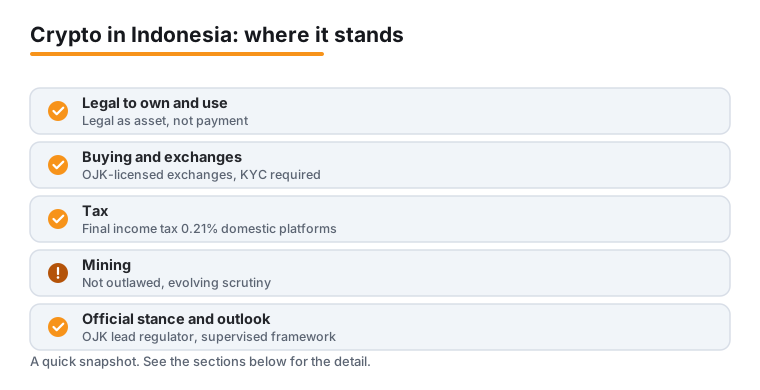
Yes, with an important limit. Buying, holding, selling and trading Bitcoin and other crypto assets is legal in Indonesia for individuals and businesses, and the country hosts a sizeable licensed exchange sector. Crypto is recognised as a legitimate asset that can be traded and invested in, and it is now formally classified as a digital financial asset within the financial-services sector.
However, crypto is not legal tender and cannot be used as a means of payment. Indonesia's Currency Law (Law No. 7 of 2011) recognises only the rupiah for settling payments, and Bank Indonesia prohibits the use of crypto to pay for goods or services, regardless of any private agreement between buyer and seller. In practice you can legally own and trade Bitcoin, but a merchant accepting it directly as payment would be operating against the payment-system rules.
So the relevant question for most people is not whether they can hold crypto, but which obligations apply: identity verification (KYC) when using a licensed platform, tax on transactions, and the prohibition on using crypto as money. Reports of cafes or shops accepting Bitcoin in tourist areas should be treated with caution, because direct crypto payment is not permitted.
Who regulates crypto: OJK, Bank Indonesia and the tax authority
Three official bodies matter most for crypto in Indonesia in 2026:
- Otoritas Jasa Keuangan (OJK), the Financial Services Authority, is now the lead regulator for crypto assets, exchanges, custodians and related service providers. Supervision was transferred from Bappebti starting 10 January 2025, and OJK and Bappebti formally ended the transition period on 20 January 2026, so authority now sits fully with OJK. Its official site is ojk.go.id.
- Bank Indonesia (BI), the central bank, remains the monetary and payment-system authority and enforces the ban on crypto as a means of payment, since the rupiah is the sole legal tender. Its official site is bi.go.id.
- The Directorate General of Taxes (Direktorat Jenderal Pajak, DJP), under the Ministry of Finance, administers crypto taxation. Its official site is pajak.go.id.
Indonesia's anti-money-laundering reporting centre, PPATK (the Financial Transaction Reports and Analysis Center), also plays a role: licensed providers must report suspicious transactions to it. Bappebti, the former commodity-futures regulator under the Ministry of Trade, no longer supervises crypto trading after the transition ended.
Key crypto laws and frameworks in Indonesia
The legal architecture rests on a few core instruments. The top of that architecture changed on 17 June 2026, when Law No. 4 of 2026 amended the 2023 P2SK Law and wrote crypto activity directly into statute.
- Law No. 4 of 2023 (UU P2SK), the Financial Sector Development and Strengthening Law. This placed digital financial assets, including crypto, inside the financial-services sector and designated OJK as the responsible authority, shifting crypto from being treated as a commodity to a financial asset.
- Law No. 7 of 2011 (the Currency Law). Establishes the rupiah as the sole legal tender and underpins Bank Indonesia's prohibition on crypto as a means of payment.
- OJK Regulation No. 27 of 2024 (POJK 27/2024) on the operation of trading in digital financial assets including crypto assets. This is the core licensing and conduct rulebook covering capital, governance, custody, risk management and consumer protection.
- OJK Regulation No. 23 of 2025 (POJK 23/2025), issued in late 2025, which amends POJK 27/2024 to align with international best practice and introduces a framework for crypto derivatives trading.
- SEOJK No. 20 of 2024, which sets out anti-money-laundering and know-your-customer expectations for providers.
Further OJK implementing regulations to align with Law No. 4 of 2026 are expected for areas not yet fully addressed, timing is not yet fixed, and until those rules land the existing OJK frameworks continue to govern. The rules already dated are POJK 30/2025 on governance and risk management, in force since 1 July 2026, and PADK 3/2026 on trading operations and reporting, set on 30 June 2026 and in force from 1 September 2026. The POJK 23/2025 amendment can be found on the OJK regulations portal at ojk.go.id (POJK 23/2025).
Licensing and registration of crypto exchanges (VASPs)
To operate legally, crypto platforms must be licensed within Indonesia's regulated ecosystem, now supervised by OJK under POJK 27/2024 and its amendments. On 19 December 2025 OJK published a whitelist of around 29 licensed platforms across the crypto-asset trading ecosystem, comprising a national crypto exchange, a clearing and settlement institution, custodians and a set of digital-financial-asset traders. The list mixes fully licensed traders and prospective traders still completing approval. As of early July 2026 OJK reported 26 licensed digital asset traders, two digital asset exchanges, two clearing and guarantee institutions and two custody operators, serving 22.4 million digital financial asset and crypto consumers. The number changes as licences are granted or revoked, so check the current list with OJK.
- Central market infrastructure. The national crypto exchange (bourse) is CFX, operated by PT Bursa Komoditi Nusantara, and PT Kliring Komoditi Indonesia acts as the clearing and settlement institution. These sit at the centre of the regulated model that separates the exchange, clearing and custody functions.
- Existing PFAK licences carry over. Crypto-asset trader (PFAK) licences issued by Bappebti before the transfer remained valid and moved under OJK supervision, so established platforms such as Indodax, Pintu, Reku, Pluang and Tokocrypto continued to operate while transitioning into the new framework.
- Capital and conduct requirements. Under POJK 27/2024 an applicant must demonstrate paid-up capital of at least IDR 100 billion (roughly USD 6 million) and maintain equity of at least IDR 50 billion. A minimum of three directors is required, with the majority being Indonesian citizens domiciled in Indonesia and the President Director required to be an Indonesian citizen, plus a minimum of two commissioners and at least one staff member holding a Certified Information Systems Security Professional (CISSP) certification. These sit alongside obligations on AML and CFT systems, consumer protection and segregation of customer assets through regulated custody.
- Ecosystem structure. Indonesia's regulated model historically separates roles between an exchange, a clearing house and custodians, intended to keep customer assets segregated and traceable.
For users, the practical rule is simple: use a platform that appears on OJK's licensed list and complies with KYC. You can check licensing status via OJK's licensing pages at ojk.go.id (crypto and digital financial asset licensing).
Crypto and Bitcoin tax in Indonesia
Crypto transactions are taxable in Indonesia, and the tax treatment was overhauled alongside the move to OJK supervision. Under Minister of Finance Regulation (PMK) No. 50 of 2025, crypto is treated for tax purposes as a financial instrument (akin to securities) rather than an intangible good. PMK 50/2025 took effect on 1 August 2025, and related amendments were made through PMK 53/2025 and PMK 54/2025.
- Final income tax on disposals. The Directorate General of Taxes states that under PMK 50/2025 a seller pays a final Article 22 income tax (PPh Pasal 22 final) of 0.21% of transaction value when selling through a licensed domestic trading provider, and 1% of transaction value through a foreign platform. The gap is deliberate, and it pushes trading onto OJK-licensed venues. VAT of 12% applies to the commission charged by exchange, swap and e-wallet services, and 2.2% VAT applies to crypto mining verification services. Transfers of crypto assets themselves are not subject to VAT.
- VAT on transfers removed. Because crypto is now treated as a financial instrument, the transfer of crypto assets is exempt from value-added tax (VAT), reversing the earlier position where buying crypto attracted VAT.
- Service providers and miners. VAT can still apply to the platforms that facilitate trades (on their commission or fees) and to miners providing transaction-verification services. Under PMK 50/2025 the income tax provisions for miners apply from tax year 2026, so that change is now live. Miners compute income tax at general rates rather than a special final rate and must keep full business records. VAT of 2.2% applies separately to mining verification services.
- Records. Keep dates, rupiah values, amounts and counterparties for every transaction to support your annual tax return.
Do not rely on a specific rate from any article, including this one, because Indonesia's crypto tax rules have changed more than once recently and depend on whether you trade on a licensed or foreign platform and on your status. Confirm your position with the Directorate General of Taxes at pajak.go.id or a registered Indonesian tax adviser. See also our general guide to crypto taxes. This section is general information, not tax advice.
AML, KYC and the Travel Rule
Anti-money-laundering and counter-terrorist-financing obligations are central to Indonesia's regulated crypto regime. Licensed providers must verify customer identity, monitor transactions and report suspicious activity.
- KYC and customer due diligence. Identity verification is mandatory on licensed platforms; registering and verifying with your ID is a legal requirement, not optional. Expectations are set out in instruments such as SEOJK No. 20 of 2024.
- Suspicious transaction reporting. Providers must report suspicious transactions to PPATK, Indonesia's Financial Transaction Reports and Analysis Center, the country's financial-intelligence unit.
- FATF alignment and the Travel Rule. Indonesia has aligned with FATF recommendations, including the crypto Travel Rule (FATF Recommendation 16), under which originator and beneficiary information must be transmitted for transfers above a de minimis threshold reported around USD 1,000 in rupiah value.
For ordinary users this mainly means completing KYC and understanding that licensed platforms will collect and may share required information for larger transfers. Confirm current AML and KYC requirements with OJK and PPATK, as the detailed rules continue to evolve under the new framework.
Buying and using crypto in practice
A careful, lawful path to buying Bitcoin in Indonesia looks like this:
- 1. Choose a licensed platform. Use an exchange that appears on OJK's licensed list and complies with local KYC and consumer-protection rules. Compare fees, security record, liquidity and support.
- 2. Register and verify. Complete identity verification (KYC) with your ID and details; this is required. Enable two-factor authentication, ideally via an authenticator app rather than SMS.
- 3. Deposit rupiah. Fund the account through a supported method such as bank transfer, allowing for any limits or processing times.
- 4. Place an order. Buy Bitcoin with a market or limit order. Start small while you learn the platform.
- 5. Secure your holdings. For meaningful amounts, consider withdrawing to a wallet you control. A hardware (cold) wallet with an offline backup of the recovery phrase offers strong protection; never store the phrase online or share it.
- 6. Keep records. Save transaction details and rupiah values for tax reporting.
Remember that buying and holding is legal, but using crypto to pay merchants in Indonesia is not, and the rupiah remains the only legal tender. To spend value locally you generally need to convert crypto back to rupiah through a licensed exchange. Because crypto cannot be used as payment, public Bitcoin ATMs are essentially absent from the Indonesian market, and the lawful route to convert between rupiah and crypto is through a licensed online exchange. Treat any informal crypto-for-cash machine or service with caution.
Bitcoin mining in Indonesia
Bitcoin mining is not specifically outlawed in Indonesia, and the main issues for miners are commercial, tax and energy-related rather than questions of basic legality. That said, miners operate in an evolving regulatory environment and should expect scrutiny.
- Energy and cost. Mining is electricity-intensive. Profitability depends heavily on power prices and reliability, and large operations need to consider grid impact, sourcing and increasingly emissions and the case for lower-carbon power.
- Tax. Mining income (block rewards and fees) is taxable. Under the 2025/2026 tax changes, mining earnings have been reported as moving to normal income-tax treatment from 2026, and VAT can apply to verification services. Treat mining as a reportable business activity and keep clear records.
- Licensing and compliance. Commercial miners should consider business registration and AML obligations, and engage constructively with local authorities and communities on land, power and noise.
For most individuals, small-scale home mining of Bitcoin is unlikely to be profitable once hardware and electricity costs are accounted for. Serious mining tends to be an industrial activity tied to access to cheap, reliable power. Confirm tax and permitting specifics with the relevant Indonesian authorities before committing capital.
Recent developments (2025 to 2026)
The period from 2025 into 2026 has been the most consequential stretch yet for Indonesian crypto policy:
- Supervision transferred to OJK. Authority over crypto assets moved from Bappebti to OJK starting 10 January 2025, with the formal transition period ending on 20 January 2026, marked by the signing of an end-of-memorandum deed between the two agencies.
- Tax regime overhauled. PMK 50/2025 took effect on 1 August 2025, reclassifying crypto as a financial instrument, removing VAT on transfers and setting final income-tax rates of roughly 0.21% (domestic licensed platforms) and 1% (foreign platforms).
- Derivatives framework introduced. OJK Regulation No. 23 of 2025, which took effect on 10 November 2025, amended POJK 27/2024 to align with international best practice and to introduce a framework for crypto and digital-financial-asset derivatives trading. An exchange must obtain OJK approval before facilitating derivatives, and a retail user must pass a knowledge test before trading these products.
- Market kept growing. OJK reported crypto-asset transactions of about IDR 482 trillion for 2025 and around 19.5 million registered crypto holders by late 2025, keeping Indonesia among the larger crypto markets by user numbers.
- Token-offering regime developing. OJK published a draft regulation on the public offering of digital financial assets on 19 September 2025 and closed public consultation on 2 October 2025, and it had still not been finalised as of the Chambers Indonesia guide last updated 11 June 2026. Under the draft, all market participants including issuers must be locally incorporated as an Indonesian limited liability company (Perseroan Terbatas), an offering is public when conducted within Indonesia via mass media or made to more than 100 parties, offerings of at least IDR 1 billion require a business licence from OJK while smaller ones require only notification, and unbacked crypto asset offerings of at least IDR 1 billion require approval from the authorised exchange. Until the final rules are published, treat any token sale marketed to Indonesian residents as outside a defined lawful route.
The official press release on the end of the transition period is published by OJK at ojk.go.id (OJK and Bappebti end transition, January 2026).
Consumer risks and protection
Key risks. Beyond price volatility, the main risks for Indonesian users are scams and fraud, platform failure or insolvency, loss or theft of private keys, irreversible transactions, and the legal line around payments, since using crypto as money is prohibited even though holding and trading it is allowed. Trading on unlicensed foreign platforms also carries weaker protection and a higher tax rate. Self-custody removes counterparty risk but shifts full responsibility for security onto you. Crypto is not covered by deposit-protection schemes, so platform failure or loss of keys can mean total loss.
Protection under the new regime. The move to OJK supervision is intended to raise consumer-protection and governance standards over time, with expectations on capital, segregation of customer assets, risk management and complaint handling for licensed platforms. This may reduce some platform risks, but it does not remove market risk. Be especially wary of guaranteed-return schemes and people who contact you first offering to invest on your behalf; these are common scams.
To reduce risk: use only OJK-licensed platforms, complete KYC, enable strong two-factor authentication, consider self-custody for larger holdings, and keep records. If something looks too good to be true, it almost certainly is.
Official sources and how to verify
Because Indonesia's framework and tax rules are still settling, treat dates, rates and licensing requirements as moving targets and verify them at the source. The authoritative places to check are:
- Otoritas Jasa Keuangan (OJK), the Financial Services Authority, for crypto licensing, conduct rules and the list of licensed platforms: ojk.go.id, including the crypto and digital-financial-asset licensing page.
- Bank Indonesia (BI), the central bank, for the rupiah's legal-tender status and the payment-instrument ban: bi.go.id.
- Directorate General of Taxes (DJP), for crypto taxation under PMK 50/2025: pajak.go.id.
For related background on wikicrypto, see our overviews of crypto regulation, crypto taxes and our country regulation hub. This article is general information as of 2026 and is not legal, tax or financial advice; always confirm the current position with OJK, Bank Indonesia and the Directorate General of Taxes, or with a licensed local adviser, before acting.
What changed in 2026: Law No. 4 of 2026 and the dates that follow
Indonesia's crypto framework moved up a level in June 2026. Law No. 4 of 2026, the first amendment to the P2SK Law (Law No. 4 of 2023), was enacted and took effect on 17 June 2026. Crypto is now written into primary legislation rather than governed by OJK regulation alone, and ABNR describes a new taxonomy of regulated entity: the Digital Financial Asset Financial Institution (Lembaga Jasa Keuangan Aset Keuangan Digital, or LJK AKD).
Three parts of the amendment matter to ordinary holders and to the platforms they use. The list of supervised activities is now explicit and much wider, covering tokenisation, initial offerings of digital financial assets, stablecoins used for transaction purposes, staking, crypto asset lending, crypto asset pledging, and other spot and derivative crypto asset activities. OJK gained express power to suspend or block crypto asset transactions and trading activities that do not comply with applicable laws, including activities conducted by foreign parties. And financial-sector consumer protection now applies to crypto businesses, with liability for consumer losses extending to management, third parties acting on their behalf, and controlling parties or shareholders.
The law does not finish the job on its own. Further OJK implementing regulations are expected for areas not yet fully addressed, and timing is not yet fixed, with existing OJK frameworks continuing to govern until those rules land. The dates that are already fixed are these:
| Instrument | Status | Date | What it means in practice |
|---|---|---|---|
| Law No. 4 of 2026 (amended P2SK Law) | In force | 17 June 2026 | Crypto firms sit inside the financial-sector consumer protection regime; OJK can block non-compliant trading, including by foreign parties |
| POJK 30/2025 governance and risk management, with SEOJK 34/SEOJK.07/2025 on business plans | In force | 1 July 2026 | Annual governance reports and semi-annual risk profile reports; at least two directors |
| PADK 3/2026 reporting rules | Adopted, not yet in force | Set 30 June 2026, effective 1 September 2026 | Daily reporting dropped; monthly within 10 business days, quarterly within 15, annual by 30 April, incidents within 5 business days |
| POJK 23/2025 adjustment period closes | Deadline | 10 November 2026 | Customer-fund placement and system-control adjustments must be complete unless OJK extends |
| First business plans under SEOJK 34/2025 | Deadline | 30 November 2026 | Operators file one-year business targets, strategy and financial projections |
| POJK 6/2026 alignment of existing influencer material | Deadline | 4 December 2026 | Pre-existing marketing cooperation material must be reviewed and adjusted |
| Strategic mineral and commodity exchange operational | Deadline under Law 4/2026 | 1 January 2027 | Required by the amended P2SK Law, outside crypto but part of the same statute |
| First realisation reports on business plans | Deadline | After Q1 2027 | Platforms report performance against the plans filed in 2026 |
| Draft POJK on digital financial asset offerings (ICO and ITO regime) | Drafted, consultation closed | Published 19 September 2025, consultation closed 2 October 2025, still unissued | Would require issuers to be Indonesian PT companies; OJK licensing above IDR 1 billion, notification below |
| IAKD Roadmap 2026 to 2031 | In drafting | Symposium held 2 July 2026 | Sets direction on stablecoins, tokenisation, digital asset tax, OTC trading and a single investor identifier |
Stablecoins and the payment ban after Law 4/2026
The headline rule is unchanged: the rupiah is Indonesia's only legal tender and crypto cannot be used to pay for goods and services. Law No. 4 of 2026 does not reverse that, but it introduces a distinction that did not exist before. Under the amended P2SK Law a stablecoin cannot serve as a direct means of payment, yet it may be used as a means of transaction after a recommendation from the exchange and OJK approval.
That route is not usable yet. Further OJK implementing regulations are expected and their timing is not fixed, so until they land the practical position for a person in Indonesia is the same as before: hold and trade through a licensed platform, and convert to rupiah to spend. Stablecoin regulation is one of the named focus areas of the IAKD Roadmap 2026 to 2031, alongside asset tokenisation, digital financial asset taxation, over-the-counter transactions, cybersecurity and a single investor identifier, so this is the area most likely to move next.
Enforcement in 2026 and the new rules for crypto influencers
Indonesia's illegal-finance task force, Satgas PASTI, shut down 228 unlicensed platforms between January and May 2026, and Indonesia's Anti-Scam Centre had 579,459 cases of digital financial fraud reported as of 31 May 2026. The same figure of 228 illegal digital financial asset traders appears in reporting of remarks by Satgas PASTI secretary Hudiyanto. The practical consequence for a user is that a platform not on OJK's list can lose access at short notice, taking access to funds with it.
Promotion is now regulated too. OJK Regulation No. 6 of 2026 on the conduct of financial services information disseminators was set on 26 May 2026 and took effect on 4 June 2026. It expressly covers crypto asset products. What it requires:
- Anyone conveying financial information must demonstrate competency by holding a relevant official licence or professional certification.
- Paid collaborations must be disclosed, and only licensed products may be promoted.
- Crypto asset product marketing may only be carried out through official media owned by the licensed financial services firm (PUJK).
- Administrative fines of up to IDR 15 billion may be imposed.
- OJK may apply for access termination without first issuing a warning letter where there is significant potential public harm.
- Marketing cooperation material agreed before 4 June 2026 must be reviewed and adjusted by 4 December 2026.
If someone is promoting a crypto product to you in Indonesia without disclosing a commercial relationship, or from a channel that is not the licensed firm's own official media, that is now a regulatory breach rather than just a warning sign.
Frequently asked questions
Is Bitcoin legal in Indonesia?
Yes, as an asset. Buying, holding, selling and trading Bitcoin and other crypto assets is legal through licensed platforms, and crypto is classified as a digital financial asset. However, crypto is not legal tender and cannot be used to pay for goods or services; the rupiah is Indonesia's only legal tender under the Currency Law (Law No. 7 of 2011), and Bank Indonesia enforces that ban.
Who regulates cryptocurrency in Indonesia?
The Financial Services Authority, Otoritas Jasa Keuangan (OJK), is now the lead regulator for crypto assets. Supervision transferred from the commodity-futures agency Bappebti starting 10 January 2025, and the transition period formally ended on 20 January 2026. Bank Indonesia remains responsible for the payment system and enforces the prohibition on crypto as payment, and the Directorate General of Taxes administers crypto tax.
Do I have to pay tax on crypto in Indonesia?
Generally yes. Under PMK 50/2025, effective 1 August 2025, crypto is treated as a financial instrument: a final income tax applies to disposals, reported as around 0.21% on licensed domestic platforms and around 1% on foreign ones, transfers are exempt from VAT, and mining income moves to normal income-tax treatment from 2026. Rates and rules have changed recently, so confirm your situation with the Directorate General of Taxes (pajak.go.id) or a registered tax adviser. This is not tax advice.
Can I use Bitcoin to pay for things in Indonesia?
No. Using crypto as a means of payment is prohibited; only the rupiah is legal tender under the Currency Law. You can legally own and trade crypto, but to spend value locally you generally need to convert it to rupiah through a licensed exchange. Reports of merchants accepting Bitcoin directly should be treated with caution.
How do I know if a crypto exchange is licensed in Indonesia?
Check OJK's official licensing pages at ojk.go.id, which list the entities authorised within the crypto-asset trading ecosystem under OJK Regulation No. 27 of 2024 and its amendments. Established platforms that held a Bappebti PFAK licence before the transfer carried over under OJK supervision. Using a licensed platform is also relevant for tax, since foreign or unlicensed platforms attract a higher final income-tax rate.
Are there Bitcoin ATMs in Indonesia?
Not in any meaningful way. Because crypto cannot be used as payment and the regulated model routes buying and selling through licensed online exchanges, public crypto ATMs are essentially absent. The lawful way to convert between rupiah and crypto is via an OJK-licensed exchange. Treat any informal crypto-for-cash machine with caution, both for legal reasons and because such channels are common vectors for scams.
How big is Indonesia's crypto market?
Large by user numbers. OJK reported crypto-asset transactions of about IDR 482 trillion (roughly USD 28 to 29 billion) across 2025 and around 19.5 million registered crypto holders by late 2025. That places Indonesia among the larger crypto markets worldwide by number of participants. Figures are updated periodically, so check OJK for the current data.
Can I trade crypto derivatives in Indonesia?
Yes, within the regulated framework. OJK Regulation No. 23 of 2025, effective 10 November 2025, introduced rules for crypto and digital-financial-asset derivatives. An exchange must get OJK approval before offering these products, and a retail user must pass a knowledge test before trading them. Derivatives are higher-risk than spot trading; only use OJK-approved platforms and understand the product first.
What is Law No. 4 of 2026 and does it change anything for crypto holders in Indonesia?
Law No. 4 of 2026 is the first amendment to the 2023 P2SK Law. It was enacted and took effect on 17 June 2026 and it writes crypto into primary legislation rather than leaving it to OJK regulation alone. It expands the scope of financial sector technological innovation to expressly cover digital financial asset activities, naming tokenisation, initial offerings, stablecoins used for transaction purposes, staking, crypto asset lending, crypto asset pledging and other spot and derivative crypto activities. It extends financial-sector consumer protection to crypto and digital asset institutions, and gives OJK authority to freeze or block non-compliant crypto transactions and trading activities including those conducted by foreign parties. For an individual holder nothing about legality changed: crypto is still legal to own and trade and still cannot be used as payment. What changed is that the platform you use now sits inside the financial-sector consumer protection regime, and offshore platforms carry a higher risk of being blocked.
Can I pay with a stablecoin in Indonesia?
Not yet. The rupiah remains Indonesia's only legal tender and crypto cannot be used to pay for goods and services. Law No. 4 of 2026 does add a distinction: a stablecoin cannot serve as a direct means of payment, but it may be used as a means of transaction after a recommendation from the exchange and approval from OJK. Further OJK implementing regulations are expected and their timing is not yet fixed, so in practice the route is not usable today. Stablecoin regulation is a named focus of OJK's IAKD Roadmap 2026 to 2031, which was still in drafting as of August 2026.
How many crypto exchanges are licensed by OJK right now?
As of early July 2026 OJK reported 26 licensed digital asset traders, two digital asset exchanges, two clearing and guarantee institutions and two custody operators, covering 22.4 million digital financial asset and crypto consumers. Separately, the illegal-finance task force Satgas PASTI shut down 228 unlicensed platforms between January and May 2026. Always check OJK's own list before depositing.
Are there rules about crypto influencers and promotions in Indonesia?
Yes, since 4 June 2026. OJK Regulation No. 6 of 2026 on the conduct of financial services information disseminators was set on 26 May 2026 and expressly covers crypto asset products. Anyone conveying financial information must demonstrate competency by holding a relevant official licence or professional certification, must disclose paid collaborations, may only promote licensed products, and crypto asset marketing may only be carried out through official media owned by the licensed financial services firm. Administrative fines of up to IDR 15 billion may be imposed, and OJK may apply for access termination without first issuing a warning letter where there is significant potential public harm. Marketing cooperation material agreed before 4 June 2026 must be reviewed and adjusted by 4 December 2026.
When will Indonesia regulate token sales, ICOs and tokenisation?
OJK published a draft regulation on the public offering of digital financial assets on 19 September 2025 and closed consultation on 2 October 2025, and it was still not finalised as of the Chambers Indonesia guide last updated 11 June 2026. Law No. 4 of 2026 now brings initial offerings of digital financial assets within the supervised scope, without setting a deadline for implementing rules. The draft would require all market participants including issuers to be Indonesian limited liability companies, would treat an offering as public when made within Indonesia via mass media or to more than 100 parties, and would require an OJK business licence for offerings of at least IDR 1 billion, with notification only below that. The final terms may differ from the draft.
What compliance deadlines are coming for Indonesian crypto platforms?
Four dates are fixed. PADK 3/2026, which replaces daily reporting with monthly, quarterly, annual and incident reporting through a centralised OJK system, takes effect on 1 September 2026. The adjustment period under POJK 23/2025 for infrastructure changes runs a maximum of 12 months from its 10 November 2025 effective date, closing on 10 November 2026 unless OJK extends it. First business plans under SEOJK 34/SEOJK.07/2025 are due by 30 November 2026. Marketing cooperation material must be aligned with POJK 6/2026 by 4 December 2026. First realisation reports on those business plans fall due after the first quarter of 2027.
Facts reviewed: 5 August 2026. Page updated: 5 August 2026.