USDC vs USDT: Which Stablecoin Is Safer in 2026?
USDC and USDT are the two biggest dollar stablecoins, and people argue about which one is safer like it settles the matter. It does not. They are built differently, regulated differently, and they fail in different ways. This is a plain look at who runs each coin, what backs it, where you can actually use it in 2026, and the honest catch that neither side likes to mention.
The short answer first
If you only care about transparency and regulatory standing, USDC is the safer pick today. Circle, the company behind USDC, runs a fully licensed, audited, US-regulated operation and is the only major stablecoin that clears the bar in both the United States and the European Union.
If you care about liquidity and being accepted everywhere, USDT wins easily. Tether's USDT is the largest stablecoin in the world by a wide margin, and on most global exchanges and in most trading pairs it is still the default.
So the real answer is: it depends on what you are protecting against. Both depend on their issuer staying solvent and honest. Neither is risk-free, and anyone who tells you otherwise is selling something.
Who runs each one
USDC is issued by Circle, a US company that went public in 2025 and now reports earnings like any other listed firm. That matters more than it sounds. A public company faces auditors, the SEC, and shareholders who all want to see the books. Circle posted real numbers for late 2025 and its USDC supply grew sharply through the year.
USDT is issued by Tether, a company that operated for years outside the US system and built its scale offshore. Tether is profitable, holds a large reserve buffer, and is by far the bigger of the two by market size, with roughly 185 to 190 billion dollars of USDT in circulation in 2026 against USDC's mid-70s billions. But Tether has a history that USDC does not: in 2021 it settled with the New York Attorney General and the CFTC over past claims about its backing. That settlement is old news now, yet it still shapes how cautious people treat the coin.
One newer wrinkle: in January 2026 Tether launched a separate US coin called USAT, issued through a nationally chartered bank with Tether acting as the tech and branding partner rather than the issuer. USAT is built to fit US rules. It is also tiny so far, with a market cap in the tens of millions, so it does not change the USDT picture for now. Do not confuse the two.
What actually backs each coin
USDC's reserves are simple and easy to check. Roughly 80 percent sits in the Circle Reserve Fund, a government money market fund registered with the SEC, managed by BlackRock and custodied at BNY Mellon, holding short-dated US Treasuries and overnight repo. The other 20 percent or so is cash at large regulated banks. Circle publishes monthly attestations from Deloitte and breaks down the holdings clearly.
USDT's reserves are bigger and more mixed. Most of it, around 80 percent, is in US Treasuries and cash equivalents. The rest spreads across gold, a slice of Bitcoin, secured loans, and other investments. Tether also keeps a reserve buffer above what it owes, reported at over 8 billion dollars in early 2026. The point worth understanding: gold, Bitcoin, and loans can swing in value or be hard to sell fast in a panic. Treasuries and cash cannot swing much. So USDT carries a bit more market risk inside the reserve, in exchange for the yield Tether earns on it.
Attestation is not the same as an audit
This trips up a lot of people, so read it twice. An attestation is a snapshot. An accountant confirms that on one particular day, the reserves matched the coins outstanding. An audit is a full, ongoing examination of the financial statements with an opinion attached. They are not the same thing, and the gap matters.
For years both coins relied on attestations. USDC gets monthly ones from Deloitte. USDT gets quarterly point-in-time confirmations from BDO Italia. In 2026 the picture is shifting: Tether engaged KPMG, a Big Four firm, for its first full independent financial statement audit, and Circle is moving toward a full audit as part of its post-IPO reporting. Both are heading the right way. As of mid-2026, neither has the long, clean audit track record that a traditional bank would have. Treat monthly transparency as a strong signal, not a guarantee.
Where the law stands: GENIUS Act and MiCA
Two big rulebooks now decide where a stablecoin can live.
In the US, the GENIUS Act became law in July 2025. It defines a payment stablecoin, demands 1-to-1 backing in cash or short-dated Treasuries, requires monthly attestations and annual audits for the large issuers, and bans paying yield to holders. USDC already met these conditions, so Circle was first in line under the new federal regime. USDT, with its offshore structure and mixed reserves, does not fit the GENIUS framework, which is part of why Tether spun up the separate USAT coin for the US.
In Europe, MiCA is the rulebook. It requires a licensed issuer and independent reserve audits. Circle got an EMI license in France and made USDC compliant. Tether chose not to pursue MiCA compliance for USDT. That single decision has had real consequences, which leads to the next part.
Where you can actually use each one in 2026
This is the practical difference most readers will feel. Because USDT is not MiCA-compliant, regulated exchanges serving the European Economic Area have pulled it.
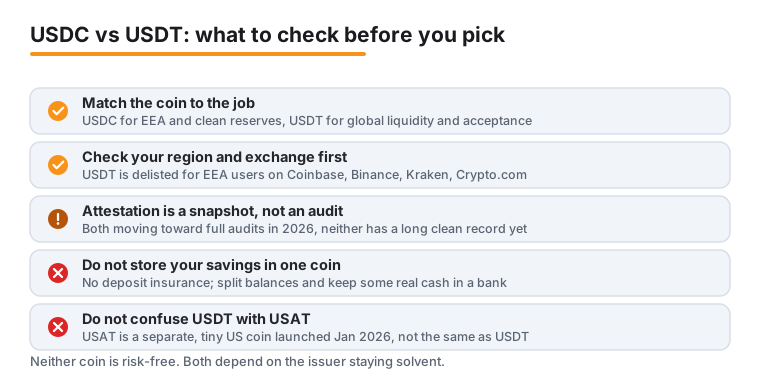
Between late 2024 and the first half of 2025, the major venues acted. Coinbase suspended USDT for European users. Binance delisted USDT spot pairs for EEA customers. Kraken put USDT in sell-only mode and then disabled it. Crypto.com stopped offering USDT to EU customers and auto-converted leftover balances to a compliant asset. The effect was sharp: USDT trading volume on EU venues dropped heavily, while USDC volume on the same venues climbed, and USDC's share on EU-regulated platforms swung to roughly 65 percent, a near reversal of the old order.
Outside the EEA the story flips. Globally, USDT remains the most liquid stablecoin, the one with the deepest order books and the widest acceptance across exchanges, payment apps, and on-chain markets in Asia, Latin America, and elsewhere. If you are trading on a global venue or sending value across borders, USDT is usually the path of least resistance.
So before you pick a coin, check two things: where you live, and which exchange you use. The right answer in Lisbon is not the right answer in Lagos.
How each one can actually break
Safer does not mean unbreakable, and USDC has the scar to prove it. In March 2023, Silicon Valley Bank collapsed with about 3.3 billion dollars of Circle's cash reserves stuck inside it. USDC briefly fell to around 87 cents over a weekend. It snapped back to a dollar within days once US regulators backstopped SVB deposits and Circle resumed redemptions, but for a couple of days holders did not know how it would end. The lesson: even a transparent, well-run stablecoin inherits the risk of the banks where it parks cash.
USDT's risk is different. It is concentration and trust. It is enormous, its reserves include assets that can move in value, and a sudden flood of redemptions during a market crisis is the scenario skeptics worry about. Tether has met every large redemption wave so far, including some big ones, which is a genuine point in its favor. But the size that makes it useful is the same size that makes a failure unthinkable to model.
Both coins share the deepest risk of all: they are only as good as the company standing behind them. There is no government deposit insurance on a stablecoin. If the issuer becomes insolvent or freezes redemptions, your token is a claim, not cash.
How to choose, in plain terms
Match the coin to the job instead of hunting for one winner.
- If you are in the EEA and using a regulated exchange, USDC is the practical choice. USDT may not even be available to you.
- If you want the clearest reserves and the tightest regulatory standing, lean USDC.
- If you are trading on a global venue, need the deepest liquidity, or are moving money in regions where USDT is the standard, USDT is hard to beat on acceptance.
- If you are holding a large balance, do not park your whole stack in one coin or on one exchange. Split it, and keep some in actual dollars in a bank if you can.
- Whatever you pick, do not treat any stablecoin as a savings account. It is a tool for moving and parking value short-term, not a place to store your life savings.
The honest summary: USDC is the more transparent and more regulated coin, USDT is the more liquid and more widely accepted one, and both still ride on the solvency and honesty of a single company. Pick with that tradeoff in front of you, not behind it.
Frequently asked questions
Is USDC safer than USDT?
On transparency and regulation, yes. USDC has cleaner, simpler reserves, monthly attestations from Deloitte, a US public company behind it, and full compliance with both US and EU rules. But safer is not the same as safe. USDC itself briefly lost its peg in March 2023 when a bank holding its reserves failed. Both coins ultimately depend on their issuer staying solvent.
Why was USDT delisted in Europe?
Because Tether chose not to comply with MiCA, the EU's stablecoin rulebook that took effect at the end of 2024. MiCA requires a licensed issuer and independent reserve audits. Without that, regulated exchanges serving the European Economic Area, including Coinbase, Binance, Kraken, and Crypto.com, removed USDT spot trading for EEA users through late 2024 and early 2025.
Does USDT have a real audit yet?
Not a long-running one. For years Tether published quarterly point-in-time attestations from BDO Italia, which confirm reserves on a single date rather than auditing the full financials. In 2026 Tether engaged KPMG, a Big Four firm, for its first comprehensive independent audit. That is a real step forward, but as of mid-2026 the clean multi-year audit history is not there yet.
What backs USDT versus USDC?
USDC is roughly 80 percent in a SEC-registered government money market fund of short-dated Treasuries and repo, with the rest as cash at large banks. USDT is around 80 percent Treasuries and cash equivalents, with the remainder in gold, Bitcoin, secured loans, and other investments. USDT's mix carries a bit more market risk inside the reserve in exchange for higher yield.
Can a stablecoin lose its dollar peg?
Yes, and it has happened. USDC fell to about 87 cents over a weekend in March 2023 after Silicon Valley Bank collapsed with billions of Circle's cash inside. It recovered within days once redemptions resumed. The takeaway is that a stablecoin inherits the risk of the banks and assets behind it, so a peg is a promise backed by reserves, not a law of nature.
What is USAT and is it the same as USDT?
No. USAT is a separate US dollar stablecoin Tether launched in January 2026, issued through a nationally chartered US bank with Tether as the technology and branding partner. It is built to fit US rules under the GENIUS Act, unlike USDT. As of 2026 it is very small, with a market cap in the tens of millions, so it does not change the practical picture for USDT holders. Do not treat the two as interchangeable.
Last updated: 2026-06-24.