How to Spot a Pig-Butchering Crypto Scam (2026)
A stranger texts you by accident. Or a charming match appears on a dating app. Weeks of friendly, then affectionate, messages follow. Eventually they mention a crypto trade that made them rich, and offer to show you how. That is the opening of a fraud that police call pig-butchering: the victim is the pig, fattened with attention before being financially slaughtered. In 2025 the FBI's Internet Crime Complaint Center logged more than one million complaints for the first time in its history, and investment fraud, much of it these crypto schemes, accounted for $8.6 billion in reported losses. This guide walks through how the long con works, what is new in 2026, the warning signs, and the exact steps to take if it happens to you or someone you love. This is educational content, not financial or legal advice.
Where the name comes from
The term is a rough translation of a Chinese phrase, sha zhu pan, used by the criminal crews who pioneered the method. The idea is unpleasant on purpose. The target is fattened up with warmth, fake profits, and false trust over weeks or months, then drained all at once. It is not a quick swipe of a credit card. It is a relationship built to be destroyed.
Two things make it different from older scams. First, the money almost always leaves through cryptocurrency, which is fast and hard to claw back once sent. Second, much of the work is done by trafficked people. Investigators at Chainalysis and human-rights groups have documented large compounds in Myanmar, Cambodia, and Laos where workers are lured with fake job ads, have their passports taken, and are forced to run scam scripts under threat of violence. The person typing loving messages may be a victim too. That does not make the financial damage any smaller, but it explains why these operations run day and night and never seem to stop.
The long con, step by step
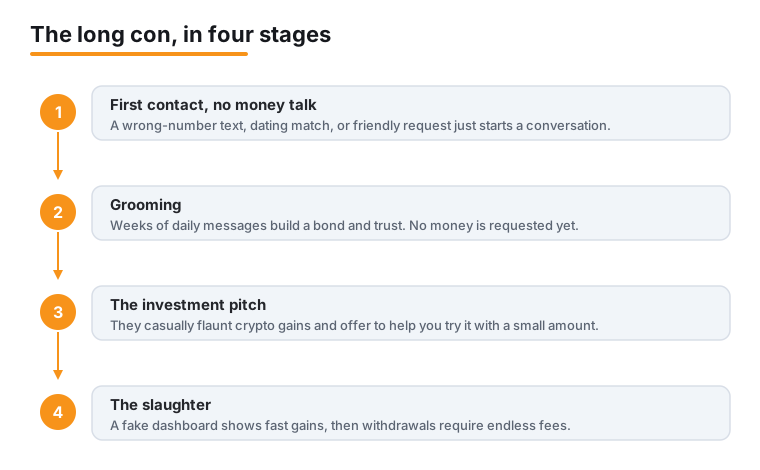
The pattern is remarkably consistent. Chainalysis breaks it into four stages, and most real cases follow them closely.
1. First contact, with no money talk. A message arrives that seems harmless: a wrong-number text ("Hi David, are we still on for lunch?"), a dating-app match, a friendly LinkedIn request, or a comment on your social post. There is no pitch. The goal is only to start talking.
2. Grooming. Daily messages build a bond over weeks. They ask about your day, your family, your dreams. They share a polished life story: successful, attractive, often widowed or living abroad. Romance is common, but plenty of victims are roped in as friends or business contacts. No money is requested yet. Trust is the product being manufactured.
3. The investment pitch. Casually, they mention crypto trading. An uncle gave them a tip, or they use a special platform with an inside edge. They never pressure you to join. They simply prosper while you watch. Eventually they offer to help you try it with a small amount.
4. The slaughter. You deposit a little. A slick app or website shows your balance climbing. You may even be allowed to withdraw a small "profit" early, which removes your doubt and makes you put in far more. Then, when you try to take out the big balance, the platform demands a "tax," a "fee," or a "compliance deposit" before release. Each payment only brings another demand. The money is already gone. At some point the contact and the site vanish.
What is new in 2026: AI, deepfakes, and fake dashboards
The old version relied on a human reading from a script. The 2026 version is faster and harder to catch.
AI-written grooming. Language models now write fluent, warm messages in any language, with no broken grammar to tip you off. The same crew can keep hundreds of "relationships" going at once, each one feeling personal. The flirty paragraph that melts your heart may have been generated in a second.
Deepfake video calls. "They video-called me, so they must be real" used to be solid logic. Not anymore. Live face-swap tools let a scammer appear on camera as the attractive person in the profile photos. The face may glitch when they turn sideways, touch their hair, or pass a hand in front of it, but a short, low-light call can look convincing. A video chat is no longer proof of identity.
Fake trading apps and dashboards. The platform you are sent to is built to fool you. It mirrors real market prices, has a professional logo, and may sit in a copycat of a known brand. Your balance ticks up in real time. None of it is real. There is no trading happening behind the screen, only numbers a server is told to show you. Some fakes are even slipped into official app stores for a while before being removed, so "I downloaded it from the App Store" is not a safety guarantee.
The warning signs, in plain terms
No single sign proves a scam. Several together should stop you cold.
- It started with a stranger's unsolicited message, especially a "wrong number" text or a too-good match who reached out first.
- Feelings move fast. Talk of love, soulmates, or a shared future within days or a couple of weeks.
- They will not meet in person and have excuses for every attempt: travel, an oil rig, the military, a sick relative.
- Money enters through a story, not a demand. They show off gains and let you bring up joining. Pressure feels absent, which is the trick.
- The platform is one they introduced you to. It is not a well-known, regulated exchange you found on your own.
- Returns are steep and steady. Real markets lurch around. Charts that only climb are a red flag.
- Withdrawing requires paying first. A legitimate exchange deducts fees from your balance. It never asks you to wire in fresh money to release your own funds. This single sign is close to a guarantee of fraud.
- You are told to keep it secret or warned that family "won't understand the opportunity." Isolation protects the scam.
If you want a broader primer on fraud patterns across the industry, our overview of crypto scams and fraud covers the main families and how they overlap.
A short worked example
Maria, 54, gets a text meant for "Ben." She replies that they have the wrong number. The sender is friendly, apologizes, and they keep chatting. Over five weeks the conversation turns warm. He says he trades gold-backed crypto on a platform his cousin runs, and shows screenshots of healthy gains.
Maria tries it with $500. A clean dashboard shows it grow to $610 in two weeks. She withdraws $100 to test it; the money lands in her wallet. Convinced, she deposits $20,000. The dashboard soon reads $34,000. When she requests a withdrawal, a message says she owes a 15 percent "capital gains tax" of $5,100, payable in crypto, before release. She pays. Then a "liquidity fee" appears. She has now sent roughly $25,100 and can withdraw nothing. The cousin's platform stops loading. Ben stops replying.
Every step felt reasonable in the moment. That is the design. The small successful withdrawal early on did most of the work, because it turned a doubter into a believer right before the large deposit.
If you think you are being targeted right now
You do not need to be certain. If the pattern fits, act as if it is a scam.
- Stop sending money immediately. No more deposits, no "tax" or "fee" payments. Releasing your balance never requires sending fresh funds.
- Do not tell them you are onto them. Just slow down and stop paying. There is no benefit to arguing.
- Reverse image search the photos. Save a profile picture and search it on Google Images or TinEye. Stolen photos of models or strangers are common.
- Check the platform independently. In the United States, search the company at the SEC and FINRA, and look at the FBI's and the FTC's scam alerts. If a trading site is not a regulated exchange you can verify on your own, treat it as fake.
- Talk to someone offline. A friend, an adult child, your bank's fraud line. Saying it out loud breaks the spell that secrecy creates.
- Screenshot everything before it disappears: chats, profiles, the dashboard, wallet addresses you sent to, and transaction IDs. You will need these to report.
If money is already gone
Move quickly, because the first hours matter most, but be realistic. Recovery is hard and often impossible once crypto has been moved.
- Call your bank or card issuer now if you funded the crypto purchase from them. Ask to stop or reverse pending transfers. Speed is everything.
- Contact the exchange you bought through. Regulated exchanges have fraud teams and may freeze or flag the receiving address if you reach them fast. Send them the wallet addresses and transaction IDs.
- Report it to the authorities (see the next section). Even if you never see the money again, your report feeds investigations and can help others.
- Write down a timeline while it is fresh: dates, amounts, platform names, usernames, phone numbers, and every crypto address and transaction ID.
- Watch for the second scam. Victims are often contacted again within weeks by someone promising to recover the funds. More on that below.
For context on why on-chain transfers are so hard to undo and what realistically can and cannot be done, see our explainer on crypto recovery. If you are deciding where to keep any remaining funds, cold storage basics explains how to hold crypto offline so a stranger can never direct your transfers.
How and where to report it
Reporting is free and helps even when recovery does not happen. Keep your screenshots and transaction list ready.
- FBI Internet Crime Complaint Center. File at ic3.gov. This is the main federal channel for crypto fraud in the US, and the FBI's cryptocurrency investment fraud page explains what details to include.
- Federal Trade Commission. File at reportfraud.ftc.gov. These reports drive enforcement and public warnings.
- Your state securities or financial regulator. Many run active crypto-fraud units. In California, for example, the Department of Financial Protection and Innovation keeps a public scam tracker.
- The crypto exchange involved, through its support or fraud channel.
- Chainabuse, a free community reporting site run by TRM Labs, where you can flag scam wallet addresses so others are warned.
If you are outside the US, report to your national police cybercrime unit and your financial regulator. The action that matters is reporting somewhere official, fast.
The second trap: recovery scams
This deserves its own warning because it catches so many people at their lowest point. After a loss, you may be contacted by a "recovery expert," a "blockchain investigator," a "lawyer," or even someone claiming to be from a government agency, promising to get your money back for an upfront fee. It is almost always the same criminals, or a related crew, returning for a second bite.
The rule from regulators is blunt. The FTC's guidance on refund and recovery scams says never pay upfront for help getting a refund, and that nobody legitimate will contact you out of the blue with such an offer. The CFTC makes the same point in its advisory on being re-victimized by recovery frauds. If anyone asks for a fee, a "tax," or a "bond" before they recover your funds, walk away. Real law enforcement and real regulators never charge you to investigate. Recovery rates for stolen crypto are low, and no service can credibly promise to beat those odds.
Why ordinary, smart people fall for it
Victims often blame themselves harshly. That is misplaced. These scams are engineered by professionals to defeat normal judgment. They build a real-feeling relationship first, so by the time money appears you are not evaluating a stranger's pitch, you are helping a person you care about. The early small "profit" you withdraw flips your brain from caution to confidence. The slow pace avoids the alarm a hard sell would trigger. And the secrecy keeps the one thing that breaks the spell, an outside opinion, out of reach.
The people hit hardest skew older: the FBI reported that Americans aged 60 and over lost about $7.7 billion to internet crime in 2025. But targets span every age and education level, including engineers, doctors, and finance workers. Anyone can be groomed. The defense is not being smarter; it is knowing the pattern, slowing down, and talking to someone before any money moves. If you are new to the basics of how the technology works, our plain-English crypto explainer is a calm place to start before you ever consider investing anything.
Frequently asked questions
Is a video call proof that the person is real?
No. In 2026, live face-swap and deepfake tools can put a fake face on camera in real time. Glitches sometimes show when the person turns their head, touches their face, or moves a hand across the screen, but a short or dimly lit call can look genuine. Treat video as one weak signal, not proof of identity.
I withdrew a small profit early, so isn't the platform legitimate?
That early payout is part of the script. Scammers let you take out a small amount to convince you the system pays, right before you commit a large sum. The real test is later: if withdrawing your balance requires sending in new money for a tax or fee, it is fraud. Genuine exchanges take fees from your existing balance and never ask you to wire fresh funds to release your own money.
Can I get my cryptocurrency back?
Sometimes a little, often nothing. Crypto transfers are fast and hard to reverse once sent. Acting within hours gives the best chance: call your bank, contact the exchange you bought through, and report to the authorities. Industry data shows only a small share of stolen crypto is ever recovered, so be wary of anyone who promises to get it all back, especially for an upfront fee.
A family member is in one of these and won't listen. What can I do?
Stay calm and avoid attacking the "partner," which usually makes them defend the relationship harder. Ask gentle questions: have you met in person, why does withdrawing cost extra money, can we check this platform together. Show them official warnings from the FBI and FTC. Suggest pausing payments for a week to "think it over." Most importantly, keep talking to them. Isolation is the scam's main weapon, and your steady contact is the counter to it.
Where should I report a pig-butchering scam in the United States?
File with the FBI's Internet Crime Complaint Center at ic3.gov and with the FTC at reportfraud.ftc.gov. Also notify the crypto exchange you used, your state's securities or financial regulator, and consider flagging the scam wallet on Chainabuse. Reporting is free, takes about fifteen minutes, and helps investigators even if your own funds are gone.
How can I avoid being targeted in the first place?
Be skeptical of any stranger who messages you first, especially "wrong number" texts and fast-moving online romances. Never let a new online contact guide your investing, and never use a trading platform someone introduced you to without verifying it independently with regulators like the SEC and FINRA. Keep your crypto on reputable, regulated services, talk to a trusted person before moving money, and remember that no real return is both high and guaranteed.
Last updated: 2026-06.