What Is a Stablecoin Depeg, and Why It Happens
A stablecoin is supposed to sit at one dollar and stay there. A depeg is when it slips off that mark and trades for less, say 98 cents, or 87 cents, or in the worst cases close to nothing. The thing most people get wrong is treating every depeg the same. A fiat-backed coin wobbling for two days because a bank got into trouble is a completely different animal from an algorithmic coin going into a death spiral. Know which kind you hold before you do anything in a panic.
What a depeg actually is
Most popular stablecoins aim for a one-to-one value with the US dollar. One USDC, one USDT, one dollar. The peg is the promise. A depeg is the moment the market price stops matching that promise.
It shows up as a number just under a dollar. You see USDC at 0.995 on an exchange ticker, or DAI at 0.97. Sometimes it is tiny and boring. Sometimes it is a five-alarm fire. The price you see is what buyers and sellers are willing to trade for right now, and that can drift away from the redemption value the issuer claims to honor.
Here is the key split. With a fiat-backed coin, there is a company holding real reserves that says it will give you a dollar for each coin. The market price can dip below a dollar out of fear, but if the reserves are real, the gap usually closes. With an algorithmic coin, there is no pile of dollars behind it. The peg is held by code and trader incentives. When confidence breaks, there is nothing to fall back on.
USDC at 87 cents: the SVB scare
In March 2023, USDC, the dollar coin run by Circle, dropped to about 0.87. For a coin that is supposed to never move, that was a shock. People panicked.
What happened was a bank problem, not a coin problem. Circle had roughly 40 billion dollars in reserves backing USDC. About 3.3 billion of that cash, around 8 percent, was sitting in Silicon Valley Bank when SVB failed and went into FDIC receivership on March 10. The other 77 percent or so was in short-dated US Treasuries held through BlackRock, which were never at risk.
So the math was simple once you looked. The worst case was an 8 percent hole, and even that depended on the SVB money being lost entirely. The market overshot to 13 cents below par because fear moves faster than spreadsheets. On March 12, regulators guaranteed all SVB deposits. USDC climbed back toward a dollar within about 48 hours and was fully repegged inside roughly three days. Anyone who panic-sold at 87 cents handed real money to whoever was calm enough to buy.
UST going to zero: the death spiral
Now the opposite case. In May 2022, TerraUSD, known as UST, was the third-largest stablecoin and held a 40-billion-dollar ecosystem around it. It was algorithmic. There was no vault of dollars. The peg was kept by a trading loop with a sister token called LUNA: you could always burn one dollar of UST for one dollar of LUNA, and the other way around.
That loop works fine when people believe in it. It breaks badly when they stop. Around May 7, large holders pulled hundreds of millions of UST out of Anchor, a protocol that had been paying close to 20 percent yields. UST slipped under a dollar. To defend the peg, the system minted huge amounts of new LUNA, which crashed LUNA's price, which made the peg even harder to hold, which minted even more LUNA. That feedback loop is the death spiral.
The numbers are hard to believe. LUNA supply went from about 343 million tokens to over 6.5 trillion in a week. UST fell to 67 cents, then 23 cents, then kept going. By mid-May both were essentially worthless. Around 50 billion dollars evaporated. There was no bank guarantee coming, because there was no bank and no reserves. This peg did not recover. It died.
The six things that break a peg
Almost every depeg traces back to one of six causes. Knowing which one is happening tells you whether to wait it out or get out.
- Reserve loss. The dollars or assets backing the coin lose value or get stuck somewhere. That was USDC and SVB.
- Bank run. Too many holders try to redeem at once and the issuer cannot turn reserves into cash fast enough. USDT briefly slid to around 0.95 during the 2022 turmoil for this reason.
- Algorithmic failure. The code-and-incentive mechanism breaks and there is no real backing to catch it. That was UST. In October 2025, Ethena's USDe, a different kind of synthetic dollar, briefly traded as low as 0.65 on Binance during a record selloff before recovering.
- Regulatory halt. A regulator orders the issuer to stop. In February 2023, New York regulators told Paxos to stop minting BUSD, which started a slow wind-down.
- DEX liquidity gap. On a decentralized exchange, a pool runs dry on one side and the quoted price drifts even though the coin is fine elsewhere. This is often a local glitch, not a real depeg.
- Exchange freeze. One platform halts withdrawals or trading, so its price for the coin detaches from the rest of the market.
The first three can be fatal or serious. The last three are often local and temporary, but they still cost you if you sell into them.
Fiat-backed scare versus algorithmic death: how to tell them apart
This is the part worth memorizing. When you see a stablecoin off its peg, the first question is not how far it dropped. It is what kind of coin it is and why.
A fiat-backed scare looks like this: the coin has real reserves, a known issuer, and published attestations. The drop is tied to a specific event, a bank, a rumor, a stuck payment. The gap is usually a few cents to maybe 15 cents at the extreme. There is a clear path back, like a deposit guarantee or a reserve report. These recover, often in hours or a couple of days.
An algorithmic death looks different: the peg is held by a mechanism, not by cash. The price does not just dip, it accelerates downward. A sister token is collapsing at the same time. Supply is ballooning. There is no reserve report that can fix it because there are no reserves. Once it crosses a certain point, it does not come back.
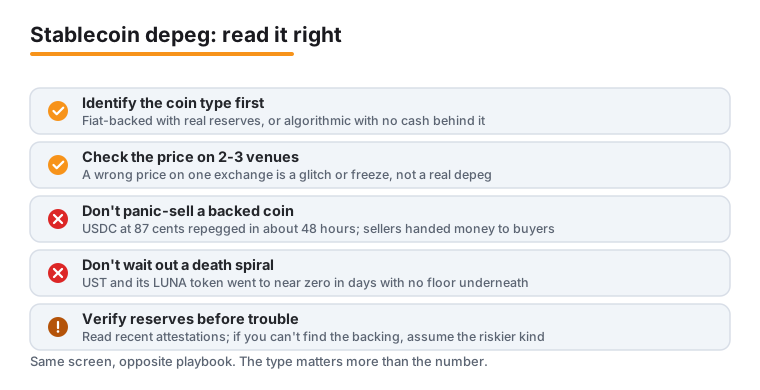
If you cannot tell which one you are looking at, that itself is a warning. With a serious fiat-backed coin you can usually find a recent reserve attestation in minutes. If you cannot find out what is actually behind a coin, you are holding the riskier kind by default.
What to do when the coin you hold slips
The instinct is to sell the second you see 0.98. Slow down. Selling locks in the loss, and on a real fiat-backed coin the dip is often the temporary part.
Work through it in order. First, identify the coin type. Fiat-backed with real reserves, or algorithmic. Second, find the cause. Is this a bank story, a regulator story, a single-exchange glitch, or a mechanism unwinding. Third, check the depth. A few cents on a backed coin is noise. A coin sliding past 90 cents and still falling while a paired token craters is a different situation.
For a backed coin in a scare, the calmer move is often to wait for the reserve facts and the issuer statement rather than dumping into a thin, panicky market. For an algorithmic coin in a spiral, waiting can wipe you out, because there is no floor under it. Same screen, opposite playbook. That is exactly why the type matters more than the number.
One more practical note. A price that looks wrong on one venue may be a liquidity gap or a frozen exchange, not a real depeg. Check the price on two or three independent sources before you react. If it is a dollar everywhere except one place, the problem is that place, not the coin.
How to check a coin before trouble starts
The best time to understand a stablecoin is before it wobbles, not during. The work takes a few minutes.
For USDC, Circle publishes monthly attestation reports from a major accounting firm, plus weekly reserve disclosures and daily portfolio reporting with the actual Treasury holdings listed through BlackRock. You can read the latest attestation on Circle's transparency page and confirm the snapshot date is recent. For USDT, Tether publishes its own reserve breakdowns, though it is not a US-licensed issuer and has said it plans to register under the new US rules through a foreign-issuer pathway while launching a separate US-focused coin called USAT.
That brings up the GENIUS Act, the first US federal law for fiat-backed stablecoins, signed in July 2025. It requires issuers to hold full one-to-one reserves in cash and short-dated Treasuries and to disclose them. As of mid-2026 the detailed rules are still being finalized, with the law set to take effect by early 2027 at the latest. It does not make depegs impossible. It does make the backing of compliant coins easier to verify, which is half the battle.
The honest limit
No stablecoin is risk-free, and anyone telling you otherwise is selling something. Even a fully backed coin can dip in a panic, and even strong reserves can be temporarily stuck, as SVB showed. Reserve attestations are a snapshot, not a live guarantee, and they confirm the assets exist on a given date, not that nothing can go wrong tomorrow.
What you can do is stack the odds. Hold coins with real, verifiable reserves and a regulated issuer. Avoid putting size into algorithmic or exotic synthetic dollars unless you fully accept they can go to zero in days. And when a depeg hits the headlines, take the extra two minutes to ask which of the six causes it is before you touch the sell button. The people who lost the most in both USDC and UST were the ones who reacted to the price instead of the cause.
Frequently asked questions
Is a depeg always a disaster?
No. Most depegs are small and brief. A fiat-backed coin like USDC slipping to 0.995 on a busy day is normal noise. The dangerous depegs are the ones where the backing is in doubt or where there is no real backing at all, like an algorithmic coin in a spiral. The size of the drop matters less than the reason behind it.
Why did USDC recover but UST did not?
USDC had real reserves. Its 2023 drop to 87 cents was caused by about 8 percent of its cash being stuck at Silicon Valley Bank, and once deposits were guaranteed it repegged within roughly 48 hours. UST had no reserves. Its peg was held by a code mechanism that broke, and once confidence went there was nothing to restore value. One had a floor, the other did not.
Should I sell the moment a stablecoin loses its peg?
Not automatically. For a backed coin in a temporary scare, selling at the bottom just hands your money to a calmer buyer, since these usually recover. For an algorithmic coin in a death spiral, waiting can wipe you out because there is no floor. The right move depends entirely on which type of coin you hold and what caused the drop.
What are the six main causes of a depeg?
Reserve loss, a bank run on the issuer, algorithmic mechanism failure, a regulatory halt, a liquidity gap on a decentralized exchange, and a freeze on a single exchange. The first three can be serious or fatal. The last three are often local glitches that affect one venue, not the coin everywhere.
How can I check if a stablecoin's reserves are real?
For USDC, read the monthly attestation reports and weekly reserve disclosures on Circle's transparency page and confirm the snapshot date is recent. For USDT, Tether publishes its own reserve breakdowns. If you cannot find any clear, recent information about what backs a coin, treat it as the riskier kind by default.
Does the GENIUS Act make stablecoins safe?
It helps but does not remove all risk. The GENIUS Act, signed in July 2025, requires compliant US fiat-backed issuers to hold full one-to-one reserves in cash and short-dated Treasuries and to disclose them. That makes backing easier to verify. It does not stop a coin from dipping in a panic or reserves from getting temporarily stuck, and as of mid-2026 the detailed rules are still being finalized.
Last updated: 2026-06-24.