Bitcoin ETF vs Owning Bitcoin Directly
There are two very different ways to put money into bitcoin. One is to buy a fund that holds bitcoin for you and trades like a stock in your normal investment account. The other is to buy the actual coins and hold them yourself. They sound similar, but they behave differently on taxes, fees, trading hours, and who is responsible if something goes wrong. This guide walks through both, side by side, so you can see which fits your situation. It is educational content and not financial advice.
Two ways to own the same thing
A spot bitcoin exchange-traded fund (an ETF, a fund that trades on a stock exchange) holds real bitcoin in storage and issues shares that you buy and sell in a brokerage account. The fund company handles the coins; you hold shares. The U.S. Securities and Exchange Commission approved the first batch of these funds on January 10, 2024, and they now trade on exchanges like NYSE Arca, Cboe BZX, and Nasdaq, according to the SEC's own statement on the approval.
Direct ownership means you buy bitcoin on an exchange or app and the coins are recorded to an address you control. You can leave them on the exchange or move them to your own wallet. When you hold the keys yourself, no company stands between you and the coins. That is the appeal, and also the catch. If you are new to the asset itself, our bitcoin basics guide covers what bitcoin actually is before you decide how to hold it.
What the ETF route gives you
The ETF buys and stores bitcoin, then reflects its value in a share price. Buying a share is the same action as buying a share of any company: search the ticker, enter a number, place the order. Common funds include IBIT from BlackRock, FBTC from Fidelity, ARKB, and BITB. IBIT is the largest, with tens of billions of dollars in assets, per the iShares product page.
What you get with the fund:
- Your existing account works. If you have a brokerage at Fidelity, Schwab, Vanguard, or similar, you can buy these shares there. No new app, no crypto exchange sign-up.
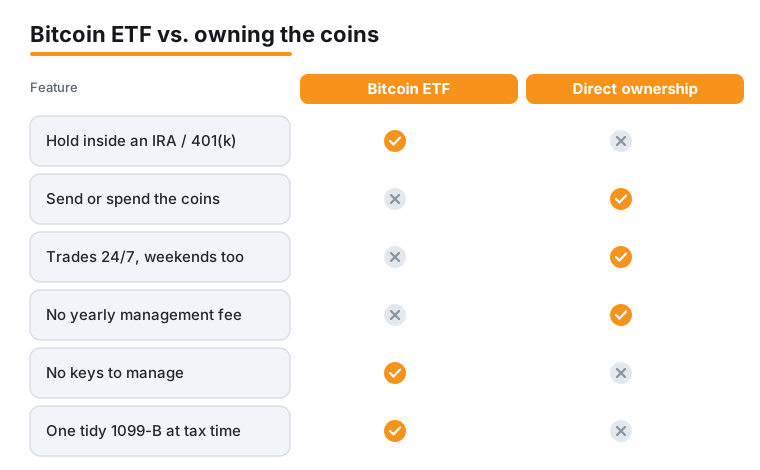
- Retirement accounts are open to you. You can hold a bitcoin ETF inside a Traditional IRA, a Roth IRA, and some 401(k) plans. That is the single biggest thing direct coins cannot match for most people.
- Storage is not your job. The fund's custodian holds the coins. IBIT uses Coinbase as custodian; FBTC stores in-house through Fidelity Digital Assets, per The Motley Fool's fund comparison.
- Taxes arrive on a familiar form. Your broker sends a 1099-B in mid-February with proceeds, cost basis, and holding period already filled in.
What direct ownership gives you
When you buy bitcoin and move it to a wallet you control, you hold a secret called a private key, usually backed up as a 12 to 24 word recovery phrase (the seed phrase). Whoever has that phrase controls the coins. That single fact drives every advantage and every danger.
- You can move it any time. Bitcoin settles around the clock, every day of the year, including weekends and holidays.
- No yearly management fee. There is no fund taking a slice each year. You pay a fee when you buy or sell, and network fees when you move coins, but nothing for simply holding.
- You can actually use it. You can send bitcoin to another person, pay a merchant who accepts it, or hold it offline with no company involved.
- You carry the full responsibility. Lose the recovery phrase and the coins are gone. There is no password reset and no support line that can restore them. Researchers believe a large share of all bitcoin is already lost this way. One widely cited estimate from analytics firm Chainalysis put it near 3.7 million coins, roughly a fifth of the supply, as Decrypt reported, though figures vary by method.
If you go this route, read our guide to bitcoin wallets before you move anything off an exchange.
Fees, compared with a real example
The ETF charges an annual fee, quoted as an expense ratio (a percentage of your holding taken each year). As of 2026, IBIT and FBTC both charge 0.25%. ARKB is 0.21%. Grayscale's lower-cost fund sits near 0.15%, while the older GBTC still charges 1.50%, according to U.S. News's roundup of spot bitcoin ETFs. The range runs from about 0.15% to 1.50%, so the fund you pick matters.
A worked example. Say you hold $10,000 in a fund at 0.25%. That is about $25 per year, taken quietly from the fund's value, not billed to you. At 1.50% it would be roughly $150 a year for the same exposure. Over ten years at a flat balance, the 0.25% fund costs around $250; the 1.50% fund costs around $1,500. Real balances move, but the gap between a cheap fund and an expensive one is the point.
Direct ownership has no yearly fee. Instead you pay a transaction fee when you buy (often a fraction of a percent on a low-cost exchange, sometimes more), and a small network fee when you send coins. If you buy once and hold for years without moving anything, your ongoing cost can be close to zero. For comparing exchange costs, our page on how to buy and sell crypto is a good starting point.
How taxes differ
This is where the two paths really split, so treat the specifics here as a starting point and confirm with a tax professional for your own return.
The ETF. Shares are securities. Your broker reports each sale on Form 1099-B with cost basis and holding period included. Sell after holding 12 months or more and gains are taxed at long-term capital gains rates (0%, 15%, or 20% depending on income); sell sooner and gains are taxed as ordinary income. Most tax professionals also treat ETF shares as subject to the wash-sale rule, which can delay a loss deduction if you rebuy within 30 days.
Direct bitcoin. The IRS treats bitcoin as property under Notice 2014-21, not as a security, as laid out on the IRS digital assets page. The same long-term and short-term brackets apply. But starting with 2025 transactions, exchanges send the new Form 1099-DA: gross proceeds for sales on or after January 1, 2025, and cost basis for covered assets acquired on or after January 1, 2026, per the IRS final broker-reporting rules. Because bitcoin is property and not a security, the wash-sale rule does not currently apply to it, which some holders use to claim a loss and rebuy right away. If you move coins between your own wallets, you have to track cost basis yourself; the exchange cannot see what happened off its platform.
Our general crypto taxes overview goes deeper on record-keeping for direct holdings.
Trading hours and access
The ETF trades only when the stock market is open, roughly 9:30 a.m. to 4:00 p.m. Eastern on weekdays, with no trading on market holidays. Bitcoin's price keeps moving overnight and on weekends; the fund's share price catches up when the market reopens. If a big move happens Saturday night, you cannot trade the ETF until Monday.
Direct bitcoin trades every hour of every day. You can buy or sell at 2 a.m. on a Sunday. That is freedom if you want it, and a way to make panicked decisions at bad hours if you do not. Neither schedule is better; they suit different temperaments.
Security and who you trust
With the ETF you trust a regulated fund and its custodian to hold the coins and not lose them. You also trust your brokerage to keep your account safe. You do not handle keys at all. The risk you take on is counterparty risk, the chance that a company in the chain fails or is compromised. For a major regulated fund this is low, but it is not zero.
With direct ownership you remove those companies but become your own security team. A hardware wallet (a small offline device that signs transactions) is the common recommendation. The danger is rarely fancy hacking; it is ordinary human error. People lose the recovery phrase, store it where someone finds it, or fall for a scammer who talks them into typing it into a fake site. If you hold your own coins, treat the recovery phrase like the only copy of a deed to a house. Our bitcoin security guide covers the practical habits that prevent most losses.
Who each option suits
The ETF tends to fit you if:
- You want bitcoin exposure inside a Roth IRA, Traditional IRA, or 401(k) for the tax treatment.
- You already have a brokerage and do not want a separate crypto app.
- You want one tidy 1099-B at tax time and no key management.
- You are fine trading only during market hours and paying a small yearly fee.
Direct ownership tends to fit you if:
- You want to actually send or spend bitcoin, not just hold a price bet.
- You want no yearly management fee and plan to hold for a long time.
- You want to trade or move coins on weekends and overnight.
- You are willing to take full responsibility for storing a recovery phrase safely.
Plenty of people do both: an ETF in the retirement account, a small amount of real bitcoin in a wallet to learn how it works. There is no rule that you must pick one. Before committing either way, the bitcoin investing overview is worth reading, because both paths expose you to the same sharp price moves.
Common mistakes to avoid
Grabbing the most famous fund without checking the fee. A 1.50% fund and a 0.25% fund hold the same asset. Over years, the difference is real money. Compare expense ratios before you buy.
Assuming the ETF lets you withdraw coins. It does not. You own shares, not bitcoin you can send to a friend or a merchant. If using bitcoin matters to you, the ETF is the wrong tool.
Storing your recovery phrase as a photo or in cloud notes. Anything connected to the internet can be reached. Write the phrase on paper or metal and keep it offline, ideally in more than one location.
Forgetting that moving coins between your own wallets still needs records. The transfer is not a taxable sale, but you must carry your cost basis with the coins. Without records, calculating gains later is painful.
Trading the ETF at the open after weekend news. The price can gap up or down at 9:30 a.m. Monday to reflect what bitcoin did while the market was closed. Know that before you place a market order at the bell.
Frequently asked questions
Can I take the actual bitcoin out of an ETF?
No. A spot bitcoin ETF gives you shares that track bitcoin's price. The fund holds the coins through its custodian, and you cannot redeem your shares for bitcoin to send or spend. If owning coins you can move yourself matters, you need direct ownership in a wallet.
Which is cheaper over the long run?
It depends on how you behave. Direct ownership has no yearly fee, so a buy-and-hold investor who rarely moves coins can pay almost nothing to keep them. An ETF charges an expense ratio every year, commonly 0.25% in 2026, though funds range from about 0.15% to 1.50%. If you trade often, exchange transaction fees on direct coins can add up too. For a long hold, direct ownership is usually cheaper; for hands-off simplicity, a low-fee ETF is close.
Can I hold a bitcoin ETF in my IRA or 401(k)?
Yes for IRAs at most brokerages, and sometimes for 401(k)s. You can buy spot bitcoin ETFs in a Traditional or Roth IRA at brokerages like Fidelity, Schwab, and Interactive Brokers. A 401(k) can hold one only if your plan adds it to the menu or offers a brokerage window. For 2026 the IRS set the IRA contribution limit at $7,500, with an extra $1,100 catch-up if you are 50 or older. Holding bitcoin directly inside a standard retirement account is far harder, which is the ETF's main advantage here.
Are the taxes really different between the two?
The capital gains brackets are the same, but the paperwork and some rules differ. The ETF reports on Form 1099-B as a security, and most professionals apply the wash-sale rule to it. Direct bitcoin is property under IRS Notice 2014-21; exchanges now report it on Form 1099-DA (gross proceeds from 2025, cost basis from 2026), and the wash-sale rule does not currently apply. Confirm the details for your situation with a tax professional.
Is one option safer than the other?
They carry different risks rather than one being plainly safer. With the ETF you rely on a regulated fund, its custodian, and your broker; the danger is that a company in that chain fails. With direct ownership you remove those companies but become fully responsible for a recovery phrase that cannot be reset if lost. Most direct losses come from human error, not hacking. Pick the risk you are better equipped to manage.
Can I do both?
Yes, and many people do. A common pattern is holding a bitcoin ETF inside a retirement account for the tax treatment, while keeping a small amount of bitcoin in a personal wallet to learn how sending and self-custody work. Nothing requires you to choose only one path.
Last updated: 2026-06.