Home › Crypto Regulation › Guernsey
Bitcoin and Cryptocurrency Regulation in Guernsey
Quick answer — Guernsey, 2026
- Legal: Legal to own and use, not legal tender
- Tax: No capital gains tax or VAT; flat 20% income tax if trading as a business
- Buying: Mostly via international exchanges; few retail exchanges licensed locally
Guernsey is a British Crown Dependency in the Channel Islands and a long-established international finance centre, sitting outside both the United Kingdom and the European Union with its own parliament, courts and financial regulator. Together with Alderney, Herm and Sark it forms the Bailiwick of Guernsey. Crypto activity here is governed primarily through the Bailiwick's financial-services rules rather than a single standalone "crypto law", and the key piece of legislation is the Lending, Credit and Finance (Bailiwick of Guernsey) Law, 2022, which came into force on 1 July 2023 and created a dedicated licensing regime for virtual asset service providers (VASPs).
This guide explains how Bitcoin and other cryptocurrencies are treated in Guernsey, who regulates them, how they are taxed, the licensing rules for service providers, and the practical realities of buying and using crypto. It is general information as of 2026 and is NOT legal, tax or financial advice. Crypto rules are evolving, so always confirm the current position with the Guernsey Financial Services Commission (GFSC) and a qualified local adviser before acting. For broader context, see our guide to crypto regulation and our country regulation hub.
On this page: Legal status · Who regulates it · Taxes · How to buy · Mining
Is Bitcoin and crypto legal in Guernsey?
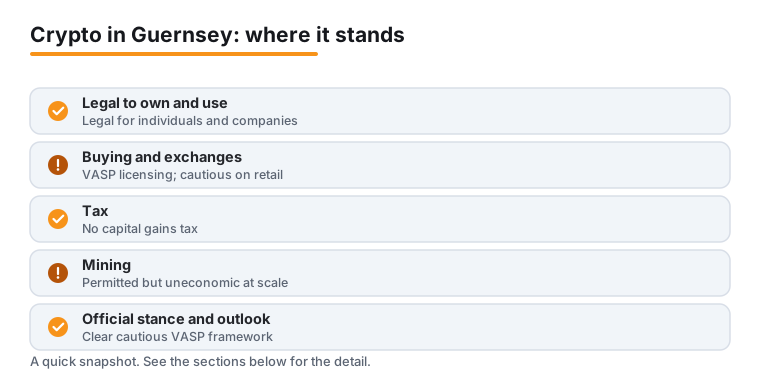
Yes. Owning, buying, selling and using Bitcoin and other cryptocurrencies is legal in Guernsey for individuals and companies. There is no ban on holding digital assets or transacting in them. Crypto is not, however, legal tender. The official currency is the pound (the Guernsey pound circulates alongside sterling), and no merchant is obliged to accept Bitcoin.
What matters in Guernsey is the distinction between private use and providing crypto services as a business. Personal buying, holding and using of crypto is unrestricted. By contrast, carrying on a virtual asset business in or from within the Bailiwick, such as running an exchange, custody service or transfer service, is a regulated activity that requires a licence from the regulator. Guernsey has historically taken a deliberately cautious, consumer-protection-focused stance toward retail crypto, while building a credible framework for institutional and fund use.
Who regulates crypto in Guernsey
The principal regulator is the Guernsey Financial Services Commission (GFSC), the integrated financial-services supervisor for the Bailiwick. The GFSC licenses and supervises virtual asset service providers (VASPs) under the Lending, Credit and Finance Law, alongside its supervision of banking, investment, fiduciary, insurance and pension business. It also handles financial-crime supervision and the Bailiwick's anti-money-laundering regime.
The GFSC has launched a Digital Finance Initiative (DFI), described as a programme to position the Bailiwick as a trusted, agile and forward-thinking jurisdiction for digital financial innovation, including work on tokenisation and blockchain and an industry digital forum. As part of the DFI, the GFSC operates an Innovation Sandbox and Concierge service, a structured environment paired with a regulatory point of contact for firms exploring blockchain, tokenisation and other digital-finance products. Tax matters are handled separately by the Revenue Service of the States of Guernsey. The official regulator site is gfsc.gg, where you can read the regulator's own approach to crypto currency funds.
Key laws and frameworks
Guernsey does not have a single dedicated "crypto act". Instead, crypto activity is captured by the Bailiwick's financial-services and financial-crime legislation, with one law in the lead.
The Lending, Credit and Finance Law 2022
The Lending, Credit and Finance (Bailiwick of Guernsey) Law, 2022 (the "LCF Law") came into force on 1 July 2023. It is best known for regulating consumer credit and home finance, but it also created the Bailiwick's first dedicated licensing regime for virtual asset service providers. Part III of the LCF Law deals with VASPs, defined broadly to capture firms that exchange virtual assets for fiat or other virtual assets, transfer virtual assets, provide safekeeping or custody, or participate in financial services connected to the issue or sale of virtual assets. Fintech platforms running crowdfunding and peer-to-peer lending are also covered.
Supporting financial-crime law
VASPs and other financial-services businesses are subject to the Bailiwick's anti-money-laundering and counter-terrorist-financing framework, anchored by laws such as the Criminal Justice (Proceeds of Crime) (Bailiwick of Guernsey) Law, 1999, and supplemented by the GFSC's Handbook on Countering Financial Crime. See the GFSC overview of the Lending, Credit and Finance sector for the regulator's own description of the regime.
Licensing and registration of exchanges and VASPs
Businesses that provide virtual asset services in or from within the Bailiwick generally need a licence from the GFSC. Under Part III of the LCF Law, a firm carrying on VASP activity must hold the appropriate licence, comply with regulatory and substance requirements, and observe restrictions on the types of virtual assets it deals with. Since the LCF Law came into force on 1 July 2023, persons carrying on the covered activities have been required to hold an appropriate licence.
- Who needs a licence. Firms that exchange, transfer, safekeep or facilitate the issue or sale of virtual assets as a business, including exchanges and custodians, fall within the VASP regime.
- Exemptions. Limited exemptions exist, and where a standard exemption does not apply a firm can seek a discretionary exemption from the GFSC. The GFSC has noted that discretionary exemption approvals are typically time-limited (for example, to three years) and apply only to the specific activity and asset disclosed.
- Cautious posture on retail. That posture changed in July 2026. The GFSC confirmed it will delete Rule 10.2(1), which prevented VASP licensees from providing services to retail customers, calling it "a significant change" and stating that licensed firms "will be able to offer digital finance services to retail customers" once the revised rules take effect, which is intended for 1 October 2026. Licensees serving retail customers must notify the Commission.
For users, the practical takeaway is to favour providers that are properly licensed or that operate from established, well-regulated jurisdictions, and to confirm a provider's status before depositing funds. You can also see our guide to crypto regulation for how licensing works across jurisdictions.
Crypto taxation in Guernsey
Guernsey is generally regarded as a low-tax jurisdiction, but the treatment of crypto depends on whether you act as a private investor or carry on a business or trade. The notes below are general and not tax advice.
- No capital gains tax. Guernsey does not levy a capital gains tax, so gains realised by a private individual on disposing of crypto are generally not taxed as capital gains.
- No VAT or inheritance tax. The Bailiwick has no value-added tax (VAT) or general consumption tax, and no inheritance tax.
- Income tax can apply. Guernsey applies a flat 20% rate of income tax. Where crypto activity amounts to a trade or profession, for example active, organised trading or a crypto business, the profits can be taxable as income. The line between private investment and trading depends on the facts.
- No crypto-specific tax code. There is no separate crypto tax statute, so crypto is taxed under Guernsey's existing general tax principles.
- International reporting (CARF). Guernsey has committed to the OECD's Crypto-Asset Reporting Framework (CARF). Regulations implementing CARF were made on 30 December 2025 and came into force on 1 January 2026, with the first reporting expected in 2027 in respect of 2026 data, reported to the Guernsey Revenue Service. This means greater automatic exchange of crypto tax information going forward.
Because outcomes depend on your circumstances, this guide deliberately avoids stating specific figures for your situation. Confirm your position with the Revenue Service of the States of Guernsey or a qualified adviser. For background, see our crypto taxes guide.
AML, KYC and the Travel Rule
Anti-money-laundering (AML) and know-your-customer (KYC) obligations are central to Guernsey's regime. Licensed VASPs are treated as financial-services or prescribed businesses and must comply with the Bailiwick's framework, anchored by the Criminal Justice (Proceeds of Crime) (Bailiwick of Guernsey) Law, 1999, and the GFSC's Handbook on Countering Financial Crime (AML, CFT and CPF). The framework reflects Financial Action Task Force (FATF) standards, and Guernsey is assessed by MONEYVAL.
In practice, regulated providers must verify customer identity, identify beneficial owners, monitor transactions on a risk basis, keep records and report suspicious activity. The FATF "Travel Rule" applies to qualifying virtual asset transfers, requiring identifying information about the originator and beneficiary to travel with the transfer. For everyday users, the visible effect is that compliant platforms ask for identity documents and may request source-of-funds information. See the GFSC's financial-crime pages for the regulator's guidance.
Buying and using crypto in practice
Because Guernsey is a small jurisdiction outside the EU and UK, residents typically buy crypto through international exchanges and brokers that accept Channel Islands customers rather than through a large local exchange sector. Historically the GFSC limited licensed VASPs to institutional and wholesale counterparties, so no local retail exchange sector developed. That restriction, Rule 10.2(1) of the LCF Rules, is being deleted, with the revised rules intended to take effect on 1 October 2026. That opens the door to locally licensed retail services, though at the time of writing no firm had announced one. A general path looks like this:
- Choose a reputable provider that accepts Guernsey residents, ideally one that is well regulated in its home jurisdiction, and compare fees, supported assets and security.
- Verify your identity (KYC), typically with a government ID and proof of address, before trading or withdrawing.
- Deposit funds in pounds sterling or another supported currency. Bank transfers usually carry lower fees on larger amounts, though some local banks are cautious about crypto-related payments.
- Place your order and review the total cost, including fees and spread.
- Secure your holdings. Decide between platform custody and a personal wallet (a hardware wallet for larger amounts), and safeguard your recovery phrase. Whoever controls the private keys controls the coins.
- Keep records of dates, amounts and values, which helps if income tax or reporting questions arise.
Crypto can also be used for cross-border transfers, which can settle quickly. Note that transfers through regulated providers carry Travel Rule and AML checks, that on- and off-ramp costs and price volatility matter, and that the rules of the country on the other end also apply. Going digital does not exempt a transfer from financial-crime rules.
Bitcoin ATMs in Guernsey
There is no specific Bitcoin-ATM licensing regime named in Guernsey law, and the Bailiwick is not a place where crypto ATMs are a common sight. Operating a crypto ATM as a business that exchanges fiat for virtual assets would generally fall within the VASP activities regulated under Part III of the LCF Law, meaning an operator would need to consider whether a GFSC licence is required.
Given the GFSC's cautious approach to retail virtual asset services and the small size of the local market, anyone considering installing or operating a crypto ATM in Guernsey should seek the regulator's view and qualified legal advice before proceeding rather than assuming it is exempt. Users of any machine should be alert to high fees and to the same scam risks that affect crypto ATMs elsewhere.
Bitcoin mining in Guernsey
Bitcoin mining is not prohibited in Guernsey, but the island is not a natural mining hub. It is small and densely settled, it imports a significant share of its energy, and electricity costs are not the kind of cheap, abundant power that attracts large-scale industrial mining. As a result, mining tends to be small in scale rather than data-centre operations.
There is no special mining-licence regime aimed at individuals. However, mining carried on as a commercial enterprise could have business, income-tax and energy consequences, and the GFSC confirmed in July 2026 that it "does not generally consider that mining or validation activities would require a VASP licence", while noting that staking may require one depending on the circumstances and on whose behalf it is carried out. Anyone planning more than a hobby setup should weigh the electricity economics and seek local advice.
Recent developments (2025-2026)
Guernsey's recent direction has been to keep its cautious, consumer-protection stance while opening selective doors for institutional and fund use of crypto.
- Crypto funds statement (9 June 2025). The GFSC issued a statement recognising that collective investment schemes can provide vehicles for investors to gain indirect exposure to cryptocurrencies, provided investors are well informed of the risks and able to bear potential losses. The statement signalled a more flexible approach to certain digital assets, noting that some cryptocurrencies such as Bitcoin appear to be entering a more mature period, while reiterating caution on VASPs and retail exchange services.
- Fund tokenisation policy statement (May 2024). The GFSC published a policy statement confirming that the existing Bailiwick regime already permits fund tokenisation, meaning the register of holders of units in a Guernsey collective investment scheme can be maintained using distributed ledger technology, provided the scheme still complies with the Protection of Investors (Bailiwick of Guernsey) Law, 2020. The statement indicated the GFSC expects a private, permissioned blockchain under the control of the scheme's designated administrator.
- Digital Finance Consultation Paper (December 2025). The GFSC opened a Digital Finance Consultation Paper proposing targeted changes to the VASP regime. Among the proposals, the GFSC set out plans to remove the blanket restriction on retail VASPs and instead assess them case by case, and to create a separate framework for privately issued stablecoins so that stablecoins would be regulated as a distinct asset class rather than as virtual assets, with their issuers licensed as a financial firm business under the LCF Law. The consultation was stated to run until 6 March 2026. These proposals have since been settled. In its feedback paper of 24 July 2026 the GFSC confirmed it will delete Rule 10.2(1), the retail restriction, with the revised Part 10 rules intended to come into effect on 1 October 2026. Stablecoin feedback and rules are still to come, planned for Autumn 2026.
- Digital Finance Initiative and Innovation Sandbox. The GFSC has been developing its Digital Finance Initiative to support innovation in tokenisation and blockchain, including an Innovation Sandbox and Concierge service, building on earlier tokenisation policy work.
- CARF implementation. Regulations implementing the OECD Crypto-Asset Reporting Framework were made on 30 December 2025 and came into force on 1 January 2026, with first reporting expected in 2027 on 2026 data.
Because these dates and positions are time-sensitive and can change, always check the official GFSC and States of Guernsey pages for the latest position rather than relying on a snapshot.
Consumer risks and protection
Regulation reduces some risks but does not remove them, and Guernsey's cautious approach to retail crypto means consumers carry significant responsibility. Keep the following in view:
- Market risk. Crypto prices are highly volatile and speculative, and capital can be lost quickly. This guide makes no price predictions.
- Limited local recourse. Most residents use overseas platforms, so local consumer-protection and complaints routes may not apply, and assets held abroad may be hard to recover if a platform fails.
- Counterparty and security risk. Scams, hacks, platform failures and lost keys are persistent threats everywhere. Use reputable, well-regulated platforms and secure your private keys.
- Regulatory change. Rules and the GFSC's stance continue to evolve, and obligations around AML and reporting can tighten.
Sensible principles apply: only commit what you can afford to lose, verify a provider's regulatory status, understand what you are buying, and seek licensed advice for anything beyond modest sums.
Official sources and how to verify
This article is general information as of 2026 and is NOT legal, tax or financial advice. For current and binding information, always verify with the named official regulator and authorities before acting:
- Guernsey Financial Services Commission (GFSC), the supervisor for virtual asset service providers, licensing and financial-crime obligations.
- GFSC: Lending, Credit and Finance, the regulator's overview of the LCF Law 2022 regime that covers VASPs.
- GFSC: Financial Crime, for the Bailiwick's AML, CFT and countering-financial-crime framework that applies to VASPs.
- GFSC: The Commission's approach to crypto currency funds, the regulator's 9 June 2025 statement on collective investment schemes with crypto exposure.
For tax and Crypto-Asset Reporting Framework questions, consult the Revenue Service of the States of Guernsey and a qualified local adviser. To check whether a specific provider is licensed in Guernsey, look it up in the GFSC's public register and confirm its status directly. You can also explore our wider regulation hub for comparisons with other countries.
August 2026 update: the retail restriction is being removed
On 24 July 2026 the Guernsey Financial Services Commission published its feedback paper and guidance on digital finance, closing out the consultation it launched on 11 December 2025. The headline change is that the Commission will delete Rule 10.2(1) of the Lending, Credit and Finance Rules, 2023, which limited Part III VASP licensees to institutional and wholesale counterparties. The feedback paper calls this "a significant change" and says it "means firms licensed and regulated by the Commission will be able to offer digital finance services to retail customers".
A small number of respondents pushed back on the ground that cryptoassets are too complex or too risky for retail customers. The Commission rejected that: "complexity and risk in investments is not unique to digital finance and virtual assets, and the Commission does not consider this sufficient reason to continue to deny retail investors the opportunity to invest in this sector".
Three rules go at once. Rule 10.1(1), which required holders of licences under any regulatory Law who carry on Part III VASP activities to hold a VASP licence as well, is deleted, although the Commission is clear that this "does not eliminate the need for additional licences in all cases" and that its effect is to increase flexibility to grant limited permissions. Rule 10.2(1), the retail restriction, is deleted. Rule 10.3, the VASP specific environmental declaration, is deleted; the Commission noted the rule "was also drafted in a Bitcoin-centric era". The revised Part 10 rules "are intended to come into effect on 1 October 2026 unless otherwise specified".
The Commission is not adding a separate retail conduct rulebook. It relies on the minimum criteria for licensing, rules on safeguarding client and customer money, the Principles of Conduct of Finance Business and AML, CFT and CPF controls that already apply to all licensees. Firms offering virtual asset services directly to retail customers will have to notify the Commission. The expectations the Commission set out in June 2025 for funds with cryptoasset exposure are carried across to retail VASP services: customers should be well informed of risks and able to bear potential losses, the regulated status of service providers including any custodian should be considered, and the Business Risk Assessment should support proper compliance monitoring, testing and risk management.
Alongside the feedback paper the Commission published a Guidance Note on the Tokenisation of Investments and Other Assets. It rescinds the 14 May 2024 fund tokenisation policy statement and confirms that the register of holders' interests in a Bailiwick fund or security may be maintained using public or private DLT. The note expressly does not apply to stablecoins. The Commission also confirmed that a separate VASP licence is not needed merely to advise on virtual assets, that tokenised insurance linked securities are not virtual assets for VASP licensing purposes, and that insurers, intermediaries and insurance managers may accept premiums, and pay claims, in stablecoins or cryptocurrency without holding a VASP licence.
Guernsey's crypto legislative pipeline and when each piece moves
Guernsey has no standalone crypto act. What it has is a rolling programme of amendments to the Lending, Credit and Finance (Bailiwick of Guernsey) Law, 2022 and its rules. The table below sets out what is decided, what is still open, and the dates the Commission has actually published.
| Measure | Stage | Timing | What it means in practice |
|---|---|---|---|
| Revised Part 10 VASP rules, deleting Rules 10.1(1), 10.2(1) and 10.3 | Decided, not yet in force | Intended to come into effect 1 October 2026 unless otherwise specified | Licensed firms may serve retail customers, subject to notifying the Commission; VASP only environmental returns end; the Rule 10.1(1) deletion increases flexibility but does not remove the need for other licences in all cases |
| Draft section 40 (VASP) Notice consolidating licensing disapplications | Open for comment | Comments to [email protected] by 31 August 2026 | One consolidated exemption notice. Those relying on it must notify the Commission and appear on a register, except persons who make investments, hold or trade virtual assets for their own benefit |
| Regulations amending section 17 of the LCF Law 2022 | Agreed, drafting to follow | No date stated; to be advanced with the Law Officers of the Crown and the Policy and Resources Committee | Licensing would apply only to activity carried on for or on behalf of another natural or legal person, putting own account trading outside the Law itself |
| Dual licensing relief for Protection of Investors and insurance licensees | Agreed, to be delivered through the section 40 Notice rather than a change to section 17 | Tied to the section 40 Notice; no separate date stated | POI licensees could custody digital assets, and POI and insurance licensees could trade, hold or invest in virtual assets, without a second VASP licence |
| Stablecoin framework | Consulted, rules pending | "We plan to issue stablecoin feedback and rules during Autumn 2026" | A distinct regime for privately issued stablecoins. Nothing binding until published |
| MONEYVAL remediation package: Handbook on Countering Financial Crime plus Schedules 1, 3 and 4 of the Criminal Justice (Proceeds of Crime) Law, 1999 | Open consultation | Responses sought by Friday 9 October 2026 | Updated AML and CFT obligations for VASPs and other prescribed businesses, and a review of the Appendix C list of FATF equivalent jurisdictions |
| Income Tax (Approved International Agreements) (Implementation) (Crypto-Asset Reporting Framework) Regulations, 2025, Guernsey Statutory Instrument 2025 No. 135 | In force since 1 January 2026 | First exchanges in 2027 covering 2026 data | Crypto service providers register with the Director and report customer and transaction data to the Guernsey Revenue Service for automatic exchange |
Sources for the table are the GFSC Growth with Digital Finance feedback paper (July 2026), the GFSC MONEYVAL consultation notice of 30 July 2026, and the States of Guernsey Crypto-Asset Reporting Framework page.
Mining, validation and staking: the regulator's stated position
The GFSC addressed this directly in its July 2026 feedback paper. It confirmed that it "does not regulate the use of blockchain or distributed ledger technology" and that "there are no regulatory requirements for licensing for firms providing IT or support services for VASPs".
On mining, the Commission concluded that it "does not generally consider that mining or validation activities would require a VASP licence". It added that "Certain activities, such as staking, may require a VASP licence depending on circumstances and for whom the activity is being carried out", and that it is not issuing further guidance because "In most cases the position is clear and licensing is not required". It declined to publish a scenario table, on the basis that more complex proposals each have their own characteristics.
The practical reading: running your own mining rig or validator node in Guernsey is not a licensable activity. Staking on behalf of other people can be, because the licensing test turns on whether the activity is carried out for another person. Firms with novel or borderline models are pointed to the Commission's Innovation Sandbox and Concierge service; the sandbox began in October 2025 and the Commission licensed a further participant, a digital administrator, on 6 August 2026. Sandbox licensed firms appear on the Commission's list of regulated entities with an asterisk by their name.
The tax numbers that actually apply
Guernsey has no capital gains tax, so for a private investor the live question is not how a gain is taxed but whether the activity amounts to a trade, in which case income tax applies.
- Income tax is charged at a flat 20%. The Revenue Service states plainly: "Income tax is 20% of assessable income."
- The personal allowance for 2026 is £15,200.
- Personal allowances begin to be withdrawn once income exceeds £85,000.
These are the 2026 figures from the States of Guernsey tax rates and allowances page and are revisited at each Budget. There is no crypto specific tax statute, so whether a disposal is an untaxed capital transaction or a taxable trading profit is decided on general principles and on the facts of the activity. Reporting is separate from liability: under the CARF regulations, Guernsey Statutory Instrument 2025 No. 135, made on 30 December 2025 and in force from 1 January 2026, information about your holdings can be reported in a year when no tax is due.
Frequently asked questions
Is cryptocurrency legal in Guernsey?
Yes. Buying, holding, selling and using cryptocurrencies such as Bitcoin is legal in Guernsey for individuals and businesses. Crypto is not legal tender, and businesses that provide virtual asset services in or from within the Bailiwick must be licensed by the Guernsey Financial Services Commission under the Lending, Credit and Finance Law 2022. Everyday personal use is unrestricted. This is general information, not legal advice; verify with the GFSC.
Who regulates crypto in Guernsey?
The Guernsey Financial Services Commission (GFSC) is the main regulator. It licenses and supervises virtual asset service providers (VASPs) under Part III of the Lending, Credit and Finance (Bailiwick of Guernsey) Law, 2022, and oversees the Bailiwick's anti-money-laundering regime. Tax matters are handled separately by the Revenue Service of the States of Guernsey. The official regulator site is gfsc.gg.
Do crypto exchanges need a licence in Guernsey?
Generally yes. Firms carrying on virtual asset activities such as exchange, transfer, custody or facilitating the issue or sale of virtual assets in or from within the Bailiwick must hold a VASP licence from the GFSC under the LCF Law 2022, subject to limited exemptions. The GFSC was previously restrictive here, limiting licensed VASPs to institutional and wholesale counterparties, but that rule is being deleted, with the revised rules intended to take effect on 1 October 2026. Always confirm a provider's status with the GFSC before depositing funds.
How is crypto taxed in Guernsey?
Guernsey has no capital gains tax, no VAT and no inheritance tax, so a private investor's crypto gains are generally not taxed as capital gains. However, Guernsey applies a flat 20% income tax, and where crypto activity amounts to a trade or business the profits can be taxable as income. There is no crypto-specific tax statute. From 2026, the OECD Crypto-Asset Reporting Framework (CARF) phases in, with first reporting expected in 2027 on 2026 data. Because details depend on your circumstances, confirm with the Guernsey Revenue Service or a qualified adviser. This is not tax advice.
What is the Lending, Credit and Finance Law 2022?
It is the Bailiwick of Guernsey law, in force since 1 July 2023, that regulates consumer credit, home finance and certain fintech platforms, and that also created Guernsey's first dedicated licensing regime for virtual asset service providers. Part III of the law deals with VASPs and requires firms carrying on virtual asset activities to be licensed by the GFSC, subject to limited exemptions.
Can I mine Bitcoin in Guernsey?
Mining is permitted but uncommon at scale. Guernsey is a small island that imports much of its energy, and electricity costs make large industrial mining generally uneconomic. Hobby mining is possible, while commercial operations should consider business and income-tax treatment, energy costs, and whether any activity could engage the VASP regime. Seek local advice for anything beyond a small setup.
What is Guernsey's Digital Finance Consultation Paper?
In December 2025 the Guernsey Financial Services Commission opened a Digital Finance Consultation Paper proposing changes to its virtual asset service provider (VASP) regime. The proposals include removing the blanket restriction on retail VASPs so they would be assessed case by case, and introducing a separate framework for privately issued stablecoins. The consultation was stated to run until 6 March 2026. The Commission published its feedback on 24 July 2026 and confirmed the retail restriction will be removed when the revised Part 10 rules take effect, which is intended for 1 October 2026. The stablecoin element is still outstanding, with rules planned for Autumn 2026.
How does Guernsey plan to regulate stablecoins?
Under the December 2025 Digital Finance Consultation Paper, the GFSC proposed treating privately issued stablecoins as a distinct asset class rather than as virtual assets, with issuers licensed as a financial firm business under the Lending, Credit and Finance Law 2022. The proposals set out requirements around reserve assets, redemption and disclosure. As of August 2026 the stablecoin rules have still not been published. The GFSC stated in its July 2026 feedback paper that it plans to issue stablecoin feedback and rules during Autumn 2026, so this remains the one major part of the package that is not yet settled.
Can retail customers in Guernsey use a locally licensed crypto firm?
Not yet, but the barrier is being removed. Rule 10.2(1) of the Lending, Credit and Finance Rules limited GFSC licensed VASPs to institutional and wholesale counterparties. In its feedback paper of 24 July 2026 the Commission confirmed it will delete that rule, calling it a significant change and saying licensed firms will be able to offer digital finance services to retail customers. The revised rules are intended to come into effect on 1 October 2026. Firms offering these services directly to retail customers must notify the Commission. Whether any firm launches a retail service is a commercial decision, so check the GFSC register before assuming a provider is licensed.
When do Guernsey's new VASP rules take effect?
The revised Part 10 VASP rules are intended to come into effect on 1 October 2026 unless otherwise specified. They delete Rule 10.1(1), which required holders of other regulatory licences carrying on VASP activities to hold a VASP licence as well, Rule 10.2(1), the restriction to institutional and wholesale counterparties, and Rule 10.3, the VASP specific environmental declaration. The Commission notes that deleting Rule 10.1(1) does not eliminate the need for additional licences in all cases. Separately, changing the Lending, Credit and Finance Law itself needs regulations from the Policy and Resources Committee, and no date has been given for those.
Has Guernsey regulated stablecoins yet?
No. Stablecoins were covered in the consultation paper of 11 December 2025, but the GFSC has not published rules. In its July 2026 feedback paper the Commission said it is progressing plans for a proportionate regulatory framework for stablecoins and plans to issue stablecoin feedback and rules during Autumn 2026. The December 2025 paper proposed a new category, a Licensed Stablecoin, pegged to a fiat currency and fully backed by suitably liquid assets in that currency, with issuers licensed as a financial firm business rather than under the VASP regime. Until rules are issued, nothing in that proposal is binding. The Commission has separately confirmed that insurers and intermediaries may accept premiums in stablecoins or cryptocurrency without holding a VASP licence.
Do I need a licence to mine or stake crypto in Guernsey?
For mining or running a validator node, generally no. The GFSC stated in July 2026 that it does not generally consider mining or validation activities to require a VASP licence, and that it does not regulate the use of blockchain or distributed ledger technology. Staking is different: the Commission said staking may require a VASP licence depending on the circumstances and for whom the activity is carried out. The dividing line is whether you are acting on your own behalf or providing a service to other people. Commercial operations should still consider income tax on trading profits and electricity costs, and can raise novel models with the Commission's Innovation Sandbox and Concierge service.
Will my crypto be reported to the Guernsey tax authorities?
Increasingly, yes. Guernsey implemented the OECD Crypto-Asset Reporting Framework through the Income Tax (Approved International Agreements) (Implementation) (Crypto-Asset Reporting Framework) Regulations, 2025, Guernsey Statutory Instrument 2025 No. 135, made on 30 December 2025 and in force from 1 January 2026 for years of charge beginning on or after that date. The Revenue Service states that entities or individuals providing services effectuating exchange transactions in crypto assets for or on behalf of customers are obliged to report. The intention is for the first exchanges to take place in 2027 covering 2026 data. Reporting is separate from liability, so information about your holdings can be exchanged even in a year when you owe no Guernsey tax.
Facts reviewed: 13 August 2026. Page updated: 13 August 2026.