Home › Crypto Regulation › Jersey
Bitcoin and Cryptocurrency Regulation in Jersey
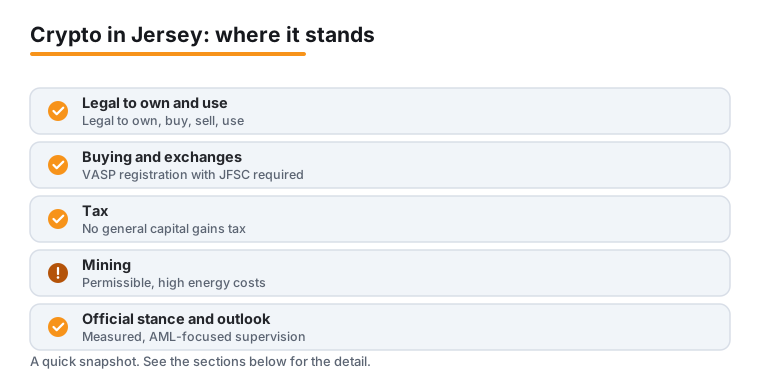
Quick answer — Jersey, 2026
- Legal: Legal to own and trade, not legal tender
- Tax: No general capital gains tax, trading taxed as income, GST rules
- Buying: Via JFSC-registered VASPs or well-regulated international exchanges
Jersey, the largest of the Channel Islands, is a self-governing British Crown Dependency with its own legislature, courts and financial regulator. It is a long-established international finance centre, and it has taken a deliberately measured approach to crypto: rather than passing a single stand-alone digital assets statute, Jersey has folded virtual assets into its existing financial services and anti-money-laundering laws. Crypto businesses are supervised primarily by the Jersey Financial Services Commission, and the island treats involvement in token issuance, exchanges and related services as a sensitive activity that attracts close scrutiny.
This page explains the current legal status of Bitcoin and other cryptocurrencies in Jersey, who regulates the sector, how virtual asset businesses are registered and taxed, and what individuals and businesses should know in practice. This is general information as of 2026 and is NOT legal, tax, or financial advice. Crypto laws change quickly, so verify any specific point with the Jersey Financial Services Commission, the Government of Jersey, or a qualified local professional before acting. For background, see our overview of crypto regulation.
On this page: Legal status · Who regulates it · Taxes · How to buy · Mining
Is Bitcoin and crypto legal in Jersey?
Yes. Owning, buying, selling and using Bitcoin and other cryptocurrencies is legal in Jersey. There is no prohibition on individuals holding digital assets, and the island has positioned itself as a regulated home for fintech and digital asset businesses rather than banning the sector.
Legal does not mean unregulated, and it does not mean crypto is money in the legal sense. Cryptocurrency is not legal tender in Jersey. The official currency is the pound sterling (Jersey issues its own notes and coins at par with sterling). Crypto is instead treated as another asset class within Jersey's existing financial services and anti-money-laundering framework, and businesses that provide virtual asset services to people in Jersey must register with and be supervised by the Jersey Financial Services Commission (JFSC).
For an ordinary resident or visitor, the practical takeaway is straightforward: you can legally use crypto, but you should expect regulated platforms to ask for identity verification and to operate under JFSC registration.
Who regulates crypto in Jersey?
The principal regulator for the sector is the Jersey Financial Services Commission (JFSC). The JFSC registers and supervises virtual asset service providers (VASPs), enforces the island's anti-money-laundering regime, and reviews token issuances and digital asset business under its broader financial services remit. Where a firm carries out VASP activity but holds no other regulated licence, the JFSC supervises it for anti-money-laundering, counter-terrorist-financing and counter-proliferation-financing (AML/CFT/CPF) purposes, rather than for prudential or conduct-of-business requirements.
Tax matters are handled separately by Revenue Jersey, the tax authority within the Government of Jersey, which administers income tax, the Goods and Services Tax (GST) and the island's tax-reporting obligations. You can confirm the regulator and its published guidance directly at the JFSC's VASP pages and tax guidance at gov.je.
Key laws and frameworks
Jersey has deliberately avoided a single bespoke crypto statute. Instead, virtual assets are regulated through existing laws, the most important of which are:
- The Proceeds of Crime (Jersey) Law 1999, which (as amended) brings virtual asset service providers within scope as a supervised activity. VASPs are defined under Schedule 2, Part 4 of that Law.
- The Proceeds of Crime (Amendment No. 6) (Jersey) Law 2022, which updated the VASP regime to align Jersey with Financial Action Task Force (FATF) standards, with the recast Schedule 2 taking effect on 30 January 2023.
- The Control of Borrowing (Jersey) Order 1958 (COBO), under which a Jersey company issuing tokens to the public typically needs COBO consent from the JFSC.
Crypto activity is also caught by the JFSC's Sound Business Practice Policy, which treats token issuance, crypto exchange and related services as a sensitive activity subject to greater scrutiny. The JFSC has published guidance for issuers of initial coin offerings and, in 2024, a guidance note on the tokenisation of real-world assets. Two 2026 instruments changed this picture. The Control of Borrowing (Jersey) Amendment Order 2026, in force 13 April 2026, inserted a definition of retail investor into COBO and removed the consent requirement for a non-Jersey domiciled entity that is not an investment fund, treating consents already granted in those categories as no longer having effect. The Money Laundering (Jersey) Amendment Order 2026 amends the Money Laundering (Jersey) Order 2008 in two stages, with Articles 1, 2, 3 and 10 in force from 30 June 2026 and the rest from 31 October 2026. Businesses should still take local legal advice rather than rely on summaries. See our general guide to crypto regulation for wider context.
Licensing and registration of exchanges and VASPs
A business that provides virtual asset services to persons in Jersey must register with the JFSC as a virtual asset service provider. Based on FATF definitions, the activities that bring a firm within the VASP regime generally include:
- Exchange between virtual assets and fiat currencies
- Exchange between one or more forms of virtual assets
- Transfer of virtual assets
- Safekeeping or administration of virtual assets, or of instruments enabling control over virtual assets
- Participation in, and provision of financial services related to, an issuer's offer or sale of a virtual asset
Virtual currency exchange businesses have been required to register with the JFSC since 2016. The 2022 amendment broadened and modernised the regime, with a transition period that gave existing businesses until 30 June 2023 to register; new businesses must register before commencing operations. The JFSC has stated that the application must be completed by the VASP itself and cannot be submitted on its behalf by an anti-money-laundering services provider.
Token issuers face a separate route: an offering of tokens to the public typically requires COBO consent, and the JFSC reviews whether the token is a security based on its economic function and whether it is tradeable or transferable. Before depositing funds with any platform, check that it is genuinely registered. Since May 2024 the JFSC has published a list of Jersey-registered VASPs on its website.
Crypto and Bitcoin tax in Jersey
Jersey is a low-tax jurisdiction and, importantly, it does not levy a general capital gains tax on individuals. As a result, an individual who occasionally buys and sells cryptocurrency as a personal investment generally does not face a Jersey capital gains charge simply for selling at a profit.
That headline should not be mistaken for crypto being tax-free in all cases. Revenue Jersey's published guidance applies established principles:
- Income tax and trading. If your crypto activity amounts to a trade, profits are taxable as income. Whether you are trading is judged using the long-standing badges of trade (frequency, organisation, intention and so on). Business profits and losses in crypto must be converted to sterling and reported under normal income tax rules.
- Mining. Mining on a small or irregular scale is not generally regarded as a trading activity, whereas commercial, organised mining can be taxable.
- GST (Goods and Services Tax). Jersey's GST applies to supplies of goods and services. The guidance states that no GST is due where cryptocurrencies are exchanged for sterling, other currencies, or other cryptocurrencies. Where crypto is used to pay for goods or services, the sterling-equivalent value of the payment is used to calculate any GST due on that underlying supply.
This section is informational only and not tax advice. The figures that do the work are simple. Revenue Jersey states that an occasional disposal of cryptocurrency gives rise to no taxable profit or loss, personal income tax is capped so that you will never pay more than 20% on your total income in the year, and GST is charged at 5% on the majority of goods and services supplied in Jersey for local use, including imports. A business must register for GST once taxable turnover passes 300,000 pounds in any 12 months, and the standard personal exemption threshold for 2026 is 21,250 pounds, up from 20,700 pounds in 2025. Confirm your position with Revenue Jersey's cryptocurrency tax guidance or a qualified adviser. For general background, see our guide to crypto taxes.
AML, KYC and consumer-protection rules
Anti-money-laundering and counter-terrorist-financing obligations are the heart of how Jersey supervises crypto. Registered VASPs fall within Jersey's AML/CFT/CPF regime, which is built on the Proceeds of Crime (Jersey) Law 1999 and supporting orders and codes of practice, and which is designed to meet FATF standards.
In practice this means a compliant VASP must apply customer due diligence and KYC, assess and manage money-laundering risk, monitor for and report suspicious activity, and comply with the so-called Travel Rule for virtual asset transfers, under which originator and beneficiary information must accompany transfers. For users, the effect is that any platform serving the Jersey public is expected to require full identity verification when you open an account, fund it, or withdraw, and may ask about source of funds for larger transactions.
It is worth being clear about the limits of this supervision. Where a VASP holds no other regulated licence, the JFSC oversees it for AML/CFT/CPF purposes only, not for conduct or prudential standards. Registration therefore signals AML supervision rather than a guarantee that a platform is financially sound or that your funds are protected like bank deposits.
Buying and using crypto in practice
Residents and visitors can buy crypto through international exchanges and through providers registered locally. Any platform that markets virtual asset services to the Jersey public is expected to hold the appropriate JFSC registration and to be supervised under the island's AML regime.
A typical path looks like this, and is a general guide rather than an endorsement of any provider:
- Choose a platform. Prefer a reputable exchange that is transparent about its registration status, ideally registered with the JFSC or in another well-regulated jurisdiction.
- Create and verify your account. Expect to provide identity documents and proof of address to satisfy KYC requirements.
- Fund your account. Deposit pounds sterling by the methods the platform supports.
- Place your order after reviewing fees and the exchange rate.
- Secure your holdings. For anything beyond small amounts, consider moving funds to a wallet you control, such as a hardware wallet, and keep your recovery phrase offline and private.
Because Jersey is a small market, local fiat on-ramps can be more limited than in larger countries, and some international platforms may restrict service to the island. Be alert to scams: unrealistic returns, pressure to act quickly, and unsolicited investment managers are common red flags. Our guide on crypto taxes covers record-keeping, which is useful even where no capital gains tax applies, in case any activity is treated as trading.
Bitcoin ATMs in Jersey
There is no Jersey law that specifically authorises or bans Bitcoin ATMs, also called crypto kiosks. In principle, operating one would fall under the same logic as other crypto services: a machine that lets the public exchange cash for virtual assets (or vice versa) is carrying on virtual asset exchange activity, which points towards VASP registration with the JFSC and full AML/CFT obligations, including identity checks on users.
In practice, Jersey is a very small market and crypto ATMs are not a prominent feature of the island. Availability changes over time, and machines listed on third-party tracking websites are not always operational. Regulators in many jurisdictions have grown wary of crypto ATMs because of fraud and money-laundering concerns, so anyone thinking of operating one in Jersey should confirm the registration and AML position with the JFSC before doing so, and users should treat any kiosk with the same caution as any other crypto on-ramp.
Bitcoin mining in Jersey
There is no specific Jersey law that bans cryptocurrency mining, and the island's framework is focused on financial services such as exchange, custody and token issuance rather than on mining as an activity. In principle, mining is permissible.
The main considerations are tax and economics. On tax, Revenue Jersey's guidance indicates that small-scale or irregular mining is not generally treated as a trade, while commercial, organised mining can generate taxable income; mining receipts can also fall outside the scope of GST where they are not consideration for a supply made in the course of business. On economics, Jersey is a small island that imports much of its energy, and electricity costs are not especially cheap, which makes large-scale, energy-intensive mining far less attractive than in jurisdictions with abundant low-cost power. Anyone considering mining should model electricity costs carefully, keep proper records, and check any business, planning or environmental requirements with the relevant Jersey authorities.
Recent developments (2024 to 2026)
Several developments stand out in the period to 2026:
- Published VASP register. In May 2024 the JFSC began publishing a list of Jersey-registered VASPs on its website, supporting transparency and the Travel Rule.
- First retail VASP registration. In April 2025 MoonPay obtained JFSC registration as a virtual asset service provider, reported as the first retail VASP registration in Jersey, covering on-ramp, off-ramp and swap services. This showed the regime being used by a consumer-facing crypto provider rather than only by institutional or custody businesses.
- Tokenisation guidance. In 2024 the JFSC issued a guidance note on the tokenisation of real-world assets, clarifying its expectations for representing physical and traditional finance assets as blockchain tokens, and signalling that stablecoins are expected to be fully backed by low-risk assets rather than algorithmic.
- Crypto-Asset Reporting Framework (CARF). Jersey committed to the OECD's CARF and an expanded Common Reporting Standard, signing the multilateral competent authority agreement on 26 November 2024. The States made the Taxation (International Tax Compliance) (Crypto-Asset Reporting Framework) (Jersey) Regulations 2025 on 12 December 2025, under Article 2 of the Taxation (Implementation) (Jersey) Law 2004, alongside the Taxation (Implementation) (International Tax Compliance) (Common Reporting Standard) (Jersey) Amendment Regulations 2025. Both sets of Regulations came into force on 1 January 2026, so the obligations are live now rather than pending. Regulation 5 requires the information return to be delivered on or before 30 June following the calendar year to which it relates, making 30 June 2027 the first Jersey deadline, and Regulation 4 requires the supporting records to be kept for 5 years beginning with the day after the end of the calendar year to which they relate. This will require reporting crypto-asset service providers to collect and report customer tax information, including tax residence and taxpayer identification numbers.
Every instrument named here is registered and published in full by the Jersey Legal Information Board at jerseylaw.je, which is where a commencement date or a penalty figure can be read in the text of the law itself rather than in a summary.
Consumer risks and protection
Jersey has a mature regulatory environment, but real risks remain that users should weigh:
- Market volatility. Crypto prices can move sharply, and losses can be significant and rapid.
- Limited nature of supervision. For VASPs without another licence, JFSC oversight is for AML purposes only. That is not the same as conduct or prudential protection, and crypto holdings are not covered by the Jersey Bank Depositors Compensation Scheme.
- Platform and counterparty risk. Exchanges can fail or be hacked. Prefer platforms that segregate client assets and are genuinely registered, and avoid leaving large balances on an exchange.
- Regulatory change. The rules are changing on a published timetable rather than an unknown one. The CARF Regulations took effect on 1 January 2026, the Control of Borrowing amendment took effect on 13 April 2026, the JFSC penalty order made on 11 August 2026 takes effect on 1 September 2026, and the remaining provisions of the Money Laundering (Jersey) Amendment Order 2026 take effect on 31 October 2026.
- Scams and fraud. Pseudonymous, irreversible transactions are attractive to fraudsters, so be sceptical of unsolicited offers and guaranteed returns.
Registration with the JFSC offers more comfort than dealing with an unregistered platform, but no regulation removes the underlying market risk. Apply the same caution you would anywhere: verify, diversify, secure your keys, and confirm anything legal or tax-related with official sources. This page is informational only and is not legal, tax, or financial advice.
Official sources and how to verify
Crypto rules evolve, so always confirm specific points with primary, official sources rather than third-party summaries. The most authoritative references for Jersey are:
- Jersey Financial Services Commission (JFSC) VASP pages, the regulator for virtual asset service providers and the island's AML supervision.
- Government of Jersey cryptocurrency tax treatment guidance, published by Revenue Jersey, covering income tax, GST and mining.
- Government of Jersey CARF and CRS guidance for crypto-asset tax reporting from 2026.
To verify whether a specific platform is permitted to serve you, check the JFSC's published list of registered VASPs and the firm's stated registration status. This is general information as of 2026 and is not legal advice; for your particular situation, confirm with the Jersey Financial Services Commission or a qualified Jersey professional. You can also browse our wider regulation hub for other jurisdictions.
Jersey crypto legislation: what is in force and what is coming
Jersey still has no single crypto statute. What changed is the law around it. The table lists each Jersey instrument that bears directly on crypto, the stage it has reached, and the dates that matter. Each one is registered and published in full by the Jersey Legal Information Board.
| Instrument | Status | What it does |
|---|---|---|
| Taxation (International Tax Compliance) (Crypto-Asset Reporting Framework) (Jersey) Regulations 2025 (R&O 96/2025) | Made 12 December 2025, in force since 1 January 2026 | Puts the OECD Crypto-Asset Reporting Framework into Jersey law. Due diligence, 5 year record keeping, and an annual return due on or before 30 June following the calendar year. |
| Taxation (Implementation) (International Tax Compliance) (Common Reporting Standard) (Jersey) Amendment Regulations 2025 (R&O 97/2025) | Made 12 December 2025, in force since 1 January 2026 | Updates the CRS Regulations 2015 on the same day, and inserts Regulation 8A so gross proceeds reported under CARF are not reported twice. |
| Control of Borrowing (Jersey) Amendment Order 2026 (R&O 19/2026) | Made 5 March 2026, in force 13 April 2026 | Inserts a definition of retail investor into COBO 1958 and removes the consent requirement for a non-Jersey domiciled entity that is not an investment fund. Consents already granted in those categories are treated as no longer having effect. |
| Financial Services Commission (Financial Penalties) (Jersey) Amendment Order 2026 (R&O 20/2026) | Made 5 March 2026, in force 12 March 2026 | Resets the maximum civil penalty on a firm to a percentage of average annual turnover, capped in cash terms for bands 1, 2 and 2A. |
| Money Laundering (Jersey) Amendment Order 2026 (R&O 77/2026) | Made 17 April 2026. Articles 1, 2, 3 and 10 in force 30 June 2026, the remainder in force 31 October 2026 | Rewrites parts of the Money Laundering (Jersey) Order 2008, the rulebook every registered VASP follows: enhanced risk states, the compliance officer requirement, and the rules on relying on another firm's customer checks. |
| Financial Services Commission (Financial Penalties) (Jersey) Amendment No. 2 Order 2026 (R&O 90/2026) | Made 11 August 2026, comes into force 1 September 2026 | Replaces the single maximum that applies to individuals with separate figures for principal persons and for key persons or senior management function holders. |
Two practical takeaways. The reporting change is already live, so a Jersey platform is collecting your tax residence and taxpayer identification number now, not from some future date. And the AML rulebook is mid-change, with the bulk of the 2026 amendment landing on 31 October 2026, which is the next date a Jersey crypto business has to work towards. Beyond that there is no published crypto bill. The Government of Jersey says only that it is conducting a 12 week review of the JFSC's enabling law and memorandum of understanding to clarify Jersey's risk appetite for emerging sectors such as digital assets.
CARF reporting: what a Jersey platform now collects and sends
This is the single biggest change for an ordinary holder, and it is already in effect. Under the CARF Regulations and the Government of Jersey CARF guidance:
- Who is caught. Reporting crypto-asset service providers, which the Government of Jersey describes as businesses, individuals and entities which provide services effectuating exchange transactions in crypto-assets for or on behalf of customers.
- What is collected. Information on the jurisdictions of tax residence and taxpayer identification numbers of the users of relevant crypto-assets, and of their beneficial owners.
- What is reported. Exchanges between crypto-assets and fiat currencies, exchanges between crypto-assets, and transfers. Retail payment transactions are reportable where an intermediary processes payments on behalf of a merchant accepting crypto-assets in payment for goods or services exceeding 50,000 euros.
- Deadlines. Regulation 5 requires the information return to be delivered on or before 30 June following the calendar year to which it relates, so the first Jersey return, covering 2026, is due by 30 June 2027. Regulation 4 requires the supporting records to be kept for 5 years beginning with the day after the end of the calendar year to which they relate.
- Where it goes. Jersey publishes a list of reportable jurisdictions. As at 22 July 2026 the list for the 2026 reporting period was Austria, Denmark, Finland, Hungary, Iceland, Indonesia, Japan, Korea, Latvia, Liechtenstein, Lithuania, Netherlands, New Zealand, Norway, San Marino, Slovak Republic, Slovenia, South Africa and Sweden. The same guidance records that 46 jurisdictions have committed to implement CARF for the 2026 reporting period, 29 for 2027 and one for 2028.
Central Bank Digital Currency and Specified Electronic Money Products are excluded from the scope of CARF, but fall within the scope of reporting under the expanded Common Reporting Standard.
Penalties: what getting this wrong costs in Jersey
Jersey's supervision of crypto is AML supervision, but the numbers are set out in law rather than left to discretion.
- Operating without registration. Carrying on a Schedule 2 business, which by paragraph 24 of Schedule 2 to the Proceeds of Crime (Jersey) Law 1999 includes a virtual asset service provider, without being registered is an offence under Article 10 of the Proceeds of Crime (Supervisory Bodies) (Jersey) Law 2008. A person who contravenes that Article is liable to imprisonment for a term of 7 years and a fine.
- AML breaches by a firm. Article 21A of the Financial Services Commission (Jersey) Law 1998 gives the JFSC power to impose civil financial penalties, and applies it to the Money Laundering (Jersey) Order 2008. Its definition of registered person expressly includes a supervised person as defined in Article 1(1) of the 2008 Supervisory Bodies Law, which is what a registered VASP is. Under the Financial Penalties Order 2015, consolidated to 12 March 2026, the firm level maxima are the lower of 4% of average annual turnover and 100,000 pounds for band 1, the lower of 6% and 4,000,000 pounds for band 2, the lower of 7% and 4,000,000 pounds for band 2A, and 8% of average annual turnover for band 3.
- AML breaches by individuals. Principal persons, key persons and senior management function holders are already exposed, under a single set of maxima of 10,000, 200,000, 300,000 and 400,000 pounds across bands 1, 2, 2A and 3. From 1 September 2026 that single column is replaced by two. A principal person faces 5,000, 100,000, 150,000 and 250,000 pounds, and a key person or a person who performs a senior management function faces nil, nil, 100,000 and 200,000 pounds.
- CARF failures. Up to 300 pounds for failure to comply, a daily default penalty of up to 60 pounds for each day the failure continues, up to 3,000 pounds for inaccurate information in a return, and an increased daily default penalty of up to 1,000 pounds per day where the Commissioners so decide.
Jersey crypto figures at a glance
Every figure below comes from a Government of Jersey or Jersey law page, linked in the source column.
| Item | Figure | Source |
|---|---|---|
| Tax on an occasional personal crypto disposal | Revenue Jersey states that on occasional transactions giving rise to exchange gains or losses on the disposal of cryptocurrencies there is no taxable profit or loss arising, and no allowance for expenses relating to that activity | Cryptocurrency tax treatment |
| Maximum personal income tax rate if your activity is a trade | You will never pay more than 20% personal tax on your total income in the year | Marginal income deduction |
| Standard personal exemption threshold, 2026 | 21,250 pounds, up from 20,700 pounds in 2025 | 2026 budget tax summary |
| GST rate | 5% on the majority of goods and services supplied in Jersey for local use, including imports | GST quick guide |
| GST registration threshold | Taxable turnover over 300,000 pounds in any 12 months | Registering for GST |
| GST on exchanging crypto for sterling, another currency or another crypto | No GST due | Cryptocurrency tax treatment |
| GST on mining income received by a GST registered entity | Generally outside the scope, on the understanding that the activity is not an activity in the course or furtherance of business under Article 6 of the GST (Jersey) Law 2007 | Cryptocurrency tax treatment |
| Valuing a purchase made in crypto for GST | Converted to sterling at the date of the transaction | Cryptocurrency tax treatment |
| CARF retail payment reporting trigger | Merchant payment transactions exceeding 50,000 euros | CARF guidance |
| First CARF return to Revenue Jersey | On or before 30 June 2027, covering calendar year 2026 | CARF Regulations 2025 |
Frequently asked questions
Is Bitcoin legal in Jersey?
Yes. Holding, buying, selling and using cryptocurrency is legal in Jersey. However, Bitcoin is not legal tender; the official currency is the pound sterling. Crypto is treated as an asset class within Jersey's existing financial services and anti-money-laundering laws, and businesses that provide virtual asset services to people in Jersey must register with and be supervised by the Jersey Financial Services Commission (JFSC).
Who regulates cryptocurrency in Jersey?
The Jersey Financial Services Commission (JFSC) is the principal regulator. It registers and supervises virtual asset service providers (VASPs), chiefly for anti-money-laundering, counter-terrorist-financing and counter-proliferation-financing purposes, and reviews token issuances under laws such as the Control of Borrowing (Jersey) Order 1958. Tax is handled separately by Revenue Jersey, the Government of Jersey's tax authority.
Do crypto exchanges need to register in Jersey?
Yes. A business providing virtual asset services to persons in Jersey, such as exchanging crypto for fiat or between crypto, transferring or safekeeping virtual assets, or providing services around token offerings, must register with the JFSC as a VASP. Virtual currency exchange businesses have been registrable since 2016, and the regime was modernised by the Proceeds of Crime (Amendment No. 6) (Jersey) Law 2022, with the recast Schedule 2 taking effect on 30 January 2023. Since May 2024 the JFSC has published a list of registered VASPs.
Do I pay tax on crypto profits in Jersey?
Jersey does not have a general capital gains tax, so an individual who occasionally buys and sells crypto as a personal investment generally does not face a Jersey capital gains charge on the profit. However, if your activity amounts to a trade it is taxable as income under the badges of trade, organised mining can be taxable, and GST can apply to goods and services bought with crypto (calculated on the sterling-equivalent value). This is not tax advice; confirm with Revenue Jersey or a qualified adviser.
Is there a special crypto law in Jersey?
No single stand-alone crypto statute. Jersey deliberately regulates virtual assets through existing laws, principally the Proceeds of Crime (Jersey) Law 1999 (which defines and supervises VASPs) as amended in 2022, and the Control of Borrowing (Jersey) Order 1958 for token issuances. The JFSC also applies its Sound Business Practice Policy, treating crypto as a sensitive activity, and has issued guidance on initial coin offerings and on the tokenisation of real-world assets.
What is CARF and when does it start in Jersey?
CARF is the OECD's Crypto-Asset Reporting Framework, a global standard requiring crypto-asset service providers to collect and report customer tax information for automatic exchange between countries. Jersey signed the multilateral competent authority agreement in November 2024, and draft regulations were lodged in October 2025 and debated by the States Assembly. According to Government of Jersey guidance, the rules take effect from 1 January 2026, with the first reports due to Revenue Jersey by 30 June 2027 and the first international exchanges expected in 2027. Check the gov.je CARF guidance for current detail.
Can I use a crypto exchange in Jersey?
Yes. Residents can use crypto exchanges, and a growing number of providers are registered locally. In April 2025 MoonPay became registered as a virtual asset service provider with the JFSC, reported as the first retail VASP registration in Jersey, covering buying, selling and swapping crypto. Many residents also use larger international exchanges that operate under regulation elsewhere. Before funding any account, check the platform's registration status, expect full identity verification, and confirm it will serve customers in Jersey.
Is crypto taxed when I spend it in Jersey?
Jersey has no general capital gains tax, so an individual disposing of crypto held as a personal investment does not usually face a Jersey capital gains charge. Where you use crypto to pay for goods or services, Revenue Jersey's guidance applies Goods and Services Tax (GST) to the underlying supply based on the sterling-equivalent value of the payment, and no GST is due merely for exchanging crypto for sterling, another currency or another cryptocurrency. If your activity amounts to a trade it is taxed as income. This is not tax advice; confirm your position with Revenue Jersey or a qualified adviser.
What happens if a crypto business operates in Jersey without registering?
It is a criminal offence. Carrying on a Schedule 2 business, which by paragraph 24 of Schedule 2 includes a virtual asset service provider, without being registered is an offence under Article 10 of the Proceeds of Crime (Supervisory Bodies) (Jersey) Law 2008, and a person who contravenes that Article is liable to imprisonment for a term of 7 years and a fine. Separately, the JFSC can impose civil financial penalties on a registered person for breaching the Money Laundering (Jersey) Order 2008, and it can already penalise principal persons, key persons and senior management function holders. From 1 September 2026 the individual maxima are set separately, at up to 250,000 pounds for a principal person and up to 200,000 pounds for a key person or senior management function holder in the most serious band.
Will my Jersey crypto exchange report me to my home tax authority?
If your provider is a reporting crypto-asset service provider in Jersey and you are tax resident in a reportable jurisdiction, yes. The Taxation (International Tax Compliance) (Crypto-Asset Reporting Framework) (Jersey) Regulations 2025 came into force on 1 January 2026 and require the provider to collect your jurisdiction of tax residence and taxpayer identification number, and to deliver an annual information return on or before 30 June following each calendar year. The first return, covering 2026, is due by 30 June 2027. As at 22 July 2026 the reportable jurisdiction list for the 2026 period was Austria, Denmark, Finland, Hungary, Iceland, Indonesia, Japan, Korea, Latvia, Liechtenstein, Lithuania, Netherlands, New Zealand, Norway, San Marino, Slovak Republic, Slovenia, South Africa and Sweden.
What rate of tax would I pay if my crypto activity counts as trading in Jersey?
Trading profits are charged to Jersey personal income tax, and Revenue Jersey states that you will never pay more than 20% personal tax on your total income in the year. The standard exemption threshold for 2026 is 21,250 pounds, up from 20,700 pounds in 2025, and a marginal income deduction can reduce the bill on lower incomes. Whether you are trading is judged on the badges of trade, which Revenue Jersey sets out in its guidance for people working for themselves. If your activity is not a trade, Revenue Jersey guidance says an occasional disposal of cryptocurrency gives rise to no taxable profit or loss, and no allowance for related expenses.
Facts reviewed: 13 August 2026. Page updated: 13 August 2026.