Home › Crypto Regulation › Netherlands
Bitcoin & Cryptocurrency Regulation in Netherlands
Quick answer — Netherlands, 2026
- Legal: Legal to own and trade, not legal tender
- Tax: Taxed as wealth in Box 3 on a deemed return
- Buying: Via MiCA-licensed exchanges listed in the AFM register
The Netherlands is one of Europe's more crypto-friendly countries, and owning, buying, selling and using Bitcoin and other crypto-assets is fully legal there. As a European Union member state, it applies the EU's Markets in Crypto-Assets Regulation (MiCA) alongside its own supervision and tax rules. Two regulators share responsibility: the Dutch Authority for the Financial Markets (Autoriteit Financiele Markten, AFM) licenses and supervises crypto-asset service providers, while De Nederlandsche Bank (DNB) handles prudential and integrity supervision, including for stablecoin issuers. Crypto held by individuals is generally taxed as wealth by the Dutch Tax Administration (Belastingdienst). For 2026 the defining developments are the full bedding-in of MiCA licensing and the arrival of EU-wide crypto tax reporting under the DAC8 directive.
This guide explains the current legal status, the regulators, how crypto is taxed, and the practicalities of buying, mining, sending and investing in crypto in the Netherlands. This is general information as of 2026 and is not legal, tax or financial advice. Crypto rules and tax figures change frequently, so always verify the current position with the official regulators named here, the AFM, DNB and the Belastingdienst, and a qualified Dutch adviser before acting. For wider context, see our guide to crypto regulation and our country regulation hub.
On this page: Legal status · Who regulates it · Taxes · How to buy · Mining
Is Bitcoin & crypto legal in Netherlands?
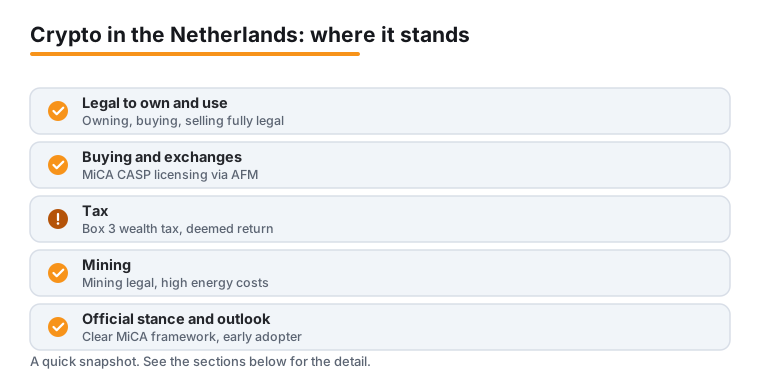
Yes. Owning, buying, selling, holding and transferring Bitcoin and other crypto-assets is legal in the Netherlands. There is no prohibition on individuals using cryptocurrency, and Dutch residents can hold crypto in self-custody wallets or with licensed providers without special permission.
What Bitcoin is not is legal tender. The euro is the official currency, and no merchant is obliged to accept crypto as payment, though some choose to do so voluntarily. For most legal and tax purposes, crypto-assets are treated as a form of property or asset rather than as money.
While ownership is unrestricted, the provision of crypto services to the public is regulated. Businesses that exchange, custody or otherwise deal in crypto-assets for customers must be authorised. This is where MiCA, the AFM and DNB come in, and it is the main way the law touches ordinary users, by shaping which platforms and services they can lawfully use.
Who regulates crypto in the Netherlands?
The Netherlands uses a "Twin Peaks" model of financial supervision, and that structure carries over to crypto. Two authorities share the work:
- The Dutch Authority for the Financial Markets (AFM): the competent authority for licensing crypto-asset service providers (CASPs) under MiCA and for conduct supervision, focused on investor protection, transparency, disclosure and market integrity. The AFM maintains the official public register of authorised crypto firms.
- De Nederlandsche Bank (DNB): the central bank, responsible for prudential and integrity supervision. DNB is closely involved in supervising issuers of stablecoins (e-money tokens and asset-referenced tokens) and in financial-soundness and anti-money-laundering integrity matters.
- The Dutch Tax Administration (Belastingdienst): administers the taxation of crypto for individuals and businesses.
You can confirm whether a provider is authorised by checking the AFM's official crypto register: AFM crypto-asset service providers register. DNB explains its MiCA role on its own site: De Nederlandsche Bank, MiCAR.
Crypto regulations & laws in Netherlands
The Dutch crypto framework now sits primarily on the EU's Markets in Crypto-Assets Regulation (MiCA), which is directly applicable across all member states. MiCA creates a single rulebook covering the issuance of crypto-assets and the licensing and conduct of crypto-asset service providers (CASPs) such as exchanges, brokers, custodians and trading platforms. The MiCA rules for stablecoins (asset-referenced tokens and e-money tokens) applied from 30 June 2024, and the rules for CASPs applied from 30 December 2024.
The Netherlands moved early. It designated the AFM as the competent authority for CASP licensing and conduct supervision, and was among the first EU countries to issue MiCA CASP licences. On the first day of MiCA CASP enforcement the AFM granted the EU's earliest CASP authorisations, to firms including MoonPay, BitStaete, ZBD and Hidden Road, and established Dutch platforms such as Bitvavo, Finst, Coinmerce and Bitonic have since been licensed. DNB retains a supervisory role on prudential and integrity matters and is involved in overseeing issuers of e-money tokens and asset-referenced tokens (stablecoins).
Key elements of the regime include:
- CASP licensing: Exchanges, brokers, custodians and trading platforms need an AFM (or another EU regulator's) authorisation to serve Dutch customers. A licence granted in one EU country can be passported across the bloc.
- Stablecoins: E-money tokens and asset-referenced tokens face stricter rules on reserves, disclosure and approval, with DNB involved in their supervision.
- Anti-money-laundering (AML): Providers must apply customer due diligence (KYC), monitor transactions, and comply with EU AML rules, including the "travel rule" requiring identifying information to accompany crypto transfers.
- Disclosure and market integrity: Public token offerings generally require a published white paper, alongside conduct, governance and anti-market-abuse standards.
An earlier Dutch system required virtual-asset service providers to register with DNB under anti-money-laundering law. That regime has been superseded by MiCA: the Netherlands set a relatively short national transitional period that ended on 30 June 2025, after which a full MiCA CASP licence is required to operate. The transitional details are now settled. Dutch grandfathering ended on 30 June 2025, and the EU-wide backstop under MiCA Article 143(3) ran only until 1 July 2026, so no provider anywhere in the EEA can still rely on a legacy national registration. Only the list of authorised firms still changes, so check the AFM's official public register to confirm a provider's current status.
Licensing & registration of crypto exchanges
Under MiCA, exchanges, brokers, custodians and trading platforms that serve Dutch customers must hold a CASP licence from the AFM or from another EU regulator (a licence is passportable across the EU). The old DNB anti-money-laundering registration for virtual-asset service providers no longer suffices; following the end of the Dutch transitional period on 30 June 2025, a full MiCA CASP authorisation is required.
What licensing involves in practice:
- Authorisation classes and capital: MiCA sets minimum own-funds requirements that scale with the services offered, broadly from around 50,000 euros for advisory and order-related services, 125,000 euros for exchange and order-execution services, and 150,000 euros for custody and trading-platform operators.
- Fit-and-proper and governance: firms must demonstrate suitable management, sound governance, risk controls, custody safeguards for client assets, and AML systems.
- Conduct and disclosure: licensed providers must meet transparency, complaint-handling and market-integrity obligations.
- Process: obtaining a licence is a substantial undertaking, typically taking many months from application to approval.
For users, the key takeaway is simpler: before depositing funds, confirm the provider appears in the AFM crypto register as authorised or notified, and check exactly which services it is permitted to offer.
Crypto & Bitcoin tax in Netherlands
How crypto is taxed in the Netherlands depends mainly on whether you are a private holder or are trading or mining as a business. The Dutch Tax Administration (Belastingdienst) publishes official guidance, and the broad principles below are general; rates, thresholds and rules change every year, so confirm current figures with the Belastingdienst or a tax adviser. See also our overview of how crypto is taxed.
- Private investors (Box 3): For most individuals, crypto-assets count as taxable wealth and fall under Box 3 (income from savings and investments). The Dutch system has not traditionally taxed the gain on each trade. Instead it looks at the total value of your assets, including crypto valued in euros on a reference date, above a tax-free allowance, and applies tax on a deemed (assumed) return rather than your actual profit. For 2026, crypto sits in the investments-and-other-assets category with a deemed return of 6 percent, the Box 3 tax rate is 36 percent, and the per-person tax-free allowance for 2026 is 59,357 euros (118,714 euros for fiscal partners, with figures set annually). The Belastingdienst has published the rest of the 2026 set: deemed returns of 1.28 percent on bank deposits and 2.70 percent on debts, alongside the 6.00 percent that applies to crypto. Only the 6.00 percent investment figure is final. The bank-deposit and debt percentages are provisional and are set definitively in early 2027.
- Actual-return option: Following 2024 Dutch Supreme Court rulings, taxpayers can ask to be taxed on their actual return where it is lower than the deemed return. This is now a named statute: the Wet tegenbewijsregeling box 3 (Stb. 2025, 195 and 196) entered into force on 19 July 2025 and reaches back to 1 January 2017. It works on your total Box 3 assets combined, not on crypto in isolation, so a loss on crypto is netted against gains on savings and other investments. For 2024 and earlier you file the separate Opgaaf werkelijk rendement (OWR) form; from tax year 2025 you enter the actual return in the regular income tax return, where the figures are not pre-filled.
- Reform in progress: The Netherlands is moving away from the deemed-return system toward taxing actual returns. On 12 February 2026 the House of Representatives passed the Actual Return in Box 3 Act (Wet werkelijk rendement box 3), which would tax the actual return on assets, including the annual change in value of crypto, at 36 percent, with a planned start of 1 January 2028. For most assets, including crypto, this uses a capital-growth basis that taxes yearly value changes whether or not you have sold; the Senate has not voted. After its plenary debate on 30 June 2026 the Eerste Kamer postponed the vote on the bill itself until it has dealt with a novelle, an amending bill the cabinet said it would send, and on 7 July 2026 it rejected a motion by Senator Schalk (SGP) stating there was no objection to the proposal being withdrawn. State Secretary Eerenberg told the Senate he had no firm timeline for the novelle, so the bill is alive but parked and 1 January 2028 is a target rather than a settled date.
- Business or professional activity: If your activity amounts to a business or employment-style income, for example professional trading or mining as an enterprise, it may instead be taxed as profit or income (Box 1) at progressive rates.
- VAT: In line with EU case law, exchanging traditional currency for Bitcoin is generally exempt from VAT.
Whatever your situation, keep detailed records of dates, amounts, euro values and counterparties, and file through the Belastingdienst's online portal within the annual window. The official starting point is the Belastingdienst's crypto guidance: Belastingdienst, declaring and paying tax on crypto.
AML & KYC rules in Netherlands
Anti-money-laundering (AML) and know-your-customer (KYC) obligations are central to how crypto is regulated in the Netherlands. Licensed crypto-asset service providers must verify customer identity, monitor transactions, screen against sanctions lists and report suspicious activity, in line with EU AML rules and MiCA.
- Identity verification: Before you can trade, withdraw or in many cases deposit, a licensed provider will require KYC documents such as a passport or ID and proof of address.
- Transaction monitoring: Providers monitor activity for signs of money laundering or fraud and may request the source of funds for larger transactions.
- The travel rule: The EU's transfer-of-funds rules require that identifying information about the sender and recipient accompany crypto transfers between providers above set thresholds.
- Integrity supervision: DNB has historically played a key role in integrity and AML supervision of the sector.
For ordinary users this mainly means that anonymity is limited on regulated platforms: expect to verify your identity and to have larger or unusual transactions scrutinised. Self-custody of your own assets remains permitted, but converting to or from euros through a licensed provider brings these checks into play.
Buying & using crypto in practice in Netherlands
Dutch residents have a wide choice of ways to buy crypto. The Netherlands is home to one of Europe's largest exchanges, Bitvavo, and many other domestic and EU-based platforms and apps serve the market, typically under a MiCA CASP licence held with the AFM or another EU regulator. Major international exchanges also operate locally on the same basis.
Practical points to expect when using a licensed provider:
- Identity verification (KYC): You must verify your identity before trading or withdrawing, in line with AML rules.
- Funding: SEPA bank transfers, iDEAL (the popular Dutch online-payment method), cards and other euro methods are common.
- Provider authorisation: Prefer MiCA-licensed providers, and cross-check a firm's status in the AFM's official register before depositing funds.
- Fees and spreads: Compare trading fees, deposit and withdrawal costs, and spreads, which vary widely between platforms.
- Spending crypto: Some Dutch merchants and payment services accept crypto, but acceptance is voluntary and far from universal, since crypto is not legal tender.
A typical buying path is: choose a MiCA-licensed provider and check it in the AFM register; open and verify an account; fund it with euros via iDEAL or SEPA; place an order after comparing fees; decide whether to leave assets with the provider or withdraw to your own wallet (a hardware wallet for larger amounts) and protect your recovery phrase offline; and keep records for your annual tax filing. Peer-to-peer trading is also possible, but using a regulated, MiCA-licensed provider generally offers the strongest consumer protections.
Bitcoin ATMs in Netherlands
The Netherlands has only a small network of Bitcoin ATMs, concentrated in cities such as Amsterdam, and the count has fluctuated, partly because operating a machine that exchanges euros for crypto is now a regulated activity.
Under MiCA, a Bitcoin ATM operator that exchanges fiat currency for crypto-assets is providing a crypto-asset service and so generally needs an AFM CASP licence, on top of AML obligations such as identity checks. These requirements raised the compliance bar and have kept the number of machines low compared with some other countries.
If you do use an ATM, expect identity verification for all but the smallest amounts, and note that fees and spreads tend to be considerably higher than online exchanges. Counts and locations change frequently, so use a current ATM-locator service to find active machines and confirm the operator is properly authorised.
Bitcoin mining in Netherlands
Bitcoin mining is legal in the Netherlands. There is no specific ban on running mining hardware, but miners operate within the country's general legal, tax, energy and environmental frameworks, and several factors make large-scale proof-of-work mining challenging.
The biggest constraint is energy. Dutch electricity prices are relatively high by global standards, and the country has faced significant grid-congestion problems that make it difficult and costly to secure large new power connections. Energy use and sustainability are politically sensitive, and proof-of-work mining's electricity demand has drawn criticism. Together these make the Netherlands a comparatively expensive place to mine at scale, though miners that tap surplus or renewable power can cut both costs and carbon footprint.
On tax, mining rewards are generally taxable: hobby-scale mining still requires you to track the euro value of rewards, while mining run as a business is likely taxed as business income and may bring registration, VAT and environmental-compliance obligations. Anyone mining at scale should take professional advice.
Recent developments & outlook for 2026
The headline change for 2026 is greater transparency. The Netherlands, like other EU states, is implementing EU-wide crypto tax reporting under the DAC8 directive, which is aligned with the OECD's Crypto-Asset Reporting Framework (CARF). The Dutch implementing act was adopted by the House of Representatives on 27 January 2026 and took effect on 10 April 2026, applying retroactively from 1 January 2026. The reporting obligations apply to crypto-asset service providers for transactions from 1 January 2026, with the first reports due to the tax authority by 31 January 2027 and then exchanged automatically between countries. The rules carry substantial penalties for non-compliance, up to about 1.1 million euros where a provider acts with intent or gross negligence. In practice, crypto activity is becoming far more visible to the Belastingdienst, so accurate personal record-keeping matters more than ever.
Alongside this, MiCA continues to mature: providers have completed the move to full CASP authorisation under AFM supervision after the Dutch transitional period ended on 30 June 2025, and the post-transition regime is now in force. Domestically, the long-running reform of the Box 3 wealth tax took a concrete step when the House of Representatives passed the Actual Return in Box 3 Act on 12 February 2026; the Senate then paused it. On 30 June 2026 the Eerste Kamer postponed its vote until a cabinet novelle is before it, and on 7 July 2026 it rejected a motion saying there was no objection to withdrawing the bill. As passed by the House, it would tax actual returns at 36 percent from 1 January 2028, with crypto on a capital-growth basis, so yearly value changes would be taxed whether or not you sold. The cabinet has described the coming novelle as moving towards taxing gains when they are realised instead, so that basis may not be the one that finally arrives.
Because specific thresholds, deadlines and authorised-provider lists evolve, treat the descriptions here as general orientation and verify current details with the official sources before acting.
Consumer risks & protection in Netherlands
Even with one of Europe's earlier MiCA regimes, crypto remains a high-risk asset class and the protections differ sharply from those for bank deposits. Key points for Dutch consumers:
- No deposit guarantee: Crypto holdings are not covered by the deposit-guarantee scheme that protects bank balances. If a platform fails or your keys are lost, you can lose everything.
- Market volatility: Prices can swing dramatically, and you can lose a large part or all of your capital.
- Platform and counterparty risk: Even licensed providers can fail, be hacked, or suffer outages. MiCA improves custody and conduct standards but does not eliminate this risk.
- Scams and fraud: Fake exchanges, phishing, romance and investment scams, and impersonation of regulated firms are common. The AFM publishes warnings and supervises conduct.
- Stablecoin risk: A stablecoin can lose its peg or its issuer can fail, despite the reserve rules under MiCA.
Protect yourself by using only providers you have confirmed in the AFM register, enabling strong security (two-factor authentication, hardware wallets for larger holdings), keeping recovery phrases offline and private, being sceptical of guaranteed-return or "get rich quick" promises, and only investing money you can afford to lose. None of this is financial advice; consider speaking to a licensed Dutch financial adviser.
Official sources & how to verify
Crypto rules and tax figures change often, so always confirm the current position with primary, official sources rather than relying on summaries. The most important official starting points for the Netherlands are:
- Authorisation of a provider: the AFM's public register, AFM crypto-asset service providers register. Check that any platform you use is listed and see which services it may offer.
- Stablecoin and prudential rules: the central bank's MiCA page, De Nederlandsche Bank, MiCAR.
- Tax: the Dutch Tax Administration's crypto guidance, Belastingdienst, declaring and paying tax on crypto.
For the EU framework itself, the MiCA regulation and the DAC8 directive are published by the European Union institutions. When in doubt, contact the AFM, DNB or the Belastingdienst directly, or consult a qualified Dutch lawyer or tax adviser. This page is general information as of 2026 and is not legal, tax or financial advice; verify your situation with the named official regulators before acting. See also our crypto regulation explainer.
What changed since 30 June 2026
This page was last fact-checked on 30 June 2026. Two things have moved since. Neither changes the headline answer: owning, buying, selling and holding crypto remains legal in the Netherlands.
- On 1 July 2026 the EU-wide MiCA transitional period under Article 143(3) ran out. The Netherlands had already ended its own national grandfathering a year earlier, on 30 June 2025, so nothing changed for Dutch-licensed platforms. What changed is that the last national transitional regimes elsewhere in the EEA have now expired. ESMA describes the clause as allowing firms registered under national law before 30 December 2024 to continue only until 1 July 2026, or until an authorisation was granted or refused. Any platform serving Dutch customers, wherever in the EEA it is based, must now hold a crypto-asset service provider authorisation, or a notification if it is a bank or another already regulated firm. See ESMA, Markets in Crypto-Assets Regulation, whose register of authorised firms is republished weekly.
- The Box 3 reform bill stalled in the Senate. After its plenary debate on 30 June 2026, the Eerste Kamer postponed the vote on the Wet werkelijk rendement box 3 until it has dealt with a novelle, an amending bill the cabinet said it would send. On 7 July 2026 the Senate rejected a motion by Senator Schalk (SGP) stating that it had no objection to the bill being withdrawn. See Eerste Kamer, Senaat houdt stemming box 3-wet aan.
No other change to Dutch crypto law surfaced between 30 June and 3 August 2026. No new Dutch crypto statute was published in the Staatsblad, and the 2026 Box 3 rate and allowance are unchanged.
The Dutch laws behind the crypto rules
MiCA and DAC8 are EU instruments, but they only bite in the Netherlands through named Dutch statutes that assign supervisory powers, tax duties and penalties. These are the ones that matter, with their Staatsblad references:
| Law | Reference | In force | What it does |
|---|---|---|---|
| Uitvoeringswet verordening cryptoactiva (bill 36527) | Stb. 2024, 415 | 4 February 2025 | Implements MiCA, Regulation (EU) 2023/1114. Amends the Wet op het financieel toezicht (Wft) and the Wet op de economische delicten so the AFM and DNB have supervisory and enforcement powers over crypto. The AFM leads on conduct and licensing, DNB on prudential supervision and stablecoins. |
| Uitvoeringswet verordening bij geldovermakingen en overdrachten van cryptoactiva te voegen informatie (bill 36526) | Stb. 2024, 414 | 4 February 2025 | Implements the Transfer of Funds Regulation, Regulation (EU) 2023/1113, the travel rule. Expands the Wwft from two to nine categories of crypto provider, so nearly all MiCA-regulated firms must run customer due diligence and report suspicious transactions to the FIU. |
| Wet tegenbewijsregeling box 3 (bill 36706) | Stb. 2025, 195 and 196 | 19 July 2025 | Lets you be taxed on your actual Box 3 return where it is lower than the deemed return, reaching back to 1 January 2017. |
| Wet implementatie EU-richtlijn gegevensuitwisseling cryptoactiva (bill 36782) | Stb. 2026, 79 | Published 10 April 2026, applies from 1 January 2026 | Transposes DAC8, Directive (EU) 2023/2226, plus the OECD Crypto-Asset Reporting Framework for non-EU residents. Providers report customer and transaction data to the Belastingdienst. |
| Uitvoeringsbesluit verzamel- en verificatievereisten voor rapporterende aanbieders van cryptoactivadiensten | Stb. 2026, 93 | Decree of 20 April 2026, published 23 April 2026 | Sets the detailed collection and verification requirements providers must apply to customer data before it is exchanged. |
Sources: NJB, Uitvoeringswet verordening cryptoactiva, NJB, Aanscherping Wwft voor cryptoactivadiensten, Eerste Kamer, bill 36706, Eerste Kamer, bill 36782 and Staatsblad 2026, 93.
What is coming next, and when
Three things are in the pipeline. Only one of them is Dutch.
- Wet werkelijk rendement box 3, bill 36748, targeted at 1 January 2028 on a date to be set by royal decree. It would replace the deemed return with tax on your actual return at 36 percent. As passed by the House the main rule is a capital-growth basis, which covers crypto alongside securities and bank balances, so the yearly change in value would be taxed whether or not you sold. Status as of August 2026: adopted by the Tweede Kamer on 12 February 2026; debated in the Eerste Kamer on 30 June 2026, where the vote was postponed until a cabinet novelle arrives; a motion saying there was no objection to withdrawing the bill was rejected on 7 July 2026. State Secretary Eerenberg told the Senate he had no firm timeline for the novelle, so 1 January 2028 is a target and not a certainty. Note also that the novelle is expected to change the basis itself: the cabinet has described it as moving from taxing unrealised growth towards taxing gains when they are realised, so the capital-growth treatment of crypto may not be what finally arrives. See Eerste Kamer, bill 36748, the Senate's account of the 30 June debate and the government's timeline for the reform.
- Prinsjesdag, Tuesday 15 September 2026, when the cabinet presents the Belastingplan 2027 package. That package is the normal vehicle for fixing the following year's Box 3 percentages and tax-free allowance, so it is the date to watch for the 2027 crypto figures. See Forvis Mazars on the Belastingplan 2027.
- The EU Anti-Money Laundering Regulation, Regulation (EU) 2024/1624, published in the Official Journal on 19 June 2024, applies directly in the Netherlands with no national implementing act needed. It brings crypto-asset service providers fully into scope as obliged entities, with risk-based customer due diligence, suspicious transaction reporting, retention of records for at least five years and travel-rule compliance. It is reported to apply from 10 July 2027, with the EU Anti-Money Laundering Authority beginning direct supervision of up to 40 selected high-risk institutions from 1 January 2028. See Deloitte Legal on the EU AML package for the dates and Jones Day on CASPs under MiCA and AMLR for the obligations.
Beyond these, no crypto-specific bill is before the Dutch parliament. The Dutch pipeline is almost entirely EU-driven, and the domestic debate is about wealth taxation rather than crypto as such.
When crypto stops being a Box 3 asset
Crypto only leaves Box 3 when you do more than hold it, and the Belastingdienst applies a different test depending on what you are doing.
- Mining. The tax authority's test is whether your proceeds exceed your costs. If they do, there can be inkomsten uit overig werk (income from other work) or winst uit onderneming (business profit), taxed in Box 1 at progressive rates.
- Trading. Buying and selling on your own account is treated much like currency speculation and stays in Box 3. It moves to Box 1 where you put in extra arbeid, additional labour, that produces a systematic return beyond what ordinary asset management would give.
- Being paid in crypto. Crypto received from an employer is loon in natura, wage in kind, and the employer converts it to euros at the moment you receive it.
Crypto that stays in Box 3 is declared at its value in economic terms on 1 January, the peildatum. Source: Belastingdienst, Cryptovaluta.
Frequently asked questions
Is Bitcoin legal in the Netherlands?
Yes. Buying, holding, selling and transferring Bitcoin and other crypto-assets is legal in the Netherlands. However, crypto is not legal tender (the euro is), so no business is obliged to accept it as payment, and companies that provide crypto services to the public must be licensed under EU MiCA rules.
Who regulates crypto in the Netherlands?
The Dutch Authority for the Financial Markets (AFM) is the competent authority for licensing and supervising crypto-asset service providers under the EU's MiCA regulation, and it maintains the official register of authorised firms. De Nederlandsche Bank (DNB) handles prudential and integrity supervision, including for stablecoin issuers. Tax is administered by the Dutch Tax Administration (Belastingdienst). Always check a provider's current authorisation in the AFM's official register before depositing funds.
How is crypto taxed in the Netherlands?
For most private individuals, crypto is treated as wealth under Box 3 (income from savings and investments) and taxed on the value of your assets above a tax-free allowance, traditionally using a deemed return (around 6 percent for the 2026 investments category) taxed at 36 percent, rather than your actual trading profit. Following 2024 court rulings, taxpayers can opt to be taxed on their actual return where it is lower, and the system is being reformed toward actual-return taxation: the House of Representatives passed the Actual Return in Box 3 Act on 12 February 2026, which, if approved by the Senate, would tax actual returns (including yearly changes in the value of crypto) at 36 percent from 2028. Crypto activity run as a business may instead be taxed as income. Rules and figures change every year, so confirm the current treatment with the Belastingdienst or a tax adviser.
Do crypto exchanges need a licence in the Netherlands?
Yes. Under MiCA, exchanges, brokers, custodians and trading platforms serving Dutch customers need a CASP licence from the AFM or another EU regulator (passportable across the EU). An earlier DNB anti-money-laundering registration regime applied until the national transitional period ended on 30 June 2025, after which a full MiCA licence is required. Check the AFM register before using any platform.
What changes for crypto users in the Netherlands in 2026?
Two things stand out. First, EU-wide crypto tax reporting under the DAC8 directive (aligned with the OECD's Crypto-Asset Reporting Framework) is now in force: the Dutch implementing act took effect on 10 April 2026, retroactive to 1 January 2026, so providers collect and report user transaction data for 2026 to the tax authority, with first reports due by 31 January 2027 and then exchanged between countries, making activity far more transparent. Second, the post-MiCA regime is now fully in force after the Dutch transition ended on 30 June 2025, and the domestic Box 3 wealth-tax reform (a proposed move to actual-return taxation around 2028) could change how crypto is taxed. Keep accurate records and verify current rules with official sources.
Is crypto held on a Dutch platform protected if the platform fails?
No. Crypto holdings are not covered by the deposit-guarantee scheme that protects bank balances in the Netherlands. MiCA improves custody, governance and conduct standards for licensed providers, but it does not guarantee your funds against platform failure, hacking, fraud or loss of access. Use only providers you have confirmed in the AFM register, secure your own keys, and only invest money you can afford to lose. This is general information, not financial advice.
Which crypto exchanges are licensed in the Netherlands?
Several platforms hold an AFM MiCA CASP licence, including established Dutch names such as Bitvavo, Finst, Coinmerce and Bitonic, alongside firms like MoonPay that were among the EU's first to be authorised on the opening day of MiCA enforcement. A provider licensed in another EU country can also serve Dutch customers by passporting its licence. Because the authorised list changes over time, always confirm a platform's current status in the AFM's official crypto register before depositing funds. This is general information, not financial advice.
When does the Netherlands start taxing actual crypto returns?
Not yet. For now, most private holders are taxed under Box 3 on a deemed return rather than their real gains. On 12 February 2026 the House of Representatives passed the Actual Return in Box 3 Act, which would tax the actual return on assets, including the yearly change in value of crypto whether or not you have sold, at 36 percent from 1 January 2028. As of 3 August 2026 the Senate has still not voted. It postponed the vote on 30 June 2026 until the cabinet sends an amending bill (a novelle), and on 7 July 2026 it rejected a motion saying there was no objection to withdrawing the proposal. The state secretary gave the Senate no firm timeline for the novelle, so 1 January 2028 is a target rather than a certainty. Confirm the current position with the Belastingdienst or a tax adviser.
Which Dutch law actually regulates crypto?
There is no single Dutch crypto act. The substantive rules come from the EU and are switched on in the Netherlands by named implementing statutes. The Uitvoeringswet verordening cryptoactiva (Stb. 2024, 415), in force since 4 February 2025, implements MiCA and amends the Wet op het financieel toezicht so the AFM and DNB have their supervisory powers. The Uitvoeringswet verordening bij geldovermakingen en overdrachten van cryptoactiva te voegen informatie (Stb. 2024, 414), also in force since 4 February 2025, implements the EU travel rule and expands the Wwft anti-money-laundering act from two to nine categories of crypto provider. Tax reporting comes from a third act, the Wet implementatie EU-richtlijn gegevensuitwisseling cryptoactiva (Stb. 2026, 79), published on 10 April 2026 and applying retroactively from 1 January 2026.
Did anything change for Dutch crypto users on 1 July 2026?
Not in the Netherlands specifically, because Dutch grandfathering had already ended a year earlier on 30 June 2025. What ran out on 1 July 2026 was the EU-wide MiCA transitional period under Article 143(3), the last date on which any EEA platform could still operate on an old national registration. In practice that means a platform can no longer tell you it is transitioning. If it serves customers in the Netherlands it needs a crypto-asset service provider authorisation, or a notification if it is a bank or another already regulated firm, and you can check that in the AFM register, which lists firms authorised or notified by the AFM or by the supervisor of another EU member state. The AFM can take enforcement measures against parties without a licence or notification.
Can I be taxed on what my crypto actually did instead of a deemed 6 percent?
Yes, but only if your total Box 3 assets performed worse than the deemed return, not your crypto alone. The Wet tegenbewijsregeling box 3 came into force on 19 July 2025 and reaches back to 1 January 2017. The actual return is calculated across all your Box 3 assets combined, so a crypto loss is netted against gains on savings and other investments before you can benefit. For 2024 and earlier you use the separate Opgaaf werkelijk rendement (OWR) form; from tax year 2025 you enter it directly in the regular income tax return, and the figures are not pre-filled, so you need your own records.
Will the Dutch tax authority find out about my crypto?
Increasingly, yes, and automatically. Under the Wet implementatie EU-richtlijn gegevensuitwisseling cryptoactiva, published on 10 April 2026 and applying retroactively from 1 January 2026, reporting crypto-asset service providers must collect, verify and report customer identity and transaction data to the Belastingdienst, which then exchanges it with other EU member states and eligible third countries. Providers started keeping records of their customers on 1 January 2026 and must file with the Belastingdienst annually by 31 January, so the first reports, covering calendar year 2026, are due by 31 January 2027. An implementing decree, Staatsblad 2026, 93, sets the verification requirements providers must apply, which is why platforms have been re-requesting tax residency details from existing customers.
Facts reviewed: 5 August 2026. Page updated: 5 August 2026.