Home › Crypto Regulation › Bermuda
Bitcoin and Cryptocurrency Regulation in Bermuda
Quick answer — Bermuda, 2026
- Legal: Legal to own and use, not legal tender; businesses licensed under DABA 2018
- Tax: No personal income or capital gains tax on crypto
- Buying: Via international or BMA-licensed exchanges, with standard KYC
Bermuda is one of the world's most established jurisdictions for regulated crypto and blockchain business. The island built a dedicated legal framework early, anchored by the Digital Asset Business Act 2018 (DABA), and its financial regulator, the Bermuda Monetary Authority (BMA), licenses and supervises companies that issue, exchange, custody, or otherwise deal in digital assets in or from within Bermuda. Holding, buying, and using cryptocurrency is legal for individuals, and Bermuda levies no income tax or capital gains tax. This guide explains the regulator, the key laws, licensing for crypto businesses, taxation, anti-money laundering rules, and how to verify everything against official sources. It is general information for 2026 and is not legal advice.
On this page: Legal status · Who regulates it · Taxes · How to buy · Mining
Is cryptocurrency legal in Bermuda?
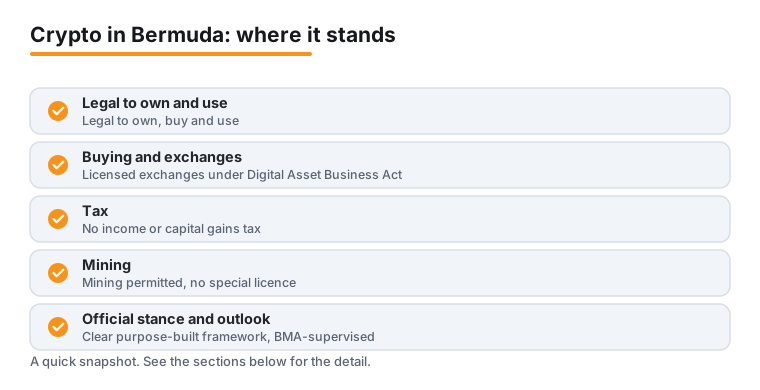
Yes. Owning, buying, selling, and using cryptocurrency is legal for individuals and businesses in Bermuda. There is no ban on holding bitcoin or other digital assets. What Bermuda regulates is the business of dealing in digital assets: companies that carry on "digital asset business" in or from within Bermuda must be licensed by the Bermuda Monetary Authority under the Digital Asset Business Act 2018.
Cryptocurrency is not legal tender in Bermuda; the Bermudian dollar (pegged to the US dollar) remains the official currency. Bermuda is bringing more of its economy on-chain through USDC stablecoin pilots and has approved, but not yet legislated, the acceptance of digital assets for government fees. As at August 2026 there is no mandate forcing anyone to accept or use crypto, and the planned digital Bermuda dollar is to be privately issued rather than a central bank digital currency. For broader background, see our overview of crypto regulation.
Who regulates crypto in Bermuda? The Bermuda Monetary Authority (BMA)
The Bermuda Monetary Authority (BMA) is the integrated regulator for financial services in Bermuda, including banking, insurance, investment business, and digital asset business. The BMA administers and enforces the Digital Asset Business Act 2018, issues licences, publishes codes of practice and rules, and supervises licensed firms on a prudential and conduct basis.
The BMA maintains an Innovation Hub for testing emerging technology and has run initiatives such as inviting proposals for pilot decentralised finance (DeFi) projects to explore supervisory approaches. You can read directly about the regime on the BMA's Digital Asset Business and Digital Assets Supervision and Regulation pages.
Key laws and frameworks
The core statute is the Digital Asset Business Act 2018 (DABA), which came into force on 10 September 2018 and made Bermuda one of the first jurisdictions to create a purpose-built digital asset business regime. A second statute, the Digital Asset Issuance Act 2020, came into force in May 2020 and requires any undertaking seeking to conduct a digital asset issuance to obtain prior authorisation from the BMA, with an issuance document made available to acquirers. The BMA's framework is built out through subordinate rules and codes, expanded from 2018 to 2026. Notable instruments include:
- Digital Asset Business Act 2018 (the primary law)
- Digital Asset Business Code of Practice (updated February 2024)
- Digital Asset Custody Code of Practice (2024)
- Cyber Risk Rules 2023 and the Operational Cyber Risk Management Code of Practice
- Digital Asset Business (Custody of Client Assets) Rules 2025, in force from February 2025
- Single Currency Pegged Stablecoin (SCPS) Guidance, issued November 2024
The official text of the Act is published by the Government of Bermuda and the BMA. Always confirm the current consolidated version, because rules and codes are updated regularly.
Licensing and registration of crypto businesses (VASPs and exchanges)
Under DABA, a company that conducts digital asset business in or from within Bermuda must hold a licence from the BMA. "Digital asset business" covers a broad set of activities, including issuing, selling or redeeming digital assets; operating a digital asset exchange; operating as a payment service provider using digital assets; providing custodial wallet services; operating a digital asset derivative exchange; digital asset benchmark administration; and digital asset lending or related services.
The BMA offers three licence classes:
- Class T (Test) licence for early-stage firms testing a proof of concept in a controlled, sandbox-style environment.
- Class M (Modified) licence for firms operating with conditions for a limited period, often as a step toward a full licence.
- Class F (Full) licence for established firms providing the full range of digital asset business activities.
Applicants must meet requirements on fit-and-proper persons, governance, capital and prudential standards, cyber risk, client-asset safeguarding, and anti-money laundering. The exact obligations depend on the activity and licence class. Firms outside Bermuda that target Bermuda from abroad can still fall within scope, so legal advice on the perimeter is essential.
Taxation of crypto in Bermuda
Bermuda is a no-direct-tax jurisdiction. It imposes no personal income tax, no capital gains tax, no withholding tax, and no tax on dividends or interest. As a general matter there are no income, capital gains, or withholding taxes imposed in Bermuda on digital assets or on transactions involving them, which is a major reason crypto investors and businesses are drawn to the island.
Two points to keep in mind. First, Bermuda still applies payroll tax and social-insurance contributions in respect of employees, plus customs duties and other levies. For 1 April 2026 to 31 March 2027 employer payroll tax runs from 0.5 per cent on annual payroll under 200,000 up to 9.5 per cent above 1 million, with all exempt undertakings at 9.75 per cent, and the employee portion is banded from 0.25 per cent to 12.5 per cent with the tax cap remaining at 1 million per person. The most common rate of customs import duties is 25 per cent, and foreign currency purchased by a resident from a local bank carries a 1.25 per cent foreign currency purchase tax. Second, Bermuda introduced a 15% corporate income tax that took effect from 1 January 2025, but it applies only to large multinational enterprise groups with annual revenue above 750 million euros, in line with the OECD global minimum tax. Most individuals and smaller businesses are outside its scope. Your home country may still tax your crypto regardless of Bermuda's rules; see our guide to crypto taxes and consult a tax adviser.
AML and KYC requirements
Licensed digital asset businesses are treated as regulated financial institutions for anti-money laundering and anti-terrorist-financing (AML/ATF) purposes. The Digital Asset Business Act amended Bermuda's AML laws to bring DABA licensees within the scope of the Proceeds of Crime Act 1997, the Anti-Terrorism (Financial and Other Measures) Act 2004, and the related Proceeds of Crime (Anti-Money Laundering and Anti-Terrorist Financing) Regulations.
In practice this means licensed firms must perform customer due diligence (identity verification, or KYC), conduct ongoing monitoring, keep records, file suspicious activity reports, appoint compliance officers, and maintain internal controls and risk assessments. These obligations sit alongside Bermuda's commitments as a member of the international AML framework and are supervised by the BMA. Individuals using a licensed exchange should expect standard identity checks.
Buying and using crypto in practice
For an ordinary user in Bermuda, there is no legal barrier to buying, holding, or spending cryptocurrency. Most residents access crypto through international exchanges, and a growing number of local merchants have accepted digital payments, particularly the USDC stablecoin, during government and industry pilots that in 2026 included resident airdrops and pop-up marketplaces. Bermuda hosted 49 licensed digital asset businesses at the end of 2025, up from 36 a year earlier, according to the BMA annual report tabled on 26 June 2026. You can check any firm's licence type and allowed business activities on the BMA register of regulated entities using the Digital Assets Business filter.
When choosing a platform, prefer providers that are regulated (in Bermuda under DABA, or in another reputable jurisdiction), apply standard KYC, and publish clear terms on custody and withdrawals. Self-custody of your private keys remains legal and is often the safest option for long-term holdings. For a primer on the rules landscape generally, see our regulation hub.
Bitcoin ATMs
There is no specific statute in Bermuda that singles out crypto or bitcoin ATMs by name. Instead, an operator that runs an ATM as part of a business of exchanging digital assets for fiat (or vice versa), or providing related payment or custodial services, would generally be carrying on "digital asset business" and could require a BMA licence under DABA, along with AML/KYC compliance.
Bermuda is a small market, so the availability of physical crypto ATMs is limited and can change. If you plan to operate one, treat it as a regulated activity and confirm the licensing position with the BMA before launching. If you are simply a user, be aware that crypto ATM transactions tend to carry high fees and are a common vector for scams.
Crypto mining
Bermuda does not have a dedicated cryptocurrency mining law, and mining as a personal or business activity is not prohibited. There is no special licence required merely to mine. However, mining at any meaningful scale faces practical constraints on the island: electricity is relatively expensive and largely imported, land and cooling are limited, and importing mining hardware is subject to customs duties.
Where mining is combined with other regulated activity (for example, operating a pool that also exchanges or custodies assets for clients), that surrounding activity could bring a business within DABA's perimeter. Because Bermuda has not published mining-specific guidance, anyone planning a commercial operation should seek local legal and tax advice and confirm energy and import costs.
Recent developments (2024 to 2026)
Bermuda has continued to iterate on its framework rather than overhaul it:
- Stablecoin guidance (November 2024): the BMA issued Single Currency Pegged Stablecoin (SCPS) Guidance setting expectations on full reserve backing in high-quality liquid assets, independent monthly attestations, redemption rights, governance, and operational resilience.
- Custody of Client Assets Rules 2025 (in force February 2025): mandatory segregation of client assets, limits on pooling without client consent, and stricter due diligence on third-party custodians and intermediaries.
- On-chain economy ambitions (January 2026): on 19 January 2026, at the World Economic Forum annual meeting in Davos, the Government of Bermuda announced plans, with support from Circle and Coinbase, to become the world's first fully on-chain national economy using the USDC stablecoin, through government and institutional pilots rather than any mandate or forced adoption. See the official announcement.
- On-chain economy, next phase (first half of 2026): the initiative moved from concept to real-world tests. The BMA ran an educational event that airdropped 100 USDC to residents so they could spend it with onboarded local merchants at a pop-up marketplace and, if they chose, convert it back to cash. Cabinet then approved policy proposals, announced on 8 May 2026, to amend the Public Treasury Administration and Payments Act and the Public Funds Act so that government fees can be paid in digital assets, starting with the Department of Motor Vehicles as a high-volume area. As at 3 August 2026 no Bill of that description appears on the House of Assembly bill lists for 2025 or 2026, and the 2026 list ends with bills passed on 22 July 2026, so this remains at proposal stage. The Government also announced work with Stellar on a sovereign Bermuda digital dollar and updated property, contract, and securities law to recognise smart-contract transfers and digital share registers.
- Payments reform: after a consultation paper on 13 October 2025 and a stakeholder letter on 19 November 2025, the BMA is working toward a Payment Services Act to replace the Money Service Business Act 2016. It would license digital facility providers, payment handling providers and payment technology providers across five licence classes. Existing money service businesses would get a one-year transition and newly in-scope firms six months to apply. Stablecoin issuers could elect Payment Services Act or DABA licensing. No enactment date has been announced.
- Operational resilience: the BMA issued the final Operational Resilience and Outsourcing Code in September 2025, following a consultation paper of 14 January 2025. Digital asset businesses must comply by 31 March 2028. It requires registrants to proactively adopt measures to avoid, minimise, recover from and respond to operational disruptions.
Because the rules move quickly, treat dates and details here as a starting point and verify the latest position with the BMA.
Consumer risks and protections
Bermuda's licensing regime is designed to raise standards for firms operating from the island, including rules on client-asset segregation, cyber risk, and stablecoin reserves. That offers more comfort than dealing with a wholly unregulated provider, but it does not eliminate risk. Crypto prices are volatile, transactions are generally irreversible, and a BMA licence is not a guarantee against losses or business failure.
Practical precautions: confirm whether a provider is actually licensed (do not rely on marketing claims), read the terms on custody and withdrawals, be alert to investment scams and fake platforms, enable strong security on your accounts, and consider self-custody for significant holdings. If something looks like a guaranteed-return scheme, treat it as a likely fraud.
Official sources and how to verify
This guide is a summary. For authoritative, current information always go to the primary sources:
- Bermuda Monetary Authority - Digital Asset Business (the regulator's main DAB page, with codes, rules, and guidance)
- Bermuda Monetary Authority - Digital Assets Supervision and Regulation
- Government of Bermuda - Digital Asset Business Act 2018 (the statute)
This page is general information current as of 2026 and is not legal or tax advice. Rules change and your situation may differ, so verify the current position with the Bermuda Monetary Authority and a qualified Bermuda lawyer or tax adviser before acting.
What changed since 30 June 2026
Bermuda's core crypto law has not changed. The Digital Asset Business Act 2018 and the Digital Asset Issuance Act 2020 remain the two operative statutes, the Bermuda Monetary Authority remains the regulator, and Bermuda still levies no personal income tax, no capital gains tax and no withholding tax. Four things moved in the weeks to 3 August 2026.
- On 20 July 2026 the BMA published a consultation paper on a Guidance Note on the Use of Recognised Stablecoins within Bermuda insurance, insurance-linked securities and investment fund structures. Comments close on 30 September 2026. To qualify, a stablecoin would need to be fully backed one for one by cash or cash-equivalent assets, redeemable at par no later than the close of the next business day under normal and stressed conditions, and subject to at least monthly independent attestation of reserves. Algorithmic, crypto-backed and undercollateralised designs would generally not qualify, and limited purpose insurers would be expected to keep stablecoin exposure within 25 per cent of total statutory capital and surplus. Commercial insurers are excluded from the initial framework.
- On 23 July 2026 Premier and Minister of Finance David Burt confirmed that the planned digital Bermuda dollar will be privately issued and is expressly not a central bank digital currency. No issuer and no launch date have been named.
- The BMA's asset tokenisation consultation closed on 30 June 2026 and the Authority is reviewing responses. No final rules have been published.
- The BMA's 2025 annual report, tabled on 26 June 2026, recorded 49 licensed digital asset businesses at the end of 2025, up from 36 a year earlier.
One correction matters for anyone planning around it. Cabinet approved policy proposals, announced on 8 May 2026, to amend the Public Treasury Administration and Payments Act and the Public Funds Act so that government fees can be paid in digital assets, but no Bill of that description appears on the House of Assembly bill lists for 2025 or 2026, and the 2026 list ends with bills passed on 22 July 2026. Reporting on 15 July 2026 still described the change as proposed legislation. Confirm with the relevant department before assuming any government fee can be paid in crypto today.
Legislation in progress and when it should move
Bermuda is not writing a new crypto statute. It is extending the existing one through subordinate rules, codes and targeted amendments. Here is the pipeline as at 3 August 2026, with what each measure would concretely change.
| Measure | Stage | Timing | What it would mean |
|---|---|---|---|
| Amendments to the Public Treasury Administration and Payments Act and the Public Funds Act | Cabinet approved policy proposals, no Bill tabled | Announced 8 May 2026 and set out in a ministerial statement of 29 May 2026. Not on the 2025 or 2026 House bill lists | Would confirm the Accountant General's role in receiving, managing, reconciling and auditing digital asset payments to Government, and modernise the FinTech Development Fund, with at least 50 per cent of monies disbursed reserved for projects involving majority Bermudian-owned companies |
| Payment Services Act | Consultation complete, drafting | Consultation paper 13 October 2025, BMA stakeholder letter 19 November 2025. No enactment date announced | Would replace the Money Service Business Act 2016 with five licence classes across digital facility providers, payment handling providers and payment technology providers. Existing money service businesses get a one-year transition and newly in-scope firms six months to apply. Stablecoin issuers could elect Payment Services Act or DABA licensing |
| Asset tokenisation framework | Consultation closed, feedback under review | Discussion paper 5 November 2025, stakeholder letter 30 March 2026, consultation paper 9 April 2026, closed 30 June 2026 | Targeted amendments to DABA 2018, the Digital Asset Issuance Act 2020, the Investment Business Act 2003 and the Investment Funds Act 2006. Firms dealing in tokenised investments would elect one licence instead of holding two, fund registers could exist purely on chain, and managers and administrators of tokenised funds would be exempt from DABA licensing |
| Guidance Note on the Use of Recognised Stablecoins | Open consultation | Published 20 July 2026, closes 30 September 2026 | Eligibility criteria, permitted use cases and exposure limits for stablecoin use by limited purpose insurers, insurance-linked securities structures, funds and insurance intermediaries |
| Operational Resilience and Outsourcing Code | Issued, compliance date pending | Final Code issued September 2025 | Digital asset businesses must comply by 31 March 2028. Requires registrants to proactively adopt measures to avoid, minimise, recover from and respond to operational disruptions |
| Digital Bermuda dollar | Announced, framework being drafted | Issuance model confirmed 23 July 2026. No issuer or launch date | A privately issued token, not a central bank digital currency and not legal tender. The Bermudian dollar remains the official currency |
Named instruments in force that the page does not list
Beyond DABA 2018 and the codes already listed, the BMA's digital asset business framework includes these instruments, with the dates shown by the BMA.
- Digital Asset Issuance Act 2020, with the Digital Asset Issuance Rules 2020 last updated 19 January 2024 and a Statement of Principles dated 16 December 2020. Anyone seeking to conduct a digital asset issuance needs prior BMA authorisation.
- Digital Asset Business (Client Disclosure) Rules 2018, updated 27 November 2023.
- Digital Asset Business Prudential Standards Annual Return Rules 2018, updated 27 November 2023.
- Digital Asset Business Accounts Rules 2021, updated 27 November 2023.
- Digital Asset Business Exemption Order 2023, dated 20 November 2023.
- Digital Asset Business Single Currency Pegged Stablecoins Guidance, dated 2 December 2024.
- Digital Asset Business Operational Cyber Risk Management Code of Practice, dated 26 March 2025.
- Guidance Note for prospective applicants for digital asset business licensing, dated 8 September 2025.
- Digital Asset Business Exemption, Modification and Licence Variation Form, dated 16 June 2026.
The taxes that do apply in Bermuda
Bermuda has no personal income tax, no capital gains tax and no withholding tax, so a resident who sells crypto at a profit owes no Bermuda tax on the gain. That is the complete crypto tax answer. The taxes that do exist fall on other things, and these are the current rates. Amounts are Bermuda dollars, pegged one to one with the US dollar.
- Foreign currency purchase tax of 1.25 per cent on foreign currency purchased by a resident from a local bank. Buying crypto from an exchange is not a bank foreign currency purchase, so this normally does not bite on a crypto trade.
- Payroll tax for 1 April 2026 to 31 March 2027. Employer rates run from 0.5 per cent for annual payroll under 200,000, through 2 per cent from 200,000 to 350,000, 4.75 per cent from 350,001 to 500,000, 7 per cent from 500,001 to 1 million, and 9.5 per cent above 1 million, with all exempt undertakings at 9.75 per cent. The employee portion is banded at 0.25 per cent on the first 48,000, 7.75 per cent to 96,000, 10.75 per cent to 200,000, 11.5 per cent to 500,000 and 12.5 per cent to 1 million. The tax cap remains at 1 million per person.
- Corporate income tax of 15 per cent from 1 January 2025, only for multinational enterprise groups with annual revenue above 750 million euros.
- Customs duty, where the most common rate of customs import duties is 25 per cent. This is the practical reason importing mining hardware is expensive, alongside electricity costs.
- Financial services tax, under which money service businesses pay 1 per cent on aggregated outgoing transmission. This is the regime the proposed Payment Services Act would replace.
Verifying a licence, and the AML assessment under way
The BMA publishes a searchable register of regulated entities with a Digital Assets Business sector filter, showing each licensee's licence type, registration number, licence effective and expiry dates and allowed business activities. That register is the only reliable way to check a firm's claim to be BMA licensed. A licence covers the licensed activity and does not protect against price falls or business failure.
The BMA also publishes public warnings, including one dated 16 July 2026 about an investment opportunity seminar presentation held in Bermuda on 14 July 2026 and one dated 22 July 2026 about a fraudulent demand for payment. Checking the notices page before dealing with an unfamiliar promoter takes a minute.
On anti-money laundering, Bermuda is preparing for its fifth round Caribbean Financial Action Task Force mutual evaluation. Through its National Anti-Money Laundering Committee, Bermuda hosted a three-day training programme on the revised FATF Standards and Methodology from 23 to 25 February 2026, with pre-on-site visit training scheduled for 20 to 22 April 2026 and over 100 participants per day from competent and relevant authorities. Ahead of it, the Proceeds of Crime (Miscellaneous) Act 2025 took effect on 20 October 2025, amending the Proceeds of Crime Act 1997, the Proceeds of Crime (Anti-Money Laundering and Anti-Terrorist Financing Supervision and Enforcement) Act 2008 and the 2008 Regulations that DABA licensees are supervised under.
Frequently asked questions
Is cryptocurrency legal in Bermuda?
Yes. Individuals and businesses can legally own, buy, sell, and use cryptocurrency in Bermuda. It is not legal tender, and companies that carry on digital asset business in or from Bermuda must be licensed by the Bermuda Monetary Authority under the Digital Asset Business Act 2018.
Who regulates crypto in Bermuda?
The Bermuda Monetary Authority (BMA) is the regulator. It administers the Digital Asset Business Act 2018, issues Class T, Class M, and Class F licences, and supervises licensed firms. Its official information is published at bma.bm.
Do I have to pay tax on crypto in Bermuda?
Bermuda imposes no personal income tax and no capital gains tax, so individuals generally face no Bermuda tax on crypto gains. A 15% corporate income tax applies from 2025, but only to very large multinational groups with revenue above 750 million euros. Your home country may still tax you, so check local rules.
Do crypto exchanges need a licence in Bermuda?
Yes. Operating a digital asset exchange in or from within Bermuda is a regulated digital asset business activity requiring a BMA licence under DABA. Licensees must meet governance, prudential, cyber, client-asset, and anti-money laundering requirements.
Are bitcoin ATMs legal in Bermuda?
There is no specific bitcoin-ATM statute. Running an ATM as part of a business that exchanges or transmits digital assets would generally be digital asset business and could require a BMA licence plus AML and KYC compliance. Availability on the island is limited, and you should confirm the licensing position with the BMA.
Can I pay Bermuda government fees with crypto?
Bermuda has begun accepting digital assets for some public fees. Not yet as a matter of law. Cabinet approved policy proposals, announced on 8 May 2026, to amend the Public Treasury Administration and Payments Act and the Public Funds Act to allow government fees to be paid in digital assets, starting with the Department of Motor Vehicles as a high-volume area, but no such Bill appears on the House of Assembly bill lists for 2025 or 2026. This is being rolled out in phases as part of the island's on-chain economy plan with Circle, Coinbase, and Stellar, so check the current position with the relevant department before assuming a specific fee can be paid in crypto.
What is Bermuda's on-chain economy plan and the Bermuda digital dollar?
At the World Economic Forum in Davos on 19 January 2026, Bermuda announced plans to become the world's first fully on-chain national economy, with support from Circle and Coinbase, built around the USDC stablecoin. In the following months it ran resident airdrops and merchant pilots, started accepting some government fees in digital assets, and announced work with Stellar on a sovereign Bermuda digital dollar. It is a phased, pilot-led programme rather than a mandate, so no one is forced to use crypto.
Are Circle and Coinbase regulated in Bermuda?
Yes. Circle and Coinbase were among the first global firms licensed by the Bermuda Monetary Authority under the Digital Asset Business Act 2018, and both are involved in Bermuda's on-chain economy initiative. A Bermuda licence covers the licensed activity and does not remove market risk, so treat any provider's regulated status as one factor among several.
Is this page legal advice?
No. This is general information current as of 2026, not legal or tax advice. Rules change frequently. Verify the current position with the Bermuda Monetary Authority and a qualified Bermuda lawyer or tax adviser before acting.
Can I actually pay Bermuda government fees in crypto right now?
Not confirmed as a matter of law. Cabinet approved policy proposals, announced on 8 May 2026, to amend the Public Treasury Administration and Payments Act and the Public Funds Act so the Government can accept digital assets for services, fees and obligations, with the Department of Motor Vehicles named in reporting as the starting point because it is a high-volume area. No Bill of that description appears on the House of Assembly bill lists for 2025 or 2026, and the 2026 list ends with bills passed on 22 July 2026. Reporting on 15 July 2026 still described the change as proposed. Check with the relevant department before assuming a specific fee can be paid in digital assets.
Is the digital Bermuda dollar a central bank digital currency?
No. On 23 July 2026 Premier and Minister of Finance David Burt said it is going to be privately issued, as the Government does not want a central bank digital currency. The Ministry of Finance and the Bermuda Monetary Authority were developing a legislative road map and evaluating possible technology partners as of March 2026. No issuer and no launch date have been announced, and the Bermudian dollar remains the official currency.
What is the BMA doing about tokenised assets and when will the rules land?
The BMA published a discussion paper on asset tokenisation on 5 November 2025, a stakeholder letter on 30 March 2026 and a consultation paper on 9 April 2026 which closed on 30 June 2026. It would make targeted amendments to the Digital Asset Business Act 2018, the Digital Asset Issuance Act 2020, the Investment Business Act 2003 and the Investment Funds Act 2006, letting a firm dealing in tokenised investments elect whether to be licensed under DABA or the Investment Business Act instead of holding both, and enabling a fund register to be tokenised and exist purely on chain. The BMA is reviewing feedback and has not announced an implementation date.
How do I check that a Bermuda crypto firm really holds a BMA licence?
Use the BMA register of regulated entities at bma.bm/regulated-entities and filter the sector dropdown for Digital Assets Business. Each entry shows the licence type, registration number, licence effective and expiry dates and allowed business activities. The BMA also publishes public warnings, including one dated 16 July 2026 about an investment opportunity seminar presentation held on 14 July 2026 and one dated 22 July 2026 about a fraudulent demand for payment. A licence covers the licensed activity only and is not protection against losses or business failure.
Are there any Bermuda taxes a crypto user should know about?
There is no personal income tax, no capital gains tax and no withholding tax, so a Bermuda resident owes no Bermuda tax on a crypto gain. The levies that do exist fall elsewhere: a 1.25 per cent foreign currency purchase tax on foreign currency purchased by a resident from a local bank, which does not normally apply to buying crypto from an exchange; payroll tax for 1 April 2026 to 31 March 2027 running from 0.5 per cent to 9.5 per cent for employers, 9.75 per cent for all exempt undertakings, with an employee portion of 0.25 to 12.5 per cent and a tax cap of 1 million per person; customs import duties most commonly at 25 per cent, which is why importing mining hardware is expensive; and 15 per cent corporate income tax from 1 January 2025 for multinational groups above 750 million euros in revenue. Your home country may still tax you.
Facts reviewed: 9 August 2026. Page updated: 9 August 2026.