Home › Crypto Regulation › Cayman Islands
Bitcoin and Cryptocurrency Regulation in Cayman Islands
Quick answer — Cayman Islands, 2026
- Legal: Legal to own and use, not legal tender
- Tax: No income, capital gains or corporate tax
- Buying: Via CIMA-registered or licensed providers and international exchanges
The Cayman Islands is one of the world's leading offshore financial centres and has built a dedicated, two-tier framework for cryptocurrency businesses. Owning and trading crypto is legal, and the territory deliberately positions itself as a regulated home for digital-asset and fintech companies rather than banning the sector. Virtual asset businesses are supervised by the Cayman Islands Monetary Authority under the Virtual Asset (Service Providers) Act, a regime that moved into its licensing phase on 1 April 2025.
This page explains the current legal status of Bitcoin and other cryptocurrencies in the Cayman Islands, who regulates the sector, how virtual asset service providers are registered or licensed, how crypto is taxed, and what individuals and businesses should know in practice. This is general information as of 2026 and is NOT legal, tax, or financial advice. Crypto rules change quickly, so verify any specific point with the Cayman Islands Monetary Authority or a qualified local professional before acting. For wider background, see our overview of crypto regulation.
On this page: Legal status · Who regulates it · Taxes · How to buy · Mining
Is Bitcoin and crypto legal in the Cayman Islands?
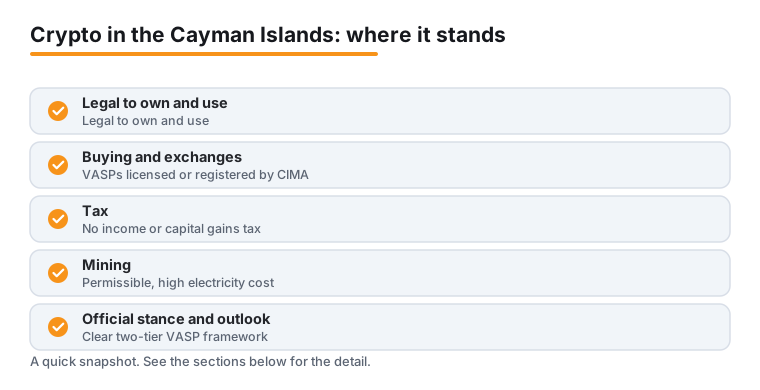
Yes. Owning, buying, selling and using Bitcoin and other cryptocurrencies is legal in the Cayman Islands. There is no prohibition on individuals holding digital assets, and parties who invest or trade in cryptocurrencies for their own account, or who simply make and receive payments in crypto, are generally not subject to specific Cayman regulation. The territory has chosen to regulate service providers rather than restrict ordinary users.
Legal does not mean unregulated, and it does not mean crypto is money. Bitcoin is not legal tender in the Cayman Islands. The official currency is the Cayman Islands dollar (KYD), which is pegged to the US dollar. Cryptocurrencies are treated as virtual assets, and any business that provides virtual asset services in or from the islands must be registered with, or licensed by, the Cayman Islands Monetary Authority.
For an ordinary resident or visitor, the practical takeaway is simple: you can legally use crypto, but you should expect the regulated platforms you deal with to ask for identity verification and to operate under registration or a full licence.
Who regulates crypto in the Cayman Islands?
The principal regulator for digital assets is the Cayman Islands Monetary Authority (CIMA). CIMA registers, licenses and supervises virtual asset service providers (VASPs), sets fit-and-proper standards, and enforces anti-money-laundering, prudential and conduct requirements. Within CIMA, a dedicated VASP and Fintech Innovation Unit handles applications and queries and can be reached at [email protected].
Other parts of government play supporting roles. The Ministry of Financial Services and Commerce develops policy and legislation for the sector, and the Department for International Tax Cooperation (DITC) administers international tax-transparency frameworks, including the OECD Crypto-Asset Reporting Framework. The Cayman Islands has no securities-style income or capital-gains tax authority of the kind found in onshore jurisdictions.
You can confirm the regulator and its published guidance directly on CIMA's Virtual Asset Service Providers resources page, which links to registration requirements, FAQs, forms, regulatory measures and VASP statistics.
Key laws and frameworks
The cornerstone of crypto regulation in the Cayman Islands is the Virtual Asset (Service Providers) Act, originally enacted in 2020 and now read as the 2024 Revision. It provides the framework for the conduct of virtual asset services and for the registration and licensing of the businesses that provide them. The Act was designed to be implemented in phases, and CIMA supplements it with regulations, regulatory measures and a published regulatory policy.
The phased rollout matters for understanding the regime today:
- Phase one focused on anti-money-laundering and registration. The core registration provisions came into effect on 31 October 2020, with related enforcement provisions following in early 2021.
- Phase two, the licensing phase, came into force on 1 April 2025 through amendments to the Act. It requires virtual asset custody providers and virtual asset trading platform operators to hold a full licence rather than only a registration.
- A revised regulatory policy reflecting the licensing regime took effect on 23 May 2025.
- A separate Virtual Asset (Service Providers) (Amendment) Act, 2025 was passed on 27 June 2025 to clarify the treatment of tokenised funds.
The framework is intended to align with international standards set by the Financial Action Task Force (FATF) and the Caribbean Financial Action Task Force (CFATF). Because the rules are detailed and still maturing, businesses in particular should take local legal advice rather than rely on summaries. For wider context, see our general guide to crypto regulation.
Licensing and registration of VASPs and exchanges
The Cayman Islands operates a two-tier authorisation regime under the VASP Act. Lower-risk activities require registration with CIMA, while higher-risk services require a full licence. Since 1 April 2025, the two activities that must hold a full licence are:
- Virtual asset custody services, and
- operating a virtual asset trading platform.
Registration is no longer available for those two categories. Existing registrants conducting those activities before 1 April 2025 were given a transitional window of ninety days, with a licence application due by 29 June 2025, and were generally permitted to keep operating while the application was reviewed. Firms in scope that failed to apply by that deadline faced cancellation of their registration. Once a licence is granted, the firm's previous registration is cancelled.
The licensing regime introduced a number of additional obligations on custody providers and trading platforms, widely reported by Cayman law firms to include enhanced prudential requirements, segregation of client assets from the firm's own assets, stronger disclosure to clients (covering matters such as internal safeguards, insurance arrangements and complaints procedures), and the submission of cybersecurity and risk-management plans. Governance requirements were also tightened: a licensed VASP must appoint a minimum of three directors, including at least one independent director who is not otherwise affiliated with the business. CIMA sets the fees. Its VASP guidance states that a licensee or registered person must pay the prescribed annual renewal fee on or before 15 January each year, and that every application for registration must be accompanied by a KYD 1,000 assessment fee. The 2025 amendments also widened CIMA's supervisory and enforcement powers, reported to include imposing conditions on licences, issuing cease-and-desist orders, revoking licences, cancelling registrations and withdrawing waivers. Before depositing funds with any provider, check that it genuinely holds the relevant CIMA registration or licence rather than relying on marketing claims.
Crypto and Bitcoin tax in the Cayman Islands
The Cayman Islands is a well-known tax-neutral jurisdiction. It imposes no income tax, no capital gains tax, no corporate tax and no withholding tax. As a result, an individual or company in the Cayman Islands generally does not face a specific Cayman tax charge simply for buying, holding or selling cryptocurrency at a profit. Companies can also apply for tax-exemption undertakings (certificates) that confirm this treatment for a long fixed period.
That headline should not be mistaken for crypto being entirely free of obligations:
- If you are tax-resident in another country, your home jurisdiction may tax your crypto gains or income regardless of Cayman rules. US citizens, for example, are generally taxed on worldwide income.
- The Cayman Islands has adopted the OECD Crypto-Asset Reporting Framework (CARF). The CARF regulations took effect on 1 January 2026, alongside changes to the Common Reporting Standard rules. Reporting crypto-asset service providers must collect due-diligence and transaction information from that date and report it to the DITC for automatic exchange with partner jurisdictions. The first CARF reporting cycle runs in 2027 in respect of 2026 data, with a first submission deadline reported as 30 June 2027. This broadens international transparency without creating a Cayman tax charge.
- Virtual asset businesses still bear regulatory fees and the compliance costs of the VASP regime.
This section is informational only and not tax advice. We deliberately avoid quoting specific rates or thresholds, which can change and should be checked against official sources such as the Department for International Tax Cooperation or a qualified adviser. For general background, see our guide to crypto taxes.
AML, KYC and the Travel Rule
Anti-money-laundering and counter-terrorist-financing (AML/CFT) obligations are central to the Cayman VASP regime and were the focus of its first phase. Registered and licensed VASPs must apply customer due diligence and Know Your Customer (KYC) procedures, conduct ongoing transaction monitoring, screen against sanctions lists, report suspicious activity, and appoint compliance officers, including a money-laundering reporting officer. From 18 September 2026, CIMA's Rule on Effective Compliance Programme for the Prevention and Detection of Money Laundering, Terrorist Financing and Proliferation Financing for Financial Services Providers requires CIMA registered and licensed firms, including VASPs, to retain relevant records for five years, to hold a written risk assessment, and to have the compliance programme independently audited, with every third audit performed by an external service provider.
The Cayman Islands also applies the virtual asset Travel Rule, derived from FATF Recommendation 16. This requires VASPs to obtain, hold and pass on specified information about the originator and beneficiary of a virtual asset transfer above a defined threshold, so that customer information accompanies transactions between providers. The regime is designed to align Cayman practice with global AML standards set by FATF and overseen regionally by CFATF.
For users, the practical effect is that any compliant platform serving the Cayman public will require full identity verification when you open an account, fund it, or withdraw, and may ask about the source of funds for larger transactions. These checks are a legal requirement on the provider, not an optional extra.
Buying and using crypto in practice
Residents and visitors can buy crypto through major international exchanges and through providers authorised locally. Any platform that provides virtual asset custody or operates a trading platform in or from the Cayman Islands is expected to hold a CIMA licence, while certain other services operate under registration. The Cayman ecosystem is institution-focused, so retail infrastructure is comparatively limited.
A typical path looks like this, and is a general guide rather than an endorsement of any provider:
- Choose a platform. Prefer a reputable exchange that is transparent about its regulatory status, ideally registered or licensed in the Cayman Islands or another well-regulated jurisdiction.
- Create and verify your account. Expect to provide identity documents and proof of address to satisfy KYC requirements.
- Fund your account. Deposit using the methods the platform supports, keeping bank and card requirements in mind.
- Place your order after reviewing fees and the exchange rate.
- Secure your holdings. For anything beyond small amounts, consider moving funds to a wallet you control, such as a hardware wallet, and keep your recovery phrase offline and private.
Be alert to scams. Unrealistic returns, pressure to act quickly, and unsolicited investment managers are common red flags, and crypto transactions are typically irreversible. If a provider claims to be CIMA-regulated, you can and should verify that claim before sending any money. For a step-by-step primer, see our guide to crypto regulation.
Bitcoin ATMs in the Cayman Islands
Bitcoin ATM coverage in the Cayman Islands is very limited. The territory's crypto ecosystem is oriented toward institutional and corporate activity, such as funds and licensed service providers, rather than retail cash-to-crypto infrastructure, so the small population of physical crypto kiosks reflects that focus rather than a specific ban.
Where crypto ATMs or cash-conversion services do operate, the underlying activity can fall within the VASP regime, meaning the operator may need to be registered with or licensed by CIMA and to apply the same AML and KYC checks as other providers. That generally means identity verification at the machine and limits on anonymous transactions. Fees and exchange rates at ATMs are often substantially worse than on mainstream online exchanges, so they are best used only for small, convenience-driven transactions. If you intend to use one, confirm the operator's regulatory status and understand the costs before transacting.
Bitcoin mining in the Cayman Islands
There is no specific Cayman Islands law that bans cryptocurrency mining, and the VASP Act is focused on financial services such as custody, trading and issuance rather than on mining as an activity. Mining is not regulated as a virtual asset service under the Virtual Asset (Service Providers) Act. It is neither licensed nor prohibited, and no CIMA authorisation is needed to mine.
The real constraint is economic. The Cayman Islands relies heavily on imported fuel for electricity, and power costs are comparatively high, with reported all-in residential rates in the region of roughly 35 to 40 US cents per kilowatt-hour. High electricity prices, import duties on equipment and a warm climate that adds cooling costs make large-scale, energy-intensive Bitcoin mining within the islands far less attractive than in jurisdictions with cheap or surplus power. In practice, the Cayman Islands is more attractive as a tax-neutral base for the holding company or headquarters of a mining group whose substantive mining operations are located overseas. Anyone considering mining locally should model electricity costs carefully and check rules on power supply, equipment import and any business-licensing requirements.
Recent developments (2024 to 2026)
The defining recent development is the move into the licensing phase of the VASP regime. With effect from 1 April 2025, virtual asset custody providers and virtual asset trading platform operators must hold a full CIMA licence rather than relying on registration, and existing registrants in those categories were given until the end of June 2025 to apply. CIMA published a revised regulatory policy effective 30 May 2025 to reflect the new regime, including the requirement for at least three directors with one independent director, enhanced prudential and disclosure standards, and client-asset segregation.
Other notable steps include the Virtual Asset (Service Providers) (Amendment) Act, 2025, passed on 27 June 2025, which revised the definition of the issuance of virtual assets to exclude equity interests under the Mutual Funds Act and investment interests under the Private Funds Act, and continued growth in the number of VASPs authorised by CIMA. The practical effect is that a regulated tokenised fund whose virtual asset activity is incidental to running the fund is generally regulated under the funds regime rather than being required to register or license under the VASP Act, though a fund that also provides custody, exchange or transfer services to third parties stays within the VASP Act. In August 2025 the Ministry of Financial Services and Commerce published a consultation paper on further tokenised-fund measures, and separate amendment bills to the Mutual Funds Act, Private Funds Act and VASP Act to provide expressly for tokenised funds were introduced in 2026.
Looking ahead, a further phase of the regime is expected to bring into force provisions relating to a regulatory sandbox licence for innovative or novel products and to the issuance of newly created virtual assets to the public. Separately, the OECD Crypto-Asset Reporting Framework took effect on 1 January 2026, adding international tax-reporting obligations for crypto-asset service providers, with the first reporting cycle in 2027 for 2026 data. Because the framework is detailed and still evolving, the most reliable way to track changes is to monitor CIMA and government publications directly rather than relying on secondary summaries.
Consumer risks and protection
The Cayman Islands offers a developed regulatory environment for digital-asset businesses, but real risks remain that users should weigh:
- Market volatility. Crypto prices can move sharply, and losses can be significant and rapid.
- Platform and counterparty risk. Even large, prominent firms can fail. Favour providers that segregate client assets and genuinely hold the relevant CIMA registration or licence.
- Regulatory change. The VASP framework is still maturing, with licensing, sandbox and issuance provisions being phased in. Requirements on custody, trading and reporting can tighten further.
- Limited retail infrastructure. With few local on-ramps and ATMs, many residents rely on international platforms whose protections vary by jurisdiction.
- Scams and fraud. Pseudonymous, irreversible transactions are attractive to fraudsters, so be sceptical of unsolicited offers and guaranteed returns.
Dealing with a CIMA-registered or licensed provider offers more protection than using an unregulated platform, but no regulation removes the underlying market risk. Apply the same caution you would anywhere: verify, diversify, secure your keys, and confirm anything legal or tax-related with official sources. This page is informational only and is not legal, tax, or financial advice.
Official sources and how to verify
Crypto rules evolve, so always confirm specific points with primary, official sources rather than third-party summaries. The most authoritative references for the Cayman Islands are:
- Cayman Islands Monetary Authority (CIMA) Virtual Asset Service Providers resources, the regulator for VASPs, with registration requirements, FAQs, forms and statistics.
- Virtual Asset (Service Providers) Act (2024 Revision) on the official Cayman Islands legislation portal, where you can also find its amendments in full.
- Department for International Tax Cooperation (DITC) for international tax-transparency frameworks such as the Crypto-Asset Reporting Framework.
To verify whether a specific platform is permitted to serve you, check CIMA's published VASP information and the firm's stated registration or licence status, and when in doubt contact CIMA's VASP and Fintech Innovation Unit at [email protected]. This is general information as of 2026 and is not legal advice; for your particular situation, confirm with the named regulator or a qualified Cayman Islands professional. You can also browse our wider regulation hub for other jurisdictions.
What is changing: Cayman Islands crypto rules as of August 2026
As of August 2026 the position for an individual is unchanged. Buying, holding, trading and paying in crypto are legal, crypto is not legal tender, and there is no Cayman tax on a crypto gain. What has moved in 2026 is the compliance load on the firms you buy through, and one dated change is still ahead.
The table below lists the named instruments that are in force or carry a fixed commencement date.
| Instrument | Status and date | What it does |
|---|---|---|
| Virtual Asset (Service Providers) Act (2024 Revision), licensing phase | In force since 1 April 2025 | Custodians and trading platforms need a full CIMA licence, not registration |
| Virtual Asset (Service Providers) (Amendment) Act, 2026 | In force 24 March 2026 | Tokenised fund token issuance is not a virtual asset issuance; repeals the 2025 Amendment Act |
| Mutual Funds (Amendment) Act, 2026 and Private Funds (Amendment) Act, 2026 | In force 24 March 2026 | Tokenised funds supervised under the funds regime, with CIMA oversight of the tokens |
| CIMA Rule and Statement of Guidance on Market Conduct for VASPs | Issued February 2026 | Conduct, conflicts, client assets, marketing, complaints, insurance |
| Tax Information Authority (International Tax Compliance) (Crypto-Asset Reporting Framework) Regulations, 2025 | In force 1 January 2026 | Crypto service providers report customer and transaction data for exchange abroad |
| Rule on Effective Compliance Programme (AML, CFT, CPF) | Gazetted 20 July 2026, effective 18 September 2026 | Binding AML programme, audit and record retention standards |
| Rule on Compliance with Financial Sanctions and Targeted Financial Sanctions | Gazetted 20 July 2026, effective 18 September 2026 | Binding sanctions screening standards |
| VASP Act phase three (public issuance and sandbox licence) | Enacted but not commenced, no date announced | Would open direct public token issuance and a sandbox licence of up to one year |
The supervised population is small. CIMA's own VASP statistics page reports 18 registered virtual asset service providers as at Q4 2025, broken down as virtual asset trading platform 3, virtual asset custody 7, issuance of virtual assets 1, virtual currency to virtual currency or fiat conversion 10, participating in financial services relating to virtual assets 4, and transfer of virtual assets 2. Those categories add up to more than 18 because a single entity can hold more than one service category.
New CIMA AML and sanctions rules apply to Cayman VASPs from 18 September 2026
This is the one Cayman crypto change still ahead. On 20 July 2026 CIMA published two finalised Rules in the Gazette: the Rule on Effective Compliance Programme for the Prevention and Detection of Money Laundering, Terrorist Financing and Proliferation Financing for Financial Services Providers, and the Rule on Compliance with Financial Sanctions and Targeted Financial Sanctions. Both take effect on 18 September 2026, 60 days after publication.
They apply to every CIMA registered or licensed financial services provider, and CIMA lists both on its own index of virtual asset service provider regulatory measures with that effective date, so Cayman VASPs are squarely in scope. They do not apply to firms that are not CIMA registered or licensed.
Concrete obligations the AML Rule imposes:
- A documented compliance programme with a governance framework setting out the roles of the governing body, the anti-money-laundering compliance officer and the money-laundering reporting officer
- A written money laundering, terrorist financing and proliferation financing risk assessment
- Customer due diligence and sanctions screening
- Independent audit of the programme, with every third audit performed by an external service provider
- Five year retention of identification data, account files, correspondence and transaction records
- Notification to CIMA where material compliance functions are outsourced
- Documented staff training programmes
For a user, the practical effect from late September 2026 is that re-verification requests, sanctions screening and source of funds questions on Cayman licensed platforms become more routine and more consistently documented. Neither Rule places any obligation on an individual who simply holds or trades crypto for their own account.
Tax: still no Cayman charge, but CARF reporting now has fixed dates
The Cayman Islands imposes no corporate, income, capital gains, withholding, inheritance or gift tax, and the 2026 Global Legal Insights chapter confirms this applies to the issuance, holding and trading of digital assets on the same basis as any other asset. Stamp duty can apply to original documents executed in the Cayman Islands or brought into the Islands after execution, but the sums are generally nominal.
Reporting is a separate question from taxation. The Tax Information Authority (International Tax Compliance) (Crypto-Asset Reporting Framework) Regulations, 2025 took effect on 1 January 2026. The dates that matter:
- Registration on the DITC Portal by Cayman Reporting Crypto-Asset Service Providers was originally due 30 April 2026. A Department for International Tax Cooperation industry advisory dated 25 March 2026 extended that deadline to 31 January 2027, to allow time for DITC Portal functionality.
- Self certifications of tax residence must be collected from new users at onboarding and from existing users by 31 December 2026.
- The first annual CARF report is due by 30 June 2027, covering calendar year 2026.
- The obligation sits with providers, not with individual holders.
The practical consequence: activity carried out during 2026 through a Cayman reporting provider can reach your home tax authority from mid 2027 onward. Cayman does not tax the gain. The country you are tax resident in may, and it will increasingly have the data.
What is still not regulated in the Cayman Islands
Three gaps are worth stating plainly, because they are often described inaccurately elsewhere.
- Stablecoins. There is no standalone Cayman stablecoin law. Stablecoins are treated as virtual assets under the VASP Act and carry the same obligations as any other virtual asset, but the Cayman Islands imposes no mandatory reserve or backing asset requirement on stablecoin issuers as a condition of VASP Act registration. Depending on the rights attached, such as redemption or conversion rights, a stablecoin can also require authorisation under the Securities Investment Business Act, as Conyers explains.
- Mining. Mining is not regulated as a virtual asset service under the VASP Act. It is neither licensed nor prohibited. The barriers are commercial, being electricity cost and import duty on equipment, not legal.
- Phase three of the VASP Act. The Act already contains provisions covering issuance of newly created virtual assets directly to the public and a sandbox licence, a temporary licence of up to one year that CIMA may direct an applicant to apply for, but those provisions have not been brought into force and no commencement date has been announced. Until they are, there is no operating Cayman sandbox route.
Frequently asked questions
Is Bitcoin legal in the Cayman Islands?
Yes. Holding, buying, selling and using cryptocurrency is legal in the Cayman Islands, and individuals trading for their own account are generally not subject to specific regulation. However, Bitcoin is not legal tender; the official currency is the Cayman Islands dollar, which is pegged to the US dollar. Businesses that provide virtual asset services in or from the islands must be registered with, or licensed by, the Cayman Islands Monetary Authority under the Virtual Asset (Service Providers) Act.
Who regulates cryptocurrency in the Cayman Islands?
The Cayman Islands Monetary Authority (CIMA) is the principal regulator for virtual asset service providers under the Virtual Asset (Service Providers) Act (2024 Revision). A dedicated VASP and Fintech Innovation Unit within CIMA handles applications and queries. The Ministry of Financial Services and Commerce develops policy, and the Department for International Tax Cooperation administers international tax-transparency frameworks such as the Crypto-Asset Reporting Framework.
Do crypto exchanges and custodians need a licence in the Cayman Islands?
Yes. Since 1 April 2025, virtual asset custody providers and virtual asset trading platform operators must hold a full CIMA licence rather than only a registration, which is no longer available for those two categories. Lower-risk virtual asset services may instead require registration. Licensed providers are governed by CIMA's Rule and Statement of Guidance on Market Conduct for Virtual Asset Service Providers, issued in February 2026, which applies to every VASP authorised under the VASP Act. It covers integrity and conflicts of interest, client asset safeguards, marketing and promotions, client onboarding and client agreements, complaints handling, public disclosures, cross border transactions and proprietary trading, with further obligations specific to trading platforms and custodians, and it sets insurance requirements covering professional liability, theft or loss of client assets, business interruption and cybersecurity. Governance requirements are unchanged: a licensed VASP must appoint at least three directors, including at least one independent director.
Do I pay tax on crypto profits in the Cayman Islands?
The Cayman Islands has no income tax, no capital gains tax, no corporate tax and no withholding tax, so a person or company in the islands generally does not face a specific Cayman tax charge simply for selling crypto at a profit. However, if you are tax-resident elsewhere your home country may still tax you, and the Cayman Islands is implementing the OECD Crypto-Asset Reporting Framework from 2026, which adds reporting obligations for crypto-asset service providers. This is not tax advice; confirm your position with the Department for International Tax Cooperation or a qualified adviser.
What is the Cayman Islands VASP Act?
The Virtual Asset (Service Providers) Act, originally enacted in 2020 and now in its 2024 Revision, is the Cayman Islands' main crypto law. It governs the conduct of virtual asset services and the registration and licensing of providers, and is supervised by CIMA. It was rolled out in phases: registration and anti-money-laundering rules came first in 2020, and a licensing phase requiring custody providers and trading platforms to hold a full licence took effect on 1 April 2025. Further provisions on a regulatory sandbox and the issuance of new virtual assets are expected to follow.
Are there rules on crypto AML and the Travel Rule in the Cayman Islands?
Yes. Registered and licensed VASPs must apply customer due diligence and KYC checks, monitor transactions, screen for sanctions, report suspicious activity, and appoint compliance officers. The Cayman Islands also applies the virtual asset Travel Rule, derived from FATF Recommendation 16, which requires providers to collect and pass on originator and beneficiary information for transfers above a set threshold. The regime is designed to align with FATF and CFATF standards, so compliant platforms will verify your identity before letting you transact.
How are tokenised funds regulated in the Cayman Islands?
In 2025 the Cayman Islands amended the VASP Act to revise the definition of the issuance of virtual assets so that it excludes equity interests under the Mutual Funds Act and investment interests under the Private Funds Act. That 2025 Act has since been repealed. The Virtual Asset (Service Providers) (Amendment) Act, 2026, which commenced on 24 March 2026, confirms that a regulated tokenised mutual fund issuing digital equity tokens, and a regulated tokenised private fund issuing digital investment tokens, is not making a virtual asset issuance for VASP Act purposes. Such funds are supervised under the Mutual Funds Act or Private Funds Act as amended on the same date, not under the VASP Act. A fund that also provides custody, exchange or transfer services to third parties remains within the VASP Act. Further amendment bills to provide expressly for tokenised funds were introduced in 2026. This is general information, not legal advice, and fund structures should be confirmed with a qualified Cayman Islands adviser.
Will my crypto activity be reported under CARF in the Cayman Islands?
The Cayman Islands adopted the OECD Crypto-Asset Reporting Framework, whose regulations took effect on 1 January 2026. Reporting crypto-asset service providers must collect due-diligence and transaction information from that date and report it to the Department for International Tax Cooperation, which exchanges it automatically with partner jurisdictions. The first reporting cycle runs in 2027 in respect of 2026 data, with a first submission deadline reported as 30 June 2027. CARF is a transparency measure and does not by itself create a Cayman tax charge, but information about your activity may reach your home tax authority.
What changes for crypto firms in the Cayman Islands on 18 September 2026?
Two CIMA Rules gazetted on 20 July 2026 take effect: the Rule on Effective Compliance Programme for the Prevention and Detection of Money Laundering, Terrorist Financing and Proliferation Financing for Financial Services Providers, and the Rule on Compliance with Financial Sanctions and Targeted Financial Sanctions. They apply to all CIMA registered or licensed providers, including VASPs, and require a documented and independently audited compliance programme, a written risk assessment, sanctions screening, five year record retention and documented staff training. They impose nothing on individuals who hold or trade crypto for their own account.
Which law confirms that tokenised funds are outside the Cayman VASP regime?
The Virtual Asset (Service Providers) (Amendment) Act, 2026, which commenced on 24 March 2026 alongside the Mutual Funds (Amendment) Act, 2026 and the Private Funds (Amendment) Act, 2026. It also repealed the earlier 2025 Amendment Act. Together they confirm that a regulated tokenised fund issuing digital equity tokens or digital investment tokens is not making a virtual asset issuance, and is supervised under the funds regime instead. A fund that also offers custody, exchange or transfer services to third parties remains inside the VASP Act.
When do Cayman crypto service providers first report under CARF?
The first annual report under the Tax Information Authority (International Tax Compliance) (Crypto-Asset Reporting Framework) Regulations, 2025 is due by 30 June 2027, covering calendar year 2026. Registration on the DITC Portal was originally due by 30 April 2026, but a DITC industry advisory dated 25 March 2026 extended that deadline to 31 January 2027. The duty falls on Cayman Reporting Crypto-Asset Service Providers, not on individual holders, though individuals will be asked for a self certification of tax residence.
Is there a stablecoin law in the Cayman Islands?
No. There is no standalone stablecoin legislation. Stablecoins are treated as virtual assets under the VASP Act and carry the same obligations as any other virtual asset, but the Cayman Islands imposes no mandatory reserve or backing asset requirement on issuers as a condition of VASP Act registration. Depending on the rights attached to the token, such as redemption or conversion rights, the Securities Investment Business Act can also apply.
Does the Cayman Islands have a crypto regulatory sandbox?
Not yet in operation. The VASP Act already contains provisions for a sandbox licence, a temporary licence of up to one year that CIMA may direct an applicant to apply for, and for direct public issuance of newly created virtual assets, but those phase three provisions have not been brought into force and no commencement date has been announced. Firms with novel models must currently fit the existing registration or licence categories.
Facts reviewed: 5 August 2026. Page updated: 5 August 2026.