Home › Crypto Regulation › Cuba
Bitcoin & Cryptocurrency Regulation in Cuba
Quick answer — Cuba, 2026
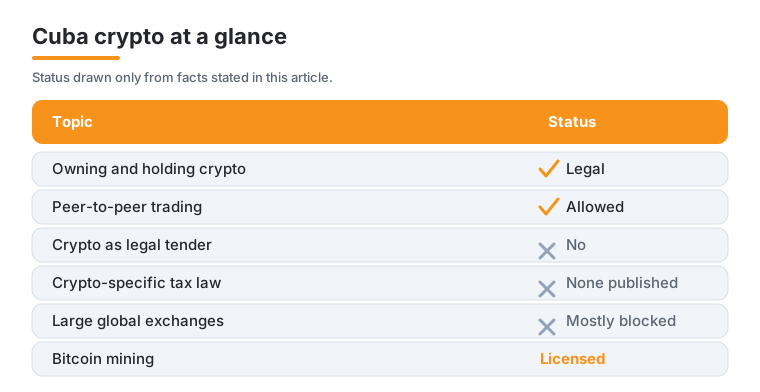
- Owning and trading crypto is legal in Cuba, but it is not legal tender; the Cuban peso stays the only official currency and business use needs Banco Central de Cuba approval.
- There is no published crypto-specific tax, though general tax and reporting rules can still apply.
- Most residents buy and receive crypto peer-to-peer via platforms like QvaPay and BitRemesas, often using dollar-pegged stablecoins.
Cuba occupies an unusual position in the global crypto landscape. Cut off from much of the international banking system by a decades-long United States embargo, facing a shortage of hard currency and unreliable remittance channels, many Cubans have turned to Bitcoin and dollar-pegged stablecoins as practical tools rather than speculative bets. At the same time, the Cuban state keeps tight control over money and foreign exchange, so the legal framework is cautious and highly centralized around the central bank. This guide explains where cryptocurrency stands in Cuba as of 2026: its legal status, who regulates it, the specific resolutions that govern it, how licensing and reporting work, the realities of mining and remittances, and the risks anyone should weigh before getting involved.
This is general information as of 2026 and is not legal, tax, or financial advice. Cuban rules are evolving and are published in the Official Gazette (Gaceta Oficial). Always verify the current position with the Banco Central de Cuba and a qualified local professional before acting. For broader context, see our overview of crypto regulation.
On this page: Legal status · Who regulates it · Taxes · How to buy · Mining
Is Bitcoin and crypto legal in Cuba?
Holding and using cryptocurrency is not illegal in Cuba, and the state has formally recognized it. Crypto is treated as a regulated virtual asset rather than something banned. The key distinction is that cryptocurrency is not legal tender: the Cuban peso remains the only official currency, and no merchant is obliged to accept Bitcoin or any other token.
In practice, individuals can own crypto, hold a wallet, and trade peer-to-peer, while any commercial or institutional activity built around crypto is funneled through a central-bank licensing system. Under the governing resolutions, financial institutions and other legal entities may only use virtual assets to settle monetary, commercial, exchange, or financial obligations when specifically authorized by the Banco Central de Cuba. The framework is permissive enough to keep ordinary personal use in a legal grey-to-green zone, but restrictive enough that nothing happens at a business level without the central bank's sign-off.
Who regulates crypto in Cuba
The sole regulator is the Banco Central de Cuba (BCC), the country's central bank. It is the only institution with authority to review and approve licenses for virtual asset service providers (VASPs), to set the conditions and restrictions on authorized operations, and to grant, refuse, suspend, or revoke those licenses. Within the BCC, a specialized Cryptoassets Group (Grupo de Criptoactivos) evaluates applications and specific authorization requests.
Because Cuba does not have a separate financial-markets regulator for this sector, the BCC concentrates supervision of money, foreign exchange, and virtual assets in one body. The Ministry of Finance and Prices (Ministerio de Finanzas y Precios) sets the accounting standards that licensed providers must follow. You can read the central bank's own explanation of the rules on its official site, the Banco Central de Cuba.
Key laws and frameworks
Cuba's crypto regime sits primarily in central-bank resolutions published in the Official Gazette rather than in a single comprehensive statute. The core instruments are:
- Resolution 215 of 2021 (BCC). Published in the Official Gazette and in force from September 15, 2021, it established that the Banco Central de Cuba regulates the use of certain virtual assets in commercial transactions and the granting of VASP licenses for financial, exchange, collection, or payment operations within and from national territory. This is the foundational text.
- Resolution 89 of 2022 (BCC). Published in the Official Gazette in 2022, it defined the detailed requirements and procedures that individuals and companies must meet to operate as VASPs, including the documentation, business-model description, and platform and cryptographic standards an applicant must submit.
- Resolution 4 of 2026 (BCC). Published in the Extraordinary Official Gazette No. 46 of March 23, 2026, it authorized a small, named group of private enterprises to use virtual assets for international payments under strict conditions (see Recent developments below).
Because key rules can change through new resolutions without a high-profile public debate, the only reliable way to confirm current requirements is to check the latest published text. The Official Gazette maintains a topic page for virtual assets (activos virtuales), and the foundational resolution is indexed as Resolucion 215 de 2021 del Banco Central de Cuba.
Licensing and registration of exchanges and VASPs
Any company wishing to provide crypto exchange, custody, payment, or related services in or from Cuba must obtain a license from the Banco Central de Cuba. Under Resolution 89/2022, an applicant submits an application letter with supporting documents that include its corporate purpose and bylaws, a business proposal describing the operating model, and information on the virtual assets, platform, and cryptographic standards it intends to use. The BCC evaluates each request on legality and socioeconomic interest.
Key features of the regime:
- Decision timeline. The central bank must grant or deny a license within a total period that does not exceed ninety working days from receipt of the required documentation.
- License term. Licenses are issued initially for one year and can be extended for an additional year.
- Conditions set per license. The BCC specifies in each license the characteristics of the virtual assets, the conditions and restrictions on authorized operations, and the control and custody measures the provider must apply.
- Accounting and reporting. Licensed providers must keep accounts under the standards issued by the Ministry of Finance and Prices and present financial statements accordingly.
Reporting and enforcement have tightened over time, including stronger anti-money-laundering duties and integrity checks on applicants.
Crypto and Bitcoin tax in Cuba
Cuba has no crypto-specific capital gains or transaction tax for individual holders. What exists instead is an accounting rule: Resolución 268 de 2023 of the Ministry of Finance and Prices approved Norma Específica de Contabilidad No. 18, Activos Virtuales, which binds persons authorised by the central bank to book crypto held for trading within twelve months as inventory and all other holdings as intangible fixed assets, measured at the lower of acquisition cost or active market value. That absence should not be read as a guarantee that crypto activity is tax-free. Cuba operates a general tax system covering income and certain business activities, and authorized commercial use of crypto, for example by a licensed enterprise, can fall within ordinary business-tax, accounting, and reporting obligations.
For most individuals trading peer to peer the obstacle is not the rate but the absence of a declaration route. No Ministry of Finance and Prices resolution on the personal income tax names virtual assets as a category of income, so there is no published line on which to declare a disposal, and currency controls still govern how any proceeds are converted. Converting crypto to pesos or dollars and moving funds can intersect with foreign-exchange and anti-money-laundering rules even where no specific tax is named.
There is no crypto-specific rate to quote, but there is a default. Income of natural persons is taxed under the Impuesto sobre los Ingresos Personales established by Ley 113 de 2012, "Del Sistema Tributario". Cuban press summaries of the taxes in force for 2026, alongside the state budget law Ley 181 de 2025, report a progressive scale running from 5 percent on annual income up to 25,000 Cuban pesos to 50 percent on income above 1,000,000 pesos, with non-state economic actors also paying 35 percent on profits and a territorial contribution of 1 percent of gross income. The gazette record for Ley 181 does not set out these brackets itself, so they are reported figures rather than ones quoted from the law. Anyone with meaningful holdings, business income, or cross-border flows should treat their situation as uncertain and consult a qualified Cuban tax adviser. For general background see our guide to crypto taxes. Nothing here is tax advice.
AML and KYC rules
Anti-money-laundering (AML) and know-your-customer (KYC) duties are central to Cuba's framework, reflecting the heightened scrutiny that surrounds money movement in a tightly controlled, sanctioned economy. Licensed VASPs must comply with the guidelines issued by the Banco Central de Cuba for preventing, detecting, and combating money laundering, the financing of terrorism, and the financing of the proliferation of weapons.
In practice this means licensed providers are expected to identify and verify customers, monitor transactions, keep records, and report suspicious activity. Amendments after the original 2021 and 2022 resolutions strengthened these obligations, including probity or integrity checks on those applying for or holding licenses. Because cross-border transfers are the most sensitive activity in a country with strict foreign-exchange control, that is where AML monitoring is most intense. The authoritative source for the current AML expectations is the central bank itself.
Buying and using crypto in practice
Buying crypto in Cuba is shaped more by infrastructure and sanctions than by domestic law. The US embargo means most large international exchanges either block Cuban users or cannot reliably serve them, and international card payments are difficult. As a result, the dominant channel is peer-to-peer (P2P) trading rather than centralized order books.
Cubans commonly transact through homegrown platforms oriented toward remittances and payments, the best known being QvaPay (a payment gateway with a US-dollar-pegged internal balance, QUSD) and BitRemesas, both associated with entrepreneur Erich Garcia Cruz. Trades are also arranged through messaging groups and informal networks. Among the most used assets are Bitcoin, Ethereum, Litecoin, and the dollar-pegged stablecoin USDT (Tether).
Key practical points:
- Access is restricted. Expect many global exchanges to be unavailable; verify before relying on any platform.
- Stablecoins are popular. Dollar-pegged stablecoins are favored because they avoid Bitcoin's volatility while preserving cross-border utility.
- Self-custody matters. Use a reputable wallet and safeguard the recovery phrase offline; vet P2P counterparties carefully and start small.
- Connectivity is a constraint. Limited and costly internet access remains a real obstacle to using exchanges and wallets.
Crypto remittances to Cuba
Remittances are where crypto has made the biggest real-world difference in Cuba. Money sent home by relatives abroad has long been a critical income source, and traditional channels have been fragile, most prominently when Western Union scaled back and suspended much of its Cuba service, cutting a major formal lifeline for many families.
Crypto stepped into that gap. The common pattern is direct and informal: a sender abroad transfers Bitcoin or a stablecoin, and a recipient in Cuba converts it to local cash through a P2P counterparty or a remittance-focused platform such as BitRemesas or QvaPay, which offer payouts to bank cards in pesos. The appeal is that transfers can settle quickly, route around blocked banking rails, and avoid some legacy fees. The trade-offs are equally real: Bitcoin's price can move between sending and cash-out (stablecoins reduce this), informal exchange relies on trusting the counterparty, local conversion often carries a meaningful spread, and cross-border transfer is the most scrutinized activity under Cuba's rules while sanctions add complexity for senders abroad.
Bitcoin mining in Cuba
Mining is constrained above all by Cuba's energy situation. The national grid suffers chronic shortages and blackouts that can last many hours a day, and electricity is a scarce, politically sensitive resource. That backdrop dominates any discussion of Bitcoin mining on the island.
Rather than ban mining, the state has worked to bring it inside its licensing framework, with reported requirements that operations be licensed and account for their energy use, leaning on renewable sources such as solar to avoid straining the grid. Unauthorized or heavy electricity use can attract penalties. Specific figures for energy caps or technical standards that circulate online do not appear in the official Gazette, so this guide does not treat them as settled. The one confirmed Cuban rule that touches mining is an accounting one: under Norma Específica de Contabilidad No. 18, approved by Resolución 268 de 2023, mining costs are recognised in the result of the period when they are incurred rather than capitalised. Anyone considering mining should confirm current licensing and energy requirements directly with the authorities. For most individuals, large-scale mining is not realistic given unreliable power, the difficulty of importing specialized hardware under sanctions, and the risk of operating outside the rules.
Recent developments (2025 to 2026)
The clearest recent signal of Cuba's cautious, state-controlled approach came in March 2026. Through Resolution 4 of 2026, published in the Extraordinary Official Gazette No. 46 of March 23, 2026, the Banco Central de Cuba authorized a small, named group of ten legal entities, mostly private micro, small, and medium enterprises (MIPYMES) plus one mixed company, to use virtual assets for international payments tied directly to their registered business activities. The conditions are strict: one-year licenses (renewal requires about sixty days' advance notice), quarterly reporting to the central bank on transaction amounts, the virtual assets used, and the service providers involved, operations only through BCC-licensed channels, and no domestic crypto use or speculative trading. The resolution takes effect seven working days after its Gazette publication, so the permits became operational in early April 2026, and non-compliance can trigger immediate revocation of the authorization. Reporting indicates the ten entities were nine private MIPYMES plus one mixed (joint-venture) company, spread across sectors: about six in technology and digital services, and the remainder in areas such as gastronomy, transport, and light manufacturing.
Crucially, this was not a general opening for all businesses; it was a specific, experimental permit granted to entities whose proposals were vetted by the BCC's Cryptoassets Group. It captures the overall posture well: controlled pilots, not blanket permission. Reporting has also referenced interest in a state-aligned digital currency for domestic commerce, but as of 2026 no such currency or central-bank digital currency (CBDC) is confirmed as launched or in public pilot, and the central bank's attention remains on supervising private virtual-asset activity under the existing resolutions. Treat unconfirmed announcements with skepticism and verify against the Official Gazette.
Consumer risks and protection
The risks in Cuba are distinctive, and formal consumer protection for crypto is limited. Regulatory uncertainty is high because much of the framework lives in central-bank resolutions that can change quietly. US sanctions complicate access to exchanges, hardware, and on/off-ramps, and add legal complexity for senders abroad. Infrastructure, especially electricity and internet, is unreliable. The heavy reliance on informal P2P networks for cash-out introduces real counterparty and fraud risk, with little formal recourse if a deal goes wrong, on top of crypto's ordinary volatility.
Practical protection comes mostly from caution rather than regulation: use self-custody and protect your keys, prefer stablecoins when the goal is transferring value rather than speculating, vet counterparties and use escrow where available, start with small amounts, never act on unsolicited offers promising guaranteed profits, and be skeptical of any service advertising things that do not match the official position (for example, a public network of Bitcoin ATMs, which there is no evidence operates in Cuba). Keep records and confirm the current legal and reporting requirements before any larger or cross-border activity. For a wider view of how rules differ by country, see our regulation hub.
Official sources and how to verify
Because Cuba's crypto rules are administrative and evolving, verifying against primary sources is essential. The authoritative places to check are:
- Banco Central de Cuba, the regulator that licenses providers and sets AML rules: bc.gob.cu.
- Gaceta Oficial de la Republica de Cuba, where the binding resolutions are published; see its virtual-assets topic page: gacetaoficial.gob.cu/es/activos-virtuales.
- Resolution 215 of 2021, the foundational text, indexed at the Official Gazette: Resolucion 215 de 2021.
When you find conflicting figures online, treat the official Gazette text as controlling. This article is general information as of 2026 and is not legal advice; readers should verify the current position with the Banco Central de Cuba and a qualified Cuban professional before acting. For related guides, see crypto regulation and crypto taxes.
What is changing in 2026 and 2027
Nothing in Cuba's virtual asset rules changed between 30 June and mid August 2026. The gazette's activos virtuales index still ends at Resolución 4 de 2026, the separate criptomoneda index still ends at Resolución 215 de 2021, and the Banco Central de Cuba has published no further virtual asset measure. Three clocks are nevertheless running.
- The published provider licence runs to about 28 January 2027. Resolución 134 de 2025 granted EBIORO UAB a virtual asset service provider licence stating that it enters into force on 28 January 2026, granted for one year from that date, with renewal expressly subject to the results of supervision, compliance with the applicable rules and an express assessment by the central bank. Because Resolución 4 de 2026 obliges the authorised companies to transact only through a licensed provider, that renewal decision matters to every one of them.
- The ten corporate authorisations come up in early 2027. Resolución 4 de 2026 was published on Monday 23 March 2026, takes effect seven working days later, is issued with a validity of one year, and may be extended only on application made not less than sixty calendar days before it expires. The gazette gives no calendar date for either event, so the early 2027 timing is worked out from those two clauses rather than quoted from the text. OnCuba reports the scheme is framed as a pilot that could widen to the rest of the private sector if it proves effective.
- A Ley Tributaria is scheduled for 2026. Acuerdo X-165 de 2025 approved the updated 2026 to 2027 legislative calendar, which lists a Ley Tributaria as item 7, sponsored by the Ministry of Finance and Prices, to update tax policy. It was not among the laws passed when the Assembly sat on 30 July 2026, leaving the December 2026 sitting as the remaining slot. No draft has been published, so whether it reaches virtual assets is not yet knowable.
What is absent from that calendar matters as much as what is on it. The twenty nine laws and five decree laws scheduled for 2026 and 2027 include no banking law, no central bank law, no anti-money-laundering law and no virtual asset law. On current evidence Cuban crypto rules will keep arriving as central bank resolutions in the Gaceta Oficial rather than as acts of parliament, which is why the gazette, not the National Assembly, is the thing to watch.
One external pressure is worth tracking. Cuba is a member of GAFILAT, and the central bank has itself published a note on the fifth round of mutual evaluations, which lists deficient supervision of virtual asset service providers among the highly prioritised weaknesses. Resolución 6 de 2026 of the Interior Ministry says plainly that it was issued because of changes to the FATF standard and its evaluation methodology, and the context of the country's evaluation. GAFILAT has presented a calendar covering on-site visits for all eighteen member countries, but no date for Cuba has been published.
The rules that actually apply, norm by norm
| Norm | What it does | Status |
|---|---|---|
| Decreto-Ley 317, 7 December 2013 | Base law on preventing and detecting operations connected with money laundering, terrorist financing and proliferation financing, and on naming the competent authorities | In force, and the authority under which Resolución 6 de 2026 was issued |
| Decreto-Ley 361 "Del Banco Central de Cuba", 14 September 2018 | Central bank statute. Article 25(d) is the power under which Resolución 4 de 2026 was issued | In force |
| Resolución 215 de 2021, Banco Central de Cuba, Gaceta Oficial No. 73 Extraordinaria de 2021 | Founding norm for central bank regulation of certain virtual assets in commercial transactions and for licensing providers. Its apartado Cuarto requires central bank authorisation before legal persons may use virtual assets | In force. The gazette record lists no modifying and no repealing norm |
| Resolución 89 de 2022, Banco Central de Cuba, Gaceta Oficial No. 43 Ordinaria de 2022 | Specific requirements for authorisation, operation, regulation, supervision, corrective mechanisms and cancellation of provider licences operating in and from Cuba | In force. No modifying or repealing norm on record |
| Resolución 76 de 2023, Banco Central de Cuba, Gaceta Oficial No. 55 Ordinaria de 2023 | Designates the Dirección General de Investigación de Operaciones Financieras of the central bank as the registry and supervision authority for providers, and sets their duties: customer due diligence, freezing funds of persons designated by the UN Security Council, reporting suspicious operations within seventy-two hours, and keeping records at least five years | In force |
| Resolución 268 de 2023, Ministerio de Finanzas y Precios, Gaceta Oficial No. 114 Ordinaria of 22 November 2023 | Approves Norma Específica de Contabilidad No. 18, Activos Virtuales, the binding accounting standard for holders authorised by the central bank | In force |
| Resolución 134 de 2025, Banco Central de Cuba | Grants EBIORO UAB a new provider licence and repeals Resolución 8 de 2025 | In force from 28 January 2026, for one year, renewal subject to supervision results |
| Resolución 4 de 2026, Banco Central de Cuba, Gaceta Oficial No. 46 Extraordinaria, 23 March 2026 | Authorises ten named legal entities to use virtual assets for cross-border payments tied to their corporate purpose, through licensed providers only, with quarterly reporting and immediate revocation for breach | In force seven working days after publication, for one year |
| Resolución 100 de 2026, Ministerio de Justicia, Gaceta Oficial No. 50 Extraordinaria, 16 April 2026 | Requires notaries, lawyers and consultants to report operations they may presume suspicious of laundering, terrorist financing or proliferation financing. Supersedes Resolución 175 de 2014 | In force |
| Resolución 86 de 2026, Ministerio de Finanzas y Precios, Gaceta Oficial No. 37 Ordinaria de 2026 | Procedure for supervising bookkeeping by self-employed workers and non-state economic actors as obligated subjects for anti-money-laundering purposes | In force |
| Resolución 6 de 2026, Ministerio del Interior, Gaceta Oficial No. 65 Extraordinaria, 18 May 2026 | Designates the Dirección Técnica de Investigaciones to coordinate the Interior Ministry's part in the anti-money-laundering system, citing changes to the FATF standard and the country's evaluation context | In force |
Who actually holds a licence
Two layers of permission exist, and both are named in the gazette. On the provider layer, Resolución 134 de 2025 licenses EBIORO UAB, a Lithuanian company, to collect, pay and carry out exchange operations to and from national territory, exchange virtual assets against legal tender and digital currencies, hold custody of and administer virtual assets, transfer them between users, platforms and authorised third parties, provide financial services connected with virtual asset offerings and intermediation, and build and run the supporting platforms. It must disclose the risks of virtual assets including volatility, irreversibility and the absence of central bank backing, maintain robust and updated cybersecurity with periodic technical audits, obtain prior approval of its daily and monthly transaction limits, keep its crypto accounting, operations and assets separate from its other business, commission quarterly external audits, and accept on-site and remote supervision.
This is the provider licence on record, and it repealed the earlier Resolución 8 de 2025 covering the same company. It is worth noting that Resolución 134 de 2025 does not itself appear in the gazette's activos virtuales index, so that index cannot be relied on as a complete register of provider licences, and the resolution claims no exclusivity.
The user layer has ten occupants, named in Resolución 4 de 2026: the MIPYMEs Ingenius Tecnologías, Dofleini, La Calesa Real, La Meknica, Cema Soltec, El Asadito, Pasarela Digital, ARA and DQ Dasqom, and the mixed enterprise Prosa. Their applications were assessed by the central bank's Grupo de Criptoactivos. Their use is confined to cross-border payments tied to their corporate purpose, so a software firm may pay for foreign servers but may not trade for gain, and operating directly outside the authorised platforms is expressly prohibited. CriptoNoticias reports that the ten are obliged to operate through already licensed providers such as EBIORO UAB.
None of this reaches ordinary individuals. No licence has been published for a retail exchange serving the Cuban public, and the peer-to-peer services Cubans actually use do not appear anywhere in the gazette's virtual asset records.
Tax and accounting: what applies in the absence of a crypto tax
Cuba publishes no crypto tax rate. Two things do apply, and both can be named.
- The default for individuals is the Impuesto sobre los Ingresos Personales established by Ley 113 de 2012, "Del Sistema Tributario", Gaceta Oficial No. 53 Ordinaria de 2012. Cuban press summaries of the taxes in force for 2026, alongside the state budget law Ley 181 de 2025, report a progressive scale running from 5 percent on annual income up to 25,000 Cuban pesos to 50 percent on income above 1,000,000 pesos, with non-state economic actors also facing 35 percent on profits and a territorial contribution for local development of 1 percent of gross income. See Periódico Cubano. The gazette record for Ley 181 states only that it is the 2026 budget law and does not set out these brackets itself.
- None of the personal income tax rules name virtual assets. The gazette's ingresos personales index runs to Resolución 17 de 2025 and Resolución 347 de 2025, and neither mentions them. A person selling crypto peer to peer therefore has no published line on which to declare it, which is a gap in the rules rather than an exemption.
What Cuba does have is an accounting rule with teeth. Resolución 268 de 2023 approved NEC 18, Activos Virtuales, binding on natural and legal persons authorised by the central bank. Virtual assets the entity expects to trade within twelve months are booked as inventory, and all others are classified as intangible fixed assets. They are measured at the lower of acquisition cost or active market value. Mining costs are recognised in the result of the period when incurred rather than capitalised. Disclosures must cover the asset types controlled, the nature of the activity, the sources used for measurement, and a reconciliation of movements in carrying value.
Frequently asked questions
Is cryptocurrency legal in Cuba?
Yes, in the sense that it is recognized and regulated rather than banned. Under Resolution 215 of 2021, the Banco Central de Cuba regulates the use of virtual assets and licenses providers. However, crypto is not legal tender, the Cuban peso remains the only official currency, and commercial or institutional use is only allowed when authorized by the central bank.
Who regulates crypto in Cuba?
The Banco Central de Cuba (BCC), the central bank, is the sole regulator. It is the only body that can license virtual asset service providers, set the conditions and restrictions on their operations, impose anti-money-laundering and reporting requirements, and approve specific cross-border uses. You can verify the rules on its official site, bc.gob.cu.
Which laws govern crypto in Cuba?
The main instruments are central-bank resolutions published in the Official Gazette: Resolution 215 of 2021 (foundational recognition and BCC authority, in force from September 15, 2021), Resolution 89 of 2022 (detailed VASP licensing requirements and procedures), and Resolution 4 of 2026 (authorizing a named group of enterprises to use crypto for international payments).
Is there a crypto tax in Cuba?
There is no published, crypto-specific tax law in Cuba, so this guide does not state any rate or threshold. That does not mean activity is automatically tax-free, since general tax, accounting, and business rules can apply to authorized commercial use. Anyone with significant holdings or income should consult a qualified Cuban tax professional. This is not tax advice.
Can businesses in Cuba use crypto for international payments?
Only with specific central-bank authorization. In March 2026, through Resolution 4 of 2026 published in Extraordinary Official Gazette No. 46, the Banco Central de Cuba authorized ten named legal entities (mostly private MIPYMES plus one mixed company) to use virtual assets for cross-border payments tied to their registered activities, under one-year licenses with quarterly reporting, only through licensed channels, and with no domestic or speculative use. The firms spanned technology and digital services plus areas such as gastronomy, transport, and light manufacturing, the permits took effect in early April 2026, and non-compliance can trigger immediate revocation. It was a limited pilot, not a general permission.
How do Cubans send and receive money with Bitcoin?
Most commonly through peer-to-peer transfers and remittance-focused platforms such as BitRemesas and QvaPay. A sender abroad transfers Bitcoin or a stablecoin, and the recipient converts it to pesos through a local counterparty or a platform payout to a bank card. Stablecoins such as USDT are popular for avoiding Bitcoin's volatility during the transfer.
Is Bitcoin mining legal in Cuba?
Cuba has not banned mining, but it is not something individuals can do freely. The state has moved to bring mining inside its licensing framework, with reported requirements to be licensed and to account for energy use given the island's chronic electricity shortages and blackouts. Specific energy caps or technical standards circulating online are not confirmed in the Official Gazette, so anyone considering mining should check the current requirements directly with the authorities. For most people it is not practical because of unreliable power and the difficulty of importing hardware under sanctions.
Did Cuba launch a national digital currency or crypto for everyday shopping?
Not as of 2026. Reporting has referenced official interest in a state-aligned or peso-linked digital currency for domestic commerce, but there is no confirmed launch or public pilot of a central-bank digital currency. Cryptocurrency is still not legal tender, the Cuban peso remains the only official currency, and the Banco Central de Cuba's focus is on supervising private virtual-asset activity under the existing resolutions. Treat any unverified launch announcement with caution and check the Official Gazette.
Which company is licensed to provide crypto services in Cuba?
EBIORO UAB, a Lithuanian company. Resolución 134 de 2025 of the Banco Central de Cuba granted it a virtual asset service provider licence in force from 28 January 2026, repealing the earlier Resolución 8 de 2025 covering the same company. It may exchange virtual assets against legal tender and digital currencies, hold custody, transfer assets between users and authorised third parties, and run the supporting platforms. The licence runs one year and its renewal is expressly subject to the results of supervision, compliance with the applicable rules and an express assessment by the central bank. It is the provider licence on record in the Gaceta Oficial, though the gazette's virtual assets index is not a complete licence register and the resolution itself claims no exclusivity.
Which Cuban companies can legally pay in crypto?
Ten, named in Resolución 4 de 2026: the MIPYMEs Ingenius Tecnologías, Dofleini, La Calesa Real, La Meknica, Cema Soltec, El Asadito, Pasarela Digital, ARA and DQ Dasqom, plus the mixed enterprise Prosa. They may use virtual assets only for cross-border payments tied to their corporate purpose, must buy, sell, transfer and hold custody only through a central bank licensed provider, are expressly barred from operating directly outside the authorised platforms, and must file a quarterly summary detailing the amounts, the virtual assets used and the provider through which the operations were executed. Breach of any condition means immediate revocation.
Is a crypto law coming to Cuba?
Not in the parliamentary calendar. The updated 2026 to 2027 legislative schedule approved by Acuerdo X-165 de 2025 lists twenty nine laws and five decree laws, and contains no virtual asset law, no banking law, no central bank law and no anti-money-laundering law. The only scheduled item that could reach holders is a Ley Tributaria due in 2026, whose text has not been published and which was not passed at the sitting that closed on 30 July 2026. Cuban crypto rules continue to arrive as Banco Central de Cuba resolutions in the Gaceta Oficial.
Who supervises crypto firms in Cuba?
The Dirección General de Investigación de Operaciones Financieras of the Banco Central de Cuba, designated by Resolución 76 de 2023. It keeps the register of authorised virtual asset service providers and supervises them. Providers must apply customer due diligence, assess risk before launching new products, practices and technologies, report suspicious operations within seventy-two hours, keep records for at least five years after the relationship ends, and freeze without delay the funds of persons or entities designated by the United Nations Security Council. Applications to use virtual assets are assessed by the central bank's Grupo de Criptoactivos.
How do I declare crypto gains to the Cuban tax authority?
There is no published route. No Ministry of Finance and Prices resolution on the personal income tax names virtual assets as a category of income, so no form or line exists for a crypto disposal. The general default for personal income is the Impuesto sobre los Ingresos Personales under Ley 113 de 2012, reported for 2026 as running from 5 percent on annual income up to 25,000 pesos to 50 percent above 1,000,000 pesos, but nothing published applies it specifically to crypto.
Facts reviewed: 13 August 2026. Page updated: 13 August 2026.