Home › Crypto Regulation › Antigua and Barbuda
Bitcoin & Cryptocurrency Regulation in Antigua and Barbuda
Quick answer — Antigua and Barbuda, 2026
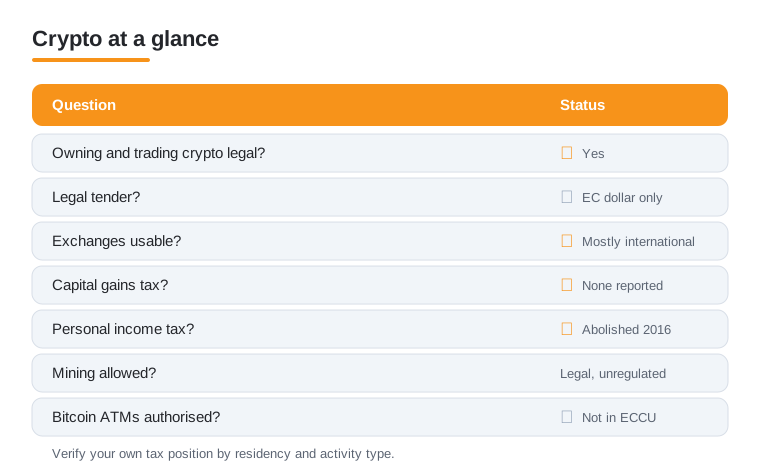
- Legal: Legal to own and trade, not legal tender; crypto businesses need an FSRC licence
- Tax: No personal income or capital gains tax, but confirm with the IRD
- Buying: Mostly via international exchanges; use FSRC-licensed local providers where available
Antigua and Barbuda is one of the earliest movers on crypto regulation in the Caribbean. The twin-island nation passed a dedicated digital-asset statute in 2020, built a licensing regime supervised by its Financial Services Regulatory Commission, and has actively courted blockchain and fintech businesses alongside its wider offshore financial-services and citizenship-by-investment strategy. For residents, expats and visitors, the practical questions are usually the same: Is it legal to hold and trade Bitcoin here? Who regulates crypto companies? How is it taxed? And how do you actually buy, send or spend it on the islands?
This guide explains the current state of cryptocurrency regulation in Antigua and Barbuda in plain language, covering legal status, the regulators, key laws, licensing, taxation, AML and KYC rules, buying and using crypto in practice, mining, recent developments and consumer risks. The information here is general and current as of 2026; it is not legal, tax or financial advice. Crypto rules and tax treatment change, so always verify the specifics with the named official regulators, the Financial Services Regulatory Commission and the Eastern Caribbean Central Bank, or a licensed local professional before acting. For broader context see our overview of crypto regulation.
On this page: Legal status · Who regulates it · Taxes · How to buy · Mining
Legal status of Bitcoin and crypto
Owning, buying, selling and trading Bitcoin and other cryptocurrencies is legal in Antigua and Barbuda for individuals. There is no law that bans private use of digital assets, and the country has gone further than most of its neighbours by creating a formal framework specifically for digital-asset businesses.
What crypto is not is legal tender. The only legal tender across the country is the Eastern Caribbean dollar (XCD), issued by the Eastern Caribbean Central Bank (ECCB) and pegged to the US dollar at EC$2.70 to US$1. That distinction matters in everyday life: a merchant, hotel or service provider may choose to accept Bitcoin if they wish, but no one is obliged to take it the way they must accept EC dollars. Any crypto payment is essentially a private commercial arrangement between the two parties.
In short, holding and using crypto is permitted, but it sits alongside the national currency rather than replacing it. Businesses that handle crypto on behalf of others face a separate, licensed regime described below.
Who regulates crypto in Antigua and Barbuda
Two authorities matter most.
The Financial Services Regulatory Commission (FSRC) is the primary regulator and licensing authority for digital-asset businesses. It licenses and supervises virtual-asset service providers under the Digital Assets Business Act, conducts fit-and-proper checks on directors and significant shareholders, can investigate and enter premises, and publicly warns the public about unlicensed operators. Its official site is www.fsrc.gov.ag, which also publishes a list of licensees and press releases.
The Eastern Caribbean Central Bank (ECCB) is the regional monetary authority for the Eastern Caribbean Currency Union (ECCU), of which Antigua and Barbuda is a member. The ECCB issues the EC dollar, oversees the banking system, and has issued public warnings that crypto products, Bitcoin ATMs and certain stablecoin schemes are not authorised, regulated or guaranteed by the regulators in the ECCU. Its official site is www.eccb-centralbank.org.
For anti-money-laundering supervision, the Office of National Drug and Money Laundering Control Policy (ONDCP) hosts the country's Financial Intelligence Unit and acts as the supervisory authority under the money-laundering legislation. Its official site is ondcp.gov.ag.
Key laws and frameworks
The cornerstone of crypto regulation is the Digital Assets Business Act, 2020 (DABA), supported by the Digital Asset Business Regulations, 2021. The framework came fully into force in May 2021 and created one of the earliest comprehensive licensing regimes for digital-asset activity in the Caribbean. DABA defines digital assets broadly to include coins and tokens and requires any person carrying on a "digital asset business" in or from within Antigua and Barbuda to hold an FSRC licence unless an exemption applies.
Supporting and overlapping laws include:
- The Money Laundering (Prevention) (Amendment) Act, 2021, which extends customer due diligence, record-keeping and suspicious-transaction reporting duties to digital-asset businesses, in line with the Financial Action Task Force (FATF) standards for virtual-asset service providers.
- Securities and investment-fund legislation, where a token behaves like a security or a collective investment scheme and may attract additional requirements.
- General company, exchange-control and tax law applicable to any business operating in the jurisdiction.
For an ordinary person buying crypto for their own account, these rules mostly operate in the background. They become directly relevant if you run a crypto business, raise money through a token, or provide services to others, in which case engagement with the FSRC and professional legal advice are essential. The principal anti-money-laundering statute is the Money Laundering (Prevention) Act 1996 (No. 9 of 1996), which the ONDCP publishes with its amendments. Alongside it sit the Prevention of Terrorism Act 2005 (No. 12 of 2005) and the Weapons of Mass Destruction (Prohibition and Non-Proliferation) Act 2024. Those are the three statutes Parliament cross-referenced in section 32A of the Special Economic Zone Act when it tightened the Zone regime in 2026.
Licensing and registration of exchanges and VASPs
Under DABA, a business that conducts "digital asset business" in or from Antigua and Barbuda must generally be licensed by the FSRC. Section 6(2) of the Digital Assets Business Act, 2020 lists the activities the FSRC may licence, and section 6(4) makes carrying on digital asset business without a licence a criminal offence, punishable on summary conviction by a fine of $50,000 or imprisonment for one year or both, and on conviction on indictment by a fine of $250,000 or imprisonment for five years or both. The Act states these figures in dollars without specifying the currency. The licensable activities are:
- Operating a digital-asset exchange or trading platform
- Acting as a payment-services provider using digital assets
- Providing custodial wallet, custody or safekeeping services for clients
- Issuing, selling or redeeming digital coins and tokens
- Lending, borrowing or providing other financial services in respect of digital assets, and fund administration for digital-asset funds
Section 9 of the Act provides for two classes of licence, not three. A Class A licence covers any or all of the digital asset business activities in the definition. A Class B licence covers the same activities for a defined period determined by the Commission. Section 10 allows the Commission to decide which class to issue regardless of which the applicant asked for. In practice the FSRC's own licensee directory uses the word Category rather than Class for one entry, so expect some variation in terminology and confirm the position with the Commission. The Act itself sets no fee amounts. Section 17 provides that a licensed undertaking pays such fee as may be determined by the Commission, on the grant of a licence and then annually before 31 March in every year following the year in which it was licensed, based on the revenue of the digital asset business, with further fees on applications for exemption, extension of a defined licence period, variance of a direction and prospectus review. For each week or part of a week that a licensee fails to comply, it is liable to a civil penalty not exceeding $5,000. Ask the FSRC for the current schedule rather than relying on secondhand figures.
Applicants face fit-and-proper assessments of directors, officers and significant shareholders, plus governance, capital, AML and reporting requirements. Commentary from advisers describes a licensing process that typically takes a few months, which is relatively quick by offshore standards, but timelines and exact requirements should be confirmed directly with the FSRC. A licensed business is also restricted in certain ways under the Act, including rules against market manipulation, insider trading and fraudulent conduct, and confidentiality obligations toward clients.
Individuals do not need a licence simply to buy or hold crypto for themselves. The licensing regime targets those who provide crypto services to others. You can check whether a provider operating locally is authorised against the FSRC licensee listing at www.fsrc.gov.ag. See our regulation hub for how other jurisdictions handle VASP licensing.
Taxation of crypto
Antigua and Barbuda is widely described as a low-tax jurisdiction. Personal income tax was abolished in 2016, which the Prime Minister and Minister for Finance described as a defining moment in the 2026 Budget Statement delivered on 4 December 2025. The Inland Revenue Department lists the taxes it administers as the Antigua and Barbuda Sales Tax, Unincorporated Business Tax, Property Tax, Corporation Tax and Entertainment Tax. Capital gains tax is not among them, and there is no crypto specific tax rule or published IRD guidance on digital assets. Advisory sources also note there is no specific corporate tax on the profits of crypto companies under the current regime, though companies remain subject to the general business-tax and regulatory environment.
This often-cited absence of income tax and capital gains tax can be relevant to how crypto gains are treated, but you should not assume a particular outcome. How any rule applies depends on your residency status, whether your activity is treated as a business or as personal investment, and the source of the income. One point advisers flag: non-residents who earn certain locally sourced payments such as dividends, interest or royalties can face a withholding tax reported at 25 percent, so the tax picture is not uniformly zero for everyone. Goods and services may still attract the Antigua and Barbuda Sales Tax (ABST) in some contexts, and rules can change.
The tax authority is the Inland Revenue Department (IRD) of the Government of Antigua and Barbuda, which oversees tax compliance. Confirm your position with the Inland Revenue Department or a qualified local adviser rather than relying on general summaries, and keep clear records of every transaction. For background on how crypto is taxed generally, see our guide to crypto taxes.
AML and KYC rules
Anti-money-laundering and know-your-customer obligations are central to the regime. DABA and the Money Laundering (Prevention) (Amendment) Act, 2021 bring digital-asset businesses within the country's AML and counter-terrorist-financing framework, consistent with FATF Recommendation 15 on virtual-asset service providers. In practice this means licensed providers must:
- Identify and verify customers (KYC), typically requiring government ID and proof of address
- Conduct ongoing monitoring and risk-based customer due diligence
- Keep transaction records and report suspicious activity to the Financial Intelligence Unit at the ONDCP
- Apply the FATF "travel rule" to share originator and beneficiary information on transfers where required
The ONDCP, through its Financial Intelligence Unit and Financial Compliance Unit, supervises and enforces these obligations. For users, the practical effect is that any compliant exchange or service will ask you to complete identity verification before you can trade or withdraw. A platform that asks for no verification at all is a warning sign rather than a convenience.
Buying and using crypto in practice
There is no Antigua-specific ban on individuals buying crypto, and most residents access the market through international exchanges rather than a large domestic one. A typical first purchase looks like this:
- Choose a platform. Pick a reputable exchange that serves Antigua and Barbuda residents, prioritising security and recognised regulation; where a provider operates locally, confirm it holds an FSRC licence.
- Verify your identity. Complete KYC by submitting ID and proof of address, as required of compliant providers under AML rules.
- Fund your account. Deposit using a supported method such as a debit or credit card or a bank transfer, in EC or US dollars where available, and check deposit and trading fees first.
- Buy and review. Purchase Bitcoin or another asset (you can buy a fraction of a coin) and confirm the fee and amount before finalising.
- Secure your coins. For anything beyond a small amount, consider moving funds to a wallet you control; a hardware wallet offers strong protection, and you should back up your recovery phrase offline and never share it.
Peer-to-peer trades are possible but carry higher counterparty and fraud risk and fewer protections. On Bitcoin ATMs, the ECCB and FSRC have publicly stated that Bitcoin ATMs are not authorised or regulated within the ECCU. They have not been declared illegal, but the warning means there is no official oversight or consumer protection if you use one, so treat any such machine with caution. Crypto can also be used for cross-border remittances, but recipients still need a reliable way to convert into EC or US dollars, volatility can erode value between sending and cashing out, and any business transmitting funds on others' behalf falls under the licensing and AML rules above.
Crypto mining
Bitcoin mining is not specifically prohibited in Antigua and Barbuda, and there is no dedicated mining licence in the way some countries have introduced. In legal terms it generally sits in an unregulated space: it is not banned, but it is also not the subject of bespoke rules, so miners must still comply with general business, electricity, import and tax requirements.
The bigger constraints are practical rather than legal. As a small island state, the country relies heavily on imported fuel for electricity, which tends to make grid power relatively expensive compared with mining hubs that have cheap hydro, gas or surplus renewables. That economics, plus a warm tropical climate that increases cooling costs, makes large-scale proof-of-work mining challenging to run profitably. Some operators look at solar or other renewable generation to offset costs, but renewables require significant upfront capital and do not by themselves guarantee a viable business.
If you are considering mining at any meaningful scale, treat power-supply agreements, equipment import duties, heat management and the tax position of mined coins as the core questions, and get local advice before committing capital.
Recent developments (2025-2026)
Two developments stand out in the current period.
First, enforcement and public warnings continue. In August 2025 the FSRC issued a press release warning that an entity calling itself "Digital Cryptocurrency Bank" (also trading as DCB) was operating without authorisation, had never been licensed to carry on international banking from or within Antigua and Barbuda, and that any claim of FSRC registration was false. The FSRC publishes such notices on its official site, and checking those notices is a useful due-diligence step.
Second, the regional central-bank digital currency story has cooled. The ECCB closed its DCash pilot in January 2024, and at the 112th Meeting of its Monetary Council on 13 February 2026 it suspended development of the planned DCash 2.0 in order to prioritise a regional Fast Payment System (FPS) and participation in the CARICOM Payments and Settlement System pilot. The FPS would let people send ordinary EC dollars instantly across the currency union, 24 hours a day, using a phone number or QR code. This shifts the official digital-payments focus from a proprietary CBDC wallet toward faster movement of the existing currency.
The direction of travel is now set out in dated documents rather than guesswork. Parliament passed the Special Economic Zone (Amendment) Act, 2026 to confirm that a licence is required for any licensable activity inside a Special Economic Zone and that the FSRC retains its full powers there. The ONDCP said in October 2025 that agencies had trained on the revised FATF standards in preparation for the 2027 mutual evaluation. And the Speech from the Throne of 26 May 2026 set a legislative agenda for 2026 to 2031 that contains no digital assets bill. Confirm the latest position with the FSRC and ECCB directly, since this area evolves.
Consumer risks and protection
The main risks for crypto users in Antigua and Barbuda fall into familiar categories: market risk from price volatility; security risk from hacks, scams and lost keys; counterparty risk from unregulated or offshore platforms; and regulatory risk, since rules and tax interpretations can change. On-chain transactions are typically irreversible, so mistakes and fraud are hard to undo.
Consumer protection for crypto is thinner than for regulated bank deposits or payment providers. The regulators have made this explicit: crypto products are not regulated or guaranteed by the ECCB, Bitcoin ATMs are not authorised in the ECCU, and the FSRC has publicly named unlicensed operators that falsely claimed authorisation. There is no government guarantee or deposit-insurance scheme standing behind a crypto holding.
Sensible practice is the same as anywhere: only commit money you can afford to lose, diversify, use secure custody, be wary of guaranteed-return promises and unsolicited "crypto bank" offers, verify that any local provider is FSRC-licensed, and keep records for tax purposes. This guide is general information current as of 2026 and is not legal, tax or financial advice; verify your situation with the named regulators or a licensed local professional.
Official sources and how to verify
Because crypto rules and tax treatment evolve, always confirm the current position against primary official sources rather than secondary summaries. The most authoritative starting points are:
- Financial Services Regulatory Commission (FSRC), the regulator and licensing authority for digital-asset businesses, including the licensee list and public warnings: www.fsrc.gov.ag.
- Eastern Caribbean Central Bank (ECCB), the monetary authority for the currency union, for currency, banking and crypto-risk notices: www.eccb-centralbank.org.
- Office of National Drug and Money Laundering Control Policy (ONDCP), host of the Financial Intelligence Unit and AML supervisory authority, for money-laundering laws, guidelines and reporting: ondcp.gov.ag.
To verify a provider, check the FSRC licensee listing and any published warnings before sending funds. To verify your tax position, contact the Inland Revenue / tax authorities or a qualified local adviser. For wider reading on the topic, see our overviews of crypto regulation and crypto taxes. Remember this page is general information as of 2026, not legal advice; confirm specifics with the official regulators named above.
What is changing: the position in August 2026
Nothing has changed for a person who simply wants to buy, hold or sell crypto. The movement in 2026 is on the business side, and it matters if you deal with any provider that says it is based in Antigua and Barbuda.
- Parliament closed the Special Economic Zone question. The Special Economic Zone (Amendment) Act, 2026, No. 1 of 2026, inserts a new section 37 headed "Financial services and digital asset activities". It bars anyone from carrying on inside a Zone any activity that needs a licence under Antigua and Barbuda law unless they hold that licence, and confirms the Financial Services Regulatory Commission can exercise its full supervisory, inspection, investigative and enforcement powers inside a Zone.
- The licensee list is short, and it is current. The FSRC Directory of Licenced Digital Asset Business was last updated on 8 July 2026 and names three companies.
- The regulator's newest public notice is about contracts for difference, not crypto. The FSRC public notice of 30 January 2026 advises that contracts for difference trading is not an activity regulated, licensed, supervised or authorised by the Commission, and that incorporation under the International Business Corporations Act does not constitute regulation or approval. It does not mention crypto. The most recent crypto specific warning remains the notice of 14 August 2025 about Digital Cryptocurrency Bank, trading as DCB.
- No crypto bill is on the government's agenda. The Speech from the Throne of 26 May 2026 set a legislative agenda for 2026 to 2031 covering police, fire and forensic services, electronic crimes, worker protection, food safety, health regulation, border security and citizenship by investment. Digital assets are not mentioned anywhere in it. The 2026 Budget Statement, delivered on 4 December 2025, contains no crypto measure either.
- Only two Acts had been published for 2026 at the time of writing. The annual Acts listing on laws.gov.ag shows No. 1 of 2026, the Special Economic Zone (Amendment) Act, and No. 2 of 2026, the Antigua and Barbuda Festivals Commission Act. No amendment to the Digital Assets Business Act appears.
The Special Economic Zone (Amendment) Act 2026, and what it means in practice
The Special Economic Zone (Amendment) Act, 2026 passed the House of Representatives on 27 March 2026 and the Senate on 31 March 2026, was assented to by Governor-General Sir Rodney Williams on 14 April 2026, and was published in the Official Gazette Vol. XLVI No. 26 dated 16 April 2026. It amends the Special Economic Zone Act, 2015 (No. 17 of 2015). Its stated purposes include enhancing compliance with the law of Antigua and Barbuda relating to money laundering, terrorist financing and proliferation financing.
This matters for crypto because a Special Economic Zone was the one place where a company might have argued it sat outside ordinary financial regulation. The Act removes that argument.
| New provision | What it requires |
|---|---|
| Section 32A | Licensees, operators and zone users must comply with the Money Laundering (Prevention) Act 1996, the Prevention of Terrorism Act 2005, the Weapons of Mass Destruction (Prohibition and Non-Proliferation) Act 2024 and any enactment governing beneficial ownership transparency. |
| Section 32B | A zone user carrying on a business or activity listed in the First Schedule to the Money Laundering (Prevention) Act 1996 must comply with the obligations applicable to a financial institution under that Act. |
| Section 33A | No one may conduct business or provide services in a Zone without approval as a zone user. The Committee must conduct due diligence including verification of identity, beneficial ownership, corporate registration and legal status, and source of funds, and may have regard to money laundering and terrorist financing risk. A register of zone users must be kept and made available to the Minister and to any competent authority on request. |
| Section 33B | Approval may be suspended or revoked for contravening the Act, failing to comply with any law of Antigua and Barbuda, providing false or misleading information, or engaging in activity inconsistent with the Zone's approved activities, after written notice and an opportunity to be heard. |
| Section 36 | National law continues to apply inside a Zone, including financial services regulation, and the powers of the Chief Executive Officer of the FSRC and the Director of the ONDCP are expressly preserved. |
| Section 37 | No licensable activity inside a Zone without holding that licence from the competent authority. The FSRC may exercise inside a Zone all supervisory, inspection, investigative and enforcement powers conferred under any enactment relating to regulated financial activities. |
| Section 38 | Anyone carrying on business in a Zone immediately before commencement has six months after commencement to apply for zone user approval. If they do not, the Committee may direct them to cease operating. |
One point of precision worth stating plainly: the words "digital asset" appear in this Act only in the heading of section 37. The operative wording of section 37 is general licensing language covering any activity requiring a licence under Antigua and Barbuda law. The effect for a crypto business is the same, because a digital asset business needs an FSRC licence, but the section is not a bespoke crypto provision.
On timing, the Act carries no commencement clause, and section 1 deals only with the short title. It was gazetted on 16 April 2026. The six month transitional window in section 38 runs from commencement rather than from a stated calendar date, so if commencement runs from gazettal the applications fall due around mid October 2026. That date is an inference, not something the Act states, so anyone relying on it should confirm the position with the Ministry of Legal Affairs.
Source: Special Economic Zone (Amendment) Act, 2026, No. 1 of 2026, published at laws.gov.ag.
Who actually holds a digital asset licence
The FSRC publishes a public directory of licensed digital asset businesses. As last updated on 8 July 2026 it lists three companies. That number is worth knowing before you believe any platform that claims to be regulated in Antigua and Barbuda.
| Licensee | Licence and permitted services as listed | Address as listed |
|---|---|---|
| RockWallet Limited (formerly Fabriik Epsilon 26c Ltd.) | Class A providing custodial wallet services and digital asset custody services; Class B providing digital asset exchange | Unit 440, Canada Place, Lauchland Benjamin Drive, St. John's |
| MNEE Limited (formerly RockWallet Custody Limited, formerly Fabriik Sigma 26c Ltd.) | Class A providing digital assets custody services | Woods Center, Suite 6, Friars Hill Road, St. John's |
| BCA Ltd trading as Pay Antigua | Listed as Category A, payment service provider. The directory uses "Category" rather than "Class" for this entry. | Wescott Tower, Crosbies, St. John's |
If a platform tells you it is FSRC licensed and its name is not on that list, treat the claim as false until the FSRC confirms otherwise. The Commission has published exactly this kind of notice before. In its press release of 14 August 2025 it advised that Digital Cryptocurrency Bank, also trading as DCB, is not an international business corporation under the laws of Antigua and Barbuda as it has never been incorporated by the Commission, and has never been issued a licence to carry on international banking business from or within Antigua and Barbuda, and that the entity's statements that it is lawfully registered and licensed by the Commission are false.
Sources: FSRC Directory of Licenced Digital Asset Business, reached from the FSRC directories page; FSRC press release of 14 August 2025.
What is in the pipeline, and when
The honest picture is that no crypto specific bill is moving. What is moving is the anti money laundering machinery around it and the regional payments agenda, on timetables set by international review rather than by domestic crypto politics.
- Legislative agenda 2026 to 2031. The Speech from the Throne of 26 May 2026 lists the government's planned slate: reforms to the Police Services, the Fire and Rescue Services, forensic services and electronic crimes of every variety, worker protection, food safety, mental health, pharmacy regulation, medical laboratories and nursing homes, advance passenger information, and amendments to the Citizenship by Investment legislation. Digital assets, virtual assets and cryptocurrency do not appear anywhere in the speech. The electronic crimes item is the only one that could plausibly touch crypto users, and the speech gives no detail on its scope.
- A 2027 mutual evaluation is the fixed date on the calendar. The ONDCP reported on 29 October 2025 that agencies had completed training on the revised FATF standards and methodology, describing it as preparation for the 5th Round Mutual Evaluation and referring to the 2027 Mutual Evaluation. That report does not mention virtual assets or crypto, so treat it as a general anti money laundering milestone rather than a signal about digital asset rules specifically.
- Regional payments work is advancing, and it is not crypto. At the 113th Meeting of the ECCB Monetary Council on 10 July 2026 in Dominica, the Council received updates on the CARICOM Payments and Settlement System pilot and the Fast Payment System, described as flagship initiatives. CAPSS is to facilitate instant cross border payments in local currencies, and the Fast Payment System is to enable real time payments across the currency union 24 hours a day. The Council also noted that an Office of Financial Conduct is scheduled to commence operations in September 2026.
- Ongoing supervisory activity. The ONDCP took part on 19 June 2026 in an ECCB led regional webinar on disrupting cyber fraud networks through intelligence led policing. That item does not mention crypto either.
- A caveat on completeness. laws.gov.ag states that all legislation within the current year will only be available at the Government Printery, so a bill can exist without being posted online. For anything time sensitive, check with the Ministry of Legal Affairs or the FSRC directly.
What tax actually applies
Antigua and Barbuda has no personal income tax. In the 2026 Budget Statement of 4 December 2025 the Prime Minister and Minister for Finance said that a defining moment came in 2016 when the government abolished personal income tax. There is no crypto specific tax rule and no published Inland Revenue Department guidance on digital assets.
That is not the same as saying crypto is tax free. The Inland Revenue Department lists the taxes it administers as the Antigua and Barbuda Sales Tax, Unincorporated Business Tax, Property Tax, Corporation Tax and Entertainment Tax. Two of those matter for crypto:
- Unincorporated Business Tax applies to business activity carried on by a person who is not incorporated. If your crypto activity looks like a trade rather than personal investment, this is the head of tax to ask about, not personal income tax.
- Corporation Tax applies to companies. A company that trades or mines crypto is a company like any other, and the absence of personal income tax does not exempt it.
The IRD does not publish its rates on those web pages, and this page does not state any rate for that reason. Ask the IRD directly on 1 (268) 468-9473 or by email at [email protected], or take local advice, and keep a full transaction record either way. Nothing here is tax advice.
Frequently asked questions
Is cryptocurrency legal in Antigua and Barbuda?
Yes. Buying, holding and trading crypto is legal for individuals, and the country has a dedicated framework, the Digital Assets Business Act 2020, for licensing crypto businesses. However, crypto is not legal tender; only the Eastern Caribbean dollar holds that status. Merchants may accept Bitcoin voluntarily but are never required to. This is general information as of 2026, not legal advice.
Who regulates crypto in Antigua and Barbuda?
The Financial Services Regulatory Commission (FSRC) licenses and supervises digital-asset businesses under the Digital Assets Business Act and its 2021 regulations. The Eastern Caribbean Central Bank (ECCB) is the monetary authority that issues the EC dollar and publishes crypto-risk warnings, including on unauthorised Bitcoin ATMs, while the ONDCP hosts the Financial Intelligence Unit for anti-money-laundering supervision. You can verify licensees at www.fsrc.gov.ag.
Do crypto exchanges need a licence in Antigua and Barbuda?
Yes. A business carrying on digital-asset business in or from Antigua and Barbuda, such as operating an exchange, payment service, custodial wallet or custody service, or issuing and redeeming tokens, generally must hold an FSRC licence under the Digital Assets Business Act unless an exemption applies. Applicants face fit-and-proper checks plus governance, capital, AML and reporting requirements. Individuals do not need a licence simply to buy or hold crypto for themselves.
How is crypto taxed in Antigua and Barbuda?
Antigua and Barbuda is widely described as having no personal income tax (abolished in 2016) and no capital gains tax, with a broadly territorial system, and advisory sources note no specific corporate tax on crypto-company profits. How any of this applies to your crypto gains depends on your residency and whether the activity is a business or personal investment, so do not assume a particular treatment. Confirm with the tax authorities or a qualified local adviser and keep clear records.
Are Bitcoin ATMs legal in Antigua and Barbuda?
They are not banned, but the ECCB and FSRC have publicly stated that Bitcoin ATMs are not authorised or regulated within the Eastern Caribbean Currency Union. Because there is no official oversight, you use such machines at your own risk and without the consumer protections that apply to regulated services.
What happened to the ECCB's DCash digital currency?
The ECCB closed its DCash central-bank-digital-currency pilot in January 2024, and at its 112th Monetary Council meeting on 13 February 2026 it suspended development of the planned DCash 2.0 to prioritise a regional Fast Payment System for sending ordinary EC dollars instantly across the currency union. This is separate from private cryptocurrencies, which remain legal to hold but are not issued or guaranteed by the central bank.
How much does a crypto licence cost in Antigua and Barbuda?
Advisory sources report an FSRC application fee in the region of US$3,700 to US$7,400, an annual renewal that varies by category and turnover, and a minimum risk-capital expectation reported around US$100,000, with the licence available in three broad categories to cover different business models. These figures are indicative only and can change, so confirm the current fee schedule and category structure directly with the FSRC before you rely on them. Individuals buying crypto for their own account do not need a licence.
Who handles crypto tax in Antigua and Barbuda?
The Inland Revenue Department (IRD) of the Government of Antigua and Barbuda oversees tax compliance. The country is generally reported to have no personal income tax, capital gains tax or wealth tax, but outcomes depend on your residency and whether an activity is a business or personal investment, and non-residents can face a withholding tax reported at 25 percent on certain locally sourced dividends, interest or royalties. Confirm your position with the IRD or a qualified local adviser and keep clear records.
Has anything changed for crypto in Antigua and Barbuda in 2026?
Yes, on the business side. The Special Economic Zone (Amendment) Act, 2026 (No. 1 of 2026) was assented to on 14 April 2026 and gazetted on 16 April 2026. Its new section 37, headed Financial services and digital asset activities, provides that no one may carry on a licensable activity inside a Special Economic Zone without holding that licence from the competent authority, and that the Financial Services Regulatory Commission may exercise its full supervisory, inspection, investigative and enforcement powers inside a Zone. For individuals buying or holding crypto, nothing changed.
Can a crypto company operate from an Antigua and Barbuda Special Economic Zone without an FSRC licence?
No. Section 37 of the Special Economic Zone Act as amended in 2026 bars any activity requiring a licence or other authorization under Antigua and Barbuda law from being carried on inside a Zone unless the person holds that licence or authorization from the competent authority. On top of the licence, section 33A requires separate approval as a zone user, with due diligence including verification of identity, beneficial ownership, corporate registration and source of funds. Businesses already operating in a Zone were given six months from the Act's commencement to apply.
How many digital asset businesses are licensed in Antigua and Barbuda?
Three, as at the FSRC directory update of 8 July 2026: RockWallet Limited, holding Class A for custodial wallet services and digital asset custody services and Class B for digital asset exchange; MNEE Limited, holding Class A for digital assets custody services; and BCA Ltd trading as Pay Antigua, listed as Category A, payment service provider. If a platform claims FSRC authorisation and is not on that directory, treat the claim as false until the FSRC confirms otherwise.
Is a cryptocurrency bill going through the Antigua and Barbuda parliament?
Not as far as the public record shows. The Speech from the Throne of 26 May 2026 set out a legislative agenda for 2026 to 2031 covering police, fire and forensic services, electronic crimes, worker protection, food safety, health regulation, border security and citizenship by investment, with no mention of digital assets or cryptocurrency anywhere in the speech. Only two Acts had been published for 2026 at the time of writing, and neither concerns crypto. Note that laws.gov.ag says current year legislation is available only at the Government Printery, so check with the Ministry of Legal Affairs for anything time sensitive.
What is the penalty for running a crypto business in Antigua and Barbuda without a licence?
Section 6(4) of the Digital Assets Business Act, 2020 makes it a criminal offence. On summary conviction the penalty is a fine of $50,000 or imprisonment for one year or both. On conviction on indictment it is a fine of $250,000 or imprisonment for five years or both. The Act states these figures in dollars without specifying the currency. Individuals buying or holding crypto for their own account are not carrying on digital asset business and do not need a licence. If you think an exemption applies to your business, note that the only route in the Act is an exemption order made by the Minister on the advice of the Commission under section 7, so take local legal advice rather than assuming you fall outside the regime.
Does the FSRC regulate contracts for difference or crypto CFD brokers in Antigua and Barbuda?
No. In a public notice dated 30 January 2026 the FSRC advised that contracts for difference trading is not an activity regulated, licensed, supervised or authorised by the Commission under the laws of Antigua and Barbuda. Entities may be incorporated under the International Business Corporations Act with contracts for difference trading in their corporate purpose, but the FSRC says that incorporation does not constitute regulation, licensing, authorisation, supervision or approval, and that such entities must not hold themselves out as regulated by the Commission. The notice does not mention crypto specifically, so do not read it as a statement about crypto derivatives either way.
When is Antigua and Barbuda's next anti-money-laundering evaluation?
The Office of National Drug and Money Laundering Control Policy reported on 29 October 2025 that national agencies had completed training on the revised FATF standards and assessment methodology in preparation for the 5th Round Mutual Evaluation, and referred to the 2027 Mutual Evaluation. That report is about the general anti money laundering framework and does not mention virtual assets or crypto, so it is a date to watch rather than a signal that digital asset rules are about to change.
Facts reviewed: 4 August 2026. Page updated: 4 August 2026.