Home › Crypto Regulation › Dominica
Bitcoin & Cryptocurrency Regulation in Dominica
Quick answer — Dominica, 2026
- Legal: Legal to own and trade, not legal tender, businesses registered under 2022 Act
- Tax: No capital-gains tax; crypto income and trading taxed as income
- Buying: Via FSU-registered or global exchanges with KYC
The Commonwealth of Dominica is a small Eastern Caribbean island nation and should not be confused with the larger Dominican Republic, which has a completely separate legal system. Dominica is a member of the Eastern Caribbean Currency Union (ECCU) and the Organisation of Eastern Caribbean States (OECS), so its currency is the Eastern Caribbean dollar (XCD) issued by the Eastern Caribbean Central Bank (ECCB). Crypto-asset businesses, however, are supervised nationally by Dominica's own Financial Services Unit (FSU), part of the Ministry of Finance, under a dedicated 2022 law. This puts Dominica among the more proactive small Caribbean states on digital-asset regulation while keeping the EC dollar at the centre of everyday money.
This guide explains the current state of Dominica crypto regulation in plain language: whether Bitcoin is legal, who the regulator is, the key laws, how virtual-asset businesses register, how tax generally works, how AML and KYC rules apply, and how residents buy and use crypto in practice. The information here is general and current as of 2026; it is not legal, tax or financial advice. Crypto law evolves and personal circumstances differ, so always verify the specifics with the Financial Services Unit, the Inland Revenue Division, or a licensed local professional before acting. For wider context see our guide to crypto regulation and the full country regulation index.
On this page: Legal status · Who regulates it · Taxes · How to buy · Mining
Is Bitcoin and crypto legal in Dominica?
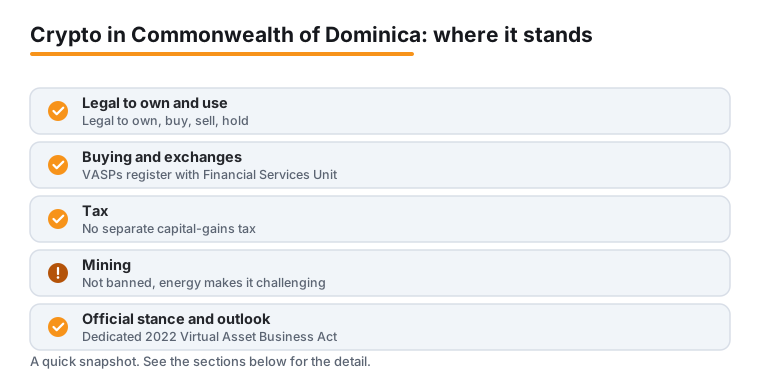
Yes. Owning, buying, selling and holding Bitcoin and other cryptocurrencies is legal for individuals in the Commonwealth of Dominica. No law prohibits private use of digital assets, and Dominica has gone further than many neighbours by enacting a specific framework to regulate businesses that deal in virtual assets.
What crypto is not is legal tender. The only legal tender in Dominica is the Eastern Caribbean dollar (XCD), issued by the Eastern Caribbean Central Bank and pegged to the US dollar at a long-standing fixed rate. A shop, hotel or service provider may choose to accept Bitcoin, but nobody is obliged to take it the way they must accept EC dollars; any crypto payment is a private commercial arrangement between the parties.
So holding and using crypto is permitted, but it sits alongside the national currency rather than replacing it. Businesses that handle crypto on behalf of other people face a separate, more demanding set of rules described below.
Who regulates crypto in Dominica?
Two bodies matter, and they play different roles.
- The Financial Services Unit (FSU), part of Dominica's Ministry of Finance, is the national regulator responsible for supervising virtual asset service providers, money services businesses and other non-bank financial entities. The FSU also acts as Dominica's Money Laundering Supervisory Authority. It is the body you register a virtual-asset business with and the authority to consult to verify whether a provider is authorised. Its official site is fsu.gov.dm.
- The Eastern Caribbean Central Bank (ECCB) is the monetary authority for the whole currency union. It issues the EC dollar, oversees commercial banks, and has helped develop harmonised virtual-asset legislation across the ECCU. The ECCB does not license individual crypto firms in Dominica, but it sets the broader monetary and financial-stability backdrop and issues public warnings about crypto scams.
Where a token behaves like an investment product or security, other financial-services laws and supervisors can also apply. For an ordinary person buying crypto for their own account, the FSU regime mostly runs in the background; it becomes directly relevant if you run a crypto business or provide services to others.
Crypto laws and frameworks in Dominica
The cornerstone of Dominica crypto regulation is the Virtual Asset Business Act, Act No. 1 of 2022, passed by Parliament and published in the Official Gazette in June 2022. It was drafted with the Eastern Caribbean Central Bank and is designed to be broadly harmonised across the ECCU, so its structure resembles the virtual-asset laws adopted by fellow OECS members such as Antigua and Barbuda and Saint Kitts and Nevis.
In broad terms, the Act requires persons who carry on virtual asset business in or from within Dominica to register with the Financial Services Unit, and it brings them within an anti-money-laundering and counter-terrorist-financing (AML/CFT) framework. Its stated aims include supporting innovation and a more cashless economy while guarding against fraud, theft, money laundering, Ponzi schemes and terrorist financing. Activities that typically fall within scope include:
- Operating a crypto exchange or trading platform
- Providing custodial or hosted wallet services
- Transferring virtual assets on behalf of others
- Issuing, offering or administering tokens, and related services
Unlike the EU, Dominica is not subject to the EU's MiCA regulation; its framework is the domestic Virtual Asset Business Act supplemented by AML/CFT laws and, for investment-type tokens, securities rules. The FSU keeps its legislation and registered-entity lists on its official site at fsu.gov.dm/legislation. The Act was put into operation by the Virtual Asset Business Regulations 2024 (S.R.O. 19 of 2024), made on 23 September 2024 and gazetted on 26 September 2024, which set the application form and fee, the ninety day decision deadline, and the capital, custody, cybersecurity and travel rule duties of a registrant.
Licensing and registration of exchanges and VASPs
Under the Virtual Asset Business Act, businesses that want to offer or operate a virtual asset business must register with the Financial Services Unit rather than simply notify it. Once approved, the FSU issues a Certificate of Registration, and registration must be renewed annually to remain valid.
The Act and the Virtual Asset Business Regulations 2024 (S.R.O. 19 of 2024) set out, among other duties:
- Local representation: a business with a registered office outside Dominica must appoint and maintain a principal representative who is ordinarily resident in Dominica, responsible for day-to-day management and for acting as the liaison with the FSU.
- Client-asset protection: the Act requires registrants to place assets in escrow to back their obligations to clients, set by section 11(1) at an amount equivalent to forty per cent of the total value of client funds held, placed in escrow with a registered trust company or with an entity or person whose business is the provision of trust or custodial services. Section 11(4) requires quarterly reports to the Authority giving the number of accounts, their value and a statement of the assets held in escrow.
- AML/CFT compliance: registrants fall under Dominica's anti-money-laundering supervision, with customer due diligence, monitoring and reporting duties.
For an individual buying crypto for personal use, registration is the platform's responsibility, not yours. If you intend to run an exchange, custodial wallet, token issuance or transfer service from Dominica, treat registration, governance and reporting as mandatory and take professional legal advice. Always confirm a provider's status against the FSU's registered-entity records before trusting it with funds.
Crypto and Bitcoin tax in Dominica
Dominica does not have detailed, crypto-specific tax legislation, so digital-asset transactions are generally assessed under the existing tax framework administered by the Inland Revenue Division (IRD). How a transaction is treated can depend on whether it looks like casual investment, business income or a trading operation, and individual facts matter.
The current position, taken from the Inland Revenue Division's published rates, is:
- Dominica does not levy a capital-gains tax. That is favourable for one-off investment gains, but it does not automatically mean crypto profits are tax-free; gains that form part of a trade or business, or income received in crypto, can fall under income tax.
- Income received in crypto, for example as payment for goods, services or employment, may be taxable as ordinary income, valued in EC or US dollars at the time of receipt. Resident personal income tax is progressive: the first XCD 30,000 of income is exempt, then 15 percent on XCD 30,001 to 50,000, 25 percent on XCD 50,001 to 80,000, and 35 percent above XCD 80,000. Larger or recurring crypto income can therefore attract tax.
- Crypto activity that amounts to a trade, such as active trading or mining carried on as a business, is generally treated as ordinary business income under those same brackets rather than as an exempt capital gain. Companies pay corporation tax at a flat rate of 25 percent, and a standard VAT of 15 percent can apply to some crypto-related services.
- Businesses that accept or deal in crypto have normal record-keeping and reporting duties.
To stay safe, keep clear records of dates, amounts, counterparties and the fiat value of each transaction, and confirm your position with the Inland Revenue Division or a qualified local tax adviser before filing. General tax background is published by the Invest Dominica Authority. These bands are the rates currently published by the Inland Revenue Division. The Budget Address for fiscal year 2026/2027, published on 6 August 2026, proposes replacing the 15, 25 and 35 percent rates with a single flat rate of 10 percent from 1 January 2027, keeping the XCD 30,000 personal allowance; see our crypto tax overview for general principles. This section is information, not tax advice.
AML and KYC rules
Anti-money-laundering and know-your-customer rules are central to Dominica's regime. The Virtual Asset Business Act places registered virtual-asset firms under AML/CFT supervision, and the Financial Services Unit serves as the country's Money Laundering Supervisory Authority. Dominica's AML framework follows the international standards promoted by the Financial Action Task Force (FATF), including the application of the so-called travel rule to virtual-asset transfers.
In practice this means any compliant platform operating in or from Dominica must:
- Verify customer identity through KYC, typically government ID and proof of address
- Conduct ongoing monitoring of transactions and customer risk
- Keep records and report suspicious activity to the authorities
For users, the practical effect is that you should expect identity checks when you sign up to any reputable service, and you should be wary of any platform that asks for no verification at all, since that is a common hallmark of scams. KYC is a legal requirement for compliant providers, not an optional step.
Buying and using crypto in practice
There is no Dominica-specific ban on individuals buying crypto, and most residents reach the market through international platforms rather than a large domestic exchange. In practice you have a few routes:
- Global exchanges: many internationally available platforms can be used from Dominica, typically funded by card or bank transfer in US or EC dollars. Availability of any specific platform changes over time and depends on each provider's own list of supported countries.
- Locally registered businesses: a service operating in or from Dominica should be registered under the Virtual Asset Business Act. Dealing with a properly registered provider gives you clearer oversight and recourse.
- Peer-to-peer: direct trades with other individuals are possible but carry higher counterparty and fraud risk and offer fewer protections.
A simple buying sequence: choose a reputable platform that accepts Dominica-based users; create and verify your account through KYC; fund it by card or bank transfer; place your order, watching fees and the exchange rate rather than just the headline price; and for anything beyond a small amount move the funds to a wallet you control, keeping the recovery phrase offline. Bitcoin ATMs are not established across the island; public ATM trackers list few or none for Dominica, and any future machine would be expected to fall under the FSU's registration and AML requirements. Whatever method you use, double-check wallet addresses before sending, because transactions cannot be undone.
Mining and remittances
No specific law in Dominica bans Bitcoin mining, and there is equally no dedicated regime encouraging it. The decisive factor is energy: Dominica is a small island system where electricity is relatively expensive compared with large grid economies, which makes energy-hungry proof-of-work mining hard to run profitably at scale. The country also has a notable geothermal and renewable-energy ambition and a strong climate-resilience focus, so any serious mining would realistically need to align with national energy policy, environmental and planning rules, and normal business and tax obligations. Small-scale or hobby mining is not prohibited, but the economics are challenging; anyone planning a real operation should model costs carefully and speak to the relevant authorities about power use and permits.
On remittances, Bitcoin and dollar-pegged stablecoins are sometimes promoted as a faster, cheaper way to send value to or from Dominica. The potential is real but comes with trade-offs: price volatility between sending and cashing out, the friction and cost of converting crypto into EC dollars, the irreversibility of transfers, and the compliance checks that services must apply. Used carefully through reputable providers and with verified addresses, crypto can be a useful remittance tool, but it is not automatically cheaper or safer than established money-transfer operators once conversion fees and risk are counted, so compare the all-in cost each time.
Recent developments (2024-2026)
Several developments shape the current picture:
- DCash wound down, then DCash 2.0 suspended. The ECCB concluded its regional central-bank-digital-currency pilot, DCash, in January 2024 after about 34 months. It then began work on a commercial successor, DCash 2.0, but the ECCB Monetary Council suspended that development in early 2026 to prioritise a regional Fast Payment System and participation in the CARICOM Payments and Settlement System, a shift set out in the Council's 112th meeting communique. The ECCB therefore does not currently operate a live digital currency or stablecoin.
- ECCB fraudulent-stablecoin warning (January 2025). The ECCB publicly warned that it is not associated with any crypto token or stablecoin on any public blockchain, after a venture on the Solana blockchain fraudulently used the ECCB logo. It urged people to verify claims and report suspicious activity.
- The TRON national-token announcement. In October 2022 the Government of Dominica announced a partnership naming the TRON protocol as a designated national blockchain infrastructure and plans for a national token (Dominica Coin / DMC). This high-profile announcement has been more publicised than visibly operational, so treat any token claiming official Dominican backing with caution and verify it through official sources.
As at August 2026 no further crypto legislation was identified in any published source. The dated items in the pipeline are the ECCB's Office of Financial Conduct, scheduled to begin operating in September 2026, the Fast Payment System and CARICOM Payments and Settlement System pilot, and a proposed flat 10 percent personal income tax from 1 January 2027.
How the regional payments shift affects crypto users
The direction of official digital money in the Eastern Caribbean has moved away from a central-bank digital currency and towards faster ordinary-money rails. After ending the DCash pilot in January 2024 and suspending DCash 2.0 in early 2026, the ECCB is focusing on a regional Fast Payment System and on joining the CARICOM Payments and Settlement System. The stated aim is to let users send EC dollars across the currency union quickly using a phone number or QR code, with settlement handled between participating central banks.
For a crypto user in Dominica this matters in two ways. First, there is no live official digital currency or ECCB stablecoin to hold, so any token claiming central-bank status should be treated as false until verified. Second, if fast EC-dollar transfers become widely available, some of the appeal of stablecoins for local and regional payments may narrow, though crypto would still sit outside the official system and outside its consumer protections. This is a policy direction rather than a finished product, so check the ECCB for the current status before assuming any service is live.
Consumer risks and protection
Consumer protection for retail crypto in Dominica is far less developed than for bank deposits or regulated investments, so the burden of caution sits largely with the user. The main risks are familiar: sharp price volatility; scams, including fraudulent schemes that falsely invoke government or central-bank backing; the irreversibility of transactions; dependence on international platforms whose access can change; and a tax and regulatory framework that is still maturing and not always crypto-specific.
The ECCB has stressed that crypto-token ventures can leave participants with significant losses and little redress, for example through pump-and-dump schemes, and has warned specifically about fraudulent use of its name and branding. Sensible habits apply everywhere: invest only what you can afford to lose, avoid borrowing to buy crypto, diversify, use reputable and registered platforms with secure storage, and be deeply sceptical of anything promising guaranteed or unusually high returns. Before trusting a provider, confirm whether it is registered with the Financial Services Unit, and independently verify any claim of official or central-bank backing. None of this is legal, tax or financial advice.
Official sources and how to verify
Because crypto rules evolve, always confirm the current position against primary official sources rather than secondhand summaries. The most useful starting points are:
- Financial Services Unit (FSU) - Virtual Asset Business, the national regulator's page on registering and verifying virtual-asset businesses.
- FSU Legislation, where the Virtual Asset Business Act and related laws are listed.
- Eastern Caribbean Central Bank - Understanding Cryptocurrency in the ECCU and the ECCB's fraudulent-stablecoin warning for the regional monetary and scam-awareness context.
- Invest Dominica Authority - Taxation for general tax background, alongside the Inland Revenue Division for tax matters.
To verify a specific provider, check whether it appears in the FSU's registered-entity records; to verify a token claiming official backing, contact the FSU or ECCB directly. This guide is general information as of 2026 and is not legal, tax or financial advice; confirm your situation with the named regulator (the Financial Services Unit), the Inland Revenue Division, or a licensed local professional before acting.
What is changing in Dominica, August 2026
No new crypto law has been passed in Dominica since the Virtual Asset Business Act, Act No. 1 of 2022. What has been missing from this page is the second half of that framework. The Act was put into operation by the Virtual Asset Business Regulations 2024, S.R.O. 19 of 2024, made by the Minister of Finance on 23 September 2024 and gazetted on 26 September 2024. Those regulations, not the Act, contain the application form, the application fee, the decision deadline, the custody rules and the travel rule. Both instruments are listed on the FSU legislation page.
No crypto bill was identified in any published source in 2026. The Budget Address for fiscal year 2026/2027, published by the Ministry of Finance on 6 August 2026 and presenting a budget proposal totalling EC$1.24 billion, makes no mention of virtual assets, cryptocurrency or blockchain.
The national regulator's most recent crypto action is a directive dated 12 May 2025. In Unauthorized Use of the Term "Crypto Bank" by Offshore Banks Licensed under the Offshore Banking Act No. 8 of 1996, signed by FSU Director Claudius Lestrade and issued under section 22(a)(iii) and (viii) of the Financial Services Unit Act No. 18 of 1996, the Financial Services Unit ordered offshore banks to stop describing themselves as a "Crypto Bank" or presenting themselves as authorised primarily to conduct cryptocurrency or digital asset banking beyond the scope of their licence. Banks were given seven calendar days to confirm in writing that non-compliant material had been removed, to supply revised marketing material and to designate the responsible compliance officer, with administrative penalties or suspension or revocation of the banking licence as the stated consequence. It is still the newest entry on the FSU advisory list. The practical lesson for a reader is that an offshore banking licence issued in Dominica is not a crypto licence.
Regionally, Dominica now chairs the currency union. Finance Minister Dr Irving McIntyre took over the chairmanship of the ECCB Monetary Council at a ceremony on 9 July 2026 and chaired the 113th Monetary Council meeting, held in Dominica on 10 July 2026. That communique records no central bank digital currency, stablecoin or crypto work of any kind. The regional agenda is the Fast Payment System, the CARICOM Payments and Settlement System pilot, and a new Office of Financial Conduct. The ECCB 2025 to 2026 Annual Report, published 26 June 2026, tells the same story and reports the EC dollar holding its fixed rate of EC$2.70 to US$1.00 with a backing ratio of 97.2 per cent as at 31 March 2026.
Inside the Virtual Asset Business Regulations 2024 (S.R.O. 19 of 2024)
These are the rules a crypto business in Dominica actually has to meet. They were made under section 22 of the 2022 Act and run to 28 regulations plus the statutory application form in the Schedule. Amounts are in Eastern Caribbean dollars, confirmed against the FSU's own published fee schedule.
| Requirement | What the rules say |
|---|---|
| Application fee | EC$10,800, non-refundable (regulation 3, and Schedule 1 to the Act) |
| Registration fee | EC$32,400, covering 1 January to 31 December (Act, section 17(2) and Schedule 1) |
| Renewal | Section 17(3) makes the renewal fee the same as the registration fee, payable on or before 31 January each year. Schedule 1 lists a late fee of EC$6,750, and section 17(5) adds two hundred and fifty dollars for each day the renewal fee is unpaid |
| Decision deadline | The Authority must decide within ninety days of receiving a complete application (regulation 4(1)). It may request more information, which the applicant has fifteen days to supply, with one extension not exceeding fifteen days (regulation 4(3) and 4(4)) |
| Client escrow | Assets equivalent to forty per cent of the total value of client funds held, placed in escrow with a registered trust company or with an entity or person whose business is the provision of trust or custodial services (Act, section 11(1)). Quarterly reports to the Authority must give the number of accounts, their value and a statement of the assets held in escrow (section 11(4)) |
| Custody of client assets | A registrant with custody of client virtual assets must maintain an amount of each type larger than its obligations to clients. Those assets are held for the client, are not the property of the registrant or third party, are not subject to creditors' claims and cannot be pledged as collateral (regulation 10). Client funds must not be transferred to the firm's own operating account or commingled (regulation 21) |
| Travel rule | Every transfer must carry the originator's name, the originator's virtual asset account number or, in its absence, a unique transaction reference number enabling traceability, and any one of the originator's physical address, National Identification Card or passport number, client identification number or place of birth, plus the beneficiary's name and account number or unique transaction reference. The originating business must not execute a transfer that does not comply (regulations 12 and 13) |
| Cybersecurity | External testing and audits by suitably qualified external experts at least annually, and more frequently if appropriate given the nature and size of the business (regulation 18(4)) |
| Insurance and risk | Policies of insurance on terms and conditions determined by the Authority (regulation 25), and an annual documented review of risk management submitted within four months after the close of each financial year (regulation 17(3)) |
| Records | Retained for a minimum of seven years, including complaint records (regulations 27 and 20(3)) |
| Operating unregistered | An offence under section 19(1)(c) of the Act. Section 19(2) makes a person liable on summary conviction to a fine of one hundred and fifty thousand dollars and imprisonment for three years |
Full text: S.R.O. 19 of 2024 and the Virtual Asset Business Act, Act No. 1 of 2022.
Which virtual asset businesses are registered with the FSU
The FSU keeps its register at fsu.gov.dm/registered-entities/virtual-asset-business. It is a search box rather than a browsable list, so nothing shows until you type. Searching a common letter such as l or t returns every entry. In August 2026 the register returns three:
- Instacoins Global Markets, 78 Independence Street, Saint George, Roseau, Dominica
- Paxum Bank Limited, Centre Cross Lane, Roseau, Dominica
- SPC RESERVES LTD, 8 Jepson Lane, St. George, Goodwill, Commonwealth of Dominica
Three registrations four years after the Act commenced is the honest measure of how developed Dominica's licensed crypto sector is. The FSU states on the same page that entities not listed on the website are not authorised to do business in the Commonwealth of Dominica, so any provider the search does not return is not registered under the Virtual Asset Business Act. Naming these three records their registration status and is not a recommendation. Search the register yourself before sending funds to any provider claiming Dominica authorisation, and treat a claim of an offshore banking licence as a separate thing entirely, as the FSU's May 2025 directive makes clear.
What is coming next, and roughly when
No crypto bill before the Dominica Parliament was identified in any published source. The dated items that will affect crypto holders and businesses come from tax policy and from the currency union, not from a new virtual asset law.
| Measure | Stage | Timing | What it would mean |
|---|---|---|---|
| Flat 10 per cent personal income tax | Announced in the Budget Address for fiscal year 2026/2027, published 6 August 2026. Not confirmed as enacted through an Income Tax Act amendment | Stated effective date 1 January 2027 | Replaces the 15, 25 and 35 per cent rates. The $30,000 personal allowance is kept, so crypto received as income, or profits from trading or mining as a business, would be taxed at 10 per cent above that allowance rather than up to 35 per cent. It does not introduce a capital gains tax |
| Removal of income tax on worldwide income | Announced in the same Budget Address | No start date stated | Residents and non-residents would be liable only on income earned in Dominica. Source rules for digital or platform income are not addressed, and no Inland Revenue Division guidance was found |
| Office of Financial Conduct | Preparations reported at the 113th ECCB Monetary Council meeting on 10 July 2026, with stakeholder consultations continuing. No adopting instrument located | Scheduled to commence operations September 2026 | A regional body which the ECCB annual report links to the regulation and supervision of non-bank financial institutions, the category the FSU supervises. Neither source says whether virtual asset businesses fall inside its perimeter |
| Fast Payment System and CARICOM Payments and Settlement System pilot | In progress, updated at the 113th meeting | No completion date given | Real time, 24/7 electronic payments across the ECCU, and instant cross-border payments in local currencies. Would narrow the practical case for using stablecoins for local and regional transfers |
| 114th ECCB Monetary Council meeting | Scheduled | Friday 30 October 2026, by videoconference from ECCB headquarters | The next scheduled point at which regional digital payment or crypto policy would be reported |
Both tax measures were announced in a budget speech. Neither has been confirmed here as enacted, so treat 1 January 2027 as the government's stated intention and check the position with the Inland Revenue Division before relying on it. This is information, not tax advice.
Frequently asked questions
Is cryptocurrency legal in the Commonwealth of Dominica?
Yes. It is legal for individuals to own, buy, sell and hold Bitcoin and other cryptocurrencies in Dominica. Crypto is not legal tender, though; the only legal tender is the Eastern Caribbean dollar, issued by the Eastern Caribbean Central Bank. Businesses dealing in virtual assets must register with the Financial Services Unit under the Virtual Asset Business Act, Act No. 1 of 2022.
Who regulates crypto in Dominica?
Crypto-asset businesses are supervised nationally by Dominica's Financial Services Unit (FSU), part of the Ministry of Finance, under the Virtual Asset Business Act, Act No. 1 of 2022. The FSU also acts as the Money Laundering Supervisory Authority. The Eastern Caribbean Central Bank (ECCB) is the regional monetary authority that issues the EC dollar and helped develop harmonised virtual-asset legislation across the currency union, but it does not license individual crypto firms.
Do I have to pay tax on crypto in Dominica?
Dominica has no detailed crypto-specific tax rules, so transactions are generally assessed under existing tax law administered by the Inland Revenue Division. Dominica has no capital gains tax, which is favourable for one-off investment gains, but income received in crypto or gains that form part of a trade or business can fall under income tax. Keep full records and confirm your position with the IRD or a qualified local adviser. This is not tax advice.
Do crypto exchanges need a licence in Dominica?
Businesses that operate a virtual asset business in or from Dominica must register with the Financial Services Unit, which issues a Certificate of Registration that must be renewed annually. Section 10(1) requires a registrant with a registered office outside Dominica to appoint and have at all times in place a person ordinarily resident in Dominica as its principal representative. Section 11(1) requires escrow assets equivalent to forty per cent of client funds held. The 2024 Regulations add capital and liquidity requirements, insurance, annual external cybersecurity testing and audit and travel rule duties, and require the Authority to decide a complete application within ninety days. Confirm the current requirements directly with the FSU before operating.
Does Dominica have its own national cryptocurrency or CBDC?
No live one. The Government of Dominica announced a TRON-based national token (Dominica Coin) in October 2022, but that initiative has been more publicised than visibly operational. Separately, the regional ECCB ran a digital-currency pilot, DCash, which was wound down in January 2024; a planned successor, DCash 2.0, was later suspended in favour of a regional Fast Payment System, so the ECCB does not currently operate a live digital currency. Be cautious about any token claiming official Dominican or ECCB backing and verify it through official sources.
Is Dominica the same as the Dominican Republic for crypto rules?
No. The Commonwealth of Dominica is a small Eastern Caribbean island that uses the Eastern Caribbean dollar, is part of the ECCB currency union, and regulates virtual-asset businesses through its Financial Services Unit. The Dominican Republic is a separate, larger country with its own currency, central bank and laws. Their crypto rules differ, so make sure any guidance you follow refers to the correct country.
How much crypto income is tax-free in Dominica?
Dominica has no separate capital-gains tax, so a one-off investment gain on crypto is generally not taxed. Crypto received as income, or profits from trading or mining carried on as a business, can be taxable under the progressive personal income tax. For residents the first XCD 30,000 of income is exempt, then 15 percent applies, rising through 25 percent to a top rate of 35 percent on higher income; companies pay corporation tax at 25 percent. Confirm the current bands with the Inland Revenue Division. This is not tax advice.
How much must a crypto business hold in escrow in Dominica?
Under the Virtual Asset Business Act, a registrant must place assets in an escrow account to back its obligations to clients. Section 11(1) of the Act sets that at an amount equivalent to forty per cent of the total value of client funds held, and the escrow must sit with a registered trust company or with an entity or person whose business is the provision of trust or custodial services. Under section 11(4) the registrant files quarterly reports to the Authority on the number and value of accounts and the assets held in escrow. Registration costs EC$10,800 to apply and EC$32,400 to register, renewable on or before 31 January each year.
Does the ECCB have a digital dollar I can use in Dominica?
Not at present. The regional DCash pilot ended in January 2024, and the planned successor DCash 2.0 was suspended in early 2026 while the ECCB prioritises a regional Fast Payment System for ordinary EC dollars and CARICOM payments integration. The ECCB has stated it does not operate any digital currency or stablecoin, and in January 2025 it warned about a token on the Solana blockchain that fraudulently used its logo. Treat any token claiming ECCB or Dominican government backing as suspect and verify it through official sources.
Which crypto companies are registered with the Financial Services Unit in Dominica?
As at August 2026 the FSU virtual asset business register returns three entries: Instacoins Global Markets, Paxum Bank Limited and SPC RESERVES LTD. The register at fsu.gov.dm/registered-entities/virtual-asset-business is a search box rather than a list, so type a common letter such as l or t to see every entry. The FSU states that entities not listed on the website are not authorised to do business in the Commonwealth of Dominica. Naming them here records registration status and is not a recommendation.
What does it cost to register a virtual asset business in Dominica?
Schedule 1 to the Virtual Asset Business Act and the FSU published fee schedule both set a non-refundable application fee of EC$10,800 and a registration fee of EC$32,400. The registration fee covers 1 January to 31 December, and section 17(3) makes the renewal fee the same amount, payable on or before 31 January each year. Schedule 1 lists a late fee of EC$6,750, and section 17(5) adds two hundred and fifty dollars for each day the renewal fee is unpaid. Under regulation 4(1) of S.R.O. 19 of 2024 the Authority must decide a complete application within ninety days. Operating without registration is an offence under section 19, and a person is liable on summary conviction to a fine of one hundred and fifty thousand dollars and imprisonment for three years.
Is crypto tax in Dominica changing in 2027?
The Budget Address for fiscal year 2026/2027, published by the Ministry of Finance on 6 August 2026, proposes replacing the 15, 25 and 35 percent personal income tax rates with a single flat rate of 10 percent from 1 January 2027, keeping the XCD 30,000 personal allowance. A related measure would remove income tax on worldwide income so that residents and non-residents are taxed only on income earned in Dominica, though no start date was given for that. Neither change creates a capital gains tax, since Dominica has none. Both were announced in a budget speech, so confirm with the Inland Revenue Division whether the enabling amendment has been passed before relying on either. This is not tax advice.
Does Dominica apply the crypto travel rule?
Yes, in law. Regulations 12 and 13 of the Virtual Asset Business Regulations 2024 require every transfer of a virtual asset to be accompanied by the originator's name, the originator's virtual asset account number or, where no such account is used, a unique transaction reference number enabling traceability, and any one of the originator's physical address, National Identification Card or passport number, client identification number or place of birth, together with the beneficiary's name and account number or unique transaction reference. The originating virtual asset business must not execute a transfer that does not comply. The information must be kept so that it is immediately available to the Authority and, on request, to any other relevant local or foreign authority. A beneficiary business must also have risk-based policies for when to execute, suspend or reject a transfer lacking the required information.
Facts reviewed: 13 August 2026. Page updated: 13 August 2026.