Home › Crypto Regulation › Dominican Republic
Bitcoin & Cryptocurrency Regulation in Dominican Republic
Quick answer — Dominican Republic, 2026
- Legal: Legal to own and trade, permitted but unregulated, not legal tender
- Tax: Income tax on gains when converted to funds, not subject to ITBIS (VAT)
- Buying: Via international exchanges, P2P, some Bitcoin ATMs, no local licensing
The Dominican Republic occupies a familiar Latin American position on digital assets: cryptocurrency is not banned, but it is not formally regulated either. Individuals are free to buy, hold, sell and trade Bitcoin, Ether, stablecoins and other tokens, yet they do so without the consumer protections that apply to bank deposits or licensed securities. As of 2026 there is no crypto-specific statute, no licensing or registration regime for exchanges, and no recognition of any token as money. The country's central bank, the Banco Central de la República Dominicana (BCRD), has stated since 2017 that the Dominican peso is the only legal tender and that virtual assets carry risks the State does not stand behind.
This guide explains how that plays out in practice in 2026: the legal status, which authorities are involved, the laws that touch the space, how the tax authority treats gains, the anti-money-laundering rules, and how residents and visitors actually buy and use crypto. It is general information as of 2026 and is NOT legal, tax or financial advice. Rules and enforcement practice evolve, so verify anything important directly with the BCRD, the tax authority (DGII), the securities regulator (SIMV) or a qualified Dominican professional before acting. For wider context, see our overview of crypto regulation and our country regulation hub.
On this page: Legal status · Who regulates it · Taxes · How to buy · Mining
Legal status: permitted but unregulated
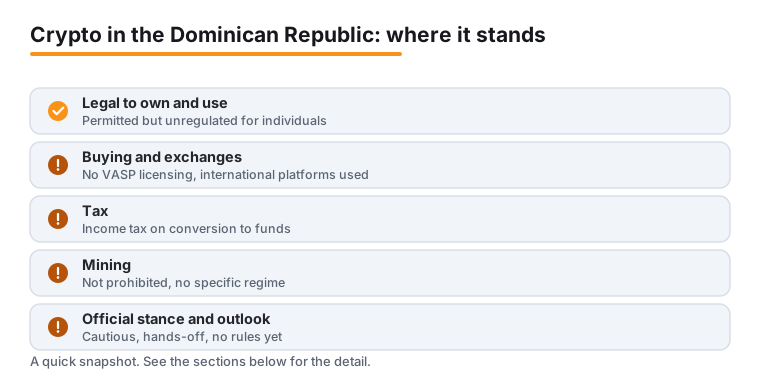
Owning, buying, selling and trading cryptocurrency is legal for private individuals in the Dominican Republic. No law prohibits citizens from holding Bitcoin, Ether, stablecoins or other tokens, and there is no penalty for trading peer-to-peer or on overseas platforms.
What crypto is not is legal tender. Articles 228 to 230 of the Dominican Constitution and Article 24 of the Monetary and Financial Law (Ley Monetaria y Financiera No. 183-02 of 21 November 2002) establish that the Dominican peso (DOP) is the sole national monetary unit with full legal-tender force, and that the Banco Central is the only entity authorised to issue currency. Because crypto is not legal tender, no person or business is obliged to accept it as payment, and it carries no State guarantee. The BCRD has summarised the position by saying virtual assets are not regulated, not supervised and do not enjoy legal protection under the current legal framework.
The accurate way to describe the picture is permitted but unregulated: you may use crypto, but you do so at your own risk and without any local investor-protection scheme. For travellers and digital nomads, this means you can hold and spend crypto freely, but should not assume merchants accept it. Pesos, US dollars and cards remain the norm.
Who regulates crypto: the authorities involved
No single regulator oversees cryptocurrency in the Dominican Republic. Instead, several existing authorities apply their general mandates:
- Banco Central de la República Dominicana (BCRD) and the Monetary Board (Junta Monetaria) are the monetary authority. They issued the foundational warning on virtual currencies on 27 June 2017 and have reiterated it since. Under the Monetary and Financial Law, regulated banks and financial institutions are not authorised to use or carry out operations with virtual assets within the Dominican payment system, and a regulated institution that took part in the commercialisation or use of such assets could be sanctioned for participating in prohibited operations.
- Superintendencia del Mercado de Valores (SIMV) is the securities regulator. Ordinary, unregistered virtual assets are explicitly not supervised by the SIMV, but a token structured as a security could fall under the Securities Market Law, and pending bill 05569-2024-2028-CD would remove the doubt by requiring every security token issuance to be authorised and registered with the SIMV (article 16) (Ley No. 249-17) and require authorisation.
- Unidad de Análisis Financiero (UAF) is the financial-intelligence unit responsible for anti-money-laundering (AML) and counter-terrorist-financing oversight under Law No. 155-17.
- Dirección General de Impuestos Internos (DGII) is the tax authority, which has issued written guidance on how crypto gains are taxed (covered below).
- ProUsuario, the financial-consumer-protection office under the Superintendencia de Bancos, publishes consumer warnings about crypto risks.
The practical effect is a cautious, hands-off framework: crypto firms are not licensed as such, and any platform operating in the country does so without a bespoke regulatory seal.
Key laws and official frameworks
There is no dedicated cryptocurrency or virtual-asset law in the Dominican Republic as of 2026. The relevant rules come from general instruments:
- Constitution, Articles 228 to 230 and Ley Monetaria y Financiera No. 183-02 (Article 24): establish the peso as the only legal tender and the BCRD as the sole issuer.
- BCRD Comunicado of 27 June 2017: states that virtual assets such as Bitcoin, Litecoin and Ethereum are not regulated, supervised or legally protected, are not foreign currency under the exchange regime, and are not legal tender, so no one is obliged to accept them as payment.
- Reglamento del Sistema de Pagos, Article 11, literal v) (adopted via Monetary Board Resolution JM 210129-02 of 29 January 2021): reiterates that virtual assets are not a guaranteed means of payment within the Dominican payment system.
- Securities Market Law No. 249-17: the general securities framework that could apply to tokens qualifying as negotiable securities (for example, tokenised assets or security tokens).
- Anti-Money-Laundering Law No. 155-17: the AML/CFT framework administered with the UAF.
- Tax Code (Código Tributario), in particular Articles 267, 268 and 297, which the DGII has cited when treating crypto gains as taxable income.
Treat any claim that the country has "approved new Bitcoin regulations" with scepticism unless it cites an official BCRD, SIMV or congressional source. As of 2026, no comprehensive crypto statute has been enacted.
Licensing and registration of exchanges (VASPs)
The Dominican Republic has no Virtual Asset Service Provider (VASP) licensing or registration regime. There is no crypto-exchange licence to apply for, no register of authorised platforms, and no regulator that vets exchanges, custodians or brokers as such. This sets the country apart from jurisdictions that have built dedicated VASP frameworks.
In practice, Dominicans use globally available exchanges and peer-to-peer markets rather than locally licensed venues. A business offering crypto services in the country is not licensed for that activity, even if it is otherwise registered as a company and meets general AML obligations. Because no authority issues a crypto-specific seal of approval, be wary of any platform that claims to be "licensed" or "authorised" by a Dominican regulator to deal in crypto; that authorisation does not exist for ordinary virtual assets. The exception is genuine securities activity, where the SIMV is the competent authority and unauthorised public offerings have led to enforcement action.
How crypto gains are taxed (DGII)
There is no dedicated crypto tax law, but the DGII has addressed the issue in written guidance (consultas). The tax authority has stated that the buying, selling and investment of digital assets has no specific fiscal regime, yet when crypto is converted into liquid funds (money recognised in the country), the resulting income is taxable because it represents an increase in wealth (incremento patrimonial). The DGII grounds this in Articles 267, 268 and 297 of the Tax Code.
The standard Income Tax (Impuesto Sobre la Renta, ISR) applies to such gains. As a general reference, the corporate ISR rate is 27 percent, while individuals are taxed under a progressive scale; the exact treatment depends on whether the activity looks like trading commissions or a capital gain, and on the taxpayer's residency and circumstances. The DGII has also indicated that proceeds from selling crypto are not subject to ITBIS (the value-added tax), because virtual assets are treated as intangible goods rather than a tangible product or a service rendered in Dominican territory.
Note that the DGII's consulta answers are binding only for the specific taxpayer who asked, based on the exact facts presented. Do not rely on a specific rate you read online; confirm your own position with the DGII or a qualified Dominican tax adviser. For general background, see our guide to crypto taxes.
AML and KYC rules
The Dominican Republic's anti-money-laundering and counter-terrorist-financing regime is set by Law No. 155-17 and supervised with the Unidad de Análisis Financiero (UAF). The law creates obligated subjects (financial institutions, businesses and designated professionals) who must perform customer due diligence, keep records for at least ten years, appoint a compliance officer, and report suspicious activity. Cash transactions above the equivalent of roughly US$15,000 must be reported to the UAF.
There is, however, no crypto-specific AML rule that designates exchanges as obligated subjects, and there is no national crypto KYC standard. In practice, the identity verification you encounter comes from the platforms themselves: reputable international exchanges run their own KYC (identity documents, proof of address, sometimes source-of-funds checks) to meet their home-jurisdiction obligations, not because a Dominican rule requires it. AML obligations can still intersect with crypto where a regulated institution, a designated professional or a large cash transaction is involved.
Buying and using crypto in practice
Several practical routes exist, none unique to the Dominican Republic:
- International exchanges. Globally available platforms generally accept Dominican users and support card or bank-transfer funding after identity verification. Availability, supported payment methods and tradable assets can change by region, so confirm current terms on the platform itself.
- Peer-to-peer (P2P) trading. P2P marketplaces let you buy directly from another person, often paying in pesos or US dollars by local transfer or cash. P2P is popular where banking rails for crypto are limited, but it carries counterparty and scam risk; use platforms with escrow and reputation systems, and never release funds before confirming receipt.
- Bitcoin ATMs and walk-in offices. A small number of crypto ATMs and physical exchange offices operate in cities and tourist hubs such as Santo Domingo, Santiago and Punta Cana. Availability changes frequently and fees are typically higher than online, so check a live directory before relying on one.
Crypto and stablecoins are also used as one channel for cross-border remittances, which matter to the Dominican economy. Recipients still need a reliable way to convert to pesos or US dollars, and there is no consumer protection if a platform fails, so compare cost and counterparty risk against established remittance providers. Whatever the method, expect KYC on regulated platforms, watch fees and spreads, move significant holdings into a wallet you control, and keep records for tax purposes.
Mining in the Dominican Republic
Bitcoin mining is not specifically prohibited, and there is no dedicated mining licence or ban. The decisive factor for anyone considering it is electricity: the country's grid has historically faced reliability and cost challenges, and power tariffs largely determine whether mining is profitable. Commercial-scale mining lives or dies on cheap, stable energy.
The Dominican Republic has been expanding renewable generation, which has prompted interest in pairing mining with solar, wind or surplus power. Would-be miners should also weigh import duties on equipment, business registration, and the general tax and AML obligations that apply to any commercial activity. Because there is no mining-specific regime, treat mining as a normal energy-intensive business and get local advice on permits and electricity contracts before investing.
Recent developments and outlook
Two bills, 05400-2024-2028-CD and 05569-2024-2028-CD, are before the Chamber of Deputies Finance Committee, and both would license crypto service providers rather than ban them, but nothing comprehensive has been enacted. Officials and commentators have increasingly discussed the need to address crypto, including from a tax-policy angle: in 2025 the DGII publicly emphasised that crypto-assets should be addressed fiscally in the Dominican Republic independently of their relationship with the financial system. The BCRD's strategic planning has likewise flagged the study of digital currencies and payment innovation, and a future update of the Monetary and Financial Law to reflect new financial technologies.
On the usage side, stablecoins have grown as a channel for savings and cross-border transfers across Latin America. Industry reports for 2025 describe stablecoins as a large and growing share of crypto activity in the region, driven partly by remittance demand and demand for dollar access. Remittances are a large part of the Dominican economy, so any move toward cheaper digital-dollar transfers is relevant, but the legal status of these tools in the country has not changed: they remain unregulated and unprotected locally.
Pressure from international AML standards and the growth of regional digital-asset rules point toward eventual licensing and consumer-protection frameworks, but timing is uncertain. Congress is the place to watch. Both crypto bills missed their Finance Committee periods in May 2026 but are still recorded as live rather than lapsed, and the next ordinary legislature opens on 16 August 2026. Until one of them clears both chambers and is promulgated, the position described above remains in force. Verify current developments against the official sources below rather than relying on secondary reports.
Consumer risks and protection
The central risk in the Dominican Republic is the regulatory vacuum. Because crypto is unregulated rather than protected, users carry the full weight of platform failure, fraud, hacking and lost keys with no domestic safety net, and banking access can be a friction point because regulated institutions are generally kept away from crypto.
ProUsuario, the financial-consumer-protection office under the Superintendencia de Bancos, has warned that anyone acquiring virtual assets does so entirely at their own risk, that anyone can announce a digital issuance (making legitimate offerings hard to distinguish from scams), that assets promising unusually high returns are especially risky, and that extreme volatility means an investment can lose all its value. Dominican authorities and media have documented crypto-related fraud, often through pyramid schemes and unauthorised investment platforms; one widely reported case involved arrests over a scheme that promised crypto returns without SIMV authorisation.
Sensible principles apply: never invest more than you can afford to lose, favour reputable and well-established platforms, secure your own keys, keep records for tax purposes, and be deeply sceptical of guaranteed-return offers. This is general information as of 2026 and not investment advice; consult a licensed Dominican professional about your own situation.
Official sources and how to verify
Because this area is unregulated and evolving, always confirm the current position against primary official sources rather than secondary summaries. The key bodies and their official websites are:
- Banco Central de la República Dominicana (BCRD) and its official communique on cryptocurrencies and virtual assets (monetary authority and the foundational 2017 warning).
- Dirección General de Impuestos Internos (DGII) (tax authority; publishes the consultas on the fiscal treatment of crypto).
- Superintendencia del Mercado de Valores (SIMV) (securities regulator; relevant to security tokens and public offerings).
- Unidad de Análisis Financiero (UAF) (AML/CFT under Law No. 155-17).
- ProUsuario (financial-consumer protection and crypto risk warnings).
To verify a claim, look for a dated official document (a comunicado, resolución, circular, consulta or law number) on these sites. This guide is general information as of 2026 and is not legal advice; for your specific situation, confirm with the named regulator or a qualified Dominican lawyer or accountant. See also our broader crypto regulation overview.
What is changing: two crypto bills are now in the Chamber of Deputies
The Dominican Republic still has no crypto law in force, but for the first time it has crypto bills formally in Congress. Two draft laws were deposited in the Chamber of Deputies in March and April 2026 and both were referred to its Permanent Finance Committee (Comisión Permanente de Hacienda). Neither has been voted on, and neither produced a committee report before the first ordinary legislature closed on 27 July 2026. The Chamber's own bill tracker still records each as VIGENTE (live) rather than PERIMIDO (lapsed), with its last status update logged on 24 July 2026. The next ordinary legislature opens on 16 August 2026 under Article 89 of the Constitution, which fixes the two annual sittings at 27 February and 16 August and gives each a duration of 150 days.
| Bill | Sponsor | Deposited | Where it stands in August 2026 |
|---|---|---|---|
| 05400-2024-2028-CD, Proyecto de ley de prevención, control y regulación de las criptomonedas | Deputy Carlos de Pérez Juan (Fuerza del Pueblo, La Romana); the deposited text credits its authorship to Mag. Argenis García del Rosario | 16 March 2026 | Referred to the Finance Committee on 7 April 2026. Committee period expired 6 May 2026 with no report. Recorded as live. |
| 05569-2024-2028-CD, Proyecto de ley de activos digitales y criptoactivos | Deputy Jorge Frías (PRM, Santo Domingo), who died on 7 August 2026 | 9 April 2026 | Referred to the Finance Committee on 15 April 2026. Committee period expired 4 May 2026 with no report. Recorded as live. |
The Finance Committee, chaired by deputy Francisco Javier Paulino, held a working session with financial and technology sector guests in late May 2026, at which the general manager of Finlabs, José Frank Almeyda Pastor, recommended unifying the two texts and running a 60 day public consultation. At a later session reported on 8 June 2026, Paulino said the two bills had been merged for study. No merged text has been deposited, and the Chamber's tracker still lists two separate initiatives, each with its own number and status.
What the two bills would actually require
The two texts take different routes to the same destination, a licensed market supervised by the securities regulator. Neither is law today, so nothing below applies yet. These are the obligations each would create, by article of the text as deposited.
- Licensing. Bill 05400 would bar anyone from acting as a crypto service provider (exchanges, custodians, payment processors, wallet providers) without the "calidad certificante" granted by the securities superintendency, and would create a special provider registry (articles 4 and 5). Article 4(11) expressly excludes people who use crypto as end users in payment transactions. Bill 05569 would instead require a PSAD licence, with simplified scales for startups and small entities (article 12), covering custody, exchange, buying and selling, tokenisation, staking and DeFi services (article 13), plus segregation of client assets from company assets (article 15).
- Foreign platforms. Bill 05400 article 9 extends the certification requirement to the digital platforms of non-domiciled multinational companies. Bill 05569 article 50 requires foreign platforms to register with the SIMV to operate in the country.
- Who would supervise. Bill 05569 would create a Consejo Nacional de Activos Digitales y Criptoactivos chaired by the Superintendente del Mercado de Valores, sitting with the Superintendente de Bancos, the Governor of the Banco Central, the director general of the Unidad de Análisis Financiero and the director general of the DGII (article 7). Bill 05400 creates no new body and leaves supervision with the securities superintendency and the monetary authorities.
- Banks. Bill 05400 article 13 says financial intermediaries may open accounts for crypto users but that this remains at their discretion. It would not compel banks to serve crypto customers.
- Tax. Bill 05400 treats crypto as a digital asset taxable under Tax Code articles 267, 268 and 297, with the tax obligation arising on any gain above fifty thousand Dominican pesos (RD$50,000.00). It treats crypto to crypto exchanges as capital gain or loss events, splits income into gains on transmission, gains without transmission (airdrops and referral rewards), capital yield (staking) and economic activity (mining and trading for third parties), exempts hard fork receipts whose market value at the fork is zero, and lets crypto losses offset unrelated gains and carry forward two years (articles 14 to 16). Bill 05569 article 53 would apply capital gains tax, ITBIS on services and other taxes coordinated by the DGII through regulation, and article 54 would make licensed providers report transactions to the DGII.
- Anti money laundering. Bill 05400 article 11 would require risk disclosure, KYC and AML programmes and reporting of suspicious transactions to the financial intelligence unit, and article 18 would make tax fraud committed through crypto a predicate offence for money laundering under Law 155-17 of 1 June 2017.
- Mining and crypto ATMs. Bill 05569 would require a PSAD licence for proof of work and proof of stake validation (article 30), while the Ministerio de Energía y Minas would set the technical parameters and energy consumption limits applying to mining (article 31), with possible fiscal incentives for clean energy use (article 55). It would also require crypto ATMs to be registered and licensed, with the SIMV regulating their location and density (article 51).
- Penalties. Bill 05569 article 49 sets fines of 10 to 100 public sector minimum wages plus suspension and revocation of the licence, without prejudice to applicable criminal penalties.
Both texts as deposited are downloadable from the Chamber's system: bill 05400-2024-2028-CD and bill 05569-2024-2028-CD.
When either bill could take effect
Neither bill names a commencement date, but each writes its own lead time into the text. Bill 05400 has an 18 month vacatio legis: it would enter into force 18 months after publication in the Gaceta Oficial (article 22), with the DGII given 90 days to issue the tax rules and the Executive 90 days to create the provider registry regulation (articles 20 and 21). Bill 05569 would enter into force on promulgation and publication, subject to the periods set in the Civil Code (article 58), but its licensing regime depends on implementing regulations the SIMV has 180 days to draft and propose to the Executive (article 56), and the Bolsa de Valores de la República Dominicana would get 18 months from entry into force to adapt its rules and infrastructure (article 52). Both create a regulatory sandbox, which is the route firms would use first.
The binding constraint is the congressional calendar, not the drafting. Both bills missed their Finance Committee periods in May 2026 and neither reached the floor during the first ordinary legislature, which closed on 27 July 2026. Both are still recorded as live, so the remaining sequence is a committee report, a vote in the Chamber of Deputies, then the full process again in the Senate, then promulgation. Bill 05569 lost its sole sponsor when deputy Jorge Frías died on 7 August 2026, after the date of the tracker's last status update. Nothing in the public record commits Congress to a date, and no crypto bill has yet been voted on in either chamber.
A Constitutional Court case is testing the regulatory vacuum
Running alongside Congress, the Tribunal Constitucional is holding a direct action of unconstitutionality brought by Marino Marrero Báez. He asks the court to declare an unconstitutional legislative omission arising from the prolonged absence of express legal regulation of virtual assets, including stablecoins, and to strike down administrative practices and general criteria that impose restrictions or de facto blocks on digital asset use through automatic exclusions and implicit prohibitions. His case is that these restrictions are applied "sin acto administrativo formal, sin procedimiento y sin motivación individualizada", that is, without a formal administrative act, without procedure and without individualised reasoning, and that the result has been exclusion from the formal financial system. The court left the case in estado de fallo, meaning ready for judgment, in late April 2026. No ruling was found in the sources checked for this update.
Frequently asked questions
Is cryptocurrency legal in the Dominican Republic?
Yes. Individuals can legally buy, hold, sell and trade crypto. However, under the Constitution (Articles 228 to 230) and the Monetary and Financial Law No. 183-02, the Dominican peso is the only legal tender, so crypto is not money, is not State-backed, and is not regulated. You use it at your own risk and without local investor protections.
Who regulates crypto in the Dominican Republic?
No single regulator. The Banco Central (BCRD) and Monetary Board set monetary policy and issued the 2017 warning that crypto is not legal tender; the SIMV may have jurisdiction if a token is a security under Law No. 249-17; the UAF oversees anti-money-laundering rules under Law No. 155-17; the DGII handles tax; and ProUsuario publishes consumer warnings. None licenses crypto exchanges as such.
Does the Dominican Republic tax cryptocurrency?
There is no dedicated crypto tax law, but the DGII has stated in written guidance that when you convert crypto into liquid funds, the income is taxable as an increase in wealth under Articles 267, 268 and 297 of the Tax Code, and the standard Income Tax (ISR) applies. Proceeds are not subject to ITBIS (VAT) because crypto is treated as an intangible good. The exact treatment depends on your circumstances, and DGII consulta answers bind only the specific taxpayer who asked, so confirm with the DGII or a qualified Dominican tax adviser.
Do crypto exchanges need a licence in the Dominican Republic?
No. There is no Virtual Asset Service Provider (VASP) licensing or registration regime, no crypto-exchange licence and no official register of authorised platforms. Dominicans typically use international exchanges and peer-to-peer markets. Be wary of any platform claiming to be "authorised" by a Dominican regulator to deal in ordinary crypto, because that authorisation does not exist; the SIMV is only competent for genuine securities activity.
Are there AML and KYC rules for crypto?
The general AML/CFT regime is Law No. 155-17, supervised with the UAF, which imposes due-diligence, record-keeping and suspicious-transaction-reporting duties on obligated subjects and requires reporting of cash transactions above roughly US$15,000. There is no crypto-specific AML rule or national crypto KYC standard, so the identity checks you encounter come from the exchanges themselves meeting their own home-jurisdiction obligations.
Is the Dominican Republic about to pass a new crypto law?
As of 2026, no comprehensive crypto statute has been enacted. Officials have discussed addressing crypto, including the DGII's 2025 comments on taxing crypto-assets and the BCRD's interest in studying digital currencies and updating the Monetary and Financial Law. The direction looks like gradual formalisation rather than a ban, but timing is uncertain. Verify any reported change against the official BCRD, SIMV or congressional sources before relying on it.
Can Dominican banks offer crypto services?
No. Regulated banks and other financial institutions supervised by the BCRD are not authorised to use or carry out operations with virtual assets within the Dominican payment system. A regulated institution that took part in dealing with crypto could be sanctioned under the Monetary and Financial Law for participating in prohibited operations. This is why crypto activity in the country happens through international platforms and peer-to-peer trading rather than through local banks, and why banking access for crypto can be a friction point.
Are stablecoins like USDT used in the Dominican Republic?
Stablecoins are used in the Dominican Republic and across Latin America, mainly as a way to hold value in US dollars and to send or receive cross-border transfers, which matter given the size of remittances to the country. Industry reports for 2025 describe stablecoins as a large and growing share of crypto activity across Latin America. Legally, though, stablecoins are treated like any other virtual asset here: they are not legal tender, not regulated and not protected, so users carry the counterparty and platform risk themselves.
Is crypto legal in the Dominican Republic in August 2026?
Yes. Owning, buying and trading crypto is legal, and there is still no crypto-specific law in force. What changed in 2026 is that two bills to regulate it are formally before the Chamber of Deputies: 05400-2024-2028-CD, deposited 16 March 2026, and 05569-2024-2028-CD, deposited 9 April 2026. Both sit in the Permanent Finance Committee, neither has been voted on, and neither had produced a committee report by August 2026.
When will the Dominican Republic have a crypto law?
No date has been set and no crypto bill has been voted on in either chamber. Both bills missed their Finance Committee periods in May 2026 but are still recorded as live, so the remaining steps are a committee report, a Chamber vote and then the full process again in the Senate. The next ordinary legislature opens on 16 August 2026. Even after promulgation there is a delay built into each text: bill 05400 has an 18 month vacatio legis, and bill 05569 depends on SIMV implementing regulations due within 180 days.
Would I need a licence to run an exchange or a crypto ATM if these bills pass?
Yes under either text, though the mechanism differs. Bill 05400 would require a certification known as the calidad certificante from the securities superintendency for exchanges, custodians, payment processors and wallet providers, and extends that to the platforms of non-domiciled multinational companies. Bill 05569 would require a PSAD licence, would make foreign platforms register with the SIMV, and would require crypto ATMs to be registered and licensed, with the SIMV regulating where they can be placed and how densely. Neither requirement exists today.
Do the pending bills change how crypto is taxed?
They would, but neither is in force, so today's default treatment still applies. Bill 05400 keeps gains inside the existing income tax under Tax Code articles 267, 268 and 297 but adds a threshold so the obligation arises on gains above RD$50,000, treats crypto to crypto exchanges as capital gain or loss events, taxes airdrops, staking yield and mining under separate categories, exempts hard fork receipts valued at zero at the fork, allows crypto losses to offset unrelated gains and carry forward two years, and gives the DGII 90 days to publish the rules. Bill 05569 would add ITBIS on crypto services and would make licensed providers report transactions directly to the DGII.
Is anyone challenging the lack of regulation in court?
Yes. The Tribunal Constitucional left in estado de fallo, meaning ready for judgment, a direct action of unconstitutionality brought by Marino Marrero Baez in late April 2026. It asks the court to declare an unconstitutional legislative omission over the prolonged absence of any law on virtual assets, and to strike down administrative practices that restrict digital asset use without a formal administrative act, without procedure and without individualised reasoning. No ruling was found in the sources checked.
Facts reviewed: 13 August 2026. Page updated: 13 August 2026.