Home › Crypto Regulation › Bahamas
Bitcoin & Cryptocurrency Regulation in Bahamas
Quick answer — Bahamas, 2026
- Legal: Legal to own and use, not legal tender; businesses register under the DARE Act 2024
- Tax: No personal income or capital gains tax; VAT and CARF reporting can apply
- Buying: Via SCB-registered or reputable international exchanges, with KYC
The Bahamas is one of the most actively regulated jurisdictions for digital assets in the Western Hemisphere. The country was an early mover: the Central Bank launched the world's first nationally deployed retail central bank digital currency, the Sand Dollar, in 2020, and the Securities Commission built a dedicated licensing regime for crypto businesses through the Digital Assets and Registered Exchanges Act. After the 2022 collapse of FTX, which had based much of its operation in Nassau, Bahamian authorities replaced that framework with a substantially expanded law, the Digital Assets and Registered Exchanges Act, 2024 (the DARE Act 2024), which came into force on 29 July 2024.
This page explains the current legal status of Bitcoin and other cryptocurrencies in the Bahamas, who regulates the sector, how digital assets are licensed and taxed, and what individuals and businesses should know in practice. This is general information as of 2026 and is NOT legal, tax, or financial advice. Crypto laws change quickly, so verify any specific point with the Securities Commission of The Bahamas, the Central Bank, or a qualified local professional before acting. For background, see our overview of crypto regulation.
On this page: Legal status · Who regulates it · Taxes · How to buy · Mining
Is Bitcoin and crypto legal in the Bahamas?
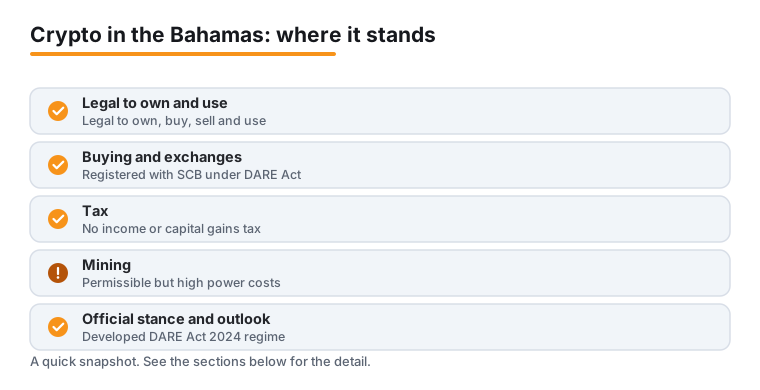
Yes. Owning, buying, selling and using Bitcoin and other cryptocurrencies is legal in the Bahamas. There is no prohibition on individuals holding digital assets, and the country has deliberately positioned itself as a regulated home for crypto and fintech businesses rather than banning the sector.
Legal does not mean unregulated. Bitcoin is not legal tender in the Bahamas. The official currency is the Bahamian dollar (pegged one-to-one to the US dollar), and the only government-issued digital currency is the Sand Dollar, the Central Bank's digital version of the Bahamian dollar. Cryptocurrencies are instead treated as digital assets, and any business that conducts digital asset activities in or from the Bahamas must be registered with and supervised by the Securities Commission.
For an ordinary resident or visitor, the practical takeaway is simple: you can legally use crypto, but you should expect the platforms you use to ask for identity verification and to operate under registration.
Who regulates crypto in the Bahamas?
The principal regulator for digital assets is the Securities Commission of The Bahamas (SCB). The SCB registers and supervises digital asset businesses, sets fit-and-proper standards, and enforces investor-protection, conduct and systems-and-controls requirements under the DARE Act. Any person engaging in digital asset business in or from the Bahamas must be registered with the SCB.
The Central Bank of The Bahamas is responsible for monetary policy, the Bahamian dollar, exchange controls and the wider payments system, and it issues and oversees the Sand Dollar. The Department of Inland Revenue, part of the Ministry of Finance, administers Value Added Tax, business licence fees and other taxes.
You can confirm the regulator and its published guidance directly at the Securities Commission of The Bahamas DARE pages and the Central Bank of The Bahamas.
Key laws and frameworks
The cornerstone of crypto regulation in the Bahamas is the Digital Assets and Registered Exchanges Act, 2024 (DARE Act 2024). It replaced the original DARE Act 2020 and came into force on 29 July 2024. It is the framework in force today, supported by subsidiary rules including the Digital Assets and Registered Exchanges (Fees) Rules, 2024.
The DARE Act 2024 widened the scope of regulated activity well beyond simple trading. Areas brought within supervision include:
- Operating a digital asset exchange or trading platform
- Custody of clients' digital assets, including custodial wallet services
- Advisory and asset-management services involving digital assets
- Digital asset derivatives
- Staking services and the operation or management of staking pools, with a first-of-its-kind disclosure regime
- The issuance of digital tokens and offerings, subject to disclosure and financial-reporting standards
The Act also creates a defined regime for stablecoins, with rules on acceptable reserve assets, segregation, reporting and redemption. Notably, the issuance of algorithmic stablecoins is expressly prohibited, a direct response to instability seen elsewhere in the market. The SCB has said the law is aligned with international standards, including IOSCO recommendations for crypto and digital assets and the Financial Action Task Force (FATF) recommendations on anti-money-laundering.
Because the rules are detailed and still maturing, businesses in particular should take local legal advice rather than rely on summaries. See our general guide to crypto regulation for wider context.
Licensing and registration of exchanges and VASPs
Under the DARE Act 2024, any business carrying on digital asset activities in or from the Bahamas must be registered with the Securities Commission. The registration categories used under the Act cover the main lines of digital asset business, including:
- Digital Asset Exchange, operating a platform for trading digital assets
- Custodial Wallet Provider, safekeeping and storage of digital assets for clients
- Broker-Dealer, acting as an intermediary in digital asset transactions
- Staking and yield services, offering staking or other yield-generating arrangements
- Issuer of digital assets, making token offerings subject to disclosure and reporting standards
Applicants must demonstrate fit-and-proper standards and sound systems and controls, and there are minimum capital and reporting requirements that vary by category. The SCB requires registered firms to appoint key officers, including a Chief Executive Officer, a Compliance Officer and a Money Laundering Reporting Officer. Application, registration and annual renewal fees are set out in the Digital Assets and Registered Exchanges (Fees) Rules, 2024 and vary by category and activity. Industry advisers report that a straightforward registration commonly takes around three to six months, with more complex business models taking longer, depending on the completeness of the application.
The 2024 framework also imposes stricter client-asset protection. Custodians must keep digital assets separate and insulated from the firm's own estate and segregate client holdings from other non-client assets, a direct response to the commingling of customer and corporate funds seen in the FTX collapse. Before depositing funds, check that a platform is genuinely registered. The SCB publishes information about regulated firms on its website.
Crypto and Bitcoin tax in the Bahamas
The Bahamas is a well-known low-tax jurisdiction. It does not levy a personal income tax, a capital gains tax, or a general corporate income tax. As a result, an individual resident faces no Bahamian capital gains charge at all for selling cryptocurrency at a profit, because The Bahamas levies neither capital gains tax nor personal income tax and neither appears among the taxes the Department of Inland Revenue administers.
That headline should not be mistaken for crypto being entirely tax-free. Several points matter:
- The Bahamas operates a Value Added Tax (VAT), administered by the Department of Inland Revenue. VAT and other indirect taxes generally apply to goods and services supplied in the Bahamas, and can affect some crypto-related business activity, though the sale of digital assets themselves is not typically treated as a VAT-able supply.
- Digital asset businesses are subject to business licence fees and the regulatory fees and reporting costs of the DARE regime.
- If you are tax-resident in another country, your home jurisdiction may tax your crypto gains or income regardless of Bahamian rules. US citizens, for example, are generally taxed on worldwide income.
- The Bahamas is among the jurisdictions that have committed to the OECD's Crypto-Asset Reporting Framework (CARF), an international standard for automatic exchange of crypto-account information between tax authorities. No start date for CARF data collection has been set out in any published Bahamian statute, statutory instrument or Competent Authority notice as at August 2026, and the Competent Authority's tax reporting portal still covers FATCA and the Common Reporting Standard only. No income or capital gains tax is created by CARF; it is about transparency and information sharing, so gains that are taxable in your home country may become more visible to that country's tax authority.
This section is informational only and not tax advice. The concrete numbers are these. The Bahamas levies no personal income tax and no capital gains tax, so a resident selling crypto at a gain owes no Bahamian tax on that gain. Value Added Tax applies at a standard rate of 10 percent, with a zero rate of 0 percent for some supplies; it was introduced in January 2015 and is administered by the Department of Inland Revenue, which also administers Business Licence, Real Property Tax, Stamp Duty, Condo-Hotel Tax and Vacation Rental Tax. Digital asset businesses pay fees to the Securities Commission set by the Digital Assets and Registered Exchanges (Fees) Rules, 2024, starting at $12,500 a year for a digital asset business and $18,750 a year for a digital asset exchange. Confirm your position with the Bahamas Department of Inland Revenue or a qualified tax adviser. For general background, see our guide to crypto taxes.
AML, KYC and consumer-protection rules
Anti-money-laundering and counter-terrorist-financing (AML/CFT) obligations apply to registered digital asset businesses, drawn from the Bahamas' broader financial-services rulebook. Applicants and licensees must apply customer due diligence and KYC procedures, assess and manage risks, monitor for and report suspicious activity, and comply with laws including the Proceeds of Crime Act, the Anti-Terrorism Act and the Financial Transactions Reporting Act. Firms must also appoint a qualified Money Laundering Reporting Officer who liaises with the authorities.
For users, the practical effect is that any compliant platform serving the Bahamian public will require full identity verification when you open an account, fund it, or withdraw, and may ask about the source of funds for larger transactions. The DARE Act 2024 also strengthened investor-protection and disclosure requirements, including fit-and-proper standards for issuers and enhanced financial reporting. The SCB has stated the regime is aligned with FATF recommendations.
Buying and using crypto in practice
Residents and visitors can buy crypto through international exchanges and through platforms registered locally. Any platform that markets digital asset services to the Bahamian public is expected to hold the appropriate registration under the DARE Act and to be supervised by the Securities Commission.
A typical path looks like this, and is a general guide rather than an endorsement of any provider:
- Choose a platform. Prefer a reputable exchange that is transparent about its registration status, ideally registered locally under the DARE Act or in another well-regulated jurisdiction.
- Create and verify your account. Expect to provide identity documents and proof of address to satisfy KYC requirements.
- Fund your account. Deposit Bahamian or US dollars by the methods the platform supports, keeping exchange-control rules in mind for larger sums.
- Place your order after reviewing fees and the exchange rate.
- Secure your holdings. For anything beyond small amounts, consider moving funds to a wallet you control, such as a hardware wallet, and keep your recovery phrase offline and private.
The Bahamas maintains exchange-control rules administered by the Central Bank that govern the movement of foreign currency by residents. These can interact with how crypto is bought, sold and moved across borders, so residents in particular should understand them before moving large sums. Be alert to scams: unrealistic returns, pressure to act fast, and unsolicited investment managers are common red flags.
The Sand Dollar (central bank digital currency)
The Sand Dollar is the Bahamas' central bank digital currency, a digital version of the Bahamian dollar issued by the Central Bank of The Bahamas through authorised financial institutions. Launched nationally in 2020, it was the world's first fully deployed retail CBDC, intended to widen access to regulated payments and improve financial inclusion for unbanked and underbanked communities.
The Sand Dollar should not be confused with cryptocurrencies such as Bitcoin. The Sand Dollar is a centralised, government-issued liability pegged one-to-one to the Bahamian dollar, not a decentralised, market-priced crypto asset. Adoption has so far remained modest, and the Central Bank has signalled it expects usage to grow as efficiency and acceptance improve. Official information is published at the Sand Dollar website.
Bitcoin mining in the Bahamas
There is a specific Bahamian provision on mining, and it is a prohibition. Section 8 of the DARE Act 2024 is headed Prohibition on mining of digital assets and provides that no person shall carry on the mining of digital assets as a business in or from within The Bahamas, or purport to do so, except where the mining is ancillary to a digital asset business registered under section 9, or where the person carries on proprietary mining, which section 8(2) defines as mining of digital assets on a person's own behalf. Mining on your own behalf is therefore permitted; running mining as a business is not, unless it sits inside a registered digital asset business.
The bigger constraint is practical and economic. The Bahamas is a tropical archipelago that relies heavily on imported fuel for electricity, and power costs are comparatively high. High and variable electricity prices make large-scale, energy-intensive Bitcoin mining far less attractive than it is in jurisdictions with cheap or surplus power, and cooling adds further cost. Growing interest in renewable energy, particularly solar, could in theory make some small-scale mining more viable over time, but for now the Bahamas is not a notable mining destination. Anyone considering it should model electricity costs carefully and check local rules on power supply, import of equipment, and any business-licensing or environmental requirements.
Recent developments (2024 to 2026)
The defining recent development is the DARE Act 2024, which the Securities Commission announced in late July 2024 and which came into force on 29 July 2024. It replaced the DARE Act 2020 and was widely read as the Bahamas reaffirming its ambition to be a credible, well-supervised crypto hub after the reputational damage of the FTX failure. Key changes included an expanded definition of digital asset activities (covering staking, custody, advisory and derivatives), a stablecoin regime with a ban on algorithmic stablecoins, stronger client-asset segregation, and enhanced investor-protection and disclosure standards.
Through 2025 and into 2026, the focus has been on implementation and supervision under the new Act, including registration of digital asset businesses, the Fees Rules, 2024, and continued alignment with IOSCO and FATF standards. The Central Bank has continued to develop the Sand Dollar.
A further development is on the tax-transparency side. The Bahamas has committed to the OECD's Crypto-Asset Reporting Framework (CARF), the global standard for automatic exchange of information on crypto accounts. No Bahamian statute, statutory instrument or Competent Authority notice imposing CARF due diligence or reporting on crypto asset service providers had been published as at 4 August 2026. The Bahamas Competent Authority's tax reporting portal covers the Foreign Account Tax Compliance Act and the Common Reporting Standard only, and its most recent notice, dated 27 May 2026, addresses FATCA and CRS deadlines without mentioning crypto assets. This does not introduce a new crypto tax in the Bahamas, but it means account information can be shared with tax authorities in other countries. Because the framework is detailed and still maturing, the most reliable way to track changes is to monitor SCB publications directly rather than relying on secondary summaries.
Consumer risks and protection
The Bahamas offers an unusually developed regulatory environment for digital assets, but real risks remain that users should weigh:
- Market volatility. Crypto prices can move sharply, and losses can be significant and rapid.
- Platform and counterparty risk. The FTX failure, which originated in a Bahamas-based group, showed that even large, prominent firms can collapse. Use platforms that segregate client assets and are genuinely registered.
- Regulatory change. The DARE framework has already been overhauled once and continues to be refined. Rules on exchanges, stablecoins, custody and reporting can tighten further.
- Exchange-control friction. Cross-border movement of value by residents can be subject to Central Bank rules.
- Scams and fraud. Pseudonymous, irreversible transactions are attractive to fraudsters, so be sceptical of unsolicited offers and guaranteed returns.
Registration with the SCB offers more protection than dealing with an unregulated platform, but no regulation removes the underlying market risk. Apply the same caution you would anywhere: verify, diversify, secure your keys, and confirm anything legal or tax-related with official sources. This page is informational only and is not legal, tax, or financial advice.
Official sources and how to verify
Crypto rules evolve, so always confirm specific points with primary, official sources rather than third-party summaries. The most authoritative references for the Bahamas are:
- Securities Commission of The Bahamas (SCB) DARE pages, the regulator for digital asset businesses and the DARE Act 2024.
- Central Bank of The Bahamas, responsible for the Bahamian dollar, exchange controls and the Sand Dollar.
- Bahamas Department of Inland Revenue for VAT, business licence fees and tax administration.
To verify whether a specific platform is permitted to serve you, check the SCB's published register of regulated firms and the firm's stated registration status. This is general information as of 2026 and is not legal advice; for your particular situation, confirm with the named regulator or a qualified Bahamian professional. You can also browse our wider regulation hub for other jurisdictions.
Bahamas crypto status in August 2026
The core position has not moved. Owning, buying, selling and holding cryptocurrency is legal for individuals in The Bahamas, Bitcoin is not legal tender, and any business carrying on digital asset activity in or from within The Bahamas must be registered with the Securities Commission of The Bahamas under the Digital Assets and Registered Exchanges Act, 2024 (No. 40 of 2024). The Act was brought into force on 29 July 2024 by S.I. No. 54 of 2024, a notice dated 26 July 2024 and signed by Philip Davis as Minister of Finance.
Three points define the current picture:
- A second crypto statute is now in force. The Decentralised Autonomous Organisations Act, 2026 (No. 8 of 2026) took effect on 26 March 2026 and makes the Securities Commission the Registrar of DAOs.
- The register is real but small. The Commission's Register of Digital Asset Businesses lists 35 entities as at 30 June 2026. Its Annual Report 2025 records 32 firms registered under the DARE Act at 31 December 2025 against 25 at 31 December 2024, which the Commission describes as a 28 percent increase.
- No crypto tax reporting obligation has been published. The Bahamas Competent Authority's tax reporting portal covers the Foreign Account Tax Compliance Act and the Common Reporting Standard only.
Decentralised Autonomous Organisations Act, 2026: the second crypto statute
The Decentralised Autonomous Organisations Act, 2026 (No. 8 of 2026) received assent on 23 March 2026 and was published in the Extraordinary Official Gazette at Nassau on 25 March 2026. The Securities Commission's Annual Report 2025 states that the Act came into effect on 26 March 2026. It runs to 20 sections and names the Securities Commission of The Bahamas as the Registrar.
- The Act defines a DAO as an organisation without a central entity that operates through a series of smart contracts deployed on a permissionless distributed ledger (section 2).
- Before applying, an applicant must already be registered as an exempted limited liability partnership under the Exempted Limited Partnership Act (Ch. 312), deemed a purpose trust under the Purpose Trusts Act (Ch. 176A), or licensed as a SMART Fund under the SMART Fund Rules made pursuant to the Investment Funds Act (section 4).
- Contravening the registration requirement is an offence carrying a fine of twenty thousand dollars on summary conviction (section 3(2)).
- A registered DAO has separate legal personality from its governance token holders (section 5(3)) and its name must include the letters DAO as a suffix (section 7).
- Governance tokens issued by a registered DAO are classified and regulated under the DARE Act 2024 (section 14(3)), and a DAO must establish measures to prevent and remediate a holder or group of related persons obtaining a significant percentage of tokens (section 14(4)).
- Each DAO must appoint at least one responsible person, who must be resident in The Bahamas if a natural person, and who may be removed and held personally liable by the Registrar for failing to follow the outcome of a vote (sections 12 and 13(5)). Evidence of an audit of the DAO's smart contracts must be filed annually, though the Registrar may grant an exemption (section 8).
- The Registrar may approve registration only if satisfied that the DAO operates on a permissionless distributed ledger, was developed using publicly available open source code, has measures against security incidents and hacks, has systems and controls for operational resilience, and has a governance structure that includes sufficient decentralisation (section 6(1)).
Two pieces are not in place yet. The registration fee is the fee prescribed by the Minister under section 5(1)(f), and section 20 allows the Minister to make regulations after consulting the Registrar. Neither appears on the Commission's website as at 4 August 2026. Section 15(3) requires the DAO register to be accessible for viewing on the Registrar's website, and the Commission's registrant search currently offers registers for the Securities Industry Act, Investment Funds Act, Financial and Corporate Service Providers Act and DARE only.
What the DARE Act actually prohibits
The DARE Act is permissive for individuals and restrictive for businesses. Three prohibitions sit in the Act itself and matter more in practice than the licensing detail.
- Unregistered digital asset business (section 7). No person shall carry on a digital asset business in or from within The Bahamas, or purport to do so, unless that person is a legal entity registered under section 9.
- Mining as a business (section 8). The section is headed Prohibition on mining of digital assets. No person shall carry on the mining of digital assets as a business in or from within The Bahamas, or purport to do so, except where the mining is ancillary to a digital asset business registered under section 9, or where the person carries on proprietary mining. Section 8(2) defines proprietary mining as mining of digital assets on a person's own behalf. Mining for yourself is outside the prohibition; running a commercial mining or hosting operation is not.
- Algorithmic stablecoins (section 49(1)). No person shall issue a stablecoin that aims or purports to maintain a stable value by way of protocols that provide for the increase or decrease of the supply of that stablecoin or other digital assets in response to changes in demand.
Where a stablecoin is permitted, section 50(1) requires the issuer to fully back it so that the value of the reserve assets is at all times at least equal to the nominal value of all outstanding units, limits reserve assets to fiat currencies, legal tender, commodities, digital assets or any other form not prohibited by the Commission, and requires reserve assets to be segregated from the operating assets of the issuer and from the reserve assets of any other stablecoins. Section 53(2) requires redemption policies that confer a right to redeem units at a 1:1 exchange rate for the underlying fiat currency, legal tender, commodity or digital asset, net of ordinary well disclosed fees, and section 53(3) bars redemption until the issuer has verified the holder's identity. Section 52 allows the Commission to require an issuer to delist, halt or otherwise limit or curtail a stablecoin, before or after issuance.
Firms registered to provide staking services must, under section 20(3)(b), warn clients before onboarding and on request that staked assets might be subject to full or partial losses of value, might be lost or stolen for example as a result of a hack, that earnings from staking may give rise to tax liabilities, and that where applicable the assets are not covered by any insurance protection.
What registration costs and who holds it
The Securities Commission publishes the DARE fee schedule set by the Digital Assets and Registered Exchanges (Fees) Rules, 2024, S.I. No. 110 of 2024, made on 23 December 2024 and gazetted the same day. The figures below are the Commission's own published DARE fee tables.
| Category | Application | Registration | Annual |
|---|---|---|---|
| Digital asset exchange | $6,250 | $18,750 | $18,750 |
| All other digital asset businesses | $3,750 | $12,500 | $12,500 |
| Exchange, additional activity | $7,500 | $6,250 | $6,250 |
| Other applicant, additional activity | $5,000 | $3,750 | $3,750 |
| CEO, compliance officer or MLRO (each) | $575 | n/a | $800 |
| Token offering, offering memorandum filing | $6,000 | n/a | n/a |
Administrative items such as director changes, digital asset approvals, audit confirmation letters, replacement certificates, name changes, filing extensions, surrender of registration and exemption applications are priced separately in a range of $500 to $700. The Commission's Annual Report 2025 records that these fee rules became effective on 31 December 2024.
Who holds these registrations is public. The Register of Digital Asset Businesses as at 30 June 2026 lists 35 entities, of which 8 carry the registration type Digital Asset Exchange and Digital Asset Business. Entities on the register include Bitfinex Biz Limited and Bitfinex Tech Inc., OKX Bahamas Fintech Company Limited, Gate Global Limited, Uphold Worldwide Ltd., Galaxy Bahamas Ltd., Delchain Limited and Sun Island Transfers Ltd. trading as SunCash. FTX Digital Markets Ltd. also appears, shown in official liquidation with its registration suspended. Each entry names the chief executive officer, compliance officer and money laundering reporting officer and lists the exact activities registered, so a reader can check a platform before funding an account.
Supervision in 2025 was outsourced. The Annual Report records that the Commission engaged a Big Four external consultant to conduct a deep dive review of DARE licensees covering all areas including governance and money laundering, terrorist financing and proliferation financing risk, and that as a result no onsite examinations by internal Commission teams were carried out.
Legislative pipeline: what is coming and roughly when
Several items are moving. Only some carry a published date, and that is stated plainly below.
| Item | Stage | What it would mean | Timing |
|---|---|---|---|
| Ministerial regulations and registration fees under the DAO Act 2026 (sections 5(1)(f) and 20) | Enabling power in force, nothing published | Would fix what a DAO pays to register, and guidance would define sufficient decentralisation | No date published as at 4 August 2026 |
| Central Bank reform package amending the Central Bank of The Bahamas Act 2020, the Banks and Trust Companies Regulation Act 2020, the Protection of Depositors (Amendment) Act 2020 and the Payment Systems Act 2012 | Public consultation advanced, not enacted | Would move money transmission providers onto a comprehensive payments framework, expand payment system oversight and consumer protection, and support governance and digital currency reforms | Not stated. The Central Bank says the benefits follow once enacted |
| Securities Industry Regulations, 2026 | Consultation closed | Securities regime alongside DARE at the same regulator, relevant to token offerings. Not crypto specific | Consulted 30 December 2025 to 2 March 2026; no adoption date published |
| Digital Asset Policy Statement, The Bahamas' Approach to Digital Asset Regulation | Being updated, not finalised | Would clarify registration and supervision and outline the Commission's future legal and regulatory considerations for the sector | No date published |
| Fast Payment System, SandDollar enabled | Initial study completed | A 24 hour instant rail for person to person, person to business and person to government payments within seconds, which the Central Bank says is intended to be SandDollar enabled | Study ran 15 to 24 July 2026 and was announced on 29 July 2026; no launch date given |
| Government Digital Payment System procurement | Open tender | Design, supply, implementation and ongoing support of a government digital payment system | Published 19 June 2026, amended 17 July 2026, proposals due 14 August 2026 at 4:00 pm EDT |
| CFATF mutual evaluation of The Bahamas | Scheduled | Assessment of anti money laundering effectiveness, covering digital asset businesses supervised by the Securities Commission | Scheduled for 2026, alongside the OECD CRS peer review |
Sources for the above are the Central Bank's Financial Stability Report 2025, its Fast Payment System press release, its Government Digital Payment System tender, and the Securities Commission's consultation documents page and Annual Report 2025. There is no crypto specific bill before Parliament on the Commission's bills page, which still lists only the Securities Industry Bill 2024 and the Digital Assets and Registered Exchanges Bill 2024, both tabled 15 May 2024 and since enacted.
CARF and crypto tax reporting: what is actually published
The Bahamas has no personal income tax and no capital gains tax, so there is no Bahamian tax on a resident's crypto gain. The reporting side is where the page overstates matters, because the published position is narrower than a fixed start date implies.
- The Bahamas Competent Authority's tax reporting portal at the Ministry of Finance covers the Foreign Account Tax Compliance Act and the Common Reporting Standard. It carries no Crypto-Asset Reporting Framework registration, no CARF deadline and no crypto asset reporting section.
- The Competent Authority's most recent industry notice, dated 27 May 2026, deals only with FATCA and CRS. It confirms that for the 2025 reporting period the statutory FATCA and CRS reporting deadline remained 30 June 2026, that no administrative penalties would be imposed on reports filed on or before 31 July 2026 for that period, and that the mandatory CRS registration deadline remained 15 June 2026, with a bulk registration facility for filers with 200 or more entities. Crypto assets are not mentioned.
- The Securities Commission's Annual Report 2025 records staff attending the OECD CARF Working Group Meeting and the 10th CARF Meeting in Paris, and taking Crypto-Asset Reporting Framework courses. That is engagement at international level, not a domestic legal obligation.
The accurate statement as at August 2026 is that The Bahamas is engaged with CARF at OECD level, but no Bahamian statute, statutory instrument or Competent Authority notice imposing CARF due diligence or reporting on crypto asset service providers has been published. Anyone relying on a specific start date should confirm it directly with the Competent Authority at the Ministry of Finance rather than assume one.
The taxes that do exist are administered by the Department of Inland Revenue: Value Added Tax, Business Licence, Real Property Tax, Stamp Duty, Condo-Hotel Tax and Vacation Rental Tax. Neither income tax nor capital gains tax appears among them. Value Added Tax was introduced in January 2015 and applies at a standard rate of 10 percent, with a zero rate of 0 percent for some supplies.
Frequently asked questions
Is Bitcoin legal in the Bahamas?
Yes. Holding, buying, selling and using cryptocurrency is legal in the Bahamas. However, Bitcoin is not legal tender. The official currency is the Bahamian dollar, and the only government-issued digital currency is the Sand Dollar. Businesses that conduct digital asset activities in or from the Bahamas must be registered with and supervised by the Securities Commission of The Bahamas under the DARE Act 2024.
Who regulates cryptocurrency in the Bahamas?
The Securities Commission of The Bahamas (SCB) is the principal regulator for digital asset businesses under the Digital Assets and Registered Exchanges Act, 2024 (DARE Act 2024). The Central Bank of The Bahamas oversees the Bahamian dollar, exchange controls and the Sand Dollar, and the Department of Inland Revenue administers taxes such as VAT. Standard anti-money-laundering rules also apply.
What is the DARE Act 2024?
The Digital Assets and Registered Exchanges Act, 2024 is the Bahamas' main crypto law. It came into force on 29 July 2024, replacing the DARE Act 2020. It expanded regulated activity to include exchanges, custody, advisory and management, derivatives and staking, created a stablecoin regime (banning algorithmic stablecoins), strengthened client-asset segregation, and enhanced investor-protection and disclosure standards. It is supervised by the Securities Commission of The Bahamas.
Do I pay tax on crypto profits in the Bahamas?
The Bahamas has no personal income tax and no capital gains tax, so an individual resident generally does not face a specific Bahamian capital gains charge simply for selling crypto at a profit. That said, Value Added Tax and other indirect taxes can apply to certain activities, digital asset businesses pay fees, and if you are tax-resident elsewhere your home country may still tax you. This is not tax advice; confirm your position with the Department of Inland Revenue or a qualified adviser.
Do crypto exchanges need a licence in the Bahamas?
Yes. Any business carrying on digital asset activities in or from the Bahamas, including operating an exchange or providing custody, must be registered with the Securities Commission of The Bahamas under the DARE Act 2024. Registered firms must meet fit-and-proper and systems-and-controls standards, appoint key officers (including a Compliance Officer and a Money Laundering Reporting Officer), pay fees under the 2024 Fees Rules, and apply AML/KYC procedures.
What is the Sand Dollar?
The Sand Dollar is the Bahamas' central bank digital currency, a digital version of the Bahamian dollar issued by the Central Bank of The Bahamas. Launched nationally in 2020, it was the world's first fully deployed retail CBDC, intended to improve payment efficiency and financial inclusion. It is distinct from cryptocurrencies like Bitcoin: it is a government liability pegged to the Bahamian dollar, not a decentralised, market-priced asset. Adoption has so far remained modest.
Is the Bahamas adopting the OECD crypto reporting framework (CARF)?
Yes. The Bahamas is among the jurisdictions that have committed to the OECD's Crypto-Asset Reporting Framework, a global standard for automatic exchange of information on crypto accounts between tax authorities. The Bahamas has indicated that crypto asset service providers will begin CARF-related due diligence and data collection from 1 January 2026, with reporting and cross-border exchange following in later years. CARF does not create a new crypto tax in the Bahamas; it is about transparency, so account information can be shared with tax authorities in other countries where you may be taxed.
What types of crypto business can register under the DARE Act 2024?
The DARE Act 2024 covers the main lines of digital asset business, including operating a digital asset exchange, providing custodial wallet services, acting as a broker-dealer, offering staking and yield services, and issuing digital assets through token offerings. Each category has fit-and-proper, capital, systems-and-controls and reporting requirements, and all must register with and be supervised by the Securities Commission of The Bahamas.
Is there a new crypto law in the Bahamas in 2026?
Yes. The Decentralised Autonomous Organisations Act, 2026 (No. 8 of 2026) received assent on 23 March 2026, was published in the Extraordinary Official Gazette on 25 March 2026, and according to the Securities Commission's Annual Report 2025 came into effect on 26 March 2026. It creates a registration regime for decentralised autonomous organisations with the Securities Commission of The Bahamas as Registrar. It sits alongside the DARE Act 2024 rather than replacing it, and governance tokens issued by a registered DAO are classified and regulated under DARE. The registration fee prescribed by the Minister and any ministerial regulations had not been published as at August 2026, and no DAO register yet appears on the Commission's registrant search.
Can I mine Bitcoin in the Bahamas?
Mining on your own behalf is permitted. Running mining as a business is not, unless it is ancillary to a digital asset business registered with the Securities Commission. Section 8 of the DARE Act 2024, headed Prohibition on mining of digital assets, provides that no person shall carry on the mining of digital assets as a business in or from within The Bahamas except where the mining is ancillary to a business registered under section 9, or where the person carries on proprietary mining, which the Act defines as mining of digital assets on a person's own behalf.
How much does it cost to register a crypto business in the Bahamas?
Under the fee tables the Securities Commission publishes for the DARE regime, set by the Digital Assets and Registered Exchanges (Fees) Rules, 2024, a digital asset exchange pays $6,250 on application, $18,750 on registration and $18,750 each year after that. All other digital asset businesses pay $3,750 on application, $12,500 on registration and $12,500 a year. Each of the chief executive officer, compliance officer and money laundering reporting officer costs $575 on application and $800 a year. Filing an offering memorandum for a token offering costs $6,000, and administrative items fall in a range of $500 to $700.
Has the Bahamas started CARF crypto tax reporting?
Not on any published basis as at August 2026. The Bahamas Competent Authority's tax reporting portal at the Ministry of Finance covers the Foreign Account Tax Compliance Act and the Common Reporting Standard only, and its most recent industry notice, dated 27 May 2026, sets FATCA and CRS deadlines without mentioning crypto assets. The Securities Commission's Annual Report 2025 shows staff attending OECD CARF meetings in Paris, which is engagement at international level rather than a domestic obligation. Confirm any start date directly with the Competent Authority rather than assuming one.
How many crypto firms are registered in the Bahamas?
The Securities Commission's Register of Digital Asset Businesses lists 35 entities as at 30 June 2026, of which 8 carry the registration type Digital Asset Exchange and Digital Asset Business. FTX Digital Markets Ltd. appears on the register in official liquidation with its registration suspended. The Commission's Annual Report 2025 records 32 firms registered under the DARE Act at 31 December 2025 against 25 at 31 December 2024, which it describes as a 28 percent increase.
Facts reviewed: 4 August 2026. Page updated: 4 August 2026.