Home › Crypto Regulation › Barbados
Bitcoin & Cryptocurrency Regulation in Barbados
Quick answer — Barbados, 2026
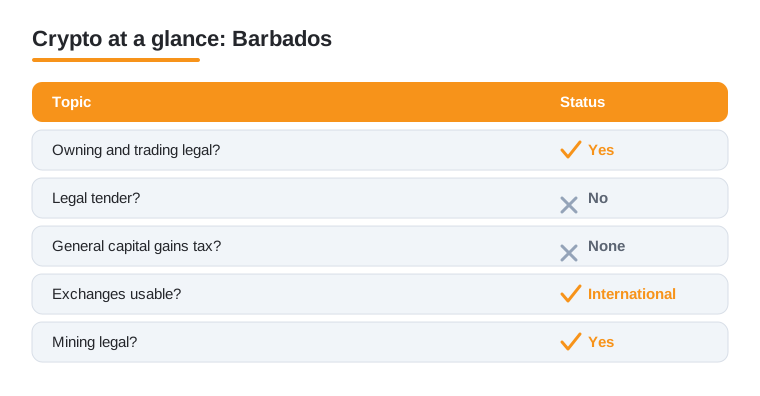
- Owning, buying, and selling crypto is legal in Barbados; it is just not legal tender.
- No general capital gains tax on personal crypto, but business or trading profits can be taxed as income.
- Residents buy via reputable international exchanges, completing ID and KYC checks first.
Barbados is one of the Caribbean's more fintech-forward economies, and Bitcoin and other cryptocurrencies are legal to buy, hold, and sell here. The island has a notable place in crypto history: the local company Bitt Inc. built early digital-currency products in Barbados and later helped develop DCash, the Eastern Caribbean's central bank digital currency. Despite that pedigree, Barbados has not enacted a dedicated, comprehensive crypto statute. Digital-asset activity is instead supervised under existing financial-sector and anti-money-laundering rules by the Central Bank of Barbados (CBB) and the Financial Services Commission (FSC), which jointly run a regulatory sandbox to test new fintech models.
This guide explains how crypto is treated in Barbados as of 2026: whether it is legal, who regulates it, the laws that apply, how exchanges and businesses are supervised, taxation, AML and KYC obligations, mining, recent developments, and the practical steps for buying Bitcoin safely. Because Barbados lacks bespoke crypto legislation and the rules are still evolving, this is general information as of 2026 and is NOT legal, tax, or financial advice. Always verify the current position with the named official regulators, the Central Bank of Barbados, the FSC, and the Barbados Revenue Authority, or a qualified local advisor, before acting.
On this page: Legal status · Who regulates it · Taxes · How to buy · Mining
Is Bitcoin and crypto legal in Barbados?
Yes. Owning, buying, selling, and using Bitcoin and other cryptocurrencies is legal for individuals in Barbados. No law bans or criminalises holding crypto. What crypto is not is legal tender: the only official currency is the Barbados dollar (BBD), which is pegged to the US dollar at a fixed rate of roughly two BBD to one USD. No merchant is obliged to accept Bitcoin, although some may choose to.
The key nuance is that Barbados regulates crypto activity indirectly. Rather than a single dedicated crypto act, the authorities apply general financial-services, anti-money-laundering (AML), and company law to businesses that deal in digital assets. For an ordinary user, buying and holding is straightforward. For a business offering crypto services, the picture is more demanding and depends on how the regulators classify the activity. For wider context on how different countries approach this, see our overview of crypto regulation.
Who regulates crypto in Barbados?
Oversight is shared between two bodies, but crypto is no longer unassigned. The FSC's April 2026 consultation paper states that the Commission has been identified as the designated authority for the supervision and regulation of Virtual Assets and Virtual Asset Service Providers, while the Central Bank retains banking, payments and monetary responsibilities.
Central Bank of Barbados (CBB)
The Central Bank of Barbados handles monetary policy, the payment system, and financial stability, and supervises banks and certain financial institutions. It also assesses licensees' AML and counter-financing-of-terrorism (CFT) compliance.
Financial Services Commission (FSC)
The Financial Services Commission supervises non-bank financial institutions, including securities, insurance, credit unions, and pensions. Where a crypto activity resembles a regulated securities or financial product, it can fall within the FSC's remit.
The joint regulatory sandbox
The CBB and FSC jointly operate a Regulatory Sandbox, a controlled environment in which fintech firms can live-test innovative products while regulators observe. The sandbox is designed for technology-based financial offerings that may not clearly fit existing legislation; regulators use it to decide whether current law covers the activity or whether new rules are needed. Other authorities also touch crypto indirectly: the Barbados Revenue Authority handles tax and crypto-asset reporting, while AML supervision involves the Anti-Money Laundering Authority and the Financial Intelligence Unit.
Key laws and regulatory frameworks
Barbados does not yet have a comprehensive, crypto-specific law. Instead, several existing frameworks apply to digital-asset activity.
- Anti-money-laundering law: the Money Laundering and Financing of Terrorism (Prevention and Control) Act, 2011-23, together with the Money Laundering and Financing of Terrorism (Prevention and Control) (Amendment) Act, 2019-22, is the backbone framework, applied through the AML/CFT/CPF Financial Services Commission Guidelines 2021, Barbados' Targeted Financial Sanctions Omnibus Guidelines of November 2019, and the Anti-Terrorism Act, Cap. 158. It establishes customer due diligence, record-keeping, and suspicious-activity reporting duties for regulated financial institutions and designated businesses.
- FATF international standards: Barbados aligns with the Financial Action Task Force (FATF) recommendations, including the standards that extend AML and CFT obligations to virtual-asset service providers.
- General financial-sector and company law: banking, securities, insurance, and corporate legislation apply to crypto businesses depending on how their activity is classified.
- OECD reporting frameworks: Barbados has committed to the OECD Crypto-Asset Reporting Framework (CARF) and the updated Common Reporting Standard, covered under taxation below.
Note: Barbados is a member of the Caribbean Community (CARICOM), not the European Union, so the EU's Markets in Crypto-Assets Regulation (MiCA) does not apply here. Some advisory firms describe Barbados as drawing on FATF and MiCA-style principles, but MiCA itself is not Barbados law. Because much depends on regulator interpretation, confirm current requirements with the CBB and FSC.
Licensing and registration of exchanges and crypto businesses
Barbados does not yet operate a named virtual-asset service provider (VASP) licence, but one is being designed. The FSC's April 2026 consultation proposes an activity-based, modular regime in which a firm is licensed for the specific activities it performs, such as exchange, brokerage, custody, advisory or issuance. Because there is no dedicated crypto statute, the route for a crypto business depends on how the regulators classify its activity.
The practical path often runs through the joint CBB and FSC sandbox. An applicant whose product does not clearly fit existing legislation can apply to test it under supervision. At the end of the process, if the regulators conclude the activity falls within existing law, the applicant is directed to the relevant licence; if no existing law covers it, the regulators recommend a way forward. Bitt was an early participant that tested a mobile digital-wallet product in this way.
In practice, a crypto business operating from Barbados should expect to: incorporate locally and meet company-law obligations; implement full KYC and AML and CFT controls; conduct due diligence on owners and beneficial owners; maintain records and internal audits; and report to the relevant regulator. There are no published capital, custody or fit-and-proper requirements specific to crypto. The FSC's own gap analysis records that Barbados has no explicit requirements on segregation of client assets, custody arrangements or key management, no Travel Rule implementation, and no defined standards for advertising, risk warnings or client classification. Prospective operators should contact the FSC AML/CFT/CPF unit directly at [email protected] and take local legal advice.
Crypto and Bitcoin tax in Barbados
Tax is where Barbados is most often called crypto-friendly, but the position is more nuanced than headlines suggest, and there is no crypto-specific tax statute.
No general capital gains tax
Barbados does not levy a general capital gains tax, so a one-off gain from selling crypto held as a personal investment is generally not taxed as a capital gain. This is a core reason the island appeals to investors and remote workers, some of whom relocate under residence programmes such as the Welcome Stamp remote-work visa. That 12-month, renewable visa (launched in 2020) is aimed at remote workers earning from foreign sources, and holders are generally treated as non-resident for Barbados income-tax purposes, so foreign-earned income is not taxed locally. Note that value-added tax still applies to goods and services bought on the island.
When income tax can apply
This does not make all crypto activity tax-free. Where crypto dealing, mining, or trading amounts to a business or regular profit-making activity, the proceeds can be treated as ordinary income and taxed accordingly. Residence status also matters. Where crypto profits are taxed as income, the individual rates from income year 2026 are 11.5 per cent on income above BBD 25,000 but not more than BBD 75,000, and 27.5 per cent on income over BBD 75,000, with a personal allowance of BBD 25,000 deducted first. A crypto business run through a Barbados company pays corporation tax at 9 per cent, or 5.5 per cent if it qualifies as a small resident company. Whether you fall on the investment or the trade side of the line, and your residence status, still decide which of these applies. Confirm your situation with the Barbados Revenue Authority or a qualified local tax advisor, and see our general guide to crypto taxes.
CARF and reporting
Barbados endorsed the international CARF joint statement in 2023 and signed the related multilateral competent authority agreement in 2024. According to the Barbados Revenue Authority, implementation is targeted for 2027, with the first automatic exchanges of crypto-account information expected in 2028. The takeaway: even in a low-tax environment, expect platforms to collect tax-residency and identification details and report them. This is general information, not tax advice.
AML, KYC, and reporting obligations
Anti-money-laundering rules are the most concrete legal constraint on crypto activity in Barbados. The framework rests on the Money Laundering and Financing of Terrorism (Prevention and Control) Act, 2011-23 and its 2019 amendment, supervised by the Anti-Money Laundering Authority, with suspicious-activity reports going to the Financial Intelligence Unit.
Regulated entities, which can include money-service businesses and financial institutions dealing in digital assets, are expected to verify customer identity (KYC), obtain beneficial-ownership information, assess and monitor risk on a risk-based basis, keep records, and report knowledge or suspicion of money laundering or terrorist financing. The Central Bank assesses licensees' AML and CFT compliance against this legislation. Barbados also follows FATF recommendations, which extend these expectations to virtual-asset service providers. For users, the everyday effect is that any reputable exchange or platform serving Barbados will require identity verification before you can trade or withdraw. Official AML guidance is published by the Financial Services Commission and the Office of the Attorney General.
Buying and using crypto in practice
There is no Barbados-licensed national crypto exchange, so residents typically use established international platforms that accept Barbadian customers. The sensible approach is to choose a reputable, well-regulated global exchange and follow standard safety practice.
- Identity verification (KYC): mainstream platforms require you to verify your identity with a government ID and often proof of address before trading or withdrawing. This is a legal AML expectation, not optional.
- Funding: options vary by platform and may include card payments, bank transfers, or stablecoin deposits. Card and conversion fees can be significant, so compare costs.
- Currency: the Barbados dollar is pegged to the US dollar, which makes pricing in USD-denominated markets straightforward, although banks may apply conversion charges and local foreign-exchange rules apply.
- Bitcoin ATMs: physical crypto kiosks are very limited in Barbados; do not assume a machine will be conveniently located, and expect identity checks and higher fees where one exists.
- Custody: you can leave funds on an exchange or move them to a self-custody wallet. Self-custody removes counterparty risk but makes you solely responsible for securing your keys.
Confirm that any platform actually serves Barbadian residents and review its fees, security history, and withdrawal terms before depositing. Tourists can generally use the same global platforms and wallet apps they use at home, subject to normal visa and currency rules.
Bitcoin mining in Barbados
No law bans cryptocurrency mining in Barbados, but the island is not a natural fit for large-scale proof-of-work operations. The decisive factor is energy: Barbados relies heavily on imported fuel and has historically high electricity costs, which erodes the thin margins that mining depends on. That makes it hard to compete with regions that have cheap, abundant power.
Energy and climate policy also point the other way. Barbados has prominent renewable-energy ambitions and a strong sustainability agenda, and the energy intensity of proof-of-work mining sits awkwardly against those goals. In principle, miners drawing on the island's expanding solar and other renewable capacity could reduce the environmental footprint, but cost and infrastructure remain real barriers. For tax, mining done as a commercial activity can be treated as income rather than falling under the no-capital-gains rule, so anyone mining beyond a hobby scale should take local tax advice.
Recent developments (2024 to 2026)
Several developments have shaped the picture in the period leading into 2026:
- CARF and CRS commitments: Barbados endorsed the CARF joint statement in 2023 and signed the multilateral competent authority agreement in 2024, committing to implement crypto-asset reporting in 2027 with first exchanges in 2028, and to the updated Common Reporting Standard.
- Revenue Authority engagement: in June 2025 the Barbados Revenue Authority held an information session on implementing the amended Common Reporting Standard, which expands its scope to include crypto-assets and strengthens due-diligence requirements.
- Sandbox milestones: The Central Bank's published sandbox participant list carries a single entry: Bitt Digital Inc., which tested the provision of a digital wallet enabling users to send, receive and store mMoney and process other transactions from a mobile device or PC, with a start date of 19 November 2018 and an end date of 5 July 2019. The FSC is now building a licensing framework through public consultation rather than working case by case through the sandbox.
- DCash wound down regionally: DCash, the Eastern Caribbean Central Bank digital currency that Bitt helped build, closed its live pilot on 12 January 2024. The ECCB explored a successor, DCash 2.0, but reporting in early 2026 indicated the ECCB had suspended DCash 2.0 development to prioritise a regional fast-payment system instead. This is a currency-union matter, not a Barbados national decision, but it is the closest CBDC story touching the island.
That changed in April 2026. The FSC published a consultation paper on a standalone Virtual Assets and VASP framework, confirmed that it has been identified as the designated authority for virtual assets, and followed it on 3 July 2026 with a public notice requiring anyone operating or proposing to operate as a VASP in Barbados to identify themselves by 31 July 2026. No bill has been laid before Parliament and no commencement date has been published, so the framework is being designed rather than applied. Check the official sources below for the latest position.
Consumer risks and protection
The main risks in Barbados are less about prohibition and more about uncertainty and the usual hazards of crypto. Because there is no comprehensive crypto statute, much depends on how the Central Bank and FSC interpret and develop the rules, and that can shift. Businesses face the clearest exposure, since licensing expectations may tighten as legislation is finalised.
For users, the familiar risks dominate: price volatility, scams and phishing, exchange or wallet failures, and the irreversibility of mistaken transfers. Critically, crypto sits outside statutory depositor protection. Barbados insures bank deposits under the Deposit Insurance Act, Cap. 323, and Parliament passed a replacement, the Protection of Depositors Act, 2026, in the House of Assembly on 23 June 2026 and the Senate on 8 July 2026; that Act continues the existing Barbados Deposit Insurance Corporation and Fund, and its published text makes no reference to virtual assets. There is no investor-compensation scheme for crypto either, and the proposed VASP framework does not propose one, so there is little recourse if a platform collapses or funds are stolen. Sensible principles apply everywhere: understand what you are buying, only commit money you can afford to lose, use reputable platforms with strong security, enable two-factor authentication, consider self-custody for larger holdings, and keep records for tax and CARF reporting. If something looks too good to be true, treat it as a likely scam, and report fraud to the relevant authorities.
Official sources and how to verify
Because the framework is evolving and this guide is general information rather than advice, always confirm the current position with primary official sources before acting:
- Central Bank of Barbados for monetary, payments, financial-stability, AML supervision, and the regulatory sandbox.
- Financial Services Commission for non-bank financial supervision and AML and CFT guidance.
- Barbados Revenue Authority for tax and the Crypto-Asset Reporting Framework (CARF).
- Office of the Attorney General (Anti-Money Laundering) for AML legislation and policy.
For broader background, see our hub on crypto regulation by country. This page is general information as of 2026 and is not legal, tax, or financial advice; verify any decision with the named official regulators or a qualified local professional.
What is changing: Barbados is drafting a VASP law
Between April and July 2026 Barbados moved from having no visible crypto policy to having an open, dated one. The single most consequential fact sits in the Financial Services Commission's own consultation paper: the Commission "has been identified as the designated authority for the supervision and regulation of Virtual Assets (VAs) and Virtual Asset Service Providers (VASPs)". That settles a question this guide could previously only leave open.
- Dated 12 April 2026. The FSC's 22 page consultation paper Development of a Virtual Assets and Virtual Assets Service Provider (VASP) Framework is built around seven policy pillars. It was the Day 5 topic at the Commission's 15th Anniversary Industry Stakeholder Consultation on its Legislative Reform Project, held on 17 April 2026 at the Hilton, Barbados.
- What it is for. The paper says its outputs "will directly inform the development of primary legislation, regulations, guidelines, and the supervisory framework for VASPs in Barbados", and is designed to "generate practical, drafting-ready inputs". The stated benchmark is alignment with FATF Recommendations 15 and 16, and with IOSCO and Financial Stability Board guidance.
- April 2026, in parallel. The same reform programme produced a stack of consultation papers. The innovation pillar of the securities paper lists a "Licensing and Supervision of VASPs Law (addressed in a standalone consultation paper)" and a "New Virtual Asset related Law" as companion workstreams, alongside a redrafted Securities Act based on the CARICOM model law and proposed amendments to the Financial Services Commission Act, 2010-21.
- 3 July 2026. The FSC issued a Request for Information. All persons and entities "operating or proposing to operate as VASPs within Barbados" were asked to identify themselves, and the notice states that "Entities are required to submit the information by Friday, July 31, 2026", as part of a Sectoral Risk Assessment covering money laundering, terrorist financing and proliferation financing. The notice adds that submitting information "does not constitute registration, licensing, authorisation or approval", and that failure to respond "may be taken into account in the Commission's assessment of sectoral and institutional risks".
Timing, stated plainly: no virtual asset bill appears in the Parliament of Barbados bills listing, and the FSC has published no commencement date and no date when licence applications open. The FSC's lists of regulated entities still cover only pensions, securities, credit unions and insurance. The one timing signal in the consultation paper is its closing question, which asks stakeholders for "the top three actions the Commission must prioritise in the next 12 months to establish a credible, competitive, and proportionate VASP regime in Barbados".
What the proposed VASP regime would require
The April 2026 paper is marked "For Discussion Purposes Only" and none of it is law. It is still the clearest published statement of what a Barbados crypto licence would involve, and it contains the FSC's own list of what the jurisdiction currently lacks.
| Proposed element | What it would mean in practice |
|---|---|
| Activity-based, modular licensing | Distinct regulated activities including exchange, brokerage, custody, advisory and issuance, with a firm licensed for specific combinations of activities and requirements aligned to the risk profile of each. The paper asks whether the regime should be activity-based, entity-based or hybrid, and whether licensing should be tiered by custody of assets, retail exposure, size and complexity, or scale and volume. |
| Travel Rule | Full FATF-aligned implementation. The gap analysis records the Travel Rule as a current gap, alongside the treatment of unhosted wallets and peer-to-peer transactions. |
| Custody and client assets | Institutional-grade custody and asset safeguarding standards. The gap analysis states there are "currently no explicit requirements" on segregation of client assets, custody arrangements and key management, or safeguards against loss, theft or misuse of digital assets. |
| Market conduct and consumer protection | Disclosure, transparency and risk warning requirements, rules on advertising and promotions, measures against market abuse and conflicts of interest, and differentiation between retail and institutional clients. The paper records "no defined standards for advertising, risk warnings, or client classification" today. |
| Local presence | Open question. The paper asks whether there should be requirements for local presence and an accountable representative. |
| Transition period | Open question. The paper asks what transition period is appropriate for existing operators and for new entrants. No period has been proposed. |
| Enforcement toolkit | The paper asks which enforcement tools are essential, listing licence revocation, fines, removal of management and asset seizure, and what the Commission should publish to demonstrate supervisory effectiveness and enforcement outcomes. |
Two practical points follow. An operator already serving Barbadian customers should assume a licensing obligation is coming and that no transition window has been fixed. And until the framework exists there is no Barbadian crypto licence to hold, so no platform can accurately describe itself as licensed in Barbados for virtual asset services. Source: FSC VASP consultation paper, April 2026.
The tax rates that actually apply
Barbados has no crypto-specific tax statute, and as of August 2026 the Barbados Revenue Authority has published no crypto guidance in its guidance notes or policy notes. What governs a crypto position is therefore the general rate table.
| Tax | Rate | When it bites on crypto |
|---|---|---|
| Capital gains tax | None | The Barbados Revenue Authority states that "there is no tax on capital", so a one-off disposal of crypto held as a personal investment falls outside it. |
| Personal income tax | 11.5 per cent on income above BBD 25,000 but not more than BBD 75,000; 27.5 per cent on income over BBD 75,000, from income year 2026 | Crypto dealing, trading or mining carried on as a business or regular profit-making activity. The policy note's worked examples deduct a personal allowance of BBD 25,000 first. |
| Corporation tax | 9 per cent, or 5.5 per cent for a qualifying small resident company | A crypto business run through a Barbados company. The 5.5 per cent rate requires gross income of BBD 2,000,000 or less, paid-up capital of BBD 1,000,000 or less, no more than 25 employees, and at least 75 per cent of shares beneficially owned by a resident of Barbados, with all group members meeting the same tests. Holding companies, Foreign Currency Permit holders and companies granted tax concessions are excluded. |
| VAT | 17.5 per cent standard rate | Goods and services bought locally, not the crypto itself. The registration threshold has been BBD 200,000 a year since 1 January 2016. Accommodating direct tourism services are 7.5 per cent and telecommunications services 22 per cent. |
The individual rates were cut in the 2026 Budget. The Minister of Finance, Ryan Straughn MP, announced on Monday 16 March 2026 that rates would fall from 12.5 per cent to 11.5 per cent and from 28.5 per cent to 27.5 per cent with effect from income year 2026 (Policy Note OGC No. 001/2026, Income Tax Act, Cap. 73). The 9 per cent figure is the rate of tax the Revenue Authority applies in its corporation tax prepayment formula from income year 2024 (Policy Note OGC No. 009/2023), and the 5.5 per cent conditions are set out in Policy Note OGC 08/2025, applying to income earned after 1 January 2024. A separate Corporation Top-Up Tax regime applies to companies in large multinational groups. This is general information, not tax advice; confirm your own position with the Barbados Revenue Authority or a qualified local adviser.
Deposit insurance exists in Barbados, and it does not cover crypto
Barbados has had a statutory deposit insurance scheme for years under the Deposit Insurance Act, Cap. 323, and Parliament has now passed a replacement. The Protection of Depositors Act, 2026 passed the House of Assembly on 23 June 2026 and the Senate on 8 July 2026. It does not create a new body: section 5(1) provides that the Barbados Deposit Insurance Corporation established under the former Act shall continue in existence, and section 18(1) continues the existing Deposit Insurance Fund. Section 54 provides that the Act comes into operation on a date fixed by Proclamation, and no Proclamation or insured limit order could be confirmed, so the new Act is passed but not yet shown as in operation.
Either way the position for a crypto holder is the same. The Act defines a deposit as the unpaid balance of the aggregate of money or its equivalent received or held by a member institution in the usual course of its deposit taking business, and the published text contains no reference to virtual assets, crypto-assets or digital assets. A balance sitting on a crypto exchange, and a self-custodied wallet, are both outside the scheme. The FSC's proposed VASP framework does not propose a compensation fund either, so if a platform fails there is no Barbadian scheme to claim against.
Frequently asked questions
Is cryptocurrency legal in Barbados?
Yes. Buying, holding, selling, and using Bitcoin and other cryptocurrencies is legal for individuals in Barbados. Crypto is not legal tender, however; the Barbados dollar, pegged to the US dollar, is the only official currency. There is no comprehensive crypto-specific law, so digital-asset businesses are supervised under general financial-sector and anti-money-laundering rules.
Who regulates crypto in Barbados?
Oversight is shared by the Central Bank of Barbados (CBB) and the Financial Services Commission (FSC), which jointly run a regulatory sandbox for fintech products. There is no single dedicated crypto regulator or statute; instead existing financial, AML, and company laws are applied to crypto activity, with FATF international standards informing the approach. The Barbados Revenue Authority handles tax and crypto-asset reporting.
Do I have to pay tax on crypto in Barbados?
Barbados has no general capital gains tax, so a gain on crypto held as a personal investment is generally not taxed as a capital gain. However, if your crypto activity amounts to a business or trade, the profits can be taxed as ordinary income, and outcomes depend on your residence status. Barbados has also committed to the OECD's CARF reporting framework, with implementation targeted for 2027. This is general information, not tax advice; confirm your position with the Barbados Revenue Authority or a qualified local advisor.
Does Barbados have a crypto or VASP licence?
There is no single named VASP licence in Barbados, because the country has no dedicated crypto statute. A crypto business is regulated according to how its activity is classified, often via the joint CBB and FSC regulatory sandbox, and must meet KYC, AML, and CFT obligations. Prospective operators should engage the regulators directly and take local legal advice rather than rely on third-party summaries.
Does Barbados have its own central bank digital currency (CBDC)?
Not its own. The Barbadian company Bitt built early digital-wallet products locally and later helped develop DCash, but DCash was the Eastern Caribbean Central Bank's CBDC for the currency union, not a Barbados national currency. That DCash pilot closed on 12 January 2024, and reporting in early 2026 indicated the ECCB had suspended its planned DCash 2.0 successor to focus on a regional fast-payment system. Barbados has studied digital-currency questions but had not issued its own CBDC as of 2026.
Can tourists use Bitcoin in Barbados?
Generally yes. Visitors can use the same international exchanges and wallet apps they use at home, and there is no crypto-specific entry rule. Bear in mind that physical Bitcoin ATMs are scarce, few merchants accept crypto, and normal visa and currency-exchange rules still apply, so plan to rely mainly on online platforms.
Is there a crypto exchange based in Barbados?
No. There is no Barbados-licensed national crypto exchange, so residents use established international platforms that accept Barbadian customers. Any reputable platform will require identity verification (KYC) before you can trade or withdraw, in line with anti-money-laundering expectations. Confirm that a platform actually serves Barbados residents, and review its fees, security record, and withdrawal terms before depositing.
Does the Barbados Welcome Stamp visa affect crypto tax?
The Welcome Stamp is a 12-month, renewable remote-work visa for people earning from foreign sources. Holders are generally treated as non-resident for Barbados income-tax purposes, so foreign-earned income is not taxed locally, and Barbados has no general capital gains tax. That does not automatically exempt crypto treated as a trade or business, and it does not remove tax obligations you may owe in your home country. Value-added tax still applies to local spending. This is general information, not tax advice; confirm your position with the Barbados Revenue Authority or a qualified advisor.
Does Barbados have a crypto law yet?
No. As of August 2026 no virtual asset bill appears in the Parliament of Barbados bills listing, and no crypto statute is in force. The Financial Services Commission published a consultation paper on a standalone Virtual Assets and VASP framework dated 12 April 2026, and ran a Sectoral Risk Assessment that required VASPs to identify themselves by 31 July 2026. The consultation is intended to produce drafting-ready inputs for primary legislation, but no bill text, commencement date or licence application date has been published.
Who will regulate crypto businesses in Barbados?
The Financial Services Commission. Its April 2026 consultation paper states that the Commission has been identified as the designated authority for the supervision and regulation of virtual assets and virtual asset service providers. The Central Bank of Barbados keeps banking, payments, monetary policy and financial stability. The contact point for virtual asset matters is the FSC AML/CFT/CPF unit at [email protected] or 421-2142.
I run a crypto business in Barbados. Did I miss the FSC deadline?
The FSC asked all persons and entities operating or proposing to operate as VASPs in Barbados to identify themselves by Friday 31 July 2026 as part of its Sectoral Risk Assessment. The notice says the request is issued solely for information gathering purposes, that submission does not constitute registration, licensing, authorisation or approval, and that failure to respond may be taken into account in the Commission's assessment of sectoral and institutional risks. If you did not respond, contact the FSC AML/CFT/CPF unit at [email protected].
What tax rate applies if my crypto trading counts as a business in Barbados?
For an individual, the rates from income year 2026 are 11.5 per cent on income above BBD 25,000 but not more than BBD 75,000, and 27.5 per cent on income over BBD 75,000, with a personal allowance of BBD 25,000 deducted first. If you trade through a Barbados company, corporation tax is 9 per cent, or 5.5 per cent for a qualifying small resident company. The Barbados Revenue Authority states there is no tax on capital, so a one-off disposal of crypto held as a personal investment is treated differently from trading. This is general information, not tax advice.
Is my crypto covered by deposit insurance in Barbados?
No. Barbados insures bank deposits under the Deposit Insurance Act, Cap. 323, and Parliament has passed a replacement, the Protection of Depositors Act, 2026, which continues the existing Barbados Deposit Insurance Corporation and Fund and comes into operation on a date fixed by Proclamation. Neither covers crypto: the published text of the 2026 Act contains no reference to virtual assets, so a balance held at a crypto exchange or in a self-custodied wallet is not covered, and there is no separate investor-compensation scheme for crypto.
What would a Barbados VASP licence require if the framework is enacted?
Based on the FSC's April 2026 consultation, the proposed direction is activity-based, modular licensing covering exchange, brokerage, custody, advisory and issuance; full FATF Travel Rule compliance; institutional-grade custody with segregation of client assets and key management controls; disclosure, risk warning and advertising rules; and differentiation between retail and institutional clients. Local presence requirements and the transition period for existing operators are still open questions in the paper. None of this is law yet.
Facts reviewed: 4 August 2026. Page updated: 4 August 2026.