Home › Crypto Regulation › Grenada
Bitcoin & Cryptocurrency Regulation in Grenada
Quick answer — Grenada, 2026
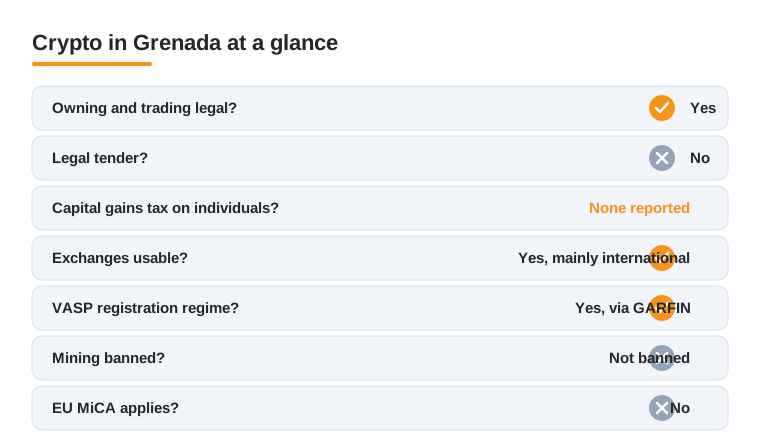
- Legal: Legal to own and trade, not legal tender
- Tax: Low-tax jurisdiction, widely reported no capital gains tax on individuals
- Buying: Mostly via international exchanges; few or no locally registered providers
Grenada, the Caribbean nation known as the "Spice Isle," sits within the Eastern Caribbean Currency Union (ECCU) and uses the Eastern Caribbean dollar (XCD), issued by the Eastern Caribbean Central Bank (ECCB). For anyone holding, trading, or building with Bitcoin and other cryptocurrencies here, the legal picture is more defined than in many small economies. Grenada passed a dedicated Virtual Asset Business Act in 2021, brought it into force with detailed regulations in 2024, and created a registration regime for crypto businesses supervised by a named domestic regulator.
Grenada is not a member of the European Union, so the EU Markets in Crypto-Assets Regulation (MiCA) does not apply here. Instead, the country relies on its own Virtual Asset Business Act and on regional anti-money-laundering and central bank guidance. This guide explains where crypto stands legally in Grenada, who regulates it, how buying and selling typically works, and what to know about tax, mining, and risk. Regulation in this area changes quickly, so treat everything below as a starting point and confirm specifics with the official sources named at the end. This is general information as of 2026 and is not legal advice.
On this page: Legal status · Who regulates it · Taxes · How to buy · Mining
Is Bitcoin and crypto legal in Grenada?
Owning, buying, selling, and holding Bitcoin and other cryptocurrencies is not prohibited in Grenada. There is no law banning private individuals from using crypto, and the country has gone further than many of its neighbours by introducing a formal regime for crypto businesses through the Virtual Asset Business Act, 2021.
It is important to separate legal to own from legal tender. Cryptocurrencies are not legal tender in Grenada. The only currency that carries legal-tender status across the Eastern Caribbean Currency Union is the Eastern Caribbean dollar, issued by the Eastern Caribbean Central Bank. No merchant is obliged to accept Bitcoin, and crypto is not a government-backed form of money.
The ECCB has issued public advisories warning that cryptocurrencies are volatile, are not backed by any government or central bank, and have been used in scams. So while you are free to participate, you do so at your own risk and without the consumer protections that apply to bank deposits or the national currency. For broader context on how different countries approach this, see our overview of crypto regulation.
Who regulates crypto in Grenada?
The regulator for virtual asset businesses is the Grenada Authority for the Regulation of Financial Institutions (GARFIN), the supervisor of the non-bank financial sector. GARFIN handles registration, supervision, compliance monitoring, and enforcement under the Virtual Asset Business Act, 2021 and its 2024 regulations. Its official website is garfin.gd, and it maintains a dedicated section for virtual asset service providers.
A second, regional body matters for context. The Eastern Caribbean Central Bank (ECCB) is the monetary authority for Grenada and seven other ECCU members. The ECCB does not license or regulate decentralised cryptocurrencies; its role is monetary policy and the EC dollar. It has, however, repeatedly cautioned the public about crypto risk and ran a central bank digital currency pilot called DCash, which is a digital form of the EC dollar and is not a cryptocurrency.
Tax matters fall to the Inland Revenue Division of Grenada's Ministry of Finance. In short, GARFIN supervises crypto businesses, the ECCB sets monetary policy and warns consumers, and Inland Revenue administers tax. For an explainer on regulatory concepts used across this site, see our crypto regulation guide.
Key laws and frameworks
Grenada's central piece of crypto legislation is the Virtual Asset Business Act, 2021 (Act No. 7 of 2021), passed by Parliament in 2021. It created a registration and supervision framework for businesses providing virtual asset services rather than targeting ordinary individual users. You can read the Act on the Parliament of Grenada website.
The Act was operationalised by the Virtual Asset Business Regulations 2024 (S.R.O. 9 of 2024), published in the Government Gazette on 24 May 2024, roughly three years after the Act was approved. These regulations set out the practical detail of registration, fees, timelines, and ongoing obligations.
The Act broadly defines a virtual asset as a digital representation of value that can be digitally traded, transferred, or used for payment or investment, while excluding digital representations of fiat currency. Businesses in scope are called virtual asset service providers (VASPs) and can include exchanges, custodians, transfer services, and certain token issuers. Because Grenada is outside the EU, frameworks such as MiCA do not apply; the Virtual Asset Business Act and Grenada's anti-money-laundering laws are the governing rules.
Licensing and registration of exchanges and VASPs
Under the Virtual Asset Business Act and the 2024 Regulations, any person who offers or operates a virtual asset business in or from Grenada must register with GARFIN before operating. Covered activities include exchanging virtual assets for fiat, exchanging between different virtual assets, transferring virtual assets, safekeeping or administering virtual assets, and providing financial services related to the issue or sale of a virtual asset.
Reported requirements and figures from the 2024 Regulations include:
- Application fee of EC$2,500 and a registration fee of EC$10,000.
- GARFIN must decide whether to grant or refuse a complete application within 90 days of receipt.
- Applicants must provide the registered office and place of business in Grenada, a statement of the nature and scope of the business, a risk assessment of products and services, and written AML/CFT policies and procedures.
- Where a registrant issues or offers a virtual asset for sale, a prospectus must be submitted to GARFIN for review at least 14 days beforehand.
- Operating a virtual asset business without registration is an offence. On summary conviction the reported penalty is a fine of EC$10,000 and up to 2 years imprisonment, and on conviction on indictment the reported penalty rises to a fine of up to EC$250,000 and up to 7 years imprisonment.
Note that GARFIN's public register has, at times, shown zero registered providers, which means much real-world activity by Grenada residents still happens through international exchanges. Exact fees, thresholds, and exemptions are set by GARFIN and can change, so prospective operators should obtain the current rules directly from GARFIN or qualified local counsel before applying.
Crypto and Bitcoin tax in Grenada
Grenada is widely described as a low-direct-tax jurisdiction. Personal income tax applies only to income arising in Grenada, with a reported tax-free band up to EC$36,000, 15 percent on income between EC$36,000 and EC$60,000, and 30 percent above that. Several published guides report that Grenada does not impose a capital gains tax on individuals, which is why it is often called crypto-friendly for individual investors.
However, no single crypto-specific tax rule sets out every scenario, and the treatment of digital assets is not always spelled out. Whether a gain or activity is taxable can depend on whether you act as an individual or a business, whether the activity is treated as trading or investing, and how the proceeds are characterised. Business income and certain transactions may still fall within Grenada's tax system.
No crypto tax measure appears in the 2026 Budget Statement, and the Inland Revenue Division's published notices deal only with the taxes it routinely administers, namely Personal Income Tax, Corporate Income Tax and Annual Stamp Tax, whose filing and payment deadline was extended to 30 April in 2026. There is therefore no official crypto tax rate to quote, and this guide does not present one. A question about a specific disposal goes to the IRD directly on the GTAX hotline, 421 4247. Anyone with meaningful crypto holdings, business income, or capital movements should confirm their position with Grenada's Inland Revenue Division or a qualified local tax adviser. For general concepts, see our guide to crypto taxes. This section is general information, not tax advice.
AML and KYC rules
Anti-money-laundering and counter-financing-of-terrorism (AML/CFT) compliance is at the core of Grenada's crypto regime. The Virtual Asset Business Act explicitly references the risk, recognised by the Financial Action Task Force (FATF), that VASPs can be exploited for money laundering and terrorist financing.
Registered virtual asset businesses are expected to implement written AML/CFT policies, conduct customer due diligence (KYC), keep records, monitor transactions, and report as required. A risk assessment of the products and services offered must accompany registration. These obligations sit alongside Grenada's broader AML legislation that applies to financial institutions generally.
For everyday users, the practical effect is more identity verification, not less. Any compliant platform dealing with Grenada will normally ask for government-issued ID and proof of address, and larger deposits or withdrawals can trigger source-of-funds questions. Expect the same KYC steps on reputable international exchanges that serve Grenada residents.
Grenada is a member of the Caribbean Financial Action Task Force (CFATF), the regional body that assesses how member countries apply FATF anti-money-laundering and counter-terrorist-financing standards. Building the Virtual Asset Business Act and its VASP registration regime was in part a response to FATF's 2019 recommendation that countries bring virtual asset service providers under AML supervision. That FATF standard also includes the so-called Travel Rule, under which a VASP sending virtual assets is expected to pass identifying information about the sender and recipient to the receiving VASP. In practice this is one reason compliant platforms collect more customer detail on transfers.
Buying and using crypto in practice
There is no general prohibition on residents buying cryptocurrency. In practice, most people access crypto through international exchanges rather than a large domestic marketplace, because Grenada is a small market with limited local crypto infrastructure and a public register that has shown few or no locally registered providers.
A typical path looks like this:
- Choose a reputable platform that accepts customers in Grenada, supports a funding currency you can use, and has a strong security and compliance record.
- Complete KYC verification by submitting government ID and proof of address.
- Fund the account using methods your bank and the platform permit; some local banks are cautious about crypto-related transactions, so confirm fees first.
- Place an order, ideally starting small while you learn the interface.
- Secure your holdings with two-factor authentication and, for meaningful amounts, a self-custody hardware wallet.
Keep records of purchases and sales, including dates and values, in case you later need them for tax or compliance. If a service claims to be licensed in Grenada, ask which regulator oversees it and verify the claim with GARFIN. Treat unsolicited investment offers, social-media tips, and pressure to act quickly as red flags.
Bitcoin mining in Grenada
Neither of Grenada's two virtual asset instruments mentions mining. S.R.O. 9 of 2024 contains no mining provision, and GARFIN's legislation index lists no separate mining rule, so mining is neither separately licensed nor separately prohibited. The country is still not a natural fit for large-scale mining. The most significant factor is electricity: Grenada's power is relatively expensive and is generated substantially from imported fuel, which makes energy-intensive proof-of-work mining costly compared with regions that have cheap or surplus power. The tropical climate also adds cooling challenges for hardware.
On the regulatory side, mining as a personal hobby is different from running a mining business. Anyone operating commercially should consider whether their activity, and especially the sale or custody of mined coins, brings them within the scope of the Virtual Asset Business Act or other business, energy, and tax rules. Mining is not prohibited in a blanket sense, but high energy costs make it economically marginal for most participants, and commercial operators should check their obligations with GARFIN, the relevant utility regulator, and a tax adviser before investing in equipment.
Remittances and stablecoins
Remittances matter in Grenada, as across much of the Caribbean, because many families receive support from relatives abroad. Traditional money-transfer services can be slow and carry meaningful fees, which is why some people consider Bitcoin and stablecoins for cross-border transfers. Transfers can settle quickly and operate outside banking hours, but several frictions apply.
- On-ramps and off-ramps. The real cost depends on how cheaply each side converts between crypto and local currency. If the recipient must cash out through a high-fee channel, the savings shrink.
- Volatility. Holding Bitcoin between sending and receiving exposes both parties to price swings. Stablecoins reduce this but carry their own risks.
- Compliance. Converting to or from EC dollars through a registered service will normally involve identity verification.
- Irreversibility. Crypto transactions generally cannot be reversed, so address accuracy is critical.
Crypto can be a useful remittance tool for technically comfortable users, but it is not automatically cheaper or safer than established services. Compare the all-in cost of each route, including conversion fees on both ends, before deciding.
Recent developments (2024 to 2026)
The most concrete recent development remains the gazetting of the Virtual Asset Business Regulations 2024 (S.R.O. 9 of 2024) on 24 May 2024, made by the Minister on the recommendation of the Authority under section 22 of the Virtual Asset Business Act No. 7 of 2021. The Regulations set the application form and its non-refundable $2,500.00 application fee, a 90-day decision deadline, capital and liquidity duties without a fixed minimum, originator and beneficiary information on every transfer, mandatory indemnity insurance, ring fencing of client funds and a seven-year minimum record retention period. They contain no annual registration fee, no prospectus provision and no penalty amounts, and the only sum of money named in the instrument is the $2,500.00 application fee. This moved Grenada from having a law on the books to having a working registration framework supervised by GARFIN.
At the regional level, the ECCB discontinued the original DCash central bank digital currency pilot and has redirected attention toward modernised regional payment systems rather than crypto adoption. As of August 2026 no official Grenadian source names a virtual asset measure in progress. The Ministry of Finance Medium Term Fiscal Framework 2027 to 2029, published in August 2026, names the Insurance Bill, the Pensions Bill and the Cooperative Societies Act reform as the non-bank financial legislation in the pipeline, and mentions virtual assets only to record that the 2021 Act has no registered entities operating under it. The regional workstream it does describe is an ECCB consultation on an Instant Payment System for real-time cross-border transactions across the ECCU, which is a payments project rather than a crypto framework.
Internationally, the FATF published its sixth targeted update on virtual assets and VASPs in June 2025, reporting that more jurisdictions have adopted or are adopting Travel Rule legislation, with the count of jurisdictions passing or advancing such rules rising from 65 in 2024 to 85 in 2025. Grenada's 2021 Act and 2024 Regulations placed virtual asset businesses under formal AML supervision, but the framework has so far produced no registrants at all. GARFIN's public register reads "0 REGISTERED VIRTUAL ASSET SERVICE PROVIDERS", and the Ministry of Finance confirmed in August 2026 that the 2021 Act "currently has no registered entities operating under its framework", more than two years after the Regulations were gazetted.
For 2026 and beyond, expect continued emphasis on consumer warnings, AML compliance, and business registration, with the legal status of individual ownership remaining permitted but unprotected. Because rules and platform availability can change, verify current requirements with the official sources named below before acting.
Consumer risks and protection
The main risks for crypto users in Grenada are the universal ones, amplified by a small market. Price volatility can erase value quickly. Scams, fake platforms, and social-engineering fraud are persistent threats, and recourse may be limited when bad actors operate from abroad. Self-custody puts security entirely in your hands, so lost keys mean lost funds, and reliance on international exchanges introduces counterparty and access risk.
Critically, crypto is not covered by deposit protection or the consumer safeguards that apply to regulated local financial products, and the ECCB has openly cautioned the public about crypto risk. If a platform claims to be registered in Grenada, verify it directly with GARFIN before sending any money, and be sceptical of guaranteed returns. Only commit money you can afford to lose, and treat unsolicited offers and time pressure as warning signs. None of this is financial advice.
Official sources and how to verify
Crypto rules change, and secondary sources can be out of date or inaccurate. Always confirm the current position with the primary, official sources. As of 2026, the most authoritative places to check are:
- GARFIN (Grenada Authority for the Regulation of Financial Institutions), the regulator of virtual asset businesses, including its virtual asset service provider register and publications.
- The Virtual Asset Business Act, 2021 (Act No. 7 of 2021) as published by the Parliament of Grenada.
- The Eastern Caribbean Central Bank for monetary policy, the EC dollar, and public advisories on cryptocurrency risk.
For tax questions, contact Grenada's Inland Revenue Division (Ministry of Finance) or a qualified local adviser. You can also browse other jurisdictions on our crypto regulation hub. This guide is general information as of 2026 and is not legal advice; verify any decision that matters with GARFIN and other named official regulators before you act.
What is changing in Grenada as of August 2026
Nothing in Grenada's crypto rulebook has changed since the Virtual Asset Business Regulations 2024 were gazetted on 24 May 2024. GARFIN's virtual asset legislation index still lists exactly two instruments, Act No. 7 of 2021 and S.R.O. 9 of 2024. No amendment, no new statutory rule and no regulator circular has been added.
Three checks fix the position as of August 2026:
- GARFIN's public register of virtual asset service providers reads "0 REGISTERED VIRTUAL ASSET SERVICE PROVIDERS". The Ministry of Finance says the same thing in its Medium Term Fiscal Framework 2027 to 2029, published in August 2026: the Virtual Asset Business Act enacted in 2021 "currently has no registered entities operating under its framework, though GARFIN is continuously building supervisory capacity in this area". More than two years after the registration framework went live, no company has completed registration.
- The 2026 Budget Statement, presented to the House of Representatives on 1 December 2025 by Minister for Finance Dennis Cornwall, does not use the words virtual asset, crypto, digital asset, fintech, blockchain or GARFIN anywhere. The 2026 structural reform priorities it lists are secured transactions policy, water resource and wastewater management, disaster risk financing, education support, and tax administration and collections including a modernised professional licensing framework.
- GARFIN's most recent published communication on crypto is still the Eastern Caribbean Central Bank due diligence advisory of 21 November 2022, issued after the collapse of FTX. It warns that consumers should be aware of "the risk of the loss of their investment, fraud and cyber-attacks, especially in jurisdictions where the sector is unregulated", and points readers to the lists of regulated entities on the websites of national regulators in each ECCB member country.
The practical effect for a reader: owning, buying and selling crypto is lawful for an individual in Grenada, the law that exists is aimed at businesses, and there is no GARFIN-registered domestic platform to buy from.
What S.R.O. 9 of 2024 actually requires
The Virtual Asset Business Regulations 2024 were made by the Minister on the recommendation of the Authority under section 22 of the Virtual Asset Business Act No. 7 of 2021 and gazetted on 24 May 2024. There are 28 regulations and an application Schedule. The operative requirements are these.
| Requirement | What the gazetted text says | Where |
|---|---|---|
| Application and fee | Application on the form in the Schedule, accompanied by a non-refundable application fee. The Schedule's attachment list names "Non-refundable application fee of $2,500.00". Grenada's currency is the Eastern Caribbean dollar. | Reg 3(k), Schedule |
| Decision deadline | The Authority must decide whether to grant or refuse within 90 days of receipt of a complete application. | Reg 4(1) |
| Requests for more information | The applicant must within 15 days supply the requested information or request an extension. The Authority may grant an extension of time not exceeding 15 days. | Reg 4(3), 4(4) |
| Capital and liquidity | No fixed minimum figure. A registrant must meet adequate capital and liquidity requirements with respect to the nature, size and complexity of the business, and the Authority may require additional capital and liquidity by written notice depending on risk profile. | Reg 6 |
| Travel rule | All transfers of virtual assets must be accompanied by the originator's name, the originator virtual asset account number or a unique transaction reference number, plus one of physical address, National Identification Card or passport number, client identification number or place of birth, together with the beneficiary's name and account number or reference. No minimum value threshold appears in the text. The originating business must not execute a transfer that does not comply. | Reg 12, Reg 13 |
| Client money | Funds received from clients or from other virtual asset businesses must be ring fenced, not transferred to the registrant's own operating account and not commingled. | Reg 21 |
| Insurance | A registrant must establish and maintain appropriate policies of insurance on terms and conditions determined by the Authority, indemnifying it against liability from an act or omission by the registrant or its officers or employees. | Reg 25 |
| Records | All records obtained or produced during the operation of the business retained a minimum of seven years from the date obtained or produced. The complaints register is kept a minimum of seven years too. | Reg 27, Reg 20(3) |
| Personnel changes | Any significant shareholder, director, manager, executive or principal representative or officer appointed after approval of registration must complete and submit Parts II and IV of the application to the Authority within 30 days of appointment. | Schedule, General Note 2 |
| Tax standing | Applicants must provide a current tax compliance certificate from tax authorities and a copy of a document showing an income tax registration number. | Schedule, Part 1.10 and Attachments |
Three points worth stating plainly, because this page currently attributes them to the 2024 Regulations. S.R.O. 9 of 2024 contains no annual or post-grant registration fee, no prospectus provision and no penalty amounts. The only sum of money named anywhere in the instrument is the $2,500.00 application fee. A registration fee, a prospectus rule or a penalty figure would have to come from the Act itself, which GARFIN publishes only as an access restricted file, so those figures could not be checked either way.
Legislative pipeline as of August 2026
No official Grenadian source names a crypto bill, a draft amendment or a consultation paper. The government's own account of its financial legislation pipeline names other things.
- The Ministry of Finance Medium Term Fiscal Framework 2027 to 2029, published in August 2026, reviews financial regulatory developments for the first quarter of 2026. The measures it names are the Insurance Bill and the Pensions Bill, both "under active revision, with enactment targeted before the end of 2026", and the Cooperative Societies Act reform, which was "mandated for completion by December 2025 but remains unpassed, with approval expected in the immediate future". Virtual assets appear once in the entire document, to record that the 2021 Act has no registered entities operating under it.
- Ministry of Finance news releases across 2025 and 2026 cover the IMF Article IV report, a tax filing deadline extension, public procurement, port reform, debt, energy and disaster risk insurance. None mentions virtual assets.
- The Government's release on the IMF 2025 Article IV consultation, dated 22 January 2026, covers the growth outlook, the Debt Sustainability Analysis, the Fiscal Resilience Framework and the 60 percent debt to GDP target for 2035. It carries no virtual asset or fintech recommendation.
- The nearest thing to a regional digital finance workstream is not a crypto measure. The same Medium Term Fiscal Framework records that the ECCB "is also advancing consultations on an Instant Payment System for real-time cross-border transactions across the ECCU", alongside a credit bureau launched in August 2025. Both are payments and credit infrastructure rather than virtual asset frameworks.
Where a real change would appear first, in order of speed: a name added to GARFIN's virtual asset service provider register, a new statutory rule number on GARFIN's legislation index, or a revenue measure in the next Budget Statement, which for 2026 was delivered on 1 December 2025.
Frequently asked questions
Is Bitcoin legal in Grenada?
Yes. Owning and trading Bitcoin is not banned in Grenada, and the country has a registration regime for crypto businesses under the Virtual Asset Business Act, 2021. However, Bitcoin is not legal tender; only the Eastern Caribbean dollar holds that status, and the Eastern Caribbean Central Bank has warned the public about crypto risks.
Who regulates cryptocurrency in Grenada?
Virtual asset businesses are regulated by the Grenada Authority for the Regulation of Financial Institutions (GARFIN) under the Virtual Asset Business Act, 2021 and the Virtual Asset Business Regulations 2024 (S.R.O. 9 of 2024). GARFIN handles registration, AML/CFT supervision, and enforcement. The Eastern Caribbean Central Bank (ECCB) handles monetary policy and the national currency and issues advisories on crypto risk, but it does not license cryptocurrencies.
Does a crypto exchange need a licence in Grenada?
Any person or business offering virtual asset services in or from Grenada must register with GARFIN before operating. Reported fees are an application fee of EC$2,500 and a registration fee of EC$10,000, and GARFIN must decide on a complete application within 90 days. Operating without registration is an offence, with a reported penalty of a fine of EC$10,000 and up to 2 years imprisonment on summary conviction, rising to a fine of up to EC$250,000 and up to 7 years imprisonment on conviction on indictment. Confirm current fees and requirements directly with GARFIN.
Do I have to pay tax on crypto in Grenada?
It depends on your circumstances and how the activity is characterised. Grenada is a low-direct-tax jurisdiction and is widely reported not to levy a capital gains tax on individuals, but that does not guarantee all crypto activity is tax-free, especially for businesses. This guide does not present a definitive crypto tax rate; confirm your position with Grenada's Inland Revenue Division or a qualified local tax adviser. This is not tax advice.
Does EU MiCA apply in Grenada?
No. Grenada is not a member of the European Union, so the EU Markets in Crypto-Assets Regulation (MiCA) does not apply. Grenada is governed by its own Virtual Asset Business Act, 2021, the 2024 regulations, and its anti-money-laundering laws, with GARFIN as the regulator.
How can I verify whether a crypto platform is registered in Grenada?
Check directly with GARFIN at garfin.gd, which supervises virtual asset service providers and maintains related publications. If a platform claims to be licensed in Grenada, ask which regulator oversees it and confirm the claim with GARFIN before sending any money. Be aware that GARFIN's register has at times shown very few or no registered providers, so treat unverified licensing claims with caution.
Is Grenada a member of any anti-money-laundering body for crypto?
Yes. Grenada is a member of the Caribbean Financial Action Task Force (CFATF), the regional group that reviews how member countries apply FATF anti-money-laundering and counter-terrorist-financing standards. The Virtual Asset Business Act, 2021 and the 2024 regulations put virtual asset service providers under GARFIN's AML supervision, in line with the FATF standard that also includes the Travel Rule for sharing sender and recipient information on virtual asset transfers.
Did the Virtual Asset Business Act take effect immediately in Grenada?
No. Parliament passed the Virtual Asset Business Act (Act No. 7 of 2021) in 2021, but the detailed rules needed to operate it, the Virtual Asset Business Regulations 2024 (S.R.O. 9 of 2024), were not published until 24 May 2024, roughly three years later. Until those regulations were gazetted, the practical registration framework supervised by GARFIN was not fully in place. Always confirm the current position directly with GARFIN.
How many crypto companies are registered with GARFIN?
None. GARFIN's public register of virtual asset service providers showed zero registered providers in August 2026, and the Ministry of Finance said the same in its Medium Term Fiscal Framework 2027 to 2029, recording that the Virtual Asset Business Act enacted in 2021 currently has no registered entities operating under its framework. That is more than two years after the Virtual Asset Business Regulations 2024 were gazetted on 24 May 2024. There is therefore no GARFIN-registered domestic exchange or custodian in Grenada.
Is there a crypto bill before Grenada's Parliament in 2026?
No official source names one. The 2026 Budget Statement, delivered to the House of Representatives on 1 December 2025, does not mention virtual assets, crypto, digital assets, fintech or blockchain anywhere. The financial legislation the government does name for 2026 is the Insurance Bill, the Pensions Bill and the Cooperative Societies Act reform, and GARFIN's legislation index still lists only Act No. 7 of 2021 and S.R.O. 9 of 2024.
What does it cost to apply to register a virtual asset business in Grenada?
The Schedule to S.R.O. 9 of 2024 requires a non-refundable application fee of $2,500.00 to accompany the application form, and that is the only sum of money named anywhere in the instrument. GARFIN then has 90 days from receipt of a complete application to grant or refuse it, and the applicant has 15 days to answer any request for further information, extendable by not more than 15 days.
Does Grenada's travel rule have a minimum transaction size?
No threshold appears in the text. Regulation 13 of S.R.O. 9 of 2024 requires originator and beneficiary information on all transfers of virtual assets, and states that the originating virtual asset business must not execute a transfer that does not comply with those requirements.
Which anti-money-laundering rules apply to crypto in Grenada if there is no crypto-specific one?
The Proceeds of Crime (Anti-Money Laundering and Terrorist Financing) Guidelines, S.R.O. No. 6 of 2012. Regulation 2 of the 2024 virtual asset Regulations adopts the beneficial owner definition in section 2(1) of those Guidelines and extends it to a natural person who ultimately owns or controls a registrant, a natural person on whose behalf a transaction is being conducted, a person who exercises ultimate effective control over a registrant, and, where neither the first nor the third of those identifies a natural person, the person holding the position of senior managing official.
Facts reviewed: 13 August 2026. Page updated: 13 August 2026.