Home › Crypto Regulation › British Virgin Islands
Bitcoin and Cryptocurrency Regulation in British Virgin Islands
Quick answer — British Virgin Islands, 2026
- Legal: Legal to own and use, not legal tender
- Tax: No income or capital gains tax on crypto
- Buying: Mostly via international online exchanges
The British Virgin Islands (BVI) is one of the world's leading offshore financial centres and a notable home for cryptocurrency and digital asset businesses. Many crypto companies are incorporated as BVI Business Companies, and the territory has built a dedicated, registration-based regime for crypto service providers through the Virtual Assets Service Providers Act, 2022, which came into force on 1 February 2023. Combined with the absence of direct taxes, this has made the BVI a popular base for exchanges, custodians, token issuers and tokenisation projects.
This page explains the current legal status of Bitcoin and other cryptocurrencies in the BVI, who regulates the sector, how virtual asset businesses are registered and taxed, and what individuals and businesses should know in practice. This is general information as of 2026 and is NOT legal, tax, or financial advice. Crypto laws change quickly, so verify any specific point with the British Virgin Islands Financial Services Commission or a qualified local professional before acting. For background, see our overview of crypto regulation.
On this page: Legal status · Who regulates it · Taxes · How to buy · Mining
Is Bitcoin and crypto legal in the British Virgin Islands?
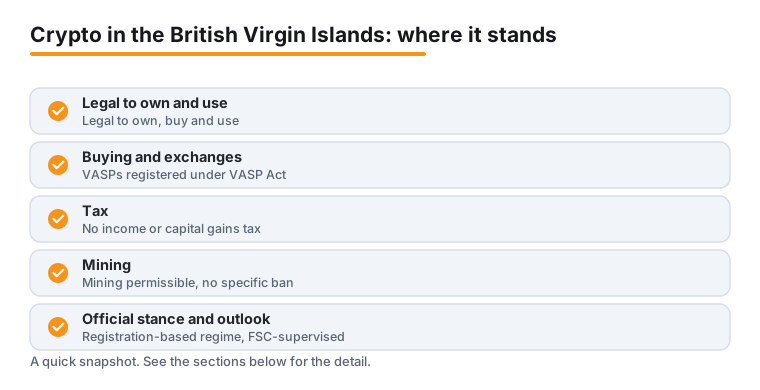
Yes. Owning, buying, selling and using Bitcoin and other cryptocurrencies is legal in the British Virgin Islands. There is no prohibition on individuals holding digital assets, and rather than banning the sector the territory has deliberately positioned itself as a regulated, tax-neutral home for crypto and fintech businesses.
Legal does not mean unregulated, and it does not mean legal tender. The official currency of the BVI is the US dollar, and cryptocurrencies are not recognised as legal tender. Crypto is instead treated as a virtual asset, and any business that provides a virtual asset service in or from the BVI must register with and be supervised by the Financial Services Commission under the Virtual Assets Service Providers Act, 2022 (the VASP Act).
For an ordinary resident or visitor, the practical takeaway is simple: you can legally hold and use crypto, but you should expect any compliant platform you deal with to ask for identity verification and to operate under registration.
Who regulates crypto in the British Virgin Islands?
The principal regulator for digital assets is the British Virgin Islands Financial Services Commission (BVI FSC), often referred to simply as the Commission. It was established as an autonomous regulator under the Financial Services Commission Act, 2001 and supervises the BVI's banking, insurance, investment business, trust and company services, and now virtual asset sectors.
Under the VASP Act, the Commission is the competent authority responsible for registering and supervising Virtual Assets Service Providers (VASPs). It sets fit-and-proper standards, reviews applications, imposes conditions, conducts AML/CFT supervision, and can take enforcement action. It is important to note that the FSC does not generally approve or vet the underlying tokens themselves; its focus is on the conduct, governance and anti-money-laundering controls of registered businesses.
You can confirm the regulator, its published guidance and its legislation directly at the British Virgin Islands Financial Services Commission website, which hosts the VASP Act, application guidance and industry circulars relating to virtual assets.
Key laws and frameworks
The cornerstone of crypto regulation in the BVI is the Virtual Assets Service Providers Act, 2022 (No. 17 of 2022), known as the VASP Act. It came into force on 1 February 2023 and was the result of a public consultation by the Commission. It creates a registration regime for any person carrying on the business of providing a virtual asset service in or from within the BVI.
Under the Act, a virtual asset is broadly defined as a digital representation of value that can be digitally traded or transferred and used for payment or investment purposes. A virtual asset service includes activities carried on for or on behalf of another person such as:
- Exchange between virtual assets and fiat currency
- Exchange between one or more forms of virtual assets
- Transfer of virtual assets
- Safekeeping or administration of virtual assets, or instruments enabling control over them (custody)
- Participation in, and provision of, financial services related to an issuer's offer or sale of a virtual asset
The regime sits alongside the wider BVI financial-services and anti-money-laundering rulebook, including the Anti-Money Laundering Regulations and the Anti-Money Laundering and Terrorist Financing Code of Practice (both amended in 2022 to bring VASPs into scope), and the Proceeds of Criminal Conduct Act. Note that, under FSC guidance, the act of simply issuing a token (an ICO or ITO) is not by itself a VASP activity, so a pure token issuer that provides no other regulated service does not need to register as a VASP. Because the rules are detailed and still maturing, businesses in particular should take local legal advice rather than rely on summaries. See our general guide to crypto regulation for wider context.
Licensing and registration of exchanges and VASPs
Under the VASP Act, any business providing a virtual asset service in or from the BVI must be registered with the Financial Services Commission before carrying on that activity. This captures operators of virtual asset exchanges, custodians, transfer services and certain providers of services connected to token offerings.
The Commission operates three registration categories: a general VASP registration, a custody registration, and an exchange registration. A firm applies for the category or categories that match the services it intends to provide. Registered firms appear on the FSC's public list of regulated entities, which shows the company name, registration category and status; beneficial-ownership details are not published there.
In practice an applicant must generally be a BVI-incorporated company with a substantive governance framework. Reported requirements include appointing at least two individual directors, a compliance officer and a money laundering reporting officer, and engaging an authorised representative in the BVI. Applications are made on the Commission's approved form and must specify the category of registration, accompanied by a business plan describing the nature and scale of the activities, details and fit-and-proper evidence for directors and senior officers, AML/CFT policies and procedures, and the applicable fee.
Industry advisers report application fees in the region of US$10,000 for exchange or custody services and US$5,000 for other VASP services, with separate fees per category where multiple services are offered, and a review process that typically gives initial feedback within around six weeks and aims to conclude within roughly six months. When the Commission approves an application it issues a certificate of registration and may impose conditions, such as a requirement to hold professional indemnity insurance. Operating without the required registration is a criminal offence carrying substantial fines and potential imprisonment. Figures and timelines can change, so confirm the current fees and process with the FSC before relying on them. Before depositing funds with any platform, check that it is genuinely registered.
Crypto and Bitcoin tax in the British Virgin Islands
The British Virgin Islands is a well-known tax-neutral jurisdiction. It does not levy a personal income tax, a capital gains tax, a corporation tax, or an inheritance or estate tax. As a result, an individual or company that is tax-resident in the BVI does not face BVI income tax, capital gains tax or corporation tax for trading, holding, mining or staking cryptocurrency.
That headline should not be mistaken for crypto being entirely free of all obligations:
- The BVI does levy a payroll tax on employers and employees in respect of remuneration paid for work performed in the territory, so a crypto business that employs staff locally can fall within payroll tax. Customs duties, annual company fees and certain property taxes also exist.
- BVI companies may be subject to economic substance requirements and to international information-exchange rules. The Common Reporting Standard applies, and the BVI International Tax Authority has confirmed it is implementing the OECD's updated CRS 2.0 (effective from 1 January 2026) and the OECD's Crypto-Asset Reporting Framework (CARF). Under the BVI plan, reporting crypto-asset service providers are expected to collect data for the 2027 calendar year and file their first CARF reports with the International Tax Authority in 2028, extending automatic exchange of information to crypto-asset transactions.
- If you are tax-resident in another country, your home jurisdiction may tax your crypto gains or income regardless of BVI rules. US citizens, for example, are generally taxed on worldwide income.
This section is informational only and not tax advice. We deliberately avoid quoting specific rates, which change and should be checked against official sources. Confirm your position with the BVI Government's Inland Revenue Department or a qualified tax adviser, and see our general guide to crypto taxes.
AML, KYC and consumer-protection rules
Anti-money-laundering and counter-terrorist-financing (AML/CFT) obligations apply directly to registered VASPs. From 1 December 2022, amendments to the Anti-Money Laundering Regulations and the Anti-Money Laundering and Terrorist Financing Code of Practice brought VASPs within the BVI AML/CFT regime, with customer due diligence required for virtual asset transactions valued at US$1,000 or more, consistent with the Financial Action Task Force (FATF) standards.
Registered firms must apply customer due diligence and KYC procedures, assess and manage money-laundering and terrorist-financing risk, monitor for and report suspicious activity, and comply with laws including the Proceeds of Criminal Conduct Act. They must appoint a qualified money laundering reporting officer to liaise with the authorities, and the FSC has signalled ongoing supervisory focus on AML/CFT controls, IT and key-management security, ownership transparency and the qualifications of compliance staff.
For users, the practical effect is that any compliant platform serving BVI customers will require full identity verification when you open an account, fund it or withdraw, and may ask about source of funds for larger transactions. The travel rule and related transfer-information requirements also apply to VASPs handling qualifying transfers.
Buying and using crypto in practice
Residents and visitors can buy crypto through international exchanges and through platforms registered locally. Any platform that provides virtual asset services in or from the BVI is expected to hold registration under the VASP Act and to be supervised by the Financial Services Commission.
A typical path looks like this, and is a general guide rather than an endorsement of any provider:
- Choose a platform. Prefer a reputable exchange that is transparent about its registration status, ideally registered under the VASP Act or in another well-regulated jurisdiction.
- Create and verify your account. Expect to provide identity documents and proof of address to satisfy KYC requirements.
- Fund your account. The BVI uses the US dollar, so deposits in USD are common via the methods the platform supports.
- Place your order after reviewing fees and the exchange rate.
- Secure your holdings. For anything beyond small amounts, consider moving funds to a wallet you control, such as a hardware wallet, and keep your recovery phrase offline and private.
Because the BVI is a small territory, local on-the-ground crypto infrastructure is limited and most activity is conducted through online platforms. Be alert to scams: unrealistic returns, pressure to act fast, and unsolicited investment managers are common red flags.
Bitcoin ATMs in the British Virgin Islands
There is no widely reported network of Bitcoin ATMs (sometimes called BTMs) in the British Virgin Islands, reflecting the territory's small population and the fact that most crypto activity is institutional or conducted online rather than through retail kiosks.
Importantly, the VASP framework does contemplate machines of this kind. A device such as a Bitcoin ATM, teller machine or vending machine that enables the exchange of virtual assets for fiat currency or other virtual assets through an electronic terminal can fall within the definition of a virtual asset service, meaning an operator would need to consider registration with the Commission and full AML/KYC compliance. Anyone planning to operate such a machine in the BVI should take local legal advice on whether their activity triggers VASP registration before launching.
Bitcoin mining in the British Virgin Islands
There is no specific BVI law that bans cryptocurrency mining, and the VASP Act is focused on financial services such as exchange, transfer and custody rather than on mining as an activity. Mining cryptocurrencies is not within scope of the VASP Act, so it needs no FSC registration, and because the BVI has no income tax or capital gains tax, mining rewards earned by a BVI-resident person would generally not attract a specific BVI tax charge.
The bigger constraint is practical and economic. The BVI is a small Caribbean territory that relies heavily on imported fuel for electricity, so power costs are comparatively high and the local grid is modest in scale. High electricity prices and tropical cooling requirements make large-scale, energy-intensive Bitcoin mining far less attractive than it is in jurisdictions with cheap or surplus power. For these reasons the BVI is not a notable mining destination. Anyone considering mining should model electricity costs carefully and check local rules on power supply, import of equipment, and any business-licensing or environmental requirements.
Recent developments (2023 to 2026)
The defining recent development is the VASP Act itself, which came into force on 1 February 2023 and established the registration regime now in place. Since then the focus has been on implementation, supervision and incremental guidance rather than wholesale change.
- Growing registrations. The number of registered VASPs has grown steadily. The Commission reported 14 registered VASPs as at 30 July 2025 and more than 16 later in the year, with more expected to be approved into 2026, alongside strong interest in stablecoin and tokenisation structures.
- FSC FAQs (2025). In November 2025 the FSC issued Industry Circular 43 of 2025, publishing a detailed FAQ document to help industry understand and comply with virtual asset and VASP requirements, including confirming that pure token issuance does not by itself require VASP registration.
- FATF grey listing (2025 to 2026). On 13 June 2025 the Financial Action Task Force added the BVI to its list of jurisdictions under increased monitoring (the grey list), following its mutual evaluation. The BVI remained on that list through the FATF's February and June 2026 updates while working through an agreed action plan to strengthen risk-based supervision, beneficial-ownership transparency and enforcement. This has practical implications for due diligence on BVI structures.
- EU AML high-risk listing (2025 to 2026). Aligning with the FATF decision, the European Commission adopted a delegated regulation on 4 December 2025 adding the BVI to the EU list of high-risk third countries for money laundering. That regulation entered into force on 29 January 2026, meaning EU-regulated firms must apply enhanced due diligence to transactions involving BVI parties.
- Reporting standards. The BVI International Tax Authority has confirmed it is implementing CRS 2.0 (effective 1 January 2026) and the OECD's Crypto-Asset Reporting Framework (CARF), with reporting crypto-asset service providers expected to collect data for 2027 and file their first CARF reports in 2028.
Because the framework is detailed and evolving, the most reliable way to track changes is to monitor FSC publications directly rather than relying on secondary summaries.
What the FATF and EU listings mean for crypto users
Two 2025 to 2026 developments affect anyone dealing with BVI crypto companies, though neither makes crypto illegal in the territory.
- FATF grey list. The BVI was added on 13 June 2025 and remained on the FATF's list of jurisdictions under increased monitoring through the February and June 2026 updates. The BVI has made a high-level commitment to strengthen its anti-money-laundering regime and is working through an action plan.
- EU high-risk list. Following the FATF decision, the European Commission adopted a delegated regulation on 4 December 2025 adding the BVI to the EU list of high-risk third countries, which entered into force on 29 January 2026.
The practical effect is enhanced due diligence. Banks, EU-regulated firms and other counterparties are expected to apply extra checks to BVI companies and structures, which can mean more paperwork and longer onboarding when a BVI-registered VASP or a BVI holding company is involved. For an individual user, the day-to-day experience of buying or holding crypto is largely unchanged, but you may notice stricter identity and source-of-funds questions. You can confirm the current status directly on the FATF country page for the Virgin Islands (UK).
Consumer risks and protection
The BVI offers a developed regulatory environment for digital asset businesses, but real risks remain that users should weigh:
- Market volatility. Crypto prices can move sharply, and losses can be significant and rapid.
- Platform and counterparty risk. Even large, prominent firms can fail. Use platforms that segregate client assets and are genuinely registered, and confirm registration before depositing funds.
- Limited retail protection. The VASP regime is built primarily around AML/CFT and fit-and-proper supervision; it is not a deposit-guarantee or investor-compensation scheme, so registration does not protect you from market losses or business failure.
- Regulatory change. Rules on registration, reporting and AML continue to be refined, particularly following the 2025 FATF grey listing and the move toward CARF.
- Scams and fraud. Pseudonymous, irreversible transactions are attractive to fraudsters, so be sceptical of unsolicited offers and guaranteed returns.
Dealing with an FSC-registered VASP offers more protection than using an unregulated platform, but no regulation removes the underlying market risk. Apply the same caution you would anywhere: verify, diversify, secure your keys, and confirm anything legal or tax-related with official sources. This page is informational only and is not legal, tax, or financial advice.
Official sources and how to verify
Crypto rules evolve, so always confirm specific points with primary, official sources rather than third-party summaries. The most authoritative references for the British Virgin Islands are:
- British Virgin Islands Financial Services Commission (BVI FSC), the regulator for virtual asset service providers, which publishes the VASP Act, application guidance and industry circulars.
- Virtual Assets Service Providers Act, 2022 (official text, PDF), the primary law governing crypto businesses in the BVI.
- FATF statement on jurisdictions under increased monitoring (June 2025), which sets out the BVI's grey-list status and action plan.
To verify whether a specific platform is permitted to provide services in or from the BVI, check the FSC's published information on registered VASPs and the firm's stated registration status. This is general information as of 2026 and is not legal advice; for your particular situation, confirm with the named regulator or a qualified BVI professional. You can also browse our wider regulation hub for other jurisdictions.
What is changing in the British Virgin Islands, August 2026
Nothing in the core legal position has moved since this page was last reviewed on 30 June 2026. The Virtual Assets Service Providers Act, 2022 is still the only crypto-specific statute, no amendment to it was found in 2026, and the Regulatory Code amendment for VASPs that was expected during 2025 still has no published text. Three things did happen.
- 22 July 2026, BVI Financial Services Commission. The Commission issued Industry Circular 22 of 2026, encouraging licensees to review two Financial Investigation Agency publications: the 2026 Terrorist Financing Typology Report and the 2025 Virtual Assets Strategic Analysis Report. The second analyses money laundering and terrorist financing trends drawn from virtual asset related suspicious activity reports filed by Virgin Islands exchanges, and highlights emerging typologies including layering through virtual assets, cross-border transfers to evade sanctions and the use of unhosted wallets. The first flags rapid movement of funds, the use of intermediary wallets and transactions involving high-risk wallets as red flags. The Commission encouraged licensees, particularly VASPs, to consider how the findings can be incorporated into institutional risk assessments, customer due diligence, sanctions screening and suspicious activity reporting. In practice this is what tightens on a user: more questions at onboarding, and more attention to withdrawals to self-custody wallets.
- 19 June 2026, FATF. The Virgin Islands (UK) stayed on the list of jurisdictions under increased monitoring at the June plenary. Bosnia and Herzegovina and Iraq were added, Algeria and Namibia were removed, and the territory was not among the removals. The FATF restated a five-item action plan whose first entry is "enhancing risk-based supervision of TCSPs, Investment Businesses and VASPs", which puts crypto supervision explicitly among the things the territory has committed to fix.
- 3 June 2026, National Financial Services Strategy. The Government ran a confidential stakeholder survey through the FSC as part of developing a National Financial Services Strategy and an accompanying implementation roadmap, with focus groups to follow. The submission date was 15 June 2026. See Industry Circular 16 of 2026. No draft text has been published, so there is nothing here that binds anyone yet.
Registration numbers continue to grow slowly rather than dramatically. Seventeen VASPs were registered under the Act as at 13 January 2026. The live count is the FSC's own register of regulated entities, which shows categories such as "Custody Providers - VASP" against each firm.
The legislative pipeline and when it bites
The BVI is not writing a new crypto licensing law. The pipeline is tax reporting. Here is what is coming, at what stage it sits on 3 August 2026, and what it would mean.
| Item | Stage at 3 August 2026 | Timing | What it means in practice |
|---|---|---|---|
| CRS 2.0 amendments to the Mutual Legal Assistance (Tax Matters) Act | In force | Effective 1 January 2026. Data collected across 2026. First reports due to the International Tax Authority by 31 May 2027. | Crypto held through a BVI financial institution becomes reportable to your home tax authority, including indirect exposure held through derivatives and investment vehicles. Specified electronic money products and CBDCs are in scope too. |
| CARF implementing legislation | Committed, not yet introduced | A May 2026 source states legislation will be introduced during 2026, effective for the 2027 calendar year, with first reports to the ITA in 2028 and exchanges in 2028. | Brokers, dealers, exchanges, trading platforms and crypto-asset ATM operators would report customer identity and transaction data, including reportable retail payment transactions exceeding US$50,000. |
| Regulatory Code amendment for VASPs | Expected, no published text | Expected in 2025 per the source. Still not published and no new target date announced. | Would add advertising and promotional standards for registered VASPs on top of registration and AML duties. No effect on individual holders. |
| FATF action plan | Active, restated 19 June 2026 | No exit date published. Not delisted at the June 2026 plenary. | Closer FSC supervision of VASPs, and continued caution from overseas banks toward BVI companies and structures. |
| National Financial Services Strategy | Survey closed, no draft published | Announced 3 June 2026, submission date 15 June 2026. Implementation roadmap to follow, no publication date. | Sector-wide rather than crypto-specific. It binds nobody today. |
Sources for the timing above: the BVI International Tax Authority on CRS 2.0 and CARF, a May 2026 analysis of CARF in the BVI, a June 2026 summary of the CRS 2.0 changes, and the 2026 BVI blockchain and crypto-assets chapter.
The tax rates that do apply, even with no capital gains tax
The BVI charges no personal income tax, no capital gains tax, no corporation tax and no inheritance or estate tax, so buying, holding, selling, mining or staking crypto produces no BVI tax charge. That is the whole story for an investor. It is not the whole story for anyone earning in the territory, because the BVI does levy payroll tax, and the Payroll Taxes Act, 2004 defines remuneration broadly to include wages, salary, leave pay, bonus, gratuity, fees, allowances, severance pay, housing and other benefits in kind. Payment for work performed in the BVI is therefore within scope whatever form it takes, and the valuation point is one to settle with the Inland Revenue Department rather than assume.
- A Class 1 employer or self-employed person pays 10 per cent of the tax base, made up of 8 per cent from the employee and 2 per cent from the employer.
- A Class 2 employer or self-employed person pays 14 per cent, made up of 8 per cent from the employee and 6 per cent from the employer.
- Class 1 requires all three of: payroll not exceeding US$150,000 in a financial year, annual turnover not exceeding US$300,000, and seven or fewer employees and deemed employees. Anyone who does not meet all three is Class 2.
- Each employee is entitled to an annual exemption on the first US$10,000 of earned remuneration.
- Registration is due within 30 days of commencing business. The monthly return, form P6, is due within 21 days following the month. The annual return, form P7, and the annual payroll remittance, form F48, are due by 30 April following the tax year.
- Late filing costs US$50 or 5 per cent of the tax payable, whichever is greater, plus a further 1 per cent of the tax payable for each month the failure continues.
Rates, thresholds, exemptions and deadlines are published by the Government of the Virgin Islands on its payroll tax page. The absence of income and capital gains tax is confirmed in the British Virgin Islands blockchain and cryptocurrency chapter, which states the BVI is a tax-neutral jurisdiction with income tax set at 0 per cent and no capital gains, gift, profits or inheritance taxes. Note that zero BVI tax does not mean zero tax: if you are tax resident somewhere else, that country taxes you, and CARF is designed to tell it what you did.
Frequently asked questions
Is Bitcoin legal in the British Virgin Islands?
Yes. Holding, buying, selling and using cryptocurrency is legal in the British Virgin Islands. However, Bitcoin is not legal tender; the official currency is the US dollar. Crypto is treated as a virtual asset, and any business providing a virtual asset service in or from the BVI must be registered with and supervised by the British Virgin Islands Financial Services Commission under the Virtual Assets Service Providers Act, 2022.
Who regulates cryptocurrency in the British Virgin Islands?
The British Virgin Islands Financial Services Commission (BVI FSC) is the regulator for virtual asset service providers under the Virtual Assets Service Providers Act, 2022. It registers and supervises VASPs, sets fit-and-proper standards, and enforces anti-money-laundering rules. Note that Cayman's CIMA and Bermuda's BMA are separate regulators for other jurisdictions; in the BVI the relevant authority is the FSC.
What is the VASP Act in the British Virgin Islands?
The Virtual Assets Service Providers Act, 2022 (No. 17 of 2022) is the BVI's main crypto law. It came into force on 1 February 2023 and creates a registration regime for any business providing a virtual asset service, such as exchange, transfer or custody, in or from the BVI. Registered firms must meet fit-and-proper and governance standards, appoint key officers including a money laundering reporting officer, and comply with AML/KYC rules. It is supervised by the Financial Services Commission.
Do I pay tax on crypto profits in the British Virgin Islands?
The BVI has no personal income tax, no capital gains tax and no corporation tax, so a BVI-resident person generally does not face a specific BVI tax charge simply for trading, holding, mining or staking crypto. However, payroll tax can apply to employers and employees on local remuneration, economic substance and international reporting rules (including the coming Crypto-Asset Reporting Framework) may apply to companies, and if you are tax-resident elsewhere your home country may still tax you. This is not tax advice; confirm with the BVI Inland Revenue Department or a qualified adviser.
Do crypto exchanges need to register in the British Virgin Islands?
Yes. Any business carrying on a virtual asset service in or from the BVI, including operating an exchange, transfer service or custody business, must register with the Financial Services Commission under the VASP Act before doing so. Registered firms must be BVI-incorporated, meet fit-and-proper standards, appoint key officers, pay the applicable fees (reported at around US$10,000 for exchange or custody services and US$5,000 for other services), and apply AML/KYC procedures. Operating without registration is a criminal offence.
Why is the British Virgin Islands on the FATF grey list?
On 13 June 2025 the Financial Action Task Force added the BVI to its list of jurisdictions under increased monitoring, commonly called the grey list, after a mutual evaluation identified deficiencies in areas such as risk-based supervision, beneficial-ownership transparency and enforcement. The BVI has agreed an action plan to address these points. Grey listing does not make crypto illegal in the BVI, but it often means banks and counterparties apply extra scrutiny to BVI companies and structures. The FATF itself states in its 19 June 2026 listing that it does not call for the application of enhanced due diligence measures to jurisdictions under increased monitoring, so grey-list friction is a commercial choice by banks. The separate EU high-risk third country listing is different, and it does legally require EU-regulated firms to apply enhanced due diligence.
How many VASPs are registered in the British Virgin Islands?
The register has grown steadily since the VASP Act took effect. The Financial Services Commission reported 14 registered VASPs as at 30 July 2025, with more approvals expected. The Commission maintains a public list of regulated entities showing each firm's name, registration category and status, so you can check the current count and confirm whether a specific platform is registered on the FSC website.
Will crypto users in the British Virgin Islands be affected by CARF reporting?
Yes, indirectly. The BVI International Tax Authority is implementing the OECD's Crypto-Asset Reporting Framework (CARF) alongside CRS 2.0, which took effect on 1 January 2026. Under the BVI plan, reporting crypto-asset service providers are expected to collect transaction and user data for the 2027 calendar year and file their first CARF reports with the International Tax Authority in 2028, after which that information can be exchanged with other tax authorities. CARF does not create a new BVI tax on crypto; it is a reporting and information-exchange measure.
Is there a new crypto law in the British Virgin Islands in 2026?
No. The Virtual Assets Service Providers Act, 2022 remains the only crypto-specific statute and no amendment to it was found as at 3 August 2026. The Regulatory Code amendment for VASPs that was expected in 2025 still has no published text. The activity in 2026 is in tax reporting rather than licensing: CRS 2.0 applies from 1 January 2026, and professional-firm reporting says CARF legislation will be introduced during 2026.
Is the British Virgin Islands still on the FATF grey list in August 2026?
Yes. At the plenary of 17 to 19 June 2026 the FATF kept the Virgin Islands (UK) under increased monitoring. Algeria and Namibia were removed and Bosnia and Herzegovina and Iraq were added, but the territory was not delisted. The first item on its restated five-item action plan is enhancing risk-based supervision of trust and company service providers, investment businesses and VASPs. No exit date has been published.
When will crypto held in the British Virgin Islands be reported to my home tax authority?
In two waves. CRS 2.0 applies from 1 January 2026 to crypto held through BVI financial institutions, including indirect exposure held through derivatives and investment vehicles, with data collected across 2026 and first reports due by 31 May 2027. CARF would then cover brokers, dealers, exchanges, trading platforms and crypto-asset ATM operators: a May 2026 professional-firm analysis states legislation will be introduced during 2026, applying to the 2027 calendar year, with first reports to the International Tax Authority in 2028. No CARF bill had been published as at 3 August 2026.
Do I pay tax if I am paid in crypto for work in the British Virgin Islands?
There is no BVI income tax or capital gains tax, but payroll tax applies to remuneration for work performed in the territory, and the Payroll Taxes Act, 2004 defines remuneration to include benefits in kind. The combined rate is 10 per cent for a Class 1 employer or self-employed person, being 8 per cent from the employee and 2 per cent from the employer, and 14 per cent for Class 2, being 8 per cent from the employee and 6 per cent from the employer. Each employee is entitled to an annual exemption on the first US$10,000 of earned remuneration. Confirm the valuation of a crypto payment with the Inland Revenue Department.
What did the BVI regulator publish about crypto in July 2026?
On 22 July 2026 the Financial Services Commission issued Industry Circular 22 of 2026, encouraging licensees to review the Financial Investigation Agency's 2026 Terrorist Financing Typology Report and 2025 Virtual Assets Strategic Analysis Report. The reports flag rapid movement of funds, intermediary wallets and high-risk wallets as red flags, and identify layering through virtual assets, cross-border transfers to evade sanctions and the use of unhosted wallets as emerging typologies. The Commission encouraged licensees, particularly VASPs, to build the findings into risk assessments, customer due diligence and sanctions screening, which in practice means more onboarding questions and more scrutiny of withdrawals to self-custody.
Facts reviewed: 6 August 2026. Page updated: 6 August 2026.