Home › Crypto Regulation › Trinidad and Tobago
Bitcoin & Cryptocurrency Regulation in Trinidad and Tobago
Quick answer — Trinidad and Tobago, 2026
- Legal: Legal to own and use, not legal tender; crypto businesses now regulated under the 2025 VA/VASP Act
- Tax: No general capital gains tax, but short term gains within 12 months taxed as income; no crypto guidance
- Buying: Via sandbox approved local providers or international exchanges; P2P carries higher risk
Trinidad and Tobago moved from years of regulatory silence to a concrete legal framework for crypto in a short space of time. In late 2025 Parliament passed the Virtual Assets and Virtual Asset Service Providers Act, 2025 (the VA/VASP Act), which received Presidential assent on 23 December 2025 and brought crypto businesses under formal supervision for the first time. The change was driven largely by the country's preparations for its Caribbean Financial Action Task Force (CFATF) mutual evaluation and the need to meet international anti money laundering standards.
This page explains what that means in practice: whether holding Bitcoin is legal, who regulates the sector, how exchanges and buying now work, and the current position on taxation, AML/KYC, mining and consumer protection. It is general information as of 2026 and is not legal, tax, or financial advice. The rules are new and several deadlines fall within 2026, so always confirm the current position with the Trinidad and Tobago Securities and Exchange Commission (TTSEC) or another named official body before acting. For background, see our general guide to crypto regulation.
On this page: Legal status · Who regulates it · Taxes · How to buy · Mining
Legal status of Bitcoin and crypto
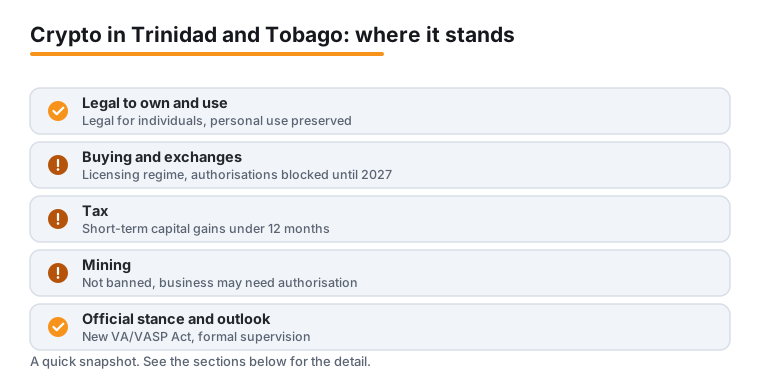
For individuals, owning, buying, holding and selling Bitcoin and other cryptocurrencies is not prohibited in Trinidad and Tobago. No law bans personal ownership, and people are generally free to hold crypto in wallets they control. The VA/VASP Act, 2025 expressly preserves this: under section 4(6), a person may buy, sell or use virtual assets they own for personal transactions, provided this is not carried on as a business or on behalf of another person.
What is now regulated is crypto activity carried on as a business for example exchanges, transfer services, brokers and custodians. The Act introduces a licensing regime plus a transitional prohibition: the regulator cannot grant any authorisation on or before 31 December 2026, so unlicensed commercial virtual asset activity is restricted during this build out period unless an operator is admitted to the Regulatory Sandbox.
It is also important to be clear what crypto is not. Bitcoin is not legal tender. The only legal tender is the Trinidad and Tobago dollar (TTD), merchants are under no obligation to accept crypto, and digital assets are treated as property or investment instruments rather than state issued money. In short: legal to hold as an individual, and now formally regulated when offered as a business.
The regulator and supervisory bodies
The lead regulator for virtual assets is the Trinidad and Tobago Securities and Exchange Commission (TTSEC), the statutory body established under the Securities Act. The TTSEC authorises virtual asset service providers (VASPs), administers the Regulatory Sandbox, and supervises compliance. Its official website is ttsec.org.tt.
Two other bodies share the wider mandate. The Central Bank of Trinidad and Tobago (central-bank.org.tt) is responsible for monetary policy, payments and financial stability, and has publicly supported tighter oversight of the sector; it has consistently stated that cryptocurrencies are not legal tender. The Financial Intelligence Unit of Trinidad and Tobago (FIUTT) (fiu.gov.tt) leads anti money laundering and counter financing of terrorism (AML/CFT) supervision and receives suspicious transaction reports. Because responsibilities are shared, anyone running a crypto business should confirm requirements with the TTSEC first.
Key laws and frameworks
The cornerstone of the framework is the Virtual Assets and Virtual Asset Service Providers Act, 2025, passed by Parliament in late 2025 and assented to on 23 December 2025. It is supported by subsidiary rules and a fee schedule published by the TTSEC. The Act broadly aligns the country with international standards for supervising virtual asset service providers.
Reported and confirmed features of the Act include:
- A licensing regime. No person may carry on virtual asset activities as a business unless authorised by the TTSEC or operating under an approved sandbox arrangement.
- A transitional prohibition. Under section 4(3) the Commission cannot grant an authorisation on or before 31 December 2026, so commercial activity is restricted during that window unless sandbox approved.
- A Regulatory Sandbox. Providers can apply to operate under close supervision while the full regime is developed.
- AML/CFT alignment. A central purpose is to meet FATF and CFATF expectations.
The framework sits alongside the existing Securities Act (which establishes the TTSEC) and the country's AML/CFT laws, including the Proceeds of Crime Act and the Financial Intelligence Unit of Trinidad and Tobago Act. You can verify the Act text on the TTSEC site: Virtual Assets and Virtual Asset Service Providers Act, 2025 (PDF).
Licensing and registration of exchanges and VASPs
Any platform offering exchange, brokerage, transfer or custody services as a business in or from Trinidad and Tobago is a virtual asset service provider (VASP) and falls under the TTSEC's authorisation requirements. The Act sets transitional obligations for firms that were already operating when it came into force:
- Notify the TTSEC. Existing operators were required to notify the Commission in writing of their activities within one month of commencement broadly by late January 2026.
- Cease or apply. Within three months they must either cease the activity or obtain valid authorisation, with eligible firms able to apply to the Regulatory Sandbox.
- Wait for the window. Because no authorisation can be granted on or before 31 December 2026, full licensing is expected to follow the build out of the detailed framework.
Carrying on virtual asset activity without proper authorisation, or making false or misleading statements to the regulator, carries criminal penalties including fines and imprisonment under the Act. In May 2026 the TTSEC publicly recognised the first cohort of firms accepted into the Regulatory Sandbox. The list named on the TTSEC website was: All Your IT Innovations Ltd, Avocado Technologies Ltd, Cryptt.IO Trinidad and Tobago Limited, Shine Technologies Limited, Bitzup Exchange Limited, Zazen Technology Limited, Quantum Chaos Ltd and Innotech Labs Ltd. Acceptance into the sandbox is not the same as full authorisation, and the list can change, so always check the current status of any provider directly with the TTSEC before using it. Anyone considering operating a crypto business should obtain professional advice and confirm the current notification and application process directly with the TTSEC, as deadlines and procedures are evolving through 2026.
Taxation of crypto
Trinidad and Tobago has no general capital gains tax. However, the Income Tax framework imposes a short term capital gains tax on gains arising where a chargeable asset is acquired and disposed of within 12 months. Such gains are added to other income and taxed at the normal rates (the individual rate is 25% up to TTD 1 million and 30% above that, and the standard corporation tax rate is 30%). Gains on assets held longer than 12 months are generally not taxed under this rule.
There is, at the time of writing, no detailed, crypto specific tax guidance published that we can cite with confidence. Some secondary sources describe crypto being taxed as income or short term gains, but this should be treated as commentary rather than official rules. Mining, trading or providing services for reward may generate taxable income depending on the facts. Because the treatment of digital assets is unsettled and fact specific, do not rely on rates quoted online. Keep full records of dates, amounts and TTD values for every transaction, and confirm your position with the Inland Revenue Division (ird.gov.tt) or a qualified local tax professional. For general background, see our overview of crypto taxes.
AML, KYC and reporting rules
Anti money laundering and counter financing of terrorism (AML/CFT) is the central driver of the new regime. The VA/VASP Act is designed to bring virtual asset providers within the same supervisory net as other financial entities, in line with FATF and CFATF standards. The Financial Intelligence Unit of Trinidad and Tobago (FIUTT) is the agency with responsibility for AML/CFT supervision and for receiving suspicious transaction and activity reports. In March 2026 the FIUTT published a public version of its 2025 ML/TF Risk Assessment of Virtual Assets and Virtual Asset Service Providers, which reviews money laundering and terrorist financing risks tied to the sector and informs how providers are supervised.
In practice, authorised or sandbox approved VASPs are expected to apply customer due diligence (KYC), verify customer identity, keep transaction records, monitor for suspicious activity and report it. For ordinary users this means expecting identity verification (government ID and proof of address) when signing up to a compliant platform, and being aware that banks may query crypto related transfers. Platforms that ask for no verification at all are a warning sign. AML obligations sit on top of the country's broader laws such as the Proceeds of Crime Act and the FIUTT Act.
Buying and using crypto in practice
Residents can buy crypto, but the route now matters more than it used to. Under the framework, any platform offering exchange, brokerage, transfer or custody services as a business in or from Trinidad and Tobago needs TTSEC authorisation or a sandbox arrangement. In practice people typically acquire crypto through:
- Sandbox approved or authorised local providers the route with the most oversight as the regime matures.
- Established international exchanges that accept Trinidad and Tobago users, usually funded by card or bank transfer where supported. Using these as an individual is generally permitted.
- Peer to peer (P2P) trades, which carry higher counterparty and fraud risk and offer little recourse.
A few practical realities apply. The TTD is not freely convertible and foreign exchange access can be tight, so converting between TTD and crypto (the on and off ramps) is often the real bottleneck rather than the transfer itself. Expect KYC, confirm fees, spreads and withdrawal terms before depositing, secure larger holdings in a wallet you control, and keep records. This is general information, not a recommendation of any platform.
Mining and ATMs
Mining. No specific law bans Bitcoin mining in Trinidad and Tobago, and the activity is not separately licensed simply because someone runs hardware. The practical constraints are energy and economics: electricity is generated predominantly from natural gas, so power cost and reliability, heat and cooling, and the terms of commercial electricity use are the key questions. Anyone mining as a business should also assess whether related activities bring them within the VA/VASP framework, and should treat mining proceeds as potentially taxable.
Bitcoin ATMs. Crypto ATM coverage has historically been very limited, and public tracking maps have generally shown little consistent presence, so travellers should not assume a kiosk will be available. The new regime adds a nuance: operating a crypto ATM as a business is itself a virtual asset service, so an operator falls under the TTSEC authorisation requirements and the transitional rules. If you encounter a machine, verify the operator, check the rate and fees (kiosk rates are often poor), and confirm it is operating lawfully. For most users an authorised exchange is cheaper and more transparent.
Recent developments (2025 to 2026)
The pace of change has been rapid:
- Late 2025: Parliament debated and passed the Virtual Assets and Virtual Asset Service Providers Bill, the country's first dedicated crypto law. The Central Bank publicly supported tighter oversight.
- 23 December 2025: the VA/VASP Act, 2025 received Presidential assent and came into force.
- Early January 2026: the TTSEC issued public notices on the Act, opening the notification window for existing providers and publishing sandbox rules and a fee schedule.
- 22 January 2026: the deadline for existing operators to notify the TTSEC and file a Regulatory Sandbox application, with prescribed fees.
- March 2026: the Financial Intelligence Unit of Trinidad and Tobago published a public version of its 2025 ML/TF Risk Assessment of Virtual Assets and Virtual Asset Service Providers, examining money laundering and terrorist financing risks in the sector.
- May 2026: the TTSEC held an inaugural Industry Dialogue Series on virtual assets and formally recognised the first group of virtual asset service providers accepted into the Regulatory Sandbox. Reported figures put the number at eight to nine firms. Successful applicants receive a Certificate of Acceptance to operate in the sandbox through to 31 December 2026.
- Through 2026: the transitional prohibition on granting full authorisations runs to 31 December 2026 while the detailed framework is developed, against the backdrop of the country's CFATF mutual evaluation.
Because this is a live, fast moving area, dates and procedures may shift. Treat the timeline above as a guide and verify the current position with the TTSEC.
Consumer risks and protection
The framework is intended to improve consumer protection, but in 2026 several risks remain elevated. The regime is brand new and transitional, the list of supervised providers is small and may change, and the commercial prohibition runs to the end of 2026 pending authorisations so a service you use today may alter how it operates.
Persistent risks include:
- Volatility. Crypto prices can swing sharply; only consider funds you can afford to lose.
- Scams and fraud. Be wary of unregulated P2P deals and any scheme promising guaranteed returns, a common fraud pattern. Platforms requiring no KYC are a red flag.
- FX and liquidity. Limited TTD convertibility can make moving in and out of crypto harder than in larger markets.
- Irreversibility. On chain transactions generally cannot be reversed, and lost private keys cannot be recovered.
The sensible posture: favour authorised or sandbox approved providers, keep good records, never share private keys or seed phrases, and watch for official updates. You can review related material in our regulation hub.
Official sources and how to verify
Because crypto rules in Trinidad and Tobago are new and changing, always check the primary official sources rather than relying on summaries. The most authoritative references are:
- Trinidad and Tobago Securities and Exchange Commission (TTSEC) the lead regulator for virtual assets, including notices, sandbox rules and the VASP fee schedule: ttsec.org.tt.
- The VA/VASP Act, 2025 text hosted by the TTSEC: read the Act (PDF).
- Central Bank of Trinidad and Tobago for monetary, payments and financial stability matters and its position on crypto: central-bank.org.tt.
- Financial Intelligence Unit (FIUTT) for AML/CFT requirements: fiu.gov.tt.
- Inland Revenue Division for tax matters: ird.gov.tt.
This page is general information as of 2026 and is not legal, tax, or financial advice. Rules and deadlines are evolving, so verify the current position directly with the TTSEC and the other named official bodies, and consult a qualified local professional before acting.
Frequently asked questions
Is cryptocurrency legal in Trinidad and Tobago in 2026?
Yes for individuals. There is no ban on owning, buying or selling crypto for personal use, and the Virtual Assets and Virtual Asset Service Providers Act, 2025 expressly preserves personal use. However, anyone conducting virtual asset activities as a business , such as an exchange or custodian, must be authorised by the TTSEC or operate under its Regulatory Sandbox, and the regulator cannot grant authorisations on or before 31 December 2026.
Who regulates crypto in Trinidad and Tobago?
The lead regulator is the Trinidad and Tobago Securities and Exchange Commission (TTSEC), which authorises virtual asset service providers and runs the sandbox. The Central Bank of Trinidad and Tobago oversees monetary and financial stability matters, and the Financial Intelligence Unit (FIUTT) leads anti money laundering supervision. Verify requirements at ttsec.org.tt.
Is Bitcoin legal tender in Trinidad and Tobago?
No. The only legal tender is the Trinidad and Tobago dollar (TTD). The Central Bank has consistently stated that cryptocurrencies are not legal tender. Bitcoin and other crypto are treated as assets, not state issued money, and merchants are not obliged to accept them.
Do I have to pay tax on crypto in Trinidad and Tobago?
Possibly. There is no general capital gains tax, but a short term capital gains tax applies to gains on chargeable assets disposed of within 12 months of acquisition, which are added to income and taxed at normal rates. There is no detailed crypto specific guidance we can cite with confidence, so treat rates quoted online as commentary. Keep full records and confirm your position with the Inland Revenue Division (ird.gov.tt) or a qualified tax professional.
Can I still use international crypto exchanges from Trinidad and Tobago?
Many international exchanges accept users from Trinidad and Tobago, and using them as an individual is generally permitted. The licensing regime focuses on providers operating as a business in or from the country. For the strongest protection, prefer providers that are TTSEC authorised or sandbox approved, and always verify a platform's status and terms before depositing funds.
What happens to crypto businesses operating without a licence?
Carrying on virtual asset activities as a business without proper authorisation, or making false or misleading statements to the regulator, is an offence under the VA/VASP Act, 2025 and can attract fines and imprisonment. Existing operators were required to notify the TTSEC shortly after the Act took effect and then either cease or apply for authorisation. Confirm the current notification and application process directly with the TTSEC.
Which crypto providers are approved in Trinidad and Tobago?
In May 2026 the TTSEC recognised the first firms accepted into its Regulatory Sandbox. The entities named on the TTSEC website were All Your IT Innovations Ltd, Avocado Technologies Ltd, Cryptt.IO Trinidad and Tobago Limited, Shine Technologies Limited, Bitzup Exchange Limited, Zazen Technology Limited, Quantum Chaos Ltd and Innotech Labs Ltd. Sandbox acceptance is not the same as full authorisation, and the list can change, so verify a provider's current status at ttsec.org.tt before using it.
When can crypto firms get a full licence in Trinidad and Tobago?
Not before 31 December 2026. Under the VA/VASP Act, 2025 the TTSEC cannot grant a full authorisation on or before that date, so during 2026 approved firms operate under the Regulatory Sandbox rather than a full licence. Certificates of Acceptance for sandbox participants run through to 31 December 2026. Check the TTSEC for the timetable for full authorisations.
Facts reviewed: 30 June 2026. Page updated: 3 August 2026.